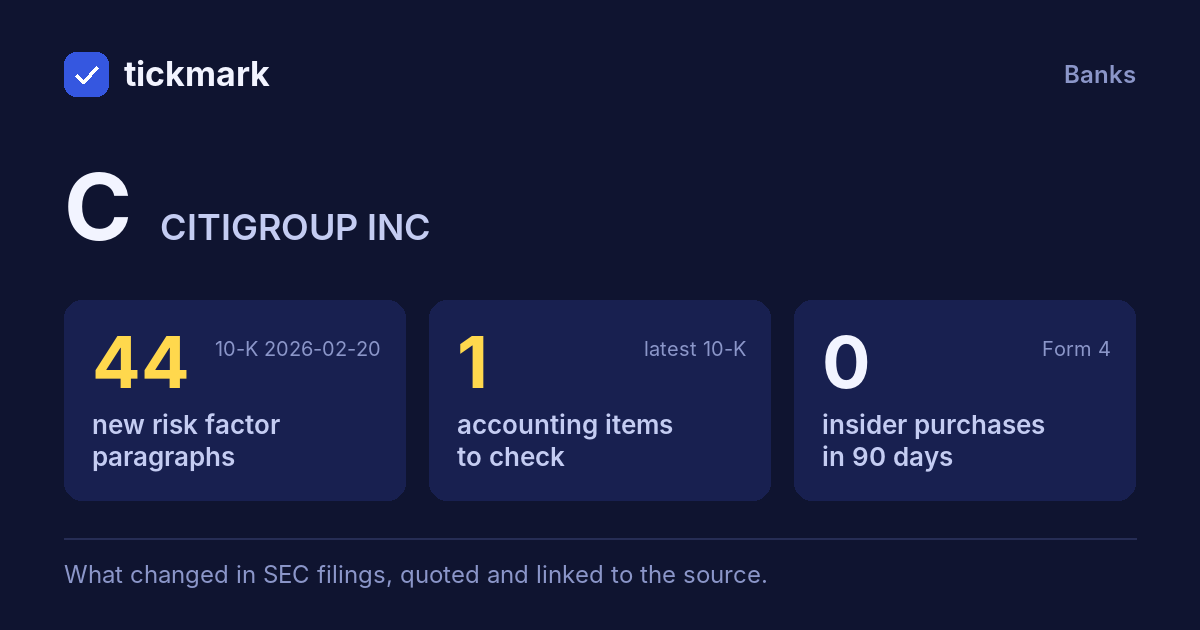
10-K 0000831001-26-000011 (2026-02-20) vs 10-K 0000831001-25-000067 (2025-02-21)
| Section | Compared text | Words now | Changed |
|---|
| Risk Factors | Item 1A | 12,406 |
36.7% |
| MD&A | Item 7 | 32,883 |
40.8% |
| Legal Proceedings | Item 3 | 6,606 |
46.1% |
| Accounting Policies | Item 8, Note 1 – SUMMARY OF SIGNIFICANT ACCOUNTING POLICIES | 13,711 |
27.6% |
The redline: what was cut and what was added
In each section, the paragraph that changed most, marked against last year's 10-K:
cut words struck through, new words highlighted and underlined.
Risk Factors 296 words changed in this paragraph; it is 44% similar to last year's version.
• potential fiscal, monetary, tax, sanctions and other changes promulgated by the U.S. federal government and other governments (see the macroeconomic challenges and uncertainties and changes to interest rates risk factors above) References to “regulatory” refer to both formal regulation and the views and expectations of Citi’s regulators in their supervisory and enforcement roles, which, as they change over time, can have a major impact. Additionally, U.S. and international regulatory and legislative initiatives have not always been undertaken or implemented on a coordinated basis, and areas of divergence have developed and continue to develop with respect to their scope, interpretation, timing, structure or approach, leading to inconsistent or even conflicting requirements, including within a single jurisdiction. Further, ongoing regulatory and legislative uncertainties and changes make Citi’s long-term business, balance sheet and strategic planning difficult, subject to change, and potentially more costly and may impact its results of operations. U.S. and other regulators globally have implemented and continue to discuss various changes to certain regulatory requirements, which would require ongoing assessment by management as to the impact to Citi, its businesses and business planning. Business planning must necessarily be based on possible or proposed rules or outcomes, which can change significantly upon finalization, or upon implementation or interpretive guidance from numerous regulatory bodies worldwide, and such guidance can change. Regulatory and legislative changes have also significantly increased Citi’s compliance risks and costs (see the implementation and interpretation of regulatory scrutiny and changes risk factor below) and can adversely affect Citi’s competitive position, as well as its businesses, revenues, results of operations and financial condition. Citi May Be Unable to Achieve Its Objectives from Its Simplification, Transformation and Enhanced Business Performance Priorities. Citi has been pursuing overall simplification initiatives to enhance its client focus and reduce expenses. Citi’s simplification initiatives, including completing its divestiture of Banamex, involve various execution challenges, may take longer than expected and may result in higher expenses, or lower than expected expense savings, CTA and other losses or other negative financial or strategic impacts, which could be material, and litigation and regulatory scrutiny (for information about CTA impacts, see the changes in or incorrect assumptions risk factor below). As part of its multiyear transformation, Citi also continues to make significant investments and undertake substantial actions across the Company to modernize its data and technology infrastructure, further strengthen its risk and controls environment and further enhance safety and soundness (see “Citi’s Multiyear Transformation” above and the legal and regulatory proceedings risk factor below).
Source: Item 1A, 10-K 0000831001-26-000011 vs Item 1A, 10-K 0000831001-25-000067
Accounting Policies 186 words changed in this paragraph; it is 33% similar to last year's version.
Any adjustments needed to the modeled expected losses in the quantitative calculations are addressed through a qualitative adjustment. The qualitative management adjustment considers, among other things: certain component includes risks that are not fully captured in the quantitative component. These may include but are not limited to portfolio characteristics and concentrations; collateral coverage; model limitations; characteristics, idiosyncratic events; events, factors not within historical loss data or the economic forecast, uncertainty in the credit environment and other relevant criteria under factors as required by banking supervisory guidance for the ACL. The qualitative adjustment also reflects the estimated impact primary examples of the pandemic on the economic forecasts and the impact on credit loss estimates. The total ACL is composed of risks that are not fully captured in the quantitative component are (i) potential impacts on vulnerable industries and qualitative components. regions due to emerging macroeconomic risks and uncertainties, including those related to a potential global recession, inflation, interest rates and commodity prices and (ii) transfer risk associated with exposures outside the U.S. Citi’s qualitative component declined year-over-year, primarily largely driven by (i) the full release reclassification of COVID-19 - AO Citibank to held-for-sale, including the related ACL, resulting from Citi’s planned sale of AO Citibank (which was sold on February 18, 2026). See “Accounting Changes” below for information about how the calculation of the quantitative component of the ACL changed in 2025.
Source: Item 8, Note 1 – SUMMARY OF SIGNIFICANT ACCOUNTING POLICIES, 10-K 0000831001-26-000011 vs Item 8, Note 1 – SUMMARY OF SIGNIFICANT ACCOUNTING POLICIES, 10-K 0000831001-25-000067
Legal Proceedings 177 words changed in this paragraph; it is 65% similar to last year's version.
Since April 2018, Citigroup and certain of its affiliates, including Citibank and CGMI, have been named in state court qui tam lawsuits in which Edelweiss Fund, LLC alleges that Citi and other financial institutions defrauded certain state and municipal VRDO issuers in connection with resetting VRDO interest rates. Filed under each state’s respective false claims act, these actions are pending in state courts in California, Illinois, New Jersey, and New York, and are captioned STATE OF CALIFORNIA EX REL. EDELWEISS FUND, LLC v. JP MORGAN CHASE & CO., ET AL., STATE OF ILLINOIS EX REL. EDELWEISS FUND, LLC v. JP MORGAN CHASE & CO., ET AL., STATE OF NEW JERSEY EX REL. EDELWEISS FUND, LLC v. JP MORGAN CHASE & CO., ET AL., and STATE OF NEW YORK EX REL. EDELWEISS FUND, LLC v. JP MORGAN CHASE & CO., ET AL., respectively. In the Illinois California state qui tam, a hearing on the parties entered into a settlement agreement effective parties’ motions for summary judgment is scheduled for February 1, 2024. 19, 2026 and trial is set for June 8, 2026. In the New Jersey state qui tam, on December 27, 2024, the Appellate Division of the New Jersey Superior Court remanded the case to the trial court for the entry of summary judgment in favor of defendants. defendants, and on May 16, 2025, the New Jersey Supreme Court granted the plaintiff-relator’s petition for certification of the appeal. In the New York state qui tam, the trial court granted in part and denied in part defendants’ and plaintiff-relator’s cross-motions for summary judgment decision on April 4, 2025. Defendants appealed the decision to the New York Supreme Court Appellate Division, First Judicial Department. Additional information concerning these actions is publicly available in court filings under the docket numbers CGC-14-540777 (Cal. Super. Ct.) (Schulman, J.), 2017 L 000289 (Ill. Cir. Ct.) (Donnelly, J.), A163264 (Cal. 1st App. Div.); L-885-15 (N.J. Super. Ct.) (Hurd, J.), A-1340-23 (N.J. App. Div.), and 090285 (N.J. S. Ct.); and 100559/2014 (N.Y. Sup. Ct.) (Borrok, J.). J.) and 2025-02242 (N.Y. App. Div.).
Source: Item 3, 10-K 0000831001-26-000011 vs Item 3, 10-K 0000831001-25-000067
MD&A 141 words changed in this paragraph; it is 32% similar to last year's version.
• Risk Management Committee: assists the Board in fulfilling its responsibility with respect to (i) Committee (Board RMC) provides oversight of Citigroup’s risk management framework and risk culture, including the significant policies and practices used in managing credit, market (trading for risk management and non-trading), liquidity, strategic, operational, compliance and reputation, including those pertaining to capital management, and (ii) oversight of oversees the performance of the Global Citi’s Credit Risk Review (GRR) credit function. This Committee reviews Citigroup’s aggregate risk profile and collateral review function. The Committee reports to ensures the Board of Directors regarding Citigroup’s risk profile, as well as management’s adherence to its risk management framework, including the significant policies and practices employed to manage risks in Citigroup, as well as the overall adequacy of the Company’s risk management functions. Its responsibilities include approving the Enterprise Risk Management function. Framework (ERMF) and key risk policies, reviewing the risk appetite statement and recommending it to the Board. Additionally, this Committee has responsibilities regarding the approval, replacement and compensation of the Chief Risk Officer.
Source: Item 7, 10-K 0000831001-26-000011 vs Item 7, 10-K 0000831001-25-000067
Every change, by type
Sentences and paragraphs of C's Risk Factors and MD&A, 10-K 2026-02-20 against 10-K 2025-02-21.
Each links to the text at sec.gov.
Quiet changes are sentences kept from last year with one to four words changed, at least one of them a hedge, a modal or a qualifier
(may, could, will, not, significant, material…). A year or date rolling forward is not counted.
The full word list
adverse, adversely, all, although, anticipate, anticipates, any, approximately, believe, believes, can, cannot, certain, could, expect, expects, generally, however, if, intend, intends, largely, likely, many, material, materially, may, might, most, must, never, no, not, possible, primarily, probable, should, significant, significantly, some, substantial, substantially, unlikely, will, would
AddedRisk Factors
• increases in unemployment rates, recessions or slowing economic growth in the U.S., Europe and other regions or countries
Read it in 10-K 2026-02-20 at sec.gov ↗
AddedRisk Factors
• government fiscal or monetary actions (see the changes to interest rates risk factor below)
Read it in 10-K 2026-02-20 at sec.gov ↗
AddedRisk Factors
For example, substantial new import tariffs and a significant increase in the U.S. effective tariff rate occurred in 2025. There can be no assurance that there will not be additional significant changes in tariff or trade policies. Potential impacts in the U.S. and globally related to trade or tariff policies could include heightened market volatility, increased economic uncertainty, adverse impacts to inflation and global economic activity, disruptions in global supply chains and trade flows, impacts on corporate profitability and credit losses, and other adverse impacts.
Read it in 10-K 2026-02-20 at sec.gov ↗
AddedRisk Factors
between China and Taiwan and/or China and the U.S.; high and rising government debt levels in the U.S. and other countries; sanctions; natural disasters; and pandemics.
Read it in 10-K 2026-02-20 at sec.gov ↗
AddedRisk Factors
Central banks’ decisions on key interest rates directly affect borrowing and investment costs, loan and investment returns, and the valuation of financial assets. U.S. and global interest rate levels can significantly affect Citi’s results of operations.
Read it in 10-K 2026-02-20 at sec.gov ↗
AddedRisk Factors
Interest rates on loans Citi makes are typically based off or set at a spread over a benchmark interest rate and would likely decline or rise as benchmark rates decline or rise, respectively. While interest Citi earns on its assets and pays on its liabilities generally tends to move in the same direction as changes in benchmark rates, one can decline or rise faster than the other, thereby decreasing or increasing Citi’s net interest income.
Read it in 10-K 2026-02-20 at sec.gov ↗
AddedRisk Factors
Higher interest rates can negatively impact the economy, resulting in higher unemployment and lower growth. Increases in interest rates can also adversely impact the fair value of available-for-sale (AFS) and held-to-maturity (HTM) debt securities held by Citi, and thereby Citi’s capital levels and regulatory liquidity position. Interest rate movements, as well as pricing and product competition, can also impact depositor behavior and thereby affect net interest income.
Read it in 10-K 2026-02-20 at sec.gov ↗
AddedRisk Factors
Citi’s ability to return capital also depends on a variety of other factors, including, but not limited to, the following:
Read it in 10-K 2026-02-20 at sec.gov ↗
AddedRisk Factors
• its ability to maintain an effective capital planning process and management framework, which takes into account forecasts of expected macroeconomic conditions and their associated impacts to the level of Citi’s regulatory capital and risk-weighted assets under both the Standardized Approach and the Advanced Approaches, as well as the Supplementary Leverage ratio (SLR)
Read it in 10-K 2026-02-20 at sec.gov ↗
AddedRisk Factors
• deferred tax asset (DTA) utilization (see the ability to utilize DTA risk factor below)
Read it in 10-K 2026-02-20 at sec.gov ↗
AddedRisk Factors
Citi, its management and its businesses continue to face regulatory and legislative uncertainties and changes, both in the U.S. and globally. While the ongoing regulatory and legislative uncertainties and changes facing Citi are numerous and subject to change, examples include, but are not limited to, the following:
Read it in 10-K 2026-02-20 at sec.gov ↗
AddedRisk Factors
• potential changes to U.S. laws or regulations with respect to credit cards, including a possible cap on interest rates
Read it in 10-K 2026-02-20 at sec.gov ↗
RemovedRisk Factors
For example, inflation could resurge if the FRB were to reduce interest rates prematurely and/or at too accelerated a pace, or if certain policies were further pursued in the U.S., including those related to trade, tariffs and immigration.
Read it in 10-K 2025-02-21 at sec.gov ↗
RemovedRisk Factors
The FRB’s annual stress testing requirements are integrated into ongoing regulatory capital requirements. Citi’s SCB equals the maximum projected decline in its CET1 Capital ratio under the supervisory severely adverse scenario over a nine-quarter CCAR measurement period, plus four quarters of planned common stock dividends as a percentage of Citi’s risk-weighted assets, subject to a minimum requirement of 2.5%. The SCB is calculated by the FRB using its proprietary data and modeling of each firm’s results. Accordingly, Citi’s SCB may go up, based on the supervisory stress test results, thus potentially resulting in an increase in Citi’s required regulatory CET1 Capital ratio under the
Read it in 10-K 2025-02-21 at sec.gov ↗
RemovedRisk Factors
Standardized Approach. In addition, a breach of the SCB and other regulatory capital buffers may result in gradual limitations on capital distributions and discretionary bonus payments to executive officers. For additional information on the SCB, see “Capital Resources - Regulatory Capital Buffers” above.
Read it in 10-K 2025-02-21 at sec.gov ↗
RemovedRisk Factors
Citi’s ability to return capital also depends on its results of operations and financial condition, including the capital impact related to its remaining divestitures, such as, among other things, any temporary capital impact from CTA losses, net of hedges (see the incorrect assumptions or estimates and the emerging markets risk factors below); Citi’s effectiveness in planning, managing and calculating its level of regulatory capital and risk-weighted assets under both the Advanced Approaches and the Standardized Approach, as well as the Supplementary Leverage ratio (SLR); its implementation and maintenance of an effective capital planning process and management framework; forecasts of macroeconomic conditions; and deferred tax asset (DTA) utilization (see the ability to utilize DTA risk factor below).
Read it in 10-K 2025-02-21 at sec.gov ↗
RemovedRisk Factors
In October 2024, the FRB announced that it will maintain its current framework for calculating allowances on loans in the supervisory stress test through the 2025 stress test cycle, while continuing to evaluate appropriate future enhancements to this framework. The impacts on Citi’s capital adequacy of any potential incorporation by the FRB of CECL into its supervisory stress tests in future stress test cycles, and of other potential regulatory changes in the FRB’s stress testing methodologies, remain unclear. For additional information regarding the CECL methodology, including the transition provisions related to the adverse regulatory capital effects resulting from adoption of the CECL methodology, see “Capital Resources - Current Regulatory Capital Standards - Regulatory Capital Treatment - Modified Transition of the Current Expected Credit Losses Methodology” above and Note 1.
Read it in 10-K 2025-02-21 at sec.gov ↗
RemovedRisk Factors
Although various uncertainties exist regarding the extent of, and the ultimate impact to Citi from, changes to regulatory capital, results from the FRB’s stress testing and CCAR regimes, and regulatory evaluation or examination findings, these changes could increase the level of capital Citi is required or elects to hold, including as part of Citi’s management buffer, thus potentially adversely impacting the extent to which Citi is able to return capital to shareholders.
Read it in 10-K 2025-02-21 at sec.gov ↗
RemovedRisk Factors
Citi, its management and its businesses continue to face regulatory and legislative uncertainties and changes, both in the U.S. and globally. While the ongoing regulatory and legislative uncertainties and changes facing Citi are too numerous to list completely, examples include, but are not limited to (i) potential changes to various aspects of the U.S. regulatory capital framework and requirements applicable to Citi, including, among others, significant revisions to the U.S. Basel III rules (see the capital return risk factor and “Capital Resources - Regulatory Capital Standards and Developments” above) and (ii) potential fiscal, monetary, tax, sanctions, human capital and other changes promulgated by the U.S. federal government and other governments (see the macroeconomic and geopolitical risk factor above and the ability to utilize DTAs risk factor below). References to “regulatory” refer to both formal regulation and the views and expectations of Citi’s regulators in their supervisory and enforcement roles, which, as they change over time, can have a major impact. In particular, U.S. regulators have indicated that the level of their expectations is increasing and prompt negative examination findings/ratings and enforcements actions are more likely.
Read it in 10-K 2025-02-21 at sec.gov ↗
RemovedRisk Factors
Additionally, U.S. and international regulatory and legislative initiatives have not always been undertaken or implemented on a coordinated basis, and areas of divergence have developed and continue to develop with respect to their scope, interpretation, timing, structure or approach, leading to inconsistent or even conflicting requirements, including within a single jurisdiction.
Read it in 10-K 2025-02-21 at sec.gov ↗
RemovedRisk Factors
Further, ongoing regulatory and legislative uncertainties and changes make Citi’s long-term business, balance sheet and strategic budget planning difficult, subject to change and
Read it in 10-K 2025-02-21 at sec.gov ↗
RemovedRisk Factors
Citi’s Ability to Achieve Its Objectives from Its Transformation, Simplification and Other Priorities May Not Be as Successful as It Projects or Expects.
Read it in 10-K 2025-02-21 at sec.gov ↗
RemovedRisk Factors
As part of its multiyear transformation, Citi continues to make significant investments and undertake substantial actions across the Company to improve its risk and controls environment, modernize its data and technology infrastructure and further enhance safety and soundness (see “Executive Summary” and “Citi’s Multiyear Transformation” above and the legal and regulatory proceedings risk factor below).
Read it in 10-K 2025-02-21 at sec.gov ↗
RemovedRisk Factors
Citi has also been pursuing overall simplification initiatives that have included management and operating model changes and actions to enhance focus on clients and reduce expenses. Citi’s simplification actions also include completing its remaining divestitures, including the planned IPO of Mexico Consumer/SBMM. These simplification initiatives involve various execution challenges, may take longer than expected and may result in higher than expected expenses, CTA and other losses or other negative financial or strategic impacts, which could be material, and litigation and regulatory scrutiny (for information about potential CTA impacts, see the capital return risk factor above and the incorrect assumptions or estimates and emerging markets risk factors below).
Read it in 10-K 2025-02-21 at sec.gov ↗
RewordedRisk Factors
Additional areas of uncertainty include, among others, geopolitical challenges, tensions and conflicts, including such as those related to the Russia - Ukraine war (see the emerging markets risk factor below) and conflicts in the Middle East; potential policies East and priorities resulting from the new U.S. administration; in other regions; economic and geopolitical challenges related to China, including weak economic growth, related policy actions, challenges in the Chinese real estate sector, banking and credit markets, trade restrictions, and tensions or conflicts between China and Taiwan and/or China and the U.S.; high and rising government debt levels in the U.S. and other countries; significant volatility and disruptions in financial markets, including foreign currency volatility and devaluations; natural disasters; and pandemics.
Read it in 10-K 2026-02-20 at sec.gov ↗
RewordedRisk Factors
Citi’s co-branding and private label relationships could also be negatively impacted by, among other things, the general economic environment, including the impacts stemming from potential increases in unemployment, inflation or interest rates or lower economic growth rates, as well as a risk of recession; changes in consumer sentiment, spending patterns and credit card usage behaviors; a decline in sales and revenues, partner store closures, any reduction in air and business travel, or other operational difficulties of the retailer or merchant; changes in partner business strategies, including changes in products and services offered; termination or non-renewal of partner agreements, including early termination due to a contractual breach or exercise of other early termination right; or other factors, including bankruptcies, liquidations, restructurings, consolidations or other similar events, whether due to a challenging macroeconomic environment or otherwise.
Read it in 10-K 2026-02-20 at sec.gov ↗
RewordedRisk Factors
Citi’s ability to return capital to its common shareholders consistent with its capital planning efforts and targets, whether through its common stock dividend repurchase program or through share repurchases, its common stock dividend, substantially depends, among other things, on its regulatory capital requirements, including the annual recalibration of the Stress Capital Buffer (SCB), which is based upon the results of the CCAR process required by the FRB, and recalibration of the GSIB surcharge, as well as the supervisory expectations and assessments regarding individual institutions. requirements.
Read it in 10-K 2026-02-20 at sec.gov ↗
RewordedRisk Factors
Examples of regulatory or legislative changes that have resulted in increased compliance risks and costs include (i) the U.S. regulatory capital framework and requirements, which have continued to evolve (see the capital return risk factor and “Capital Resources” above); and (ii) various laws relating to the limitation of cross-border data movement and/or collection and use of customer information, including data localization and protection and privacy laws, which also can conflict with or increase compliance complexity with respect to other laws, including anti-money laundering laws.
Read it in 10-K 2026-02-20 at sec.gov ↗
RewordedRisk Factors
Conversely, failure to adequately invest in and upgrade Citi’s technology and processes or properly implement its enterprise-wide simplification could result in Citi’s inability to be sufficiently competitive, meet regulatory expectations, be serve clients effectively and avoid disruptions to its businesses, and operational errors (see the operational processes and systems and legal and regulatory proceedings risk factors below).
Read it in 10-K 2026-02-20 at sec.gov ↗
RewordedRisk Factors
These potential changes, if adopted as originally proposed, would likely impact changes will affect Citi’s regulatory capital requirements and position and materially increase Citi’s regulatory the amount of capital requirements, and thus adversely impact the extent to which Citi is will be able to return capital to shareholders (see “Capital Resources - Regulatory Capital Standards and Developments” above).
Read it in 10-K 2026-02-20 at sec.gov ↗
RewordedRisk Factors
Further, the introduction of mobile platforms and These emerging technologies, such as artificial intelligence (AI) and digital assets, assets (including tokenized deposits, cryptocurrencies, stablecoins and other assets and products that use distributed ledger or blockchain technology) and changes in the payments space (e.g., instant and 24/7 payments) are accelerating, and, as a result, certain of Citi’s products and services could become less competitive. competitive (see the AI risk factor below).
Read it in 10-K 2026-02-20 at sec.gov ↗
RewordedRisk Factors
Moreover, Citi may need could be required to record additional adjust its reserves for expected losses for its credit exposures based on the transfer risk associated with exposures outside the U.S., driven by safety and soundness considerations under U.S. banking law (see “Managing Global Risk - Other Risks - Country Risk - Argentina” and “ - Russia” and “Significant Accounting Policies and Significant Estimates” below). below and Note 1).
Read it in 10-K 2026-02-20 at sec.gov ↗
RewordedRisk Factors
Specifically, Citi’s continued ability to compete in each of its lines of business, to grow and manage its businesses effectively and effectively, as well as to execute its transformation, simplification and other priorities, including, for example, hiring employees to grow businesses or hiring employees to support Citi’s strategic priorities, depends on its ability to hire new employees and to retain and motivate its existing employees.
Read it in 10-K 2026-02-20 at sec.gov ↗
RewordedRisk Factors
Physical risks from climate change include acute risks, such as wildfires, hurricanes, tropical cyclones, heat waves, floods and droughts, as well as consequences of chronic changes in climate, such as rising sea levels, prolonged droughts and systemic changes to geographies and any resulting population migration. climate.
Read it in 10-K 2026-02-20 at sec.gov ↗
RewordedRisk Factors
GAAP, a sale, substantial liquidation sale or other deconsolidation event of any foreign operations, operation that results in a substantially complete liquidation of an investment in a foreign entity, such as those related to Citi’s remaining divestitures or legacy businesses, would result in reclassification of any foreign CTA component of AOCI related to that foreign operation, entity, including amounts associated with related hedges and taxes, into Citi’s earnings.
Read it in 10-K 2026-02-20 at sec.gov ↗
RewordedRisk Factors
Citi could incur significant losses, receive negative regulatory evaluation or examination findings or be subject to additional enforcement actions, and its regulatory capital, capital ratios and ability to return capital could be negatively impacted, if Citi’s risk management and other processes, including its ability to manage and aggregate data in a timely and accurate manner, strategies or models are deficient or ineffective. ineffective (for additional information, see the capital return risk factor above and the regulatory scrutiny and changes and the legal and regulatory proceedings risk factors below).
Read it in 10-K 2026-02-20 at sec.gov ↗
Quiet changesRisk Factors
Large financial institutions, such as Citi, face significantly heightened significant regulatory and supervisory expectations and scrutiny in the U.S. and globally, including with respect to, among other things, governance, infrastructure, data and risk management practices and controls.
Read it in 10-K 2026-02-20 at sec.gov ↗
AddedMD&A
• Citi continued to advance its transformation, with over 80% of transformation programs now at or nearly at Citi’s target state. Additionally, in December 2025, the OCC terminated its July 2024 amendment to Citibank’s 2020 Consent Order (see “Citi’s Multiyear Transformation” below).
Read it in 10-K 2026-02-20 at sec.gov ↗
AddedMD&A
• Citi continued to make progress on its remaining divestitures, including completing the sale of a 25% equity stake in Banamex in 2025 and signing and closing the sale of AO Citibank in Russia to Renaissance Capital (RenCap) on February 18, 2026. For additional information about the sale of AO Citibank and its impacts, see “Recent Developments” and “Managing Global Risk - Other Risks - Country Risk - Russia” below.
Read it in 10-K 2026-02-20 at sec.gov ↗
AddedMD&A
• Russia-related notable item: revenues included a $1.2 billion ($1.1 billion after-tax) loss on sale related to the held-for-sale accounting treatment related to Citi’s plan to sell AO Citibank in Russia (which was sold on February 18, 2026)
Read it in 10-K 2026-02-20 at sec.gov ↗
AddedMD&A
• Banamex-related notable item: expenses included a goodwill impairment of $726 million ($714 million after-tax) related to Citi’s agreement to sell a 25% equity stake in Grupo Financiero Banamex, S.A. de C.V. (Banamex)
Read it in 10-K 2026-02-20 at sec.gov ↗
AddedMD&A
Excluding the Russia-related notable item and the Banamex-related notable item, net income was $16.1 billion, or $7.97 per share.
Read it in 10-K 2026-02-20 at sec.gov ↗
AddedMD&A
Citigroup’s operating expenses of $55.1 billion increased 3% from the prior year, driven by higher compensation and benefits, the Banamex-related notable item, higher technology and communications and higher transactional and product servicing expenses, partially offset by lower deposit insurance expenses and restructuring charges. The increase in compensation and benefits was driven by performance-related compensation and higher severance. The increase in technology and communication was driven by continued investments in transformation and businesses. The increase in transactional and product servicing was driven by higher volumes in USPB, Markets and Wealth, partially offset by All Other. Excluding the Banamex-related notable item, expenses were $54.4 billion. For additional information on Citi’s transformation investments, see “Citi’s Multiyear Transformation” below.
Read it in 10-K 2026-02-20 at sec.gov ↗
AddedMD&A
Citi’s total provisions for credit losses and for benefits and claims were $10.3 billion, reflecting net credit losses of $9.1 billion and a net allowance for credit losses (ACL) build of $1.2 billion.
Read it in 10-K 2026-02-20 at sec.gov ↗
AddedMD&A
Net credit losses were up 1% from the prior year, driven by increases in Legacy Franchises in All Other, largely offset by decreases in USPB. The net ACL build was driven by changes in the macroeconomic outlook and transfer risk.
Read it in 10-K 2026-02-20 at sec.gov ↗
AddedMD&A
• further strengthen controls, enhance data quality and governance, reduce risk and continue to improve Citi’s regulatory compliance and its culture
Read it in 10-K 2026-02-20 at sec.gov ↗
AddedMD&A
For additional information on Citi’s transformation progress, investments and governance over the last several years, see “Citi’s Multiyear Transformation” in Citi’s 2024 Annual Report on Form 10-K.
Read it in 10-K 2026-02-20 at sec.gov ↗
AddedMD&A
Citi continued to make progress on its transformation in 2025. As of December 31, 2025, over 80% of Citi’s transformation programs were at or nearly at the Company’s target state. Progress through 2025 included the following:
Read it in 10-K 2026-02-20 at sec.gov ↗
AddedMD&A
• enhanced and implemented automated controls to further mitigate risk of large erroneous payments in over 90 countries
Read it in 10-K 2026-02-20 at sec.gov ↗
RemovedMD&A
• Citi continued to advance its transformation, including its efforts to improve risk management, modernize technology and infrastructure and improve resiliency across the organization. Simultaneously, as a result of the July 2024 Civil Money Penalty Consent Orders and Consent Order Amendment, Citi recognized the need to accelerate progress in certain areas, particularly with regard to data quality management related to governance and regulatory reporting. (See “Citi’s Multiyear Transformation” below).
Read it in 10-K 2025-02-21 at sec.gov ↗
RemovedMD&A
• Citi completed its organizational simplification announced in September 2023, resulting in a simpler management structure that aligns to and facilitates Citi’s strategy, while improving accountability and decision-making and advancing the execution of Citi’s transformation.
Read it in 10-K 2025-02-21 at sec.gov ↗
RemovedMD&A
• As part of its strategic refresh, Citi continued to make progress on its remaining divestitures, including exits of its consumer banking operations in Korea and Poland and its overall operations in Russia. Additionally, Citi completed the separation of its Services, Markets, Banking and Wealth businesses in Mexico from its consumer banking and small business and middle-market banking operations in Mexico (Mexico Consumer/SBMM) in December 2024, an important milestone toward the planned initial public offering (IPO) of Citi’s Mexico Consumer/SBMM business. (See “All Other (Managed Basis)” below.)
Read it in 10-K 2025-02-21 at sec.gov ↗
RemovedMD&A
Citigroup revenues of $81.1 billion in 2024 increased 3% on a reported basis. This increase in revenues largely reflected an increase in non-interest revenue (up 15%), including the benefit of a smaller impact from the Argentina currency devaluation ($(253) million in 2024 versus approximately $(1.9) billion in 2023) as well as strength in underlying fee drivers in each of Citi’s reportable operating segments. The increase in non-interest revenue was partially offset by a decline in net interest income (down 1%). The decrease in net interest income primarily reflected lower revenues in All Other (managed basis), partially offset by higher interest-earning balance growth in U.S. Personal Banking (USPB). Excluding divestiture-related impacts, primarily related to gains on the sales of Citi’s India and Taiwan consumer banking businesses in the prior year, as well as the Argentina currency devaluation, revenues of $81.4 billion in 2024 also increased 3% versus the prior year.
Read it in 10-K 2025-02-21 at sec.gov ↗
RemovedMD&A
Citigroup’s operating expenses of $54.0 billion decreased 4% from the prior year. Excluding the FDIC special assessment ($203 million in 2024 versus approximately $1.7 billion in the prior year), expenses of $53.8 billion decreased 2%, driven by savings related to Citi’s organizational simplification and stranded cost reduction, as well as the lower restructuring charges ($259 million in 2024 versus $781 million in the prior year) and repositioning costs. The decrease was partially offset by higher volume-related expenses, investments in Citi’s transformation and other risk and controls initiatives, as well as the costs of the July 2024 Civil Money Penalty Consent Orders entered into with the Federal Reserve Board (FRB) and the Office of the Comptroller of the Currency (OCC).
Read it in 10-K 2025-02-21 at sec.gov ↗
RemovedMD&A
Excluding the FDIC special assessment and divestiture-related impacts, expenses of $53.5 billion also decreased 2%.
Read it in 10-K 2025-02-21 at sec.gov ↗
RemovedMD&A
Citi’s total provisions for credit losses and for benefits and claims was $10.1 billion, compared to $9.2 billion in the prior year. The increase was driven by higher net credit losses in Branded Cards and Retail Services in USPB, reflecting the continued maturation of multiple cards loan vintages originated in recent years. The maturation was delayed by unprecedented levels of government stimulus during the pandemic. In addition, the increase was due to macroeconomic pressures related to the elevated inflationary and interest rate environment impacting both card portfolios, with lower FICO band customers primarily driving the increase. The higher net credit losses were partially offset by a lower net build in the allowance for credit losses (ACL), primarily due to a smaller build related to transfer risk associated with exposures outside the U.S. (approximately $0.2 billion in 2024 versus $1.9 billion in 2023), driven by safety and soundness considerations under U.S. banking law. For additional information on Citi’s ACL, see “Significant Accounting Policies and Significant Estimates - Citi’s Allowance for Credit Losses (ACL)” below.
Read it in 10-K 2025-02-21 at sec.gov ↗
RemovedMD&A
Net credit losses of $9.0 billion increased 40% from the prior year. Consumer net credit losses of $8.6 billion increased 39%, largely reflecting the continued rise in net credit loss rates in Branded Cards and Retail Services. Corporate net credit losses increased to $397 million from $250 million in the prior year.
Read it in 10-K 2025-02-21 at sec.gov ↗
RemovedMD&A
Subject to evolving macroeconomic conditions, Citi expects to continue to experience an elevated net credit loss rate for full-year 2025 in line with 2024, with higher loss rates in the first half of the year in Branded Cards and Retail Services consistent with seasonal patterns. Citi also expects that its future ACL builds will be driven by both the macroeconomic environment and business volumes, among other factors. For additional information on Citi’s consumer and corporate credit costs, see each respective business’s results of operations and “Credit Risk” below.
Read it in 10-K 2025-02-21 at sec.gov ↗
RemovedMD&A
In January 2025, a series of wildfires affected the Los Angeles metropolitan area and surrounding regions, causing loss of life and the destruction of more than 16,000 structures. While Citi continues to assess the wildfires’ impact on its customers and clients in the affected areas, Citi does not currently expect the wildfires to have a direct material impact to its consumer or corporate credit portfolios or its overall results of operations.
Read it in 10-K 2025-02-21 at sec.gov ↗
RemovedMD&A
Services net income of $6.5 billion increased 40%, as higher revenue and lower cost of credit were partially offset by higher expenses.
Read it in 10-K 2025-02-21 at sec.gov ↗
RemovedMD&A
Services revenues of $19.6 billion increased 9%, largely driven by a 28% increase in non-interest revenue and higher net interest income (up 1%). Excluding the impact of the Argentina currency devaluation ($(178) million in 2024 versus approximately $(1.2) billion in 2023), Services revenues increased 3% and its non-interest revenue increased 5%. The increase in net interest income reflected the benefit of higher deposit and loan volumes, largely offset by a decline in interest rates in Argentina.
Read it in 10-K 2025-02-21 at sec.gov ↗
RewordedMD&A
(iii) (2) 2025 includes (i) an approximate $209 $186 million gain on sale loss recorded in revenue (approximately $115 $157 million after-tax) related to after-tax), driven by the Thailand announced sale of the Poland consumer banking business sale; business; and (iv) (ii) approximately $161 $877 million (approximately $108 million after-tax) in operating expenses (approximately $821 million after-tax), driven by a goodwill impairment charge in Mexico ($726 million ($714 million after-tax)) and other costs, primarily related to separation costs in Mexico and severance costs in the Asia exit markets. markets (collectively approximately $151 million (approximately $107 million after-tax)).
Read it in 10-K 2026-02-20 at sec.gov ↗
RewordedMD&A
As previously disclosed, on July 10, 2024, In 2024 the FRB entered into a Civil Money Penalty Consent Order with Citigroup in the amount of approximately $61 million, having found that Citigroup had ongoing deficiencies related to its data quality management program and inadequate measures for managing and controlling its data quality risks; and the OCC entered into a Civil Money Penalty Consent Order with Citibank, a wholly owned subsidiary of Citigroup, in the amount of $75 million. million, having found that Citibank had failed to make sufficient and sustainable progress toward achieving compliance with the OCC’s 2020 Consent Order.
Read it in 10-K 2026-02-20 at sec.gov ↗
RewordedMD&A
As of December 31, 2025, Wealth includes the Private Bank, Citigold and Wealth at Work and Citigold businesses and provides financial and advisory services to a range of client segments including affluent, consisting of ultra-high net worth, high net worth and ultra-high net worth clients through banking, lending, mortgages, investment, custody and trust product offerings in 20 countries, including the U.S., Mexico and four wealth management centers: affluent clients.
Read it in 10-K 2026-02-20 at sec.gov ↗
RewordedMD&A
(5) Approximately $0 million, $25 million and $155 million in NCLs relating to certain Other Asia Consumer businesses classified as held-for-sale HFS in Other assets and Other liabilities on the Consolidated Balance Sheet were include approximately $0 million and $25 million in NCLs recorded as a reduction reductions to Other revenue in revenue (Other revenue) in 2024, 2023 2024 and 2022, 2023, respectively.
Read it in 10-K 2026-02-20 at sec.gov ↗
RewordedMD&A
Citi’s net interest income in the fourth quarter of 2024 2025 was $13.7 billion $15.7 billion, on both a reported basis and $13.8 billion on a taxable equivalent basis, a decrease an increase of $0.1 billion 14%, or $1.9 billion, from the prior-year period, primarily driven by Markets (down approximately $0.1 billion), partially offset by non-Markets (up approximately $0.04 billion). period.
Read it in 10-K 2026-02-20 at sec.gov ↗
RewordedMD&A
As of December 31, 2024, 2025, approximately 77% 75% of USPB EOP loans consisted of Branded Cards and Retail Services credit card loans, of which generally drives the overall credit performance of USPB, as 70% represented Branded Cards loans and 30% represented Retail Services net credit losses represented approximately 95% of total USPB net credit losses for the fourth quarter of 2024. loans.
Read it in 10-K 2026-02-20 at sec.gov ↗
RewordedMD&A
Personal Banking (USPB) includes Branded Cards and Retail Services, with includes proprietary credit card portfolios (Value, Rewards and Cash) and Cash), co-branded card portfolios (including Costco and American Airlines) within Branded Cards, and co-brand and private label relationships within Retail Services (including, among others, The Home Depot, Best Buy, Macy’s and Sears). personal installment loans.
Read it in 10-K 2026-02-20 at sec.gov ↗
RewordedMD&A
At progressively higher interest current rate levels, the marginal net interest income benefit is lower, as levels Citi assumes it will be unable to pass on a larger share of initial rate changes declines to depositors (i.e., higher betas), further reducing depositors, increasing Citi’s IRE sensitivity. sensitivity to a 100 bps downward shock.
Read it in 10-K 2026-02-20 at sec.gov ↗
RewordedMD&A
Notwithstanding the 2024 Consent Orders and the Amendment, Citi’s transformation target outcomes remain focused on changing its business and operating models such that they simultaneously (i) strengthen controls, enhance data quality, reduce risk and improve Citi’s regulatory compliance and its culture, and (ii) enhance Citi’s value to customers, clients and shareholders. simultaneously:
Read it in 10-K 2026-02-20 at sec.gov ↗
RewordedMD&A
Revenues increased 32% (including losses on loan hedges), reflecting higher 32%, driven by growth in Investment Banking and Corporate Lending revenues, along with (excluding the impact of losses on loan hedges) and a lower mark-to-market loss on loan hedges ($180 (a $118 million loss versus $443 a $180 million loss in the prior year).
Read it in 10-K 2026-02-20 at sec.gov ↗
RewordedMD&A
For additional information about trends, uncertainties the sale of AO Citibank and risks related to Services’ future results, its impacts, see “Executive Summary” above and below, “Managing Global Risk - Other Risks - Country Risk - Argentina” Russia” below and “ - Russia” below. “Sale of AO Citibank” in Note 2.
Read it in 10-K 2026-02-20 at sec.gov ↗
RewordedMD&A
Market risk of trading portfolios is the potential for losses risk of economic or trading loss arising from changes in the value of Citi’s assets and liabilities resulting from changes in market variables variables, such as interest rates, equity and commodity prices, foreign exchange rates, equity prices, commodity prices and rates or credit spreads, as well as their implied volatilities. spreads.
Read it in 10-K 2026-02-20 at sec.gov ↗
Quiet changesMD&A
(1) (3) 2024 includes approximately $318 million (approximately $220 million after-tax) in operating expenses, primarily related to separation costs in Mexico and severance costs in the Asia exit markets.
Read it in 10-K 2026-02-20 at sec.gov ↗
Quiet changesMD&A
Funding and liquidity risks arise from several factors, many of which are mostly or entirely largely outside of Citi’s control, such as disruptions in the financial markets, changes in key funding sources, credit spreads, changes in Citi’s credit ratings and macroeconomic, geopolitical and other conditions.
Read it in 10-K 2026-02-20 at sec.gov ↗
Quiet changesMD&A
A large majority of these institutional deposits are within TTS, and of these, approximately 80% over 70% are from clients that use all three TTS integrated services: payments and collections, liquidity management and working capital solutions.
Read it in 10-K 2026-02-20 at sec.gov ↗
Quiet changesMD&A
In addition, nearly approximately 80% of TTS deposits are from clients that have a longer than 15-year relationship with Citi.
Read it in 10-K 2026-02-20 at sec.gov ↗