Screener / SEC EDGAR /CIK 0000023217 /10-K filed Jul 15, 2026, compared with Jul 10, 2025 /Numbers from the XBRL of the 10-Ks
NYSE Consumer staples · Packaged Foods

Conagra Brands Inc. CAG

Compare with peers Embed
The 10-K against last year's

112 changes: 18 added, 9 removed, 85 reworded

10-K Jul 15, 2026 vs Jul 10, 2025

10-K 0001104659-26-083905 (Jul 15, 2026) vs 10-K 0001558370-25-009180 (Jul 10, 2025)

Every paragraph, and how much of it changed

One bar per paragraph, in the order of the 10-K. Height and colour show the share of its words not in the closest paragraph a year earlier; the tallest bars are new paragraphs.

Risk Factors

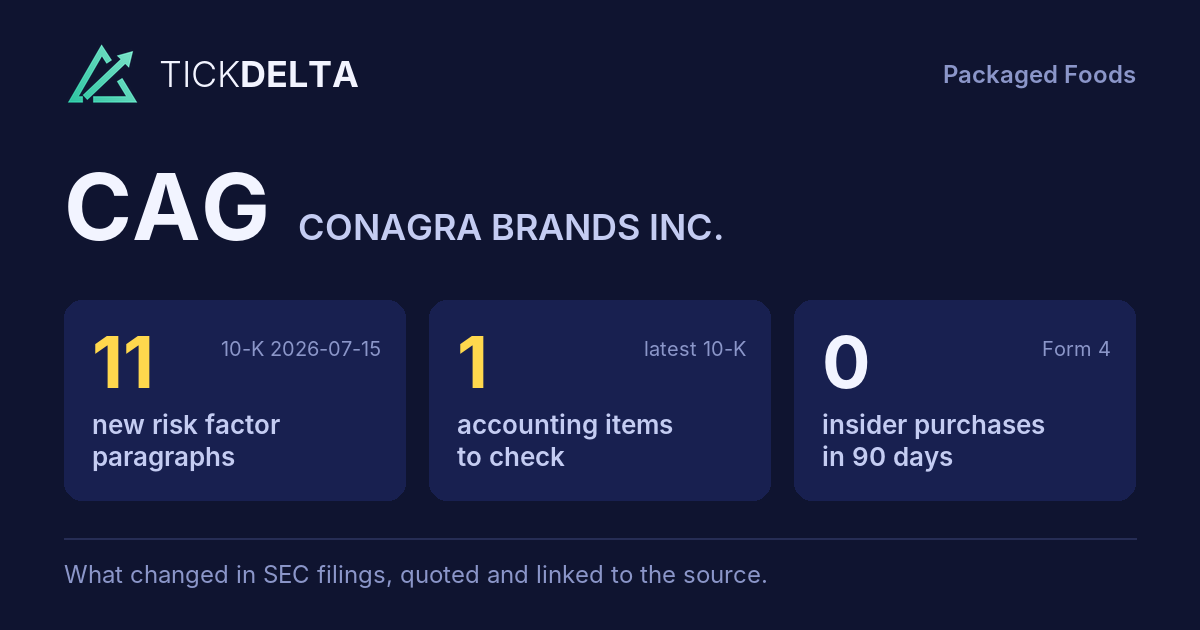
134 paragraphs · 11 new · 52 reworded · 4 gone · 10-K Jul 15, 2026 against Jul 10, 2025
New paragraph Reworded (5% of its words or more) Same or nearly
Paragraph 97 · 50% changed Every version of it
Additionally, we may face increased pressure from customers, consumers, investors, activists and other stakeholders to modify our products or operations away from ingredients or activities that are considered to have a higher impact on climate change. Such changes to methodologies or lack of progress (whether actual or perceived) could adversely affect our business, operations, and reputation, and increase risk of litigation.
Paragraph 15 · 47% changed Every version of it
Our business, financial condition, condition and results of operations have been impacted in the past been and could continue to may be adversely affected impacted in the future by disruptions in the global economy. The global economy caused has been negatively impacted by geopolitical conflicts. conflicts, and related supply disruptions, fuel cost increases, export controls and economic sanctions, including the recent military conflicts in the Middle East,
Paragraph 111 · 47% changed Every version of it
We are exposed to cybersecurity risk through based on our information systems increasing adoption and our use of third-party information systems. AI in a rapidly-evolving regulatory landscape.
Paragraph 33 · 46% changed Every version of it
We sell food products for human consumption, which involves risks creates a risk of legal claims for personal injury resulting from the consumption of our products. We may be subject to liability resulting from claims (and have been or could be subject to lawsuits) alleging that the use or consumption of any of our products causes injury (including pending litigation alleging that certain of our products should be considered “ultra-processed” and consumption of such as “ultra-processed” products allegedly causes negative health impacts), illness, or death. Such claims may also allege product contamination or spoilage, product tampering, other adulteration of food products such as foreign material, mislabeling, and misbranding. We may be subject to liability if the consumption of any of our products causes injury, illness, or death. In addition, we may take marketplace action such as a voluntary product recall in the event of contamination or damage. We have issued recalls and have from time to time been and currently are involved in lawsuits relating to our food products. A significant product liability judgment or a widespread product recall may negatively impact our sales and profitability for a period of time depending on the costs of the recall, the destruction of product inventory, product availability, competitive reaction, customer reaction, and consumer attitudes.
Paragraph 35 · 45% changed Every version of it
In addition, we could be the target of claims of false or deceptive advertising under U.S. federal and state laws as well as foreign laws, including consumer protection statutes of some states. The marketing of food products has come under increased regulatory scrutiny in recent years, and the food industry has been subject to an increasing number of proceedings, investigations, and claims relating to alleged false or deceptive labeling and marketing under federal, state and foreign laws or regulations. Changes in legal or regulatory requirements (such as new food safety requirements, new food labeling requirements for allergens, ingredients, and nutrition information, updated requirements for the use of “healthy” in connection with our food products, and bans on certain food ingredients or packaging materials), evolving interpretations of existing legal or regulatory requirements, or changes in enforcement priorities may result in increased compliance costs, capital expenditures, higher production costs, and other financial obligations that could adversely affect our business or financial results. If we are found to be out of compliance with applicable laws and regulations in these areas, we could be subject to civil remedies, including fines, injunctions, termination of necessary licenses or permits, or recalls, as well as potential criminal sanctions, any of which could have a material adverse effect on our business.
Paragraph 21 · 44% changed Every version of it
The Company uses a variety of strategies to seek Furthermore, our efforts to offset this input cost inflation such as these increasing productivity, cutting costs, increasing pricing, costs through offsetting price increases and engaging in commodity hedging. However, we making changes to package sizes may not be able to generate sufficient productivity improvements timely, sufficient, or cost reductions, timely make offsetting price increases, sustain sustainable. Such efforts may be rejected by our price increases, customers or effectively hedge for such inflation. Commodity price volatility consumers, and may result in unfavorable commodity positions, the costs of which we may not be able to fully offset on acceptable timelines or at all. lower sales volumes. To the extent we are unable to offset present and future input cost increases including over sustained periods of elevated input cost inflation, our operating results could be materially and adversely affected.
Paragraph 121 · 41% changed Every version of it
As of May 25, 2025, 31, 2026, we had goodwill of $10.50 $8.12 billion and other intangibles of $2.42 $1.83 billion. The net carrying value of goodwill represents the fair value of acquired businesses in excess of identifiable assets and liabilities as of the acquisition date (or subsequent impairment date, if applicable). The net carrying value of other intangibles represents the fair value of trademarks, customer relationships, and other acquired intangibles as of the acquisition date (or subsequent impairment date, if applicable), net of accumulated amortization. Goodwill and other acquired intangibles expected to contribute indefinitely to our cash flows are not amortized, but must be evaluated by management at least annually for impairment. Amortized intangible assets are evaluated for impairment whenever events or changes in circumstance indicate that the carrying amounts of these assets may not be recoverable. Impairments to goodwill and other intangible assets may be caused by multiple factors including increasing competitive pressures, reduced demand for our products, disruption in our operations as a result of internal and external events including disruptions involving contract manufacturing arrangements, lower than expected revenue and profit growth rates, changes in industry earnings before interest, taxes, depreciation and amortization multiples, changes in discount rates based on changes in cost of capital (interest rates, etc.), or the bankruptcy of a significant customer. Any impairment to goodwill or other intangible assets could negatively impact our net worth.
Paragraph 95 · 40% changed Every version of it
We may also be subjected to decreased availability or less favorable pricing for water as a result of such change, which could impact our manufacturing and distribution operations. In addition, natural disasters and extreme weather conditions may disrupt the productivity of our facilities or the operation of our supply chain. The increasing Continued concern over climate change also may result in more additional regional, federal, and/or global legal and regulatory requirements including changes to energy policies, increased mandatory disclosure, disclosure obligations, and carbon pricing regulations or carbon taxes. In the event that If such additional regulations are enacted and are more aggressive than the our climate risk mitigation measures that we are currently undertaking to monitor our emissions and improve our energy efficiency, measures, we may experience significant increases in our costs of operation and delivery. In particular, delivery, including, increasing regulation of fuel emissions could substantially increase the distribution and supply chain costs associated with our products. As a result, climate change could negatively affect our business and operations. emissions.

MD&A

117 paragraphs · 7 new · 49 reworded · 5 gone · 10-K Jul 15, 2026 against Jul 10, 2025
New paragraph Reworded (5% of its words or more) Same or nearly
Paragraph 18 · 50% changed
a net gain of $8.7 $42.2 million ($6.6 ($20.6 million after-tax) primarily after-tax loss) associated with insurance proceeds from the previous fire that occurred at one divestiture of our manufacturing facilities. Chef Boyardee® and frozen fish businesses,
Paragraph 14 · 49% changed
Diluted earnings per share were $2.40 and $0.72 in fiscal 2025 and 2024, respectively. The increase in diluted earnings per share reflected higher net income. See “Items Impacting Comparability” below as several for a discussion of significant items affected affecting the comparability of year-over-year results.
Paragraph 8 · 49% changed
Our We continue to expect our industry continues to be impacted by shifting weak consumer behavior, sentiment, inflation, commodity cost fluctuations, exchange rate volatility, labor cost inflation, input cost inflation, supply chain pressures, trade and regulatory uncertainty, and other global macroeconomic challenges. Although In fiscal 2026, these challenges resulted in input cost inflation, labor cost inflation, and higher oil, energy, and fuel costs. Additionally, in fiscal 2026, rapidly changing trade policies U.S. tariffs and announcements of potential tariff increases reciprocal tariffs caused increased uncertainty in the second half of fiscal 2025, we saw little impact to our results in fiscal 2025 due to delayed implementation or effect of the announced tariffs. Throughout fiscal 2025, we experienced an elevated amount of as well as input cost inflation and negative impacts from foreign exchange rates, in key materials used in our products, including tin-plate steel used in packaging for our canned products, which we were able to partially offset through our on-going with productivity initiatives. initiatives and price increases on impacted products.
Paragraph 52 · 48% changed
The liability for gross unrecognized tax benefits related to uncertain tax positions was $11.0 million 1 Segment operating profit is defined as operating profit excluding the effect of May 25, 2025. items impacting comparability. See Note 14, “Pre-Tax Income 20, “Business Segments and Income Taxes”, Related Information”, to the Consolidated Financial Statements contained in this report for information related to income taxes. further discussion.
Paragraph 115 · 44% changed
In November 2024, September 2025, the FASB issued ASU 2024-03, Disaggregation of Income Statement Expenses, 2025-06, Intangibles – Goodwill and Other – Internal-Use Software, to provide disaggregated disclosures of specific expense categories underlying certain income statement expense line items on an annual and interim basis. The disclosure requirements will be applied on a prospective basis, modernize the outdated guidance for accounting for software costs by aligning the accounting with the option to apply it retrospectively. how software is developed today. The effective date for the standard is for fiscal years beginning after December 15, 2026 2027 and interim periods within those fiscal years beginning after December 15, 2027. years. Early adoption is permitted. The amendments in this ASU should be applied either prospectively, retrospectively, or utilizing a modified transition approach. We are in the process of analyzing the impact of the ASU on our consolidated financial statements and related disclosures.
Paragraph 11 · 43% changed
Fiscal 2025 performance 2026 results compared to fiscal 2024 2025 reflected a decrease in lower net sales, with inclusive of a 53rd week in fiscal 2026. On an organic (excludes basis, which excludes the impacts of foreign exchange, acquisitions, divestitures, and divestitures) decreases the 53rd week, increased net sales in our Foodservice segment were more than offset by declines in our Grocery & Snacks, Refrigerated & Frozen, and Foodservice segments, partially offset by an increase in our International segment. Overall gross segments. Gross profit decreased primarily as a result of due to lower net sales, input cost inflation, and unfavorable operating leverage, partially offset by productivity. Excluding items impacting comparability, overall segment operating profit decreased in all of our segments compared to productivity and the prior year. Corporate expenses and selling, general and administrative (“SG&A”) expenses were higher primarily due to items impacting comparability, as discussed below, partially offset by lower incentive compensation expense. We recognized higher equity method investment earnings, lower interest expense, and lower income tax expense, in each case compared to fiscal 2024. Excluding items impacting comparability, our effective tax rate was lower compared to fiscal 2024. 53rd week.
Paragraph 50 · 43% changed
an increase in salary, wage, and fringe benefit deferred compensation expense of $18.4 $8.0 million primarily due to merit market volatility between periods, and employee insurance costs,
Paragraph 84 · 42% changed
Cash generated from operating activities totaled $1.69 $1.40 billion in fiscal 2025, 2026, as compared to $2.02 $1.69 billion generated in fiscal 2024. 2025. The decrease in operating cash flows for fiscal 2025 2026 compared to fiscal 2024 2025 was primarily driven by lower operating profits, lower dividend payments received from one of our equity method investments, profits and higher inventory balances. These decreases were partially offset by the accelerated receipt of our outstanding receivables initiated in exchange for a slightly higher prompt pay discount, which increased our cash flow from operations the second quarter of fiscal 2025, partially offset by approximately $140 million. Operating cash flows in fiscal 2025 also benefited from lower tax payments as a result of lower taxable income and recent interactions with the U.S. Internal Revenue Service (“IRS”) allowing for additional tax deductions. favorable inventory management.

A paragraph is matched with the one last year that shares the most of its words; under half in common makes it new. The paragraphs shown are the 8 reworded the most in each section.

The paragraph that changed most in each section

The redline

Marked against last year's 10-K: cut words struck through, new words highlighted.

Risk Factors194 words changed in this paragraph; it is 43% similar to last year's version.
continuing military conflict between Russia and Ukraine, and geopolitical tensions elsewhere including between China and Taiwan. Although most of our products are manufactured in North America and we source the significant majority of our ingredients and raw materials from North America, global supply has at times been and may continue to be constrained, which has caused and may continue to cause the price of certain ingredients and raw materials used in our products to increase and/or we may experience disruptions to our operations. Additionally, although we have no direct operations in Russia, Ukraine, Iran or elsewhere in the Middle East, Russia, Ukraine, China, or Taiwan, we have experienced, or may experience, shortages in materials from these regions, increased tariffs, sanctions or restrictions relating to these areas, regions, and resulting increased costs or volatility relating to transportation, energy, fuel, and raw materials impacted by as a result of impacts from conflicts in these regions, and reduced consumer confidence and consumption in these regions due in part to the negative impact of military these conflicts and rising tensions in these areas on the global economy. To date, these Further escalations of geopolitical tensions related to military conflicts, including increased or fluctuating trade barriers or restrictions on global trade, could also result in cyberattacks, supply or distribution disruptions, lower consumer demand, and changes to foreign exchange rates and financial markets, any of which may adversely affect our business and supply chain. In addition, the effects of the ongoing conflicts have not had a material impact on could heighten many of our business, financial condition, or results known risks described in this Item 1A, Risk Factors.

Source: Item 1A, 10-K 0001104659-26-083905 vs Item 1A, 10-K 0001558370-25-009180

MD&A150 words changed in this paragraph; it is 32% similar to last year's version.
Net sales for fiscal 2025 2026 in our Foodservice International segment included reflected a 4.2% decrease in organic volume of 8.1% volume, a 3.2% increase due to favorable foreign exchange rates, and a 1.7% increase in organic price/mix, in each case compared to fiscal 2024, driven by 2025. The favorable foreign exchange rates were primarily due to the ongoing softness strength of the US dollar relative to the Mexican Peso in restaurant traffic and the impact of lost business from comparison to the prior year. Organic price/mix increased by 3.3% The inclusion of an additional week of results in fiscal 2026 accounted for 1.9% of an increase in net sales when compared to fiscal 2024, reflecting inflation-driven pricing. Additionally, we estimate that 2025. Fiscal 2026 and 2025 included $1.1 million and $43.1 million, respectively, of net sales in related to our Foodservice segment during Chef Boyardee® business. In addition, fiscal 2025 were impacted by approximately $3 included $23.6 million due of net sales related to our ownership stake in Agro Tech Foods Limited (“ATFL”), which was sold in the temporary manufacturing disruptions in our Hebrew National® business. first quarter of fiscal 2025.

Source: Item 7, 10-K 0001104659-26-083905 vs Item 7, 10-K 0001558370-25-009180

Accounting Policies77 words changed in this paragraph; it is 54% similar to last year's version.
New Accounting Standards — In November December 2023, the FASB issued Accounting Standards Update (“ASU”) 2023-07, Segment Reporting (Topic 280): ASU 2023-09, Improvements to Reportable Segment Income Tax Disclosures, to improve reportable segment provide more detailed income tax disclosure requirements, primarily through enhanced disclosures requirements. The guidance requires entities to disclose disaggregated information about significant segment expenses. The disclosure requirements must be applied retrospectively to all prior periods presented in the financial statements. their effective tax rate reconciliation as well as information on income taxes paid. We adopted this ASU in the fourth quarter of fiscal 2025 2026 and added certain disclosures to Note 20, Business Segments 14, Pre-tax Income and Related Information. Income Taxes. The disclosures were applied retrospectively and impacted all prior periods presented.

Source: Item 8, Note 1 – SUMMARY OF SIGNIFICANT ACCOUNTING POLICIES, 10-K 0001104659-26-083905 vs Item 8, Note 1 – SUMMARY OF SIGNIFICANT ACCOUNTING POLICIES, 10-K 0001558370-25-009180

Legal Proceedings51 words changed in this paragraph; it is 66% similar to last year's version.
In 2019, we resolved a legacy litigation matter related to lead-based paint and/or pigment manufactured by an alleged predecessor to the Company during the first half of the 20th century for a total settlement of $101.7 million. Pursuant to the settlement, ConAgra Grocery Products, LLC, a wholly owned subsidiary of the Company, has The company paid annual installments toward the total settlement from fiscal 2020 through fiscal 2026, including $12.0 million paid toward that settlement in each of fiscal 2025 and 2024, and a made the final $16.7 million payable settlement payment in the second quarter of fiscal 2026.

Source: Item 3, via Note 16 – CONTINGENCIES, 10-K 0001104659-26-083905 vs Item 3, via Note 16 – CONTINGENCIES, 10-K 0001558370-25-009180

Sentences and paragraphs added, removed or reworded

Every change, by type

Sentences and paragraphs of CAG's Risk Factors and MD&A, 10-K Jul 15, 2026 against 10-K Jul 10, 2025. Each links to the text at sec.gov.

Quiet changes are sentences kept from last year with one to four words changed, at least one of them a hedge, a modal or a qualifier (may, could, will, not, significant, material…). A year or date rolling forward is not counted.

The full word list

adverse, adversely, all, although, anticipate, anticipates, any, approximately, believe, believes, can, cannot, certain, could, expect, expects, generally, however, if, intend, intends, largely, likely, many, material, materially, may, might, most, must, never, no, not, possible, primarily, probable, should, significant, significantly, some, substantial, substantially, unlikely, will, would

AddedRisk Factors
Rapid changes in trade policies, including rapidly imposed and threatened tariffs by the U.S. and reciprocal tariffs from U.S. trading partners, continue to create uncertainty and could negatively impact our business and the business of our key business partners.
Read it in 10-K Jul 15, 2026 at sec.gov
AddedRisk Factors
Rapidly imposed and threatened tariffs by the U.S. and reciprocal tariffs from U.S. trading partners create uncertainty, and increased tariffs result in increased costs for us and for our suppliers, contract manufacturers, farmers, customers, and consumers. We have seen tariff impacts on the costs of our ingredients, packaging (including tinplate steel used for our canned packaging), and other commodities used in making our products. We continue to closely monitor the changing tariff landscape and the impact it has on our business. We cannot guarantee that our strategies to mitigate resulting cost increases, and other input cost increases, including working to increase productivity, cut other costs, and increase pricing on our products, will be fully successful, if at all, sufficient or sustainable.
Read it in 10-K Jul 15, 2026 at sec.gov
AddedRisk Factors
Our success may increasingly depend on driving increased productivity and efficiency by effectively leveraging new technologies, including artificial intelligence technology and solutions (AI). Our competitors may adopt new technologies, modernize their operations, and incorporate AI into their businesses analysis and processes more quickly than we do, driving increased productivity and efficiencies, speeding innovation, and allowing for faster responses to consumer trends, which could have an adverse effect on our competitive position. Additionally, any failure to use new technologies, including AI, in an effective and ethical manner, or failure to adequately protect confidential information or address inaccuracies in AI-generated outputs, may impact our reputation and ability to compete.
Read it in 10-K Jul 15, 2026 at sec.gov
AddedRisk Factors
Changes to U.S. health policies can result in increasing scrutiny on the food industry and changes to consumer preferences. In 2025, the Food and Drug Administration called on the food industry to phase out the approved use of petroleum-based synthetic dyes in food products, and the Make America Healthy Again Commission, led by the U.S. Health and Human Services and established by an Executive Order in 2025, published assessment and strategy reports discussing factors allegedly contributing to chronic disease, including diet. Additionally, some states have proposed initiatives or adopted laws and regulations that ban or impose unique labeling requirements or restrictions for certain food ingredients and food products including packaging. While the full impact of these state and federal level activities on our products and business remains uncertain, inconsistent laws and changes to laws and regulations regarding food ingredients, production methods, labeling, packaging, or nutritional requirements could or will require reformulation of certain products, which in turn could impact demand for our products or increase our compliance costs, any of which could have a material adverse effect on our business, financial condition, and results of operations.
Read it in 10-K Jul 15, 2026 at sec.gov
AddedRisk Factors
Climate change related adverse weather conditions, water shortages, and natural disasters may reduce agricultural productivity leading to decreased availability or less favorable pricing for commodities necessary for our products, including wheat, tomatoes, and various vegetables. Climate change related reduced availability or increased cost of water may also affect our manufacturing and distribution operations, or disrupt the productivity of our facilities and supply chain.
Read it in 10-K Jul 15, 2026 at sec.gov
AddedRisk Factors
If we do not allocate and effectively manage the resources necessary to build and sustain the proper technology infrastructure and associated automated and manual control processes, including related to new AI technologies, we could be subject to billing,
Read it in 10-K Jul 15, 2026 at sec.gov
AddedRisk Factors
Similarly, rapid development and increased adoption of AI technology in our operations may create the need for rapid modifications to our cybersecurity program and increase our cybersecurity risks. Furthermore, the technology and techniques used in cyberattacks are also rapidly evolving. Threat actors are increasingly leveraging AI and machine learning techniques, such as generative AI-enabled phishing, deepfake impersonations, automated vulnerability discovery, adaptive malware, and large-scale credential-stuffing campaigns, to execute more sophisticated cyberattacks that may be more difficult to detect and defend against. We can provide no assurance that our cybersecurity program will be able to evolve at a pace sufficient to address all of these threats or that our defenses will remain effective against attacks utilizing these advanced capabilities.
Read it in 10-K Jul 15, 2026 at sec.gov
Show the other 43
AddedRisk Factors
As we increase the use of AI in our business to support operational efficiencies, supply chain management, product development, marketing capabilities, human capital management, and administrative support, the challenges associated with properly managing such use increase, as does the risk to us of reputational harm, competitive harm, and legal liability that could adversely affect our business. The use of AI exposes us to potential information deficiencies, inaccuracies or misleading output, data privacy breaches, inadequate protection of confidential information and intellectual property rights, infringement on third parties’ intellectual property rights, flawed decision-making, and increased costs that may have a negative impact on our business.
Read it in 10-K Jul 15, 2026 at sec.gov
AddedRisk Factors
Further, the global legal, regulatory, and ethical landscape surrounding AI is rapidly evolving and remains uncertain. Compliance with new and evolving laws, regulations, or industry standards relating to AI may require significant investment and resources, may limit our ability to use AI, and could result in reputational harm, legal liability, or other adverse effects on our operations and overall business. The rapidly evolving and expanding use of AI, along with the introduction of increasingly disparate requirements across the various U.S. jurisdictions in which we operate, as well as evolving international privacy and cybersecurity regimes, complicates our compliance obligations and may require adaptation of our technologies, practices, and operations, which could increase our costs.
Read it in 10-K Jul 15, 2026 at sec.gov
RemovedRisk Factors
Additionally, as a manufacturer and marketer of food products, we are subject to extensive regulation by the U.S. Food and Drug Administration, the U.S. Department of Agriculture, and other federal, state, and local government agencies. The Federal Food,
Read it in 10-K Jul 10, 2025 at sec.gov
RemovedRisk Factors
The food industry is highly competitive. Retail customer consolidation, proliferation of new, competitive products, consumer behavior shifts including retail channel preferences, and consumer price sensitivity continue to contribute to increased competition. Our
Read it in 10-K Jul 10, 2025 at sec.gov
RemovedRisk Factors
There is growing concern that carbon dioxide and other greenhouse gases in the atmosphere may have an adverse impact on global temperatures, weather patterns, and the frequency and severity of extreme weather and natural disasters. In the event that such climate change has a negative effect on agricultural productivity, we may be subject to decreased availability or less favorable pricing for certain commodities that are necessary for our products, such as wheat, tomatoes, and a wide array of vegetables. Adverse weather conditions and natural disasters can reduce crop size and crop quality, which in turn could reduce our supplies of raw materials, lower recoveries of usable raw materials, increase the prices of our raw materials, increase our cost of transporting and storing raw materials, or disrupt our production schedules.
Read it in 10-K Jul 10, 2025 at sec.gov
RewordedRisk Factors
Examples Our ability to achieve any such strategies or expectations is subject to numerous factors and conditions outside of such factors include our control, including evolving regulatory and other standards, processes, and assumptions, the pace of scientific and technological developments, increased costs and the costs, availability of requisite financing, market trends that may alter business opportunities, the trends, conduct of third-party manufacturers and suppliers, supply chain constraint or disruptions to our supply chain, disruptions, and changes in carbon markets or carbon taxes.
Read it in 10-K Jul 15, 2026 at sec.gov
RewordedRisk Factors
In the event that If such additional regulations are enacted and are more aggressive than the our climate risk mitigation measures that we are currently undertaking to monitor our emissions and improve our energy efficiency, measures, we may experience significant increases in our costs of operation and delivery. delivery, including, increasing regulation of fuel emissions.
Read it in 10-K Jul 15, 2026 at sec.gov
RewordedRisk Factors
Our business, financial condition, condition and results of operations have been impacted in the past been and could continue to may be adversely affected impacted in the future by disruptions in the global economy caused by geopolitical conflicts. economy.
Read it in 10-K Jul 15, 2026 at sec.gov
RewordedRisk Factors
As of May 25, 2025, 31, 2026, we had total debt of approximately $8.07 $7.27 billion, including approximately $7.02 billion aggregate principal amount of outstanding senior notes. unsecured notes, of which $762.5 million aggregate principal amount is maturing in October 2026.
Read it in 10-K Jul 15, 2026 at sec.gov
RewordedRisk Factors
To date, these conflicts have not had a material impact on our business, financial condition, or results of operations, but continued geopolitical turmoil may negatively impact our supply chain and our ability to manufacture or sell our products.
Read it in 10-K Jul 15, 2026 at sec.gov
RewordedRisk Factors
While we expect We anticipate continued elevated levels of input cost inflation in fiscal 2026 compared to fiscal 2025, partially driven by increased or fluctuating tariffs, 2027, and we could experience higher than expected input cost inflation in specific commodities or across multiple commodities.
Read it in 10-K Jul 15, 2026 at sec.gov
RewordedRisk Factors
During fiscal 2025, 2026, our 10 largest customers accounted for approximately 60% of our consolidated net sales, with our largest customer, Walmart, Inc. and its affiliates, accounted accounting for approximately 29% of our consolidated net sales.
Read it in 10-K Jul 15, 2026 at sec.gov
RewordedRisk Factors
We are exposed to cybersecurity risk through based on our information systems increasing adoption and our use of third-party information systems. AI in a rapidly-evolving regulatory landscape.
Read it in 10-K Jul 15, 2026 at sec.gov
RewordedRisk Factors
We sell food products for human consumption, which involves risks such as Such claims may also allege product contamination or spoilage, product tampering, other adulteration of food products such as foreign material, mislabeling, and misbranding.
Read it in 10-K Jul 15, 2026 at sec.gov
RewordedRisk Factors
The marketing of food products has come under increased regulatory scrutiny in recent years, and the food industry has been subject to an increasing number of proceedings, investigations, and claims relating to alleged false or deceptive labeling and marketing under federal, state and foreign laws or regulations.
Read it in 10-K Jul 15, 2026 at sec.gov
RewordedRisk Factors
Deterioration of in general economic conditions, an economic recession, recession or periods of inflation, slow growth, periods of inflation or increasing interest rates, or economic uncertainty may affect consumers resulting in reductions in consumer spending and have in the past harmed and could continue to harm our business and results of operations.
Read it in 10-K Jul 15, 2026 at sec.gov
RewordedRisk Factors
Growing Continued focus on wellness and growing use of weight loss medication has caused, and may cause continue to cause, shifts in consumer preferences and, if we fail to anticipate and appropriately respond to customer preferences, may impact our product sales, financial condition, and operating results.
Read it in 10-K Jul 15, 2026 at sec.gov
AddedMD&A
We will continue to evaluate the evolving macroeconomic environment to take action to mitigate the impact on our business, consolidated results of operations, and financial condition. While we will continue to seek to offset input cost inflation with productivity initiatives and tariff mitigation efforts, we anticipate that we may need to increase prices on certain products in fiscal 2027 to mitigate margin impacts and would expect corresponding elasticity impacts. Throughout fiscal 2027, continued consumer sensitivity to price increases may negatively impact our volumes while input cost inflation could negatively impact our earnings.
Read it in 10-K Jul 15, 2026 at sec.gov
AddedMD&A
We expect consumer expectations to continue to evolve and we plan to continue our focus on innovation to meet consumers’ changing preferences. With consumers prioritizing wellness and the increase in affordability and accessibility of weight loss drugs, we see consumers continuing to seek products that enhance their wellness and weight management goals, including portion-controlled, high protein, and high fiber meals and snacks, positioning our portfolio of products well for fiscal 2027.
Read it in 10-K Jul 15, 2026 at sec.gov
AddedMD&A
an income tax benefit of $35.2 million and related equity method investment benefit of $0.3 million ($35.5 million after-tax) associated with certain elections made on an income tax return of a joint venture,
Read it in 10-K Jul 15, 2026 at sec.gov
AddedMD&A
During the second quarter of fiscal 2026, we repaid the entire $1.0 billion aggregate principal amount of 4.60% senior unsecured notes on the maturity date of November 1, 2025, using remaining proceeds from the Senior Unsecured Notes, cash on hand, and the issuance of commercial paper.
Read it in 10-K Jul 15, 2026 at sec.gov
AddedMD&A
perspective of marketplace participants. While management believes those expectations and assumptions are reasonable, they are inherently uncertain. Unanticipated market or macroeconomic events and circumstances may occur, which could affect the accuracy or validity of the estimates and assumptions.
Read it in 10-K Jul 15, 2026 at sec.gov
RemovedMD&A
Our industry is anticipating increased supply chain challenges, commodity cost volatility, and consumer and economic uncertainty due to rapid changes in global trade policies including increasing or fluctuating tariffs. We expect inflation and tariffs to negatively impact our costs of goods sold in fiscal 2026. We expect consumer trends to continue to evolve and our volumes to improve over time; however, in the near-term, we expect economic pressures on consumers, including the challenges of high inflation and the impact of increased or fluctuating tariffs, and related price increases, to continue to negatively impact our volumes throughout fiscal 2026. We also expect foreign exchange rates to continue to negatively impact our earnings through fiscal 2026. We will continue to evaluate the evolving macroeconomic environment to take action to mitigate the impact on our business, consolidated results of operations, and financial condition.
Read it in 10-K Jul 10, 2025 at sec.gov
RemovedMD&A
a decrease in consulting and professional fees of $11.8 million, partially due to the implementation of a new enterprise resource planning software system in Mexico in the prior year, and
Read it in 10-K Jul 10, 2025 at sec.gov
RemovedMD&A
During the second quarter of fiscal 2025, we repaid the remaining $250.0 million aggregate principal amount outstanding under our unsecured Term Loan Agreement, dated August 26, 2023 (the “2023 Term Loan”). The repayment was primarily funded by operating cash flows.
Read it in 10-K Jul 10, 2025 at sec.gov
RemovedMD&A
​ ​ ​ ​ ​ ​ ​ ​ ​ ​ ​ ​ Discount Rate Long-Term Growth Rate Royalty Rate ​ Carrying Amount ​ ​ ​ ​ ​ ​ ​ (in billions) Minimum Maximum Minimum Maximum Minimum Maximum Brands (<10% cushion) $ 1.1 8.25% 12.50% 0.0% 2.0% 1.0% 11.0%
Read it in 10-K Jul 10, 2025 at sec.gov
RemovedMD&A
​ ​ ​ ​ ​ ​ ​ ​ ​ ​ ​ ​ Discount Rate Long-Term Growth Rate Royalty Rate ​ 50-Basis-Point 25-Basis-Point 100-Basis-Point ​ Increase Decrease Increase Decrease Increase Decrease Brands (<10% cushion) ​ (70.9) ​ 81.1 ​ 28.4 ​ (23.5) 253.5 (247.9)
Read it in 10-K Jul 10, 2025 at sec.gov
RewordedMD&A
These risks, uncertainties, and factors include: risks associated with general economic and industry conditions, including inflation, oil, energy and fuel costs, reduced consumer confidence and spending, increased tariffs and taxes, actual or threatened hostilities or war and/or other geopolitical conflicts, declining benefits or increased limitations changing eligibility requirements under government food assistance programs for consumers, rising unemployment, recessions, increased energy costs, supply chain challenges, increased tariffs and taxes, labor cost increases or shortages, interest rate and currency rate fluctuations, actual or threatened hostilities or war, and or other geopolitical conflicts; fluctuations; risks related to the availability and prices of commodities and other supply chain resources, including raw materials, packaging, energy, and transportation, weather conditions, health pandemics or outbreaks of pandemics, epidemics, and disease, or other geopolitical uncertainty; in humans, plants, and animals; disruptions or inefficiencies in our supply chain and/or operations; risks related to the effectiveness of our hedging activities and ability to respond to volatility in commodities; risks related to the ultimate impact of, including reputational harm caused by, any product recalls and product liability or labeling litigation, including litigation related to lead-based paint and pigment and cooking spray; litigation; risks related to our ability to execute operating and value creation plans and achieve returns on our investments and targeted operating efficiencies from cost-saving initiatives, and to benefit from trade optimization programs; risks related to our ability to deleverage on currently anticipated timelines, and to continue to access capital on acceptable terms or at all; risks related to the Company’s competitive environment, cost structure, and related market conditions; risks related to our ability to respond to changing consumer preferences preferences, including health and wellness perceptions and the success of our innovation and marketing investments; risks associated with actions by our customers, including changes in distribution and purchasing terms; risks related to the seasonality of our business; risks associated with our contract manufacturing arrangements and other third-party service provider dependencies; risks associated with actions of governments and regulatory bodies that affect our businesses, including the ultimate impact of new or revised regulations or interpretations including designed to address climate change; risks related to the Company’s ability to execute on its strategies or achieve expectations related to environmental, social, and governance matters, including as a result of evolving legal, regulatory, and other standards, processes, and assumptions, the pace of scientific and technological developments, increased costs, the availability of requisite financing, and changes in carbon pricing or carbon taxes; risks related to a material failure in or breach of our or our vendors’ information technology systems and other cybersecurity incidents; risks related to our ability to identify, attract, hire, train, retain and develop qualified personnel; risk of increased pension, labor or people-related expenses; risks and uncertainties associated with intangible assets, including any future goodwill or intangible assets impairment charges; risks relating to our ability to protect our intellectual property rights; risks relating to acquisition,
Read it in 10-K Jul 15, 2026 at sec.gov
RewordedMD&A
The decrease in gross profits was driven by the organic net sales declines decline discussed above, the impacts of input cost inflation, and unfavorable operating leverage, and a reduction in profit associated with the sale of our ownership stake in ATFL, partially offset by productivity. the inclusion of the 53rd week of our current fiscal year, productivity, and favorable foreign exchange rates.
Read it in 10-K Jul 15, 2026 at sec.gov
RewordedMD&A
The decrease in operating cash flows for fiscal 2025 2026 compared to fiscal 2024 2025 was primarily driven by lower operating profits, lower dividend payments received from one profits and the accelerated receipt of our equity method investments, and higher outstanding receivables initiated in the second quarter of fiscal 2025, partially offset by favorable inventory balances. management.
Read it in 10-K Jul 15, 2026 at sec.gov
RewordedMD&A
The decrease was driven by the net sales decline discussed above, impacts of lower organic net sales, input cost inflation, and unfavorable operating leverage, and a reduction in profit associated with the sale of our frozen fish business, partially offset by the inclusion of the 53rd week of our current fiscal year and productivity.
Read it in 10-K Jul 15, 2026 at sec.gov
RewordedMD&A
The decrease in gross profits was driven by the net sales declines discussed above, the impacts of input cost inflation, and unfavorable operating leverage, and a reduction in profit from divested businesses, partially offset by the increase in organic net sales discussed above, the inclusion of the 53rd week of our current fiscal year, and productivity.
Read it in 10-K Jul 15, 2026 at sec.gov
RewordedMD&A
Our We continue to expect our industry continues to be impacted by shifting weak consumer behavior, sentiment, inflation, commodity cost fluctuations, exchange rate volatility, labor cost inflation, input cost inflation, supply chain pressures, trade and regulatory uncertainty, and other global macroeconomic challenges.
Read it in 10-K Jul 15, 2026 at sec.gov
RewordedMD&A
Net sales for fiscal 2025 2026 in our Refrigerated & Frozen segment included a decrease in organic price/mix of 3.5% 1.0% and an increase in organic volume of 0.3% compared to fiscal 2024, primarily attributable to an increase in strategic trade investments. 2025.
Read it in 10-K Jul 15, 2026 at sec.gov
RewordedMD&A
Net sales for fiscal 2025 2026 in our International segment reflected a 5.7% 4.2% decrease in organic volume, a 3.2% increase due to unfavorable favorable foreign exchange rates, and a 3.9% 1.7% increase in organic price/mix, and a 3.4% decrease in organic volume, in each case compared to fiscal 2024. 2025.
Read it in 10-K Jul 15, 2026 at sec.gov
RewordedMD&A
Net sales for fiscal 2025 2026 in our Grocery & Snacks segment included a decrease in organic volumes of 2.4% and an increase in price/mix of 1.1% and 0.9%, respectively, 2.3% when compared to fiscal 2024. 2025, primarily due to inflation-driven pricing and corresponding elasticity impacts.
Read it in 10-K Jul 15, 2026 at sec.gov
RewordedMD&A
Fiscal 2025 2026 reflected lower interest costs and as a non-cash settlement gain result of $13.0 million associated with a the partial transfer of our U.S. defined benefit pension plan obligation to a third-party insurance provider through the purchase of an annuity contract. contract in the fourth quarter of fiscal 2025.
Read it in 10-K Jul 15, 2026 at sec.gov
RewordedMD&A
The decrease in gross profits Segment operating profit was partially offset also impacted by lower higher SG&A expenses compared to fiscal 2024, 2025, which included a decrease an increase of $20.9 $15.5 million in advertising and promotion expenses.
Read it in 10-K Jul 15, 2026 at sec.gov
RewordedMD&A
In fiscal 2025, 2026, we used $11.0 generated $150.0 million of cash, which was the net result of $1.69 $1.40 billion generated from operating activities, $542.2 $262.6 million used in generated from investing activities, $1.16 $1.52 billion used in financing activities, and a decrease an increase of $2.4 $1.4 million due to the effects of changes in foreign currency exchange rates.
Read it in 10-K Jul 15, 2026 at sec.gov

Sources

The two latest 10-Ks on EDGAR, section by section. Each change links to the text at sec.gov.

Also

New risk factors: paragraphs with nothing like them last year, quoted in full.

Work with it

Excel workbook · CSV. Google Sheet that stays up to date: paste =IMPORTDATA("https://tickdelta.com/company/CAG/export.csv") into a cell.

Next:Related parties
Esc

Type a ticker such as AAPL, a name, an investor such as Buffett, or a topic such as tariffs. ↑ ↓ to move, Enter to open.