Conagra Brands Inc. CAG
New risk paragraphs, branching off last year
Each branch is a paragraph in Risk Factors with nothing like it in the 10-K filed Jul 10, 2025. A box jumps to the paragraph as filed, below.
Paragraphs with nothing like them in last year's 10-K
11 paragraphs in Risk Factors of the 10-K filed Jul 15, 2026 with nothing like them in the 10-K filed Jul 10, 2025. Quoted exactly. Paragraphs that were only edited are under 10-K change.
Rapid changes in trade policies, including rapidly imposed and threatened tariffs by the U.S. and reciprocal tariffs from U.S. trading partners, continue to create uncertainty and could negatively impact our business and the business of our key business partners.
Rapidly imposed and threatened tariffs by the U.S. and reciprocal tariffs from U.S. trading partners create uncertainty, and increased tariffs result in increased costs for us and for our suppliers, contract manufacturers, farmers, customers, and consumers. We have seen tariff impacts on the costs of our ingredients, packaging (including tinplate steel used for our canned packaging), and other commodities used in making our products. We continue to closely monitor the changing tariff landscape and the impact it has on our business. We cannot guarantee that our strategies to mitigate resulting cost increases, and other input cost increases, including working to increase productivity, cut other costs, and increase pricing on our products, will be fully successful, if at all, sufficient or sustainable.
Failure to modernize and adopt new technologies, including artificial intelligence technology and solutions, could disadvantage us competitively.
Our success may increasingly depend on driving increased productivity and efficiency by effectively leveraging new technologies, including artificial intelligence technology and solutions (AI). Our competitors may adopt new technologies, modernize their operations, and incorporate AI into their businesses analysis and processes more quickly than we do, driving increased productivity and efficiencies, speeding innovation, and allowing for faster responses to consumer trends, which could have an adverse effect on our competitive position. Additionally, any failure to use new technologies, including AI, in an effective and ethical manner, or failure to adequately protect confidential information or address inaccuracies in AI-generated outputs, may impact our reputation and ability to compete.
Changes to U.S. health policies can result in increasing scrutiny on the food industry and changes to consumer preferences. In 2025, the Food and Drug Administration called on the food industry to phase out the approved use of petroleum-based synthetic dyes in food products, and the Make America Healthy Again Commission, led by the U.S. Health and Human Services and established by an Executive Order in 2025, published assessment and strategy reports discussing factors allegedly contributing to chronic disease, including diet. Additionally, some states have proposed initiatives or adopted laws and regulations that ban or impose unique labeling requirements or restrictions for certain food ingredients and food products including packaging. While the full impact of these state and federal level activities on our products and business remains uncertain, inconsistent laws and changes to laws and regulations regarding food ingredients, production methods, labeling, packaging, or nutritional requirements could or will require reformulation of certain products, which in turn could impact demand for our products or increase our compliance costs, any of which could have a material adverse effect on our business, financial condition, and results of operations.
Climate change related adverse weather conditions, water shortages, and natural disasters may reduce agricultural productivity leading to decreased availability or less favorable pricing for commodities necessary for our products, including wheat, tomatoes, and various vegetables. Climate change related reduced availability or increased cost of water may also affect our manufacturing and distribution operations, or disrupt the productivity of our facilities and supply chain.
If we do not allocate and effectively manage the resources necessary to build and sustain the proper technology infrastructure and associated automated and manual control processes, including related to new AI technologies, we could be subject to billing,
Show the other 3
Similarly, rapid development and increased adoption of AI technology in our operations may create the need for rapid modifications to our cybersecurity program and increase our cybersecurity risks. Furthermore, the technology and techniques used in cyberattacks are also rapidly evolving. Threat actors are increasingly leveraging AI and machine learning techniques, such as generative AI-enabled phishing, deepfake impersonations, automated vulnerability discovery, adaptive malware, and large-scale credential-stuffing campaigns, to execute more sophisticated cyberattacks that may be more difficult to detect and defend against. We can provide no assurance that our cybersecurity program will be able to evolve at a pace sufficient to address all of these threats or that our defenses will remain effective against attacks utilizing these advanced capabilities.
Our efforts to comply with privacy and data protection laws may impose significant costs and challenges that are likely to increase over time.
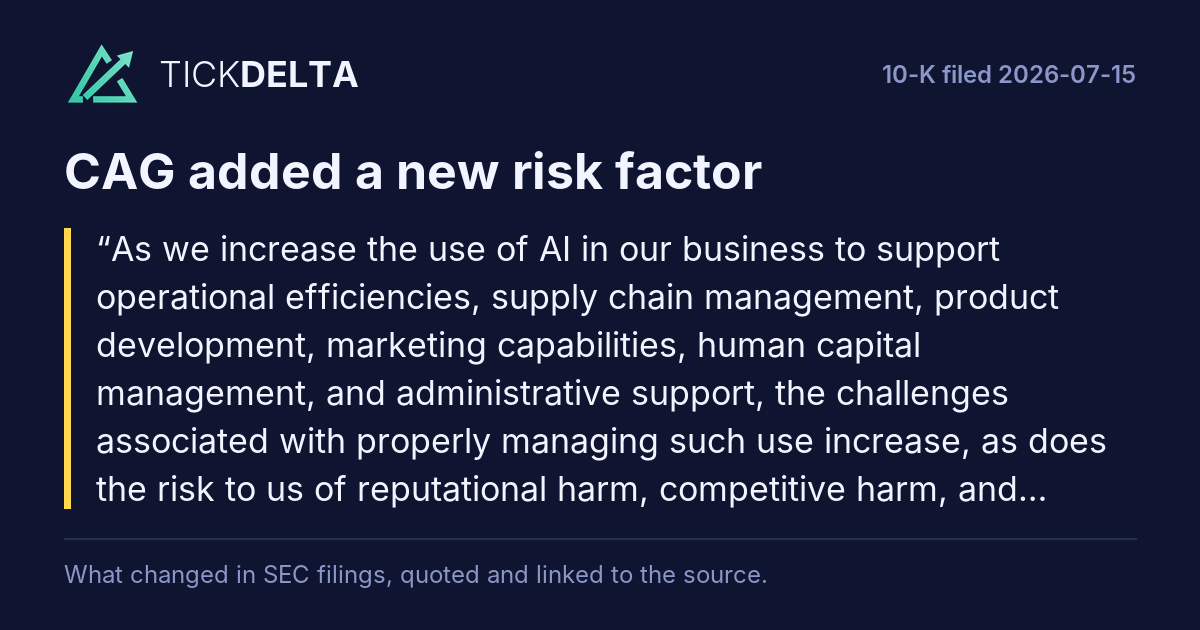
As we increase the use of AI in our business to support operational efficiencies, supply chain management, product development, marketing capabilities, human capital management, and administrative support, the challenges associated with properly managing such use increase, as does the risk to us of reputational harm, competitive harm, and legal liability that could adversely affect our business. The use of AI exposes us to potential information deficiencies, inaccuracies or misleading output, data privacy breaches, inadequate protection of confidential information and intellectual property rights, infringement on third parties’ intellectual property rights, flawed decision-making, and increased costs that may have a negative impact on our business.
Further, the global legal, regulatory, and ethical landscape surrounding AI is rapidly evolving and remains uncertain. Compliance with new and evolving laws, regulations, or industry standards relating to AI may require significant investment and resources, may limit our ability to use AI, and could result in reputational harm, legal liability, or other adverse effects on our operations and overall business. The rapidly evolving and expanding use of AI, along with the introduction of increasingly disparate requirements across the various U.S. jurisdictions in which we operate, as well as evolving international privacy and cybersecurity regimes, complicates our compliance obligations and may require adaptation of our technologies, practices, and operations, which could increase our costs.
Paragraphs in the 10-Q filed Sep 30, 2026 that were not in the one before
New in the latest 10-Q
16 paragraphs in the 10-Q filed Sep 30, 2026 with nothing like them in the 10-Q filed Apr 1, 2026 (at least half the words must differ; new numbers alone do not count). Quoted exactly, grouped by the item heading above them. This is text that changed, not a judgement of how serious it is.
Financial statements and notes
During the first quarter of fiscal 2026, we completed the sale of our Chef Boyardee® business for net proceeds of $ 607.0 million, including working capital adjustments. The business results were previously reported in our Grocery & Snacks, International, and Foodservice segments. We recognized a gain on the sale of $ 42.8 million within Gain on divestitures in the first quarter of fiscal 2026.
Read in the 10-Q
During the first quarter of fiscal 2026, we completed the sale of our frozen fish business, which includes our Van De Kamp’s® and Mrs. Paul’s® brands for net proceeds of $41.9 million, including working capital adjustments. The business results were previously reported primarily in our Refrigerated & Frozen segment. We recognized a loss on the sale of $0.4 million within Gain on divestitures in the first quarter of fiscal 2026.
Read in the 10-Q
We actively market certain other assets from time to time. These assets have also been reclassified as assets held for sale within our Condensed Consolidated Balance Sheets for periods prior to the disposal of the individual asset groups.
Read in the 10-Q
The related assets classified as held for sale reflected in our Condensed Consolidated Balance Sheets were $13.3 million within Current assets held for sale and $13.0 million within Noncurrent assets held for sale as of August 30, 2026 and May 31, 2026, respectively. 3. RESTRUCTURING ACTIVITIES
Read in the 10-Q
We regularly evaluate our operations for ways to increase efficiencies and optimize our investments. Initiatives designed to achieve our efficiency goals may take a year or more to complete and result in various restructuring charges as a result of accelerated depreciation, asset write-offs, and exit costs including severance, lease and other contract termination charges, and disposal costs.
Read in the 10-Q
Show the other 11
In fiscal 2026, we approved initiatives designed to optimize and enhance our supply chain network related to our frozen fried chicken products. We expect these initiatives will result in approximately $85 million of restructuring charges within the Refrigerated & Frozen segment, of which approximately $21 million will be cash. These charges are expected to consist of approximately $64 million of accelerated depreciation and asset write-offs and $21 million of other costs within Selling, general and administrative (“SG&A”) expenses. We recognized charges of $3.1 million in the first quarter of fiscal 2027 and incurred cumulative charges of $16.5 million ($7.5 million of cash charges and $9.0 million of non-cash charges) through the end of the first quarter of fiscal 2027. We expect these initiatives to be completed by the end of fiscal 2028.
Read in the 10-Q
In the first quarter of fiscal 2027, management approved a multi-year transformation initiative (“Project Catalyst”) that seeks to simplify and modernize our operations through process redesign, technology adoption, and organizational optimization to accelerate growth, improve productivity, and enhance cash flow performance. We continue to define and identify initiatives under Project Catalyst, some of which will result in restructuring charges. In the first quarter of fiscal 2027, we recognized cash charges of $2.3 million within SG&A expenses primarily consisting of professional and consulting fees and severance and related costs. We are currently unable to provide timing or specific estimates for any such restructuring charges or other costs that may be incurred as a result of Project Catalyst.
Read in the 10-Q
In the first quarter of fiscal 2027, management also approved a multi-year optimization initiative to drive portfolio simplicity and evaluate strategic options for non-core businesses. Some of these actions will result in restructuring charges. In the first quarter of fiscal 2027, we recognized immaterial charges within Cost of goods sold related to this initiative. We are currently unable to provide timing or specific estimates for any such restructuring charges.
Read in the 10-Q
As of May 31, 2026, we substantially completed restructuring activities related to a restructuring plan commenced in fiscal 2019 that was directed at improving SG&A expense effectiveness and efficiencies and to optimize our supply chain network (the “Conagra Restructuring Plan”). While no new initiatives were added to the Conagra Restructuring Plan, we recognized charges of $2.6 million and $4.4 million in the first quarter of fiscal 2027 and 2026, respectively, related to initiatives previously approved.
Read in the 10-Q
We have recognized cumulative charges of $356.1 million ($118.6 million in Cost of goods sold, $236.9 million in SG&A, and $0.6 million in Pension and postretirement non-service income) from the inception of the Conagra Restructuring Plan through August 30, 2026. Included in these results were $121.3 million of cash charges and $234.8 million of non-cash charges. Our total expenses for the Conagra Restructuring Plan are expected to be $358.0 million ($123.2 million of cash charges and $234.8 million of non-cash charges).
Read in the 10-Q
Goodwill and Indefinite-Lived Intangible Assets The Refrigerated & Frozen reporting unit and certain of our indefinite lived intangibles were written down to fair value as of the end of fiscal 2026, resulting in zero excess fair value over carrying amount, and, as a result, will have a heightened risk of future impairments if any assumptions, estimates, or market factors change in the future. All other reporting units and indefinite lived intangibles had more than 20 % excess fair value over carrying amount as of our last quantitative assessment. We will continue to monitor the impact of any significant changes in consumer purchasing behaviors, input cost inflation, and other macroeconomic conditions that could change certain assumptions and result in future impairments. Definite-Lived Intangible Assets Amortizing intangible assets carry a remaining weighted average life of approximately 15 years. Amortization expense was $10.8 million for the first quarter of both fiscal 2027 and 2026. Based on amortizing assets recognized in our Condensed Consolidated Balance Sheet as of August 30, 2026, amortization expense is estimated to average $39.8 million for each of the next five years. 7. DERIVATIVE FINANCIAL INSTRUMENTS See our Consolidated Financial Statements and related notes included in our Annual Report on Form 10-K for the fiscal year ended May 31, 2026, for additional information on our derivative activities. Derivatives Designated as Cash Flow Hedges During the first quarter of fiscal 2019, we entered into deal-contingent forward starting interest rate swap contracts to hedge a portion of the interest rate risk related to our issuance of long-term debt to help finance the acquisition of Pinnacle Foods, Inc. We settled these contracts during the second quarter of fiscal 2019 and deferred a $47.5 million gain in accumulated other comprehensive income that is being amortized as a reduction of interest expense over the lives of the related debt instruments. The unamortized amount at August 30, 2026 was $22.5 million. Economic Hedges of Forecasted Cash Flows Many of our derivatives do not qualify for, and we do not currently designate certain commodity or foreign currency derivatives to achieve, hedge accounting treatment. We reflect realized and unrealized gains and losses from derivatives used to economically hedge anticipated commodity consumption and to mitigate foreign currency cash flow risk in earnings immediately within general corporate expense (within cost of goods sold). The gains and losses are reclassified to segment operating results in the period in which the underlying item being economically hedged is recognized in cost of goods sold. In the event that management determines a particular derivative entered into as an economic hedge of a forecasted commodity purchase has ceased to function as an economic hedge, we cease recognizing further gains and losses on such derivatives in corporate expense and begin recognizing such gains and losses within segment operating results immediately. The following table presents the net derivative gains (losses) from economic hedges of forecasted commodity consumption and the foreign currency risk of certain forecasted transactions, under this methodology: Thirteen Weeks Ended August 30, 2026 August 24, 2025 ─────────────────────────────────────────────────────────────────────────────────────────────────────────────────────────────────────── Net derivative gains (losses) incurred $ 0.9 $ (0.6) Less: Net derivative gains allocated to reporting segments 6.1 1.6 Net derivative losses recognized in general corporate expenses $ (5.2) $ (2.2) Net derivative gains allocated to Grocery & Snacks $ 3.6 $ 1.4 Net derivative gains allocated to Refrigerated & Frozen 3.5 0.8 Net derivative losses allocated to International (1.1) (0.7) Net derivative gains allocated to Foodservice 0.1 0.1 Net derivative gains included in segment operating profit $ 6.1 $ 1.6 The fair values of our derivative positions were not material as of August 30, 2026 and were Level 1 or Level 2 assets or liabilities in the fair value hierarchy (see Note 15 for further information). We have not significantly changed our valuation techniques from prior periods.
Read in the 10-Q
postretirement non-service income; Interest expense, net; and Equity method investment earnings are centrally managed costs and have been excluded from segment operating profit. Thirteen Weeks Ended August 30, 2026 Grocery & Refrigerated International Foodservice Total
Read in the 10-Q
Snacks & Frozen ────────────────────────────────────────────────────────────────────────────────────────────────────────────────────────────────────────────────────────────────────────────── Net sales $1,079.6 $1,076.2 $212.3 $264.5 $2,632.6 Segment cost of goods sold1 752.9 866.9 151.4 217.9 1,989.1 Segment SG&A expenses2 105.9 94.9 23.2 18.9 242.9 Segment operating profit $220.8 $114.4 $37.7 $27.7 $400.6 General corporate expenses3 92.3 Gain on divestitures (42.4) Other charges, net4 3.3 Operating profit $347.4 Pension and postretirement non-service income 6.1 Interest expense, net 93.8 Equity method investment earnings 29.4 Income before income taxes $289.1 1 Segment cost of goods sold does not include items recorded in the Cost of goods sold line on our Condensed Consolidated Statements of Earnings that are presented in the Other charges, net line of this table. 2 Segment SG&A expenses are regularly provided to the CODM as a percent of net sales. Segment SG&A expenses do not include items recorded in the Selling, general and administrative expenses line of our Condensed Consolidated Statements of Earnings that are presented in the Other charges, net line of this table. 3 General corporate expenses relate to certain costs that are shared across multiple segments but are not directly attributable, which include executive compensation, share-based payment expense, and costs associated with certain corporate functions. 4 Other charges include net charges related to our restructuring plans and legal matter recoveries. The following table presents further disaggregation of our net sales: Thirteen Weeks Ended August 30, 2026 August 24, 2025 ─────────────────────────────────────────────────────────────────────────────────────────────── Frozen $ 877.7 $ 898.5 Staples Other shelf-stable 552.4 568.5 Refrigerated 176.1 177.7 Snacks 498.7 511.1 International 218.1 212.3 Foodservice 272.9 264.5 Total net sales $ 2,595.9 $ 2,632.6 To be consistent with how we present certain disaggregated net sales information to investors, we have categorized certain net sales of our segments as “Staples”, which includes all of our U.S. domestic retail refrigerated products and other shelf-stable grocery products.
Read in the 10-Q
Share sales and buybacks
The following table presents the total number of shares of common stock purchased during the first quarter of fiscal 2027, the average price paid per share, the total number of shares that were purchased as part of a publicly announced repurchase program, and the approximate dollar value of the maximum number of shares that may yet be purchased under the share repurchase program:
Read in the 10-Q
Item 6
EXHIBIT DESCRIPTION ───────────────────────────────────────────────────────────────────────────────────────────────────────────────────────────────────────────────────────────────────────────────────────────────────────────────────────────────────────────────────────────────────────────────────────────────────────────────────────────────── 3.1 Restated Certificate of Incorporation of Conagra Brands, Inc., incorporated herein by reference to Exhibit 3.1 to the Company's Current Report on Form 8-K filed with the SEC on September 23, 2024 3.2 Amended and Restated Bylaws of Conagra Brands, Inc., incorporated by reference to Exhibit 3.1 of Conagra Brands' Current Report on Form 8-K filed with the SEC on May 7, 2026 4.1 Fourth Supplemental Indenture, dated July 28, 2026, by and between the Company and U.S. Bank Trust Company, National Association, as successor Trustee (including the Form of Notes), incorporated by reference to Exhibit 4.2 of Conagra Brands’ Current Report on Form 8-K filed with the SEC on July 28, 2026 10.1 Form of Restricted Stock Units Agreement for CEO under the Conagra Brands, Inc. 2023 Stock Plan
Read in the 10-Q
10.2 Form of Performance Share Agreement for CEO under the Conagra Brands, Inc. 2023 Stock Plan 10.3 Form of Restricted Stock Units Agreement for employees under the Conagra Brands, Inc. 2023 Stock Plan 10.4 Form of Performance Share Agreement for employees under the Conagra Brands, Inc. 2023 Stock Plan 10.5 Form of Change of Control Agreement between Conagra Brands, Inc. and executives 31.1 Section 302 Certificate of Chief Executive Officer
Read in the 10-Q
The 10-Q's risk factors against the 10-K
Item 1A of the 10-Q filed Sep 30, 2026 against Item 1A of the 10-K filed Jul 15, 2026.
A 10-Q repeats only the risks that changed, so a 10-K paragraph that is missing from it is not counted as removed.
Added is a paragraph with nothing like it in the 10-K, Reworded a sentence that is in both with several words changed,
Quiet changes a sentence in both where one to four words changed and one is a hedge or a modal
(cut words struck through, new words highlighted).
Text on the page, not a score; each links to the filing at sec.gov.
What the 10-Q itself says about its risk factors:A discussion of our risk factors can be found in Item 1A, “Risk Factors”, in our Annual Report on Form 10-K for the fiscal year ended May 31, 2026 and in our other filings with the SEC. During the first quarter of fiscal 2027, there were no material changes to our previously disclosed risk factors.
Read in the 10-Q
1 paragraph in the 10-Q's Item 1A, and none of them adds, rewords or quietly edits a paragraph of the 10-K's.
Phrases used for the first time
Two-word phrases in Risk Factors of the 10-K filed Jul 15, 2026 that are in none of the 1 earlier 10-Ks stored, back to Jul 10, 2025
Where each one is used
- adopt new: Failure to modernize and adopt new technologies, including artificial intelligence technology and solutions, could disadvantage us competitively.
- rapidly evolving: Similarly, rapid development and increased adoption of AI technology in our operations may create the need for rapid modifications to our cybersecurity program and increase our cybersecurity risks. Furthermore, the technology and techniques used in cyberattacks are also rapidly evolving. Threat actors are...
- slow growth: Deterioration in general economic conditions, an economic recession or periods of slow growth, periods of inflation or increasing interest rates, or economic uncertainty may affect consumers resulting in reductions in consumer spending and have in the past harmed and could continue to harm our business and results...
- oil energy: Our business and results of operations have in the past been and may continue to be adversely affected by changes in national or global stability and economic conditions, including periods of inflation and rising interest rates; decreased energy and fuel availability coupled with increased oil, energy and fuel...
- rapidly imposed: Rapid changes in trade policies, including rapidly imposed and threatened tariffs by the U.S. and reciprocal tariffs from U.S. trading partners, continue to create uncertainty and could negatively impact our business and the business of our key business partners.
- threatened tariffs: Rapid changes in trade policies, including rapidly imposed and threatened tariffs by the U.S. and reciprocal tariffs from U.S. trading partners, continue to create uncertainty and could negatively impact our business and the business of our key business partners.
- reciprocal tariffs: Rapid changes in trade policies, including rapidly imposed and threatened tariffs by the U.S. and reciprocal tariffs from U.S. trading partners, continue to create uncertainty and could negatively impact our business and the business of our key business partners.
- trading partners: Rapid changes in trade policies, including rapidly imposed and threatened tariffs by the U.S. and reciprocal tariffs from U.S. trading partners, continue to create uncertainty and could negatively impact our business and the business of our key business partners.
Used at least twice, small words left out. Counted, not picked: a phrase can be new because the company renamed something.
What was taken out
4 paragraphs of last year's Risk Factors with nothing like them now. The longest are quoted.
Sources
Item 1A of each 10-K and 10-Q on EDGAR, quoted exactly. Each paragraph links to the filing at sec.gov.
Also
10-K change: what was reworded or cut, section by section.
Work with it
Excel workbook · CSV. Google Sheet that stays up to date: paste =IMPORTDATA("https://tickdelta.com/company/CAG/export.csv") into a cell.