Screener / SEC EDGAR /CIK 0000023217 /10-K filed Jul 15, 2026, compared with Jul 10, 2025 /Numbers from the XBRL of the 10-Ks
NYSE Consumer staples · Packaged Foods

Conagra Brands Inc. CAG

Compare with peers Embed
SEC comment letters, last 20 years

4 reviews of CAG's filings by SEC staff

UPLOAD and CORRESP
Reviews 4 latest letter Mar 17, 2025
Questions asked 16 each answered in the company's own letter
No closing letter 1 reviews without a letter saying the staff completed it

When the SEC's staff reviews a filing, it writes to the company with numbered questions, and the company answers each one in a letter. SEC publishes the exchange once the review is over, at least 20 business days later. A question is not an accusation; most reviews end with the company adding detail to its next filing.

How the reviews went

Every review on EDGAR, from the first staff letter to the letter that closes it

  1. 1. Staff letters 6 UPLOAD
  2. 2. Questions in them 16 numbered comments
  3. 3. Company replies 6 CORRESP
  4. 4. Reviews closed 3 of 4 closing letter

Half the closed reviews took 10 days or less from the first letter to the closing letter.

Form 10-K for the fiscal year ended May 26, 2024

2025-03-17 to 2025-03-27 · 1 question · 1 letter from the SEC, 1 from the company
Review closed 2025-03-27
Non-GAAP measuresGoodwill and impairment
Consolidated Statements of Earnings, page 38
SEC asked
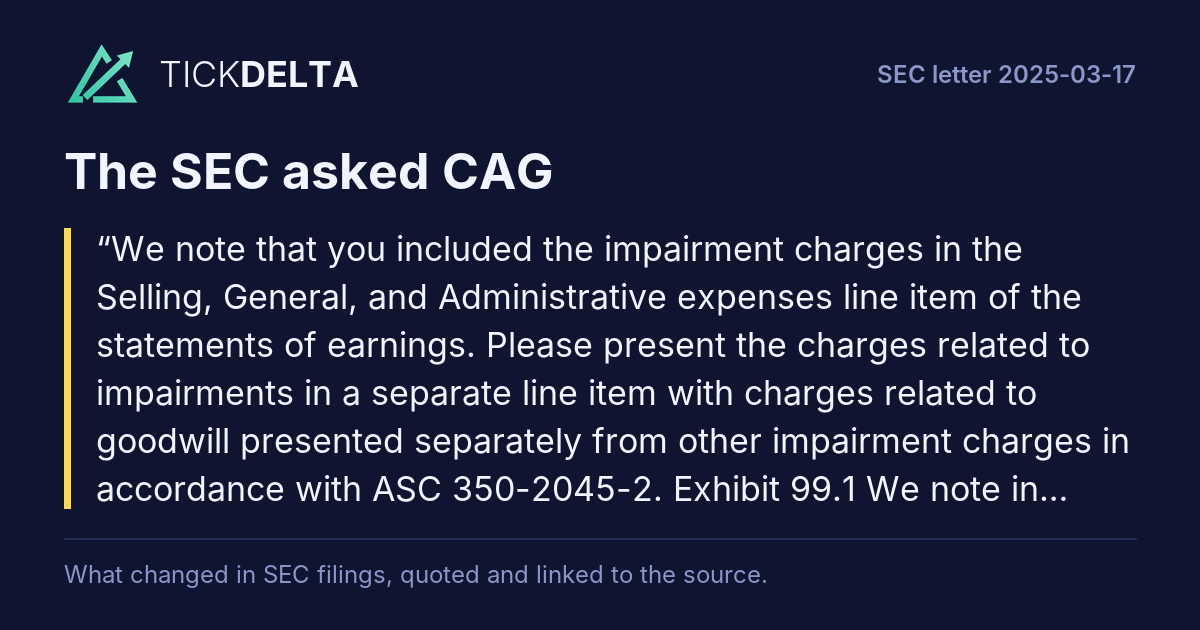
We note that you included the impairment charges in the Selling, General, and Administrative expenses line item of the statements of earnings. Please present the charges related to impairments in a separate line item with charges related to goodwill presented separately from other impairment charges in accordance with ASC 350-2045-2.
Rest of the question

Exhibit 99.1 We note in your earnings releases, you removed advertising and promotion expenses from adjusted selling, general and administrative expense, a non-GAAP measure, because this metric is used in reporting to management, and management believes this adjusted measure provides useful supplemental information to assess the company’s 2. operating performance. Please tell us your consideration of the guidance in Questions 100.01 and 100.04 of the Compliance and Disclosure Interpretations on Non-GAAP Financial Measures. 3. We note your non-GAAP financial measures contain several reconciling adjustments. Please revise your discussion in your Note on Non-GAAP Financial Measures to further describe the nature of each adjustment and the reasons why management believes the adjustment and information is useful to investors. Refer to the guidance in Item 10(e)(1)(i)(C) of Regulation S-K.

CAG answered
In response to the Staff’s comment, in future filings, in the cost and expenses itemization in the statement of earnings, we will present charges related to impairments in a separate line item and we will separately present charges related to goodwill, if recognized. As disclosed in Note 8 – Goodwill and Other Identifiable Intangible Assets, we recognized goodwill and intangible impairment charges of $526.5 million and $430.2 million, respectively in fiscal year 2024.
Rest of the answer

We respectfully submit that the requested change would not materially change a reader’s understanding of the Company’s results of operations, as the nature and amount of the impairment charges is reflected within Note 8 and in our Critical Accounting Estimates.

Read in the reply
In its next report

First report after the company's reply of Mar 26, 2025: 10-Q filed Apr 3, 2025 ↗, against the 10-Q filed Dec 19, 2024 ↗.

Tickdelta does not hold the text of both reports, so they are not compared here.
Also in this review: closing letter, 2025-03-27
Form 10-K for the fiscal year ended May 30, 2021

2021-10-20 to 2021-10-28 · 2 questions · 1 letter from the SEC, 1 from the company
Review closed 2021-10-28
InventoryGoodwill and impairment
Summary of Significant Accounting Policies · Inventories, page 44
SEC asked (1)
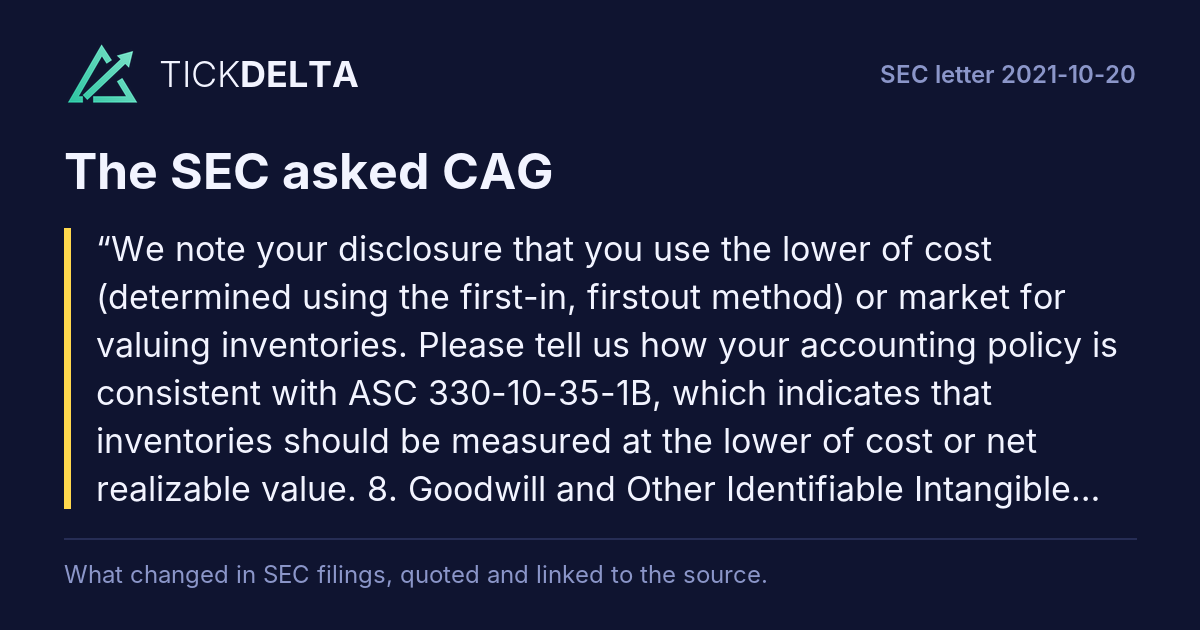
We note your disclosure that you use the lower of cost (determined using the first-in, firstout method) or market for valuing inventories. Please tell us how your accounting policy is consistent with ASC 330-10-35-1B, which indicates that inventories should be measured at the lower of cost or net realizable value. 8. Goodwill and Other Identifiable Intangible Assets, page 57
CAG answered
In response to the Staff's comment, as outlined within our 2018 Annual Report on Form 10-K, we adopted Accounting Standards Update (“ASU”) 2015-11, Inventory, which requires an entity to measure inventory at the lower of cost or net realizable value. This ASU was adopted prospectively in fiscal 2018 and has been consistently applied throughout all subsequent filings. The adoption of this guidance did not have a material impact to our financial statements. We will revise future filings to replace “market” with “net realizable value”.

8.
Rest of the answer

Goodwill and Other Identifiable Intangible Assets, page 57

Read in the reply
Summary of Significant Accounting Policies · Inventories, page 44
SEC asked (2)
Please revise future filings to provide, for each major intangible asset class, the disclosures required by ASC 350-30-50-2(a) and (b).
CAG answered
In response to the Staff's comment, we will include major intangible asset classes within our identifiable intangible asset table in future filings. Brands and trademarks account for 100% of non-amortizing intangible assets. Customer relationships represent over 90% of amortizing intangible assets with the remaining amounts associated with acquired intellectual property.
Rest of the answer

Please note that disclosure of these asset classes was included in the narrative discussion within footnote 8.

We confirm that we are responsible for the fair presentation in the consolidated financial statements of financial position, results of operations, and cash flows in conformity with U.S. generally accepted accounting principles.

Read in the reply

Also in this review: closing letter, 2021-10-28

Form S-4

2018-08-20 to 2018-08-31 · 4 questions · 1 letter from the SEC, 1 from the company
No closing letter
Legal and contingenciesIncome taxes
General
SEC asked (1)
Please revise your disclosure to describe any pending or threatened litigation relating to the merger transaction.
CAG answered
In response to the Staff’s comment, the applicable disclosure has been revised. Please see pages 22 and 126 in Amendment No. 1
Read in the reply
Unaudited Pro Forma Condensed Combined Financial Information, page 134 · Notes to Unaudited Pro Forma Condensed Combined Financial Information, page 137
SEC asked (2)
We note certain pro forma adjustments in your pro forma balance sheet combine several amounts discussed in numerous footnotes, such as but not limited to other accrued liabilities and the line items within common stockholders’ equity. We have been unable to reconcile these pro forma adjustments with the amounts disclosed in the various footnotes that are referenced.
Rest of the question

Please expand and revise your footnote disclosures to clarify how these pro forma balance sheet adjustment amounts are calculated.

CAG answered
In response to the Staff’s comment, the applicable disclosure has been revised. Please see footnotes 3.b., 3.j., 3.k. and 3.l. on pages

140, 141, 142 and 142, respectively, in Amendment No. 1.
Read in the reply
Unaudited Pro Forma Condensed Combined Financial Information, page 134 · Notes to Unaudited Pro Forma Condensed Combined Financial Information, page 137
SEC asked (3)
In footnote 3.c., you state the income tax impacts of pro forma adjustments were calculated using either the Conagra or Pinnacle statutory tax rates. Tell us why the pro forma income tax adjustment is calculated with reference to Pinnacle’s statutory tax rate.
CAG answered
In response to the Staff’s comment, the applicable disclosure on page 140 of Amendment No. 1 has been revised as follows:

“The pro forma adjustment to income tax expense was calculated by applying Conagra’s statutory income tax rate of 30.38% to each pro forma adjustment to Income (loss) from continuing operations before income taxes and equity method investment earnings, except in the case of the pro forma adjustments to depreciation, amortization and interest expense which was done by reversing the tax impact of Pinnacle’s historical depreciation, amortization and interest expense based on
Rest of the answer

its historical statutory income tax rate of 32.33% and adding back the tax impact of the estimated depreciation, amortization and interest expense in purchase accounting using Conagra’s statutory income tax rate of 30.38%. The historical statement of operations of Conagra and Pinnacle include one-time benefits associated with US Tax Reform that have not been adjusted in the pro forma presentation.”

We supplementally advise the Staff that we concluded this methodology more accurately reflects the difference in rates related to the Tax Cuts and Jobs Act of 2017 given Pinnacle’s calendar year end versus Conagra’s fiscal year end.

Read in the reply
Unaudited Pro Forma Condensed Combined Financial Information, page 134 · Notes to Unaudited Pro Forma Condensed Combined Financial Information, page 137
SEC asked (4)
We note the pro forma adjustment to increase the carrying value of Pinnacle’s plant assets to fair value in note 3.e. Tell us why you have recorded a corresponding decrease to depreciation expense when the value of the plant assets has increased.
CAG answered
Conagra acknowledges the Staff’s comment. In the second quarter of 2017, Pinnacle accelerated depreciation in the amount of approximately $22.6 million on certain plant assets of its Aunt Jemima frozen breakfast business, reflecting the significantly reduced expected useful lives of those assets. Conagra estimated the fair values of plant assets based on the Pinnacle plant asset balance at April 1, 2018, the most recent balance sheet date.
Rest of the answer

The plant assets associated with the

Aunt Jemima frozen breakfast business were not included in this balance, as they had been fully depreciated and preliminarily determined by us to have no value. Conagra’s estimate of pro forma depreciation expense does not reflect

Pinnacle’s historical accelerated depreciation, as the applicable assets are not included in the pro forma opening balance sheet. As such, the pro forma adjustment is a net decrease from the amount reflected in the historical financial statement of Pinnacle.

Read in the reply

Form 10-K

2015-09-25 to 2016-04-27 · 9 questions · 3 letters from the SEC, 3 from the company
Review closed 2016-04-27
Goodwill and impairmentSegmentsResults discussion (MD&A)Liquidity and cashDebtAcquisitionsCritical estimatesPensions
Liquidity and Capital Resources, page 28 · Sources of Liquidity and Capital, page 28
SEC asked (1)
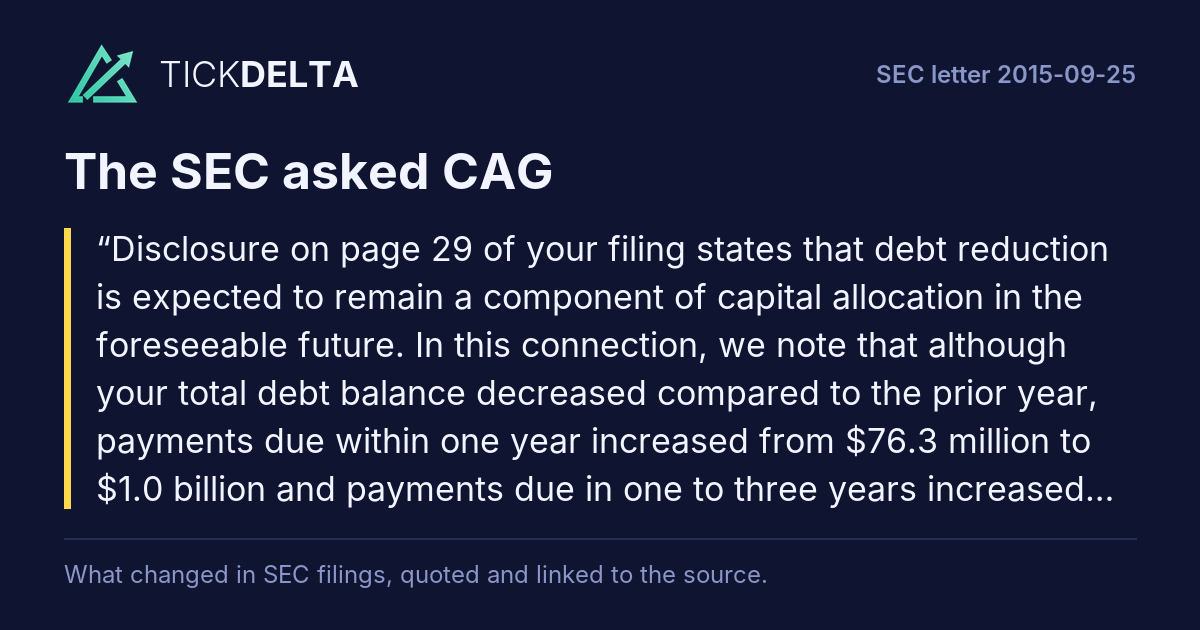
Disclosure on page 29 of your filing states that debt reduction is expected to remain a component of capital allocation in the foreseeable future. In this connection, we note that although your total debt balance decreased compared to the prior year, payments due within one year increased from $76.3 million to $1.0 billion and payments due in one to three years increased from $1.0 billion to $2.3 billion.
Rest of the question

Tell us how you considered providing disclosure specifically explaining how you plan to address this change to your debt profile including with regard to the allocation of cash resources to satisfy your debt obligations. Refer to Item 303(a)(1) of Regulation S-K and section IV.D. of SEC Release No. 33-8350. As part of your response, address the extent to which current year debt repayments are expected to impact your ability to meet your working capital needs, planned capital expenditures, and payment of anticipated quarterly dividends.

CAG answered
In accordance with the requirements of Item 303(a)(1) of Regulation S-K and section IV.D. of SEC Release No. 33-8350, the Liquidity and Capital Resources section of our Form 10-K’s Management’s Discussion and Analysis of Financial Condition and Results of Operations (“MD&A”), discloses that we have access to multiple sources of liquidity. Specifically, in addition to operating cash flows, we disclose our access to, and ability to use, our $1.5 billion revolving credit facility scheduled to mature September 2018, as well as our commercial paper program.
Rest of the answer

We cited the pending divestiture of the Private Brands business as a significant source of potential liquidity, although we were unable to provide details as to the amount or timing of any related proceeds, as formal negotiations for the sale of that business were not yet underway. We also disclose that we have access to the capital markets.

As of the date of the filing of our Form 10-K, management had not yet committed to any specific plans in regards to repaying the debt instruments that were scheduled to mature during the following fiscal year, or those that were scheduled to mature over the subsequent two fiscal years. Because the Company has access to multiple sources of liquidity, as disclosed in this section of MD&A, and as there exists uncertainty as to: the amount and timing of proceeds from the potential divestiture of the Private Brands business; the interest rates that will be available at the time of any potential refinancing transaction; as well as other strategic changes the company may make in the intervening time period, it was not practicable at the time to more specifically explain how we plan to address the changes to our debt profile.

In order to clarify our disclosures in this regard, we propose to add the following additional verbiage to the Liquidity and Capital Resources section of MD&A in future filings, and we have included such language in our recently filed Form 10-Q for the first quarter of our fiscal 2016:

“Although a significant amount of our senior debt will mature during fiscal 2016, and over the next several years, we expect to maintain or have access to sufficient liquidity to either retire or refinance such debt, as market conditions warrant, from operating cash flows, our commercial paper program, proceeds from any divestitures, access to capital markets and our revolving credit facility.”

In regards to our assessment of the extent to which current year debt repayments are expected to impact our ability to meet our working capital needs, planned capital expenditures, and payment of anticipated quarterly dividends, please consider our disclosure in this section of MD&A that states that “management believes that existing cash balances, cash flows from operations, existing credit facilities, and access to capital markets will provide sufficient liquidity to meet our working capital needs, planned capital expenditures, and payment of anticipated quarterly dividends for at least the next twelve months.”

Read in the reply
In its next report

First report after the company's reply of Oct 9, 2015: 10-Q filed Jan 6, 2016 ↗.

No earlier 10-Q before the SEC's letter is in Tickdelta, so there is nothing to compare with.

Obligations and Commitments, page 30
SEC asked (2)
We note the funded status of your pension plans was $(433.0) million as of May 25, 2014 and $(553.2) million as of May 31, 2015. Please revise to provide information regarding the timing and amount of expected pension contributions as part of your disclosure of contractual obligations, including explanatory language regarding the factors that could affect your estimates of future minimum statutory funding
Rest of the question

requirements and expected contributions. Refer to Item 303(a)(5) of Regulation S-K and, for further guidance, section II.C. of SEC Release 33-9144. Critical Accounting Estimates, page 32 Business Combinations, Impairment of Long-Lived Assets (including property, plant and equipment), Identifiable Intangible Assets, and Goodwill, page 35

CAG answered
In order to address the Staff’s comment, we propose to add the following disclosure to the Obligations and Commitments section of MD&A in future filings, and we have included this language in our recently filed Form 10-Q for the first quarter of our fiscal 2016:

As of May 31, 2015, we had aggregate unfunded pension obligations totaling $553.2 million. This amount is not included in the table above, as the unfunded pension obligation is marked-to-market each fiscal year, and we do not expect to be required to make payments to fund these amounts in the foreseeable future.
Rest of the answer

Based on current statutory requirements, we are not obligated to fund any amount to our qualified pension plans during the next twelve months. We estimate that we will make payments of approximately $10.2 million over the next twelve months to fund current benefits of nonqualified pension plans. See Note 14, Pensions and Postretirement Benefits, to the Condensed Consolidated Financial Statements, and the Company's Annual Report on Form 10-K for the fiscal year ended May 31, 2015, Critical

Accounting Estimates - Employment Related Benefits, for further discussion of our pension obligations and factors that could affect estimates of this liability.

Critical Accounting Estimates, page 32

Business Combinations, Impairment of Long-Lived Assets (including property, plant and equipment), Identifiable Intangible Assets, and Goodwill, page 35

Read in the reply
In its next report

First report after the company's reply of Oct 9, 2015: 10-Q filed Jan 6, 2016 ↗.

No earlier 10-Q before the SEC's letter is in Tickdelta, so there is nothing to compare with.

Obligations and Commitments, page 30
SEC asked (3)
During the fiscal year ended May 31, 2015, you recognized charges totaling $1.53 billion for the impairment of goodwill in your Private Brands segment. Disclosure in your filing states that additional, material impairment charges may be recognized in future periods if the future performance of one or more of the reporting units within the Private Brands segment falls short of your expectations or if there are
Rest of the question

significant changes in riskadjusted discount rates. Please provide expanded disclosure to:  Describe the methods and key assumptions used in determining fair value and how the key assumptions were determined;  Discuss the degree of uncertainty associated with the key assumptions; and  Address potential events and/or changes in circumstances that could reasonably be expected to negatively affect the key assumptions.

CAG answered
We propose to include the language below to update the Critical Accounting Estimates section of the MD&A in future periods, and we have included such language in our recently filed Form 10-Q for the first quarter of our fiscal 2016. The below language is intended to clarify our disclosures regarding key assumptions used in measuring goodwill impairment charges related to our Private Brands business.
Rest of the answer

Starting with our recently filed Form 10-Q for the first quarter of our fiscal 2016, we have added disclosure of the methodology used under ASC 360 to measure the subsequent impairment that occurred in our first quarter of fiscal 2016 when the Private Brands business met the requirements to be treated as assets held for sale (underscored text represents proposed additional wording).

Because forecasted sales and profits for the Private Brands segment continued to fall below our expectations relative to our previous projections throughout fiscal 2015, we performed quantitative analyses of goodwill on certain of our Private Brands segment reporting units in the second, third, and fourth quarters of fiscal 2015. Estimating the fair value of individual reporting units requires us to make assumptions and estimates regarding our future plans and future industry and economic conditions. We estimated the future cash flows of each reporting unit within the Private Brands segment and calculated the net present value of those estimated cash flows using a risk adjusted discount rate, in order to estimate the fair value of each reporting unit from the perspective of a market participant. For this purpose, in our most recent analysis we used the sales growth rates, ranging from -1% in our cereal reporting unit to +5% in our Snacks reporting unit, and gross margin percentages used internally for our operating plans for fiscal 2016. We estimated the rates of sales and cash flow growth for the subsequent three years based upon known trends for each applicable product category, customer-specific facts, expected rates of material and labor inflation, and planned capital expenditures for each reporting unit. We used a discount rate and terminal growth rate of cash flows of 8% and 3%, respectively, to calculate the present value of estimated future cash flows. We then compared the estimated fair value of each reporting unit to the respective historical carrying value (including allocated assets and liabilities of certain shared and Corporate functions), and determined that the fair value of the reporting unit was less than the carrying value for six of our reporting units within the Private Brands segment throughout fiscal 2015. With the assistance of a third-party valuation specialist, we estimated the fair value of the assets and liabilities of each of these reporting units in order to determine the implied fair value of goodwill of each reporting unit. We recognized impairment charges for the difference between the implied fair value of goodwill and the carrying value of goodwill within each reporting unit at the respective measurement dates. Accordingly, during fiscal 2015, we recorded charges totaling $1.53 billion for the impairment of goodwill in the Private Brands segment. The following reporting units within Private Brands were impacted: $328.7 million in Bars and Coordinated, $195.1 million in Cereal, $157.1 million in Pasta, $536.5 million in Snacks, $174.4 million in Retail Bakery, and $136.1 million in Condiments.

Following the impairment charges recorded in fiscal 2015, the carrying value of goodwill in our Private Brands reporting units included $269.3 million for Cereal, $588.2 million for Pasta, $276.5 million for Snacks, and $535.5 million for Retail Bakery. All of the goodwill for the Bars and Coordinated and Condiments reporting units was impaired as of the end of fiscal 2015. If the future performance of one or more of the reporting units within the Private Brands segment falls short of our expectations or if there are significant changes in risk-adjusted discount rates due to changes in market conditions, we could be required to recognize additional, material impairment charges in future periods. Estimating future cash flows requires significant judgment by management in such areas as future economic conditions, industry-specific conditions, product pricing, and necessary capital expenditures. Due to the intense competitive environment in private label foods and the severity of recent declines in operating performance, the degree of uncertainty of future cash flows is high. Among other factors, the loss of significant customers, unplanned rates of materials inflation, loss of key personnel, and the entrance of new competitors could result in further reductions in forecasted future cash flows, and accordingly, further impairment charges.

On June 30, 2015, we announced plans to divest our Private Brands operations. On August 7, 2015, we determined that certain assets related to the Private Brands segment were required to be classified as assets held for sale. As a result of this determination and preliminary indications of interest from potential buyers, we concluded that the assets held for sale were further impaired. We recognized a pre-tax impairment charge of $1.95 billion ($1.42 billion after-tax) in the first quarter of fiscal 2016 to write down the long-lived assets of the Private Brands business to the estimated sales price, less costs to sell.

Read in the reply
In its next report

First report after the company's reply of Oct 9, 2015: 10-Q filed Jan 6, 2016 ↗.

No earlier 10-Q before the SEC's letter is in Tickdelta, so there is nothing to compare with.

Obligations and Commitments, page 30
SEC asked (4)
We note that you assessed the recoverability of amortizing intangible assets related to certain reporting units within your Private Brands segment, but that no impairments were recognized as you expect to recover the carrying value. However, you recognized impairment charges of $43.7 million in your Private Brands segment to write-down indefinite lived intangible assets.
Rest of the question

Please tell us about the conclusions reached as of May 31, 2015 with regard to the impairment of intangible assets and describe the changes that occurred subsequently that led to the statement in your August 13, 2015 filing on Form 8- K that the assets in your Private Brands segment are impaired. Refer to the guidance regarding the recognition and measurement of an impairment loss per FASB ASC 35020-35 and 360-10-35, as applicable.

CAG answered
At May 31, 2015, the various assets of our Private Brands business did not qualify as assets held for sale, and accordingly were tested for impairments under a held and used classification. Our conclusion that the assets of the Private Brands business did not qualify as assets held for sale, as of May 31, 2015, is due to the following facts:

The board of directors of the Company is required to approve a transaction of this size.
Rest of the answer

At May 31, 3015, the board of directors of the Company had not approved the active marketing of the business.

The Company had not begun actively seeking a buyer of the assets as of May 31, 2015.

Management of the Company had not yet determined at what price it might reasonably be able to sell the Private Brands business until August 7, 2015, at which time the Company received preliminary bids from prospective buyers of this business.

Management of the Company was not able, as of May 31, 2015, to determine that it was probable that a sale of the Private Brands business would be completed within twelve months. Based on preliminary bids from potential buyers of the Private Brands business, on August 7, 2015, management determined that completion of a sale of the business, at a reasonable price, within twelve months, was probable.

Based on these facts, we determined that these assets were held and used at May 31, 2015, and were held for sale at August 7, 2015, in accordance with ASC 360-10-45-9.

At May 31, 2015, the amortizing intangible assets, principally customer relationship assets, were assessed for impairment under ASC 360-10-35-17, as assets held and used. The estimated future cash flows expected to be generated from the asset group, over the life of the principal asset, on an undiscounted basis, exceeded the book value of the assets. Accordingly, impairment was not indicated at the time.

The fair value of our indefinite-lived assets, principally brands, is measured using a relief from royalty method. In accordance with ASC 350-30-35-19, when there is an indicator of impairment, the value of indefinite-lived assets is written-down to fair value, immediately, rather than being evaluated for recovery under ASC 360-10-35-17. Due to the significant decline in sales and gross margins associated with certain brands within our Private Brands business during fiscal 2015, management determined there was an indicator of impairment. The fair value of these brands were determined to be impaired when we applied the relief from royalty method with the then current forecasts of sales and gross margins for those brands. Accordingly, we recognized impairment charges to write those assets down to estimated fair value.

Read in the reply
In its next report

First report after the company's reply of Oct 9, 2015: 10-Q filed Jan 6, 2016 ↗.

No earlier 10-Q before the SEC's letter is in Tickdelta, so there is nothing to compare with.

Notes to Consolidated Financial Statements · Note 7 – Investments in Joint Ventures, page 58
SEC asked (5)
We note that you contributed all of the assets of ConAgra Mills in exchange for a 44% ownership interest in the Ardent Mills joint venture. We also note that Ardent Mills distributed $391.4 million in cash to you as a return of capital. Please describe your accounting treatment for this transaction, including with regard to the $625.6 million gain recognized. Refer to FASB ASC 845-10-25.
Rest of the question

With your response, tell us how you determined that your legacy milling business should be presented as discontinued operations pursuant to ASU 2014-08.

CAG answered
Upon the formation of the Ardent Mills joint venture, we contributed all of the assets and liabilities of our grain milling operations to the newly formed joint venture. We concluded that the milling operations constituted a business and, in accordance with ASC 810-10-40-5, we deconsolidated the milling operations, and recognized a gain in net income, attributable to the parent, measured as the difference between a. and b., below:

a. The aggregate of all of the following:

1. The fair value of any consideration received

2.
Rest of the answer

The fair value of any retained noncontrolling investment in the former milling operations or group of assets at the date the operations are deconsolidated or the group of assets is derecognized

3. The carrying amount of any noncontrolling interest in the former milling operations (including any accumulated other comprehensive income attributable to the noncontrolling interest) at the date the operation is deconsolidated.

b. The carrying amount of the former milling operations' assets and liabilities or the carrying amount of the group of assets.

The fair value of each of these components of the transaction was estimated with the assistance of third party valuation experts.

The newly formed Ardent Mills joint venture obtained financing from unrelated financial institutions and distributed cash to the owners proportionate to their ownership interests in Ardent Mills. We treated this distribution as a reduction in the value of our equity method investment in Ardent Mills.

In accordance with ASU 2014-08, a disposal of a component of an entity or a group of components of an entity is required to be reported in discontinued operations if the disposal represents a strategic shift that has (or will have) a major effect on an entity's operations and financial results when the component of an entity or group of components of an entity is disposed of other than by sale (for example, by abandonment or in a distribution to owners in a spinoff).

Upon the contribution of the milling operations to Ardent Mills, the Company was making a strategic shift that has a major impact on the entity’s operations and financial results, as the Company ceased to have a controlling interest in a grain milling operation (a major line of business), while all of the Company’s remaining businesses are that of a manufacturer and seller of packaged food products to retail, foodservice and commercial food customers.

The Company adopted the guidance in ASU 2014-08 on the first day of its fiscal 2015. As this guidance eliminates the exception from discontinued operations presentation of significant continuing involvement, the retained equity interest in the Ardent Mills joint venture does not preclude discontinued operations classification of historical results.

Read in the reply
In its next report

First report after the company's reply of Oct 9, 2015: 10-Q filed Jan 6, 2016 ↗.

No earlier 10-Q before the SEC's letter is in Tickdelta, so there is nothing to compare with.

Note 23 – Subsequent Events, page 90
SEC asked (6)
Disclosure in your Form 10-K states that you plan to sell substantially all of your Private Brand operations, but that the planned sale did not meet the criteria for the related assets and liabilities to be classified as held-for-sale for the fiscal year ended May 31, 2015.
Rest of the question

In your August 13, 2015 filing on Form 8-K, you state that management has determined that assets related to your Private Brands segment are required to be classified as assets heldfor-sale. Please provide us with an explanation for this change in your conclusion regarding the classification of the assets related to your Private Brands segment. With your response, tell us whether the operations of your Private Brands business currently meet the conditions to be reported in discontinued operations pursuant to ASU 2014-08.

CAG answered
As indicated in our response to your comment #4 above, at May 31, 2015, the various assets of our Private Brands business did not qualify as assets held for sale, due to the following facts:

The board of directors of the Company is required to approve a transaction of this size. The board of directors of the Company did not authorize management to begin actively marketing the business until June 10, 2015.

Management of the Company had not yet determined at what price it might reasonably be able to sell the Private Brands business until August 7, 2015, at which time the Company received
Rest of the answer

preliminary bids from prospective buyers of this business.

Management of the Company was not able, as of May 31, 2015, to determine that it was probable that a sale of the Private Brands business would be completed within twelve months. Based on preliminary bids from potential buyers of the Private Brands business, on August 7, 2015, management determined that completion of a sale of the business, at a reasonable price, within twelve months, was probable.

Based on these facts, we determined that these assets were held and used at May 31, 2015, and were held for sale at August 7, 2015, in accordance with ASC 360-10-45-9.

In accordance with ASU 2014-08, as the disposal group qualifies as held for sale, and as the pending disposition of the Private Brands business represents a strategic shift in the Company’s business, we have classified the results of this business as discontinued operations for all periods presented in our recently issued Form 10-Q for the first quarter of our fiscal 2016.

***

The Company acknowledges that:

The Company is responsible for the adequacy and accuracy of the disclosure in the filing;

staff comments or changes to disclosures in response to staff comments do not foreclose the Commission from taking any action with respect to the filing; and the Company may not assert staff comments as a defense in any proceeding initiated by the Commission or any person under the federal securities laws of the United States.

We would be willing to discuss with you any additional comments the staff may have. Please contact me at 402-240-7018 with questions or comments on this response letter.

Read in the reply
In its next report

First report after the company's reply of Oct 9, 2015: 10-Q filed Jan 6, 2016 ↗.

No earlier 10-Q before the SEC's letter is in Tickdelta, so there is nothing to compare with.

Liquidity and Capital Resources, page 28 · Sources of Liquidity and Capital, page 28
SEC asked (1)
Your response to prior comment 1 refers to the statement in your Form 10-K that management believes that existing sources of liquidity will be sufficient to meet your working capital needs, planned capital expenditures, and payment of anticipated dividends for at least the next twelve months.
Rest of the question

However, it does not appear that you have provided sufficient detail to enable a financial statement user to understand your basis for this statement. Please revise your disclosure to provide additional detail addressing your ability to meet upcoming cash requirements over both the short and long term. Refer to section IV of SEC Release No. 33-8350.

CAG answered
In order to clarify our disclosures in this regard, we propose to add the following additional verbiage to the Liquidity and Capital Resources section of MD&A in future filings. This language would be in addition to the language we included in our prior comment letter response and in our most recently filed Form 10-Q (as set forth below):

“We expect to generate significant cash flows from operations in fiscal 2016, and we have access to the $1.5 billion revolving credit facility, our commercial paper program, and the capital markets.
Rest of the answer

We believe we have access to additional bank loan facilities, if needed. We also expect to receive approximately $2.7 billion in proceeds from the sale of the Private Brands business prior to the end of fiscal 2016.

Although we have not finalized plans for our future capital structure, management believes the aforementioned sources of liquidity will be adequate to meet required debt repayments, planned capital expenditures, working capital needs, and payment of anticipated quarterly dividends for the foreseeable future.”

Previously included language in our prior response and most recently filed Form 10-Q:

“Although a significant amount of our senior debt will mature during fiscal 2016, and over the next several years, we expect to maintain or have access to sufficient liquidity to either retire or refinance such debt, as market conditions warrant, from operating cash flows, our commercial paper program, proceeds from any divestitures, access to capital markets and our revolving credit facility.”

Read in the reply
In its next report

First report after the company's reply of Dec 3, 2015: 10-Q filed Jan 6, 2016 ↗.

No earlier 10-Q before the SEC's letter is in Tickdelta, so there is nothing to compare with.

Notes to Consolidated Financial Statements · Note 7 – Investments in Joint Ventures, page 58
SEC asked (2)
Your response to prior comment 5 states that the contribution of your milling operations to the Ardent Mills joint venture was a strategic shift that will have a major impact on your operations and financial results.
Rest of the question

Please provide us with a detailed analysis supporting your conclusion that the disposal of your grain milling operation meets the requirements for discontinued operations presentation pursuant to ASU 2014-08.

CAG answered
In accordance with ASU No. 2015-08, management determined that the disposal of a controlling interest in the flour milling operations constituted a strategic shift that had a major impact on our operations and financial results. The milling operations were the last of the purely commodity-based operations of the Company. The entire line of business was contributed to the Ardent Mills joint venture.
Rest of the answer

The net sales and operating profit of the milling operations were $1.86 billion, and $235 million, respectively, in fiscal 2014 (the last year for which the results were presented in continuing operations). This represented 10.5% and 18% of the company’s net sales and operating profit, respectively, during fiscal 2014. Management of the Company determined that the disposal of a controlling interest of this entire line of business represented a strategic shift and the cited financial statement amounts to be of sufficient magnitude to constitute a “major impact” on the Company’s operations and financial results.

***

The Company acknowledges that:

•

The Company is responsible for the adequacy and accuracy of the disclosure in the filing;

staff comments or changes to disclosures in response to staff comments do not foreclose the Commission from taking any action with respect to the filing; and the Company may not assert staff comments as a defense in any proceeding initiated by the Commission or any person under the federal securities laws of the United States.

We continue to be willing to discuss with you any comments the staff may have. Please contact me at 402-240-4686 with questions or comments on this response letter.

Read in the reply
In its next report

First report after the company's reply of Dec 3, 2015: 10-Q filed Jan 6, 2016 ↗.

No earlier 10-Q before the SEC's letter is in Tickdelta, so there is nothing to compare with.

Notes to Consolidated Financial Statements · Note 7 – Investments in Joint Ventures, page 58
SEC asked
Your response to prior comment 2 states that the disposal of a controlling interest in your flour milling operations constituted a strategic shift that had a major impact on your operations and financial results as your milling operations were the last of your purely commodity-based operations.
Rest of the question

It does not appear that your response adequately explains the qualitative evidence supporting the presentation of discontinued operations pursuant to ASU 2014-08. Please provide us with additional information regarding the qualitative factors considered by management in determining that this presentation was appropriate.

CAG answered
The Company was initially formed as a Midwestern flour-miller in 1919. The Company entered other commodity-based businesses throughout its history. Over time, through various acquisitions and divestitures, the Company changed its focus to that of a branded, packaged food business. The divestiture of the controlling interest in the flour milling business, through the formation of the Ardent Mills joint venture, represented the final significant step in the strategic shift of divesting the Company’s commodity-based businesses.
Rest of the answer

Whereas the flour milling business processed grains into largely homogenous raw materials for other packaged food manufacturers, the Company’s remaining businesses market and produce a vast variety of packaged food products marketed under many different brands for retail and foodservice customers in various market channels. Further, whereas the Company’s management had previously devoted significant time and resources to the active management of the flour milling business when it was a controlled business of the Company (through management activities devoted to such areas as strategy development, allocation of capital, facilities and operations management, transportation and logistics), management now plays a largely passive investor role in an entity that is managed by its own separate management team. The Company believes these qualitative conditions, when considered in conjunction with the clearly major impact on the Company’s operations and financial results, as quantified in our previous response in the letter dated December 1, 2015, represent a strategic shift and meet the requirements of ASU 2014-08 for presentation as discontinued operations.

***

The Company acknowledges that:

•

The Company is responsible for the adequacy and accuracy of the disclosure in the filing;

staff comments or changes to disclosures in response to staff comments do not foreclose the Commission from taking any action with respect to the filing; and the Company may not assert staff comments as a defense in any proceeding initiated by the Commission or any person under the federal securities laws of the United States.

We continue to be willing to discuss with you any comments the staff may have. Please contact me at 402-240-4686 with questions or comments on this response letter.

Read in the reply
In its next report

First report after the company's reply of Jan 11, 2016: 10-Q filed Apr 7, 2016 ↗.

No earlier 10-Q before the SEC's letter is in Tickdelta, so there is nothing to compare with.

Also in this review: closing letter, 2016-04-27

Letters without questions

Other letters

UPLOAD and CORRESP
1 other letter: notices that a filing will not be reviewed, requests to declare a registration effective, and the like

From the SEC's correspondence on EDGAR: staff letters (form UPLOAD) and company letters (form CORRESP), 16 letters filed since 2015-09-25. Questions and answers are matched by their numbers; topics come from words in each question. The reports are compared word for word (same form, before the first SEC letter against the first report after the company's reply). No AI.

Sources

The SEC's correspondence on EDGAR: staff letters (form UPLOAD) and company letters (form CORRESP), matched question by question. No AI.

Also

Filings: the letters in the filing list.

Work with it

Excel workbook · CSV. Google Sheet that stays up to date: paste =IMPORTDATA("https://tickdelta.com/company/CAG/export.csv") into a cell.

Next in Owners and insiders:Insider trades
Esc

Type a ticker such as AAPL, a name, an investor such as Buffett, or a topic such as tariffs. ↑ ↓ to move, Enter to open.