Form 10-K for the Fiscal Year Ended December 31, 2023
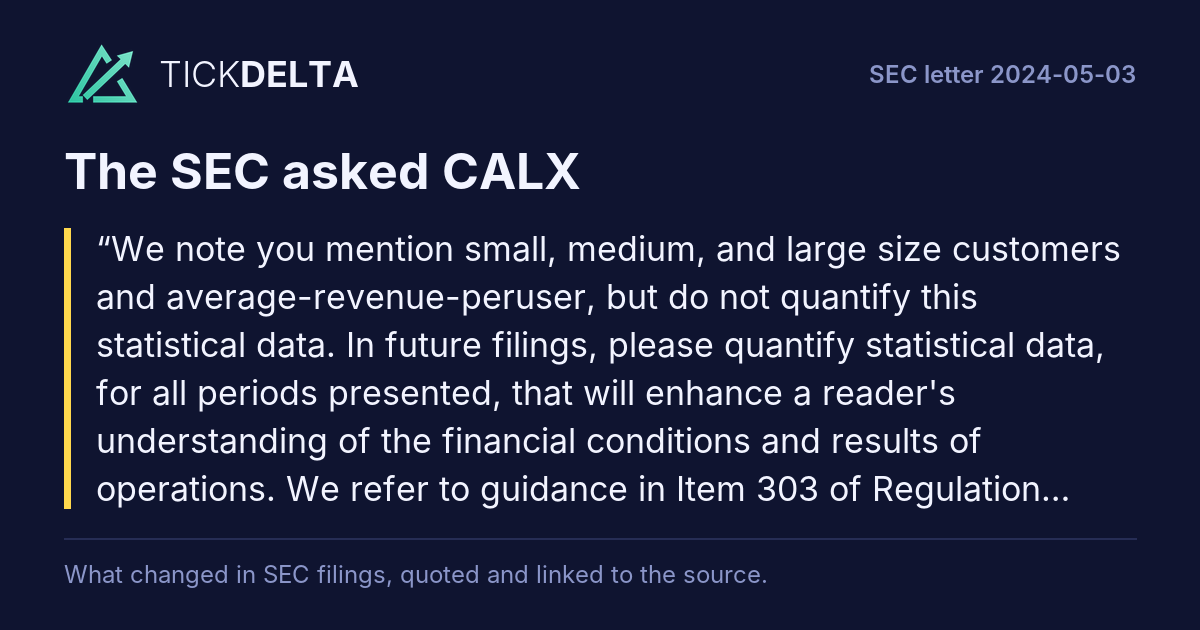
We note you mention small, medium, and large size customers and average-revenue-peruser, but do not quantify this statistical data. In future filings, please quantify statistical data, for all periods presented, that will enhance a reader's understanding of the financial conditions and results of operations. We refer to guidance in Item 303 of Regulation S-K. Provide us with your proposed future disclosure.
The Company acknowledges the Staff’s comment regarding quantifying statistical data and respectfully advises the Staff that, in future filings, we will include revenue data in our revenue discussion for our three customer categories based on the number of subscribers they serve. In addition, the Company respectfully advises the Staff that average-revenue-per-user, or ARPU, is a statistical measure that is used by our customers, but it is not a statistical measure that we use internally to measure revenue or any other financial statement items.Read in the replyRest of the answer
The reference to high ARPU markets is used to describe potential markets where we may expand our business, because our potential BSP customers in these markets would be more likely to use our platform offerings to sell managed services to their subscribers; thereby increasing their ARPU.
Below is an illustrative example of the disclosure the Company would have included in the Revenue section in its Form 10-K for the fiscal year ended December 31, 2023. Future filings will include a similar disclosure as applicable, beginning with the Form 10-Q for the quarterly period ending June 29, 2024.
Revenue
The following table sets forth our revenue by customer size (dollars in thousands):
Our revenue increased by $171.8 million, or 20%, during 2023 compared with 2022. The increase in revenue from large customers was primarily due to strength in shipments to one of our large customers. The increase in revenue from medium customers was primarily due to continued shipments throughout 2023 from a new BSP customer that we added in the third quarter of 2022. The increase in revenue from small customers was as a result of these customers adding subscribers and expanding with our platform and managed services to simplify their operations, excite their subscribers with better experiences and grow their value to the communities they serve.
First report after the company's reply of May 13, 2024: 10-Q filed Jul 23, 2024 ↗, against the 10-Q filed Apr 23, 2024 ↗.
Tickdelta does not hold the text of both reports, so they are not compared here.
Please disclose in your critical accounting policies and estimates disclosure the actual judgements and assumptions used by management. For example, when you have multiple performance obligations you should describe how stand alone selling price was determined for each performance obligation.Rest of the question
For inventory impairment, you should provide more detail and disclose the specific assumptions used when testing inventory for impairment in fiscal year 2022 and 2023. Provide us with your proposed future disclosure.
The Company acknowledges the Staff’s comment and respectfully advises the Staff that, in future filings, it will revise the Critical Accounting Policies and Estimates section to include additional disclosures regarding the judgements and assumptions that underlie the Company’s critical accounting estimates.Read in the replyRest of the answer
Below is an illustrative example of the proposed disclosure the Company plans to include in the Critical Accounting Policies and Estimates section in its Form 10-Q for the quarterly period ending June 29, 2024 and in its future periodic filings, if applicable, with necessary updates to reflect any subsequent changes of facts.
Revenue Recognition
Revenue is recognized when a performance obligation is satisfied, which occurs when control of the promised goods or services is transferred to the customer, in an amount that reflects the consideration we expect to be entitled to in exchange for those goods or services. Revenue from sales of access and premises systems is recognized when control is transferred to the customer, which is generally when the products are shipped. Revenue from software platform licenses, which provides the customer with a right to use the software as it exists, is generally recognized upfront when the license is made available to the customer. Revenue from cloud-based software subscriptions, customer support, maintenance, extended warranty subscriptions and managed services is generally recognized ratably over the contract term. Revenue from professional services and training is recognized as the services are delivered.
A performance obligation is a promise in a contract to transfer a distinct good or service to the customer and is the unit of account. A contract’s transaction price is allocated to each distinct performance obligation and recognized as revenue when, or as, the performance obligation is satisfied. Our hardware products contain both software and non-software components that function together to deliver the products’ essential functionality and therefore constitutes a single performance obligation as the promise to transfer the individual software and non-software components is not separately identifiable and, therefore, not distinct. Cloud-based software subscriptions can include multi-year agreements with a fixed annual fee for a minimum committed usage level. To the extent that minimum committed usage level each year varies, we have concluded that each year represents a distinct stand-ready performance obligation and the transaction price allocated to each performance obligation is recognized as revenue ratably over each annual period.
Our contracts generally include multiple performance obligations. For such arrangements, we allocate the contract’s transaction price to each performance obligation using the relative stand- alone selling price of each distinct good or service in the contract. Observable prices of a product or service when we sell them separately based on stratification by classes of customers and products are the best estimate of stand-alone selling prices. However, when stand-alone selling prices are not directly observable, they are estimated, and judgment is required in their determination. In these instances, we determine stand-alone selling prices using all other available information, which may include pricing practices relative to geographies, market conditions, competitive landscape, characteristics of targeted customers for hardware products, internal costs and gross margin objectives for services and internal costs and value assessments for subscriptions.
Inventory Valuation and Supplier Purchase Commitments
Inventory, which primarily consists of finished goods purchased from CMs or ODMs, is stated at the lower of cost (determined by the first-in, first-out method) and net realizable value. Inbound shipping costs and tariffs are included in the cost of inventory. In addition, from time to time, we procure component inventory primarily as a result of manufacturing discontinuation of critical components by suppliers. Furthermore, as a result of the global pandemic-induced supply chain challenges, we have purchased, and may continue to purchase, excess components from our suppliers and consign components back to our suppliers to be consumed on future finished good builds.
We regularly monitor inventory on-hand and record write-downs for excess and obsolete inventory. These write-downs are based on our assumptions of demand for our products and requires significant judgement of relevant factors including a comparison of the quantity and cost of inventory on hand to our estimated forecast of customer demand, current levels of orders and backlog, market conditions, potential obsolescence of technology, product life cycles and whether pricing trends or forecasts indicate that the carrying value of inventory exceeds our estimated selling price. Factors that could influence management’s assumptions and judgements include changes in economic conditions, competitive dynamics, winning or losing a key customer, changes in our customers’ capital expenditures, government investment programs, technology changes, new product introductions and supply-chain lead times.
We also evaluate our supplier purchase commitments, which remain elevated due to extended lead-times created by pandemic-induced supply-chain challenges, and record a liability for excess and obsolete components consistent with the valuation of our excess and obsolete inventory and future production requirements. For example, during the fourth quarter of 2023, we wrote down excess and obsolete inventory and accrued a liability for components at suppliers primarily related to a pivot in customer demand to our newer all-platform model from our older legacy product family.
Actual demand may differ from forecasted demand and may have a material effect on gross profit. If inventory is written down, a new cost basis is established that cannot be increased in future periods. The sale of previously reserved inventory has not had a material impact on our gross margin.
First report after the company's reply of May 13, 2024: 10-Q filed Jul 23, 2024 ↗, against the 10-Q filed Apr 23, 2024 ↗.
Tickdelta does not hold the text of both reports, so they are not compared here.
We note your disclosure that your revenue increased by $171.8 million, or 20%, during 2023 compared with 2022. You disclose that "the increase in revenue was primarily due to strength in shipments to one of our large customers, continued shipments throughout 2023 from a new medium-sized BSP customer that we added in the third quarter of 2022 and higher revenue from our growing base of small and medium BSPRest of the question
customers." When more than one factor is responsible for the change in an income statement line item, quantify each of the contributing factors, including any offsetting amounts. Please ensure this change is made throughout your MD&A including in your discussion of gross profit and gross margin. Provide us with your proposed future disclosure.
The Company acknowledges the Staff's comment and respectfully advises the Staff that the Company will expand its disclosures in the MD&A to quantify the impact of any two or more factors contributing to material changes in financial statement line items. Below is an illustrative example of the proposed disclosure that the Company would have included in the MD&A section in its Form 10-K for the fiscal year ended December 31, 2023.Read in the replyRest of the answer
Future filings will include a similar disclosure as applicable, beginning with the Form 10-Q for the quarterly period ending June 29, 2024.
The following table sets forth our revenue (dollars in thousands):
Our revenue increased by $171.8 million, or 20%, during 2023 compared with 2022. The increase in revenue from large customers was primarily due to strength in shipments to one of our large customers. The increase in revenue from medium customers was primarily due to continued shipments throughout 2023 from a new BSP customer that we added in the third quarter of 2022. The increase in revenue from small customers was as a result of these customers adding subscribers and expanding with our platform and managed services to simplify their operations, excite their subscribers with better experiences and grow their value to the communities they serve.
Gross Profit and Gross Margin
Gross profit increased by $82.9 million to $518.3 million during 2023 from $435.4 million during 2022. Gross margin decreased to 49.9% during 2023 from 50.2% during 2022. The decrease in gross margin of 30 basis points, compared to the corresponding period in 2022, was mainly due to charges of $28.7 million recorded in the fourth quarter of 2023 as we wrote down obsolete inventory and accrued a liability for components at suppliers primarily associated with our legacy product family that existed before our shift to an all-platform model. During 2023, customers moved to our platform model at a faster rate than originally anticipated, leaving us with excess finished goods and related components at suppliers. This decrease was partially offset by increased contributions from our platform and managed services of $#.# million, a shift in product mix of $#.# million and the sell through of a lower amount of higher priced components acquired in the secondary market due to supply-chain disruptions of $#.# million.
First report after the company's reply of May 13, 2024: 10-Q filed Jul 23, 2024 ↗, against the 10-Q filed Apr 23, 2024 ↗.
Tickdelta does not hold the text of both reports, so they are not compared here.
We note you exclude inventory and component liability charges that occurred during the year ended December 31, 2023 from non-GAAP financial measures. Given the nature of your business, which appears to include customer orders for products and services, it is not clear to us how you determined this non-GAAP adjustment is appropriate and consistent with the requirements of Question 100.01 of the Division ofRest of the question
Corporation Finance’s Compliance & Disclosure Interpretations on Non-GAAP Financial Measures. Although this inventory-write off may be unusual due to its size, based on the nature of this adjustment and your business, it appears to us that risks related to inventory and significant customers are normal operating expenses that arise in the ordinary course of your business. Please advise or revise in future filings. Provide us with your proposed future disclosure.
The Company acknowledges the Staff’s comment and respectfully advises the Staff that it has considered the guidance in Question 100.01 of the Division of Corporation Finance’s Compliance & Disclosure Interpretations on Non-GAAP financial measures (the “Non-GAAP C&DIs”). As appropriate, and through the ordinary course of our business, we record write- downs for excess and obsolete inventory and record liabilities for excess and obsolete components.Read in the replyRest of the answer
As a general matter, we do not include adjustments for routine inventory write-offs and component liability charges in our non-GAAP financial measures, nor do we plan to do so in the future. However, the inventory write-off and component liability charges that we incurred during the year ended December 31, 2023 were non-routine and not recurring in nature, for the reasons described below.
In 2018, the Company began discussing its transformation from a legacy wireline access systems company to a communication cloud and software platform, systems and services business. As the Company made progress on this transformation, it provided data points and evidence to investors. For example, in the fourth quarter of 2022, the Company noted to investors that the legacy business represented less than ten percent of bookings. In the fourth quarter of 2023, with the accelerated move by our customers to the new platforms over the course of 2023, the Company made the decision to write off $28.7 million of inventory and accrued liabilities related to excess components at suppliers was primarily related to this legacy set of products. This decision effectively wound down the legacy products, allowing the Company to fully focus on its platform model. This transformation to the all platform model was major milestone in the Company’s history and is not expected to recur in the foreseeable future. Accordingly, we determined this write-off was not a normal operating expense that is recurring in nature and was not indicative of our ongoing performance. We therefore determined it was appropriate to exclude this item from our non-GAAP financial measures.
First report after the company's reply of May 13, 2024: 10-Q filed Jul 23, 2024 ↗, against the 10-Q filed Apr 23, 2024 ↗.
Tickdelta does not hold the text of both reports, so they are not compared here.
Tell us why you believe litigation settlement is an appropriate non-GAAP adjustment. Refer to your basis in accounting literature.
The Company acknowledges the Staff’s comment and respectfully advises the Staff that it believes the litigation settlement is an appropriate non-GAAP adjustment under the accounting literature, including SEC Final Rule “Conditions for Use of Non-GAAP Financial Measures” (Release 33-8176) and the Non-GAAP C&DIs. This settlement is distinct from recurring expenses incurred in the ordinary course of the Company’s business operations because the amount of the settlement is significant and non-recurring.Read in the replyRest of the answer
We therefore determined it was appropriate to exclude this item from our non-GAAP financial measures.
Item 10(e)(1)(ii)(B) of Regulation S-K prohibits adjusting a non-GAAP performance measure to eliminate or smooth items identified as non-recurring, infrequent or unusual, when the nature of the charge or gain is such that it is reasonably likely to recur within two years or there was a similar charge or gain within the prior two years. The litigation settlement is separate and distinct from legal matters that are recurring or reasonably likely to recur within two years in the course of the Company’s business operations, consistent with Item 10(e) and C&DIs 100.01, 100.03 and 102.03. In contrast, the Company does occasionally have intellectual property disputes, and does not adjust any of its non-GAAP financial measures for expenses related to routine settlements in these matters.
The Company did not adjust any of the ordinary course, recurring legal expenses related to the legal matter giving rise to the litigation settlement that was the subject of the non-GAAP adjustment referenced in the Staff’s comment because those expenses continued and were expected to continue over time. The related litigation that resulted in the settlement was not routine in its nature, and the magnitude of the litigation settlement was unexpected and discrete and not expected to recur.
For these reasons, the Company does not consider the expenses incurred in connection with the litigation settlement as normal, recurring, cash operating expenses and, therefore, believes that excluding this item from our non-GAAP financial measures is meaningful and appropriate in evaluating the Company’s operations and not misleading to investors.
First report after the company's reply of May 13, 2024: 10-Q filed Jul 23, 2024 ↗, against the 10-Q filed Apr 23, 2024 ↗.
Tickdelta does not hold the text of both reports, so they are not compared here.
From your response to prior comment 4, we note that the non-GAAP adjustment for inventory and component liability charges related to the accelerated move by your customers to your new platforms. Please tell us more about the business transformation noted in your response and explain how it led to the decision to write off $28.7 million of inventory and accrued liabilities related to excess components in the fourthRest of the question
quarter of 2023. In addition, describe the nature of these excess components and explain in greater detail how you determined that the amount written-off was not a normal operating expense incurred in the ordinary course of your business. Refer to Question 100.01 of the Division of Corporation Finance’s Compliance & Disclosure Interpretations on Non- GAAP Financial Measures.
The Company acknowledges the Staff’s comment and respectfully advises the Staff that the Company does not consider this inventory write-off adjustment to arise in the ordinary course of its business. Instead, the Company has been in the process of transforming its business from a legacy wireline access systems company to a communications cloud and software platform, systems and managed services business. As this inventory write-off adjustment related primarily to legacy wireline access systems and the unique components thereof, it is unrelated to the go-forward operating model.Read in the replyRest of the answer
As such, we respectfully submit that the inventory write-off adjustment is appropriate and helpful to investors in understanding the results of operations of the Company in its current operating model without the impact of winding down the legacy wireline access systems business.
As background, over the past six years, the Company has undergone a transformation from a legacy wireline access systems company to a communications cloud and software platform, systems and managed services business. At the core of this transformation was the development of a stateful, fully-abstracted, multi-binary operating system combined with a cloud architecture allowing the Company’s customers to reduce their operating costs, increase their average revenue per user, improve subscriber experiences and increase their Net Promoter Scores. Over this period of time, the Company also saw profound changes in its business as the transformation took effect. Revenue more than doubled from $510 million in 2017 to $1,040 million in 2023. Gross margin increased from 34% in 2017 to 50% in 2023. The Company replaced over 75% of the workforce as of December 31, 2017 with employees having skills appropriate for the go-forward model, outsourced hardware development to its original design manufacturer (ODM) partners, reduced SKUs from over 3,500 to less than 200 and began updating its platform, cloud and managed services on a 91-day cadence.
With its inaugural stockholder letter covering its first quarter of 2018 results, furnished as Exhibit 99.2 to its Current Report on Form 8-K filed with the Commission on May 8, 2018, the Company disclosed the following:
“The End of One Era and the Beginning of Another. We have discussed the transformation of Calix from a legacy wireline access systems company to a communications cloud and software platform, systems and services business. With the announcement of EXOS at our 2017 flagship conference, ConneXions, we signaled a significant step in our transformation. Going forward, our focus will be on our platforms; Calix Cloud, EXOS and AXOS. Our platforms provide our customers with the ability to transform their networks and their business models. We benefit from this transformation as well, as we expect that our
Confidential Treatment Requested by Calix, Inc. pursuant to 17 CFR 200.83 (CALX-02) platforms will expand our total addressable market dramatically, drive higher overall margins, and enable us to reduce our operating expenses. Furthermore, this focus will afford us opportunities to streamline our business. During the quarter, we took a step in this direction when we sold our outdoor cabinet product line to Clearfield.”
As time went on, the Company provided periodic milestones on how much of the business had shifted from the legacy product set to the new platform business. On July 27, 2021, the Company shared with investors in its quarterly earnings call the following:
“The second quarter saw the Calix team achieve a number of milestones on our march to an all-platform world. On a wave of continued strong demand, for the first time, our All Platform offerings, software and the associated systems and services were greater than 50% of our bookings. We expect this trend to continue.”
In its stockholder letter for the second quarter of 2022, furnished as Exhibit 99.2 to its Current Report on Form 8-K filed with the Commission on July 25, 2022, the Company disclosed the following:
“For the second quarter of 2022, the Calix team executed with excellence as we delivered record quarterly revenue despite the ongoing global supply challenge. Moreover, the power of our All Platform model continued to drive robust demand in the form of strong bookings and an acceleration in our transformation. Demand for our All Platform software, systems and services comprised more than 80% of our total bookings in the quarter, up from 70% just one quarter ago.”
In its stockholder letter for the fourth quarter of 2022, furnished as Exhibit 99.2 to its Current Report on Form 8-K filed with the Commission on January 25, 2023, the Company disclosed the following:
“For the fourth quarter of 2022, the Calix team executed with excellence as we delivered record quarterly revenue, representing 39% year-over-year growth, and completed our third consecutive year of greater than 25% annual revenue growth despite the ongoing global supply challenge. Moreover, the power of our platform and managed services model continued to drive strong demand. Our platform and managed services model comprised more than 90% of bookings in the quarter completing our transformation to a platform company, and going forward, we will no longer cite this percentage.”
The Company respectfully advises the Staff that bookings is a leading indicator on the Company’s business, and revenue from the legacy wireline access systems product set was expected to continue for years, albeit at a declining percentage of total revenue. Therefore, the Company planned to maintain the components of these systems in inventory to continue this
Confidential Treatment Requested by Calix, Inc. pursuant to 17 CFR 200.83 (CALX-03) portion of its business. It is important to note that products sold into access networks have long product life cycles, and it is common for equipment to be in service for a decade or more.
In the fourth quarter of 2023, Calix’s management made the decision to accelerate the end of life the remaining legacy product set in order to focus solely on its platform, cloud and managed service business. This decision was made in part because customers migrated to the new platform model at a faster than expected rate. In addition, the Company’s forecast for 2024 revenue was materially lower than previously expected. The combination of these factors had an impact on our expected future demand for this legacy product set and on our evaluation of inventory and supplier commitments, resulting in the conclusion that we needed to write down $28.7 million of inventory and accrued liabilities related to excess components at suppliers.
The nature of the excess components are items used to build finish good inventory for the legacy product set, which includes items such as printed circuit boards, semiconductors, power supplies, chassis, optics, cables, etc. Please note that the legacy product set has been in market for over six years. Meaning these product designs are old and use components that were designed over six years ago and have no alternative future use.
In your response to our prior comment 4 you state, "the Company made the decision to write off $28.7 million of inventory." It is not clear to us how you can decide to impair inventory. Please provide us with your inventory impairment analysis. Also, explain to us how you tested inventory for impairment in prior periods.
The Company acknowledges the Staff’s comment and respectfully advises the Staff that the Company concluded based on our net realizable analysis that it needed to write down $28.7 million of inventory and accrued liabilities related to excess components at suppliers. The word choice of “decide” was not precise enough.Read in the replyRest of the answer
The Company decided to accelerate the end of life of its legacy product set, which, combined with other factors as described above, resulted in the unfavorable net realizable analysis.
The Company further respectfully advises the Staff that it regularly analyzes inventory for impairment and concludes at each reporting period the appropriate value of inventory based on the lower of cost or net realizable value. The analysis of the net realizable value of the Company’s inventory is based on the Company’s assumptions of demand for its products and requires significant judgement of relevant factors including a comparison of the quantity and cost of inventory on hand to the Company’s estimated forecast of customer demand, current levels of orders and backlog, market conditions, potential obsolescence of technology, product life cycles and whether pricing trends or forecasts indicate that the carrying value of inventory exceeds the Company’s estimated selling price. Factors that could influence the Company’s assumptions and judgements include changes in economic conditions, competitive dynamics, winning or losing a key customer, changes in the Company’s customers’ capital expenditures, government
Confidential Treatment Requested by Calix, Inc. pursuant to 17 CFR 200.83 (CALX-04) investment programs, technology changes, new product introductions and supply-chain lead times.
The analysis of net realizable value for the Company’s finished goods inventory is product specific. If based on the factors described above the Company determines a write-down is necessary, then the Company records a reserve on that specific product. When specific inventory is written down, it then has a new cost basis that subsequently cannot be marked up. The analysis also addresses the Company’s raw material inventory and supplier purchase commitments using the factors described above to identify any components that need to have their value written down as they will not be used in a finished good. The Company’s inventory could be written down to zero, partially written down or have no write-down depending on the conclusion of the Company.
Your response to prior comment 5 explains that the non-GAAP litigation settlement adjustment was not routine in nature and its magnitude was unexpected and discrete and not expected to recur. Please tell us about the legal matter that gave rise to the litigation settlement and summarize the terms of the settlement.Rest of the question
In addition, further explain your determination that the amount recognized for the settlement was not a normal, recurring, cash operating expense.
The Company respectfully acknowledges the Staff’s comment and advises the Staff on a confidential basis with respect to the litigation that gave rise to the settlement that was the subject of the referenced non-GAAP litigation settlement adjustment.Read in the reply
[***]
The Company notes that legal costs that are determined to be normal, recurring, cash operating expenses necessary to operate the Company’s business have not been, and will not be, excluded from the Company’s non-GAAP financial measures.Rest of the answer
Indeed, notwithstanding incurring considerable legal expenses over the course of its multi-year defense in the referenced litigation, the Company did not exclude these litigation-related expenses from its non-GAAP financial measures. Nonetheless, given the discrete nature of the referenced litigation, the complex nature of the claims that were the subject of the dispute, the timing and likely magnitude of the expected defense costs to proceed to trial, the risk of being held liable for reimbursement of some amount of plaintiff’s own considerable legal expenses and the expectation that no similarly-sized litigation settlements are likely to occur in the next two years, the Company respectfully advises the Staff that it believes that excluding this settlement amount arising from the referenced litigation from our non-GAAP financial measures was meaningful and appropriate in evaluating the Company’s operations, and not misleading to investors.
We note your response to prior comment 1. As the write-off of inventory and accrued liabilities related to excess components at suppliers related to your legacy product set appears to be a normal, recurring operating expense, please remove the non-GAAP adjustment for Inventory and component liability charges.Rest of the question
Refer to Question 100.01 of the Division of Corporation Finance’s Compliance & Disclosure Interpretations on Non- GAAP Financial Measures.
The Company respectfully advises the Staff that, in future filings, we will remove the non-GAAP adjustment for inventory and component liability charges related to our legacy product set.Read in the reply
Also in this review: closing letter, 2024-07-24