Form 10-K for the fiscal year ended December 31, 2023
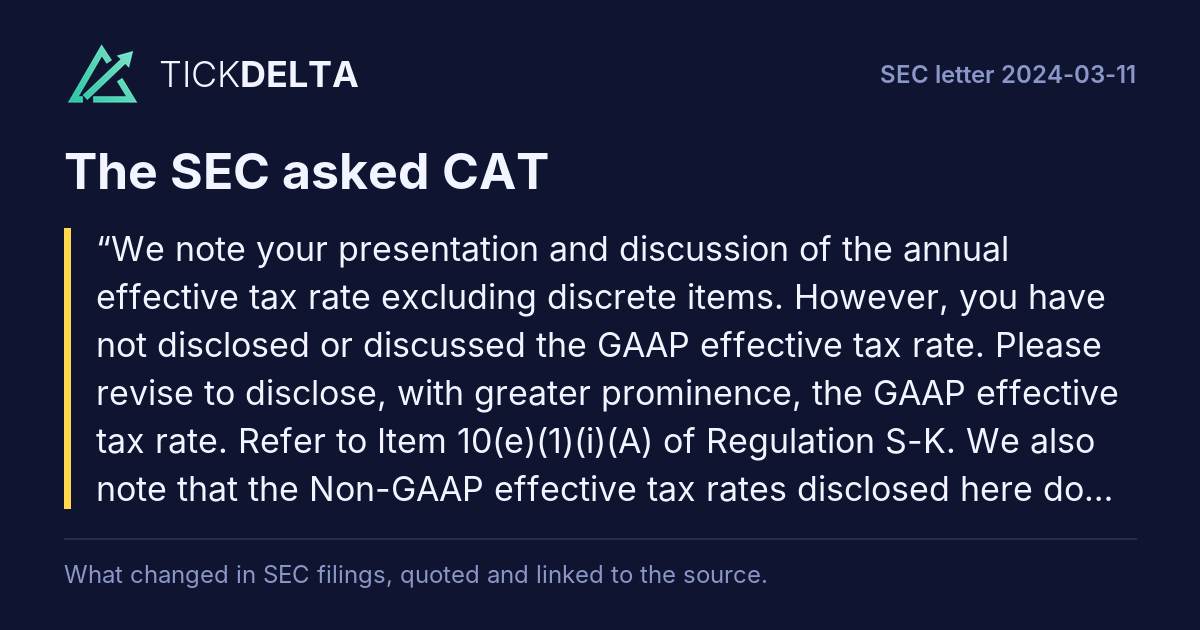
We note your presentation and discussion of the annual effective tax rate excluding discrete items. However, you have not disclosed or discussed the GAAP effective tax rate. Please revise to disclose, with greater prominence, the GAAP effective tax rate. Refer to Item 10(e)(1)(i)(A) of Regulation S-K.Rest of the question
We also note that the Non-GAAP effective tax rates disclosed here do not agree to the Non-GAAP effective tax rates disclosed in the reconciliation on page 47. Please advise.
We respectfully acknowledge the Staff’s comment regarding the GAAP effective tax rate. Beginning with the Management’s Discussion and Analysis included in our Form 10-Q for the quarter ending March 31, 2024, the Company will disclose the GAAP effective tax rate in an introductory sentence to the discussion of our provision for income taxes in accordance with Item 10(e)(1)(i)(A) of Regulation S-K.
Further, we will provide a reconciliation of our GAAP effective tax rate to our annual effective tax rate, excluding discrete items, in accordance with Item 10(e)(1)(i)(B) of Regulation S-K, alongRead in the reply ↗Rest of the answer
with the other disclosures required by Item 10(e) of Regulation
S-K.
In addition, we acknowledge the Staff’s comments regarding the disagreement between the effective tax rate measures disclosed in the discussion on page 33 of the 2023 Form 10-K (i.e., the annual effective tax rate, excluding discrete items) and the reconciliation table on page 47 of the 2023 Form 10-K (i.e., our adjusted effective tax rate). We respectfully advise the Staff that the discrete items disclosed on page 33 were determined based on the guidance in ASC 740-270-25, while the adjustments in the reconciliation table on page 47 were determined by management in compliance with the framework prescribed in Item 10(e)(1)(i) of Regulation S-K.
The adjustments reflected in the non-GAAP reconciliation table may differ from the discrete items that are excluded from our annual effective tax rate and accordingly, the calculated tax rate in the last row of the reconciliation table (i.e., our adjusted effective tax rate) often has not equaled the annual effective tax rate, excluding discrete items. As the Company does not use the adjusted effective tax rate disclosed on page 47 for any analysis or discussion purposes and in response to the Staff’s comment, in future filings, we will update the reconciliation table to omit the column presenting the adjusted effective tax rate, such that the only adjusted tax rate measure we present will be our annual effective tax rate, excluding discrete items, as discussed above.
First report after the company's reply of 2024-03-22: 10-Q filed 2024-05-01 ↗, against the 10-Q filed 2023-11-01 ↗.
Tickdelta does not hold the text of both reports, so they are not compared here.
Your discussion of segment profit for each of your segments beginning on page 33 refers to various factors that impacted segment operations; however, you do not quantify the impact of these factors. For example, you state that the increase in Resource Industries operating profit was due to favorable price realization, partially offset by lower sales volume.Rest of the question
You also disclose that the increase in Energy & Transportation’s profit was mainly due to favorable price realization and higher sales volume, partially offset by unfavorable manufacturing costs and higher SG&A/R&D expenses. Where a material change is due to two or more factors, please revise to provide a quantified discussion of the various factors impacting such change. Refer to Item 303(b) of Regulation S-K.
We respectfully acknowledge the Staff’s comment. Beginning with our Form 10-Q for the quarter ending March 31, 2024, we will revise our disclosure to expand our discussion and analysis to include both qualitative and quantitative factors that result in material changes to the Company’s segment profit to the extent such information is appropriate to enhance readers’ understanding of the magnitude and relative impact of each factor. Read in the reply ↗
First report after the company's reply of 2024-03-22: 10-Q filed 2024-05-01 ↗, against the 10-Q filed 2023-11-01 ↗.
Tickdelta does not hold the text of both reports, so they are not compared here.
We note your disclosure of consolidated net worth, covenant interest coverage ratio, and covenant leverage ratio which are non-GAAP measures. Please revise to provide the disclosures required by Item 10(e)(1)(i) of Regulation S-K.
The Company has historically presented its consolidated net worth, covenant interest coverage ratio and covenant leverage ratio (collectively, the “Covenants”) in the “Liquidity and Capital
Resources” section of its Management’s Discussion and Analysis disclosures. The Company provides this information not to demonstrate the Company’s performance, but rather to comply with Item 303(b)(1) of Regulation S-K, which requires registrants to “identify any known trends or any known demands, commitments, events or uncertainties that will result in or that are reasonably likely to result in theRead in the reply ↗Rest of the answer
registrant’s liquidity increasing or decreasing in any material way.”
We further respectfully direct the Staff’s attention to Question
102.09 of the Staff’s Compliance & Disclosure Interpretations regarding Non-GAAP Financial Measures (“Question 102.09”), in which the Staff makes clear that, notwithstanding the prohibitions set forth in Item 10(e) of Regulation S-K, if a registrant believes that (a) a credit agreement is a material agreement, (b) a covenant thereunder is a material term of the credit agreement and (c) information about such covenant is material to an investor’s understanding of the registrant’s financial condition and/or liquidity, then the registrant may in fact “be required to disclose the measure as calculated by the debt covenant as part of its MD&A.” (emphasis added) As demonstrated by the disclosures on pages 37-38 of the Company’s 2023
Form 10-K, each of the foregoing conditions has been met, which compels disclosure of the Covenants.
Importantly, both Regulation G and Item 10(e) of Regulation S-K specifically exclude from the definition of “non-GAAP financial measure” any measure that is “required to be disclosed by … Commission rules.” In light of the guidance reflected in Question 102.09 and the disclosure framework set forth in Item 303(b)(1) of Regulation S-K, we respectfully submit that disclosure of the Covenants is a required element of the Company’s periodic reports. Accordingly, the Covenants are not, by definition, “non-GAAP financial measures”, and disclosure of such Covenants in the “Liquidity and Capital Resources” section of the Company’s Management’s Discussion and Analysis should not be subject to the general prohibitions and requirements related to non-GAAP financial measures set forth in Regulation G and
Item 10(e) of Regulation S-K.
Notwithstanding the foregoing, we will enhance our disclosures in future filings, starting with our Form 10-Q for the quarter ending March 31, 2024, to make clear that the Covenants are being reported as calculated under the Credit Facility (as defined in the 2023 Form 10-K) and not pursuant to GAAP and to refer to the agreements governing the Credit Facility attached as exhibits to our periodic reports for further information related to the calculations thereof.
First report after the company's reply of 2024-03-22: 10-Q filed 2024-05-01 ↗, against the 10-Q filed 2023-11-01 ↗.
Tickdelta does not hold the text of both reports, so they are not compared here.
Please revise to remove consolidated net worth, covenant interest coverage ratio, and covenant leverage ratio from the footnotes as the disclosure of non-GAAP measures in the financial statements or footnotes is prohibited. Refer to Item 10(e)(1)(ii)(C) of Regulation S-K.
The Company respectfully acknowledges the Staff’s comment and will update future annual reports, beginning with the Form 10-K for the fiscal year ended December 31, 2024, to exclude consolidated net worth, covenant interest coverage ratio, and covenant leverage ratio from the notes to the consolidated financial statements.
* * * * *
If you need any further information, please contact William E.Read in the reply ↗Rest of the answer
Schaupp,
Vice President and Chief Accounting Officer by phone at (303) 675-1000 or by email at Bill.Schaupp@cat.com or Nicole Puza, Corporate Securities
Counsel and Corporate Secretary by phone at (224) 551-4291 or by email at Puza_Nikki@cat.com.
First report after the company's reply of 2024-03-22: 10-Q filed 2024-05-01 ↗, against the 10-Q filed 2023-11-01 ↗.
Tickdelta does not hold the text of both reports, so they are not compared here.
Also in this review: closing letter, 2024-04-01