Screener / SEC EDGAR /CIK 0000944148 /10-K filed Feb 26, 2026, compared with Feb 28, 2025 /Numbers from the XBRL of the 10-Ks
NYSE Industrials · Business Services

CBIZ, Inc. CBZ

Compare with peers Embed
SEC comment letters, last 20 years

3 reviews of CBZ's filings by SEC staff

UPLOAD and CORRESP
Reviews 3 latest letter Aug 18, 2021
Questions asked 13 each answered in the company's own letter
No closing letter 0 reviews without a letter saying the staff completed it

When the SEC's staff reviews a filing, it writes to the company with numbered questions, and the company answers each one in a letter. SEC publishes the exchange once the review is over, at least 20 business days later. A question is not an accusation; most reviews end with the company adding detail to its next filing.

How the reviews went

Every review on EDGAR, from the first staff letter to the letter that closes it

  1. 1. Staff letters 4 UPLOAD
  2. 2. Questions in them 13 numbered comments
  3. 3. Company replies 4 CORRESP
  4. 4. Reviews closed 3 of 3 closing letter

Half the closed reviews took 41 days or less from the first letter to the closing letter.

Form 10-K

2021-08-18 to 2021-09-01 · 2 questions · 1 letter from the SEC, 1 from the company
Review closed 2021-09-01
SegmentsResults discussion (MD&A)Non-GAAP measuresIncome taxes
Item 7. Management's Discussion and Analysis · Operating Practice Groups, page 25
SEC asked (1)
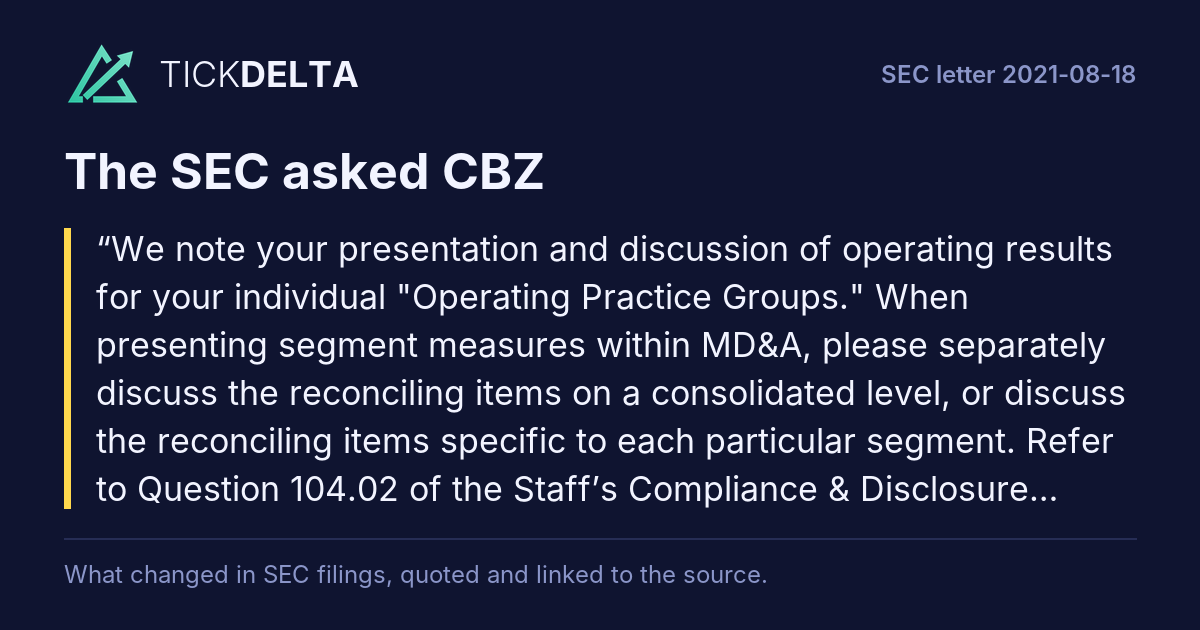
We note your presentation and discussion of operating results for your individual "Operating Practice Groups." When presenting segment measures within MD&A, please separately discuss the reconciling items on a consolidated level, or discuss the reconciling items specific to each particular segment.
Rest of the question

Refer to Question 104.02 of the Staff’s Compliance & Disclosure Interpretations ("C&DIs") on Non-GAAP Financial Measures.

CBZ answered
The Company acknowledges the Staff’s comment and advises the Staff that when the Company updates the MD&A disclosure contained in its Annual Reports on Form 10-K and Quarter Reports on Form 10-Q as indicated in the response below to the Staff’s second comment, the Company will provide a discussion of the reconciling items on a consolidated level.
Read in the reply
In its next report

First report after the company's reply of Aug 27, 2021: 10-Q filed Oct 29, 2021 ↗, against the 10-Q filed Jul 30, 2021 ↗.

Tickdelta does not hold the text of both reports, so they are not compared here.

Item 7. Management's Discussion and Analysis · Operating Practice Groups, page 25
SEC asked (2)
Please provide a discussion of segment profitability that is consistent with your ASC 280 disclosure. In this regard, we note the measure of segment results presented in MD&A in the Form 10-K for the period ended December 31, 2020 appears to be gross margin; however, per Footnote 21, performance of the practice groups is evaluated on operating income.
Rest of the question

We also note in Footnote 12 in the Form 10-Q for the interim period ended June 30, 2021 that performance of the practice groups is evaluated on income (loss) from continuing operations before income tax expense (benefit). Please advise. We remind you that the company and its management are responsible for the accuracy and adequacy of their disclosures, notwithstanding any review, comments, action or absence of action by the staff.

CBZ answered
The Company acknowledges the Staff’s comment and advises the Staff that the Company evaluates the performance of the practice groups on the basis of income (loss) from continuing operations before income tax expense (benefit). The ASC 280 disclosure contained in each of the Company’s Annual Report on Form 10-K for the fiscal year ended December 31, 2020 and the Company’s Form 10-Q for the fiscal quarter ended June 30, 2021 provides segment information for income (loss) from continuing operations before income tax expense, which is consistent with manner in which these segments are evaluated.
Rest of the answer

In future filings, the Company will ensure that the disclosure clearly indicates that the performance of the practice groups is evaluated on income (loss) from continuing operations before income tax expense (benefit). Additionally, the Company will provide a discussion of segment profitability in the MD&A section of the Company’s Annual Reports on Form 10-K and Quarterly Reports on Form 10-Q that is consistent with the Company’s ASC 280 disclosure.

Read in the reply
In its next report

First report after the company's reply of Aug 27, 2021: 10-Q filed Oct 29, 2021 ↗, against the 10-Q filed Jul 30, 2021 ↗.

Tickdelta does not hold the text of both reports, so they are not compared here.

Also in this review: closing letter, 2021-09-01
Form 10-K for the Fiscal Year Ended December 31, 2017

2018-11-08 to 2018-12-19 · 7 questions · 2 letters from the SEC, 2 from the company
Review closed 2018-12-19
RevenueSegmentsResults discussion (MD&A)
Notes to the Condensed Consolidated Financial Statements · Note 3. Revenue, page 12
SEC asked (1)
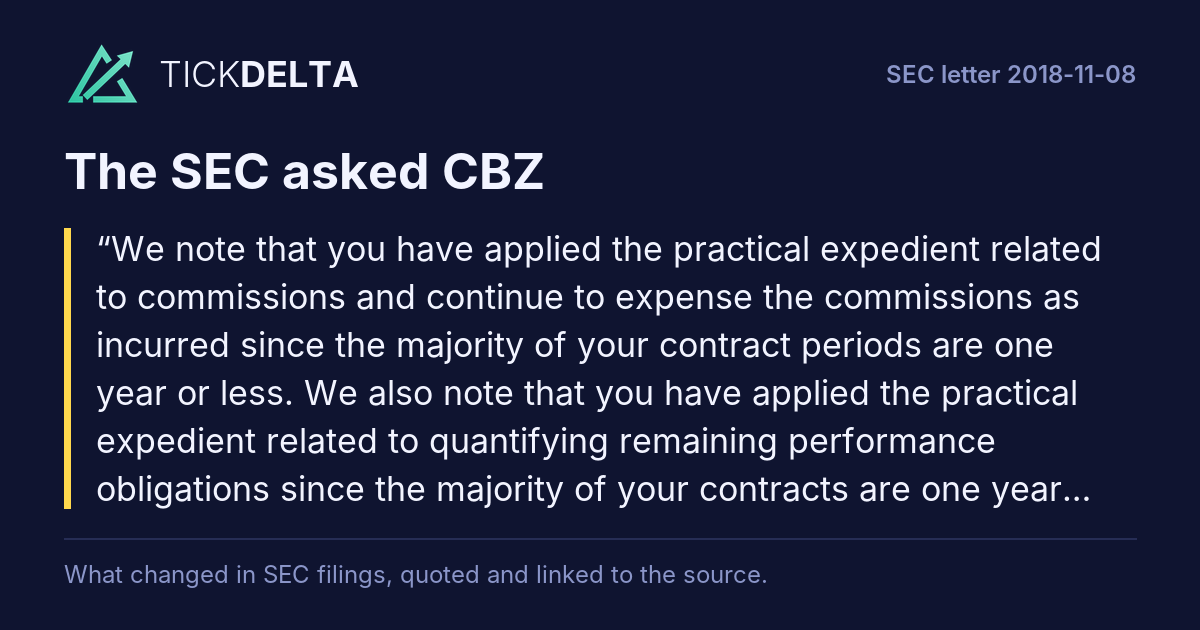
We note that you have applied the practical expedient related to commissions and continue to expense the commissions as incurred since the majority of your contract periods are one year or less. We also note that you have applied the practical expedient related to quantifying remaining performance obligations since the majority of your contracts are one year or less.
Rest of the question

Please tell us if you have applied these practical expedients to contracts with terms in excess of one year and, if so, how your application of these practical expedients is consistent with ASC 340-40-25-4 and ASC 606-10-50-14.

CBZ answered
1a: The Company’s Benefit and Insurance Services practice group pays commissions monthly and requires the recipient of the commission to be employed by the Company at the time of payment. Accordingly, the Company does not consider these commissions to be incremental costs of obtaining the customer contract and consequently a contract acquisition cost is not recognized for those commissions.
Rest of the answer

The practical expedient related to costs to obtain a contract is not relevant to the Company as these commissions are not incremental costs of obtaining a contract as defined by ASC 606-10-15-5 and ASC 340-40-15-2. The Company will eliminate the footnote disclosure regarding this practical expedient in future filings.

Response 1b: The Staff noted that the Company has applied the practical expedient related to quantifying remaining performance obligations since the majority of the Company’s contracts have an original specified duration of one year or less. The Staff questioned if the Company has applied the practical expedient to contracts with terms in excess of one year.

•

Certain contract periods related to the Company’s government healthcare consulting, group health and benefits consulting, and property and casualty insurance businesses have an original specified contract duration in excess of one year, however, the agreements provide the Company and the client with the right to cancel or terminate the contract with no substantial penalty.

With regard to the quantification and disclosure of outstanding performance obligations, the Company has applied the provisions of ASC 606-10-25-4 and the FASB Transition Resource Group memo number

10-14, and notes that the definition of contract duration does not extend beyond the goods and services already transferred for contracts that provide both the Company and the client with the right to cancel or terminate the contract with no substantial penalty.

To provide further clarification, the Company will enhance the footnote disclosure in future filings to clarify that the Company does not disclose the value of unsatisfied performance obligations for contracts with an original specified duration in excess of one year due to the Company and the client both having the right to cancel or terminate the contract with no substantial penalty.

Read in the reply
In its next report

First report after the company's reply of Nov 28, 2018: 10-K filed Feb 28, 2019 ↗, against the 10-K filed Mar 1, 2018 ↗.

Tickdelta does not hold the text of both reports, so they are not compared here.

Notes to the Condensed Consolidated Financial Statements · Note 3. Revenue, page 12
SEC asked (2)
You disclose that revenue from fixed-fee arrangements in the financial services segment is measured in hours worked and anticipated realization. Please explain to us what you mean by “anticipated realization” and how it impacts your accounting for these arrangements.
CBZ answered
2: The Company’s Financial Services practice group recognizes revenue from fixed-fee contracts as the performance obligations are met. The fixed fee divided by the product of the hours anticipated to complete a performance obligation and the standard billing rate is the anticipated realization rate. Anticipated realization rates are applied to hours charged to a contract when recognizing revenue.
Rest of the answer

At the end of each reporting period, the Company evaluates the work performed to date to ensure that the amount of revenue recognized in each reporting period for the client arrangement is equal to the performance obligations met. To provide further clarification, the Company will enhance the footnote disclosure in future filings to clarify the above definition of anticipated realization.

Read in the reply
In its next report

First report after the company's reply of Nov 28, 2018: 10-K filed Feb 28, 2019 ↗, against the 10-K filed Mar 1, 2018 ↗.

Tickdelta does not hold the text of both reports, so they are not compared here.

Notes to the Condensed Consolidated Financial Statements · Note 3. Revenue, page 12
SEC asked (3)
Please explain your outcome-based arrangements within the financial services segment and how you account for them. Refer to the authoritative guidance you relied upon.
CBZ answered
3: Certain arrangements within the Company’s Financial Services practice group are dependent upon the successful completion of contractually defined outcomes that are typically event-based (client recovery for excessive tax payments or the completion of a transaction, such as the sale of a business). The Company applied the guidance of ASC 606-10-32-5 through

32-14 in determining the appropriate accounting for these outcome-based arrangements.
Rest of the answer

Prior to recognizing revenue, the Company estimates the transaction price, including variable consideration that is subject to a constraint based on risks specific to the arrangement. The Company evaluates the estimate in each reporting period and recognizes revenue to the extent it is probable that a significant reversal of revenue will not occur. To provide further clarification, the Company will enhance the footnote disclosure in future filings to clarify the outcome-based arrangements in the Company’s Financial Services practice group.

Read in the reply
In its next report

First report after the company's reply of Nov 28, 2018: 10-K filed Feb 28, 2019 ↗, against the 10-K filed Mar 1, 2018 ↗.

Tickdelta does not hold the text of both reports, so they are not compared here.

Notes to the Condensed Consolidated Financial Statements · Note 3. Revenue, page 12
SEC asked (4)
Please tell us and disclose, if material, the amount of investment income revenue that is outside the scope of ASC 606. Refer to ASC 606-10-50-4(a).
CBZ answered
4: Investment income only relates to the Company’s client payroll funds and has historically represented less than one quarter of one percent of the Company’s consolidated revenue, which is not material. The Company will monitor the materiality of investment income and the relevant disclosures will be included in future filings if the amounts become material.
Read in the reply
In its next report

First report after the company's reply of Nov 28, 2018: 10-K filed Feb 28, 2019 ↗, against the 10-K filed Mar 1, 2018 ↗.

Tickdelta does not hold the text of both reports, so they are not compared here.

Notes to the Condensed Consolidated Financial Statements · Note 3. Revenue, page 12
SEC asked (5)
You disclose that advisory revenue is recognized when the quarterly data becomes available. Please explain for basis for recognizing revenue when the data becomes available and refer to the authoritative guidance that supports your accounting.
Rest of the question

In closing, we remind you that the company and its management are responsible for the accuracy and adequacy of their disclosures, notwithstanding any review, comments, action or absence of action by the staff.

CBZ answered
5: Certain advisory services revenue is variable and calculated based upon the value of the assets under management, as provided by a third party, multiplied by an agreed upon rate. In accordance with ASC 606-10-55-221 through 55-225, advisory services revenue is recognized as the services are performed over time. Advisory services revenue is calculated monthly or quarterly based on the estimated value of assets under management, as it is earned over the duration of the reporting period and relates to performance obligations satisfied during that period.
Rest of the answer

The variability related to the estimated asset values used to recognize revenue during the reporting period is resolved and the amount of related revenue recognized is adjusted when the actual value of assets under management is provided.

Read in the reply
In its next report

First report after the company's reply of Nov 28, 2018: 10-K filed Feb 28, 2019 ↗, against the 10-K filed Mar 1, 2018 ↗.

Tickdelta does not hold the text of both reports, so they are not compared here.

Notes to the Condensed Consolidated Financial Statements · Note 3. Revenue, page 12
SEC asked (1)
We note from your response to prior comment 1 that you do not consider your Benefit and Insurance Services practice group’s commissions to be incremental costs of obtaining a contract. Please tell us how you arrived at this conclusion. Refer to ASC 340-40-25-2.
Rest of the question

In addition, tell us the total amount of commissions expense recorded for contracts with terms in excess of one year during the nine months ended September 30, 2018.

CBZ answered
1a: The Company acknowledges the Staff’s comments. ASC 340-40-25-2 states that the incremental costs of obtaining a contract are those that an entity incurs to obtain a contract with a customer that it would not have incurred if the contract had not been obtained (for example, a sales commission), but as discussed in the FASB Transition Resource Group memo number 57-16, there could be other fact patterns that need to be considered within different commission plans that affect the determination of whether the costs are incremental to obtaining the contract.

•

As noted in our previous
Rest of the answer

response, the Company pays commissions monthly over the term of the underlying contract and requires the recipient of the commission to be employed by the Company at the time of payment (i.e. service vesting condition). Failure to remain employed at the date the commission is payable results in the forfeiture of commissions that would otherwise be due. Therefore, the Company has determined that the requirement of continued employment is substantive and accordingly does not consider such commissions to be incremental costs of obtaining the contract. As a result, a contract acquisition asset is not recognized for such commissions.

Response 1b: As noted in our previous response, the majority of the Company’s contracts have an original specified duration of one year or less. Certain contracts related to the Company’s group health and benefits consulting and property and casualty insurance businesses have an original specified contract duration in excess of one year.

The total amount of commissions expense recorded for contracts with terms in excess of one year during the nine months ended September 30, 2018 was approximately two hundred sixty thousand dollars.

Read in the reply
In its next report

First report after the company's reply of Dec 18, 2018: 10-K filed Feb 28, 2019 ↗, against the 10-K filed Mar 1, 2018 ↗.

Tickdelta does not hold the text of both reports, so they are not compared here.

Notes to the Condensed Consolidated Financial Statements · Note 3. Revenue, page 12
SEC asked (2)
We note your response to prior comment 5. Please revise in future filings to disclose that advisory services revenue is calculated on the estimated value of assets under management and is adjusted when the actual value is provided.
CBZ answered
2: The Company acknowledges the Staff’s comment. The Company will enhance the footnote disclosure related to advisory services revenue in future filings.
Read in the reply
In its next report

First report after the company's reply of Dec 18, 2018: 10-K filed Feb 28, 2019 ↗, against the 10-K filed Mar 1, 2018 ↗.

Tickdelta does not hold the text of both reports, so they are not compared here.

Also in this review: request for more time, Nov 13, 2018, closing letter, 2018-12-19

Form 10-K for the fiscal year ended December 31, 2015

2016-06-08 to 2016-08-16 · 4 questions · 1 letter from the SEC, 1 from the company
Review closed 2016-08-16
Non-GAAP measuresResults discussion (MD&A)Income taxes
Item 6. Selected Financial Data, page 22
SEC asked (1)
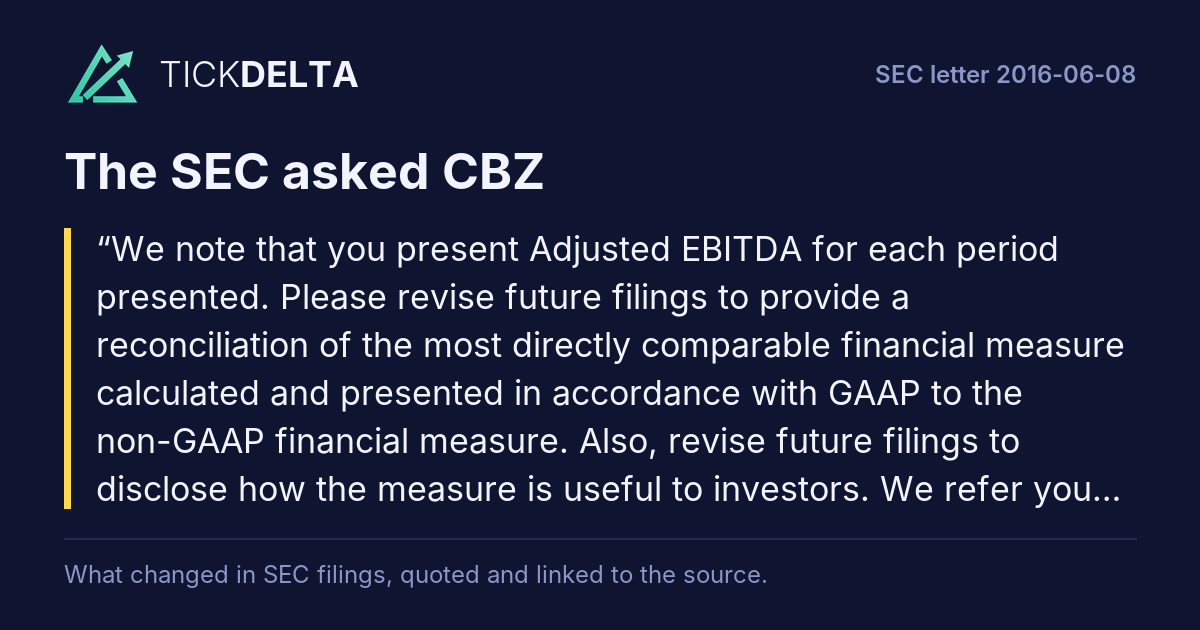
We note that you present Adjusted EBITDA for each period presented. Please revise future filings to provide a reconciliation of the most directly comparable financial measure calculated and presented in accordance with GAAP to the non-GAAP financial measure. Also, revise future filings to disclose how the measure is useful to investors. We refer you to Item 10(e)(1)(i)(B) and (C) of Regulation S -K.
Rest of the question

Similar concerns apply to your earnings releases furnished on Form 8-K.

CBZ answered
The Company will revise future filings and earnings releases to provide a reconciliation to the most directly comparable financial measure calculated and presented in accordance with GAAP to the non-GAAP financial measure, and to revise future filings to disclose how the measure is useful to investors.
Read in the reply
In its next report

First report after the company's reply of Jun 23, 2016: 10-Q filed Aug 2, 2016 ↗, against the 10-Q filed May 3, 2016 ↗.

Tickdelta does not hold the text of both reports, so they are not compared here.

Results of Operations — Continuing Operations · Earnings Per Share and Non-GAAP Earnings Per Share, page 30
SEC asked (2)
We note your reconciliations of “Non -GAAP earnings - continuing operations” and “Non-GAAP earnings per share - continuing operations” here and in your earnings releases furnished on Form 8-K. Your reconciliations do not appear to include the income tax effects of the Non-GAAP adjustments, which may be inconsistent with the updated Compliance and Disclosure Interpretations issued on May 17, 2016.
Rest of the question

Please review this guidance when preparing your next Form 10-Q and earnings release.

CBZ answered
The Company will review and apply the updated Compliance and Disclosure Interpretations issued on May 17, 2016 when preparing our next Form 10-Q and earnings release.
Read in the reply
In its next report

First report after the company's reply of Jun 23, 2016: 10-Q filed Aug 2, 2016 ↗, against the 10-Q filed May 3, 2016 ↗.

Tickdelta does not hold the text of both reports, so they are not compared here.

Results of Operations — Continuing Operations · Earnings Per Share and Non-GAAP Earnings Per Share, page 30
SEC asked (3)
Please tell us how you considered providing a more detailed discussion of how the measures noted in comment number 2 are useful to investors. In this regard, we note that your current disclosure is fairly generic. We refer you to Item 10(e)(1)(i)(B) and (C) of Regulation S-K. Similar concerns apply to your earnings releases furnished on Form 8- K.
CBZ answered
The Company uses non-GAAP financial measures such as “Non-GAAP earnings – continuing operations” but will cease reporting “Non-GAAP earnings per share – continuing operations.” The Company will also revise future filings and earnings releases to expand the disclosures and to reiterate as to the reasons why we believe the presentation of the non-GAAP financial measure provides useful information to investors regarding our financial condition and results of operations.
Read in the reply
In its next report

First report after the company's reply of Jun 23, 2016: 10-Q filed Aug 2, 2016 ↗, against the 10-Q filed May 3, 2016 ↗.

Tickdelta does not hold the text of both reports, so they are not compared here.

Results of Operations — Continuing Operations · Earnings Per Share and Non-GAAP Earnings Per Share, page 30
SEC asked (4)
We note from your fiscal 2016 outlook that adjusted EBITDA is projected to increase to within a range of $93.0 to $95.0 million. It appears that you have excluded a quantitative reconciliation for the forward-looking non-GAAP measure in reliance on the “unreasonable efforts” exception in Item 10(e)(1)(i)(B) without disclosing that fact and identifying the information that is unavailable.
Rest of the question

Your disclosure is inconsistent with the review this guidance when preparing your next earnings release.

CBZ answered
The Company will review and apply the updated Compliance and Disclosure Interpretations issued on May 17, 2016 when preparing our next earnings release, including with respect to the forward-looking non-GAAP measures.

* * *

In connection with the Company’s response to the Staff’s comments, the Company acknowledges that:

• the Company is responsible for the adequacy and accuracy of the disclosure in the filing;

staff comments or changes to disclosure in response to staff comments do not foreclose the Commission from taking any action with respect to the filing; and the Company may not
Rest of the answer

assert staff comments as a defense in any proceeding initiated by the Commission or any person under the federal securities laws of the United States.

Read in the reply
In its next report

First report after the company's reply of Jun 23, 2016: 10-Q filed Aug 2, 2016 ↗, against the 10-Q filed May 3, 2016 ↗.

Tickdelta does not hold the text of both reports, so they are not compared here.

Also in this review: request for more time, Jun 16, 2016, closing letter, 2016-08-16

From the SEC's correspondence on EDGAR: staff letters (form UPLOAD) and company letters (form CORRESP), 13 letters filed since 2016-06-08. Questions and answers are matched by their numbers; topics come from words in each question. The reports are compared word for word (same form, before the first SEC letter against the first report after the company's reply). No AI.

Sources

The SEC's correspondence on EDGAR: staff letters (form UPLOAD) and company letters (form CORRESP), matched question by question. No AI.

Also

Filings: the letters in the filing list.

Work with it

Excel workbook · CSV. Google Sheet that stays up to date: paste =IMPORTDATA("https://tickdelta.com/company/CBZ/export.csv") into a cell.

Next in Owners and insiders:Insider trades
Esc

Type a ticker such as AAPL, a name, an investor such as Buffett, or a topic such as tariffs. ↑ ↓ to move, Enter to open.