Form 10-K
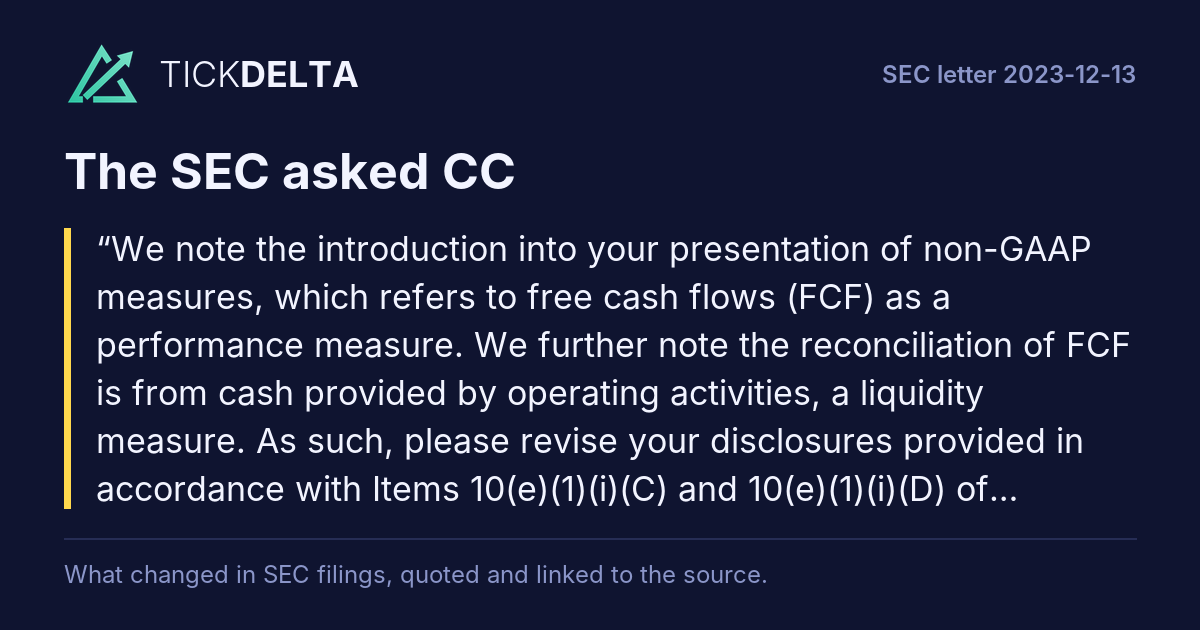
We note the introduction into your presentation of non-GAAP measures, which refers to free cash flows (FCF) as a performance measure. We further note the reconciliation of FCF is from cash provided by operating activities, a liquidity measure.Rest of the question
As such, please revise your disclosures provided in accordance with Items 10(e)(1)(i)(C) and 10(e)(1)(i)(D) of Regulation S-K to consistently characterize your presentation of FCF. Refer to Question 102.07 of the Compliance and Disclosure Interpretations for Non- GAAP Financial Measures for additional guidance. Address this comment and all other non-GAAP measure comments in both your period and current reports, as applicable.
We acknowledge the Staff’s comment and respectfully advise the Staff that we will revise our disclosures regardingRead in the reply
FCF on future reports in accordance with Items 10(e)(1)(i)(C) and 10(e)(1)(i)(D) of Regulation S-K to clearly characterize FCF as a liquidity measure.
First report after the company's reply of Dec 22, 2023: 10-K filed Mar 27, 2024 ↗, against the 10-K filed Feb 10, 2023 ↗.
Tickdelta does not hold the text of both reports, so they are not compared here.
For each non-GAAP measure presented, please present the most directly comparable financial measure or measures calculated and presented in accordance with US GAAP in accordance with Item 10(e)(1)(i)(A) of Regulation S-K and Question 102.10(a) of the Compliance and Disclosure Interpretations for Non-GAAP Financial Measures.Rest of the question
In this regard, we note your presentation of adjusted EBITDA margin, return on invested capital, and net leverage ratio without presenting the comparable margin, percentage or ratio calculated using the most comparable US GAAP measures.
We acknowledge theRead in the reply
Staff’s comment and respectfully advise the Staff that the Company will exclude references to return on invested capital and net leverage ratio from our future Annual Reports on Form 10-K and Quarterly
Reports on Form 10-Q as these non-GAAP measures are not used in any discussions elsewhere in the Relevant Reports. We do, however, plan to continue presenting these non-GAAP measures in our earnings releases that will be furnished with a Current Report on Form 8-K.Rest of the answer
As such, in future earnings releases, we will label these as non-GAAP measures, include a reconciliation of these non-GAAP measures from the most comparable US GAAP measures, and present the related GAAP measures with equal or greater prominence.
With respect to Adjusted EBITDA margin, we respectfully submit that our segment Adjusted EBITDA margin is not considered a non-GAAP measure. Adjusted EBITDA margin is presented in our MD&A at a reporting segment level and is not presented on a consolidated basis. Adjusted EBITDA margin is derived from our reporting segment operating measure of Adjusted EBITDA divided by reporting segment net sales to external customers. Each of these amounts is presented in the segment footnote to the financial statements as required by US GAAP in accordance with ASC 280, Segment Reporting. Accordingly, we do not believe a comparable US GAAP measure to the segment Adjusted EBITDA margin exists or is required to be presented in our MD&A.
First report after the company's reply of Dec 22, 2023: 10-K filed Mar 27, 2024 ↗, against the 10-K filed Feb 10, 2023 ↗.
Tickdelta does not hold the text of both reports, so they are not compared here.
For your presentation of return on invested capital and net leverage ratio using non-GAAP measures, please revise the titles to clearly distinguish these measures as being based on non-GAAP measures rather than US GAAP measures. Refer to Item 10(e)(1)(ii)(E) of Regulation S-K for guidance.
We acknowledge the Staff’s comment. As noted above in our response to the Staff’s second comment, we will exclude references to return on invested capital and net leverage ratio from our future Annual Reports on Form 10-K and Quarterly Reports on Form 10-Q as those non-GAAP measures are not used in any discussions elsewhere in the Relevant Reports.Read in the replyRest of the answer
We do, however, plan to continue presenting these non-GAAP measures in our earnings releases that will be furnished with a Current Report on Form 8-K and as such, in future earnings releases, we will clearly distinguish these measures as being based on non-GAAP measures and we will include a reconciliation of these non-GAAP measures from the most comparable
US GAAP measures in those furnished reports.
First report after the company's reply of Dec 22, 2023: 10-K filed Mar 27, 2024 ↗, against the 10-K filed Feb 10, 2023 ↗.
Tickdelta does not hold the text of both reports, so they are not compared here.
Please revise your reconciliation of Adjusted EBIT to begin with the most comparable US GAAP measure rather than another non-GAAP measure. Refer to Item 10(e)(1)(i)(B) of Regulation S-K and Question 102.10(b) of the Compliance and Disclosure Interpretations for Non-GAAP Financial Measures for guidance.
We acknowledge the Staff’s comment and respectfully advise the Staff that the Company will exclude references to Adjusted EBIT from our future Annual Reports on Form 10-K and Quarterly Reports on Form 10-Q.Read in the reply
We do, however, plan to continue presenting Adjusted EBIT in our earnings release that will be furnished with a Current Report on Form 8-K and, as such, in future earnings releases, we will include a reconciliation of Adjusted EBIT from the most comparable US GAAP measures in those furnished reports.
Form
10-Q for the Fiscal Quarter Ended September 30, 2023
Item 2.Rest of the answer
Management’s Discussion and Analysis of Financial Condition and Results of Operations Non-GAAP Financial Measures, page 73
First report after the company's reply of Dec 22, 2023: 10-K filed Mar 27, 2024 ↗, against the 10-K filed Feb 10, 2023 ↗.
Tickdelta does not hold the text of both reports, so they are not compared here.
Please expand the footnote disclosures you provide for the adjustments to discuss all material components and to quantify each component discussed. For example, footnote 5 for the litigation-related charges of $675 million for the nine-months ended September 30, 2023, refers to litigation settlements, PFOA drinking water treatment accruals, and related legal fees with a reference to Note 17.Rest of the question
However, Note 17 discloses that $592 million was recognized within selling, general and administrative expenses during the nine-months ended September 30, 2023, which leaves $83 million of the adjustment unexplained and/or unquantified.
We acknowledge the Staff’s comment and respectfully advise the Staff that the Company will expand the disclosures in our footnotes to our non-GAAP reconciliation tables to discuss and quantify material components of the adjustments in our futureRead in the reply
Annual Reports on Form 10-K and Quarterly Reports on Form 10-Q.
For example, regarding footnote 5 to the table setting forth a reconciliation of our net income (loss) attributable to Chemours to Adjusted Net Income, Adjusted EBITDA, and Adjusted EPS, we will revise the relevant footnote in our future Annual Reports on Form 10-K and Quarterly ReportsRest of the answer
on Form 10-Q to discuss and quantify material components of the adjustments to litigation-related charges. We have provided an example of the revised footnote below for the nine months ended September 30, 2023:
Page Five
Litigation-related charges pertain to litigation settlements, PFOA drinking water treatment liabilities, and related legal fees. For the nine months ended September 30, 2023, litigation-related charges included $592 million of charges related to the United States Public Water System Class Action Suit Settlement plus $24 million of third-party legal fees directly related to that settlement, $58 million for other PFAS litigation matters, and $1 million of other litigation settlements. For the nine months ended September 30, 2022, litigation-related charges
(gains) include proceeds from a settlement in a patent infringement matter. Refer to “Note 17 – Commitments and Contingent Liabilities” to the Interim Consolidated Financial Statements for further details.
First report after the company's reply of Dec 22, 2023: 10-K filed Mar 27, 2024 ↗, against the 10-K filed Feb 10, 2023 ↗.
Tickdelta does not hold the text of both reports, so they are not compared here.
We note that you are now referring to environmental remediation expenses that are adjusted as non-recurring. Please remove this characterization of this adjustment or explain how you were able to conclude this characterization is appropriate given that this is an adjustment made every period presented.Rest of the question
Refer to Item 10(e)(1)(ii)(B) of Regulation S-K and Question 102.03 of the Compliance and Disclosure Interpretations for Non- GAAP Financial Measures for guidance.
We acknowledge the Staff’s comment and respectfully advise the Staff that the Company will remove the “non-recurring” characterization of this adjustment in our future reports.Read in the reply
First report after the company's reply of Dec 22, 2023: 10-K filed Mar 27, 2024 ↗, against the 10-K filed Feb 10, 2023 ↗.
Tickdelta does not hold the text of both reports, so they are not compared here.
We note that you have included $28M for the write-off of certain raw materials inventory within the restructuring, asset-related and other charges adjustment for the nine-months ended September 30, 2023. With reference to ASC 420-10-S99-3, please tell us your consideration of the guidance in Question 100.01 the Compliance and Disclosure Interpretations for Non-GAAP Financial Measures for this portion of theRest of the question
adjustment.
We respectfully advise that the Company has considered the guidance set forth inRead in the reply
Question 100.01 of the Compliance and Disclosure Interpretations for Non-GAAP Financial Measures. The decision to write off $28 million of raw materials inventory, which was included in the Interim
Consolidated Statement of Operations as a component of Cost of Goods Sold, was a direct result of the decision to shut down the Company’s manufacturing site in Kuan Yin, Taiwan, which is in line with the Company’s strategic initiative to improve the earnings quality of the Titanium Technologies segment.Rest of the answer
This action resulted in the Company incurring asset impairment and write-offs (including the raw materials inventory in question), severance costs, contract termination costs and decommissioning and dismantling charges. The raw materials write-off primarily consisted of $22 million of ore minerals and $6 million of other raw materials and packaging that are used in the production of the Company’s various TiO2 products. The Company’s Kuan Yin production plant was designed to use ore minerals of specific grade to produce specific TiO2 products that our Titanium Technology segment sells to customers in Asia
Pacific and are not economically interchangeable with the ore minerals we typically consume at other production sites. The $28 million raw materials inventory write-off, as noted above, does not include any TiO2 finished goods inventory that were still available for sale at the time of shutdown, as we expected that inventory to be recovered under normal sales. Absent the decision to shut down our manufacturing site in Kuan Yin, these types of charges are not expected to occur or would be very infrequent, if at all, and unusual for our Company as an industrial chemical manufacturer. Our historical raw materials adjustments are generally related
Page Six to production yield and not due to obsolescence or lower of cost or market adjustments. The Company believed, based on our facts and circumstances, the action taken to write off certain of our raw materials inventory at our Kuan Yin site as a result of a shutdown was not indicative of the market conditions and valuation of similar ore minerals, nor the Company’s ability to sell TiO2 products manufactured at our various sites.
Although the Company believes that its inventory adjustments in its presentation of non-GAAP financial measures were appropriate under the circumstances and not misleading (for reasons discussed above), we acknowledge the Staff’s comment and will exclude this type of adjustment from our non-GAAP performance measures in our future reports.
We also respectfully wish to inform the Staff that, in addition to excluding the $28 million raw materials inventory write off from our non-GAAP performance measures in future reports, we will exclude an immaterial charge of $8 million related to the write-off of stores inventory which was also included in the non-GAAP adjustment line item Restructuring, asset-related, and other charges. Our accounting policies classify “stores” as inventory. This inventory includes maintenance materials, operating supplies, spare parts including extra machinery and operating/service spare parts, which normally does not become an integral part of our finished product. By its nature, this is used for planned and operating maintenance of our manufacturing assets. Absent specific US GAAP guidance, we classify
“stores” as inventory for financial reporting purposes. Similarly, the Company has considered the guidance set forth in Question 100.01 of the Compliance and Disclosure Interpretation for Non-GAAP
Financial Measures and believes that, based on the nature of stores inventory and that the write-off was directly as a result of the decision to shut-down the Company’s manufacturing site in Kuan Yin,
Taiwan, excluding this type of cost from the non-GAAP performance measures is appropriate and not inconsistent with the guidance in Question 100.01, and with reference to ASC 420-10-S99-3 is also appropriate to be included in restructuring, asset-related and other charges. Although the Company believes that including stores inventory write-off in its presentation of non-GAAP financial measures was appropriate under the circumstances and not misleading (for reasons discussed above), consistent with the
Staff’s comment, we respectfully inform the staff that we intend to exclude stores inventory write-off in its presentation of Adjusted EBITDA.
First report after the company's reply of Dec 22, 2023: 10-K filed Mar 27, 2024 ↗, against the 10-K filed Feb 10, 2023 ↗.
Tickdelta does not hold the text of both reports, so they are not compared here.
We note your presentation of adjusted free cash flows beginning in the September 30, 2023 Form 10-Q. Please tell us how you concluded that adjusting FCFs for PFAS litigation settlements is consistent with the guidance in Item 10(e)(1)(ii)(A) of Regulation S-K.
We acknowledge the Staff’s comment and respectfully advise that the Company has considered the guidance set forth inRead in the reply
Item 10(e)(1)(ii)(A) of Regulation S-K. Adjusted free cash flow is a non-GAAP financial measure that represents cash that is available to the Company to fund operating activities after investing in its asset base, and litigation settlements and fees related to PFAS and PFOA matters.Rest of the answer
When determining the nature of items to be adjusted from cash provided by
Page Seven operating activities for purposes of calculating adjusted free cash flow, the Company identifies items that are significant, unusual in nature and/or infrequent in occurrence that neither relate to the ordinary course of our business nor reflect the ongoing underlying cash generation of our businesses and on-going liquidity position. The change was driven by certain PFAS related settlements and directly related legal fees that we believe were unusual in nature or infrequent in occurrence that neither related to the Company’s ordinary course of business nor the underlying cash generation of our businesses. The Company believes that excluding items of this nature provides the Company’s investors with a better understanding of, and enables them to compare, the underlying cash generation of our businesses and our underlying liquidity from period to period.
In future reports, we will remove the presentation of Adjusted FCF from our Annual Reports on Form 10-K and Quarterly
Reports on Form 10-Q. We do, however, plan to continue presenting Adjusted FCF in our earnings releases that will be furnished with a Current Report on Form 8-K, together with the disclosure that fully describes the material components of the adjusted item(s) as well as a reconciliation of Adjusted FCF from the most comparable GAAP measure.
* *
*
Page Eight
If you require additional information or have any questions about this letter, please do not hesitate to contact me at [email protected] or (302) 773-3960 or our Chief Accounting Officer, Camela T. Wisel, at [email protected] or (302) 773-3234.
First report after the company's reply of Dec 22, 2023: 10-K filed Mar 27, 2024 ↗, against the 10-K filed Feb 10, 2023 ↗.
Tickdelta does not hold the text of both reports, so they are not compared here.
We note your response to prior comment 2 regarding your presentation of adjusted EBITDA margin only at the segment level as your segment profit measure. However, we note within the Segment Financial and Operating Data section of your earnings press releases that you include the presentation of adjusted EBITDA margin at the consolidated level.Rest of the question
As such, we continue to request that you present the most directly comparable financial measure or measures calculated and presented in accordance with US GAAP in accordance with Item 10(e)(1)(i)(A) of S-K.
We acknowledge the Staff’s comment and respectfully advise the Staff that, in future reports, we will remove the presentation of Adjusted EBITDA margin at the consolidated level in our earnings releases that will be furnished with a Current Report on Form 8-K.Read in the reply
Division of Corporate Finance
Page Two
* *
*
If you require additional information or have any questions about this letter, please do not hesitate to contact me at [email protected] or (302) 773-1000 or our Chief Accounting Officer, Camela T. Wisel, at [email protected] or (302)
773-3234.
First report after the company's reply of Jan 8, 2024: 10-K filed Mar 27, 2024 ↗, against the 10-K filed Feb 10, 2023 ↗.
Tickdelta does not hold the text of both reports, so they are not compared here.
Also in this review: closing letter, 2024-01-10