Paragraph 71 · 50% changed
Every version of it
Screener
/
SEC EDGAR
/CIK 0001030894
/10-K filed Feb 27, 2026, compared with Mar 3, 2025
/Numbers from the XBRL of the 10-Ks
NYSE
Technology · Electronic Components
Celestica Inc CLS
The 10-K against last year's
370 changes: 50 added, 94 removed, 218 reworded, 8 quiet changes
10-K Feb 27, 2026 vs Mar 3, 2025
Risk Factors
21.8%
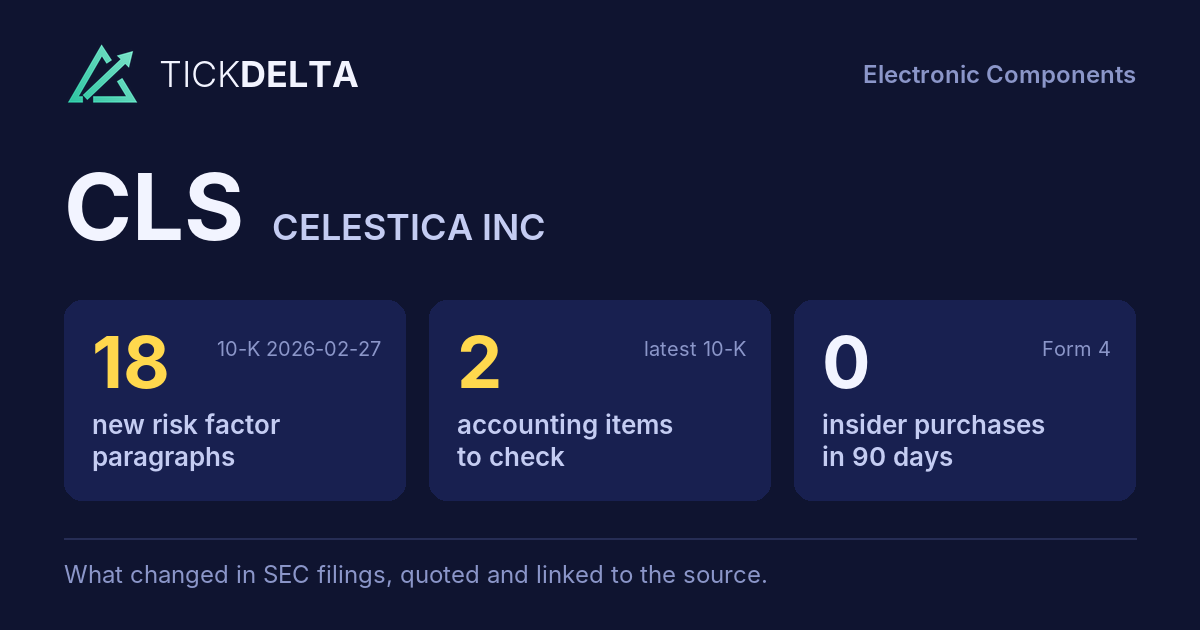
of the text changed · 21,066 words now · 18 new paragraphs, 15 gone
MD&A
43.9%
of the text changed · 20,101 words now · 32 new paragraphs, 79 gone
Legal Proceedings
24.9%
of the text changed · 745 words now
10-K 0001030894-26-000011 (Feb 27, 2026) vs 10-K 0001030894-25-000014 (Mar 3, 2025) Not compared: Accounting Policies.
Every paragraph, and how much of it changed
One bar per paragraph, in the order of the 10-K. Height and colour show the share of its words not in the closest paragraph a year earlier; the tallest bars are new paragraphs.
Risk Factors
212 paragraphs · 18 new · 101 reworded · 15 gone · 10-K Feb 27, 2026 against Mar 3, 2025
New paragraph
Reworded (5% of its words or more)
Same or nearly
Paragraph 81 · 49% changed
Every version of it
There is increasing concern that a gradual increase in global average temperatures due to increased concentration of carbon dioxide and other GHGs greenhouse gases (GHGs) in the atmosphere has, and will continue to, cause significant changes in weather patterns around the globe and an increase in the frequency and severity of natural disasters. Changes in weather patterns and an increased frequency, intensity and duration of extreme weather conditions could, among other things, impair our production capabilities, disrupt the operation of our supply chain, and impact our customers and their demand for our services. There are inherent climate-related climate and weather related risks regardless of where we conduct our business. Climate change-related weather events could negatively impact any of our locations or the locations of our customers, and may cause us to experience work stoppages, project delays, financial losses and/or additional costs to resume operations, including increased insurance costs or loss of coverage, legal liability and reputational losses. Further, the risks caused by climate change span across the industry sectors we serve, including A&D, Industrial, HealthTech, Capital Equipment, Communications and Enterprise. The direct physical risks that climate change poses to infrastructure through chronic environmental changes, such as rising sea levels and temperatures, and acute events, such as hurricanes, droughts and wildfires, is common to each of these sectors. Infrastructure owners could face increased costs to maintain their assets, which could result in reduced profitability and fewer resources for strategic investment. These types of physical risks could in turn lead to transitional risks, including market and technology shifts, including decreased demand for our services and solutions, reputational risks, such as how our sustainability practices are viewed by external and internal stakeholders, and policy and legal risks, including the extent to which climate change-related initiatives are driven by the governments in which we operate around the globe. As a result, the effects of climate change could have a long-term material adverse impact on our business, results of operations and financial condition. See "Our operations have been and could continue to be adversely affected by events outside our control," and "Our business and operations could be adversely impacted by ESG initiatives." weather-related
Paragraph 152 · 48% changed
Every version of it
Paragraph 148 · 48% changed
Every version of it
At December 31, 2024, a significant portion 2025, approximately 80% of our cash and cash equivalents was were held by foreign subsidiaries outside of Canada, a large part Canada. We have repatriated and expect to continue repatriating funds from our foreign subsidiaries. Repatriation of which may be subject to withholding taxes upon repatriation certain foreign funds could result in additional tax liabilities under current tax laws. We repatriated have recorded tax liabilities in our consolidated financial statements for the anticipated repatriations in the foreseeable future.
Paragraph 202 · 46% changed
Every version of it
Our business and operations have been and could continue to be adversely affected impacted by events outside our control. sustainability initiatives.
Paragraph 211 · 46% changed
Every version of it
Unfavorable media related to our industry, company, brand, marketing, personnel, operations, business performance, or prospects prospects, actions from securities regulators and law enforcement agencies or law suits from aggrieved parties may affect our share price and the performance of our business, regardless of its accuracy or inaccuracy. The speed at which negative publicity can be disseminated has increased dramatically with the capabilities of electronic communication, including social media outlets, websites, blogs, and newsletters. Our success in maintaining, extending, and expanding our brand image depends on our ability to adapt to this rapidly changing media environment. Adverse publicity or negative commentary from any media outlet could damage our reputation and reduce the demand for our products, which would adversely affect our business.
Paragraph 190 · 44% changed
Every version of it
Paragraph 27 · 43% changed
Every version of it
There are also risks associated with the timing and ultimate realization of anticipated revenue from a new program or service. Certain new programs or services require us to devote significant capital and personnel to new technologies and competencies. We may not meet customer expectations, which could damage our relationships with such customers and impact our ability to timely deliver conforming products or services. The success of new programs may also depend heavily on factors including product reliability, supply chain dynamics, market acceptance, regulatory approvals and/or economic conditions. Any failure to meet expectations on these factors could adversely affect our results of operations.
Paragraph 71 · 50% changed
Every version of it
10-K Mar 3, 2025Issues in the development and use of AI may result in reputational harm or liability.
10-K Feb 27, 2026
Adoption, integration and use of AI in manufacturing and service offerings and in certain of our internal processes may present regulatory, ethical, data and cybersecurity risks and result in reputational harm or liabilities.
Paragraph 81 · 49% changed
Every version of it
10-K Mar 3, 2025
There is increasing concern that a gradual increase in global average temperatures due to increased concentration of carbon dioxide and other GHGs in the atmosphere has, and will continue to, cause significant changes in weather patterns around the globe and an increase in the frequency and severity of natural disasters. Changes in weather patterns and an increased frequency, intensity and duration of extreme weather conditions could, among other things, impair our production capabilities, disrupt the operation of our supply chain, and impact our customers and their demand for our services. There are inherent climate-related risks regardless of where we conduct our business. Climate change-related weather events could negatively impact any of our locations or the locations of our customers, and may cause us to experience work stoppages, project delays, financial losses and/or additional costs to resume operations, including increased insurance costs or loss of coverage, legal liability and reputational losses. Further, the risks caused by climate change span across the industry sectors we serve, including A&D, Industrial, HealthTech, Capital Equipment, Communications and Enterprise. The direct physical risks that climate change poses to infrastructure through chronic environmental changes, such as rising sea levels and temperatures, and acute events, such as hurricanes, droughts and wildfires, is common to each of these sectors. Infrastructure owners could face increased costs to maintain their assets, which could result in reduced profitability and fewer resources for strategic investment. These types of physical risks could in turn lead to transitional risks, including market and technology shifts, including decreased demand for our services and solutions, reputational risks, such as how our sustainability practices are viewed by external and internal stakeholders, and policy and legal risks, including the extent to which climate change-related initiatives are driven by the governments in which we operate around the globe. As a result, the effects of climate change could have a long-term material adverse impact on our business, results of operations and financial condition. See "Our operations have been and could continue to be adversely affected by events outside our control," and "Our business and operations could be adversely impacted by ESG initiatives."
10-K Feb 27, 2026
There is increasing concern that a gradual increase in global average temperatures due to increased concentration of carbon dioxide and other greenhouse gases (GHGs) in the atmosphere has, and will continue to, cause significant changes in weather patterns around the globe and an increase in the frequency and severity of natural disasters. Changes in weather patterns and an increased frequency, intensity and duration of extreme weather conditions could, among other things, impair our production capabilities, disrupt the operation of our supply chain, and impact our customers and their demand for our services. There are inherent climate and weather related risks regardless of where we conduct our business. Climate and weather-related
Paragraph 152 · 48% changed
Every version of it
10-K Mar 3, 2025Due to the inherent limitations of internal control systems, misstatements due to error or fraud may occur and may not be detected in a timely manner or at all. Accordingly, we cannot provide absolute assurance that all control issues, errors or instances of fraud, if any, impacting us have been or will be prevented or detected. In addition, over time, certain aspects of a control system may become inadequate because of changes in conditions, or the degree of compliance with the policies or procedures may deteriorate, which we may not be able to address quickly enough to prevent all instances of error or fraud. In connection with our ongoing assessment of the effectiveness of our internal control over financial reporting, we may discover "material weaknesses" in our internal controls. A material weakness is a deficiency, or a combination of deficiencies, in internal control over financial reporting, such that there is a reasonable possibility that a material misstatement of the company's annual or interim financial statements will not be prevented or detected on a timely basis. The existence of any material weakness may require management to devote significant time and incur significant remediation expense. The existence of any material weakness in our internal control over financial reporting may result in errors in our financial statements that could require us to make corrective adjustments, restate our financial statements, cause us to fail to meet our reporting obligations, and cause shareholders to lose confidence in our reported financial information, all of which could materially and adversely affect the market price of our securities. If we are unable to successfully identify and remediate any material weaknesses that may arise in a timely manner, the accuracy and timing of our financial reporting may be adversely affected, and we may be unable to
10-K Feb 27, 2026
make corrective adjustments, restate our financial statements, cause us to fail to meet our reporting obligations, and cause shareholders to lose confidence in our reported financial information, all of which could materially and adversely affect the market price of our securities. If we are unable to successfully identify and remediate any material weaknesses that may arise in a timely manner, the accuracy and timing of our financial reporting may be adversely affected, and we may be unable to maintain compliance with securities law requirements regarding timely filing of periodic reports and applicable stock exchange listing requirements.
Paragraph 148 · 48% changed
Every version of it
10-K Mar 3, 2025
At December 31, 2024, a significant portion of our cash and cash equivalents was held by foreign subsidiaries outside of Canada, a large part of which may be subject to withholding taxes upon repatriation under current tax laws. We repatriated in
10-K Feb 27, 2026
At December 31, 2025, approximately 80% of our cash and cash equivalents were held by foreign subsidiaries outside of Canada. We have repatriated and expect to continue repatriating funds from our foreign subsidiaries. Repatriation of certain foreign funds could result in additional tax liabilities under current tax laws. We have recorded tax liabilities in our consolidated financial statements for the anticipated repatriations in the foreseeable future.
Paragraph 202 · 46% changed
Every version of it
10-K Mar 3, 2025
Our operations have been and could continue to be adversely affected by events outside our control.
10-K Feb 27, 2026
Our business and operations could be adversely impacted by sustainability initiatives.
Paragraph 211 · 46% changed
Every version of it
10-K Mar 3, 2025
Unfavorable media related to our industry, company, brand, marketing, personnel, operations, business performance, or prospects may affect our share price and the performance of our business, regardless of its accuracy or inaccuracy. The speed at which negative publicity can be disseminated has increased dramatically with the capabilities of electronic communication, including social media outlets, websites, blogs, and newsletters. Our success in maintaining, extending, and expanding our brand image depends on our ability to adapt to this rapidly changing media environment. Adverse publicity or negative commentary from any media outlet could damage our reputation and reduce the demand for our products, which would adversely affect our business.
10-K Feb 27, 2026
Unfavorable media related to our industry, company, brand, marketing, personnel, operations, business performance, or prospects, actions from securities regulators and law enforcement agencies or law suits from aggrieved parties may affect our share price and the performance of our business, regardless of its accuracy or inaccuracy. The speed at which negative publicity
Paragraph 190 · 44% changed
Every version of it
10-K Mar 3, 2025As a public company, we are subject to stringent laws, regulations and other requirements, including the U.S. Sarbanes-Oxley Act and the U.S. Dodd-Frank Wall Street Reform and Consumer Protection Act (Dodd-Frank), affecting, among other areas, our accounting, internal controls, corporate governance practices, securities disclosures and reporting. For example, due to our complex supply chain, compliance with Dodd-Frank diligence, disclosure and reporting requirements with respect to defined "conflict minerals" is time-consuming and costly. If we are unable to ascertain the origins of all such minerals used in the manufacturing of our products through the due diligence procedures we implement, we may be unable to satisfy our customers' certification requirements. This may harm our reputation, damage our customer relationships and result in a loss of revenue. If the SEC rules or other new social or environmental standards limit our pool of suppliers in order to produce "conflict free" or "socially responsible" products, or otherwise adversely affect the sourcing, supply and pricing of materials used in our products, we could also experience cost increases and a material adverse impact on our operating results.
10-K Feb 27, 2026
revenue. If the SEC rules or other new social or environmental standards limit our pool of suppliers in order to produce "conflict free" or "socially responsible" products, or otherwise adversely affect the sourcing, supply and pricing of materials used in our products, we could also experience cost increases and a material adverse impact on our operating results.
Paragraph 27 · 43% changed
Every version of it
10-K Mar 3, 2025
There are also risks associated with the timing and ultimate realization of anticipated revenue from a new program or service. Certain new programs or services require us to devote significant capital and personnel to new technologies and competencies. We may not meet customer expectations, which could damage our relationships with such customers and impact our ability to timely deliver conforming products or services. The success of new programs may also depend heavily on factors including product reliability, supply chain dynamics, market acceptance, regulatory approvals and/or economic conditions. Any failure to meet expectations on these factors could adversely affect our results of operations.
10-K Feb 27, 2026
There are also risks associated with the timing and ultimate realization of anticipated revenue from a new program or service. Certain new programs or services require us to devote significant capital and personnel to new technologies and
MD&A
222 paragraphs · 32 new · 151 reworded · 79 gone · 10-K Feb 27, 2026 against Mar 3, 2025
New paragraph
Reworded (5% of its words or more)
Same or nearly
Paragraph 80 · 50% changed
in 2025, compared to $39.6 million in 2024). See "Liquidity — Cash requirements — TRS" above below for a description of the our TRS Agreement. Interest payments under the TRS Agreement are based on SOFR. A one-percentage point increase in relevant interest rates would cause an insignificant increase of our annual interest expense.
Paragraph 129 · 50% changed
Year ended December 31 2025 2024 2023 Net cash provided by operating activities $ 659.5 $ 473.9 $ 326.2 Net cash used in investing activities (203.7) (212.5) (122.4) Net cash used in financing activities (283.5) (208.5) (207.9) Changes in non-cash working capital items (included in operating activities above): A/R $ (569.1) $ (270.7) $ (402.2) Inventories (427.4) 343.7 245.1 Other current assets (25.1) 45.1 8.6 A/P, accrued and other current liabilities, provisions and income taxes payable 909.5 (188.8) 87.4 831.4 Working capital changes $ (112.1) $ (70.7) $ (61.1)
Paragraph 35 · 49% changed
We remain committed to making the investments we believe are required to support our long-term objectives and to create shareholder value, while simultaneously managing our costs and resources to maximize our efficiency and productivity. Within both of our segments, we are focused on: increasing penetration in our end markets; diversifying our customer mix and product portfolios, including increasing customer engagement on design and development, engineering, and after-market services (higher higher value-added services, including ITAM/ITAD); services; and diversifying enhancing our capabilities. However, customer demand dynamics or the costs See Item 1, Business — "Celestica's Strategy" of investments that we deem desirable may prevent us from achieving our diversification objectives. In addition, the ramping activities associated with investments that we do make may be significant and could negatively impact our margins in the short and medium term. To counteract these factors, we continue to invest in and deploy automation and digital factory solutions and capabilities throughout our network to improve quality and productivity. Our Celestica Operating System, this Annual Report, of which standardizes best practices and processes across our network, continues to drive operational optimization and improved supply chain resiliency. Our recent productivity initiatives and related restructuring actions were also intended to this MD&A forms a part, for further streamline our business and increase operational efficiencies. detail.
Paragraph 109 · 49% changed
Our net income tax expense for 2022 2025 included an adverse $3.5 $68.1 million taxable foreign exchange impact arising primarily from the weakening of the Chinese renminbi relative tax benefits to the recognize previously unrecognized deferred tax assets in our U.S. dollar and a $3.3 group of subsidiaries, offset by $41.7 million Repatriation Expense related tax expenses for tax uncertainties relating to certain of our Chinese subsidiaries, offset and $35.5 million of withholding tax expenses in part by $4.9 million in favorable Reversals in one respect of repatriations from certain of our Asian subsidiaries. The withholding tax of $10.3 million associated with the repatriation of undistributed earnings from our certain Chinese subsidiaries in 2022 (realized as current tax) was fully offset by the reversal of previously accrued deferred taxes from the then-anticipated repatriation of such undistributed earnings.
Paragraph 7 · 49% changed
We deliver innovative supply chain solutions globally to customers in serve across two operating and reportable segments: Connectivity and Cloud Solutions (CCS) and Advanced Technology Solutions (ATS) and Connectivity & Cloud Solutions (CCS). Our ATS segment consists of our ATS end market, and is comprised of our Aerospace and Defense (A&D), Industrial, HealthTech, and Capital Equipment businesses. (ATS). Our CCS segment consists of our Communications and Enterprise (servers and storage) end markets. Additional information regarding our segments is included in note 22 to the 2024 AFS. Our Enterprise
Paragraph 60 · 49% changed
The preparation of financial statements in conformity with GAAP requires management to make judgments, estimates and assumptions that affect the application of accounting policies, the reported amounts of assets, liabilities, revenue and expenses, and related disclosures with respect to contingent assets and liabilities. We base our judgments, estimates and assumptions on current facts, historical experience and various other factors that we believe are reasonable under the circumstances. The economic environment also impacts certain estimates and discount rates necessary to prepare our consolidated financial statements, including significant estimates and discount rates applicable to the determination of the fair value used in the impairment testing of our non-financial assets. Our assessment of these factors forms the basis for our judgments on the carrying values of our assets and liabilities, and the accrual of our costs and expenses. Actual results could differ materially from our estimates and assumptions. We review our estimates and underlying assumptions on an ongoing basis and make revisions as determined necessary by management. Revisions are recognized in the period in which the estimates are revised and may also impact future periods.
Paragraph 112 · 48% changed
Paragraph 22 · 47% changed
We currently anticipate continued growth in our CCS segment in 2025. We expect strong growth in 2026. In our Communications end market market, we expect strong demand from hyperscalers throughout 2025, driven by program ramps and robust demand. 2026, as we continue to ramp multiple networking switching programs. In our Enterprise end market, we continue to expect demand softness volume growth in the first half of 2025, driven by the technology transition 2026 in an AI/machine learning (AI/ML) compute program with a large hyperscaler customer. However, we expect Enterprise end market revenue to improve during the second half of 2025 compared to the first half, supported by the ramping of our AI/ML compute programs. programs with our hyperscaler customers. We currently anticipate our CCS growth trajectory to be sustained into 2027.
Paragraph 80 · 50% changed
10-K Mar 3, 2025
See "Liquidity — Cash requirements — TRS" above for a description of the TRS Agreement. Interest payments under the TRS Agreement are based on SOFR. A one-percentage point increase in relevant interest rates would cause an insignificant increase of our annual interest expense.
10-K Feb 27, 2026
in 2025, compared to $39.6 million in 2024). See "Liquidity — Cash requirements — TRS" below for a description of our TRS Agreement.
Paragraph 129 · 50% changed
10-K Mar 3, 2025
A/P, accrued and other current liabilities, provisions and income taxes payable (188.8) 87.4 831.4
10-K Feb 27, 2026
Year ended December 31 2025 2024 2023 Net cash provided by operating activities $ 659.5 $ 473.9 $ 326.2 Net cash used in investing activities (203.7) (212.5) (122.4) Net cash used in financing activities (283.5) (208.5) (207.9) Changes in non-cash working capital items (included in operating activities above): A/R $ (569.1) $ (270.7) $ (402.2) Inventories (427.4) 343.7 245.1 Other current assets (25.1) 45.1 8.6 A/P, accrued and other current liabilities, provisions and income taxes payable 909.5 (188.8) 87.4 Working capital changes $ (112.1) $ (70.7) $ (61.1)
Paragraph 35 · 49% changed
10-K Mar 3, 2025
We remain committed to making the investments we believe are required to support our long-term objectives and to create shareholder value, while simultaneously managing our costs and resources to maximize our efficiency and productivity. Within both of our segments, we are focused on: increasing penetration in our end markets; diversifying our customer mix and product portfolios, including increasing design and development, engineering, and after-market services (higher value-added services, including ITAM/ITAD); and diversifying our capabilities. However, customer demand dynamics or the costs of investments that we deem desirable may prevent us from achieving our diversification objectives. In addition, the ramping activities associated with investments that we do make may be significant and could negatively impact our margins in the short and medium term. To counteract these factors, we continue to invest in and deploy automation and digital factory solutions and capabilities throughout our network to improve quality and productivity. Our Celestica Operating System, which standardizes best practices and processes across our network, continues to drive operational optimization and improved supply chain resiliency. Our recent productivity initiatives and related restructuring actions were also intended to further streamline our business and increase operational efficiencies.
10-K Feb 27, 2026
We remain committed to making the investments we believe are required to support our long-term objectives and to create shareholder value, while simultaneously managing our costs and resources to maximize our efficiency and productivity. Within both of our segments, we are focused on: increasing penetration in our end markets; diversifying our customer mix and product portfolios, including increasing customer engagement on design and development, engineering, and higher value-added services; and enhancing our capabilities. See Item 1, Business — "Celestica's Strategy" of this Annual Report, of which this MD&A forms a part, for further detail.
Paragraph 109 · 49% changed
10-K Mar 3, 2025
Our net income tax expense for 2022 included an adverse $3.5 million taxable foreign exchange impact arising primarily from the weakening of the Chinese renminbi relative to the U.S. dollar and a $3.3 million Repatriation Expense related to certain of our Chinese subsidiaries, offset in part by $4.9 million in favorable Reversals in one of our Asian subsidiaries. The withholding tax of $10.3 million associated with the repatriation of undistributed earnings from our certain Chinese subsidiaries in 2022 (realized as current tax) was fully offset by the reversal of previously accrued deferred taxes from the then-anticipated repatriation of such undistributed earnings.
10-K Feb 27, 2026
Our net income tax expense for 2025 included $68.1 million of tax benefits to recognize previously unrecognized deferred tax assets in our U.S. group of subsidiaries, offset by $41.7 million tax expenses for tax uncertainties relating to certain of our subsidiaries, and $35.5 million of withholding tax expenses in respect of repatriations from certain of our Asian subsidiaries.
Paragraph 7 · 49% changed
10-K Mar 3, 2025
We deliver innovative supply chain solutions globally to customers in two operating and reportable segments: Advanced Technology Solutions (ATS) and Connectivity & Cloud Solutions (CCS). Our ATS segment consists of our ATS end market, and is comprised of our Aerospace and Defense (A&D), Industrial, HealthTech, and Capital Equipment businesses. Our CCS segment consists of our Communications and Enterprise (servers and storage) end markets. Additional information regarding our segments is included in note 22 to the 2024 AFS.
10-K Feb 27, 2026
We serve across two operating and reportable segments: Connectivity and Cloud Solutions (CCS) and Advanced Technology Solutions (ATS). Our CCS segment consists of our Communications and Enterprise end markets. Our Enterprise
Paragraph 60 · 49% changed
10-K Mar 3, 2025
The preparation of financial statements in conformity with GAAP requires management to make judgments, estimates and assumptions that affect the application of accounting policies, the reported amounts of assets, liabilities, revenue and expenses, and related disclosures with respect to contingent assets and liabilities. We base our judgments, estimates and assumptions on current facts, historical experience and various other factors that we believe are reasonable under the circumstances. The economic environment also impacts certain estimates and discount rates necessary to prepare our consolidated financial statements, including significant estimates and discount rates applicable to the determination of the fair value used in the impairment testing of our non-financial assets. Our assessment of these factors forms the basis for our judgments on the carrying values of our assets and liabilities, and the accrual of our costs and expenses. Actual results could differ materially from our estimates and assumptions. We review our estimates and underlying assumptions on an ongoing basis and make revisions as determined necessary by management. Revisions are recognized in the period in which the estimates are revised and may also impact future periods.
10-K Feb 27, 2026
The preparation of financial statements in conformity with GAAP requires management to make judgments, estimates and assumptions that affect the application of accounting policies, the reported amounts of assets, liabilities, revenue and expenses, and related disclosures with respect to contingent assets and liabilities. We base our judgments, estimates and
Paragraph 112 · 48% changed
10-K Mar 3, 2025Our net income tax expense for 2024 included a $22.3 million withholding tax expense incurred to minimize the impact of the enactment of Pillar Two (global minimum tax) legislation in Canada, a $14.0 million tax expense for tax uncertainties relating to one of our Asian subsidiaries (Tax Uncertainties) and a $3.9 million tax expense arising from taxable temporary differences associated with the anticipated repatriation of undistributed earnings (Repatriation Expense) from certain of our Asian subsidiaries, offset in part by the recognition of $23.8 million of previously unrecognized deferred tax assets arising from both our NCS acquisition in our U.S. group of subsidiaries and deductible temporary differences in one of our Asian subsidiaries (DTA Recognition), and $11.8 million of reversals of tax uncertainties (Reversals) relating to certain of our Asian subsidiaries. Our functional and reporting currency is the U.S. dollar; however, our income tax expense is based in certain jurisdictions on taxable income determined in the currency of the country of origin. As a result, the impact of taxable foreign exchange affects our income tax expense from period to period. Taxable foreign exchange impacts were not significant in 2024.
10-K Feb 27, 2026
Our functional and reporting currency is the U.S. dollar; however, our income tax expense is based in certain jurisdictions on taxable income determined in the currency of the country of origin. As a result, the impact of taxable foreign exchange may affect our income tax expenses from period to period.
Paragraph 22 · 47% changed
10-K Mar 3, 2025
We currently anticipate continued growth in our CCS segment in 2025. We expect strong growth in our Communications end market throughout 2025, driven by program ramps and robust demand. In our Enterprise end market, we continue to expect demand softness in the first half of 2025, driven by the technology transition in an AI/machine learning (AI/ML) compute program with a large hyperscaler customer. However, we expect Enterprise end market revenue to improve during the second half of 2025 compared to the first half, supported by the ramping of AI/ML compute programs.
10-K Feb 27, 2026
We currently anticipate continued growth in our CCS segment in 2026. In our Communications end market, we expect strong demand from hyperscalers throughout 2026, as we continue to ramp multiple networking switching programs. In our Enterprise end market, we expect volume growth in 2026 in our AI/ML compute programs with our hyperscaler customers. We currently anticipate our CCS growth trajectory to be sustained into 2027.
A paragraph is matched with the one last year that shares the most of its words; under half in common makes it new. The paragraphs shown are the 8 reworded the most in each section.
The paragraph that changed most in each section
The redline
Marked against last year's 10-K: cut words struck through, new words highlighted.
MD&A517 words changed in this paragraph; it is 39% similar to last year's version.
Source: Item 7, 10-K 0001030894-26-000011 vs Item 7, 10-K 0001030894-25-000014
Risk Factors307 words changed in this paragraph; it is 57% similar to last year's version.
Our operations and those of our customers, component suppliers and/or our logistics partners may be disrupted by global or local events outside our control, including: fires and related disruptions; political instability; increased political tension between countries (including increased tensions between U.S. and other countries and between mainland China and Taiwan); geopolitical dynamics; terrorism; armed conflict (including the Russia/Ukraine conflict and the conflicts in the Middle East Conflicts); area (Middle East Conflicts)); labor or social unrest; criminal activity; disease or illness or other widespread health concerns, pandemics, epidemics or outbreaks of illness that affects local, regional, national or international economies; natural disasters and unusually adverse weather conditions (including those caused by climate change), conditions, such as hurricanes, tornados, other extreme storms, wildfires, droughts and floods; cybersecurity incidents (see "Our operations and our customer relationships may be adversely and materially affected by disruptions to our IT systems, including disruptions from cybersecurity breaches of our IT infrastructure"); and other risks present in the jurisdictions in which we, our customers, our suppliers and/or our logistics partners operate. Our production operations are also subject to energy, power and water dependencies, including upgrades to manufacturing capabilities and power enhancements at certain facilities, permitting and infrastructure constraints, utility supply interruptions, and severe weather and grid reliability issues. Any of these factors could affect ramp timing at our manufacturing sites, increase our operating costs, or limit capacity utilization, which could adversely affect our business and results of operations. These types of risks and events could disrupt operations at one or more of our sites or those of our customers, component suppliers and/or our logistics partners, with the impact of the event potentially magnified in areas where we or they have multiple facilities in close proximity. These events could also lead to higher costs or supply shortages, and may disrupt the delivery of components to us or our ability to provide finished products or services to our customers, any of which could (and in the case of materials constraints, did in the past and may in the future) adversely affect our operating results materially. We carry insurance to cover damage to our sites and interruptions to our operations, including those that may occur as a result of natural disasters, such as flooding, earthquakes or other events. Our insurance policies, however, are subject to deductibles, coverage limitations and exclusions, and may not provide adequate (or any) coverage should such events occur. Such events could also impact our insurance premiums. In addition, some of our facilities possess certifications or unique equipment necessary to work on specialized products that our other locations lack. If work is disrupted at one of these facilities as a result of the foregoing events or otherwise, it may be impractical or we may be unable to transfer such specialized work to another facility without significant costs and delays. Thus, any disruption in operations at a facility possessing specialized certifications or equipment could adversely affect our ability to provide products and services to our customers, and potentially have a negative affect our relationships and financial results.
Source: Item 1A, 10-K 0001030894-26-000011 vs Item 1A, 10-K 0001030894-25-000014
Legal Proceedings54 words changed in this paragraph; it is 31% similar to last year's version.
Source: Item 3, via Note 20 – COMMITMENTS, CONTINGENCIES AND GUARANTEES:, 10-K 0001030894-26-000011 vs Item 3, via Note 21 – COMMITMENTS, CONTINGENCIES AND GUARANTEES:, 10-K 0001030894-25-000014
Sentences and paragraphs added, removed or reworded
Every change, by type
Sentences and paragraphs of CLS's Risk Factors and MD&A, 10-K Feb 27, 2026 against 10-K Mar 3, 2025. Each links to the text at sec.gov.
Quiet changes are sentences kept from last year with one to four words changed, at least one of them a hedge, a modal or a qualifier (may, could, will, not, significant, material…). A year or date rolling forward is not counted.
The full word list
adverse, adversely, all, although, anticipate, anticipates, any, approximately, believe, believes, can, cannot, certain, could, expect, expects, generally, however, if, intend, intends, largely, likely, many, material, materially, may, might, most, must, never, no, not, possible, primarily, probable, should, significant, significantly, some, substantial, substantially, unlikely, will, would
AddedRisk Factors
Our revenue is sensitive to the investment cycles and operating conditions of a limited number of customers, including hyperscalers. As spending patterns of our major customers are influenced by technology transitions and deployment priorities, including AI-related programs, demand for our offerings may be affected by: (i) changes in our customers' AI investment
Read it in 10-K Feb 27, 2026 at sec.gov
AddedRisk Factors
strategy; (ii) their access to specialized components such as accelerators and network; (iii) their ability to secure sufficient data center capacity, grid interconnections, and access to power and water; and (iv) regulations, policies and legislations affecting AI, export controls, or data center operations that may increase compliance costs or constrain the development and commercial use of AI technology. If our customers experience delays, increased costs or reduced access to these inputs due to the foregoing factors, they may slow, scale down or cancel programs with us. This could adversely affect our revenue, margins and cash flows and increase variability of results from period to period. See also "We are dependent on our customers' ability to compete and succeed in the marketplace using products we manufacture and services we provide," and "The future development and adoption of AI and the deployment of data center infrastructure are uncertain and depend on the availability and cost of critical inputs (including power and water), which could materially affect demand for our products and services and our operating results."
Read it in 10-K Feb 27, 2026 at sec.gov
AddedRisk Factors
The purchase of materials and electronic components represents a significant portion of our costs to deliver our manufactured products. Some of these components have in the past and could in the future be rationed in response to supply shortages. Changes in forecasted volumes or in our customers' requirements can also negatively affect our ability to obtain components. We work with our suppliers and customers to attempt to ensure continuity in the supply of these components. In cases where unanticipated customer demand or supply shortages occur, we attempt to arrange for alternative sources of supply, where available, or defer planned production in response to the availability of the critical components.
Read it in 10-K Feb 27, 2026 at sec.gov
AddedRisk Factors
Increased capital expenditures to expand capacity to support anticipated growth in customer demand may not proceed as anticipated and may increase our fixed‑cost base, constrain liquidity and adversely affect returns.
Read it in 10-K Feb 27, 2026 at sec.gov
AddedRisk Factors
We anticipate our 2026 capital expenditures to be approximately $1 billion (about 6% of currently anticipated revenue), a significant increase over our historical capital expenditure range of 1.5% to 2.0% of annual revenue, to support expected growth in customer demand, particularly from our hyperscaler customers. Increased capital expenditures raise our fixed‑cost base and future depreciation expenses. Our capital investments may not proceed as anticipated, or we may encounter delays in the timely completion of construction and operationalization of new or expanded assets due to various reasons such as issues with securing required materials, equipment, utilities and labor in a timely manner. We may also experience delays or challenges related to utility, power availability, grid interconnection, supply chain constraints, and other infrastructure or regulatory requirements. Any of these factors could delay the realization of anticipated capacity, increase project costs, or result in assets that are not fully operational when expected. If demand, mix, yield or utilization differ from our expectations, or if customer roadmaps change, ramp milestones are delayed, or expected volumes do not materialize, added capacity may be underutilized and returns on these investments may be lower than expected, and our financial results could be adversely affected. We may need to secure additional financing or reallocate capital resources from other initiatives and our flexibility could be limited by, among others, market conditions, our credit arrangements and other contractual commitments. See "We are dependent on a limited number of customers and end markets and are sensitive to their investment cycles and operating conditions. Revenue decline or loss of any major customer could have a material adverse effect on our operating results, financial position and cash flows", "If we are unable to recruit or retain highly skilled talent in key jurisdictions and within desired timeframes, our business could be adversely affected" and Item 7, MD&A — "Liquidity and Capital Resources."
Read it in 10-K Feb 27, 2026 at sec.gov
AddedRisk Factors
from realizing the anticipated benefits of growth in new markets or technologies, which could materially adversely affect our business and operating results.
Read it in 10-K Feb 27, 2026 at sec.gov
AddedRisk Factors
Transfers of business or operations have increased and may again increase our costs and cause disruptions in our ability to service our customers.
Read it in 10-K Feb 27, 2026 at sec.gov
AddedRisk Factors
Our customers have in the past and may in the future require that we transfer the manufacturing of their products from one of our facilities to another to achieve cost reductions, tariff reductions and other objectives. These transfers have resulted in and could again result in increased costs to us due to facility downtime, less than optimal utilization of our manufacturing capacity and delays and complications related to the transition of manufacturing programs to new locations. These transfers, and any decision by a significant customer to terminate manufacturing services in a particular facility, could require us to close or reduce operations at certain facilities and, as a result, we may incur in the future significant costs for the closure of facilities, employee severance and related matters. We may be required to relocate or close additional manufacturing operations in the future and, accordingly, we may incur additional costs that decrease our net income.
Read it in 10-K Feb 27, 2026 at sec.gov
Show the other 72
AddedRisk Factors
events could negatively impact any of our locations or the locations of our customers, and may cause us to experience work stoppages, project delays, financial losses and/or additional costs to resume operations, including increased insurance costs or loss of coverage, legal liability and reputational losses. As a result, the effects of climate and weather related risks could have a long-term material adverse impact on our business, results of operations and financial condition. See "Our operations have been and could continue to be adversely affected by events outside our control," and "Our business and operations could be adversely impacted by sustainability initiatives."
Read it in 10-K Feb 27, 2026 at sec.gov
AddedRisk Factors
The future development and adoption of AI and the deployment of data center infrastructure are uncertain and depend on the availability and cost of critical inputs (including power and water), which could materially affect demand for our products and services and our operating results.
Read it in 10-K Feb 27, 2026 at sec.gov
AddedRisk Factors
Recent investments in AI infrastructure by hyperscalers and other data center customers have increased demand for certain products in our CCS segment, including our HPS business. However, the long‑term trajectory of AI adoption and related data center deployment is uncertain and may be affected by a variety of factors outside our control, including rapid changes in technology and customer AI roadmaps; evolving regulatory developments (including export controls and other AI-related measures) that increase our customers’ costs or restrict their AI activities; constraints on specialized components and data center capacity; and the availability, timing, reliability and price of critical utilities. Adverse developments in any of these areas could cause our cloud-based and other service provider customers, including hyperscalers and OEM customers, to delay, reduce or cancel programs, which could adversely impact demand for our products and services, as well as our revenue growth and operating results.
Read it in 10-K Feb 27, 2026 at sec.gov
AddedRisk Factors
AI‑driven, high‑density deployments require predictable access to power and adequate water and cooling capacity. Data center developers and operators may experience constraints arising from: generation, transmission and distribution capacity; longer lead times for grid interconnections and utility upgrades; siting and permitting limitations; evolving policy requirements (including mandates or targets relating to renewable energy sourcing); and increased utility or compliance costs. These constraints can lead to deployment deferrals, smaller‑scale builds, or lower utilization of installed infrastructure. If our customers encounter such constraints, they may defer or scale back data center expansions or adjust their capital expenditure priorities in AI infrastructure, which could in turn reduce orders for the products we design and/or manufacture, delay program ramps or result in cancellations. Any of these outcomes could have a material adverse effect on our business, financial condition and results of operations. See "We are dependent on a limited number of customers and end markets and are sensitive to their investment cycles and operating conditions. Revenue decline or loss of any major customer could have a material adverse effect on our operating results, financial position and cash flows" and "We are dependent on our customers' ability to compete and succeed in the marketplace using products we manufacture and services we provide."
Read it in 10-K Feb 27, 2026 at sec.gov
RemovedRisk Factors
RemovedRisk Factors
RemovedRisk Factors
RemovedRisk Factors
RemovedRisk Factors
RemovedRisk Factors
RemovedRisk Factors
RemovedRisk Factors
RemovedRisk Factors
RemovedRisk Factors
RemovedRisk Factors
RemovedRisk Factors
RewordedRisk Factors
The former policies and legislation of the U.S. administrations previously administration have created, and the current U.S. administration may continue to create, uncertainty with respect to, among other things, regarding trade agreements and free trade generally, and have resulted in and may impose result in further significant new increases on in country‑specific "reciprocal" tariffs on goods imported into the U.S. from specified countries (including Canada, Mexico and China), each countries, certain of which have imposed, and may impose continue to impose, retaliatory tariffs. tariffs and non‑tariff measures.
Read it in 10-K Feb 27, 2026 at sec.gov
RewordedRisk Factors
RewordedRisk Factors
RewordedRisk Factors
The existence of any material weakness in our internal control over financial reporting may result in errors in our financial statements that could require us to make corrective adjustments, restate our financial statements, cause us to fail to meet our reporting obligations, and cause shareholders to lose confidence in our reported financial information, all of which could materially and adversely affect the market price of our securities.
Read it in 10-K Feb 27, 2026 at sec.gov
RewordedRisk Factors
See "Our operations have been and could continue to be adversely affected by events outside our control" and "Regulation "Adoption, integration and use of AI/ML technology AI in manufacturing and service offerings and in certain of our internal processes may materially present regulatory, ethical, data and adversely impact our business. cybersecurity risks and result in reputational harm or liabilities.
Read it in 10-K Feb 27, 2026 at sec.gov
RewordedRisk Factors
Also see "We continue to operate in an uncertain global economic and political environment," "U.S. policies or legislation could have a material adverse effect on our business, results of operations and financial condition," "Our ability to successfully manage unexpected changes or risks inherent in our global operations and supply chain may adversely impact our financial performance," and "Geopolitical uncertainty, including as a result of the military conflict between Russia uncertainty and Ukraine and/or the Middle East Conflicts, conflicts may adversely affect our business, financial condition and results of operations," and Item 7, MD&A — "External Factors that May Impact our Business." operations."
Read it in 10-K Feb 27, 2026 at sec.gov
RewordedRisk Factors
At December 31, 2024, a significant portion 2025, approximately 80% of our cash and cash equivalents was were held by foreign subsidiaries outside of Canada, a large part of which may be subject to withholding taxes upon repatriation under current tax laws. Canada.
Read it in 10-K Feb 27, 2026 at sec.gov
RewordedRisk Factors
Factors such as changes in our financial estimates or operating results, buy/sell recommendations by securities analysts, the timing of announcements by us us, our competitors, customers or our competitors vendors concerning significant product developments, acquisitions or financial performance, other events affecting companies in the electronics industry, contract manufacturing and design industry (including EMS and ODM companies), or the markets in which we operate, currency fluctuations, general market fluctuations, macro-economic conditions, general stock market conditions, substantial sales of our Common Shares and/or other external factors may cause the market price of our Common Shares to decline.
Read it in 10-K Feb 27, 2026 at sec.gov
RewordedRisk Factors
Although we are successful in resolving the majority of such issues, the existence of these variances could cause us to incur significant costs in relation to corrective actions, have a material adverse impact on the demand for our services in future periods from any affected customers, damage our reputation, and/or have a material adverse effect on our business and operating results.
Read it in 10-K Feb 27, 2026 at sec.gov
RewordedRisk Factors
While laws and regulations applicable to AI are emerging and evolving, what these legal frameworks will look like remains remain uncertain and they may be inconsistent from jurisdiction to jurisdiction. jurisdiction, and compliance may require changes, updates or modifications to systems, processes and controls, and could increase costs.
Read it in 10-K Feb 27, 2026 at sec.gov
RewordedRisk Factors
In some instances, where soil or groundwater contamination existed prior to our ownership or occupation, landlords or former owners may have retained some contractual responsibility or regulatory liability, but this may not provide sufficient protection to reduce or eliminate our liability.
Read it in 10-K Feb 27, 2026 at sec.gov
RewordedRisk Factors
Quiet changesRisk Factors
See "We have incurred significant restructuring charges in the past, and expect to incur further restructuring charges in the future; we may not achieve some or all of the expected benefits from our restructuring activities, these activities may adversely affect our business, and additional restructuring actions may be required once currently-contemplated actions are complete."
Read it in 10-K Feb 27, 2026 at sec.gov
Quiet changesRisk Factors
The acquisition and implementation of new technologies and equipment and the offering of new or additional services to our customers may require significant expense or capital investment, which could reduce our operating margins and adversely affect our operating results.
Read it in 10-K Feb 27, 2026 at sec.gov
Quiet changesRisk Factors
The semiconductor industry is highly cyclical and from time to time experiences significant economic downturns, often in connection with, or in anticipation of, maturing product cycles or a decline in general economic conditions.
Read it in 10-K Feb 27, 2026 at sec.gov
Quiet changesRisk Factors
A decline in the U.S. and other government budgets, changes in spending or budgetary priorities, or delays in contract awards may significantly and adversely affect our future revenue and limit our growth prospects.
Read it in 10-K Feb 27, 2026 at sec.gov
Quiet changesRisk Factors
We have incurred significant restructuring charges in the past, and expect to incur further restructuring charges in the future; we may not achieve some or all of the expected benefits from our restructuring activities, these activities may adversely affect our business, and additional restructuring actions may be required once currently-contemplated actions are complete.
Read it in 10-K Feb 27, 2026 at sec.gov
Quiet changesRisk Factors
A change in the facts and circumstances surrounding those estimates could result in a material change to our estimates and could impact our future operating results.
Read it in 10-K Feb 27, 2026 at sec.gov
AddedMD&A
Celestica is a technology leader with deep expertise in design, engineering, manufacturing, supply chain, and platform solutions. Celestica enables critical data center infrastructure for AI, cloud and hybrid cloud, and advances technologies in high-growth markets. Our global headquarters is located in Toronto, Ontario, Canada. We operate a network of sites and design centers strategically located in North America, Asia, and Europe.
Read it in 10-K Feb 27, 2026 at sec.gov
AddedMD&A
Products in our CCS segment consist predominantly of data communications and information processing infrastructure products and systems primarily used in hyperscale data centers. These products include networking switches, optical systems, data center racks, servers and storage products used primarily by cloud-based and other service providers (including AI service providers), as well as enterprise customers, for a range of applications including AI workloads and cloud computing services. Our Hardware Platform Solutions (HPS) offering within our CCS segment enables the development of customized technology platforms, including hardware and systems-level design, software solutions (including open-source software that complements our hardware offerings, and that can be used as-is or customized for specific applications in collaboration with our customers), management of program design and aspects of the supply chain, manufacturing, and services.
Read it in 10-K Feb 27, 2026 at sec.gov
AddedMD&A
Our CCS segment businesses, compared to our ATS businesses, typically have higher margin profiles and larger program volumes, as well as more significant concentration with major customers. We engage with customers in our capacity as an original design manufacturer (ODM) and electronics manufacturing services (EMS) provider, as well as offering various software solutions and services. Within our CCS segment, our HPS business, which is broadly characterized as ODM in nature (see below), typically has a higher margin profile than our traditional EMS businesses, as we are solely or jointly involved in the design of the solution. However, due to the nature of these programs, it also requires us to make specific investments, including in research and development (R&D).
Read it in 10-K Feb 27, 2026 at sec.gov
AddedMD&A
In recent years, we have experienced an increasing shift in the mix of our programs towards cloud-based and other service providers, primarily hyperscalers, which are cyclically different from our traditional OEM customers, and currently experiencing a period of significant increases in product deployments to support their build-out of data center infrastructure, including to support AI applications. This demand growth has required our business to place a greater focus on various operational factors, including the management of our manufacturing capacity, human capital dedicated to these programs, supply chain, capital investments, and working capital requirements.
Read it in 10-K Feb 27, 2026 at sec.gov
AddedMD&A
Customer engagements in our ATS segment may increasingly involve engineering services and support. However, unlike our HPS business within our CCS segment, we do not generally collaborate with ATS customers on the design of the solutions we manufacture, or engage in R&D and product development for our own proprietary portfolio of solutions. As such, the nature of the programs in our ATS business are broadly characterized as EMS engagements, and the relationships with these customers are more consistent with our traditional business model.
Read it in 10-K Feb 27, 2026 at sec.gov
AddedMD&A
Celestica operates in the contract design and manufacturing industry and competes with a variety of providers from EMS companies to ODMs. The EMS companies that Celestica competes with, typically manage global manufacturing and logistics networks that are capable of delivering customized solutions, and may offer, depending on the extent of their
Read it in 10-K Feb 27, 2026 at sec.gov
AddedMD&A
capabilities, end-to-end services covering the full product lifecycle, which can include assembly, supply chain management, testing, system integration, fulfillment and other services. ODMs offer a similar range of services, and also typically support the design and development of products they manufacture for their customers.
Read it in 10-K Feb 27, 2026 at sec.gov
AddedMD&A
Celestica is increasingly engaged as an ODM by our customers. As part of Celestica's ODM offerings, we design and manufacture products, either as customized solutions, white box solutions or under Joint Design and Manufacturing engagements in collaboration with our customers. An ODM provider may engage in R&D activities related to new product design, optimization and other innovations, which often results in the creation of intellectual property. This business is primarily within our HPS business.
Read it in 10-K Feb 27, 2026 at sec.gov
AddedMD&A
Our customers, which include cloud-based and other service providers (including hyperscalers), OEMs and enterprise customers in a wide range of industries, outsource these services to address challenges related to cost, asset utilization, quality, time-to-market, demand volatility, customer support, and rapidly changing technologies. In particular, hyperscalers have utilized our services to increase deployments of customized advanced hardware and systems-level solutions, in order to expand and optimize their data center infrastructure.
Read it in 10-K Feb 27, 2026 at sec.gov
AddedMD&A
We currently expect ATS segment revenue to remain relatively flat or slightly increase in 2026 compared to 2025. For 2026, we expect growth in our Industrial and HealthTech businesses, supported primarily by the new program ramps, partially
Read it in 10-K Feb 27, 2026 at sec.gov
AddedMD&A
offset by lower volumes in our Capital Equipment business in the near term and the impact of the discontinuation of the margin dilutive program in our A&D business.
Read it in 10-K Feb 27, 2026 at sec.gov
AddedMD&A
See note 12 to our 2025 AFS for details of our Common Share repurchase activities.
Read it in 10-K Feb 27, 2026 at sec.gov
RemovedMD&A
RemovedMD&A
RemovedMD&A
RemovedMD&A
RemovedMD&A
RemovedMD&A
RemovedMD&A
RemovedMD&A
RemovedMD&A
RemovedMD&A
RemovedMD&A
RemovedMD&A
RewordedMD&A
Exchange Act), and “forward-looking information” within the meaning of applicable Canadian securities laws (collectively, forward-looking statements), including, without limitation, statements related to: our priorities, intended areas of focus, targets, objectives and goals; our expanded capital investment plans and capacity additions and the funding therefor; market opportunities and investments in technology platforms and roadmaps; expected research and development and other capital expenditures; developments related to new customer or program wins; timing of production ramps, deliveries and availabilities of certain key components; anticipated economic conditions, industry and market trends and projections, underlying market growth rates, customer demand, prospects and opportunities; strategic initiatives; trends in the electronics manufacturing services (EMS) industry and our segments (and/or and/or their constituent businesses) and their anticipated impact; businesses; the anticipated impact of current market conditions and customer-specific factors on each of our segments (and/or their constituent businesses) and near term expectations; potential restructuring and divestiture actions; our anticipated financial and/or operating results and outlook, including expected revenue increases and decreases (or remaining flat), as well as growth in certain segments, businesses and end markets; our strategies; our credit risk; the potential impact of acquisitions, or program wins, transfers, losses or disengagements; materials, component and supply chain constraints; anticipated expenses, capital expenditures expenses and other working capital requirements and contractual obligations (and intended methods of funding such items); the potential impact of trade policies between countries in which we conduct business (including the potential tariffs proposed and implemented by the U.S. government); government, and any reciprocal or retaliatory tariffs); the adoption, integration and use of artificial intelligence (AI) in manufacturing and service offerings and in certain of our internal processes; the impact of our price reductions and longer payment terms; our intended repatriation of certain undistributed earnings from non-Canadian subsidiaries (and amounts we do not intend to repatriate in the foreseeable future); subsidiaries; the potential impact of tax and litigation outcomes; investor dissatisfaction with inclusion, employee engagement, and other environmental, social and governance (ESG) sustainability matters; our intention to settle employee share unit awards in common shares (Common Shares); our ability to use certain tax losses; intended planned investments in our business; the potential impact of the pace of technological changes, changes (including with respect to AI technologies), customer outsourcing, program transfers, and the global economic environment; the intended method of funding Common Share common share (Common Share) repurchases; the impact of our outstanding indebtedness; liquidity and the sufficiency of our capital resources; our intention to settle outstanding equity share unit awards with Common Shares; our financial statement estimates and assumptions; recently-issued accounting pronouncements and amendments; the potential adverse impacts of events outside of our control (including those described under "External Factors that May Impact our Business" below) (External Events); below); mandatory prepayments under our credit facility; pension plan funding requirements and obligations, and the impact of annuity purchases; our compliance with covenants under our credit facility; refinancing debt at maturity; interest rates and expense; income tax incentives; accounts payable cash flow levels; accounts receivable sales; expectations with respect to reporting units with goodwill; our future warranty obligations; cybersecurity threats and incidents; our intentions with respect to environmental assessments for newly-leased or acquired properties; our expectations with respect to expiring leases; our intention to retain earnings for general corporate purposes; costs in connection with our pursuit of acquisitions and strategic transactions; and expectations regarding the acceptance of offers to sell accounts receivable (A/R) under our A/R sales programs and supplier financing programs.
Read it in 10-K Feb 27, 2026 at sec.gov
RewordedMD&A
External factors that could have a material and adverse impact on our industry and/or business include government legislation, regulations, or policies, the long-term sustainability and growth of data center-related investments; technology changes (including AI-related technologies); energy, power, and water constraints in the data center infrastructure; supplier or customer financial difficulties, fires difficulties; global economic and related disruptions, political instability, increased political tension between countries (including increased tensions between the U.S. and other countries and between mainland China and Taiwan) as well as threats of retaliatory action from other countries, Taiwan); geopolitical dynamics, terrorism, armed conflict uncertainty and conflicts (including the Russia/Ukraine conflict and the conflicts in the Middle East area (Middle East Conflicts)), area); government legislation, regulations, or policies (including with respect to tariffs and AI technology); fires and related disruptions; labor or social unrest, criminal activity, cybersecurity incidents, natural disasters and unusually adverse weather conditions (including those caused by climate change), such as hurricanes, tornados, other extreme storms, wildfires, droughts and floods, disease or illness or other widespread health concerns, pandemics, epidemics or outbreaks of illness that affects local, national or international economies, and other risks present in the jurisdictions in which we, our customers, our suppliers, and/or our logistics partners operate. weather-related risks).
Read it in 10-K Feb 27, 2026 at sec.gov
RewordedMD&A
The counterparty under the TRS Agreement is obligated to make a payment to us upon its termination (in whole or in part) or expiration (Settlement) Settlement based on the increase (if any) in the value of the TRS (as defined in Agreement over the TRS Agreement) over the agreement's Agreement’s term, in exchange for periodic payments made by us based on the counterparty's Common Share purchase costs and the SOFR plus a specified margin. margin applied to the Equity Notional Amount (defined in the TRS Agreement as an amount equal to the product of (i) the number of Common Shares then subject to the TRS Agreement (notional quantity) multiplied by (ii) the Strike Price in effect).
Read it in 10-K Feb 27, 2026 at sec.gov
RewordedMD&A
Our material assumptions include: growth in manufacturing outsourcing from customers in diversified markets; technology upgrade cycles; our ability to retain programs and customers, including no unexpected customer or program transfers, losses or disengagements; no unforeseen adverse changes in our mix of businesses; no undue negative impact on our customers' ability to compete and succeed using products we manufacture and services we provide; continued growth in our end markets; our ability to successfully diversify our customer base and develop new capabilities; anticipated demand levels across our businesses; continued growth in the advancement and commercialization of artificial intelligence (AI) technologies and cloud computing; supporting sustained high levels of capital expenditure investments by leading hyperscaler, AI and data center customers; no significant unforeseen negative impacts to our operations; no unforeseen materials price increases,
Read it in 10-K Feb 27, 2026 at sec.gov
RewordedMD&A
RewordedMD&A
RewordedMD&A
We offer a comprehensive range of products and services that cover the entire technology product manufacturing and related supply chain services to customers in both of our segments, lifecycle, including hardware design and development, new product introduction, engineering services, component sourcing, supply chain management and logistics, electronics manufacturing and assembly, testing, complex mechanical assembly, precision machining, systems integration, precision machining, order fulfillment, logistics, testing, product licensing, software enablement solutions, and after-market repair, return and information technology (IT) services, including asset management and disposition (ITAM/ITAD) services.
Read it in 10-K Feb 27, 2026 at sec.gov
RewordedMD&A
RewordedMD&A
RewordedMD&A
In each of September 2023 and February 2024, we terminated a further portion of the TRS Agreement by reducing the notional amount thereunder by an additional 0.5 million Common Shares and 1.25 million Common Shares, respectively, and received $5.0 million and $32.3 million from the relevant counterparty counterparty, respectively, each of which was recorded in connection therewith. cash provided by financing activities in our consolidated statements of cash flows.
Read it in 10-K Feb 27, 2026 at sec.gov
RewordedMD&A
Our net income tax expense for 2023 included an $11.3 million tax expense expenses arising from both the repatriation withholding taxes in respect of undistributed earnings repatriations and taxable temporary differences associated with anticipated then-anticipated repatriation of undistributed earnings from certain of our Asian subsidiaries and a $4.8 million in Tax Uncertainties, partially offset by the favorable impact of $5.5 million in Reversals in another of our Asian subsidiaries.
Read it in 10-K Feb 27, 2026 at sec.gov
RewordedMD&A
HPS revenue for 2024 2025 increased 63% 81% (to $2.8 $5.0 billion) compared to 2023, 2024, and accounted for 41% of our total 2025 revenue (compared to 29% of our total 2024 revenue (compared to 21% of our total 2023 revenue), driven by strong demand for accelerating volumes in our ramping networking products from switch programs with hyperscaler customers.
Read it in 10-K Feb 27, 2026 at sec.gov
Quiet changesMD&A
We believe that our originally-filed tax return positions are in compliance with applicable Romanian tax laws and regulations, and intend continue to vigorously defend our position through all necessary appeals or other judicial processes.
Read it in 10-K Feb 27, 2026 at sec.gov
Quiet changesMD&A
We believe that our original positions with respect to the value-added taxes are in compliance with applicable Thai tax laws and regulations, and intend continue to vigorously defend our position through all necessary appeals or other judicial processes.
Read it in 10-K Feb 27, 2026 at sec.gov
Sources
The two latest 10-Ks on EDGAR, section by section. Each change links to the text at sec.gov.
Also
New risk factors: paragraphs with nothing like them last year, quoted in full.
Work with it
Excel workbook · CSV. Google Sheet that stays up to date: paste =IMPORTDATA("https://tickdelta.com/company/CLS/export.csv") into a cell.