Added10-Q Oct 26, 2026 vs 10-K Feb 27, 2026
There have been no material changes to the risk factors previously disclosed in Part I, Item 1A of our 2025 10-K.
Each branch is a paragraph in Risk Factors with nothing like it in the 10-K filed Mar 3, 2025. A box jumps to the paragraph as filed, below.
18 paragraphs in Risk Factors of the 10-K filed Feb 27, 2026 with nothing like them in the 10-K filed Mar 3, 2025. Quoted exactly. Paragraphs that were only edited are under 10-K change.
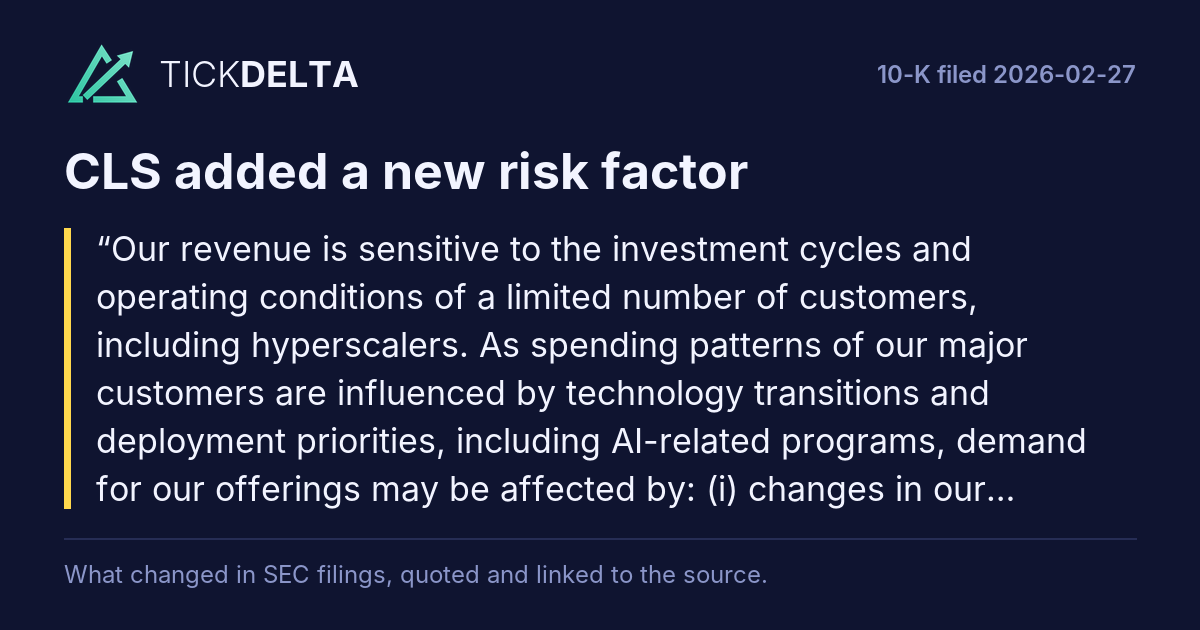
Our revenue is sensitive to the investment cycles and operating conditions of a limited number of customers, including hyperscalers. As spending patterns of our major customers are influenced by technology transitions and deployment priorities, including AI-related programs, demand for our offerings may be affected by: (i) changes in our customers' AI investment
strategy; (ii) their access to specialized components such as accelerators and network; (iii) their ability to secure sufficient data center capacity, grid interconnections, and access to power and water; and (iv) regulations, policies and legislations affecting AI, export controls, or data center operations that may increase compliance costs or constrain the development and commercial use of AI technology. If our customers experience delays, increased costs or reduced access to these inputs due to the foregoing factors, they may slow, scale down or cancel programs with us. This could adversely affect our revenue, margins and cash flows and increase variability of results from period to period. See also "We are dependent on our customers' ability to compete and succeed in the marketplace using products we manufacture and services we provide," and "The future development and adoption of AI and the deployment of data center infrastructure are uncertain and depend on the availability and cost of critical inputs (including power and water), which could materially affect demand for our products and services and our operating results."
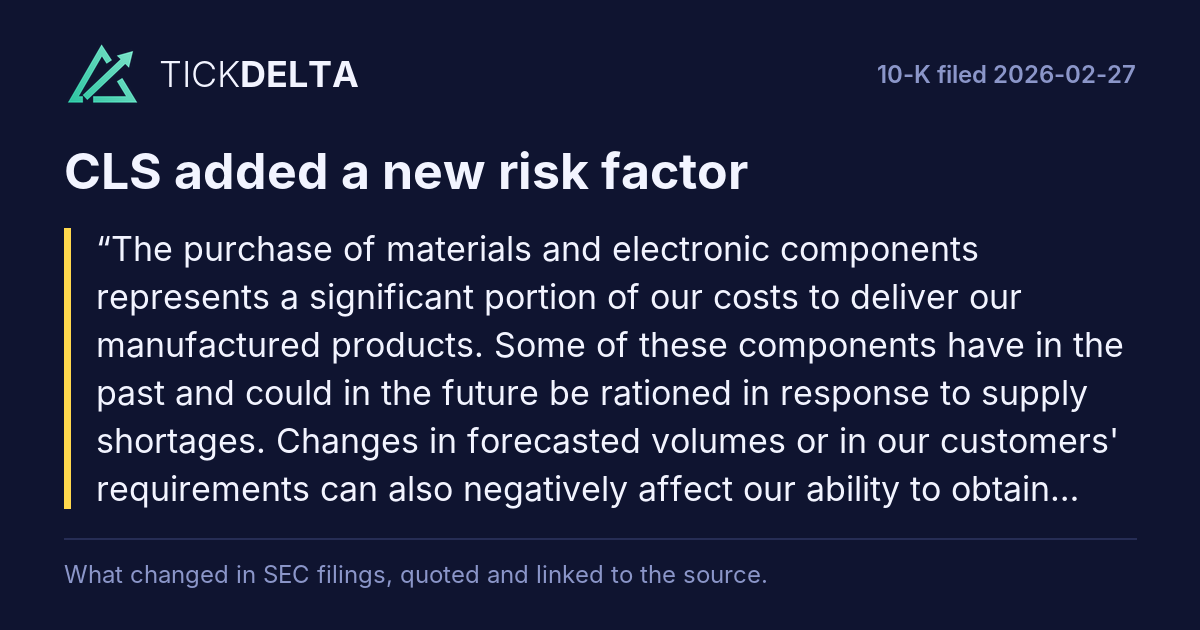
The purchase of materials and electronic components represents a significant portion of our costs to deliver our manufactured products. Some of these components have in the past and could in the future be rationed in response to supply shortages. Changes in forecasted volumes or in our customers' requirements can also negatively affect our ability to obtain components. We work with our suppliers and customers to attempt to ensure continuity in the supply of these components. In cases where unanticipated customer demand or supply shortages occur, we attempt to arrange for alternative sources of supply, where available, or defer planned production in response to the availability of the critical components.
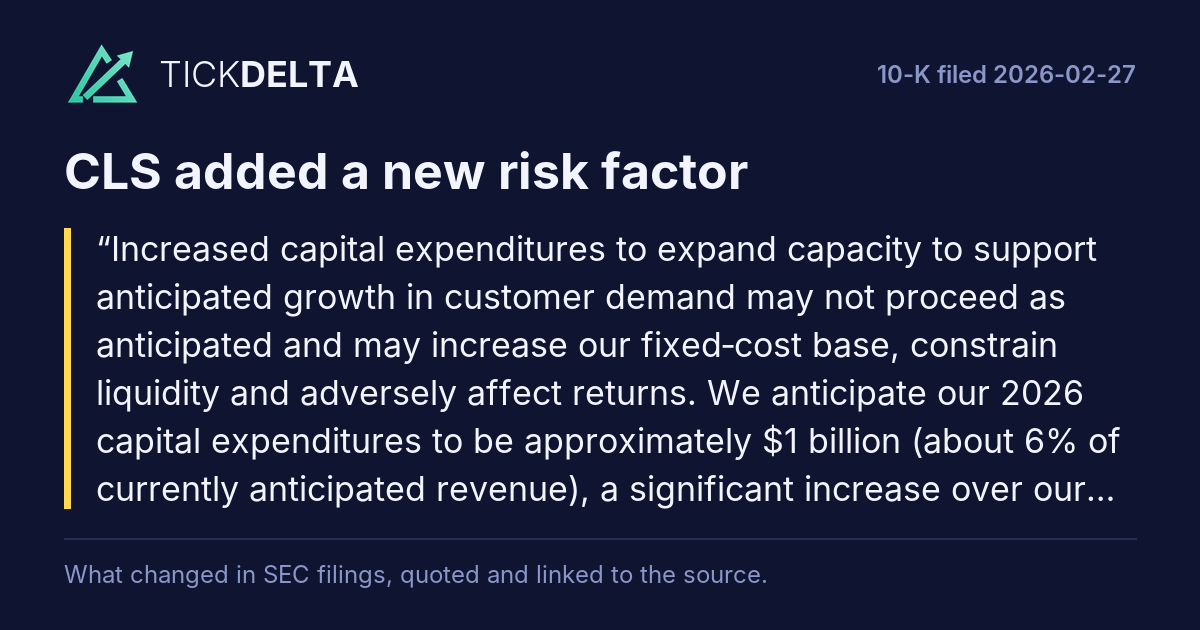
Increased capital expenditures to expand capacity to support anticipated growth in customer demand may not proceed as anticipated and may increase our fixed‑cost base, constrain liquidity and adversely affect returns.
We anticipate our 2026 capital expenditures to be approximately $1 billion (about 6% of currently anticipated revenue), a significant increase over our historical capital expenditure range of 1.5% to 2.0% of annual revenue, to support expected growth in customer demand, particularly from our hyperscaler customers. Increased capital expenditures raise our fixed‑cost base and future depreciation expenses. Our capital investments may not proceed as anticipated, or we may encounter delays in the timely completion of construction and operationalization of new or expanded assets due to various reasons such as issues with securing required materials, equipment, utilities and labor in a timely manner. We may also experience delays or challenges related to utility, power availability, grid interconnection, supply chain constraints, and other infrastructure or regulatory requirements. Any of these factors could delay the realization of anticipated capacity, increase project costs, or result in assets that are not fully operational when expected. If demand, mix, yield or utilization differ from our expectations, or if customer roadmaps change, ramp milestones are delayed, or expected volumes do not materialize, added capacity may be underutilized and returns on these investments may be lower than expected, and our financial results could be adversely affected. We may need to secure additional financing or reallocate capital resources from other initiatives and our flexibility could be limited by, among others, market conditions, our credit arrangements and other contractual commitments. See "We are dependent on a limited number of customers and end markets and are sensitive to their investment cycles and operating conditions. Revenue decline or loss of any major customer could have a material adverse effect on our operating results, financial position and cash flows", "If we are unable to recruit or retain highly skilled talent in key jurisdictions and within desired timeframes, our business could be adversely affected" and Item 7, MD&A — "Liquidity and Capital Resources."
from realizing the anticipated benefits of growth in new markets or technologies, which could materially adversely affect our business and operating results.
Transfers of business or operations have increased and may again increase our costs and cause disruptions in our ability to service our customers.
Our customers have in the past and may in the future require that we transfer the manufacturing of their products from one of our facilities to another to achieve cost reductions, tariff reductions and other objectives. These transfers have resulted in and could again result in increased costs to us due to facility downtime, less than optimal utilization of our manufacturing capacity and delays and complications related to the transition of manufacturing programs to new locations. These transfers, and any decision by a significant customer to terminate manufacturing services in a particular facility, could require us to close or reduce operations at certain facilities and, as a result, we may incur in the future significant costs for the closure of facilities, employee severance and related matters. We may be required to relocate or close additional manufacturing operations in the future and, accordingly, we may incur additional costs that decrease our net income.
events could negatively impact any of our locations or the locations of our customers, and may cause us to experience work stoppages, project delays, financial losses and/or additional costs to resume operations, including increased insurance costs or loss of coverage, legal liability and reputational losses. As a result, the effects of climate and weather related risks could have a long-term material adverse impact on our business, results of operations and financial condition. See "Our operations have been and could continue to be adversely affected by events outside our control," and "Our business and operations could be adversely impacted by sustainability initiatives."
The future development and adoption of AI and the deployment of data center infrastructure are uncertain and depend on the availability and cost of critical inputs (including power and water), which could materially affect demand for our products and services and our operating results.
Recent investments in AI infrastructure by hyperscalers and other data center customers have increased demand for certain products in our CCS segment, including our HPS business. However, the long‑term trajectory of AI adoption and related data center deployment is uncertain and may be affected by a variety of factors outside our control, including rapid changes in technology and customer AI roadmaps; evolving regulatory developments (including export controls and other AI-related measures) that increase our customers’ costs or restrict their AI activities; constraints on specialized components and data center capacity; and the availability, timing, reliability and price of critical utilities. Adverse developments in any of these areas could cause our cloud-based and other service provider customers, including hyperscalers and OEM customers, to delay, reduce or cancel programs, which could adversely impact demand for our products and services, as well as our revenue growth and operating results.
AI‑driven, high‑density deployments require predictable access to power and adequate water and cooling capacity. Data center developers and operators may experience constraints arising from: generation, transmission and distribution capacity; longer lead times for grid interconnections and utility upgrades; siting and permitting limitations; evolving policy requirements (including mandates or targets relating to renewable energy sourcing); and increased utility or compliance costs. These constraints can lead to deployment deferrals, smaller‑scale builds, or lower utilization of installed infrastructure. If our customers encounter such constraints, they may defer or scale back data center expansions or adjust their capital expenditure priorities in AI infrastructure, which could in turn reduce orders for the products we design and/or manufacture, delay program ramps or result in cancellations. Any of these outcomes could have a material adverse effect on our business, financial condition and results of operations. See "We are dependent on a limited number of customers and end markets and are sensitive to their investment cycles and operating conditions. Revenue decline or loss of any major customer could have a material adverse effect on our operating results, financial position and cash flows" and "We are dependent on our customers' ability to compete and succeed in the marketplace using products we manufacture and services we provide."
Hostilities or armed conflicts (including the Russia/Ukraine conflict and the Middle East Conflicts), or any related interruption or curtailment of trade or transport among the countries where our and our customers' facilities are located, could adversely affect our business, financial condition and results of operations. Further, political, economic and military instability
arranged. Such measures could include deferring our planned capital expenditure investments and reducing or eliminating discretionary uses of cash.
Volatility in energy and commodity prices may negatively impact our operating results.
our stockholders. Sales of our equity securities or convertible debt, or the perception that these sales could occur, could also cause the market price for our Common Shares to fall, and new securities could have rights, preferences and privileges senior to the holders of our Common Shares.
Tax authorities in certain jurisdictions are adopting increasingly assertive enforcement approaches and conducting broader examinations of both direct and indirect taxes. They may oppose the judgments we make and challenge the positions we have taken in current or prior periods and outcomes may differ materially from our estimates. As a result, we could face additional assessments of tax, interest and penalties that exceed our provisions. The timing and ultimate resolution of examinations are inherently uncertain and can take many years; in some cases, we may be required to pay, secure or otherwise fund disputed amounts while we pursue administrative or judicial remedies. Any of these developments could adversely affect our liquidity, cash flows, effective tax rate and results of operations. See also Item 7, MD&A "Operating Results — Income taxes and tax contingencies".
We have granted and will continue to grant additional share‑based awards, including stock options, restricted share units, performance share units, director share units and deferred share units, as compensation to attract, retain and incentivize directors and certain employees. Under the terms of these awards and our equity incentive plans, we may settle certain vested awards in cash or in shares. If share-based awards are settled with shares issued from treasury and we do not offset the dilution from these share settlements with share repurchases, the number of outstanding Common Shares will increase, which will dilute our shareholders’ percentage ownership. Furthermore, we may in the future issue equity or convertible securities for purposes other than compensating our employees and directors, including in connection with financings, strategic transactions or acquisitions. Any such future issuances could result in additional dilution to our shareholders. Anti-dilution or adjustment features in outstanding instruments may further increase the number of shares issuable upon conversion or exercise following any such issuances. Any or all of the foregoing could adversely affect the market price of our Common Shares. See also Item 7, MD&A — "Outstanding Share Data", and notes 2(l) and 12 to the 2025 AFS included herein.
New in the latest 10-Q
24 paragraphs in the 10-Q filed Oct 26, 2026 with nothing like them in the 10-Q filed Jul 27, 2026 (at least half the words must differ; new numbers alone do not count). Quoted exactly, grouped by the item heading above them. This is text that changed, not a judgement of how serious it is.
As of October 21, 2026, the registrant had 126,111,808 Common Shares outstanding.
Read in the 10-Q
(b) Consists of the proceeds, net of issuance costs, from our public offering of an aggregate of 11.1 million Common Shares completed on August 7, 2026 (see note 9).
Read in the 10-Q
Proceeds from issuance of capital stock under public offering, net of issuance costs 9 3,391.3 — 3,391.3 —
Read in the 10-Q
Net increase (decrease) in cash and cash equivalents 3,425.6 (7.9) 3,365.7 (117.4)
Read in the 10-Q
losses (gains) Amortization of intangible assets (excluding computer software) 10.0 10.0 29.9 29.9 Restructuring and other charges (recoveries) 11 0.9 4.9 (0.6) 23.3 Earnings before income taxes $ 455.8 $ 310.9 $ 1,153.7 $ 681.9
Read in the 10-Q
The A/R sold under each of these programs are derecognized from our A/R balance at the time of sale, and the proceeds are reflected as cash provided by operating activities in our consolidated statements of cash flows. Upon sale, we assign the rights to the A/R to the banks. A/R are sold net of discount charges, which are recorded as finance costs in our consolidated statements of operations.
Read in the 10-Q
During Q3 2026 and YTD 2026, we sold A/R aggregating $ 1,297.5 and $ 2,176.9, respectively, under our A/R sales program and SFPs (Q3 2025 - $ 11.3; YTD 2025 - $ 22.1). Aggregated discount charges incurred on both of these programs were $ 4.2 and $ 7.7 for Q3 2026 and YTD 2026, respectively (Q3 2025 - nil; YTD 2025 - $ 0.1). At September 30, 2026, $ 700.8 of sold A/R under the A/R sales program (December 31, 2025 - nil ) remained outstanding.
Read in the 10-Q
We recorded inventory write-downs of $18.5 and $61.1 for Q3 2026 and YTD 2026, respectively (Q3 2025 - $20.3; YTD 2025 - $49.6) in cost of sales.
Read in the 10-Q
The components of accrued and other current liabilities and provisions are as follow:
Read in the 10-Q
(1) On August 7, 2026, we completed a public offering and issued an aggregate of 11.1 million Common Shares at a price of $ 310 per share. In connection with this public offering, we received proceeds of $ 3,391.3, net of issuance costs (underwriting discounts and offering expenses), which were recorded within total equity on the consolidated balance sheets, capital stock on the consolidated statements of changes in equity, and financing activities on the consolidated statements of cash flows.
Read in the 10-Q
events could disrupt operations or the economics of one or more of our sites or those of our customers, component suppliers and/or our logistics partners and may materially negatively impact our operating results.
Read in the 10-Q
As previously announced, on August 7, 2026, we completed a public offering (Public Offering) of an aggregate of 11,129,031 Common Shares (including the full exercise of the underwriters' option of 1,451,612 Common Shares) at a price of $310 per share. In connection with the Public Offering, we received proceeds of $3,391.3 million, net of underwriting discounts and offering expenses of $58.7 million, which were recorded within total equity on the consolidated balance sheets, capital stock on the consolidated statements of changes in equity, and within financing activities on the consolidated statements of cash flows. We expect to use the net proceeds from this Public Offering for working capital and to support investments in capital expenditures, in addition to other general corporate purposes.
Read in the 10-Q
We intend to file a notice of intention with the Toronto Stock Exchange (TSX) to commence a new NCIB in Q4 2026, after our current NCIB expires on November 2, 2026. If this notice is accepted by the TSX, we expect to be permitted to repurchase for cancellation, at our discretion during the twelve months following such acceptance, up to 2.5% of the "public float" (calculated in accordance with TSX rules) of our issued and outstanding Common Shares. Purchases under the new NCIB, if accepted by the TSX, will be conducted in the open market or as otherwise permitted, subject to applicable terms and limitations, and will be made through the facilities of the TSX and the New York Stock Exchange. We believe that a new NCIB is in the best interests of Celestica and our shareholders.
Read in the 10-Q
At September 30, 2026, approximately 5.4 million of our Common Shares remain available for repurchase under our current NCIB. The maximum number of Common Shares we are permitted to repurchase for cancellation under our current NCIB is reduced by the number of Common Shares we arrange to be purchased by any non-independent broker in the open market during the term of the NCIB to satisfy delivery obligations under our stock-based compensation (SBC) plans. In Q3 2026, we paid $37.6 million (including transaction fees) to repurchase 0.1 million Common Shares through a non-independent broker for delivery obligations under our SBC plans. See "Summary of Q3 2026 and Year-to-Date Period" and Part II, Item 2, "Unregistered Sales of Equity Securities and Use of Proceeds" below. See note 9 to our Q3 2026 Interim Financial Statements for further details.
Read in the 10-Q
(in millions) 2026 2025 Outstanding balance of sold A/R at period end*: September 30 June March 31 December 31 September 30 June March 31
Read in the 10-Q
* See "Liquidity - Financing and finance costs - A/R sales program and customer SFPs" below for descriptions of these programs.
Read in the 10-Q
2026 2025 (in millions) September 30 June March 31 December 31 September 30 June March 31
Read in the 10-Q
We earn interest income primarily from cash and short-term deposits maintained with major financial institutions. We recorded interest income of $19.7 million in Q3 2026 and $25.5 million in YTD 2026 (Q3 2025 - $1.0 million; YTD 2025 - $3.2 million). The increases of interest income in Q3 2026 and YTD 2026 from the respective prior year periods were primarily driven by higher cash and cash equivalent balances, resulting from the Public Offering (see "Recent Developments - Public Offering" above).
Read in the 10-Q
We expect a net use of cash in 2027 driven by higher working capital requirements and capital expenditures to support our business growth. See "Capital Expenditures" below.
Read in the 10-Q
On August 7, 2026, we completed the Public Offering and issued an aggregate of 11,129,031 Common Shares at a price of $310 per share. In connection with the Public Offering, we received proceeds of $3,391.3 million, net of underwriting discounts and offering expenses of $58.7 million. We expect to use the net proceeds from this Public Offering for working capital and to support investments in capital expenditures, in addition to other general corporate purposes. See "Recent Developments - Public Offering".
Read in the 10-Q
See "Net proceeds from issuance of capital stock under Public Offering" above for a description of the Public Offering and related underwriting discounts and offering expenses.
Read in the 10-Q
performance may also be affected by matters discussed under Item 1A, Risk Factors of our 2025 10-K. These risks and uncertainties may adversely affect our long-term liquidity.
Read in the 10-Q
See "Liquidity - Financing and finance costs - A/R sales program and customer SFPs" above for a description of our A/R sales program and customer SFPs.
Read in the 10-Q
Net earnings for Q3 2026 increased $28.4 million sequentially to $397.2 million. This growth was driven by higher gross profit, a $15.9 million increase in interest income resulting from higher cash and cash equivalent balances following the Public Offering, and a $14.2 million reduction in income tax expense primarily due to the acceptance of certain subsidiaries into a bilateral advance pricing arrangement. These benefits were partially offset by a $60.1 million increase in SG&A, primarily driven by unfavorable changes in TRS FVAs ($3.0 million loss in Q3 2026 compared to $55.7 million gain in Q2 2026).
Read in the 10-Q
Item 1A of the 10-Q filed Oct 26, 2026 against Item 1A of the 10-K filed Feb 27, 2026.
A 10-Q repeats only the risks that changed, so a 10-K paragraph that is missing from it is not counted as removed.
Added is a paragraph with nothing like it in the 10-K, Reworded a sentence that is in both with several words changed,
Quiet changes a sentence in both where one to four words changed and one is a hedge or a modal
(cut words struck through, new words highlighted).
Text on the page, not a score; each links to the filing at sec.gov.
Two-word phrases in Risk Factors of the 10-K filed Feb 27, 2026 that are in none of the 1 earlier 10-Ks stored, back to Mar 3, 2025
Used at least twice, small words left out. Counted, not picked: a phrase can be new because the company renamed something.
15 paragraphs of last year's Risk Factors with nothing like them now. The longest are quoted.
Item 1A of each 10-K and 10-Q on EDGAR, quoted exactly. Each paragraph links to the filing at sec.gov.
10-K change: what was reworded or cut, section by section.
Excel workbook · CSV. Google Sheet that stays up to date: paste =IMPORTDATA("https://tickdelta.com/company/CLS/export.csv") into a cell.