Form 10-K for the Fiscal Year Ended December 31, 2022
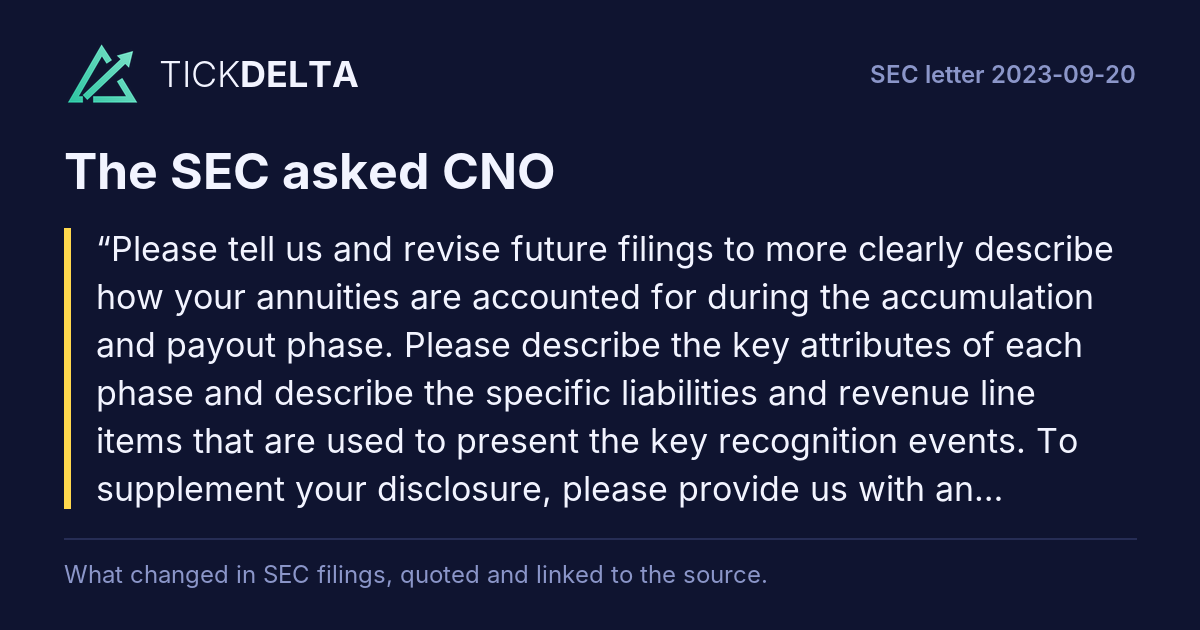
Please tell us and revise future filings to more clearly describe how your annuities are accounted for during the accumulation and payout phase. Please describe the key attributes of each phase and describe the specific liabilities and revenue line items that are used to present the key recognition events.Rest of the question
To supplement your disclosure, please provide us with an accounting analysis of the life cycle of a typical fixed index annuity, detailing the journal entries recorded with appropriate commentary at issuance and throughout the accumulation and payout phase. Please include the accounting for embedded derivatives, market risk benefits in an asset and liability position and include details regarding the periodic unlocking exercises. Please include appropriate reference to the applicable accounting guidance supporting your journal entries at each stage of the life cycle. Liability for future policy benefits, page 11
The fixed indexed annuities (“FIA”) issued by the insurance subsidiaries of CNO are a deferred annuity contract with a guaranteed minimum interest rate plus a contingent return based on the price return of an external index, which is typically the S&P 500 (and is assumed to be the S&P 500 throughout this letter).Read in the replyRest of the answer
FIA contracts are designed so that the guaranteed contract value meets regulatory requirements such that the contract holder receives no less than 90 percent of the initial deposit, compounded annually at 3 percent, which establishes a floor value for the contract.
Our FIA contracts do not have a specified maturity date; therefore, the contracts remain in the accumulation phase until the customer surrenders the contract. Although the contracts permit the holder to elect to convert their annuity contract to a periodic paying contract under various payment options after a defined period of time, few elect these options. Policyholders can surrender the contract at any time, at which point they receive their account value, as specified in the contract, less any applicable surrender charges. The account value is generally defined as the greater of the policyholder’s initial investment plus the equity-indexed return or a guaranteed floor amount (calculated as the policyholder’s initial investment plus a specified annual percentage return). One penalty-free withdrawal of up to 10 percent of either the premium paid or the account value is permitted annually after the first year of the annuity’s term and many policyholders elect that option at various times.
Our FIAs are annual periodic ratchet designed contracts, where the policyholder receives the greater of: (i) the defined appreciation in the equity index during each one-year period ending on the policy’s anniversary date; or (ii) the guarantee minimum fixed return over that period.
Consistent with the terms of the policy, the contract holder receives a portion of the appreciation in the S&P 500 index during the annual period, which is based on a participation rate that is reset on each policy anniversary date; subject to contractual guaranteed minimum participation rates. This allows the Company to set the participation rate at a level consistent with the investment return earned on the net premiums received and the current option cost to fund the indexed benefit.
In 2016, we began offering a guaranteed lifetime income rider to our FIA contracts, which allows policyholders the option to elect to receive a guaranteed income stream for life, without having to annuitize their policy. In 2021, an optional benefit was added to the rider which enhances the guaranteed income stream payout amount for a two-year period if the policyholder meets certain conditions related to the ability to perform activities of daily living. These benefits are often referred to as guaranteed living withdrawal benefits (“GLWB”).
Commissions, underwriting, sales and contract issuance and processing costs are incurred when a FIA contract is issued. When such costs are incremental costs directly related to the successful acquisition of a new insurance contract, they are capitalized and amortized on a constant level basis over the expected term to approximate straight-line amortization.
Similar descriptions of our fixed indexed products are currently provided in Item I of our Form 10-K. To the extent the above disclosures are not currently provided, they will be included in future filings.
With respect to periodic unlocking exercises, a detailed review of assumptions is performed annually during the fourth quarter. There were no assumption changes related to fixed indexed annuities in the three and six months ended June 30, 2023 and 2022. In future filings, we will include disclosures related to our periodic unlocking exercises.
In response to your request to provide detailed journal entries for the accounting for FIAs, please refer to the illustration included in Exhibit 1-1.
First report after the company's reply of Oct 13, 2023: 10-Q filed Nov 8, 2023 ↗, against the 10-Q filed Aug 9, 2023 ↗.
Tickdelta does not hold the text of both reports, so they are not compared here.
We note your disclosure that, “this liability also includes the amount of total reserves above (below) policyholder account balances for our fixed indexed annuity products due to the valuation of the related embedded derivative.” Please tell us and revise future filings to quantify this amount for each period presented and, if true, disclose that the change in this amount is recognized as “Insurance policy benefits”Rest of the question
in the statement of operations. Additionally, please tell us and in future filings revise the Policyholder account balance policy disclosure to clearly describe the portion of the embedded derivative liability that is presented in this line item and revise the table on page 44 to more clearly describe in which balance sheet line items the fair value of the embedded derivative liability is presented.
Total liabilities for insurance products related to our fixed indexed annuities are comprised of: (i) the liability related to the host contract; and (ii) the fair market value of the embedded derivatives as summarized below (dollars in millions):Read in the reply
June 30,
2023 December 31,
2022
Fixed indexed annuity insurance liabilities
Host contract liability $8,035.3 $7,856.4
Embedded derivatives at market 1,355.4 1,297.0
Total fixed indexed annuity insurance liabilities $9,390.7 $9,153.4
For presentation in the consolidated balance sheet, the total fixed indexed annuity insurance liabilityRest of the answer
balance is bifurcated between: (i) policyholder account balances (which is the total of all current balances accruing to the policyholder under the terms and conditions of the policies assuming the contracts will continue in force); and (ii) the difference between the total fixed indexed annuity insurance liabilities summarized above and the policyholder account balances, which is classified as future policy benefits. These classifications are summarized below (dollars in millions):
Policyholder account balances $9,852.6 $9,644.8
Future policy benefits (461.9) (491.4)
Total fixed indexed annuity insurance liabilities $ 9,390.7 $ 9,153.4
The following definition of policyholder account balance is provided in ASC 944, which we follow in determining the amount to record in the policyholder account balances line item in our financial statements:
At any point in time, this is the amount held by the insurance entity on behalf of the policyholder. This balance may be held in a general account, a separate account (a legally segregated account), or a combination of both on the insurance entity’s balance sheet. This account includes premiums received from the policyholder, plus any credited income, less any relevant charges (acquisition costs, cost of insurance, and so forth).
When the total policyholder account balance exceeds the total fixed indexed annuity insurance liabilities, a negative future policy benefit balance will occur.
In future filings, we will revise the table on page 44, as presented below, to more clearly describe which balance sheet items the fair value of the embedded derivative liability is included:
ACCOUNTING FOR DERIVATIVES
Our freestanding and embedded derivatives, which are not designated as hedging instruments, are held at fair value and are summarized as follows (dollars in millions):
Fair value
2023 December 31, 2022
Assets:
Other invested assets:
Fixed indexed call options $ 194.2 $ 56.7
Reinsurance receivables (18.1) (17.8)
Total assets $ 176.1 $ 38.9
Liabilities:
Embedded derivatives related to fixed indexed annuities at fair value:
First report after the company's reply of Oct 13, 2023: 10-Q filed Nov 8, 2023 ↗, against the 10-Q filed Aug 9, 2023 ↗.
Tickdelta does not hold the text of both reports, so they are not compared here.
Please tell us and revise future filings to clarify the difference between “Issuances” and “Premiums Received” in the rollforward of the liability for policyholder account balances on page 34.
“Issuances” represents funds collected from new business, and “Premiums received” represents premiums collected from policyholders during the period related to inforce business. In future filings, we will add parenthetical explanations to these line items to describe what is included in each line item, as summarized below.Read in the reply
The following table summarizes balances and changes in the liability for policyholder account balances for the six months ended June 30, 2023 (dollars in millions):
Six months ended
June 30, 2023
Fixed indexed annuities Fixed interest annuities Other annuitiesRest of the answer
Interest-sensitive life Funding agreements Other
Balance, beginning of period excluding contracts 100% ceded $ 9,490.4 $ 1,663.1 $ 127.1 $ 1,209.6 $ 1,410.8 $ 395.5
First report after the company's reply of Oct 13, 2023: 10-Q filed Nov 8, 2023 ↗, against the 10-Q filed Aug 9, 2023 ↗.
Tickdelta does not hold the text of both reports, so they are not compared here.
Please tell us and revise future filings to clarify how premiums are paid for your fixed index annuities (e.g., lump sum or installments) and the magnitude of each.
In 2023, we will begin offering fixed indexed annuities which permit flexible premium payments. However, we expect the vast majority of premium payments will continue to be paid in a lump sum. In future filings, we will add the following disclosure assuming no significant changes in consumer behavior:Read in the reply
Substantially all of the deposits on our fixed indexed annuity products are paid in a lump sum.
Please tell us and revise future filings to clarify the available payout options for your fixed index annuities (e.g., lump sum, fixed payments for a fixed amount of time, lifetime payments, etc.) and the magnitude of each payment option selected.
Although our fixed indexed annuities provide for various annuitization options which permit the policyholder to convert a policy to one which provides for periodic payments under various payment options (including the policyholder’s remaining life or for a term-certain period), the majority of policyholders take their benefit in a lump sum or may elect the option to take one penalty-free withdrawal of up to 10 percent each year of either the premium paid or the account value after the first year of the annuity’s term. Similar disclosure will be added in future filings.Read in the reply
We note your disclosure on page 65 that, “Net investment income and interest credited exclude the change in market values of the underlying options supporting the fixed indexed annuity products and corresponding offsetting amount credited to policyholder account balances.Rest of the question
Such amounts were $(181.3) million, $195.5 million and $32.3 million in 2022, 2021 and 2020, respectively.” Please provide us with and revise future filings to include an analysis of the earnings impact, for each period presented, of the embedded derivative and related items if meaningful to the analysis (e.g., interest credited to policy holder account balances, amortization of DAC, etc.) and the derivative options used to hedge the embedded derivative. The analysis should detail the specific line items in which each earnings impact is recognized in your GAAP financial statements and in your non-GAAP financial measures net operating income and non-operating income.
In response to your request, we have provided a reconciliation of the relevant fixed indexed annuity amounts in our consolidated statement of operations to our non-GAAP financial measures of margin from fixed indexed annuities and non-operating income. Please refer to Exhibit 6-1 for a reconciliation for the six months ended June 30, 2023.Read in the reply
Options are not purchased to hedge the embedded derivatives.Rest of the answer
We buy call options (including call spreads) referenced to the applicable indices in an effort to hedge potential increases to policyholder benefits resulting from increases in the particular index to which the policy’s return is linked. The value of the embedded derivatives is based on the estimated cost to fulfill our commitment to fixed indexed annuity policyholders to purchase a series of annual forward options over the duration of the policy (and is not based on the increase in the particular index to which the policy’s return is linked).
We note your disclosure on page 50 in note (a) that “fair value changes due to fluctuations in the interest rates used to discount embedded derivative liabilities related to our fixed indexed annuities” is excluded from your segment measure.Rest of the question
Please tell us and revise future filings as needed to clarify, if all changes in fair value of embedded derivative liabilities are excluded, or if it is only the portion related to changes in the discount rate. Additionally, please explain why you exclude the change in fair value of the embedded derivative liabilities from your segment measure but include the change in fair value of the derivative call options which are used to hedge the embedded derivative liability.
Prior to January 1, 2023, our non-operating earnings only included fair value changes due to fluctuations in interest rates that were used to value the embedded derivatives related to our fixed indexed annuities. In connection with our adoption of the new accounting standard related to targeted improvements to the accounting for long-duration insurance contracts effective January 1, 2023, we updated our method of determining non-operating earnings for our fixed indexed annuities to better identify the volatile non-economic impacts of that line of business to include the impacts of changes inRead in the replyRest of the answer
equity markets on the fair value of the embedded derivatives. The change in fair value of the derivative call options is not included in non-operating earnings as there is a corresponding offsetting amount credited to policyholder account balances which results in no net impact to our earnings. The reconciliation included in Exhibit 6-1 illustrates this impact.
To the extent that the adjustments included in the non-GAAP reconciliation on page 50 are presented net of tax, please revise future filings to show the adjustments on a gross basis and show the tax impact of adjustments in a separate line item with a clear explanation of how the amount was measured. Also, revise your discussion of the non- GAAP measure as needed to clarify the measurement of each adjustment.Rest of the question
Please refer to question 102.11 of the C&DIs on Non-GAAP Financial Measures for guidance. Results of Operations, page 59
The adjustments included in the non-GAAP reconciliation on page 50 are presented gross of tax and the tax impact of such adjustments is included on a separate line item. In future filings, we will revise footnote (a) to add additional disclosure indicating that the tax impact of the adjustments includes the current and deferred income tax expense or benefit associated with such items.Read in the reply
Such additional disclosure is in bold-face type below:
____________
(a)Management believes that an analysis of net income applicable to common stock before: (i) net realized investment gains (losses) fromRest of the answer
sales, impairments and change in allowance for credit losses, net of related amortization and taxes; (ii) net change in market value of investments recognized in earnings, net of taxes; (iii) fair value changes due to fluctuations in the interest rates used to discount embedded derivative liabilities related to our fixed indexed annuities, net of related amortization and taxes; (iv) fair value changes related to the agent deferred compensation plan, net of taxes; (v) changes in the valuation allowance for deferred tax assets and other tax items; and (vi) other non-operating items consisting primarily of earnings attributable to VIEs ("net operating income", a non-GAAP financial measure) is important to evaluate the financial performance of the company, and is a key measure commonly used in the life insurance industry. The income tax expense or benefit included in net non-operating income (loss) represents the current and deferred income tax expense or benefit allocated to the items included in non-operating earnings. Management uses this measure to evaluate performance because the items excluded from net operating income can be affected by events that are unrelated to the Company's underlying fundamentals. The table above reconciles the non-GAAP measure to the corresponding GAAP measure.
Please tell us and enhance your disclosure in future filings to more fully describe the line item labeled amortization and non-deferred commissions, specifically detailing what nondeferred commissions are and where they are presented in the consolidated statement of operations so a reader can better understand the nature of these adjustments and how they relate to your consolidated operating results.
The line item labeled “amortization and non-deferred commissions” is comprised of: (i) amortization of deferred acquisitions costs and present value of future profits; and (ii) commission expenses that are not directly related to the successful acquisition of new or renewal insurance contracts, and, therefore, are not eligible to be deferred. Such non-deferred commissions are included in other operating costs and expenses on the consolidated statement of operations.Read in the replyRest of the answer
In future filings, we will enhance our disclosures to describe the non-deferred commissions and where they are presented on the consolidated statement of operations.
An example of such disclosure is as follows which will be included in a footnote below the table in future filings.
(a) Amortization and non-deferred commissions are comprised of: (i) the amortization of deferred acquisition costs and present value of future profits; and (ii) commission expenses that are not directly related to the successful acquisition of new or renewal insurance contracts and, therefore, are not eligible to be deferred. Such non-deferred commissions are included in other operating costs and expenses on the consolidated statement of operations.
We note insurance policy benefits totaled ($106.2) million, $33.7 million and $108.8 million for 2022, 2021 and 2020. Please tell us and revise future filings to more clearly discuss what activity this represents and describe the key drivers resulting in the variability during the periods presented.
Insurance policy benefits related to fixed indexed annuity products were $(106.2) million, $33.7 million and $108.8 million in 2022, 2021 and 2020, respectively. Such amounts were primarily impacted by: (i) assumption unlocking exercises in each year as further disclosed on pages 60 and 61; and (ii) changes in market conditions (primarily higher interest rates and lower equity markets) which impacted the valuation of the embedded derivatives as disclosed on page 64.Read in the replyRest of the answer
The following table summarizes such impacts in each year (dollars in millions):
(Expense) income
2022 2021 2020
Insurance policy benefits $ (106.2) $ 33.7 $ 108.8
Impact of assumption unlocking exercises (32.8) 40.7 124.3
Impact of market conditions on the value of the embedded derivatives (62.0) 4.0 4.0
Insurance policy benefits, excluding impact of the above items $ (11.4) $ (11.0) $ (19.5)
In future filings, we will more clearly describe the impacts driving the variability similar to the above, and modified as appropriate.
First report after the company's reply of Oct 13, 2023: 10-Q filed Nov 8, 2023 ↗, against the 10-Q filed Aug 9, 2023 ↗.
Tickdelta does not hold the text of both reports, so they are not compared here.
Please tell us and revise future filings to detail the amount and nature of material items disclosed as “Amortization” on the face of the Consolidated Statement of Operations.
The “Amortization” line item on the face of the consolidated statement of operations is comprised of the amortization of deferred acquisition costs and the amortization of the present value of future profits. In future filings, this line item will be referred to as “Amortization of deferred acquisition costs and present value of future profits”.Read in the reply
First report after the company's reply of Oct 13, 2023: 10-Q filed Nov 8, 2023 ↗, against the 10-Q filed Aug 9, 2023 ↗.
Tickdelta does not hold the text of both reports, so they are not compared here.
We note your disclosure on page 131 that the change in fair value, net for each period in your embedded derivatives is included in the consolidated statement of operations. Please tell us and revise future filings here and in the summary of significant accounting policies to disclose in which line item(s) the net change in fair value of your embedded derivatives is presented.
The change in fair value, net line item included in our disclosure on page 131 is included in the Insurance policy benefits line item in the consolidated statement of operations. In future filings, this disclosure as well as the derivatives disclosure included in the summary of significant accounting policies will include the specific line items that are impacted by changes in fair value of our embedded derivatives.Read in the reply
First report after the company's reply of Oct 13, 2023: 10-Q filed Nov 8, 2023 ↗, against the 10-Q filed Aug 9, 2023 ↗.
Tickdelta does not hold the text of both reports, so they are not compared here.
Please tell us and revise future filings to disclose the location and amount of gains and losses on your embedded derivatives in the table on the bottom of page 149. Refer to ASC 815-10-50-4A for guidance.
In future periods, we will add to the table on the bottom of page 149 the amount included in insurance policy benefits related to embedded derivatives associated with our fixed indexed annuity products (which was disclosed on page 131). See below for an example of the revised disclosure.Read in the reply
The following table provides the pre-tax impact recognized in net income for derivative instruments, which are not designated as hedges for the periods indicated (dollars in millions):
Net investment income (loss) from policyholder and other special-purpose portfolios:
Fixed indexed call options $ (206.6)Rest of the answer
$ 220.9 $ 39.5
Total investment gains (losses):
Embedded derivatives related to modified coinsurance agreement (16.1) (3.1) 2.6
Total revenues from derivative instruments, not designated as hedges (222.7) 217.8 42.1
Insurance policy benefits:
First report after the company's reply of Oct 13, 2023: 10-Q filed Nov 8, 2023 ↗, against the 10-Q filed Aug 9, 2023 ↗.
Tickdelta does not hold the text of both reports, so they are not compared here.
Please tell us and revise future filings to disclose the amount of statutory capital and surplus necessary to satisfy regulatory requirements. Refer to ASC 944-505-50-1. In closing, we remind you that the company and its management are responsible for the accuracy and adequacy of their disclosures, notwithstanding any review, comments, action or absence of action by the staff.
The Company’s insurance subsidiaries are required to comply with minimum statutory capital and surplus levels in the states they do business. At December 31, 2022, the statutory capital and surplus of each of our insurance subsidiaries exceeded such minimum requirements which ranged from $1.4 million to $6.0 million. The combined minimum statutory capital and surplus requirements of our insurance subsidiaries is $27.4 million. Such minimum statutory capital and surplus requirements are not significant in relation to the statutory capital and surplus of our insurance subsidiaries.Read in the replyRest of the answer
In accordance with ASC 944-505-50-1, disclosure of statutory capital necessary to satisfy regulatory requirements is not required if such amounts are not significant to the entity’s statutory capital and surplus. Accordingly, no disclosure is deemed necessary.
Please note that our current disclosures do include information related to RBC requirements and the various levels of capital and surplus that could result in possible regulatory attention.
In connection with responding to your comments, the Company provides specific acknowledgment of the following:
•The Company is responsible for the accuracy and adequacy of the disclosures in our filings;
•Staff comments or changes to disclosures in response to staff comments do not foreclose the Commission from taking any action with respect to the filings; and
•The Company may not assert staff comments as a defense in any proceeding initiated by the Commission or any person under the federal securities laws of the United States.
First report after the company's reply of Oct 13, 2023: 10-Q filed Nov 8, 2023 ↗, against the 10-Q filed Aug 9, 2023 ↗.
Tickdelta does not hold the text of both reports, so they are not compared here.
Also in this review: closing letter, 2023-10-30