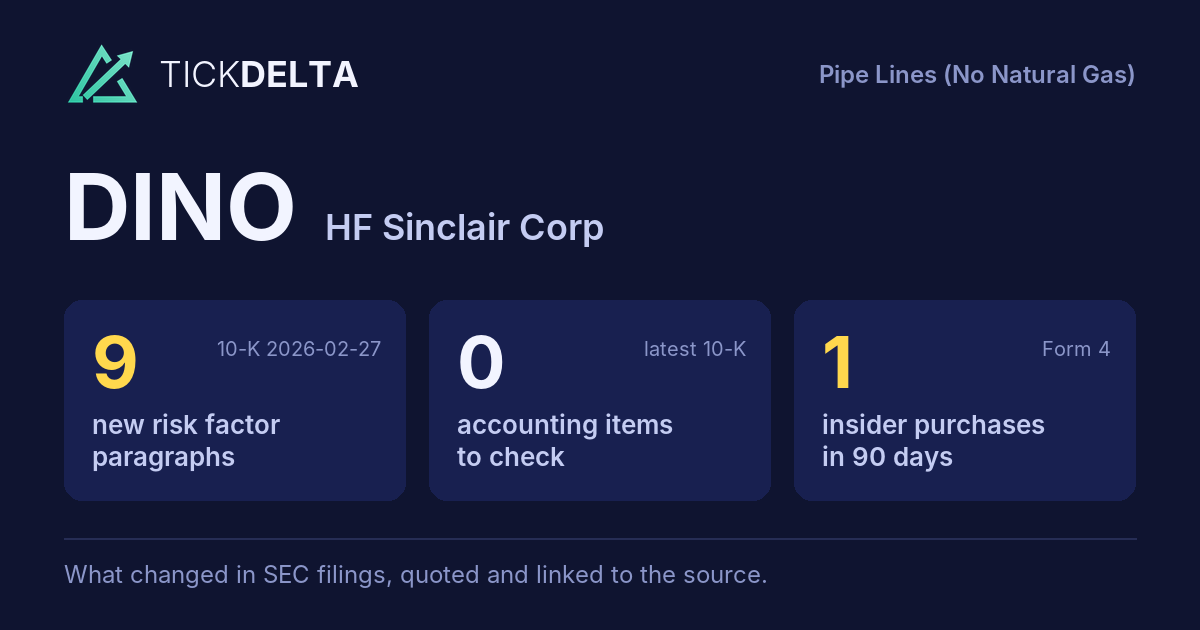
AddedRisk Factors
Additionally, certain employment practices and social initiatives are the subject of scrutiny by both those calling for the continued advancement of such policies, as well as those who believe they should be curbed, including government actors, and the complex regulatory and legal frameworks applicable to such initiatives continue to evolve. We cannot be certain of the impact of such regulatory, legal and other developments on our business. More recent political developments could mean that we face increasing criticism or litigation risks from certain “anti-ESG” parties, including various governmental agencies. Such sentiment may focus on our Renewables segment, environmental commitments or our pursuit of certain employment practices or social initiatives that are alleged to be political or polarizing in nature or are alleged to violate laws based, in part, on changing priorities of, or interpretations by, federal agencies or state governments. Consideration of ESG-related factors in our decision making could be subject to increasing scrutiny and objection from such anti-ESG parties. As a result, we may face increased litigation risks from private parties and governmental authorities related to our efforts.
Read it in 10-K Feb 27, 2026 at sec.govopen_in_new
RemovedRisk Factors
•REH Company became a significant holder of our common stock following the completion of the Sinclair Transactions.
Read it in 10-K Feb 20, 2025 at sec.govopen_in_new
RemovedRisk Factors
In 2021, the previous administration issued several executive orders that committed to substantial action on climate change, released “The Long-Term Strategy of the United States: Pathways to Net-Zero Greenhouse Gas Emissions by 2050”, which established a roadmap to net zero emissions in the United States by 2050 and called for, among other things, improving energy efficiency, decarbonizing energy sources, the increased use of zero-emission vehicles by the federal government, the elimination of subsidies provided to the fossil fuel industry, and increased emphasis on climate-related risks across governmental agencies and economic sectors. However, the 2050 roadmap and other climate change related executive orders were recently revoked, federal agencies have been directed to stop using the Social Cost of GHG emissions in rulemaking and other activities and the Interagency Working Group on the Social Cost of Greenhouse Gases has been disbanded. The previous administration’s executive orders prioritizing the reduction of GHG emissions have been rescinded and the EPA’s GHG “Endangerment Finding”, which underpins the majority of the EPA’s GHG regulations, is under review. We are unable to predict the impact of these changes. In 2023, the EPA finalized a rule to further reduce GHGs and other emissions primarily from oil production and natural gas production, transmission and storage that could increase the cost of domestic crude oil and natural gas. The EPA finalized rules in 2024 to regulate GHG emissions from power plants that could increase the cost of electricity use by our facilities.
Read it in 10-K Feb 20, 2025 at sec.govopen_in_new
RewordedRisk Factors
We have implemented safeguards and other preventative measures designed to protect our systems and confidential and proprietary data, including sophisticated network security and internal control measures; however, our information technology systems and communications network, and those of our information technology and communication service providers, remain vulnerable to interruption by natural disasters, power loss, telecommunications failure, terrorist attacks, internet failures, computer malware, ransomware, cyberattacks, data breaches and other events unforeseen or generally beyond our control. measures.
Read it in 10-K Feb 27, 2026 at sec.govopen_in_new
RewordedRisk Factors
In March 2024, Also, the EPA finalized an amendment EPA’s amendments to the RMP rules that, among other provisions, requires rules, which are subject to ongoing litigation and reconsideration by the current administration, could require refineries with HF Alkylation process (including three of our refineries) to perform a “safer technology and alternatives analysis” as part of the process hazard analysis to consider and document the practicality practicability of inherently safer technologies and other risk management measures. measures and could lead to capital expenditures in future years or otherwise constrain our operations.
Read it in 10-K Feb 27, 2026 at sec.govopen_in_new
RewordedRisk Factors
In addition to state LCFS (e.g., California LCFS, New Mexico CTFS, Oregon CFP and Washington CFS), and certain carbon cap and trade programs (e.g., Washington CAA CCA and Oregon CPP, which, we note, is in current legal limbo due to a December 2023 court decision striking down the ODEQ’s 2021 CPP rules and the ODEQ’s adoption of revised CPP rules in November 2024, which may be subject to legal challenge, CPP), we do business in multiple jurisdictions that have issued, or are considering issuing, similar low-carbon fuel regulations, policies, and standards.
Read it in 10-K Feb 27, 2026 at sec.govopen_in_new
RewordedRisk Factors
We have implemented safeguards and other preventative measures designed to protect our systems and confidential and proprietary data, including sophisticated network security and internal control measures; however, However, our information and operational technology systems and communications network, and those of our information and operational technology and communication service providers, remain vulnerable to interruption by natural disasters, power loss, telecommunications failure, terrorist attacks, internet failures, computer malware, ransomware, cyberattacks, data breaches breaches, unsuccessful transition to upgraded or replacement systems and other events unforeseen or generally beyond our control.
Read it in 10-K Feb 27, 2026 at sec.govopen_in_new
RewordedRisk Factors
Most recently, in October 2024, Likewise, the EPA finalized EPA’s 2024 updates to its volatile organic liquid storage tank emission standards, which are subject to ongoing litigation and potential repeal by the current administration, establish more protective standards for various types of vessels, including floating roof storage vessels and storage vessels that utilize closed vent systems and controls. controls that could necessitate additional expenditures in future years and result in increased costs on our operations.
Read it in 10-K Feb 27, 2026 at sec.govopen_in_new
RewordedRisk Factors
If we are unable to meet the often conflicting ESG standards or investment, lending, ratings, or voting criteria and policies set by these parties, we may lose investors, investors may allocate a portion of their capital away from us, we may face increased ESG- ESG or anti-ESG-focused activism, our cost of capital or insurance may increase, our common stock or debt securities may be adversely impacted, demand for our services and refined petroleum products may decline, and our reputation may also be negatively affected. adversely affected, all of which could adversely affect our future financial results.
Read it in 10-K Feb 27, 2026 at sec.govopen_in_new
RewordedRisk Factors
Developments in the global oil markets, such as actual or potential hostilities or other conflicts in oil producing areas, including shipping disruptions in uncertainty regarding the Red Sea, the Israel-Gaza effects and Hezbollah conflict and the Russia-Ukraine war, durations of global hostilities, war or any associated military campaigns, and worldwide demand for crude oil, particularly in developing countries, can affect the prices of crude oil and result in inflated energy prices.
Read it in 10-K Feb 27, 2026 at sec.govopen_in_new
RewordedRisk Factors
Investors, Certain investors, stakeholders and other interested parties are also increasingly focusing have in the past focused on issues related to environmental justice. justice, despite shifting sentiment toward environmental justice at the federal level.
Read it in 10-K Feb 27, 2026 at sec.govopen_in_new
RewordedRisk Factors
In addition, increasing evolving and sometimes conflicting societal expectations, as well as expectations among stakeholder groups such as investors, proxy advisors and other standard-setters, for companies to address environmental issues, including climate change, and increased consumer use of substitutes to energy commodities may result in increased costs, reduced demand for our products and our services, reduced profits, increased investigations and litigation, and negative impacts on our stock price and costs of and access to capital markets.
Read it in 10-K Feb 27, 2026 at sec.govopen_in_new
RewordedRisk Factors
Our operations are subject to catastrophic losses, operational hazards, unforeseen interruptions and other disruptive risks such as natural disasters, adverse weather, accidents, maritime disasters or casualties (including those involving marine vessels/terminals), fires, explosions, hazardous materials releases or spills (such as the release of crude oil on the Osage Pipeline in July 2022), terror spills, terrorist attacks or cyberattacks, vandalism, power failures, mechanical failures and other events beyond our control, and we have experienced certain of these events in the past.
Read it in 10-K Feb 27, 2026 at sec.govopen_in_new
RewordedRisk Factors
In For example, in February 2025, the U.S. administration announced tariffs on Canada, Mexico and China, including a 10% tariff on Canadian crude oil. oil, which is subject to potential exemption under the United States-Mexico-Canada Agreement (“USMCA”) preference.
Read it in 10-K Feb 27, 2026 at sec.govopen_in_new
RewordedRisk Factors
Furthermore, the The Netherlands Climate Act has come into effect with Act, adopted in 2019 and updated in 2023, establishes the goal of reducing GHG emissions by 55% (compared to 1990) by 2030 and to be climate neutral by 2050.
Read it in 10-K Feb 27, 2026 at sec.govopen_in_new
Quiet changesRisk Factors
Permits or other authorizations are required under these laws and regulations for the operation of our facilities, pipelines and other operations, and these permits and authorizations are subject to revocation, adverse modification and renewal or may require operational changes, which may involve significant costs.
Read it in 10-K Feb 27, 2026 at sec.govopen_in_new
Quiet changesRisk Factors
Various regulators are considering regulation of the so-called emerging contaminants, including for example, a final rule adopted by the EPA in May 2024 to list certain PFAS as CERCLA hazardous substances.
Read it in 10-K Feb 27, 2026 at sec.govopen_in_new
Quiet changesRisk Factors
While we are not party to such any climate change suits at this time, we may become subject to or impacted by similar litigation in the future.
Read it in 10-K Feb 27, 2026 at sec.govopen_in_new
Quiet changesRisk Factors
Certain undertakings that are incorporated in the EU (including EU-incorporated subsidiaries of non-EU incorporated parent entities) will may be subject to ESG reporting requirements under the EU’s CSRD, which requires in-scope companies to report extensive audited sustainability information, including disclosing risks and opportunities arising from environmental and social matters, and the impact of their business on people and the environment.
Read it in 10-K Feb 27, 2026 at sec.govopen_in_new
Quiet changesRisk Factors
If a licensor alleges that we failed to comply with any of the obligations under our license agreements, we may be required to pay damages, enter costly litigation, and the licensor may have the right to terminate part of some or all of the license.
Read it in 10-K Feb 27, 2026 at sec.govopen_in_new
AddedMD&A
The comparison between the years ended December 31, 2024 and 2023 have been omitted from this Annual Report on Form 10-K for the year ended December 31, 2025, as such information can be found in Item 7 “Management’s Discussion and Analysis of Financial Condition and Results of Operations” of our Annual Report on Form 10-K for the year ended December 31, 2024, which was filed on February 20, 2025.
Read it in 10-K Feb 27, 2026 at sec.govopen_in_new
AddedMD&A
In the Lubricants & Specialties segment, we continued to improve our sales mix optimization and base oil integration across our portfolio during 2025. Our results were impacted by the planned turnaround at our Mississauga facility and headwinds related to base oil margins. In the first quarter of 2026, we completed our acquisition of Industrial Oils Unlimited, LLC for $38 million, which will enable us to continue improving our sales mix optimization and base oil integration efforts across our portfolio.
Read it in 10-K Feb 27, 2026 at sec.govopen_in_new
AddedMD&A
On July 4, 2025, the President signed the One Big Beautiful Bill Act (“OBBBA”) into law. Among other things, OBBBA extends the PTC under Section 45Z through the end of 2029, indefinitely extends the first-year depreciation allowance on qualified property placed in service after January 19, 2025, and extends and enhances many of the provisions enacted under the 2017 Tax Cuts and Jobs Act. The enactment of OBBBA did not materially impact our results of operations but did reduce cash taxes paid.
Read it in 10-K Feb 27, 2026 at sec.govopen_in_new
AddedMD&A
As previously disclosed, the Audit Committee of our Board of Directors engaged in an assessment of certain matters relating to the Company’s disclosure processes in relation to the reporting of the Company’s financial results for the fourth quarter of 2025 and full-year 2025. That assessment began in January 2026 after Mr. Atanas Atanasov, the Company’s Executive Vice President and Chief Financial Officer, raised concerns that certain actions taken by Mr. Tim Go, Chief Executive Officer and President, created an unfavorable “tone at the top” in relation to the 2025 disclosure processes. The Company’s management and the Audit Committee, with the support of external legal counsel, reviewed the concerns and other relevant information. In the course of these reviews, the Board of Directors developed separate concerns about the approach taken by Mr. Go in some communications made to management during the 2025 disclosure processes. Also, as previously discussed, on February 17, 2026, the Board of Directors received a request from Mr. Go to take a voluntary leave of absence from his duties as an officer and director of the Company. The Board of Directors accepted Mr. Go’s request, and his leave commenced on such date.
Read it in 10-K Feb 27, 2026 at sec.govopen_in_new
AddedMD&A
On February 17, 2026, the Board of Directors also appointed the current Chairperson of the Board of Directors, Mr. Franklin Myers, as Chief Executive Officer and President of the Company on a temporary basis.
Read it in 10-K Feb 27, 2026 at sec.govopen_in_new
AddedMD&A
Also, during the latter stages of this review, a separate concern developed relating to certain actions taken by Mr. Atanasov bearing upon the review process conducted by the Company’s management and the Audit Committee and the viability of his future working relationships with other members of the Company’s management team. After discussion of these concerns, on February 24, 2026, the Board of Directors received a request from Mr. Atanasov to take a voluntary leave of absence from his duties. The Board of Directors accepted Mr. Atanasov’s request, and his leave commenced on such date. Also on February 24, 2026, the Board of Directors appointed Mr. Vivek Garg, the Company’s Vice President, Chief Accounting Officer and Controller, as acting Chief Financial Officer of the Company, effective as of such date. See Item 9B “Other Information.”
Read it in 10-K Feb 27, 2026 at sec.govopen_in_new
AddedMD&A
The Company currently expects to negotiate a mutually agreeable separation arrangement with each of Mr. Go and Mr. Atanasov.
Read it in 10-K Feb 27, 2026 at sec.govopen_in_new
AddedMD&A
The Audit Committee has completed its review and has concluded that the certain actions referenced above did not create an unfavorable “tone at the top” in relation to the 2025 disclosure processes and that the Company’s disclosure controls and procedures are effective. See Item 9A “Controls and Procedures.”
Read it in 10-K Feb 27, 2026 at sec.govopen_in_new
AddedMD&A
Other income (expense), net was $(53) million for the year ended December 31, 2025 compared to $15 million for the year ended December 31, 2024. During the year ended December 31, 2025, we assigned certain of our equity ownership interests to other parties, resulting in a loss on sale of equity method investments of $47 million. Additionally, during the year ended December 31, 2025, we recognized a $24 million loss on early extinguishment of debt, inclusive of unamortized discount and debt issuance costs, as a result of the tender and redemption of certain debt, and the termination of certain credit agreements (see Note 13 “Debt” in the Notes to the Consolidated Financial Statements for additional information).
Read it in 10-K Feb 27, 2026 at sec.govopen_in_new
AddedMD&A
On April 3, 2025, we terminated our $1.65 billion senior unsecured revolving credit facility maturing in April 2026 (the “Terminated HF Sinclair Credit Agreement”) and the $1.2 billion senior secured revolving credit facility maturing in July 2025 of our wholly owned subsidiary Holly Energy Partners, L.P. (the “Terminated HEP Credit Agreement”). Contemporaneously, we entered into a new $2.0 billion senior unsecured revolving credit facility maturing in April 2030 (the “HF Sinclair Credit Agreement”), which contains an extension feature that allows us to extend the term of the commitment from time to time in increments of up to one year subject to the terms and conditions set forth in the HF Sinclair Credit Agreement. The HF Sinclair Credit Agreement includes an accordion feature that allows us to increase such commitments to an aggregate principal amount of up to $2.75 billion. In addition, HF Sinclair was released from its obligations under the Parent Guaranty Agreement, dated as of December 1, 2023, as guarantor, in favor of Wells Fargo Bank, National Association, in its capacity as administrative agent (the “Guaranty”), and the Guaranty was terminated. We did not pay any prepayment penalties in connection with the termination of the Terminated HF Sinclair Credit Agreement or the Terminated HEP Credit Agreement. We recognized an early extinguishment loss of $1 million, inclusive of unamortized debt issuance costs.
Read it in 10-K Feb 27, 2026 at sec.govopen_in_new
AddedMD&A
We recognized an early extinguishment loss of $23 million, inclusive of unamortized discount and debt issuance costs, as a result of the tender offers and redemptions for the year ended December 31, 2025.
Read it in 10-K Feb 27, 2026 at sec.govopen_in_new
AddedMD&A
Certain inventory buy/sell arrangements in which we have a repurchase obligation are recognized as financing arrangements. During the year ended December 31, 2025, we received cash proceeds and made principal payments of $103 million related to these financing arrangements.
Read it in 10-K Feb 27, 2026 at sec.govopen_in_new
RemovedMD&A
In the Lubricants & Specialties segment, we saw strong performance (excluding first-in, first out (“FIFO”) impacts), driven by increased sales volumes, sales mix optimization and base oil integration across our portfolio during 2024.
Read it in 10-K Feb 20, 2025 at sec.govopen_in_new
RemovedMD&A
On December 1, 2023, pursuant to that certain Agreement and Plan of Merger, dated as of August 15, 2023 (the “Merger Agreement”), by and among HEP, HF Sinclair, Navajo Pipeline Co., L.P., a Delaware limited partnership and an indirect wholly owned subsidiary of HF Sinclair (“HoldCo”), Holly Apple Holdings LLC, a Delaware limited liability company and a wholly owned subsidiary of HoldCo (“Merger Sub”), HEP Logistics Holdings, L.P., a Delaware limited partnership and the general partner of HEP (“HLH”), and Holly Logistic Services, L.L.C., a Delaware limited liability company and the general partner of HLH, Merger Sub merged with and into HEP, with HEP surviving as an indirect, wholly owned subsidiary of HF Sinclair (the “HEP Merger Transaction”).
Read it in 10-K Feb 20, 2025 at sec.govopen_in_new
RemovedMD&A
Under the terms of the Merger Agreement, each outstanding common unit representing a limited partner interest in HEP (an “HEP common unit”), other than the HEP common units already owned by HF Sinclair and its subsidiaries, was converted into the right to receive 0.315 shares of HF Sinclair common stock and $4.00 in cash, without interest. The Merger Agreement consideration totaled $268 million in cash and resulted in the issuance of 21,072,326 shares of HF Sinclair common stock from treasury stock.
Read it in 10-K Feb 20, 2025 at sec.govopen_in_new
RemovedMD&A
On March 14, 2022, HollyFrontier Corporation (“HollyFrontier”) and HEP announced the establishment of HF Sinclair as the new parent holding company of HollyFrontier and HEP and their subsidiaries, and the completion of their respective acquisitions (the “Sinclair Transactions”) of Sinclair Oil Corporation (now known as Sinclair Oil LLC, “Sinclair Oil”) and Sinclair Transportation Company LLC (“STC”) from The Sinclair Companies (now known as REH Company).
Read it in 10-K Feb 20, 2025 at sec.govopen_in_new
RemovedMD&A
HF Sinclair acquired REH Company’s refining, branded marketing, renewables, and midstream businesses. The branded marketing business supplies high-quality fuels to Sinclair branded stations and licenses the use of the Sinclair brand to additional locations throughout the United States. The renewables business includes the operation of a renewable diesel unit located in Sinclair, Wyoming. The refining business includes two Rocky Mountains-based refineries located in Casper, Wyoming and Sinclair, Wyoming. Under the terms of the Contribution Agreement as amended on March 14, 2022, HEP acquired STC, REH Company’s integrated crude and refined products pipelines and terminal assets, including approximately 1,200 miles of integrated crude and refined product pipeline supporting the Sinclair refineries and third parties, eight product terminals and two crude terminals with approximately 4.5 million barrels of operated storage. In addition, HEP acquired STC’s interests in three pipeline joint ventures for crude gathering and product offtake including: Saddle Butte Pipeline III, LLC (at the time of closing, 25.06% and currently, a 26.08% non-operated interest); Pioneer Investments Corp. (49.995% non-operated interest); and UNEV Pipeline, LLC (“UNEV”) (the 25% non-operated interest not already owned by HEP, resulting in UNEV becoming a wholly owned subsidiary of HEP).
Read it in 10-K Feb 20, 2025 at sec.govopen_in_new
RemovedMD&A
Under the RFS regulations, the EPA is required to set annual volume targets of renewable fuels that obligated parties, such as us, must blend into petroleum-based transportation fuels consumed in the United States. These volume requirements are used to determine an obligated party’s renewable volume obligation (“RVO”). The EPA released a final rule on June 3, 2022 that, among other things, reduced the volume targets for 2020 and established targets for 2021 and 2022. In 2020, we recognized the cost of the RVO using the 2020 volume targets set by the EPA at that time, and in 2021 and the three months ended March 31, 2022, we recognized the cost of the RVO using our estimates. As a result of the final rule released by the EPA on June 3, 2022 as noted above, we recognized a benefit of $72 million in the year ended December 31, 2022 related to the modification of the 2020 and 2021 volume targets. In June 2023, the EPA established the targets for 2023 through 2025, which increase RVOs in each of the concurrent years.
Read it in 10-K Feb 20, 2025 at sec.govopen_in_new
RemovedMD&A
(1) Certain volumetric non-financial information has been recast to conform to current year presentation.
Read it in 10-K Feb 20, 2025 at sec.govopen_in_new
RemovedMD&A
For the year ended December 31, 2023, we recorded net earnings of $17 million of equity method investments as compared to a net loss of $0.3 million for the year ended December 31, 2022. Net loss during the year ended December 31, 2022 was primarily due to HEP’s 50% share of incurred and estimated environmental remediation and recovery expenses, net of insurance proceeds received to date, for the Osage Pipeline. In July 2022, the Osage Pipeline, which carries crude oil from Cushing, Oklahoma to El Dorado, Kansas, suffered a release of crude oil. The pipeline resumed operations during the third quarter of 2022.
Read it in 10-K Feb 20, 2025 at sec.govopen_in_new
RemovedMD&A
Additionally, our wholly owned subsidiary, HEP, has a $1.2 billion senior secured revolving credit facility maturing in July 2025 (the “HEP Credit Agreement” and, together with the HF Sinclair Credit Agreement, the “Credit Agreements”). The HEP Credit Agreement is available to fund capital expenditures, investments, acquisitions, distribution payments, working capital and for general corporate purposes. It is also available to fund letters of credit up to a $50 million sub-limit and has an accordion feature that allows us to increase the commitments under the HEP Credit Agreement up to a maximum amount of $1.7 billion. At December 31, 2024, we were in compliance with all of its covenants, had outstanding borrowings of $350 million and no outstanding letters of credit under the HEP Credit Agreement.
Read it in 10-K Feb 20, 2025 at sec.govopen_in_new
RemovedMD&A
On December 4, 2023, we completed our offers to exchange any and all outstanding HEP 5.000% senior notes maturing February 2028 (the “HEP 5.000% Senior Notes”) and HEP 6.375% senior notes maturing April 2027 (the “HEP 6.375% Senior Notes” and, together with the HEP 5.000% Senior Notes, the “HEP Senior Notes”) for HF Sinclair 5.000% senior notes maturing February 2028 (the “HF Sinclair 5.000% Senior Notes”) and HF Sinclair 6.375% senior notes maturing April 2027 (the “HF Sinclair 6.375% Senior Notes” and, together with the HF Sinclair 5.000% Senior Notes, the “Restricted HF Sinclair Senior Notes”) to be issued by HF Sinclair with registration rights and cash. In connection with the exchange offers, we amended the indenture governing the HEP Senior Notes to eliminate (i) substantially all of the restrictive covenants, (ii) certain of the events which may lead to an “Event of Default,” (iii) the SEC reporting covenant and (iv) the requirement of HEP to offer to purchase the HEP Senior Notes upon a change of control. The Restricted HF Sinclair Senior Notes were issued in exchange for the HEP Senior Notes pursuant to a private exchange offer exempt from registration under the Securities Act of 1933, as amended (the “Securities Act”). This exchange was part of a broader corporate strategy, including the HEP Merger Transaction.
Read it in 10-K Feb 20, 2025 at sec.govopen_in_new
RemovedMD&A
On May 10, 2024, HF Sinclair filed a registration statement, as amended, which was declared effective on August 5, 2024, to exchange the Restricted HF Sinclair Senior Notes for an equal principal amount of each respective series of the Restricted HF Sinclair Senior Notes (such notes offered in exchange, the “Registered HF Sinclair Senior Notes”). The Registered HF Sinclair Senior Notes are substantially identical to the Restricted HF Sinclair Senior Notes in all material respects except the Registered HF Sinclair Senior Notes are registered under the Securities Act and are not subject to restrictions on transfer or to any increase in annual interest rate for failure to comply with the Registration Rights Agreement, dated December 4, 2023, and do not have the registration rights applicable to the Restricted HF Sinclair Senior Notes. On September 5, 2024, HF Sinclair completed its offers to exchange the Restricted HF Sinclair Senior Notes for the Registered HF Sinclair Senior Notes.
Read it in 10-K Feb 20, 2025 at sec.govopen_in_new
RemovedMD&A
The Registered HF Sinclair Senior Notes are unsecured and unsubordinated obligations of ours and rank equally with all our other existing and future unsecured and unsubordinated indebtedness. Each series of the Registered HF Sinclair Senior Notes has the same interest rate, interest payment dates, maturity date and redemption terms as the corresponding series of Restricted HF Sinclair Senior Notes.
Read it in 10-K Feb 20, 2025 at sec.govopen_in_new
RewordedMD&A
Indebtedness under the HF Sinclair Credit Agreements Agreement bears interest, at our option, for borrowings in U.S. dollars at either (a) a base rate equal to the sum of (1) the highest greater of (i) the prime rate (as publicly announced from time to time by the applicable administrative agent), (ii) a base rate equal to the highest of the Federal Funds Effective Rate (as defined in the HF Sinclair Credit Agreement and as defined as the “Federal Funds Rate” in the HEP Credit Agreement) plus 0.5%, and (iii) Spread Adjusted Term SOFR (as defined in the HF Sinclair Credit Agreement and as defined as “Adjusted Term SOFR” in the HEP Credit Agreement) for a one-month interest period plus 1%, as applicable, plus (2) an applicable margin for base rate loans ranging (ranging from 0.25% 0.125% to 1.125%, 1.000%), or (b) at a rate equal to the sum of (1) Spread Adjusted Term SOFR (as defined in the HF Sinclair Credit Agreement and as defined as “Adjusted Term SOFR” in the HEP Credit Agreement) for the applicable interest period, period plus (2) an applicable margin for term SOFR loans ranging (ranging from 1.25% 1.125% to 2.125%. 2.000%).
Read it in 10-K Feb 27, 2026 at sec.govopen_in_new
RewordedMD&A
Years Ended December 31, 2024 2023 2022 Mid-Continent Region Crude charge (BPD) (1) 251,650 237,510 283,160 Refinery throughput (BPD) (2) 267,200 256,810 299,380 Sales of produced refined products (BPD) (3) 267,130 248,330 280,800 Refinery utilization (4) 96.8 % 91.4 % 108.9 % Average per produced barrel sold (5) Gross margin (6) $ 3.45 $ (0.27) $ 6.65 $ 13.92 Operating expenses (7) 6.48 6.65 6.92 6.10 Adjusted refinery gross margin (8) $ 14.38 $ 8.21 $ 17.31 $ 21.82 Less: adjusted refinery operating expenses (9) 6.48 6.65 6.92 6.10 Adjusted refinery gross margin, less adjusted refinery operating expenses $ 7.90 $ 1.56 $ 10.39 $ 15.72 Operating expenses per throughput barrel (10) $ 6.16 $ 6.65 $ 6.69 $ 5.72 Adjusted refinery operating expenses per throughput barrel (9) (11) $ 6.16 $ 6.65 $ 6.69 $ 5.72
Read it in 10-K Feb 27, 2026 at sec.govopen_in_new
RewordedMD&A
On January 23, August 18, 2025, HF Sinclair issued an aggregate principal amount of $1.4 billion $500 million of senior notes consisting of $650 million aggregate principal amount of 5.750% 5.500% Senior Notes due 2031 2032 (the “HF Sinclair 5.750% 5.500% Senior Notes”) and $750 million aggregate principal amount of 6.250% Senior Notes due 2035 (the “HF Sinclair 6.250% Senior Notes,” together with the “HF Sinclair 5.750% Senior Notes”, the “New HFS Notes”) for net proceeds of approximately $1.38 billion, $491 million, after deducting the underwriters’ discount and commissions and estimated offering expenses.
Read it in 10-K Feb 27, 2026 at sec.govopen_in_new
RewordedMD&A
Operating expenses increased 2% decreased 4% from $2,438 million for the year ended December 31, 2023 to $2,484 million for the year ended December 31, 2024, 2024 to $2,391 million for the year ended December 31, 2025, primarily due to a lower maintenance, regulatory charge related to the 2025 Consent Decree, higher people costs and other miscellaneous costs, partially offset by lower higher natural gas costs.
Read it in 10-K Feb 27, 2026 at sec.govopen_in_new
RewordedMD&A
The difference between the effective tax U.S federal statutory rate and the statutory effective tax rate for the year ended December 31, 2024 is principally 2025 was primarily due to the relationship between pre-tax earnings and the benefits attributable to of nontaxable permanent differences, renewable fuel incentives and foreign tax effects, partially offset by an increase in state income taxes and unrecognized tax benefits. other nondeductible items.
Read it in 10-K Feb 27, 2026 at sec.govopen_in_new
RewordedMD&A
We Additionally, we used a portion of the net proceeds from the notes January HFS Notes offering to repay the $350 million in outstanding borrowings under the Terminated HEP Credit Agreement, to fund the concurrent Tender Offer (as defined below) and to fund the redemption of HollyFrontier’s 5.875% Senior Notes Agreement due 2026. 2025.
Read it in 10-K Feb 27, 2026 at sec.govopen_in_new
RewordedMD&A
Years Ended December 31, 2025 2024 2023 2022 (In millions, except barrel and per barrel amounts) Refining segment Sales and other revenues $ 23,822 $ 25,340 $ 28,673 $ 34,413 Cost of sales (1) 22,484 24,787 26,142 30,112 Depreciation and amortization 548 495 461 397 Gross margin $ 790 $ 58 $ 2,070 3,904 Add: lower of cost or market inventory valuation adjustments 415 (32) 221 — Add: operating expenses 1,825 1,912 1,879 1,761 Add: depreciation and amortization 548 495 461 397 Adjusted refinery gross margin $ 3,578 $ 2,433 $ 4,631 $ 6,062 Operating expenses $ 1,825 $ 1,912 $ 1,879 $ 1,761 Less: regulatory charge (2) — 35 — — Adjusted refinery operating expenses $ 1,825 $ 1,877 $ 1,879 $ 1,761 Sales of produced refined products (BPD) (3) 638,080 637,170 602,280 628,340 Average per produced barrel sold:
Read it in 10-K Feb 27, 2026 at sec.govopen_in_new
RewordedMD&A
Lower of cost or market inventory valuation adjustments decreased pre-tax earnings by $417 million for the year ended December 31, 2025 and increased pre-tax earnings by $43 million for the year ended December 31, 2024 and decreased pre-tax earnings by $271 million for the year ended December 31, 2023. 2024.
Read it in 10-K Feb 27, 2026 at sec.govopen_in_new
RewordedMD&A
Contract Description Total Outstanding Notional Unit of Measure NYMEX futures (WTI) - short 570,000 979,000 Barrels Forward gasoline and diesel Commodity forward contracts - long 450,000 1,371,000 Barrels Commodity forward contracts - short 1,191,000 Barrels Foreign currency forward contracts 383,222,096 U.S. 522,000,000 Canadian dollar Forward commodity contracts (platinum) (1) 34,628 platinum contracts(1) 46,549 Troy ounces
Read it in 10-K Feb 27, 2026 at sec.govopen_in_new
RewordedMD&A
Years Ended December 31, 2025 2024 2023 2022 (In millions, except gallon and per gallon amounts) Renewables segment Sales and other revenues $ 991 $ 991 $ 1,189 $ 1,015 Costs Cost of sales (1) 1,027 999 1,240 1,138 Depreciation and amortization 93 78 77 53 Gross margin $ (129) $ (86) $ (128) (176) Add: lower of cost or market inventory valuation adjustments 2 (11) 50 52 Add: operating expenses 90 100 109 112 Add: depreciation and amortization 93 78 77 53 Adjusted renewables gross margin $ 56 $ 81 $ 108 $ 41 Sales of produced renewables products (in thousand gallons) 213,713 255,639 215,510 136,204 Average per produced gallon sold:
Read it in 10-K Feb 27, 2026 at sec.govopen_in_new
RewordedMD&A
Our liquidity was approximately $3.3 $3.0 billion at December 31, 2024, 2025, consisting of Cash and cash equivalents of $800 million, an undrawn $1.65 $978 million and $2.0 billion credit facility available under the HF Sinclair Credit Agreement and $850 million remaining availability under the HEP Credit Agreement.
Read it in 10-K Feb 27, 2026 at sec.govopen_in_new
RewordedMD&A
In the Refining segment, we saw lower improved refining margins in the Mid-Continent and West regions in 2024, principally as a result of high global supply of transportation fuels across the industry that continued to weigh on product margins. 2025.
Read it in 10-K Feb 27, 2026 at sec.govopen_in_new
Quiet changesMD&A
On May 7, 2024, our Board of Directors authorized a new $1.0 billion share repurchase program (the “May 2024 “2024 Share Repurchase Program”).
Read it in 10-K Feb 27, 2026 at sec.govopen_in_new
Quiet changesMD&A
Further, we may from time to time we may seek to retire some or all of our outstanding debt agreements through cash purchases, and/or exchanges, open market purchases, privately negotiated transactions, tender offers or otherwise.
Read it in 10-K Feb 27, 2026 at sec.govopen_in_new
Quiet changesMD&A
Such transactions, if any, may be material and will depend depends on prevailing market conditions, our liquidity requirements and other factors.
Read it in 10-K Feb 27, 2026 at sec.govopen_in_new
Quiet changesMD&A
This margin measure does not include excludes the non-cash effects of Lower of cost or market inventory valuation adjustments, which relate to inventory held at the end of the period.
Read it in 10-K Feb 27, 2026 at sec.govopen_in_new
Quiet changesMD&A
(3)Represents barrels sold of refined products produced at our refineries (including Asphalt and intersegment sales) and does not include excludes volumes of refined products purchased for resale or volumes of excess crude oil sold.
Read it in 10-K Feb 27, 2026 at sec.govopen_in_new
Quiet changesMD&A
This margin measure does not include excludes the non-cash effects of Lower of cost or market inventory valuation adjustments, which relate to volumes in inventory at the end of the period.
Read it in 10-K Feb 27, 2026 at sec.govopen_in_new