14 paragraphs in Risk Factors of the 10-K filed Feb 26, 2026
with nothing like them in the 10-K filed Feb 27, 2025. Quoted exactly.
Paragraphs that were only edited are under 10-K change.
Compared with the Risk Factors in the latest 10-K of the other 75 Financials companies:
a paragraph with at least half its words the same at another company is called similar, and the companies are listed under it.
A paragraph most of them have is marked boilerplate. No line means no other company has one like it.
This counts text; it does not say how serious a risk is.
We are exposed to unpredictable catastrophic events, including, but not limited to, weather-related and other natural catastrophes, as well as acts of terrorism, wars, pandemics, political instability and significant cyber or operational incidents.
Read in the 10-K ↗
We purchase prospective reinsurance for our insurance and reinsurance operations in order to mitigate the volatility of losses on our financial results. From time to time, market conditions have limited, and in some cases have prevented, insurers and reinsurers from obtaining the types and amounts of reinsurance that they consider adequate for their business needs. There is no guarantee that our desired amounts of reinsurance or retrocessional reinsurance will be available in the marketplace in the future. In the current environment, our ability to renew our current reinsurance or retrocessional reinsurance arrangements or obtain desired amounts of new or replacement coverage on favorable terms may be substantially reduced as a result of the impact of inflation, industry catastrophic losses to reinsurer capital and the appetite for certain lines of business. In addition to capacity risk, the remaining capacity may not be on terms we deem appropriate or acceptable or with companies with whom we want to do business.
The percentage of business that we reinsure may vary considerably from year to year, depending on our view of the relationship between cost and expected benefit for the contract period.
Read in the 10-K ↗
Moreover, certain states have enacted laws that require a property and casualty insurer to participate in assigned risk plans, reinsurance facilities, joint underwriting associations and other residual market plans. U.S. state regulators also require that admitted insurers offer property and casualty coverage to all risks in that market and often restrict an insurer’s ability to charge the price it might otherwise charge or restrict an insurer’s ability to offer or enforce specific policy deductibles. In these markets, we may be compelled to underwrite business at lower than desired rates or accept additional risk not contemplated in our existing rates, participate in the operating losses of residual market plans or pay assessments to fund operating deficits of state-sponsored funds, which could lead to lower than anticipated profitability.
Similar paragraph at 2 of 75 other Financials companies:
ALL,
HIG
The global economic environment continues to be impacted by fiscal or monetary policies; uncertainty concerning the future path of interest rates; the effect of social, economic and political conditions and geopolitical events, supply chain disruptions; the implementation of tariffs and other protectionist trade policies; and the possibility of a recession, government shutdowns, debt ceilings and funding. Ongoing global economic uncertainties and evolving market conditions may affect our results of operations, financial condition and capital resources.
Read in the 10-K ↗
Recent technological advancements in the insurance industry and information technology industry including in underwriting, claims, distribution and operations present new and fast-evolving competitive risks as participants seek to increase the speed of transactions, lower costs and create new opportunities. We will be at a competitive disadvantage if, over time, our competitors are more effective than us in their utilization of technology and evolving data analytics. If we do not anticipate or keep pace with these technological and other changes impacting the insurance industry, it could adversely affect our business results of operations and financial condition.
Similar paragraph at 1 of 75 other Financials companies:
CBThe completion of any business or asset acquisition or sale is subject to certain risks, including those relating to the receipt of required regulatory approvals, the terms and conditions of regulatory approvals including any financial accommodations required by regulators, our ability to satisfy such terms, conditions and accommodations, the occurrence of any event, change or other circumstances that could give rise to the termination of a transaction and the risk that parties may not be willing or able to satisfy the conditions to a transaction. As a result, there can be no assurance that any business or asset acquisition or sale will be completed as contemplated, or at all, or regarding the expected timing of the completion of the acquisition or disposition. Additionally, acquisitions and divestitures may not produce the anticipated benefits and may result in unintended consequences, which could have a material adverse impact on our financial condition and results of operations. We may not be able to achieve expected synergies as a result of acquisitions or divestitures. In the case of business or asset dispositions, we may have continued financial exposure to the divested businesses through reinsurance, indemnification or other financial arrangements following the transaction. The expected benefits of acquired or divested businesses may not be realized and involve additional uncertainties, continuing costs and risks that may negatively impact our business, financial condition, results of operations or liquidity.
Similar paragraph at 1 of 75 other Financials companies:
AIGFor example, in October 2025, the Company entered into definitive agreements to sell the renewal rights for certain lines of the commercial retail insurance business in the U.S., U.K., E.U. and Asia Pacific to AIG There can be no assurance that we will realize the anticipated economic, strategic or other benefits of the transaction. We may also incur other related costs and our existing businesses could also be negatively impacted.
Similar paragraph at 1 of 75 other Financials companies:
AIG
In the normal course of business, we are subject to regulatory and governmental investigations, document requests, subpoenas and civil actions, litigation and other forms of dispute resolution in various domestic and foreign jurisdictions. In addition, we are involved in litigation and arbitration concerning our rights and obligations under policies and contracts issued by us and under reinsurance contracts with third parties. Such investigations, inquiries, document requests, subpoenas or examinations could develop into administrative, civil or criminal proceedings or enforcement actions, including class-actions, in which remedies could include fines, penalties, restitution, remedial actions, enhanced supervision or alterations in our business practices, and could result in additional expenses, limitations on certain business activities and reputational damage.
Similar paragraph at 1 of 75 other Financials companies:
AIG
The insurance and reinsurance regulatory framework continues to be subject to increased scrutiny in many jurisdictions, including the U.S., Bermuda and Europe. The International Association of Insurance Supervisors has in place a Common Framework for the supervision of Internationally Active Insurance Groups (“IAIGs”), which is focused on the group-wide supervision of IAIGs. As described above in “Regulatory Matters”, the Company may become subject to the group supervision requirements promulgated by the BMA under the Amendment Act. Groups subject to BMA group supervision have a 12-month transition period to take steps required for compliance with the BMA authorized to grant extensions of up to an additional 12 months upon application. Under the Amendment Act, the Company may become subject to group-level solvency and capital requirements, consolidated financial reporting and auditing obligations, recovery planning requirements and prior notification or approval requirements for certain material changes within the group. As Group Supervisor, the BMA will also chair a Supervisory College, coordinating with other regulators that supervise Everest’s licensed entities in other jurisdictions. Assessing and complying with the Amendment Act’s requirements may require the Company to allocate considerable time and resources that could impact the domicile and operations of our insurance and/or non-insurance subsidiaries, result in increased costs and affect our financial condition. Group supervision by the BMA, including any future holding company designation, could affect our prescribed capital requirements, the terms of current and future debt, intercompany capital transactions, ratings and may significantly increase our cost of regulatory compliance.
Read in the 10-K ↗
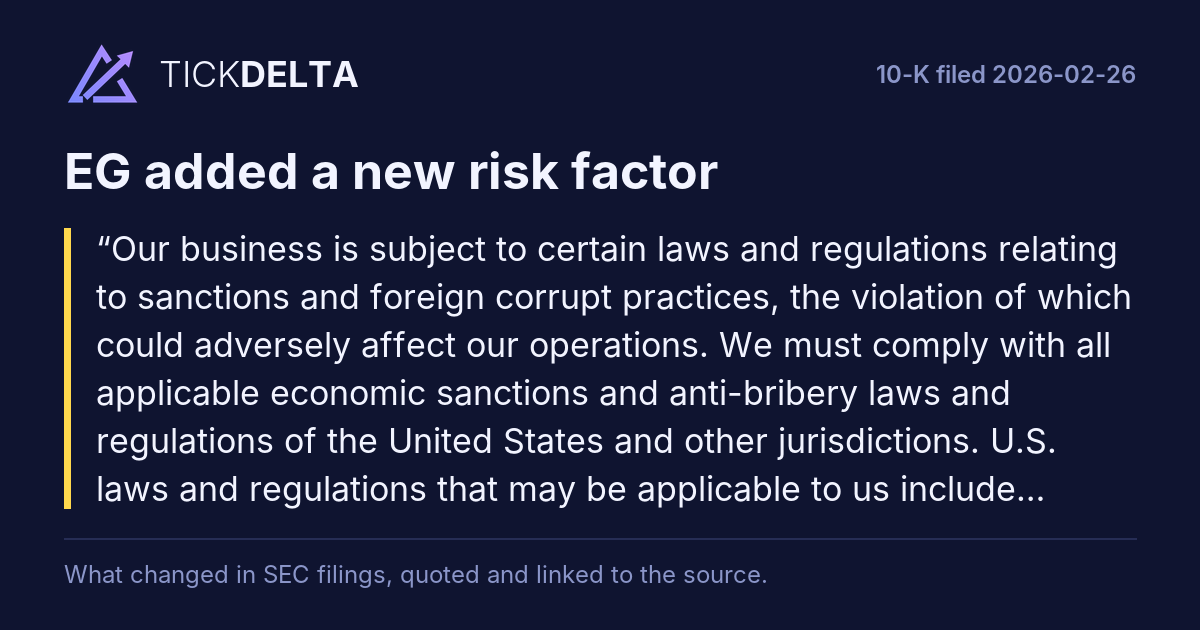
Our business is subject to certain laws and regulations relating to sanctions and foreign corrupt practices, the violation of which could adversely affect our operations.
Similar paragraph at 5 of 75 other Financials companies:
ACGL,
AXP,
GL,
KKR,
SYFWe must comply with all applicable economic sanctions and anti-bribery laws and regulations of the United States and other jurisdictions. U.S. laws and regulations that may be applicable to us include economic trade sanctions laws and regulations administered by the U.S. Treasury’s Office of Foreign Assets Control, as well as certain laws administered by the U.S. Department of State. The sanctions laws and regulations of non-U.S. jurisdictions in which we operate may differ from those of the United States and these differences may also expose us to sanctions violations. In addition, we are subject to the Foreign Corrupt Practices Act and other anti-bribery laws that generally prohibit corrupt payments or improper gifts to non-U.S. governments or officials. It is possible that personnel could fail to comply with applicable laws and regulations. In such event, we could be exposed to civil penalties, criminal penalties and other sanctions, including fines or other punitive actions, which could damage our business and reputation, and could adversely affect our financial condition and results of operations.
Similar paragraph at 1 of 75 other Financials companies:
ACGL
1 more
On January 20, 2025, President Trump issued a memorandum announcing that the OECD framework has “no force or effect in the United States” and disavowing any commitments previously made by the United States with respect to the framework. The memorandum also directs the U.S. Secretary of the Treasury to develop and present to President Trump a list of protective measures or other options towards foreign countries that are either not in compliance with any tax treaty with the United States or have tax rules that are “extraterritorial or disproportionately affect American companies.” The possible uneven enactment of the OECD framework by various jurisdictions coupled with the United States’ response to these rules could cause uncertainties to and increases in our income taxes.
On January 5, 2026, the OECD released Administrative Guidance containing the side-by-side (SbS) package on the OECD’s global minimum tax. The SbS Administrative Guidance introduced, among other things, new safe harbors, including a SbS safe harbor for multi-national groups headquartered in certain eligible jurisdictions, now limited to the US. Qualification for this safe harbor would exempt companies from the OECD global minimum tax. We expect additional Administrative Guidance in the future providing implementation guidance on the SbS. Accordingly, the OECD’s global minimum tax could be subject to further changes that will continue to cause uncertainties related to income taxes payable by our company.
Read in the 10-K ↗
New in the latest 10-Q
29 paragraphs in the 10-Q filed Oct 30, 2026 with nothing like
them in the 10-Q filed Aug 3, 2026 (at least half the words must differ; new numbers alone do not count).
Quoted exactly, grouped by the item heading above them. This is text that changed, not a judgement of how serious it is.
Financial statements and notes
Adjustments to reconcile net income to net cash provided by operating activities:
Read in the 10-Q ↗
Increase (decrease) in reserve for losses and loss adjustment expenses 1,251 3,086
Read in the 10-Q ↗
Proceeds from fixed maturities matured/called/repaid - available for sale 3,201 3,376
Read in the 10-Q ↗
Common shares issued (redeemed) during the period for share-based compensation, net of expense (18) (19)
Read in the 10-Q ↗
Cost of shares withheld on settlements of share-based compensation awards (24) (20)
Read in the 10-Q ↗
During the third quarter of 2026, the Company refined its definition of underwriting results to exclude ceded prior year favorable (unfavorable) reserve development on reserves subject to the ADC and the related amortization of the deferred gain. The Company believes this change improves period-over-period comparability, removes the timing differences created by the retroactive reinsurance accounting model from the underwriting income (loss) measure, and better aligns with the manner in which our chief operating decision maker reviews the business to assess performance and allocate resources.
Read in the 10-Q ↗
In addition, the Company introduced a new performance measure for its Legacy segment to better align the reported measures with how management evaluates this business. For the Legacy reportable segment, underwriting results are not the sole meaningful measure of segment performance due to the run-off nature of the business and its focus on managing and settling existing liabilities. Accordingly, during the third quarter of 2026, the Company introduced net reserve for losses and LAE before the impact of ADC as the Legacy segment new performance measure.
Read in the 10-Q ↗
For the Reinsurance Treaty and Global Wholesale & Specialty reportable segments, management generally monitors and evaluates financial performance based on underwriting results. During the third quarter of 2026, the Company refined its definition of underwriting results to exclude ceded prior year favorable (unfavorable) reserve development on reserves subject to the ADC and the related amortization of the deferred gain. The Company believes this change improves period-over-period comparability, removes the timing differences created by the retroactive reinsurance accounting model from the underwriting income (loss) measure, and better aligns with the manner in which our chief operating decision maker reviews the business to assess performance and allocate resources.
Read in the 10-Q ↗
Underwriting income (loss) is presented as a non-GAAP financial measure that includes earned premium less losses and LAE incurred, adjusted to exclude ceded prior year favorable (unfavorable) reserve development on reserves subject to the ADC and the related amortization of the deferred gain, commission and brokerage expenses, and other underwriting expenses. The Company measures underwriting results using ratios, including the loss, commission and brokerage, and other underwriting expense ratios, which are calculated by dividing the respective losses and expenses by premiums earned.
Read in the 10-Q ↗
For the Legacy reportable segment, underwriting results are not a meaningful measure of segment performance due to the run-off nature of the business and its focus on managing and settling existing liabilities. Accordingly, during the third quarter of 2026, the Company introduced net reserve for losses and LAE before the impact of ADC as the Legacy segment performance measure to align the reported measure with how management evaluates the business. This balance sheet-based measure is calculated as reserve for losses and LAE, less unpaid reinsurance loss recoverables adjusted to exclude the unpaid recoverable of the adverse development reinsurance agreements. Other than this measure used to evaluate the Legacy reportable segment, the Company does not review and evaluate the financial results of its reportable segments based on balance sheet data.
Read in the 10-Q ↗
Legal proceedings
On October 28, 2026, two purported shareholders filed a putative securities class action in the United States District Court for the Southern District of New York against Everest Group, Ltd. and certain current and former officers. The complaint purports to assert claims on behalf of purchasers of the Company's common shares during the period from February 8, 2024 through October 27, 2025 and alleges violations of Sections 10(b) and 20(a) of the Securities Exchange Act of 1934 and Rule 10b-5 promulgated thereunder. The complaint generally alleges that defendants made materially false or misleading statements or omissions concerning, among other things, the Company's U.S. casualty business, underwriting, pricing, loss development and reserves, and seeks damages and other relief. The Company intends to vigorously defend the action. The litigation is at a preliminary stage, and the Company is unable at this time to predict its outcome or reasonably estimate the amount or range of any potential loss.
Read in the 10-Q ↗
Financial statements and notes
On September 11, 2026, the OECD framework released additional administrative guidance and implementation materials related to the global minimum tax framework. These materials include an updated GloBE Information Return incorporating the January 2026 side-by-side package, guidance addressing explicitly conditional taxes, the Qualified Domestic Minimum Top-up Tax safe harbor, and a framework for reviewing relevant domestic legislation. The Company continues to evaluate the potential impact of these developments and to monitor further guidance and implementation activities in the relevant jurisdictions in which it operates.
Read in the 10-Q ↗
(1) For the nine months ended September 30, 2026, incurred losses and loss adjustment expenses included $8 million of ceded prior year unfavorable reserve development on reserves for losses and loss adjustment expenses subject to the ADC and the related amortization of the deferred gain.
Read in the 10-Q ↗
For the Reinsurance Treaty and Global Wholesale & Specialty reportable segments, management generally monitors and evaluates financial performance based on underwriting results. During the third quarter of 2026, the Company refined its definition of underwriting results to exclude ceded prior year favorable (unfavorable) reserve development on reserves subject to the ADC and the related amortization of the deferred gain. The Company believes this change improves period-over-period comparability, removes the timing differences created by the retroactive reinsurance accounting model from the underwriting income (loss) measure, and better aligns with the manner in which our chief operating decision maker reviews the business to assess performance and allocate resources.
Read in the 10-Q ↗
Underwriting income (loss) is presented as a non-GAAP financial measure that includes earned premium less losses and LAE incurred, adjusted to exclude ceded prior year favorable (unfavorable) reserve development on reserves subject to the ADC and the related amortization of the deferred gain, commission and brokerage expenses, and other underwriting expenses. The Company measures underwriting results using ratios, including the loss, commission and brokerage, and other underwriting expense ratios, which are calculated by dividing the respective losses and expenses by premiums earned.
Read in the 10-Q ↗
For the Legacy reportable segment, underwriting results are not the sole meaningful measure of segment performance due to the run-off nature of the business and its focus on managing and settling existing liabilities. Accordingly, during the third quarter of 2026, the Company introduced net reserve for losses and LAE before the impact of ADC as the Legacy segment performance measure to align the reported measure with how management evaluates the business. This balance sheet-based measure is calculated as reserve for losses and LAE, less unpaid reinsurance loss recoverables adjusted to exclude the unpaid recoverable of the adverse development reinsurance agreements. Other than this measure used to evaluate the Legacy reportable segment, the Company does not review and evaluate the financial results of its reportable segments based on balance sheet data.
Read in the 10-Q ↗
Unfavorable (favorable) prior year development and related amortization under ADC. On October 26, 2025 (effective October 1, 2025), the Company entered into two ADC reinsurance agreements. These agreements provide coverage for potential adverse development on North American liabilities within the Global Wholesale & Specialty and Legacy segments for net loss reserves and LAE with dates of loss prior to January 1, 2025, that are paid on or after the effective date. As noted above, to remove timing differences created by the retroactive reinsurance accounting model and improve the comparability of underlying results, management excludes ceded prior year favorable (unfavorable) reserve development on reserves subject to the ADC and the related amortization of the deferred gain from the Global Wholesale & Specialty and Legacy segments and total reportable segment underwriting results.
Read in the 10-Q ↗
For the three months ended September 30, 2026, there was no net development recorded during the period under the ADC. For the nine months ended September 30, 2026, unfavorable prior year development and related amortization under the ADC was $8 million.
Read in the 10-Q ↗
For additional claims and expenses information, refer to Reportable Segment Results.
Read in the 10-Q ↗
On September 11, 2026, the OECD framework released additional administrative guidance and implementation materials related to the global minimum tax framework. These materials include an updated GloBE Information Return incorporating the January 2026 side-by-side package, guidance addressing explicitly conditional taxes, the Qualified Domestic Minimum Top-up Tax safe harbor, and a framework for reviewing relevant domestic legislation. The Company continues to evaluate the potential impact of these developments and to monitor further guidance and implementation activities in the relevant jurisdictions in which it operates.
Read in the 10-Q ↗
• growth in specialty lines as well as growth in international business, particularly marine and financial lines,
Read in the 10-Q ↗
• growth in specialty lines as well as growth in international business, particularly marine and financial lines,
Read in the 10-Q ↗
As previously noted, for the Legacy reportable segment, underwriting results are not the sole meaningful measure of segment performance due to the run-off nature of the business and its focus on managing and settling existing liabilities. Legacy premiums are expected to decrease as premiums earn and as the commercial retail insurance business is renewed with AIG under the previously announced renewal rights agreement. Accordingly, beginning in the third quarter of 2026, the Company introduced net reserve for losses and loss adjustment expenses before impact of ADC as the Legacy segment performance measure to align the reported measure with how management evaluates the business. These changes to the segment performance measure have been reflected retrospectively.
Read in the 10-Q ↗
Net reserve for losses and LAE Reserves before impact of ADC decreased to $5.9 billion as of September 30, 2026, compared to $6.3 billion as of December 31, 2025, reflecting the decline in premiums earned and the continuing settlement of existing liabilities. Refer to movement in incurred losses and LAE below for further details.
Read in the 10-Q ↗
Legal proceedings
On October 28, 2026, two purported shareholders filed a putative securities class action in the United States District Court for the Southern District of New York against Everest Group, Ltd. and certain current and former officers. The complaint purports to assert claims on behalf of purchasers of the Company's common shares during the period from February 8, 2024 through October 27, 2025 and alleges violations of Sections 10(b) and 20(a) of the Securities Exchange Act of 1934 and Rule 10b-5 promulgated thereunder. The complaint generally alleges that defendants made materially false or misleading statements or omissions concerning, among other things, the Company's U.S. casualty business, underwriting, pricing, loss development and reserves, and seeks damages and other relief. The Company intends to vigorously defend the action. The litigation is at a preliminary stage, and the Company is unable at this time to predict its outcome or reasonably estimate the amount or range of any potential loss.
Read in the 10-Q ↗
Risk Factors
insurance capital standards, and requirement for a recovery plan, in the Act and related regulations in January 2026. Since the Company is incorporated in Bermuda and is the ultimate parent of Everest’s insurance group, the Company is subject to group supervision by the BMA under the Amendment Act.
Read in the 10-Q ↗
During the three months ended June 30, 2026, the BMA informed the Company of its formal determination that it is appropriate for the BMA to become Group Supervisor for the Company and specified that Bermuda Re would become the “designated insurer” responsible for group-level regulatory compliance for Everest pursuant to Section 27B of the Act.
Read in the 10-Q ↗
During the three months ended September 30, 2026, the Company received its registration number from the BMA as a group supervised entity. The Company expects that it will be formally designated as an IAIG by the BMA and listed on a public register of IAIGs at a future date.
Read in the 10-Q ↗
Other information
On August 4, 2026, Laura Hay, a member of the Everest Group, Ltd. Board of Directors, entered into a trading plan intended to satisfy the affirmative defense conditions of Rule 10b5-1(c) under the Securities Exchange Act of 1934 (the “Hay Trading Plan”). Pursuant to the Hay Trading Plan, an aggregate amount of up to 720 common shares of Company stock may be sold by her broker. The Hay Trading Plan expires after the close of trading on August 31, 2028.
Read in the 10-Q ↗
The 10-Q's risk factors against the 10-K
Item 1A of the 10-Q filed Oct 30, 2026 against Item 1A of the 10-K filed Feb 26, 2026.
A 10-Q repeats only the risks that changed, so a 10-K paragraph that is missing from it is not counted as removed.
Added is a paragraph with nothing like it in the 10-K, Reworded a sentence that is in both with several words changed,
Quiet changes a sentence in both where one to four words changed and one is a hedge or a modal
(cut words struck through, new words highlighted and underlined).
Text on the page, not a score; each links to the filing at sec.gov.
What the 10-Q itself says about its risk factors:
Except for the matter described above, there have been no other material changes to the risk factors disclosed in Item 1A. “Risk Factors” contained in our Annual Report on Form 10-K for the year ended December 31, 2025.
Read in the 10-Q ↗
Added10-Q 2026-10-30 vs 10-K 2026-02-26
The insurance and reinsurance regulatory framework continues to be subject to increased scrutiny in many jurisdictions, including the U.S., Bermuda and Europe. The International Association of Insurance Supervisors (“IAIS”) is a voluntary membership organization of insurance supervisors and regulators from more than 200 jurisdictions, including Bermuda and the U.S. states (through the National Association of Insurance Commissioners, or “NAIC”). In November 2019, the IAIS adopted the Holistic Framework for Systemic Risk in the Insurance Sector (“Holistic Framework”) and a Common Framework (“ComFrame”) for the Supervision of Internationally Active Insurance Groups (“IAIGs”), which is focused on the group-wide supervision of IAIGs.
Read it in the 10-Q at sec.gov ↗
Added10-Q 2026-10-30 vs 10-K 2026-02-26
Effective January 7, 2026, the Bermuda Insurance Amendment (No. 2) Act 2025 (the “Amendment”) expanded the Bermuda Monetary Authority's ("BMA") group supervision framework under the Bermuda Insurance Act 1978 (the “Act”). Under the Amendment, the BMA now designates and registers non-regulated insurance holding companies, including insurance groups headed by either (a) a specified insurer or (b) a Bermuda company that is the ultimate parent company of an insurance group. The BMA also embedded the ComFrame group supervision requirements, including risk-based
Read it in the 10-Q at sec.gov ↗
Added10-Q 2026-10-30 vs 10-K 2026-02-26
insurance capital standards, and requirement for a recovery plan, in the Act and related regulations in January 2026. Since the Company is incorporated in Bermuda and is the ultimate parent of Everest’s insurance group, the Company is subject to group supervision by the BMA under the Amendment Act.
Read it in the 10-Q at sec.gov ↗
Added10-Q 2026-10-30 vs 10-K 2026-02-26
During the three months ended June 30, 2026, the BMA informed the Company of its formal determination that it is appropriate for the BMA to become Group Supervisor for the Company and specified that Bermuda Re would become the “designated insurer” responsible for group-level regulatory compliance for Everest pursuant to Section 27B of the Act.
Read it in the 10-Q at sec.gov ↗
Added10-Q 2026-10-30 vs 10-K 2026-02-26
During the three months ended September 30, 2026, the Company received its registration number from the BMA as a group supervised entity. The Company expects that it will be formally designated as an IAIG by the BMA and listed on a public register of IAIGs at a future date.
Read it in the 10-Q at sec.gov ↗
Reworded10-Q 2026-10-30 vs 10-K 2026-02-26
Group supervision by the BMA, including any future holding company designation, BMA and designation as an IAIG could affect our the Company’s prescribed capital requirements, the terms and structure of current and future debt, our regulatory capital, intercompany capital transactions, borrowing requirements and terms, and ratings and may significantly increase our cost of regulatory compliance.
Read it in the 10-Q at sec.gov ↗ · The 10-K sentence ↗
Reworded10-Q 2026-10-30 vs 10-K 2026-02-26
Assessing Everest’s continuing assessment and complying compliance with the Amendment Act’s requirements may will require the Company to allocate considerable time and resources that could impact the domicile and operations of our insurance and/or non-insurance subsidiaries, result in increased costs and affect our financial condition.
Read it in the 10-Q at sec.gov ↗ · The 10-K sentence ↗
Reworded10-Q 2026-10-30 vs 10-K 2026-02-26
Under the Amendment Act, after the transition period, the Company may become will be subject to group-level solvency and capital requirements, consolidated financial reporting and auditing obligations, recovery planning requirements and prior notification or approval requirements for certain material changes within the group.
Read it in the 10-Q at sec.gov ↗ · The 10-K sentence ↗