Screener / SEC EDGAR /CIK 0001463101 /10-K filed Feb 17, 2026, compared with Feb 10, 2025 /Numbers from the XBRL of the 10-Ks
Nasdaq Technology · Semiconductors

Enphase Energy, Inc. ENPH

Compare with peers Embed
The 10-K against last year's

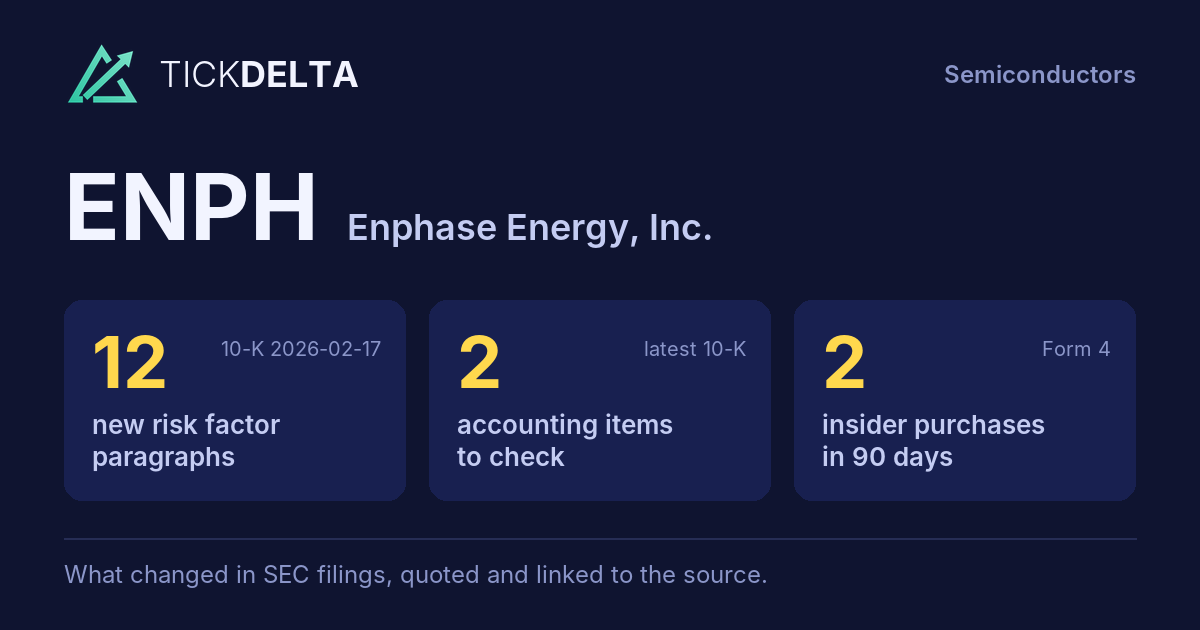
128 changes: 25 added, 18 removed, 83 reworded, 2 quiet changes

10-K Feb 17, 2026 vs Feb 10, 2025

10-K 0001463101-26-000013 (Feb 17, 2026) vs 10-K 0001463101-25-000024 (Feb 10, 2025)

Every paragraph, and how much of it changed

One bar per paragraph, in the order of the 10-K. Height and colour show the share of its words not in the closest paragraph a year earlier; the tallest bars are new paragraphs.

Risk Factors

260 paragraphs · 12 new · 55 reworded · 13 gone · 10-K Feb 17, 2026 against Feb 10, 2025
New paragraph Reworded (5% of its words or more) Same or nearly
Paragraph 117 · 49% changed Every version of it
To protect our unregistered intellectual property, including our trade secrets and know-how, we rely in part on trade secret laws and confidentiality and invention assignment agreements with our employees and independent contractors. We also require other third parties who may have access to our proprietary technologies and information to enter into non-disclosure agreements. Such measures, however, provide only limited protection, and we cannot assure that our confidentiality and non-disclosure agreements will prevent unauthorized disclosure or use of our confidential information, especially after our employees or third parties end their employment or engagement with us, or provide us with an adequate remedy in the event of such disclosure. Furthermore, competitors or other third parties may independently discover our trade secrets, copy or reverse engineer our products or portions thereof, or develop similar technology. If we fail to protect our intellectual property and other proprietary rights, or if such intellectual property and proprietary rights are infringed, misappropriated or otherwise violated, our business, results of operations or financial condition could be materially harmed.
Paragraph 129 · 48% changed Every version of it
Further, such licenses may be non-exclusive, which could result in our competitors gaining access to the same intellectual property. The licensing or acquisition of third-party intellectual property rights is a competitive area, and other established companies may pursue strategies to license or acquire third-party intellectual property rights that we may consider attractive or necessary. These established companies may have a competitive advantage over us due to their size, capital resources or greater development or commercialization capabilities. In addition, companies that perceive us to be a competitor may be unwilling to assign or license rights to us. We could encounter delays and incur significant costs, in product or service introductions while we attempt to develop alternative products or services, or redesign our products or services, to avoid infringing third-party patents or proprietary rights. Failure to obtain any such licenses or to develop a workaround could prevent us from commercializing products or services, and the prohibition of sale or the threat of the prohibition of sale of any of our products or services could materially affect our business and our ability to gain market acceptance for our products or services.
Paragraph 137 · 47% changed Every version of it
Additionally, if For example, the federal or state agencies in recently enacted OBBBA scales back the United States takes action use of the ITC for residential solar, tightens domestic content rules, imposes new non-FEOC requirements, and imposes new deadlines for projects to eliminate or reduce laws, regulations and incentives supporting solar energy, such qualify for the ITC. Such actions may could result in a decrease in demand for solar energy our technology offerings in the United States and other geographical markets, it which would harm our business, financial condition and results of operations.
Paragraph 80 · 45% changed Every version of it
December 31, 2025. We regularly monitor and evaluate the credit status of our customers and attempt to adjust sales terms as appropriate, which may not be successful. The loss of, or events affecting, one any of our major large customers has had from time to time, and could reduce our sales and in the future have an a material adverse effect on our business, financial condition and results of operations.
Paragraph 57 · 44% changed Every version of it
Our future performance depends on our ability to effectively manage our relationships with our existing customers, as well as to attract additional customers that will be able to market and support our products effectively, especially in markets in which we have not previously distributed our products. Termination Market dynamics are creating increased risks, as the solar industry is increasingly moving toward third-party ownership models such as leasing and power purchase agreements. With the enactment of agreements with current customers, failure by the OBBBA, these models may become predominant, reducing demand for direct purchases from installers. If we fail to adapt to these trends, or if customers terminate agreements, experience financial distress, or fail to perform as expected, bankruptcies of our customers or their installer customers, or failure by us to cultivate new customer relationships, could hinder our ability to expand our operations and harm perform, our revenue and operating results. results could be materially harmed.
Paragraph 98 · 39% changed Every version of it
Although we primarily sell our solutions and products directly to solar distributors, who resell to installers and integrators, who then in turn integrate our products into complete solar PV installations for residential and commercial system owners, we have recently invested significant resources in our direct-to-consumer sales channel through our website, and our future growth relies, in part, on our ability to attract consumers through this channel. Expanding our direct-to-consumer sales model will require significant expenditures in marketing, software development and infrastructure. Further, the success of direct-to-consumer sales through our website is also subject to general business regulations and laws, as well as federal, state, foreign and provincial regulations and laws specifically governing the internet and e-commerce. commerce. These regulations and laws may cover taxation, tariffs, privacy, data protection, pricing, distribution, electronic contracts and other communications, consumer protection and intellectual property. These laws and regulations can be complex, difficult to interpret and may change over time. Continued regulatory limitations and other obstacles interfering with our ability to sell our products directly to consumers could have a negative and material impact our business, prospects, financial condition and results of operations.
Paragraph 42 · 35% changed Every version of it
States. Further, it It is unknown what effect that any such new tariffs or retaliatory actions would will have on us or our the solar industry and our customers. We have moved a significant portion of our manufacturing to the United States, while retaining limited contract manufacturing in China and India. However, certain components necessary for our products are still required to be imported from outside the United States. Our lithium-ion phosphate (“LFP”) LFP battery cells for our storage products are supplied solely via our two suppliers in China. Although we are in the process of searching for other suppliers vendors outside of China for future supplies, the expertise and industry for the LFP battery cell is primarily in China China, and we cannot be certain that we it will locate additional require significant effort to identify qualified suppliers with the right expertise to develop our battery cells cells. The resulting environment of retaliatory trade or other practices or additional trade restrictions or barriers, if implemented on a broader range of products or components from outside the United States, could harm our ability to obtain necessary product components or to sell our products at prices customers are willing to pay, which could have a material adverse effect on our business, prospects, results of China, if at all. operations and cash flows.
Paragraph 6 · 32% changed Every version of it
Among other government-established incentives, NEM and related policies have supported the growth of on-grid rooftop solar products, and changes to such policies may reduce demand for electricity from our solar service offerings. NEM is a tariffed utility rate program that permits a consumer to sell the excess solar energy that the consumer’s solar panels produce to the electric utility company at a predetermined price. The most basic type of NEM tariff pays consumers the retail rate for electricity that their solar panels export to the grid, less certain “non-bypassable” fees paid by the consumer. However, certain states have sought to move away from retail rate NEM crediting for compensating excess solar generation. For example, in December 2022, California, CPUC approved NEM 3.0, which substantially reduced the CPUC adopted a “NEM 3.0” policy, also known as the Net Billing Tariff, compensation that unbundles export compensation from retail rates and instead bases it on a tool called the Avoided Cost Calculator (“ACC”), which estimates the utility costs that are avoided solar customers can earn by exports from distributed generation for each hour of the year. The CPUC did seek to ease the transition for the selling excess solar market by adopting small “adders” energy to the electric grid. The average hourly ACC export values for rate under NEM 3.0 is approximately $0.05/kWh to $0.08/kWh compared to the first several years prior average of the tariff. Nevertheless, these ACC-based export compensation values are significantly lower than retail rates for most hours of the year and may therefore increase payback periods, and thereby reduce demand, for solar-only systems. Similarly, in November 2023, the $0.25/kWh to $0.35/kWh under NEM 2.0. CPUC also adopted changes to its “Virtual NEM” and “NEM Aggregation” programs that prohibit multi-meter commercial or agricultural property owners from netting solar energy generated at or adjacent to those properties against import charges recorded on the meters at the property, except for residential account holders in a multi-family residential property. These types of modifications to NEM policies have impacted and could further harm our business, both in California, where we have derived a significant portion of historical revenues in the United States, and in other state and national jurisdictions, jurisdictions if pursued there. similar changes are adopted.

MD&A

96 paragraphs · 13 new · 51 reworded · 5 gone · 10-K Feb 17, 2026 against Feb 10, 2025
New paragraph Reworded (5% of its words or more) Same or nearly
Paragraph 35 · 49% changed
Cost of Net revenues decreased by $531.2 million, or 43%, from international markets were $284.3 million in the year ended December 31, 2024, 2025, as compared to the same period in 2023, primarily due to the lower volume of microinverter units sold, as well as from the benefit recognized from tax credits of $157.5 million under the AMPTC for U.S. manufactured microinverters shipped to customers in the year ended December 31, 2024, as compared to cost of revenues of $53.5 $395.7 million in the same period in 2023. The benefit recognized 2024, a decrease of $111.4 million, or 28%, primarily driven by continued softening in demand from the AMPTC customers in Europe, which was partially offset impacted by $38.3 million overall slower economic growth in Europe in addition to changes in government policies and $11.6 million of incremental cost for manufacturing in the United States in the year ended December 31, 2024 and December 31, 2023, respectively, thereby providing a Net IRA benefit of $119.2 million and $41.9 million, respectively. lower utility rates.
Paragraph 55 · 48% changed
We expect that our principal short-term (over the next 12 months) cash needs related to our operations will be to fund working capital, strategic investments, acquisitions, repurchases of common stock and payments of withholding taxes for net share settlement of employee equity awards, payments on our outstanding debt and purchases of property and equipment. We plan to fund any cash requirements for the next 12 months from our existing cash, cash equivalents and marketable securities on hand, and cash generated from operations. For the long-term period (beyond 12 months), we aim plan to continue growing cash flows from operations to support our ongoing business operations and strategic investment plans. We regularly evaluate our liquidity position, debt obligations and expected anticipated cash requirements. needs. As part of this ongoing assessment, we may pursue additional financing through the issuance of equity or the debt financing, as necessary, to meet support our operational and investment needs. We anticipate that access to the debt market will be more limited compared to prior years as interest rates have increased and are expected to remain high. Our ability to obtain debt or any other additional financing that we may choose to, or need to, obtain will depend on, among other things, our development efforts, business plans, operating performance and the condition of the capital markets at the time we seek financing.
Paragraph 34 · 47% changed
Net revenues decreased by $960.4 million, or 42%, in the United States were $1,188.7 million in the year ended December 31, 2024, 2025, as compared to $934.7 million in the same period in 2023, driven primarily by a 58% decrease in microinverter units shipped, partially offset by 2024, an increase in ASP for our microinverters as we sold more IQ8 microinverters relative to IQ7 microinverters. During the year ended December 31, 2024, we sold approximately 6.5 of $254.0 million, or 27%, primarily driven by higher demand and $91.2 million of microinverter units, as compared to approximately 15.5 million microinverter units in the year ended December 31, 2023. The decrease in net revenues was also partially offset by a 48% increase in IQ Batteries MWh shipped. During the year ended December 31, 2024, we shipped 521.0 MWh of IQ Batteries, as compared to 351.6 MWh shipped in the year ended December 31, 2023. shipments that are associated with safe harbor transactions with customers.
Paragraph 54 · 45% changed
We expect that our principal short-term cash requirements (over the next 12 months) cash needs related to our operations will be to fund include working capital, strategic investments, acquisitions, repurchases of common stock and payments of withholding taxes for net share settlement of employee equity awards, payments on our outstanding debt debt, and purchases of property and equipment. We plan to fund any cash requirements for the next 12 months from our existing cash, cash equivalents and marketable securities on hand, and cash generated from operations. For the long-term period (beyond 12 months), we aim to continue growing cash flows from operations to support our ongoing business operations and strategic investment plans. We regularly evaluate our liquidity position, debt obligations and expected cash requirements. As part of this ongoing assessment, we may pursue additional financing through the issuance of equity or the debt financing, as necessary, to meet our operational and investment needs. We anticipate that access to the debt market will be more limited compared to prior years as interest rates have increased and are expected to remain high. Our ability to obtain debt or any other additional financing that we may choose to, or need to, obtain will depend on, among other things, our development efforts, business plans, operating performance and the condition of the capital markets at the time we seek financing.
Paragraph 45 · 37% changed
Restructuring and asset impairment charges are of $7.1 million in the net year ended December 31, 2025, primarily consisted of $5.2 million of employee related expenses, $1.7 million of asset impairment charges resulting from restructuring initiatives implemented in 2023 and 2024 to increase operational efficiencies, reduce operating costs, $0.2 million of contract termination charges. Restructuring and to better align our workforce and cost structure with current market conditions, our business needs, and strategic priorities. Restructuring asset impairment charges of $13.2 million in the year ended December 31, 2024, primarily consisted of $6.4 million of employee severance, one-time benefits and other employee related expenses, $2.0 million of contract termination charges and $4.8 million of asset impairment charges. Restructuring charges of $15.7 million in the year ended December 31, 2023, primarily consisted of $9.8 million of asset impairment charges, $3.7 million of contract termination charges, $1.4 million of employee severance and one-time benefits, and $0.8 million of other restructuring charges.
Paragraph 64 · 36% changed
Cash flows from operating activities consisted of our net income adjusted for certain non-cash reconciling items, such as stock-based compensation expense, asset impairment, non-cash interest expense, change in the fair value of debt securities, deferred income taxes, asset impairment, depreciation and amortization, amortization (accretion) of premium (discount) on marketable securities, benefit from lease termination, provision for credit losses, and changes in our operating assets and liabilities. Net cash provided by operating activities decreased by $183.1 $377.2 million for the year ended December 31, 2024, 2025, as compared to the same period in 2023, 2024, primarily due to lower unfavorable changes in working capital. The decrease was driven principally by higher cash outflows related to prepaid income tax of $243.0 million, increase in inventory of $123.0 million, increase in grant receivable of $61.5 million, and decrease in deferred revenues of $60.8 million, reflecting changes in inventory positioning, the timing of customer prepayments and other operating assets. These working capital uses were partially offset by higher cash inflows from accounts payable, accrued expenses and other current liabilities. In addition, cash flows from operating activities benefited from higher net revenues. income in 2025 compared to 2024; however, this favorable impact was more than offset by the net working capital outflows described above.
Paragraph 79 · 35% changed
Inventory is valued at the lower of cost or market. Market is current replacement cost (by purchase or by reproduction, dependent on the type of inventory). In cases where market exceeds net realizable value (i.e., estimated selling price less reasonably predictable costs of completion and disposal), inventories are stated at net realizable value. Market is not considered to be less than net realizable value reduced by an allowance for an approximately normal profit margin. We determine cost on a first-in first-out basis. Certain factors could affect the realizable value of its inventory, including customer demand and market conditions. Management assesses the valuation on a quarterly basis and writes down include both the value for any excess costs of acquisition and obsolete manufacturing in our inventory costs. These costs include direct materials, direct labor, and indirect manufacturing costs, including depreciation and amortization. The capitalization of indirect costs is based upon expected demand, anticipated sales price, effect on the normal utilization of new product introductions, product obsolescence, customer concentrations, product merchantability and other factors. Inventory write-downs are equal our manufacturing facility in Texas. If the manufacturing facility utilization is abnormally low, the portion of our indirect manufacturing costs related to the difference between the cost of inventories and market. abnormal utilization level is expensed as incurred. Other abnormal manufacturing costs, such as wasted materials or excess yield losses, are also expensed as incurred.
Paragraph 83 · 34% changed
We recognized credits under the AMPTC as a reduction to cost of revenues beginning in the consolidated statement of operations for the microinverters manufactured in the United States and sold to customers in the year ended December 31, 2024 and 2023. Such credit is also reflected as an increase to prepaid income tax within prepaid expenses and other current assets and reduction of income tax payable within accrued liabilities on our consolidated balance sheets within accrued liabilities. There are currently several critical and complex aspects of the IRA that could affect the estimated benefits we have recognized and expect to recognize from the AMPTC. 2026. Any modifications to the law or its effects arising, for example, through (i) technical guidance and regulations from the IRS and U.S. Treasury Department, (ii) subsequent amendments to or interpretations of the law, and/or (iii) future laws or regulations rendering certain provisions of the IRA less effective or ineffective, in whole or in part, could result in material adverse changes to the benefits we have recognized and expect to recognize.

A paragraph is matched with the one last year that shares the most of its words; under half in common makes it new. The paragraphs shown are the 8 reworded the most in each section.

The paragraph that changed most in each section

The redline

Marked against last year's 10-K: cut words struck through, new words highlighted.

Risk Factors206 words changed in this paragraph; it is 62% similar to last year's version.
Among other government-established incentives, NEM and related policies have supported the growth of on-grid rooftop solar products, and changes to such policies may reduce demand for electricity from our solar service offerings. NEM is a tariffed utility rate program that permits a consumer to sell the excess solar energy that the consumer’s solar panels produce to the electric utility company at a predetermined price. The most basic type of NEM tariff pays consumers the retail rate for electricity that their solar panels export to the grid, less certain “non-bypassable” fees paid by the consumer. However, certain states have sought to move away from retail rate NEM crediting for compensating excess solar generation. For example, in December 2022, California, CPUC approved NEM 3.0, which substantially reduced the CPUC adopted a “NEM 3.0” policy, also known as the Net Billing Tariff, compensation that unbundles export compensation from retail rates and instead bases it on a tool called the Avoided Cost Calculator (“ACC”), which estimates the utility costs that are avoided solar customers can earn by exports from distributed generation for each hour of the year. The CPUC did seek to ease the transition for the selling excess solar market by adopting small “adders” energy to the electric grid. The average hourly ACC export values for rate under NEM 3.0 is approximately $0.05/kWh to $0.08/kWh compared to the first several years prior average of the tariff. Nevertheless, these ACC-based export compensation values are significantly lower than retail rates for most hours of the year and may therefore increase payback periods, and thereby reduce demand, for solar-only systems. Similarly, in November 2023, the $0.25/kWh to $0.35/kWh under NEM 2.0. CPUC also adopted changes to its “Virtual NEM” and “NEM Aggregation” programs that prohibit multi-meter commercial or agricultural property owners from netting solar energy generated at or adjacent to those properties against import charges recorded on the meters at the property, except for residential account holders in a multi-family residential property. These types of modifications to NEM policies have impacted and could further harm our business, both in California, where we have derived a significant portion of historical revenues in the United States, and in other state and national jurisdictions, jurisdictions if pursued there. similar changes are adopted.

Source: Item 1A, 10-K 0001463101-26-000013 vs Item 1A, 10-K 0001463101-25-000024

Accounting Policies162 words changed in this paragraph; it is 42% similar to last year's version.
In November 2023, July 2025, the Financial Accounting Standard Board (“FASB”) FASB issued Accounting Standards Update (“ASU”) 2023-07, “Segment Reporting ASU 2025-05, “Financial Instruments - Credit Losses (Topic 280): Improvements to Reportable Segment Disclosures” 326): Measurement of Credit Losses for Accounts Receivable and Contract Assets” (“ASU 2023-07”). ASU 2023-07 requires additional disclosures 2025-05”), which introduces a practical expedient for segment reporting, including disclosure the application of the title current expected credit loss model to current accounts receivable and position contract assets. The practical expedient allows entities to assume that conditions as of the Chief Operating Decision Maker and requires a public entity that has a single reportable segment balance sheet date remain unchanged over the remaining life of these assets, thereby eliminating the need to provide all the disclosures required by the amendments in incorporate macroeconomic forecasts. ASU 2023-07, and all existing segment disclosures in Topic 280. ASU 2023-07 2025-05 is effective for fiscal periods beginning after December 15, 2023, 2025, and interim reporting periods within fiscal years beginning after December 15, 2024. those annual reporting periods. The Company adopted ASU 2023-07 2025-05 effective for its this Annual Report on Form 10-K for the year ended December 31, 2024 and subsequent interim periods. Since ASU 2023-07 addresses only disclosures, the adoption of ASU 2023-07 2025, which did not have a significant impact on its consolidated financial statements.

Source: Item 8, Note 2 – SUMMARY OF SIGNIFICANT ACCOUNTING POLICIES, 10-K 0001463101-26-000013 vs Item 8, Note 2 – SUMMARY OF SIGNIFICANT ACCOUNTING POLICIES, 10-K 0001463101-25-000024

Legal Proceedings159 words changed in this paragraph; it is 31% similar to last year's version.
On or about July 29, 2024, six additional stockholders filed motions to be appointed lead plaintiff and have their selection of counsel appointed as lead counsel. counsel in the Securities Class Action. The Court held a hearing on the lead plaintiff motions on September 5, 2024, and appointed Lon D. Praytor as lead plaintiff on March 31, 2025. On April 17, 2025, movant Andrey Ponomarchuk filed a motion for reconsideration of the Court’s order appointing Praytor as lead plaintiff. Lead plaintiff Praytor filed an amended complaint on May 21, 2025, alleging violations of Sections 10(b) and 20(a) of the Exchange Act and Rule 10b-5 promulgated thereunder by Enphase and our chief executive officer, purported only on behalf of a class of individuals who purchased or otherwise acquired our common stock between February 7, 2023 and April 25, 2023 and removing our chief financial officer as a defendant (the remaining defendants referred hereto as “Defendants”). Defendants filed a motion to dismiss on July 2, 2025. Lead Plaintiff’s filed his opposition on August 15, 2025, and Defendants’ filed their reply on September 15, 2025. The Court has not yet issued a decision on Defendants’ motion to dismiss.

Source: Item 3, 10-K 0001463101-26-000013 vs Item 3, 10-K 0001463101-25-000024

MD&A154 words changed in this paragraph; it is 48% similar to last year's version.
We expect that our principal short-term cash requirements (over the next 12 months) cash needs related to our operations will be to fund include working capital, strategic investments, acquisitions, repurchases of common stock and payments of withholding taxes for net share settlement of employee equity awards, payments on our outstanding debt debt, and purchases of property and equipment. We plan to fund any cash requirements for the next 12 months from our existing cash, cash equivalents and marketable securities on hand, and cash generated from operations. For the long-term period (beyond 12 months), we aim to continue growing cash flows from operations to support our ongoing business operations and strategic investment plans. We regularly evaluate our liquidity position, debt obligations and expected cash requirements. As part of this ongoing assessment, we may pursue additional financing through the issuance of equity or the debt financing, as necessary, to meet our operational and investment needs. We anticipate that access to the debt market will be more limited compared to prior years as interest rates have increased and are expected to remain high. Our ability to obtain debt or any other additional financing that we may choose to, or need to, obtain will depend on, among other things, our development efforts, business plans, operating performance and the condition of the capital markets at the time we seek financing.

Source: Item 7, 10-K 0001463101-26-000013 vs Item 7, 10-K 0001463101-25-000024

Sentences and paragraphs added, removed or reworded

Every change, by type

Sentences and paragraphs of ENPH's Risk Factors and MD&A, 10-K Feb 17, 2026 against 10-K Feb 10, 2025. Each links to the text at sec.gov.

Quiet changes are sentences kept from last year with one to four words changed, at least one of them a hedge, a modal or a qualifier (may, could, will, not, significant, material…). A year or date rolling forward is not counted.

The full word list

adverse, adversely, all, although, anticipate, anticipates, any, approximately, believe, believes, can, cannot, certain, could, expect, expects, generally, however, if, intend, intends, largely, likely, many, material, materially, may, might, most, must, never, no, not, possible, primarily, probable, should, significant, significantly, some, substantial, substantially, unlikely, will, would

AddedRisk Factors
Our business and the broader solar and energy storage industry depend significantly on government-issued subsidies and economic incentives that promote the adoption and cost competitiveness of solar photovoltaic (“PV”) and energy storage systems for on-grid applications. These incentives include, among others, ITCs, feed-in tariffs (“FiTs”), NEM programs, rebates, and other policies that vary by jurisdiction. Many of these programs are subject to expiration, phase-outs, funding limitations, or policy changes, and some have already been reduced or eliminated in key markets.
Read it in 10-K Feb 17, 2026 at sec.gov
AddedRisk Factors
For example, the IRA and subsequent legislation, including the OBBBA, introduced significant changes to ITC eligibility and domestic content requirements. The Section 25D credit for residential solar and storage systems expired on December 31, 2025. In addition, the OBBBA imposes new timing requirements for eligibility under Section 48E of the Code, which governs ITCs for leased solar and storage systems. Specifically, solar-only projects that do not commence construction within 12 months of the OBBBA’s enactment must be placed in service by December 31, 2027 in order to remain eligible for the credit. Energy storage projects are not subject to this placed-in-service deadline; however, the ITC for storage systems will begin to phase down in 2034 — decreasing to 75% in 2034, 50% in 2035 and phasing out entirely by 2036. If we are unable to meet revised compliance thresholds or if these incentives are further reduced or eliminated, the cost competitiveness of our products may decline, which could reduce demand for our offerings, adversely affect our revenue and margins, and harm our business.
Read it in 10-K Feb 17, 2026 at sec.gov
AddedRisk Factors
The inability of our products to comply with the minimum domestic content tax credit thresholds, inclusive of FEOC regulations, could negatively impact our business, financial condition and results of operations.
Read it in 10-K Feb 17, 2026 at sec.gov
AddedRisk Factors
Recent legislative and regulatory changes, including those introduced under the OBBBA and related executive actions, impose stricter domestic content requirements and FEOC restrictions on projects seeking to qualify for ITCs, AMPTC and other clean energy incentives. For example, projects commencing construction after June 16, 2025 must meet a 45% domestic cost threshold, and beginning in 2026, escalating non-FEOC content requirements will apply to solar and storage projects and to manufactured components.
Read it in 10-K Feb 17, 2026 at sec.gov
AddedRisk Factors
Our microinverters and residential battery systems incorporate components sourced globally, and certain critical parts may originate from suppliers located in jurisdictions that could be designated as FEOCs. If we are unable to meet these domestic content or non-FEOC compliance thresholds, our products may not qualify for applicable tax credits, including the AMPTC, which could reduce the attractiveness of our offerings to installers, developers and customers. Failure to comply with these requirements could adversely affect demand for our products, limit our ability to compete in key markets, and negatively impact our revenue, gross margins, business operations and competitive position. Furthermore, evolving guidance and definitions under the OBBBA create uncertainty, which may require us to adjust our supply chain strategy and increase compliance costs.
Read it in 10-K Feb 17, 2026 at sec.gov
AddedRisk Factors
declining revenues. If we have to reduce our prices, or if we are unable to offset any future reductions in our average selling prices (“ASPs”) by increasing our sales volume, reducing our costs and expenses or introducing new products, our revenue and gross profit would suffer.
Read it in 10-K Feb 17, 2026 at sec.gov
AddedRisk Factors
The United States has imposed significant new tariffs on nearly all products and components imported into the United States and could propose additional tariffs or increases to those already in place. A subset of our products is sourced from China and India, and certain components necessary to manufacture our products in the United States, including our microinverters, batteries and related accessories, are imported from China, India, Taiwan, Vietnam and Japan, among other countries. It is unknown whether and to what extent these tariffs will remain in place or if other new laws or regulations will be adopted. Due to broad uncertainty regarding the timing, content and extent of any regulatory changes in the United States or abroad, we cannot predict the impact, if any, that these changes could have to our business, financial condition and results of operations.
Read it in 10-K Feb 17, 2026 at sec.gov
Show the other 59
AddedRisk Factors
Trade disputes, trade restrictions, tariffs and other geopolitical tensions between the United States and other countries may also exacerbate unfavorable macroeconomic conditions including inflationary pressures, foreign exchange volatility, financial market instability, and economic recessions or downturns, which may also
Read it in 10-K Feb 17, 2026 at sec.gov
AddedRisk Factors
negatively impact customer demand for our products or services, delay purchases or renewals, limit expansion opportunities with customers, limit our access to capital, or otherwise negatively impact our business and operations. Ongoing tariff, trade restrictions and macroeconomic uncertainty has and may continue to contribute to volatility in the price of our common stock.
Read it in 10-K Feb 17, 2026 at sec.gov
AddedRisk Factors
increases substantially, this could potentially create substantial personal wealth for our executives and employees and affect our ability to retain our personnel. In addition, any restructuring plans may adversely impact our ability to attract and retain key employees.
Read it in 10-K Feb 17, 2026 at sec.gov
AddedRisk Factors
damage caused by these disruptions or security breaches in the future. These risks, as well as the number and frequency of cybersecurity events globally, may also be heightened during times of geopolitical tension or instability.
Read it in 10-K Feb 17, 2026 at sec.gov
RemovedRisk Factors
National, state and local government bodies in many countries, including the United States, have provided incentives in the form of feed-in tariffs (“FiTs”), NEM tariffs and related policies, rebates, tax credits, tax incentives and others to system owners, distributors, system integrators and manufacturers of solar PV systems and battery energy storage systems to bolster the cost competitiveness of solar electricity in on-grid applications relative to the cost of utility power, and to reduce dependency on other forms of energy. Many of these government incentives expire, phase out over time, have limited funding allocations, that require renewal by the applicable jurisdictional authority, or are being changed by governments due to changing market circumstances or changes to national, state or local energy policy. Further, if the ITC, AMPTC, or any other existing tax credits or incentives are reduced or eliminated as part of futures changes to the U.S. Internal Revenue Code, or changes to state law or regulatory reform initiatives by subsequent legislative or executive actions, sales of our products in North America and other markets could be adversely affected.
Read it in 10-K Feb 10, 2025 at sec.gov
RemovedRisk Factors
Flex also provides receiving, kitting, storage, transportation, inventory visibility and other value-added logistics services at locations managed by Flex. In addition, we rely on several unaffiliated companies to supply certain components used in the fabrication of our products.
Read it in 10-K Feb 10, 2025 at sec.gov
RemovedRisk Factors
Challenges relating to supply chain constraints, including with respect to raw materials, semiconductors and integrated circuits, could adversely impact our revenue, gross margins and results of operations.
Read it in 10-K Feb 10, 2025 at sec.gov
RemovedRisk Factors
In times of increased demand, the global supply market for certain raw materials and components, including, in particular, semiconductors, integrated circuits and other electronic components used in some of our products, has experienced significant constraint and disruption. A constrained supply environment could affect component availability, lead times and cost and could increase the likelihood of unexpected cancellations or delays of previously committed supply of key components. To mitigate these risks, we may in the future and have in the past incurred higher costs to secure available inventory, have extended our purchase commitments and placed non-cancellable, advanced orders with or through suppliers, particularly for long lead time components. Our efforts to expand our manufacturing capacity and multi-source and pre-order components may fail to reduce the impact of these adverse supply chain conditions on our business.
Read it in 10-K Feb 10, 2025 at sec.gov
RemovedRisk Factors
Despite any mitigation efforts, constrained supply conditions may adversely impact our revenue and results of operations. At the same time, increased costs associated with supply premiums, labor, expediting fees and freight and logistics may adversely impact our gross margin, profitability and ability to reduce the cost to manufacture our products in a manner consistent with prior periods. In the past, the COVID-19 pandemic and regional conflicts and wars has also contributed to and exacerbated the strain on our supply chain, and there can be no assurance that these types of impacts will not continue, or worsen, in the future. Increased supply chain challenges could also result in increased use of cash, engineering design changes and delays in new product introductions, each of which
Read it in 10-K Feb 10, 2025 at sec.gov
RemovedRisk Factors
could adversely impact our business and financial results. In the event of any persistent supply chain challenges, these challenges would adversely impact our revenue, gross margins and results of operations.
Read it in 10-K Feb 10, 2025 at sec.gov
RemovedRisk Factors
and have implemented measures to manage the risk of a security breach or disruption, there can be no assurance that our security efforts and measures will be effective, or that attempted security breaches or disruptions would not be successful or damaging.
Read it in 10-K Feb 10, 2025 at sec.gov
RemovedRisk Factors
For example, several states or territories, including California, Hawaii and Queensland, Australia, have either implemented or are considering implementing rules regulating the installation of solar power systems, and we may not be able to adequately evolve our products and services to accommodate such new policies and regulations, which may result in new rates and tariffs. If we cannot comply with these or other new regulations or implement a solution to such noncompliance as they arise, the total market available for our microinverter and battery products in such states, and our business as a result, may be adversely impacted.
Read it in 10-K Feb 10, 2025 at sec.gov
RemovedRisk Factors
Escalating trade tensions between the U.S. and China have led to increased tariffs and trade restrictions, including tariffs applicable to certain of our products. For example, in September 2018, the U.S. began assessing 10% tariffs on certain solar products manufactured in China, including our microinverter products and related accessories which are manufactured in China. These tariffs increased to 25% in May 2019, and on January 2020, the United States and China entered into an initial trade deal which preserves the bulk of the tariffs imposed in 2018 and maintains a threat of additional sanctions should China breach the terms of the deal.
Read it in 10-K Feb 10, 2025 at sec.gov
RemovedRisk Factors
It is unknown whether and to what extent additional new tariffs or other new laws or regulations will be adopted that increase the cost of manufacturing in China and/or importing components from China to the United
Read it in 10-K Feb 10, 2025 at sec.gov
RemovedRisk Factors
In addition, while we are not aware of any other current or proposed export or import regulations that would materially restrict our ability to sell our products in countries where we offer our products for sale, any change in export or import regulations or related legislation, shift in approach to the enforcement or scope of existing regulations, or change in the countries, persons or technologies targeted by these regulations, could result in decreased use of our products by, or in our decreased ability to export or sell our products to, existing or potential customers with international operations. In such event, our business and results of operations could be adversely affected.
Read it in 10-K Feb 10, 2025 at sec.gov
RemovedRisk Factors
Under Accounting Standards Codification (“ASC”) 470-20, “Debt with Conversion and Other Options,” an entity must separately account for the host contract and conversion option associated with convertible debt instruments, such as the Notes due 2025, that may be settled entirely or partially in cash upon conversion, in a manner that reflects the issuer’s economic interest cost. We are required to amortize the debt discount as non-cash interest expense over the term of the Notes due 2025, which could adversely affect our reported or future financial results or the trading price of our common stock.
Read it in 10-K Feb 10, 2025 at sec.gov
RewordedRisk Factors
Additionally, if the federal or state agencies in the United States takes action to eliminate or reduce laws, regulations and incentives supporting solar energy, such Such actions may could result in a decrease in demand for solar energy our technology offerings in the United States and other geographical markets, it which would harm our business, financial condition and results of operations.
Read it in 10-K Feb 17, 2026 at sec.gov
RewordedRisk Factors
Complying with these forthcoming and future laws, regulations, amendments to or re-interpretations of existing laws and regulations, and contractual or other obligations relating to privacy, data protection, data transfers, data localization, or information security may require us to make changes to our services to enable us or our customers to meet new legal requirements, incur substantial operational costs, modify our data practices and policies, and restrict our business operations.
Read it in 10-K Feb 17, 2026 at sec.gov
RewordedRisk Factors
Our patent protection depends on compliance with various required procedures, document submissions, fee payments, and other requirements imposed by national patent offices, and our patent protection could be reduced or eliminated for non-compliance with these requirements, despite our engagement of reputable law firms and other professionals to help us comply with such requirements.
Read it in 10-K Feb 17, 2026 at sec.gov
RewordedRisk Factors
Although we are in the process of searching for other suppliers vendors outside of China for future supplies, the expertise and industry for the LFP battery cell is primarily in China China, and we cannot be certain that we it will locate additional require significant effort to identify qualified suppliers with the right expertise to develop our battery cells outside of China, if at all. cells.
Read it in 10-K Feb 17, 2026 at sec.gov
RewordedRisk Factors
For example, we recorded an a fair value write-down of $9.8 million and impairment charge charges of $23.0 million within “Other other income, net” net, on the consolidated statement statements of operations for the year years ended December 31, 2024 2025 and 2024, respectively, as we determined that the carrying values of two the investments were not recoverable.
Read it in 10-K Feb 17, 2026 at sec.gov
RewordedRisk Factors
We rely primarily depend on solar distributors, installers and providers of solar financing to assist in selling our products to customers, and the failure of these customers if they fail to perform at the expected level, or at all, would have an adverse effect on our business, financial condition and results of our operations. operations could be harmed.
Read it in 10-K Feb 17, 2026 at sec.gov
RewordedRisk Factors
The loss of, or events affecting, one any of our major large customers has had from time to time, and could reduce our sales and in the future have an a material adverse effect on our business, financial condition and results of operations.
Read it in 10-K Feb 17, 2026 at sec.gov
RewordedRisk Factors
In connection with the offering of the Notes due 2028, Notes due 2026 2028 and Notes due 2025, 2026, we entered into privately negotiated convertible note hedge transactions pursuant to which we have the option to purchase approximately the same number of shares of our common stock initially issuable upon conversion of the Notes due 2028, Notes due 2026 2028 and Notes due 2025, 2026, at a price approximately the same as the initial conversion price of the Notes due 2028, Notes due 2026 2028 and Notes due 2025. 2026.
Read it in 10-K Feb 17, 2026 at sec.gov
RewordedRisk Factors
Separately, we also entered into privately negotiated warrant transactions to acquire the same number of shares of our common stock initially issuable upon conversion of the Notes due 2028, 2028 and Notes due 2026 and Notes due 2025 (subject to customary anti-dilution adjustments) at an initial strike price of approximately $370.33, $370.33 and $397.91 and $106.94 per share for Notes due 2028, Notes due 2026 2028 and Notes due 2025, 2026, respectively.
Read it in 10-K Feb 17, 2026 at sec.gov
RewordedRisk Factors
We or third parties upon which whom we rely interact with could be subject to breaches of our information technology systems caused by system security risks, failure of our data protection, cyber-attacks and erroneous or non-malicious actions or failures to act by our employees or others with authorized access to our networks, others, which could cause significant reputational, legal and financial damages.
Read it in 10-K Feb 17, 2026 at sec.gov
RewordedRisk Factors
Remote work has become more common and has for some workers presents increased risks to our information technology and related systems, as more of our employees these workers utilize network connections, computers and devices outside our premises or network, including working at home, while in transit and in public locations.
Read it in 10-K Feb 17, 2026 at sec.gov
RewordedRisk Factors
In addition, during 2024, 2025, we continued to expand our operations into Europe, new European countries, although revenue from our operations in Europe declined year over year, with approximately 23% 14% of our net revenues derived from Europe for the year ended December 31, 2024, 2025, as compared to approximately 31% 23% of our net revenues from the same region for the year ended December 31, 2023. 2024.
Read it in 10-K Feb 17, 2026 at sec.gov
Quiet changesRisk Factors
If Further, if the price of solar power systems in the United States increases, as well as the cost of manufacturing our products in the United States, the use of solar power systems could become less economically feasible and could reduce our gross margins or reduce the demand of solar power systems manufactured and sold, which in turn may decrease demand for our products.
Read it in 10-K Feb 17, 2026 at sec.gov
AddedMD&A
During fiscal year 2025, our priorities included providing excellent customer service; scaling U.S. manufacturing and advancing product qualification to take advantage of both the Section 48E investment tax credit and the AMPTC under Section 45X of the Code; enhancing our Enphase Energy System offering through continued product innovation and system integration; broadening our ecosystem capabilities through collaboration with utilities and the development of VPPs; strengthening partnerships with installers and TPOs through safe harbor agreements; and increasing operating efficiencies while reducing costs.
Read it in 10-K Feb 17, 2026 at sec.gov
AddedMD&A
One Big Beautiful Bill Act. In July 2025, the OBBBA was enacted, introducing material changes to clean energy tax credit programs that are significant to our business and may impact our financial condition, results of operations and future prospects.
Read it in 10-K Feb 17, 2026 at sec.gov
AddedMD&A
The OBBBA scales back the ITC available under Section 25D of the Code for residential solar and storage systems purchased through cash or loans. Under the new law, the Section 25D credit expired on December 31, 2025. In addition, the OBBBA imposes new timing requirements for eligibility under Section 48E of the Code, which governs ITCs for leased solar and storage systems. Specifically, solar-only projects that do not commence construction within 12 months of the OBBBA’s enactment must be placed in service by December 31, 2027 in order to remain eligible for the credit. Energy storage projects are not subject to this placed-in-service deadline; however, the ITC for storage systems will begin to phase down in 2034 — decreasing to 75% in 2034, 50% in 2035 and phasing out entirely by 2036.
Read it in 10-K Feb 17, 2026 at sec.gov
AddedMD&A
The OBBBA also amends the domestic content bonus credit rules for Section 48E projects. Projects commencing construction after June 16, 2025 must meet a 45% domestic cost threshold, up from 40%.
Read it in 10-K Feb 17, 2026 at sec.gov
AddedMD&A
Additionally, the OBBBA introduces new compliance requirements under the FEOC provisions for both Section 48E and the AMPTC under Section 45X. These provisions establish an escalating threshold of non-FEOC content that must be met by solar and storage projects beginning construction in 2026 and by manufactured components produced beginning in 2026.
Read it in 10-K Feb 17, 2026 at sec.gov
AddedMD&A
On July 7, 2025, the President issued an Executive Order directing the Secretary of the Treasury to issue updated guidance within 45 days on the “beginning of construction” requirements applicable to Section 48E projects. In August 2025, Treasury and the IRS issued revised “beginning of construction” guidance for clean energy tax credits that only applies to projects above 1MW. The Executive Order also requires the Secretary to implement the FEOC restrictions set forth in the OBBBA. Additional guidance around FEOC guidance is still forthcoming and is expected to be finalized in 2026, which could make existing requirements more stringent.
Read it in 10-K Feb 17, 2026 at sec.gov
AddedMD&A
These legislative and regulatory developments have impacted and may in the future negatively impact our eligibility for certain tax credits, the attractiveness of our offerings to solar and storage system lease providers, or the overall demand for our products. If we are unable to meet the revised domestic content or FEOC requirements, our ability to qualify for these incentives could be impaired, which may adversely affect our revenue, gross margins, business operations and competitive position.
Read it in 10-K Feb 17, 2026 at sec.gov
AddedMD&A
Trade Tariff Uncertainties. The impact of new or existing tariff, trade restrictions or retaliatory actions on us, the solar industry and our customers continue to create uncertainty and impact on our business operations. We have relocated a significant portion of our manufacturing to the United States while continuing to utilize contract manufacturing in China and India. However, certain critical components for our products are still sourced from outside the United States.
Read it in 10-K Feb 17, 2026 at sec.gov
AddedMD&A
For example, LFP battery cells used in our energy storage systems are still supplied exclusively by two vendors located in China. While we are actively exploring alternative suppliers outside of China, the global supply chain for LFP battery cells remains heavily concentrated in China, and identifying qualified suppliers with the necessary expertise and capacity remains challenging.
Read it in 10-K Feb 17, 2026 at sec.gov
AddedMD&A
An escalation in trade tensions or the implementation of broader tariffs, trade restrictions or retaliatory measures on our products or components originating from countries outside the United States could adversely impact our ability to source necessary components, manufacture products at competitive cost, or sell our products at prices customers are willing to pay. Any such developments could materially and adversely affect our business operations, results of operations and cash flows.
Read it in 10-K Feb 17, 2026 at sec.gov
AddedMD&A
Safe Harbor Agreements. During the year ended December 31, 2025, we entered into multiple safe harbor agreements with customers, including solar and battery financing companies that offer TPO arrangements to homeowners, such as leases and power purchase agreements. These agreements reflect our increasing engagement in the TPO segment, which we expect to be an important growth channel for U.S. residential solar and battery adoption following the expiration of the ITC available under Section 25D of the Code on December 31, 2025. The timing and structure of these safe harbor transactions have resulted in higher variability in our quarterly revenue recognition and overall financial performance.
Read it in 10-K Feb 17, 2026 at sec.gov
AddedMD&A
Demand for Products. The prolonged softness in demand in the solar industry has continued to adversely impact certain distributors and installers, contributing to reduced liquidity, bankruptcies and business closures across the channel. These disruptions have negatively affected our revenue and profitability and could result in higher allowances for credit losses in the future. In Europe, the overall business environment across the region is still challenging, and is expected to remain constrained in 2026. In the United States, uncertainty related to changes in legislation, including from the OBBBA, which eliminates or reduces existing tax credits for clean energy programs, as well as evolving U.S. trade and tariff policies, may further contribute to market volatility and adversely impact customer demand for our products, pricing and our financial performance.
Read it in 10-K Feb 17, 2026 at sec.gov
RemovedMD&A
During the fiscal year 2024, our priorities included providing great customer service, scaling business processes, increasing efficiencies, reducing operating costs and the ongoing development of hardware and software to enhance our Enphase Energy System offering. Quality, customer service and innovation are cornerstones of our strategy, and we believe our focus on these priorities will continue to help drive our success going forward.
Read it in 10-K Feb 10, 2025 at sec.gov
RemovedMD&A
We also expanded deployments of our IQ8 series Microinverters into many new regions globally, including shipments of IQ8 Microinverters with higher peak output AC power to support newer, high-powered solar modules. We began shipping our third-generation Enphase Energy System with IQ Battery 5P in several new markets globally. We also launched IQ Battery 5P in India with the IQ System Controller, enabling backup power in a region with frequent outages.
Read it in 10-K Feb 10, 2025 at sec.gov
RemovedMD&A
Demand for Products. The demand environment for our products experienced a broad-based slowdown beginning in the second quarter of 2023 in the United States and in the third quarter of 2023 in Europe that continued into 2024. This demand environment has negatively impacted several distributors and installers, resulting in reduced liquidity, bankruptcy and business closures, which has affected our revenue and profitability, days sales outstanding and allowances for credit losses. The slower demand environment also resulted in elevated inventory with distributors and installers in late 2023 and the first half of 2024, and as a result we sold fewer microinverters to distributors and installers during the year ended December 31, 2024 compared to the same period in 2023.
Read it in 10-K Feb 10, 2025 at sec.gov
RemovedMD&A
In the United States, this slowdown was primarily the result of higher interest rates, high channel inventory and the transition from NEM 2.0 to NEM 3.0 in California. Higher interest rates resulted in larger monthly costs and longer pay-back periods for those customers who financed their systems. In Europe, this slowdown was primarily driven by a softer customer demand as utility rates dropped and policy changes were implemented. This resulted in oversupply, financial stresses throughout the industry and the resulting channel inventory correction. In addition, there has been increased uncertainty in NEM policies and solar export penalties in a key European market. The phase out of NEM in that market was ultimately not approved but solar export penalties are still causing uncertainty among consumers. While we believe we have made the appropriate corrections to our channel inventory, some of the foregoing trends in the United States and Europe could continue to have an adverse effect on our results of operations in 2025.
Read it in 10-K Feb 10, 2025 at sec.gov
RemovedMD&A
The overall decrease in net revenues during the year ended December 31, 2024, as compared to the same period in 2023, was due to a broad-based slowdown that began in 2023 in both the United States and Europe. This resulted in elevated inventory with distributors and installers, and as a result we sold fewer microinverters to distributors and installers during the year ended December 31, 2024 to normalize channel inventory, as compared to the same period in 2023. In the United States, this slowdown was primarily the result of higher interest rates, high channel inventory and the transition from NEM 2.0 to NEM 3.0 in California. Higher interest rates resulted in larger monthly costs and longer pay-back periods for those customers who financed their systems. In Europe, this slowdown was primarily driven by a softer customer demand as utility rates dropped and policy changes were implemented. This resulted in oversupply, financial stresses throughout the industry and the resulting channel inventory correction.
Read it in 10-K Feb 10, 2025 at sec.gov
RewordedMD&A
Our cash, cash equivalents, restricted cash equivalents and marketable securities increased decreased by $22.6 $204.7 million for the year ended from December 31, 2024, as compared 2024 to the same period in 2023, December 31, 2025, primarily due to cash generated from operations of $513.7 million, partially offset by $391.4 million in repurchases of common stock pursuant to our share repurchase program, payoff of the 2023 Repurchase Program Notes due 2025, investments in private and $78.8 million in public companies, issuance of loan receivables and payments of withholding taxes related to net share settlement of employee equity awards. awards, partially offset by cash generated from operations.
Read it in 10-K Feb 17, 2026 at sec.gov
RewordedMD&A
For the year ended December 31, 2024, 2025, net cash provided by investing activities of $128.3 $106.8 million was primarily from the sales and maturities of $217.0 million of marketable securities of $161.9 million, securities, net of purchases, partially offset by $33.6 $48.5 million issuance of loan receivables to private companies, $40.6 million used in purchases of test and assembly equipment for U.S. manufacturing, manufacturing related facility improvements and information technology enhancements, including capitalized costs related to internal-use software. software, $9.8 million used in investment in a tax equity fund, $6.3 million used for an investment in debt security and $5.0 million used for investment in equity of a private company.
Read it in 10-K Feb 17, 2026 at sec.gov
RewordedMD&A
The increase decrease was primarily due to product mix and increased tariff costs, partially offset by the recognition of a 9.0 16.2 percentage point of Net IRA AMPTC benefit in the year ended December 31, 2024, 2025, as compared to a 1.8 11.8 percentage point Net IRA AMPTC benefit in the same period in 2023, 2024, due to a higher proportion of sales from U.S. manufactured microinverters and an increase in ASP for microinverters, partially offset by product mix and relatively higher fixed overhead costs. IQ Battery MWh shipped.
Read it in 10-K Feb 17, 2026 at sec.gov
RewordedMD&A
We generate revenue from the sale of our various solutions, products, which include microinverter units and related accessories, IQ Battery and related accessories, IQ PowerPack 1500 and related accessories, EV charging solutions, IQ Combiner, IQ Gateway and IQ Energy Router, as well as from the sale of services, which include cloud-based monitoring services, EV charging solutions, design, proposal, permitting, installation and lead solar appointment generation services, as well as a platform matching cleantech asset owners to a local and on-demand workforce of service providers, distributors, large installers, OEMs and strategic partners. Enphase Care services.
Read it in 10-K Feb 17, 2026 at sec.gov
RewordedMD&A
We generate revenue from the sale of our various solutions, products, which include microinverter units and related accessories, IQ Battery and related accessories, IQ PowerPack 1500 and related accessories, EV charging solutions, IQ Combiner, IQ Gateway and IQ Energy Router, as well as from the sale of services, which include cloud-based monitoring services, EV charging solutions, design, proposal, permitting, installation and lead solar appointment generation services, as well as a platform matching cleantech asset owners to a local and on-demand workforce of service providers, distributors, large installers, OEMs and strategic partners. Enphase Care services.
Read it in 10-K Feb 17, 2026 at sec.gov
RewordedMD&A
Other income, expense, net, of $6.5 $10.9 million in the year ended December 31, 2023, 2025 primarily related to a $8.7 consisted of $9.8 million non-cash net gain expense related to change in the fair value of debt securities, partially offset by a $2.1 $1.0 million net loss due to foreign currency denominated monetary assets and liabilities and $0.2 million change in the fair value of our tax equity fund investment, partially offset by $0.1 million in realized loss on investments. gain from sale of marketable securities.
Read it in 10-K Feb 17, 2026 at sec.gov
RewordedMD&A
Net revenues decreased increased by $960.4 $142.6 million, or 42%, 11%, in the year ended December 31, 2024, 2025, as compared to the same period in 2023, 2024, driven primarily by a 58% 36% increase in IQ Batteries MWh shipped, partially offset by a 2% decrease in microinverter units shipped, partially offset by an increase in ASP for our microinverters as we sold more IQ8 microinverters relative to IQ7 microinverters. sold.
Read it in 10-K Feb 17, 2026 at sec.gov
RewordedMD&A
Total carrying amount of debt increased decreased by $8.6 $98.0 million for the year ended from December 31, 2024, as compared 2024 to the same period in 2023, December 31, 2025, primarily due to the payoff of the Notes due 2025, partially offset by accretion of debt discount and issuance costs.
Read it in 10-K Feb 17, 2026 at sec.gov
RewordedMD&A
For the year ended December 31, 2023, 2025, net cash used in financing activities of approximately $516.8 $241.6 million was primarily from $410.0 payment of $130.0 million used to repurchase our common stock under the 2023 Repurchase Program, $102.2 million towards the settlement of the Notes due 2025, and the payment of $120.6 $18.0 million in employee withholding taxes related to net share settlement of employee equity awards, partially offset by $13.9 $8.5 million of net proceeds from employee stock option exercises and purchases under our employee stock purchase plan.
Read it in 10-K Feb 17, 2026 at sec.gov
RewordedMD&A
We generate revenues from sales of our solutions, which include microinverter units and related accessories, storage solutions, EV charging solutions, and design, proposal, permitting, installation and lead generation services, as well as a platform matching cleantech asset owners to a local and on-demand workforce of service providers to distributors, large installers, OEMs and strategic partners. solar appointment services.
Read it in 10-K Feb 17, 2026 at sec.gov
RewordedMD&A
Restructuring and asset impairment charges of $13.2 $7.1 million in the year ended December 31, 2024, 2025, primarily consisted of $6.4 $5.2 million of employee severance, one-time benefits and other employee related expenses, $2.0 $1.7 million of asset impairment charges and $0.2 million of contract termination charges and $4.8 million of asset impairment charges.
Read it in 10-K Feb 17, 2026 at sec.gov
RewordedMD&A
The decrease increase was primarily due to lower higher projected tax expense as our operations in U.S. and foreign jurisdictions were less more profitable in 2024 as compared to the same period in 2023, partially offset by 2025, an increase in tax expense from equity compensation shortfalls in 2024 2025, and prior year true up adjustments in 2025, as compared to the same period in 2023. 2024.
Read it in 10-K Feb 17, 2026 at sec.gov

Sources

The two latest 10-Ks on EDGAR, section by section. Each change links to the text at sec.gov.

Also

New risk factors: paragraphs with nothing like them last year, quoted in full.

Work with it

Excel workbook · CSV. Google Sheet that stays up to date: paste =IMPORTDATA("https://tickdelta.com/company/ENPH/export.csv") into a cell.

Next:Related parties
Esc

Type a ticker such as AAPL, a name, an investor such as Buffett, or a topic such as tariffs. ↑ ↓ to move, Enter to open.