Enphase Energy, Inc. ENPH
New risk paragraphs, branching off last year
Each branch is a paragraph in Risk Factors with nothing like it in the 10-K filed Feb 10, 2025. A box jumps to the paragraph as filed, below.
Paragraphs with nothing like them in last year's 10-K
12 paragraphs in Risk Factors of the 10-K filed Feb 17, 2026 with nothing like them in the 10-K filed Feb 10, 2025. Quoted exactly. Paragraphs that were only edited are under 10-K change.
Our business and the broader solar and energy storage industry depend significantly on government-issued subsidies and economic incentives that promote the adoption and cost competitiveness of solar photovoltaic (“PV”) and energy storage systems for on-grid applications. These incentives include, among others, ITCs, feed-in tariffs (“FiTs”), NEM programs, rebates, and other policies that vary by jurisdiction. Many of these programs are subject to expiration, phase-outs, funding limitations, or policy changes, and some have already been reduced or eliminated in key markets.
For example, the IRA and subsequent legislation, including the OBBBA, introduced significant changes to ITC eligibility and domestic content requirements. The Section 25D credit for residential solar and storage systems expired on December 31, 2025. In addition, the OBBBA imposes new timing requirements for eligibility under Section 48E of the Code, which governs ITCs for leased solar and storage systems. Specifically, solar-only projects that do not commence construction within 12 months of the OBBBA’s enactment must be placed in service by December 31, 2027 in order to remain eligible for the credit. Energy storage projects are not subject to this placed-in-service deadline; however, the ITC for storage systems will begin to phase down in 2034 — decreasing to 75% in 2034, 50% in 2035 and phasing out entirely by 2036. If we are unable to meet revised compliance thresholds or if these incentives are further reduced or eliminated, the cost competitiveness of our products may decline, which could reduce demand for our offerings, adversely affect our revenue and margins, and harm our business.
The inability of our products to comply with the minimum domestic content tax credit thresholds, inclusive of FEOC regulations, could negatively impact our business, financial condition and results of operations.
Recent legislative and regulatory changes, including those introduced under the OBBBA and related executive actions, impose stricter domestic content requirements and FEOC restrictions on projects seeking to qualify for ITCs, AMPTC and other clean energy incentives. For example, projects commencing construction after June 16, 2025 must meet a 45% domestic cost threshold, and beginning in 2026, escalating non-FEOC content requirements will apply to solar and storage projects and to manufactured components.
Our microinverters and residential battery systems incorporate components sourced globally, and certain critical parts may originate from suppliers located in jurisdictions that could be designated as FEOCs. If we are unable to meet these domestic content or non-FEOC compliance thresholds, our products may not qualify for applicable tax credits, including the AMPTC, which could reduce the attractiveness of our offerings to installers, developers and customers. Failure to comply with these requirements could adversely affect demand for our products, limit our ability to compete in key markets, and negatively impact our revenue, gross margins, business operations and competitive position. Furthermore, evolving guidance and definitions under the OBBBA create uncertainty, which may require us to adjust our supply chain strategy and increase compliance costs.
•in the United States, our ability to comply with domestic content and non-FEOC requirements;
declining revenues. If we have to reduce our prices, or if we are unable to offset any future reductions in our average selling prices (“ASPs”) by increasing our sales volume, reducing our costs and expenses or introducing new products, our revenue and gross profit would suffer.
The United States has imposed significant new tariffs on nearly all products and components imported into the United States and could propose additional tariffs or increases to those already in place. A subset of our products is sourced from China and India, and certain components necessary to manufacture our products in the United States, including our microinverters, batteries and related accessories, are imported from China, India, Taiwan, Vietnam and Japan, among other countries. It is unknown whether and to what extent these tariffs will remain in place or if other new laws or regulations will be adopted. Due to broad uncertainty regarding the timing, content and extent of any regulatory changes in the United States or abroad, we cannot predict the impact, if any, that these changes could have to our business, financial condition and results of operations.
Show the other 3
Trade disputes, trade restrictions, tariffs and other geopolitical tensions between the United States and other countries may also exacerbate unfavorable macroeconomic conditions including inflationary pressures, foreign exchange volatility, financial market instability, and economic recessions or downturns, which may also
negatively impact customer demand for our products or services, delay purchases or renewals, limit expansion opportunities with customers, limit our access to capital, or otherwise negatively impact our business and operations. Ongoing tariff, trade restrictions and macroeconomic uncertainty has and may continue to contribute to volatility in the price of our common stock.
increases substantially, this could potentially create substantial personal wealth for our executives and employees and affect our ability to retain our personnel. In addition, any restructuring plans may adversely impact our ability to attract and retain key employees.
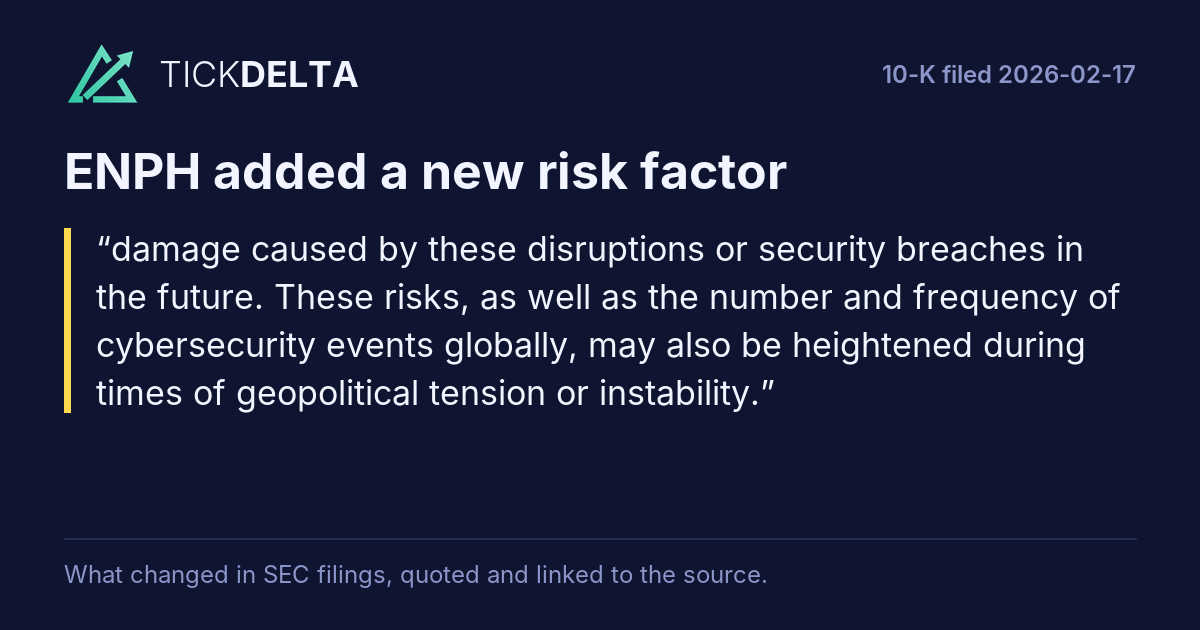
damage caused by these disruptions or security breaches in the future. These risks, as well as the number and frequency of cybersecurity events globally, may also be heightened during times of geopolitical tension or instability.
Paragraphs in the 10-Q filed Oct 27, 2026 that were not in the one before
New in the latest 10-Q
17 paragraphs in the 10-Q filed Oct 27, 2026 with nothing like them in the 10-Q filed Jul 28, 2026 (at least half the words must differ; new numbers alone do not count). Quoted exactly, grouped by the item heading above them. This is text that changed, not a judgement of how serious it is.
Financial statements and notes
As of September 30, 2026, the Company also holds equity securities measured at fair value with changes in fair value recognized in Other income (expense), net. Refer to Note 18, “Related Party Transactions” for additional information.
Read in the 10-Q
conversion rate is 467.8363 shares of SunPower common stock per $1,000 principal amount of notes (equivalent to a conversion price of approximately $ 2.14 per share). The notes are categorized as Level 2 within the fair value hierarchy, as the valuation incorporates significant inputs that are observable, either directly or indirectly. During the three and nine months ended September 30, 2026, the Company recognized decreases in the fair value of the SunPower convertible notes of approximately $ 2.9 million and $ 4.0 million, respectively, in Other income (expense), net in the condensed consolidated statements of operations. The estimated fair value of the notes was approximately $ 2.3 million and $ 6.3 million as of September 30, 2026 and December 31, 2025, respectively, based on a scenario-based probability weighted discounted cash flow model that includes significant assumptions, including the discount rate and probability weighting of the various redemption scenarios that impact the settlement of the notes.
Read in the 10-Q
The Company holds a 19.99 % non-controlling equity investment in a residential solar and storage finance entity and has extended loan receivables, a revolving credit facility and standby letters of credit to that entity and its wholly owned special-purpose subsidiaries (together, the "Investee"). The Company elected the fair value option for the equity investment, loan receivables and revolving credit facility to avoid measurement inconsistencies across its interests in the Investee. These instruments are classified as Level 3 within the fair value hierarchy, with fair values estimated using a discounted cash flow methodology incorporating market yield, projected cash flows, and estimated timing of distributions. Changes in fair value and interest income are recognized in Other income (expense), net in the condensed consolidated statements of operations.
Read in the 10-Q
As of September 30, 2026, the fair value of the loan receivables and the revolving credit facility approximated their respective outstanding balances, including accrued and capitalized interest. The following table presents the carrying amounts of the Company’s variable interests and its maximum exposure to loss as of September 30, 2026:
Read in the 10-Q
Arrangement Balance Sheet Classification Carrying Amount (Fair Value) Maximum Exposure (In thousands) ────────────────────────────────────────────────────────────────────────────────────────────────────────────────────────────────────────────────────────────────────────────────────────────── Non-controlling equity investment (19.99%) Other assets $5,000 $5,000 $1.5 million secured loan receivable — Loan 1 Other assets $1,777 $1,777 $1.0 million secured loan receivable — Loan 2 Prepaid expenses and other current assets $1,082 $1,082 $30.0 million secured revolving credit facility (approximately $24.4 million drawn) Prepaid expenses and other current assets $24,408 $30,000 $35.0 million letters of credit (drawn: None) Accrued and other liabilities — $35,000
Read in the 10-Q
Show the other 12
The Company’s maximum exposure to loss as of September 30, 2026 was approximately $ 72.9 million, comprising the aggregate carrying amounts of the equity investment, loan receivables, and revolving credit facility, the undrawn commitment on the revolving credit facility, and the aggregate stated amount of the irrevocable standby letters of credit. It will increase as paid-in-kind (“PIK”) interest is capitalized. The excess of maximum exposure over carrying amounts primarily reflects the undrawn commitment on the revolving credit facility and the letters of credit, neither of which is recorded on the condensed consolidated balance sheet.
Read in the 10-Q
Loan 1 and Loan 2 bears interest at 15 % payable in cash and mature in December 2027 and December 2026, respectively. The revolving credit facility bears interest at 9.0 % PIK capitalized quarterly, restricts advances to permitted expenditures, and matures April 30, 2027.
Read in the 10-Q
In connection with the Investee's new credit facility and a separate tax credit transfer agreement, the Company issued three irrevocable standby letters of credit with an aggregate stated amount of $ 35.0 million, which expires between March 2027 and January 2034, including annual auto-renewal. The letters of credit may be drawn upon specified events including tax credit deficiencies, events of default, or issuing bank events. The Company recognized a stand-ready guarantee liability of approximately $ 0.8 million at inception, which is amortized over the respective terms of the letters of credit. The probability of a draw is assessed as remote as of September 30, 2026; accordingly, no contingent loss accrual has been recorded. A separate reimbursement agreement with the Investee provides for repayment of any amounts drawn under the letters of credit. In connection with the Investee’s new credit facility, the Company entered into an intercreditor agreement under which the Company’s security interest in the shared collateral is subordinated to the obligations of the Investee under the new credit facility.
Read in the 10-Q
On August 19, 2026, Tigo Energy Innovations LLC filed a complaint in the United States District Court for the Western District of Texas against the Company, alleging infringement of ten patents by certain of the Company’s products. The complaint seeks unspecified damages and other relief. Given the uncertainty of litigation and the preliminary stage of the case, the Company cannot reasonably estimate the possible loss or range of loss, if any, associated with the matter. The Company disputes the allegations in this lawsuit and intends to defend the matter vigorously.
Read in the 10-Q
On May 7, 2026, the U.S. Court of International Trade held that the Section 122 proclamation was invalid and granted relief to certain named plaintiffs. The government appealed the ruling, and the Federal Circuit granted a stay of the judgment and injunction pending appeal. As of the date of this filing, the appeal remains pending. The Section 122 surcharge expired on July 24, 2026, upon reaching the applicable 150-day statutory limit.
Read in the 10-Q
If the Section 122 proclamation is ultimately held invalid and refund mechanisms applicable to the Company are established, the Company may be eligible to recover some or all of the Section 122 duties paid. However, the outcome of the appeal and the Company’s entitlement to, and the availability, timing and amount of any potential refunds remain uncertain and are subject to further judicial and administrative proceedings. Accordingly, no receivable for potential Section 122 tariff refunds has been recognized as of September 30, 2026.
Read in the 10-Q
On July 23, 2026, following Section 301 investigation initiated by the U.S. Trade Representative on March 12, 2026 and determinations announced on June 2, 2026, the Administration announced new tariffs of 10% or 12.5% on imports from 60 trading partners. The tariffs took effect on July 24, 2026, subject to specified product and other
Read in the 10-Q
exemptions. It remains uncertain whether additional tariffs or other trade restrictions may be imposed under alternative statutory authorities, whether such measures would withstand legal challenge, and whether any refund process will be available with respect to duties previously paid.
Read in the 10-Q
In July 2026, we announced expanded support that allows homeowners across the United States and Canada with existing non-Enphase solar systems to add the IQ Battery 10C and whole-home backup, without replacing the solar equipment already on the roof. With the addition of the IQ Battery 10C, IQ Combiner 6C, and IQ Meter Collar, homeowners can keep their existing solar investment while adding Enphase storage, whole-home backup, energy management, and monitoring through the Enphase® App.
Read in the 10-Q
Legal proceedings
filed their reply in support of their motion to intervene. On April 9, 2026, the Court denied both motions to intervene, and the case remains stayed.
Read in the 10-Q
On August 19, 2026, Tigo Energy Innovations LLC filed a complaint in the United States District Court for the Western District of Texas against us, alleging infringement of ten patents by certain of our products. The complaint seeks unspecified damages and other relief. Given the uncertainty of litigation and the preliminary stage of the case, we cannot reasonably estimate the possible loss or range of loss, if any, associated with the matter. We dispute the allegations in this lawsuit and intend to defend the matter vigorously.
Read in the 10-Q
Other information
Set forth below is certain information regarding a Rule 10b5-1 trading plan adopted by one of our officers (as defined in Rule 16-a-1(f) under the Exchange Act) during the third quarter of 2026. The adoption of this trading plan occurred during an open insider trading window and is intended to satisfy the affirmative defense conditions of Rule 10b5-1(c) under the Exchange Act.
Read in the 10-Q
The 10-Q's risk factors against the 10-K
Item 1A of the 10-Q filed Oct 27, 2026 against Item 1A of the 10-K filed Feb 17, 2026.
A 10-Q repeats only the risks that changed, so a 10-K paragraph that is missing from it is not counted as removed.
Added is a paragraph with nothing like it in the 10-K, Reworded a sentence that is in both with several words changed,
Quiet changes a sentence in both where one to four words changed and one is a hedge or a modal
(cut words struck through, new words highlighted).
Text on the page, not a score; each links to the filing at sec.gov.
Phrases used for the first time
Two-word phrases in Risk Factors of the 10-K filed Feb 17, 2026 that are in none of the 1 earlier 10-Ks stored, back to Feb 10, 2025
Where each one is used
- domestic content: For example, the IRA and subsequent legislation, including the OBBBA, introduced significant changes to ITC eligibility and domestic content requirements. The Section 25D credit for residential solar and storage systems expired on December 31, 2025. In addition, the OBBBA imposes new timing requirements for...
- content requirements: For example, the IRA and subsequent legislation, including the OBBBA, introduced significant changes to ITC eligibility and domestic content requirements. The Section 25D credit for residential solar and storage systems expired on December 31, 2025. In addition, the OBBBA imposes new timing requirements for...
- imposes new: For example, the IRA and subsequent legislation, including the OBBBA, introduced significant changes to ITC eligibility and domestic content requirements. The Section 25D credit for residential solar and storage systems expired on December 31, 2025. In addition, the OBBBA imposes new timing requirements for...
- key markets: Our business and the broader solar and energy storage industry depend significantly on government-issued subsidies and economic incentives that promote the adoption and cost competitiveness of solar photovoltaic (“PV”) and energy storage systems for on-grid applications. These incentives include, among others,...
- storage projects: For example, the IRA and subsequent legislation, including the OBBBA, introduced significant changes to ITC eligibility and domestic content requirements. The Section 25D credit for residential solar and storage systems expired on December 31, 2025. In addition, the OBBBA imposes new timing requirements for...
- compliance thresholds: For example, the IRA and subsequent legislation, including the OBBBA, introduced significant changes to ITC eligibility and domestic content requirements. The Section 25D credit for residential solar and storage systems expired on December 31, 2025. In addition, the OBBBA imposes new timing requirements for...
- non-feoc requirements: •in the United States, our ability to comply with domestic content and non-FEOC requirements;
- third-party websites: If we are unsuccessful in continuing to expand our direct-to-consumer sales channel by driving purchases through our website or third-party websites, our business and results of operation could be harmed.
Used at least twice, small words left out. Counted, not picked: a phrase can be new because the company renamed something.
What was taken out
13 paragraphs of last year's Risk Factors with nothing like them now. The longest are quoted.
Sources
Item 1A of each 10-K and 10-Q on EDGAR, quoted exactly. Each paragraph links to the filing at sec.gov.
Also
10-K change: what was reworded or cut, section by section.
Work with it
Excel workbook · CSV. Google Sheet that stays up to date: paste =IMPORTDATA("https://tickdelta.com/company/ENPH/export.csv") into a cell.