Form 10-K for the Year Ended December 31, 2022
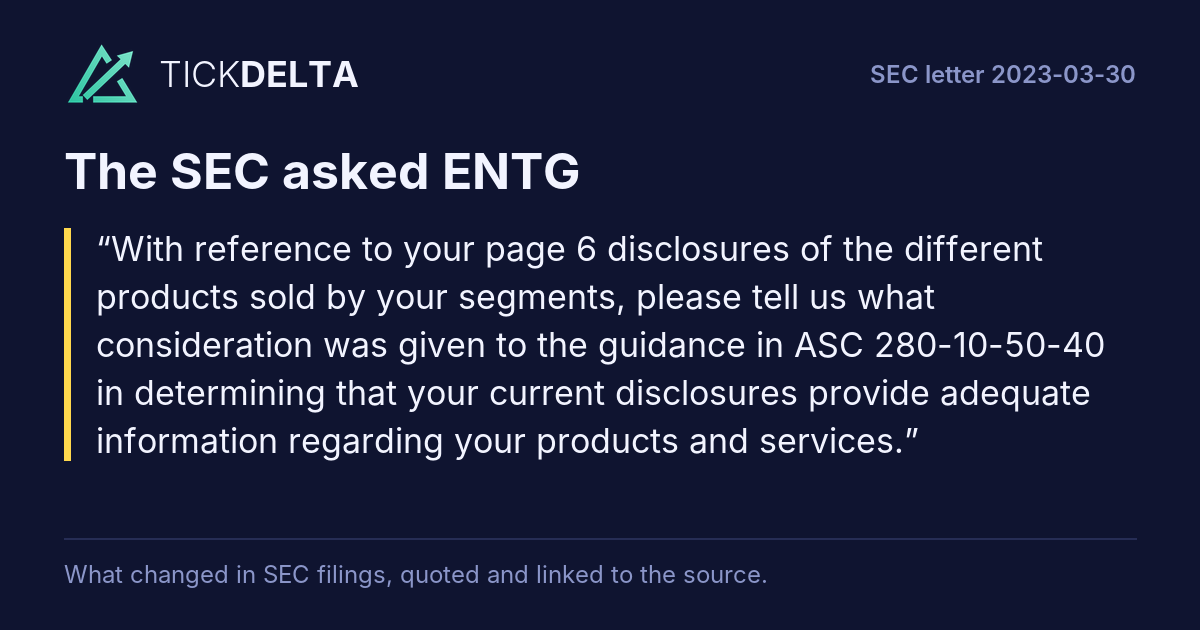
With reference to your page 6 disclosures of the different products sold by your segments, please tell us what consideration was given to the guidance in ASC 280-10-50-40 in determining that your current disclosures provide adequate information regarding your products and services.
The Company acknowledges the Staff’s comment and advises the Staff that it considers and follows the provisions of ASC 280-10-50-40, “Information about Products and Services” (“ASC 280-10-50-40”), when preparing its financial statements. ASC 280-10-50-40 states that a public entity shall report the revenues from external customers for each product and service or each group of similar products and services unless it is impracticable to do so.Read in the replyRest of the answer
In reviewing the disclosure requirements of ASC 280-10-50-40, the Company considered relevant facts related to whether the Company could accurately and comprehensively identify similar groups of products for disclosure purposes. Following such review, the Company has determined that the products within each of its reportable segments, Microcontamination Control (MC), Advanced Materials Handling (AMH), Specialty Chemicals and Engineered Materials (SCEM), and Advanced Planarization Solutions (APS), including sub-groupings set forth in the disclosure starting on pages 6 of the Company’s Form 10-K, in all material respects constitute groups of similar products, and that further disaggregation of revenues within these groups is therefore not required by
ASC 280-10-50-40.
The Company offers a broad range of customized products, with over 25,000 different catalog numbers, primarily serving the semiconductor industry. The Company’s products fall into four categories: (1) products that eliminate contamination, our MC products; (2) products that protect critical materials, our AMH products; (3) advanced materials applied to semiconductors, our SCEM products, and (4) formulated chemistries and materials that enable the chemical mechanical planarization process and other process steps, our APS products. The products in each of these four categories serve similar end-uses and applications, have similar customers, and are impacted by similar demand and business trends. For example, products in our MC segment are each used by customers to filter or purify contaminants from materials used to manufacture semiconductors and throughout the semiconductor manufacturing ecosystem, have similar customers, demand is affected by overall production of semiconductors and growth is driven by manufacturing transitions to advanced nodes. Products in our AMH segment are used to protect critical materials used during semiconductor manufacturing from contamination and damage, have similar customers, are purchased during similar times during industry expansion cycles and demand is affected by the level of capital expenditures in the semiconductor industry. Products in our SCEM segment are advanced materials, specifically designed, formulated and calibrated to enable complicated fabrication steps in semiconductor and other advanced manufacturing processes, are repeatedly consumed and regularly purchased throughout these manufacturing processes, have similar customers and demand is driven by overall production of semiconductors and the number of process steps required to make semiconductors. Products in our APS segment are chemistries and other materials used during the chemical mechanical planarization module of the semiconductor manufacturing process and other process steps, are repeatedly consumed and regularly purchased throughout the semiconductor manufacturing process, have similar customers and demand is impacted by the level of manufacturing of computer memory products.
With regard to the pipeline and industrial materials business of the SCEM segment, which comprised approximately 1.7% of the Company’s consolidated net sales for the fiscal year ended December 31, 2022, although this product line may appear somewhat dissimilar to the other products discussed above due to the difference in end markets in which it is used (oil and gas pipelines versus the semiconductor industry), the products sold are similar in that they are, like other SCEM products, advanced specialty materials specifically formulated to serve customers’ unique performance needs. In addition, the Company advises the Staff that it does not view revenues from this business as qualitatively or quantitatively material and, therefore, it concluded that even if it viewed any of these products or services as dissimilar in the context of ASC 280-10-50-40, providing disaggregated revenue information would not meaningfully enhance the users’ understanding of the Company’s financial statements or its business.
The Company considered alternative groupings of its products for disclosure and considered any natural groupings within the reportable segments as well as across the reportable segments. The Company did not view that disclosure across the reportable segments or below the reportable segment was practical nor that it would provide meaningful disclosure for the users of our financial statements because of the similarities described above within each reportable segment, which the Company believes aligns with the meaning of impracticable as used in the ASC 280-10-50-40. The disclosure starting on page 6 of the Company’s Form 10-K is intended only to help investors understand the breadth and applications of the product offerings in each of the reportable segments that the Company manufactures and sells across numerous applications and processes throughout the semiconductor ecosystem.
Based on this analysis, the Company believes that additional disclosure of revenues incremental to what is already disclosed in the Segment Information footnote on page F-34 to our financial statements in our Form 10-K for the year ended December 31, 2022 is not required and that the related disclosure in our Form 10-K satisfies the disclosure requirements of ASC 280-10-50-40. The Company will continue to evaluate its analysis in connection with its periodic reporting, and if any material changes occur in the Company’s business, the Company will evaluate the need to modify its product disclosure as contemplated by ASC 280-10-50-40.
First report after the company's reply of Apr 12, 2023: 10-Q filed May 11, 2023 ↗, against the 10-Q filed Nov 2, 2022 ↗.
Tickdelta does not hold the text of both reports, so they are not compared here.
In your determination of Adjusted EBITDA, you include adjustments for integration costs as well as contractual and non-cash integration costs. You also include an adjustment for integration costs in your determination of non-GAAP net income. Please tell us the nature of these costs. Provide a breakdown of the types of costs included in these adjustments and describe and quantify each material component.Rest of the question
With reference to the material components, please tell us what consideration you gave to Question 100.01 of the Non- GAAP Financial Measures Compliance & Disclosure Interpretations, as updated December 13, 2022, in determining it was appropriate to include these adjustments.
In our determination of Adjusted EBITDA and non-GAAP net income, the Company has included adjustments for integration costs and contractual and non-cash integration costs. The table below quantifies the major components of each of those adjustments.Read in the reply
Integration costs
FY 2022
Employee related costs
$
18,105
Professional services
32,625
Total
50,731
Contractual and non-cash integration costs
CMC Retention
18,030
Stock-based compensation alignment
21,584
Change in control costs
22,350
61,964
These costs have been excluded from Adjusted EBITDA as they are not representative ofRest of the answer
the ongoing, recurring costs necessary to operate the Company’s business; instead, these are costs specifically associated with the recent CMC Materials, Inc. (“CMC”) acquisition. The Company separated these integration costs related to the CMC acquisition into two categories in order to provide investors with clarity on the nature of our costs and to distinguish what accounted for these costs during the period. The contractual and non-cash integration costs were incurred directly as a result of the acquisition and were pursuant to the definitive agreement or legacy agreements with management or were necessary to incur in connection with the harmonization of the two company stock based compensation plans (in particular, retirement vesting).
For example, the CMC retention costs represent the costs associated with the CMC retention program that was agreed upon and set forth in the definitive acquisition agreement. The employee benefits harmonization costs represent the non-cash incremental expense associated with adopting retirement vesting obligations on Entegris equity awards, similar to those of CMC equity awards. The change in control costs relate to the CMC change in control agreements that were in place with management prior to the acquisition and the associated expense post-acquisition.
Integration costs included the employee-related costs associated with severance and retention of employees impacted by the acquisition, and costs associated with professional services engaged to support the transaction and integration.
The Company acknowledges the Staff’s comment and respectfully advise that the Company has considered the guidance set forth in Question 100.01 of the Compliance and Disclosure Interpretations on
Non-GAAP Financial Measures (“Question 100.01”). The Company believes the integration and contractual and non-cash integration costs are not normal, recurring, cash operating expenses necessary to operate our business, and therefore, are appropriate items to exclude when calculating Adjusted EBITDA and Non-GAAP net income. In assessing whether the integration costs constitute normal, recurring, cash operating expenses, the Company considered the fact that although the costs were incurred over a period of time, they related specifically to initiatives directly attributable to the acquisition and integration of the acquired CMC business and are non-recurring. The costs that are excluded from Adjusted EBITDA and Non-GAAP net income were expensed as incurred.
The Company believes that excluding these integration costs from Adjusted EBITDA and Non-GAAP net income and presenting them in our reconciliation of net income to Adjusted EBITDA provides the investment community and others with a helpful and complete understanding of our ongoing operations while enhancing the comparability of current results to results in prior periods, which may be useful for investors in their analysis of our financial performance.
First report after the company's reply of Apr 12, 2023: 10-Q filed May 11, 2023 ↗, against the 10-Q filed Nov 2, 2022 ↗.
Tickdelta does not hold the text of both reports, so they are not compared here.
You present proforma non-GAAP Net sales. Tell us and disclose if these pro forma metrics were prepared in accordance with Article 11 of Regulation S-X. If such information has not been prepared in accordance with Article 11, please revise to disclose the basis for presentation and revise the description of the measures accordingly.Rest of the question
Refer to Question 100.05 of the Non-GAAP Measures Compliance and Disclosure Interpretations as updated December 13, 2022. Ensure that you appropriately label each metric accordingly. Pursuant to Item 10(e)(1)(i) of Regulation S-K, please also disclose the reasons why management believes that presentation of this non-GAAP financial measure provides useful information to investors as well as any additional purposes for which management uses the non-GAAP financial measure.
The Company respectfully acknowledges the Staff’s comment above. The pro forma metrics were prepared in accordance with Article 11 of Regulation S-X. The Company started with the line item Proforma GAAP Sales. Proforma GAAP Sales represents the combined sales of the Company and the recent acquisition of CMC for the respective period, excluding intercompany sales. In future filings, theRead in the reply
Company will rename the line item to remove the word “GAAP.” The adjustment to the proforma line item relates to an adjustment to remove CMC’s wood treatment business.Rest of the answer
Prior to the acquisition, CMC operated a wood treatment business, which manufactured and sold wood treatment preservatives for utility poles and crossarms. CMC exited this business during the first half of 2022, prior to our acquisition of CMC. As a result, the wood treatment business had no ongoing sales at the time of the acquisition. To provide a useful view of the combined businesses on a proforma basis for comparative purposes, the Company removed the wood treatment sales from the proforma information as there will be no future sales. The Company believes that this non-GAAP financial measure will provide investors with more easily comparable and useful information when comparing current Company results to results in previous periods on a proforma basis. In future filings, the Company will provide a footnote describing this adjustment.
Based on our understanding of the requests made in your comments and on our responses and undertakings concerning future disclosures in this letter, we do not anticipate amending any past filings, but we will make the enhanced disclosures discussed in this letter in future filings as appropriate.
First report after the company's reply of Apr 12, 2023: 10-Q filed May 11, 2023 ↗, against the 10-Q filed Nov 2, 2022 ↗.
Tickdelta does not hold the text of both reports, so they are not compared here.
We note your response to comment 2. Please address the following: • Confirm you will expand your disclosures related to integration costs as well as contractual and non-cash integration costs to provide a discussion of the components of each of these adjustments along with quantification of the components; • We note that integration costs include employee-related costs related to severance and retention.Rest of the question
Quantify the amount associated with severance and retention separately; • We note that there are retention costs included in the integration costs line item as well as CMC retention costs included in the contractual and non-cash integration costs line item. Tell us the periods over which these types of compensation costs are expected to be incurred. For retention costs that extend beyond a year, please further explain how you determined that the adjustment for these costs is appropriate. Refer to Question 100.01 of the Non-GAAP Financial Measures Compliance & Disclosure Interpretations, as updated December 13, 2022; and • For professional services included in integration costs line item, confirm that there are no ongoing payments associated with these professional services. Otherwise, tell us the periods over which these services are expected to be incurred and further explain how you determined the adjustment for these costs is appropriate. Refer Interpretations, as updated December 13, 2022.
The Company acknowledges the comment and confirms that in future filings we will expand our disclosures related to integration costs as well as contractual and non-cash integration costs to provide a discussion of the components of these adjustments along with quantification of the components.Read in the reply
• We note that integration costs include employee-related costs related to severance and retention.Rest of the answer
Quantify the amount associated with severance and retention separately;
ENTEGRIS PROPRIETARY AND CONFIDENTIAL – INTERNAL
Please see the quantification of the employee-related integration costs associated with severance and retention in the table below. In future filings we will quantify the severance and retention costs separately as well major categories of other items within integration costs.
Integration Costs (in thousands)
FY 2022
Professional Fees
$
35,422
Severance
6,269
Retention
1,987
Other employee related costs and other
7,053
Total
50,731
• We note that there are retention costs included in the integration costs line item as well as CMC retention costs included in the contractual and non-cash integration costs line item. Tell us the periods over which these types of compensation costs are expected to be incurred. For retention costs that extend beyond a year, please further explain how you determined that the adjustment for these costs is appropriate. Refer to
Question 100.01 of the Non-GAAP Financial Measures Compliance & Disclosure Interpretations, as updated December 13, 2022; and
In connection with our acquisition of CMC Materials, Inc. (“CMC”), which closed on July 6, 2022 (the “Closing Date”), and pursuant to the merger agreement, CMC established a cash retention program (the “CMC Retention Program”) to promote retention and to incentivize efforts to consummate the merger and effectuate the integration. Awards under the CMC Retention Program were contingent upon the recipient’s continued employment through certain dates, subject to earlier payout upon certain qualifying termination events occurring after the closing. The terms of the retention awards granted to CMC employees under the CMC Retention Program provide that 50% of each such award will vest on the closing date and the remaining 50% will vest on the six month anniversary of the closing date, in each case subject to the employee’s continued employment in good standing through each such date. The retention pool was approximately
$18 million. Per the terms of the CMC Retention Program, substantially all awards were paid out within one year of closing.
In addition to the CMC Retention Program, Entegris entered into retention arrangements (“Entegris Retention Program”) with certain employees of both CMC and Entegris to support the integration of CMC into our business operations system, process and system consolidation and transformational activities around portfolio assessment and related actual and potential divestitures. The total amount subject to the Entegris
Retention Program is approximately $5 million. Retention agreements with these individuals were structured to last until the expected achievement of certain strategic integration milestones. Given the size of the CMC acquisition, and the complexity of the integration and related strategic initiatives, we retained certain employees for longer than one year post-closing. These integration activities require considerable planning and resources that are not part of our ordinary cost structure. The
Entegris Retention Program consists of retention agreements with terms generally ranging from 6 months to 12 months, with several lasting approximately 18 months.
It is our policy to include in our Non-GAAP adjustments employee retention that we do not believe are recurring in nature, such as the CMC Retention Program and the Entegris
Retention Program, and we believe this helps investors understand our current financial performance on a comparable basis period over period. To the extent retention costs are incurred because a resource is deemed essential to running the business, we would treat and present those costs as normal operating costs.
We believe that our presentation of employee retention costs that we reported in our Non-GAAP measures is permissible under the Commission’s rules and the Staff’s guidance and accurately reflects the management of our business. We believe that, by excluding certain non-recurring employee retention costs, investors are provided with a measure that enhances the comparability of the Company’s underlying operating results period over period. Further, the Company’s management believes that using and presenting non-GAAP measures that exclude these costs is a useful supplement for investors to GAAP disclosures because they enhance investors’ understanding of trends in operating the business without the effect of non-recurring costs associated with certain strategic initiatives related to the CMC acquisition.
• For professional services included in integration costs line item, confirm that there are no ongoing payments associated with these professional services. Otherwise, tell us the periods over which these services are expected to be incurred and further explain how you determined the adjustment for these costs is appropriate. Refer to Question 100.01 of the Non-GAAP Financial Measures Compliance & Disclosure
Interpretations, as updated December 13, 2022.
The costs associated with professional services that are included in the integration costs line item are to support the integration of our recent acquisition of CMC into the Company. As described above, following the completion of this transaction, the Company is implementing certain strategic initiatives, including related to business integration and portfolio assessment, and has incurred professional services costs in connection with such initiatives. These costs do not represent normal, recurring cash operating expenses required to operate the business. Rather, these costs are incurred in order to strategically integrate and optimize efficiencies from the CMC acquisition across the
Company’s business and to assess the strategic fit of the acquired CMC portfolio to permanently alter the Company’s operations for the long-term following the completion of the transaction. Further, given the nature of the costs that are being incurred to effect strategic, long-term change at the Company, these costs can vary significantly in amount and frequency based on the initiative being implemented and the extent of the use of professional services to support the initiative. We believe that by excluding these non-recurring costs associated with the integration of CMC, investors are provided with a measure that enhances the comparability of the Company’s underlying operating results period over period. Further, the Company’s management believes that using non-GAAP measures that exclude such costs is a useful supplement for investors to GAAP disclosures because they enhance the understanding of trends in operating the business without the effect of non-recurring costs associated with certain strategic initiatives related to the CMC acquisition.
Based on our understanding of the requests made in your comments and on our responses and undertakings concerning future disclosures in this letter, we do not anticipate amending any past filings, but we will make the enhanced disclosures discussed in this letter in future filings as appropriate.
First report after the company's reply of May 4, 2023: 10-Q filed May 11, 2023 ↗, against the 10-Q filed Nov 2, 2022 ↗.
Tickdelta does not hold the text of both reports, so they are not compared here.
Also in this review: closing letter, 2023-05-12