Screener / SEC EDGAR /CIK 0000918646 /10-K filed May 19, 2026, compared with May 20, 2025 /Numbers from the XBRL of the 10-Ks
NYSE Materials · Cement

Eagle Materials Inc EXP

Compare with peers Embed
SEC comment letters, last 20 years

2 reviews of EXP's filings by SEC staff

UPLOAD and CORRESP
Reviews 2 latest letter Mar 6, 2023
Questions asked 3 each answered in the company's own letter
No closing letter 0 reviews without a letter saying the staff completed it

When the SEC's staff reviews a filing, it writes to the company with numbered questions, and the company answers each one in a letter. SEC publishes the exchange once the review is over, at least 20 business days later. A question is not an accusation; most reviews end with the company adding detail to its next filing.

How the reviews went

Every review on EDGAR, from the first staff letter to the letter that closes it

  1. 1. Staff letters 2 UPLOAD
  2. 2. Questions in them 3 numbered comments
  3. 3. Company replies 2 CORRESP
  4. 4. Reviews closed 2 of 2 closing letter

Half the closed reviews took 26 days or less from the first letter to the closing letter.

Form 10-K for the Fiscal Year Ended March 31, 2022

2023-03-06 to 2023-03-22 · 1 question · 1 letter from the SEC, 1 from the company
Review closed 2023-03-22
RevenueNon-GAAP measuresSegmentsResults discussion (MD&A)
Management Discussion and Analysis of Financial Condition and Results of Operations · Fiscal Year 2022 vs. Fiscal Year 2021 Results by Segment, page 43
SEC asked
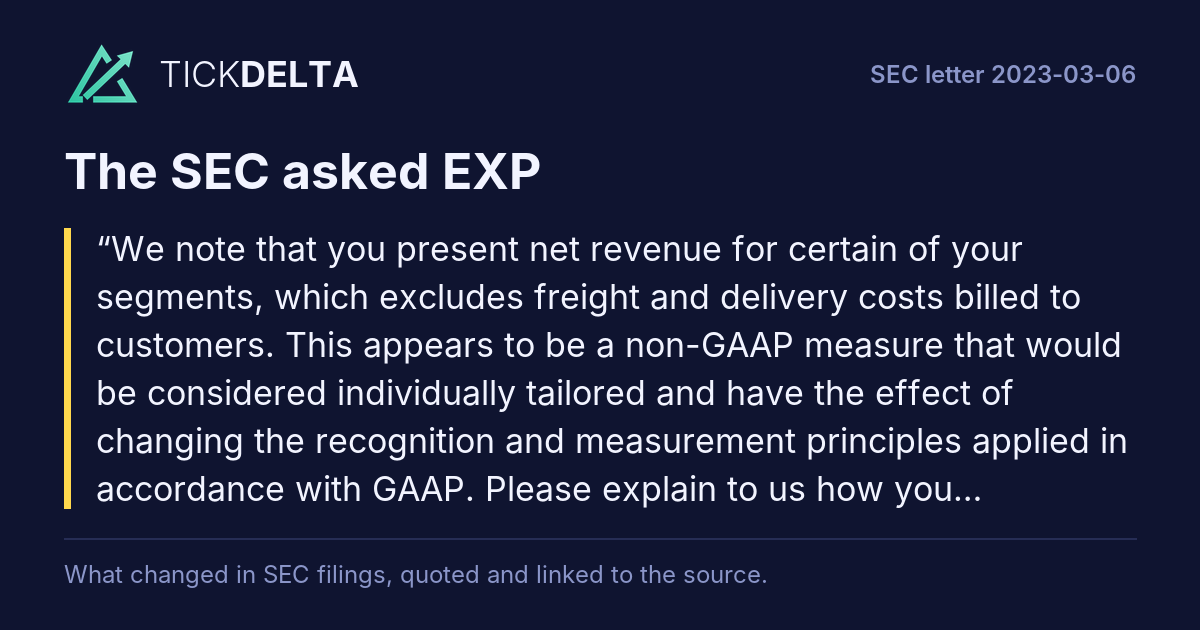
We note that you present net revenue for certain of your segments, which excludes freight and delivery costs billed to customers. This appears to be a non-GAAP measure that would be considered individually tailored and have the effect of changing the recognition and measurement principles applied in accordance with GAAP.
Rest of the question

Please explain to us how you considered Question 100.04 of the Non-GAAP Financial Measures Compliance and Disclosure Interpretations.

EXP answered
In the tables summarizing the results of operations of certain of its segments, the Company has historically included a line item labeled net revenue, which represents the mathematical result of subtracting freight and delivery costs from gross revenue, as reported. The intent of this presentation has not been to change the recognition and measurement principles applied in accordance with

GAAP or to substitute an individually tailored non-GAAP measure for the appropriate GAAP measure.
Rest of the answer

In fact, our presentation has always shown the appropriate GAAP measure in a line item appearing above net revenue. Moreover, the narrative discussion of segment results that follows the tables has focused solely on the GAAP measure, and has not mentioned or discussed changes in net revenue or the reasons for the same. We believe this information is helpful in understanding the nature of our sales arrangements with customers in each segment, and we do not believe it is misleading, particularly given the context in which it is presented.

Nevertheless, in light of the Staff’s comment, in future filings, the Company will no longer disclose net revenue for any of its segments.

Read in the reply
In its next report

First report after the company's reply of Mar 15, 2023: 10-K filed May 19, 2023 ↗, against the 10-K filed May 20, 2022 ↗.

Tickdelta does not hold the text of both reports, so they are not compared here.

Also in this review: closing letter, 2023-03-22

Form 10-K for the year ended March 31, 2019

2019-11-08 to 2019-12-04 · 2 questions · 1 letter from the SEC, 1 from the company
Review closed 2019-12-04
SegmentsGoodwill and impairmentNon-GAAP measures
Impairment or Disposal of Long-Lived and Intangible Assets, page 73
SEC asked (1)
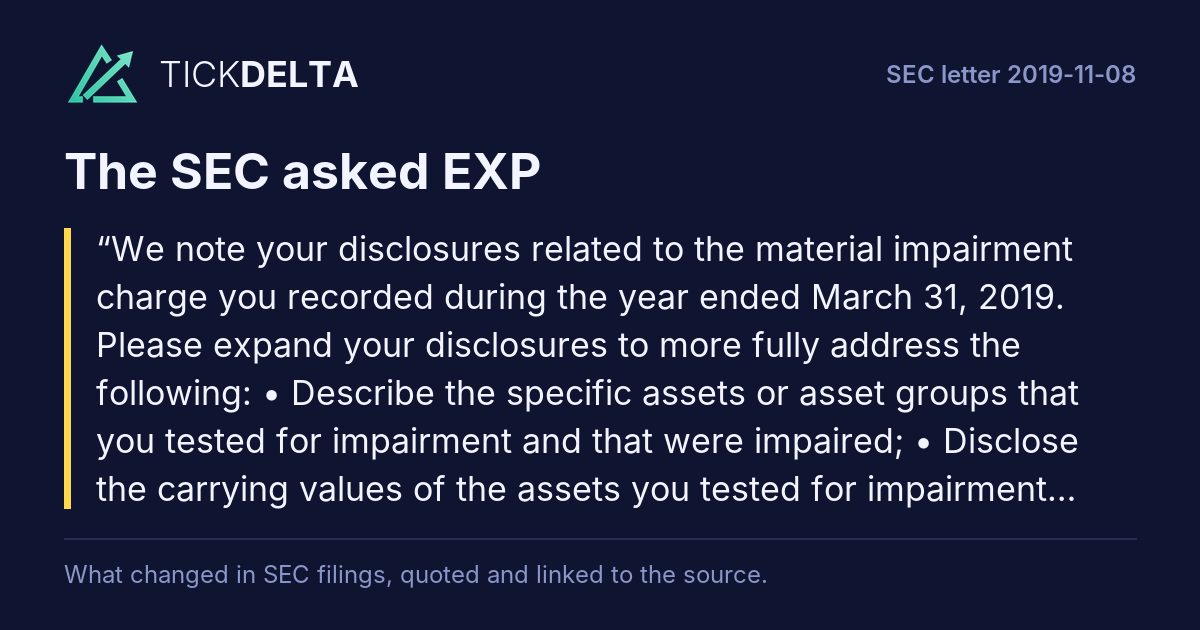
We note your disclosures related to the material impairment charge you recorded during the year ended March 31, 2019. Please expand your disclosures to more fully address the following: • Describe the specific assets or asset groups that you tested for impairment and that were impaired; • Disclose the carrying values of the assets you tested for impairment and the remaining carrying values of the assets that were
Rest of the question

impaired; and • To the extent material, disclose and discuss the risks and uncertainties related to any reasonably possible asset impairments expected in the next 12 months. Specifically address the nature of the identifiable assets in the oil and gas proppants segment, including the nature of the material capital expenditures related to this segment incurred during the last two fiscal years. Refer to ASC 360-10-50-2, ASC 820-10-50-2, ASC 820-10-55-100, and ASC 275-10-508.

EXP answered
On page 74 of the 2019

Form 10-K, we disclosed that impairment indicators were present within our Oil and Gas Proppants segment and then we described the asset groups that were tested for impairment and that were impaired.

Specifically, for purposes of our analysis, we grouped the long-lived assets of the segment into the lowest level where cash flows are generated, which is the level of individual operating or distribution facilities. Each facility is specifically identified by location in Item 1. of the 2019 Form 10-K (starting on page 21).
Rest of the answer

This disclosure specifies the number and location of our wet plants, dry plants and distribution facilities as well as the nature of the activities that occurs at each facility. Also, on page 74, we noted that impairment losses were taken to (i) property, plant and equipment, (ii) goodwill and (iii) intangible and other assets. Additionally, on pages 46 and 74, we quantified the impairment to Property, Plant and Equipment and other assets. Finally, on pages 72 and 73, we described and quantified the impairment of Goodwill and other Intangible Assets within the segment.

As reported in our December 31, 2018 Form 10-Q, the carrying value of the segment assets was

$462 million, which consisted of three operating facilities, ten distribution facilities, inventory and accounts receivable (each facility as described in Item 1 of our 2019 Form 10-K beginning on Page

21). The carrying value of property, plant, and equipment at these facilities comprised approximately $420 million of the $462 million in segment assets. Because over 90 percent of the segment assets consist of property, plant, and equipment, all of which was analyzed for impairment, we believe that our disclosure of the Identifiable Assets of the Oil and Gas Proppants segment in Footnote (F) Business Segments met the requirements for disclosing the carrying values of the assets tested for impairment. In Footnote (A) (page 74), we disclosed the total impairment of property, plant, and equipment ($211 million). Footnote (F) includes the Identifiable Assets as of the beginning of the fiscal year, current year capital expenditures, current year depreciation, depletion and amortization, and Identifiable Assets at the end of the year.

Within the segment, we concluded that approximately $284 million out of the $420 million of our property, plant, and equipment was considered impaired. After the impairment charge of $211 million, the remaining carrying value of the impaired assets was approximately $73 million, which we did not consider to be material to an understanding of future impairment risk in the segment. The relevant risks to the segment were disclosed in the 2019 Form 10-K, as further discussed below.

Our Oil and Gas Proppants segment is subject to volatility given the nature of the energy markets and is significantly impacted by drilling and completion activity as well as pricing for white sand versus competing regional sand. We disclosed in the 2019 Form 10-K these risks and uncertainties related to the Oil and Gas Proppants business in Item 1A. Risk Factors. Specifically, we disclosed that the segment’s business and financial performance depends on the level of activity in the oil and natural gas industries (page 28) and that we may be adversely affected by decreases or shifts in demand for frac sand or the development of either effective alternative proppants or new processes to replace hydraulic fracturing (page 36).

Further, throughout fiscal 2019, we experienced volatility in this segment, and during each quarter updated MD&A to discuss the uncertainties related to pricing and demand and other factors impacting this business. In the March 31, 2019 Form 10-K, on page 45, we disclosed in the Market Conditions and Outlook sections of MD&A that we were engaged in a strategic review of our portfolio of businesses, and that depending on the outcome of this review, further recoverability reviews will be required which may result in future impairment charges. This business continues to experience volatility in operating results, and the business continues to be under strategic review. In future filings, we will continue to update these disclosures to reflect changes in market conditions and other factors that may affect the risk of impairment.

In fiscal 2019 and 2018, segment capital expenditures were $52 million and $57 million, respectively, as disclosed in Footnote (F), the segment footnote. These capital expenditures were primarily related to the build out of our Utica, IL operating facility, which was completed in June 2018 as disclosed in the Business section of the 2019 Form 10-K on page 21.
Read in the reply
In its next report

First report after the company's reply of Nov 20, 2019: 10-Q filed Feb 4, 2020 ↗, against the 10-Q filed Oct 31, 2019 ↗.

Tickdelta does not hold the text of both reports, so they are not compared here.

Form 8-K Filed on July 30, 2019 · Exhibit 99.1, page 10
SEC asked (2)
We note your presentation of non-GAAP adjustments you use to calculate the non-GAAP financial measure, Adjusted Earnings per Diluted Share. Adding back adjustments, net of tax, is not consistent with the guidance provided in Question 102.11 of the the updated Compliance and Disclosure Interpretations on Non-GAAP Financial Measures (April 4, 2018). Please revise your future non-GAAP presentations accordingly.
EXP answered
We confirm that in the future we will not include adjustments on a net of tax basis in any non-GAAP presentations. Instead, we will show income taxes as a separate adjustment and provide a clear explanation.
Read in the reply
In its next report

First report after the company's reply of Nov 20, 2019: 10-Q filed Feb 4, 2020 ↗, against the 10-Q filed Oct 31, 2019 ↗.

Tickdelta does not hold the text of both reports, so they are not compared here.

Also in this review: closing letter, 2019-12-04

From the SEC's correspondence on EDGAR: staff letters (form UPLOAD) and company letters (form CORRESP), 6 letters filed since 2019-11-08. Questions and answers are matched by their numbers; topics come from words in each question. The reports are compared word for word (same form, before the first SEC letter against the first report after the company's reply). No AI.

Sources

The SEC's correspondence on EDGAR: staff letters (form UPLOAD) and company letters (form CORRESP), matched question by question. No AI.

Also

Filings: the letters in the filing list.

Work with it

Excel workbook · CSV. Google Sheet that stays up to date: paste =IMPORTDATA("https://tickdelta.com/company/EXP/export.csv") into a cell.

Next in Owners and insiders:Insider trades
Esc

Type a ticker such as AAPL, a name, an investor such as Buffett, or a topic such as tariffs. ↑ ↓ to move, Enter to open.