Added10-Q 2026-11-04 vs 10-K 2026-02-25
Item 2. Unregistered Sales of Equity Securities, Use of Proceeds, and Issuer Purchases of Equity Securities
Tickdelta is free for now. Sign up and get Pro free
4 paragraphs in Risk Factors of the 10-K filed Feb 25, 2026 with nothing like them in the 10-K filed Feb 21, 2025. Quoted exactly. Paragraphs that were only edited are under 10-K change.
Compared with the Risk Factors in the latest 10-K of the other 81 Industrials companies: a paragraph with at least half its words the same at another company is called similar, and the companies are listed under it. A paragraph most of them have is marked boilerplate. No line means no other company has one like it. This counts text; it does not say how serious a risk is.
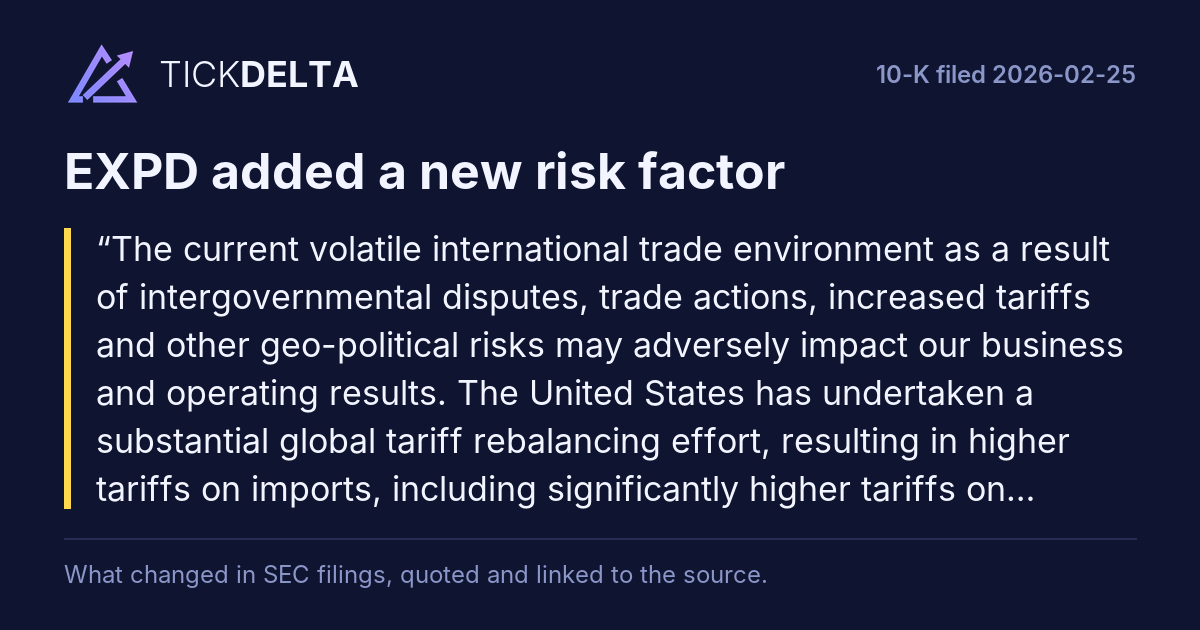
The current volatile international trade environment as a result of intergovernmental disputes, trade actions, increased tariffs and other geo-political risks may adversely impact our business and operating results.
The United States has undertaken a substantial global tariff rebalancing effort, resulting in higher tariffs on imports, including significantly higher tariffs on goods made in China and sectoral tariffs on a range of materials and products. These measures led to threatened or actual retaliatory tariffs on goods made in the United States from several countries, including China and Canada. This created an unpredictable trade environment for shippers to determine if and how to adapt their sourcing patterns given these new and fast-changing regulations. If these conditions result in a significant, short-term or longer-term, decrease or redistribution of international trade volumes, it could negatively affect our business volumes and revenues. Expeditors' activity is particularly exposed to trade volume impacts from trade actions and tariff disputes between China and the United States, as we generated 19% and 22% of our revenues and 15% and 17% of our operating income in 2025 and 2024, respectively, on exports from China and Hong Kong. Uncertainty and changes to trade volumes could also affect air and ocean freight carriers because they may adjust capacity and transportation schedules, which could result in volatility in available capacity, and average sell and buy rates, all of which could adversely impact our operations and financial results. While some of those volumes are shifting to other routes, as customers look to mitigate their exposure to China-specific tariffs, it is too early to know what the overall decline in volumes might be. Many of our customers are subject to the increased tariffs and may experience increased costs of conducting business. This could result in a loss of business, bad debt or increased expenses in the future if our customers were to abandon cargo, enter into bankruptcy or insolvency proceedings, or their ability to pay deteriorates. Additionally, the increased complexity of trade regulations and customs declaration processes challenges our ability to be in compliance with such ever-changing regulations and may require us to dedicate additional resources to our customs brokerage operations.
Read in the 10-K ↗
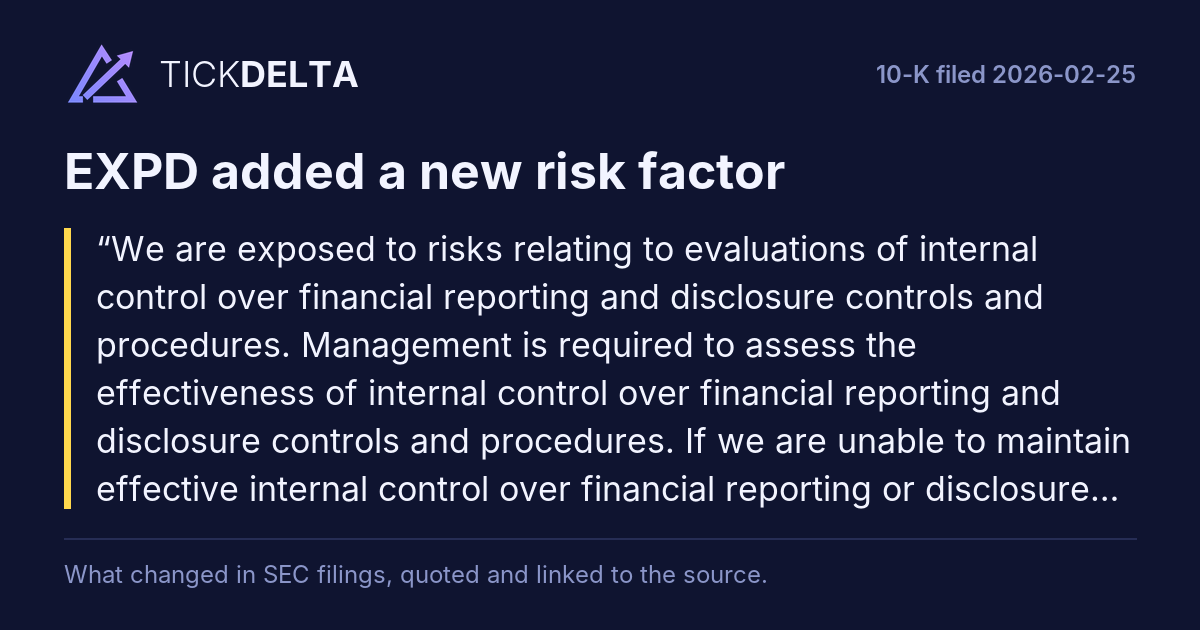
We are exposed to risks relating to evaluations of internal control over financial reporting and disclosure controls and procedures.
Management is required to assess the effectiveness of internal control over financial reporting and disclosure controls and procedures. If we are unable to maintain effective internal control over financial reporting or disclosure controls and procedures, we may be unable to record, process and report financial information accurately or timely, which could result in misstatements in our financial statements, subject us to litigation or regulatory investigations, require significant management attention and resources, and adversely affect investor confidence in our financial reporting and our stock price. In addition, uncertainties related to the design and operation of controls over operational and financial systems in connection with further development of our IT systems and processes and could further increase these risks.
Read in the 10-K ↗
6 paragraphs in the 10-Q filed Nov 4, 2026 with nothing like them in the 10-Q filed Aug 5, 2026 (at least half the words must differ; new numbers alone do not count). Quoted exactly, grouped by the item heading above them. This is text that changed, not a judgement of how serious it is.
• Ocean containers shipped returned to growth, increasing 7%, primarily in Asia. Ocean operating results also benefited from higher average buy and sell rates driven by strong demand and capacity constraints at Asia ports.
Read in the 10-Q ↗
• Customs brokerage and import services achieved double-digit growth due to onboarding new brokerage business and higher volumes in all services.
Read in the 10-Q ↗
Additionally, changes in trade regulations, customs requirements, supply chain transparency initiatives, export control requirements and enforcement activities continue to add complexity to the customs declarations process, making compliance with regulations increasingly challenging. These developments require importers and other participants in global supply chains to provide more detailed information and maintain enhanced compliance processes, increasing the importance of customs expertise, technology and regulatory compliance in the movement of goods worldwide.
Read in the 10-Q ↗
We have lease arrangements primarily for office and warehouse space in all districts where we conduct business. As of September 30, 2026, we had fixed lease payment obligations of $814 million, including $151 million payable within 12 months.
Read in the 10-Q ↗
We typically enter into unconditional purchase obligations with asset-based providers (generally short-term in nature) reserving space on a guaranteed basis. The pricing of these obligations varies to some degree with market conditions. We only enter into agreements that management believes we can fulfill. In the regular course of business, we also enter into agreements with service providers to maintain or operate equipment, facilities or software that can be longer than one year. We also regularly have contractual obligations for specific projects related to improvements of our owned or leased facilities and information technology infrastructure. Purchase obligations outstanding as of September 30, 2026 totaled $302 million.
Read in the 10-Q ↗
Period Total number Average price Total number Approximate dollar value of shares that may yet be purchased under the plans
Read in the 10-Q ↗
Item 1A of the 10-Q filed Nov 4, 2026 against Item 1A of the 10-K filed Feb 25, 2026.
A 10-Q repeats only the risks that changed, so a 10-K paragraph that is missing from it is not counted as removed.
Added is a paragraph with nothing like it in the 10-K, Reworded a sentence that is in both with several words changed,
Quiet changes a sentence in both where one to four words changed and one is a hedge or a modal
(cut words struck through, new words highlighted and underlined).
Text on the page, not a score; each links to the filing at sec.gov.
What the 10-Q itself says about its risk factors:
Read in the 10-Q ↗
In addition to the other information set forth in this report, careful consideration should be given to the risk factors under Item 1A Risk Factors in our Annual Report on Form 10-K filed on February 25, 2026. There have been no material changes in Expeditors' risk factors from those disclosed under Item 1A Risk Factors in our annual report on Form 10-K filed on February 25, 2026.
Work on EXPD in a spreadsheet:
Excel workbook (a sheet per section, ten years by column, charts, links to the filings) ·
CSV.
For a Google Sheet that stays up to date, paste =IMPORTDATA("https://tickdelta.com/company/EXPD/export.csv") into a cell.