Screener / SEC EDGAR /CIK 0000840489 /10-K filed Feb 9, 2026, compared with Feb 3, 2025 /Numbers from the XBRL of the 10-Ks
Nasdaq Consumer discretionary · Miscellaneous Retail

FirstCash Holdings, Inc. FCFS

Compare with peers Embed
SEC comment letters, last 20 years

7 reviews of FCFS's filings by SEC staff

UPLOAD and CORRESP
Reviews 7 latest letter Apr 24, 2026
Questions asked 58 each answered in the company's own letter
No closing letter 0 reviews without a letter saying the staff completed it

When the SEC's staff reviews a filing, it writes to the company with numbered questions, and the company answers each one in a letter. SEC publishes the exchange once the review is over, at least 20 business days later. A question is not an accusation; most reviews end with the company adding detail to its next filing.

How the reviews went

Every review on EDGAR, from the first staff letter to the letter that closes it

  1. 1. Staff letters 12 UPLOAD
  2. 2. Questions in them 58 numbered comments
  3. 3. Company replies 13 CORRESP
  4. 4. Reviews closed 7 of 7 closing letter

Half the closed reviews took 49 days or less from the first letter to the closing letter.

Schedule 14A

2026-04-24 to 2026-04-27 · 1 question · 1 letter from the SEC, 1 from the company
Review closed 2026-04-27
Proposal 4 · Approval of the Reincorporation of the Company to the State of Texas by Conversion, page 63
SEC asked
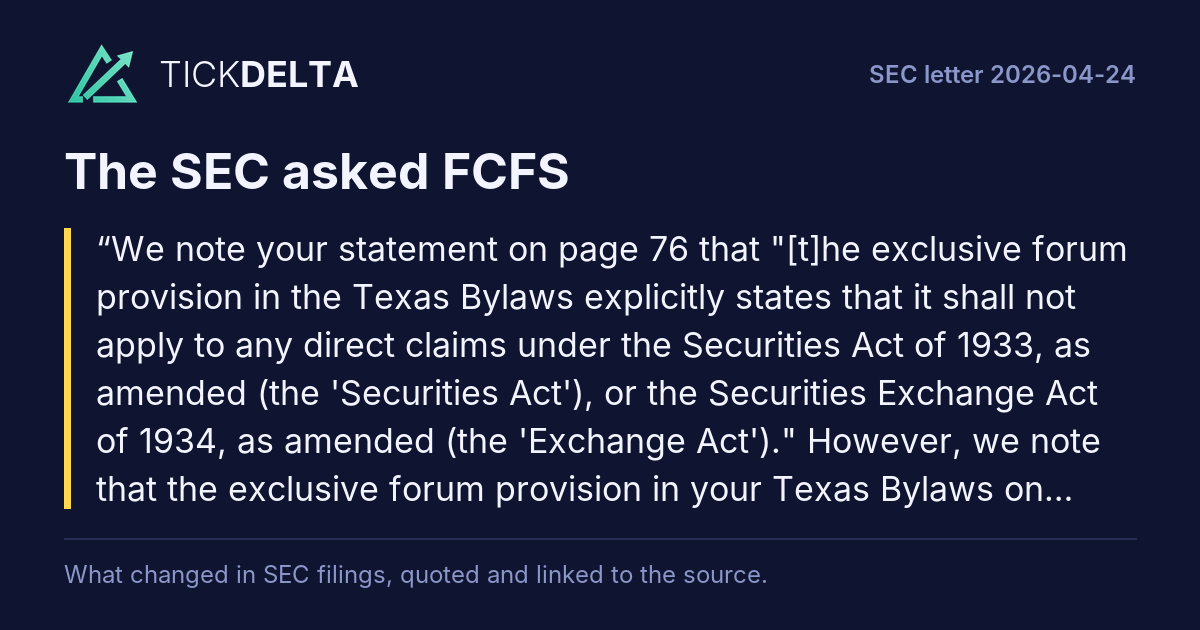
We note your statement on page 76 that "[t]he exclusive forum provision in the Texas Bylaws explicitly states that it shall not apply to any direct claims under the Securities Act of 1933, as amended (the 'Securities Act'), or the Securities Exchange Act of 1934, as amended (the 'Exchange Act')." However, we note that the exclusive forum provision in your Texas Bylaws on page D-23 states that "[u]nless the
Rest of the question

Corporation consents in writing to the selection of an alternative forum, the federal district courts of the United States of America shall be the exclusive forum for the resolution of any complaint asserting a cause of action arising under the Securities Act of 1933, as amended, or the Securities Exchange Act of 1934, as amended." Please revise for consistency. Additionally, please note that federal and state courts have concurrent jurisdiction over claims arising under the Securities Act. See Section 22 of the Securities Act. Please revise to discuss the material risks regarding the exclusive forum provision including, but not limited to, increased costs to bring a claim and that the provision can discourage claims or limit investors’ ability to bring a claim in a judicial forum that they find 1. favorable, as well as any uncertainty as to whether a court would enforce the exclusive forum provision.

FCFS answered
In response to the Staff’s comment regarding the inconsistency between the statement on page 76 and the exclusive forum provision in the Texas Bylaws on page D-23, the

Company has revised its disclosure on page 76 to state that: “While under the Securities Act both federal and state courts have jurisdiction over claims arising under the Securities Act, the Texas Bylaws provide that, unless the Company consents in writing to the selection of an alternative forum, the federal district courts of the United States of America shall be the exclusive forum for the resolution of any complaint
Rest of the answer

asserting a cause of action arising under the Securities Act or the Exchange Act.”

Alston & Bird LLP www.alston.com

Atlanta | Brussels | Century City | Charlotte

| Chicago | Dallas | London | Los Angeles | New York | Raleigh | San Francisco | Silicon Valley | Washington, D.C.

In response to the Staff’s comment regarding a discussion of the material risks regarding the exclusive forum provision in the Texas Bylaws, the Company has added additional disclosure discussing the material risks regarding the exclusive forum provision on page 67 of the revised preliminary proxy statement.

The Company respectfully requests the Staff’s assistance in completing the review of the revised preliminary proxy statement as soon as possible. Please let us know if we can provide any further information or assistance to facilitate your review. Do not hesitate to call me at (404) 881-4421 with any questions or concerns.
Read in the reply

Also in this review: closing letter, 2026-04-27
Form 10-K

2016-09-23 to 2016-10-18 · 2 questions · 1 letter from the SEC, 1 from the company
Review closed 2016-10-18
Results discussion (MD&A)InventoryNon-GAAP measuresAcquisitions
Results of Continuing Operations · Twelve Months Ended December 31, 2015 Compared to Twelve Months Ended December 31, 2014, page 39
SEC asked (1)
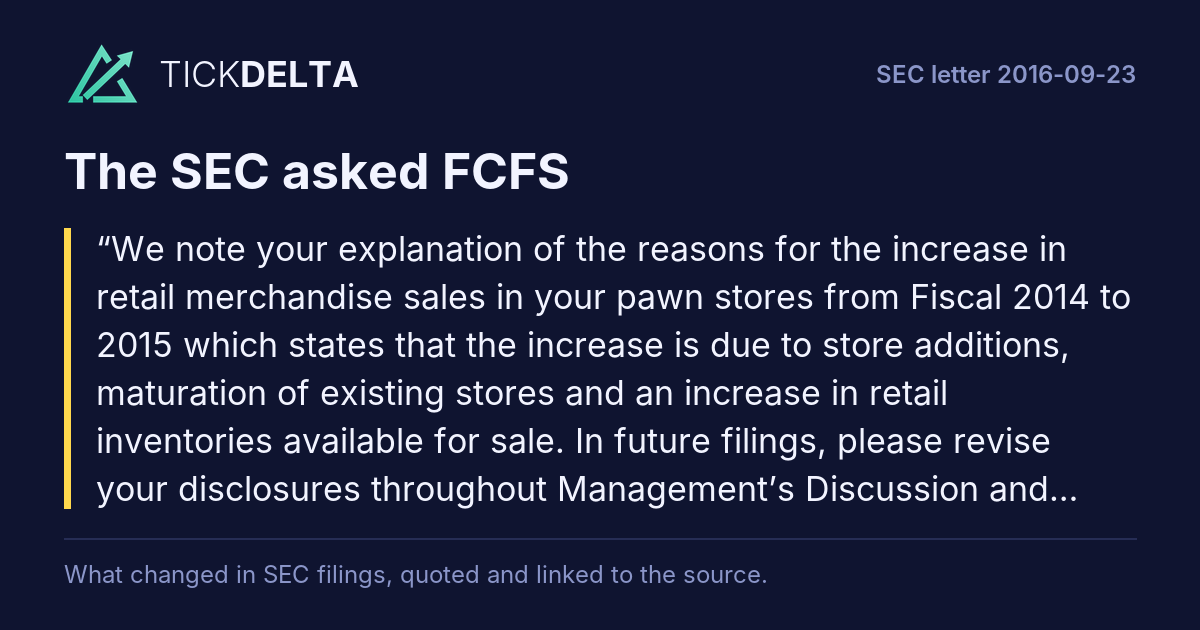
We note your explanation of the reasons for the increase in retail merchandise sales in your pawn stores from Fiscal 2014 to 2015 which states that the increase is due to store additions, maturation of existing stores and an increase in retail inventories available for sale.
Rest of the question

In future filings, please revise your disclosures throughout Management’s Discussion and Analysis to better indicate the relative significance of each reason given for increases and decreases in line items when explaining your results of operations. We believe that when multiple factors materially contribute to a change in your results, a best practice is to quantify the impact of each such factor in order to transparently provide your investors with a view of your operations through the eyes of your management. Please refer to Item 303 of Regulation S-K and our Release No. 33-8350, available on our website at https://www.sec.gov/rules/interp/33-8350.htm.

FCFS answered
In future filings, we will revise disclosures in Management’s Discussion and Analysis to better indicate the relative significance of each material reason given for increases and decreases in line items when explaining our results of operations.
Read in the reply
In its next report

First report after the company's reply of Oct 5, 2016: 10-Q filed Nov 9, 2016 ↗, against the 10-Q filed Aug 8, 2016 ↗.

Tickdelta does not hold the text of both reports, so they are not compared here.

Non-GAAP Financial Information, page 51
SEC asked (2)
Your characterization of certain adjustments related to restructuring expenses and store acquisition expenses in your disclosures related to Adjusted Net Income, Adjusted Net Income Per Share and Adjusted EBITDA as non-recurring in nature may not be consistent with Question 102.03 of the updated Compliance and Disclosure Interpretations on Non-GAAP Financial Measures issued on May 17, 2016.
Rest of the question

We note similar disclosure of “non-recurring” items in your subsequent Forms 10-Q and earnings releases. Please consider the above-mentioned Interpretations in their entirety when preparing the disclosures to be included in future filings.

FCFS answered
We acknowledge that we are responsible for the accuracy and adequacy of the disclosures in the filing. We further acknowledge that the Commission’s staff comments or changes to disclosures in response to their comments do not foreclose the Commission from taking any action with respect to the filing. We know that we may not assert staff comments as a defense in any proceeding initiated by the Commission or any person under the federal securities laws of the United States.
Read in the reply
In its next report

First report after the company's reply of Oct 5, 2016: 10-Q filed Nov 9, 2016 ↗, against the 10-Q filed Aug 8, 2016 ↗.

Tickdelta does not hold the text of both reports, so they are not compared here.

Also in this review: closing letter, 2016-10-18

Form 10-K for the Fiscal Year Ended December 31, 2012

2013-04-03 to 2013-05-07 · 8 questions · 1 letter from the SEC, 1 from the company
Review closed 2013-05-07
Liquidity and cashAcquisitionsNon-GAAP measuresGoodwill and impairmentDebt
Item 1. Business · Locations and Operations, page 7
SEC asked (1)
We note your disclosure that you are an equal partner in Cash & Go, Ltd., a joint venture. However, you state within Exhibit 21.1 that you have a 49.5% ownership interest in Cash & Go, Ltd. We also note that you have a 50.0% interest in Cash & Go Management, LLC. Please explain in detail the ownership and operating structure of Cash & Go, Ltd.
Rest of the question

and Cash & Go Management, LLC as well as how you account for these investments citing relevant U.S. GAAP. Please also specifically address in your response how you have an equal interest in the Cash & Go, Ltd. joint venture when you have a 49.5% ownership interest.

FCFS answered
Cash & Go Management, LLC has a 1% ownership interest in Cash & Go, Ltd, therefore, our 50% ownership interest in Cash & Go Management, LLC equates to a 0.5% interest in Cash & Go, Ltd. Combined with the Company’s direct ownership interest of 49.5%, this gives the Company a 50% total ownership interest in Cash & Go, Ltd. Cash & Go, Ltd. is considered a variable interest entity of the Company and the results of operations are consolidated with the Company’s based on the provisions of ASC 810-10-25. The Cash & Go, Ltd.
Rest of the answer

financial results and the minority ownership are consolidated with the Company’s results; however, their minority interests are not presented separately in the Company’s balance sheet and income statement due to immateriality. The Company will expand its disclosure in future filings to better describe its effective ownership interests in Cash & Go, Ltd. Below is our proposed disclosure to be included in the Management's Discussion and Analysis of Financial Condition and Results of Operations section for our next Form 10-K filing for the year ended December 31, 2013:

The Company is an equal partner in Cash & Go, Ltd., a joint venture, which owns and operates check cashing and financial services kiosks located inside convenience stores in the state of Texas. The Company has a 49.5% direct ownership interest in Cash & Go, Ltd., and a 50% ownership interest in Cash & Go Management, LLC, which has a 1% ownership interest in Cash & Go, Ltd., which provides the Company total ownership interest of 50% in Cash & Go, Ltd.

Read in the reply
In its next report

First report after the company's reply of Apr 19, 2013: 10-Q filed May 8, 2013 ↗, against the 10-Q filed Oct 26, 2012 ↗.

Tickdelta does not hold the text of both reports, so they are not compared here.

Operations · Non-GAAP Financial Information, page 38
SEC asked (2)
Please address the following in reference to your EBITDA Non-GAAP disclosure on page 39;  Exchange Act Release No. 47226 describes EBITDA as "earnings before interest, taxes, depreciation and amortization." We believe that “earnings” means net income as presented in the statement of operations under GAAP.
Rest of the question

The measure you reconcile to under the EBITDA header is “[e]arnings from continuing operations before interest, taxes, depreciation and amortization,” and as such, you have defined earnings as “earnings from continuing operations” rather than “net income.” Measures that are calculated differently than EBITDA as described in Exchange Act Release No. 47226 should not be characterized as "EBITDA" and their titles should be distinguished from "EBITDA," such as "Adjusted EBITDA." Please revise or tell us why you think your presentation is appropriate. Refer to Question 103.01 of our Compliance and Disclosure Interpretations on Non-GAAP financial measures on our website; and  We also note your use of income from continuing operations as the most directly comparable GAAP financial measure in your reconciliation to earnings from continuing operations before interest, taxes, depreciation and amortization. We believe that if EBITDA is presented as a performance measure, it should be reconciled to net income as presented in the statement of operations under GAAP. Please explain or revise. Refer to Question 103.02 of our Compliance and Disclosure Interpretations on Non-GAAP financial measures on our website.

FCFS answered
In future filings, we will modify the “EBITDA” title currently used to the title “EBITDA from continuing operations.” We believe disclosing this information is more useful to our investors as it reflects the ongoing operations of the Company. Additionally, we will include a reconciliation to both net income and earnings from continuing operations with the calculation for EBITDA from continuing operations.
Rest of the answer

Below is our proposed disclosure for our upcoming Form 10-Q filing for the three months ended March 31, 2013:

Earnings from Continuing Operations Before Interest, Taxes, Depreciation and Amortization

EBITDA from continuing operations is commonly used by investors to assess a company’s leverage capacity, liquidity and financial performance. The following table provides a reconciliation of net income to EBITDA from continuing operations (unaudited, in thousands):

Trailing Twelve Months Ended

March 31,

2013

2012

Net income

$

83,111

72,738

(Income) loss from discontinued operations, net of tax

806

(639

)

Income from continuing operations

83,917

72,099

Adjustments:

Income taxes

43,346

37,801

Depreciation and amortization

13,548

11,354

Interest expense

2,130

186

Interest income

(282

(260

Earnings from continuing operations before interest, taxes, depreciation and amortization

142,659

121,180

EBITDA from continuing operations margin calculated as follows:

Read in the reply
In its next report

First report after the company's reply of Apr 19, 2013: 10-Q filed May 8, 2013 ↗, against the 10-Q filed Oct 26, 2012 ↗.

Tickdelta does not hold the text of both reports, so they are not compared here.

Item 8. Financial Statements and Supplementary Data · Consolidated Statements of Cash Flows, page F-8
SEC asked (3)
We note your presentation of pawn loan receivables and consumer loans within investing activities. Please tell us whether these amounts are presented net, and if so, revise the line item heading to state as such.
FCFS answered
Beginning with Form 10-Q for the three-month period ended March 31, 2013, we intend to combine pawn loans and consumer loans into one line item in the statement of cash flows, as consumer loans are immaterial in total and in relation to pawn loans. At December 31, 2012, net consumer loans were $1.9 million, compared to pawn loans of $103.2 million and total assets of $507.7 million. For the year ended December 31, 2012, the net cash used to fund consumer loans was $625,000, compared to the net cash used to fund pawn loans of $16.7 million.
Rest of the answer

Accordingly, we will change the “Pawn loan receivables” and “Consumer loans” labels to the combined line item “Loan receivables, net of cash repayments,” in order to accurately portray that these items are presented as net amounts. Below is our proposed revision to the investing activities section in the statement of cash flows for our upcoming Form 10-Q filing for the three months ended March 31, 2013:

Three Months Ended

Cash flow from investing activities:

Loan receivables, net of cash repayments

3,136

(1,832

Purchases of property and equipment

(4,704

(4,226

Acquisitions of pawn stores, net of cash acquired

(1,468

(43,866

Net cash flow used in investing activities

(3,036

(49,924

Read in the reply
In its next report

First report after the company's reply of Apr 19, 2013: 10-Q filed May 8, 2013 ↗, against the 10-Q filed Oct 26, 2012 ↗.

Tickdelta does not hold the text of both reports, so they are not compared here.

Item 8. Financial Statements and Supplementary Data · Consolidated Statements of Cash Flows, page F-8
SEC asked (4)
We note your disclosure on page F-10 of the typical terms of pawn and consumer loans. If pawn loan receivables and consumer loans are presented net within investing activities, please explain in detail how each of these line items meets the criteria for net presentation within the consolidated statements of cash flows. See FASB ASC 230-10-45-7 through 230-10-45-9.
Rest of the question

Please specifically address the original maturities of these loans in your response.

FCFS answered
Per ASC 230-10-45-9, assets or liabilities (specifically investments, loans receivable, and debt) with original maturities of three months or less qualify for net reporting. All pawn loans have contractual maturities of 90 days or less, which qualifies them for net reporting in the statement of cash flows. As discussed in the previous response, net cash flows related to consumer loans are considered immaterial in relation to pawn loans, and will be combined with pawn loans into a single line item.
Read in the reply
In its next report

First report after the company's reply of Apr 19, 2013: 10-Q filed May 8, 2013 ↗, against the 10-Q filed Oct 26, 2012 ↗.

Tickdelta does not hold the text of both reports, so they are not compared here.

Item 8. Financial Statements and Supplementary Data · Consolidated Statements of Cash Flows, page F-8
SEC asked (5)
We note the presentation of borrowings under your revolving unsecured credit facility within your consolidated balance sheet as non-current, and the presentation of these borrowings as net within the financing activities section of your consolidated statements of cash flows. Please explain in detail how these borrowings meet the criteria for net presentation within the consolidated statements of cash flows.
Rest of the question

See FASB ASC 230-1045-7 through 230-10-45-9. Please specifically address the original maturities of these borrowings in your response.

FCFS answered
For the year ended December 31, 2012, gross proceeds from borrowings under the revolving unsecured credit facility, which matures in February 2015, were $194.5 million, and gross re-payments were $92 million. In future filings, we will present changes to the revolving unsecured credit facility as separate line items for proceeds and payments.
Rest of the answer

Below is our proposed revision to the financing activities section in the statement of cash flows for our upcoming Form 10-Q filing for the three months ended March 31, 2013:

Cash flow from financing activities:

Proceeds from line of credit

—

36,900

Payments of line of credit

(50,500

(18,900

Payments of notes payable

(792

Purchases of treasury stock

(38,751

Proceeds from exercise of share-based compensation awards

8,422

Income tax benefit from exercise of stock options and warrants

7,218

127

Net cash flow used in financing activities

(35,652

(20,836

Read in the reply
In its next report

First report after the company's reply of Apr 19, 2013: 10-Q filed May 8, 2013 ↗, against the 10-Q filed Oct 26, 2012 ↗.

Tickdelta does not hold the text of both reports, so they are not compared here.

Note 4. Acquisitions, page F-15
SEC asked (6)
We note your disclosure of several acquisitions you consummated during the most recent fiscal year, as well as your table illustrating your allocation of the purchase price. Please tell us the nature and amount of the intangible assets recognized. Additionally, please tell us what consideration was given to including the disclosures required by ASC 350-30-50.
FCFS answered
The nature and amount of intangible assets recognized as a result of acquisitions occurring during 2012 are as follows (amounts in thousands):

Fast Cash

Mister Money

BBR Unlimited (Mexico)

Other

Total

Customer relationships

1,200

699

988

350

3,237

Pawn licenses

160

240

115

515

1,360

939

465

3,752

The acquired customer relationships generally have limited value given the short duration of pawn loans (less than 90 days) and, based on customer turnover metrics, are amortized over a five-year period.
Rest of the answer

The amount allocated to pawn licenses are based on approximate market valuations and generally have an indefinite life given our ability to renew and maintain them. The total amounts allocated to the separate classes of intangible assets as a result of acquisitions in fiscal 2012 were 3% of the aggregate purchase price and less than 1% of total assets. Therefore, we considered the nature and amount of the intangible assets to be immaterial for disclosure in our 2012 filings. We will provide the disclosures, as provided ASC 350-30-50, in future periods should the amount allocated to intangible assets be material for such disclosure.

Read in the reply
In its next report

First report after the company's reply of Apr 19, 2013: 10-Q filed May 8, 2013 ↗, against the 10-Q filed Oct 26, 2012 ↗.

Tickdelta does not hold the text of both reports, so they are not compared here.

Note 4. Acquisitions, page F-15
SEC asked (7)
Please tell us how the acquisitions you made during 2012 were treated for tax purposes. Please also tell us if the tax allocation of any acquisition resulted in new or changed intangible asset tax basis and created deductible amortization of intangibles or goodwill for tax purposes.
Rest of the question

If so, please contrast the allocation performed for tax purposes with that performed for financial reporting purposes for each acquisition.

FCFS answered
The acquisitions made during 2012 were treated as asset purchases for both tax and financial reporting purposes, and the amounts allocated to goodwill and other intangibles were identical for tax and financial reporting purposes. For tax purposes, the goodwill and intangible assets are being amortized over the standard 15-year period. Given that the tax basis of the acquired assets was identical to the basis for financial reporting, we did not believe that additional tax-basis disclosures were relevant.
Rest of the answer

In future filings, however, we will specifically disclose how acquisitions are treated for tax purposes as compared with financial reporting purposes. Below is our proposed disclosure to be included in the acquisitions footnote for applicable future Form 10-Q and Form 10-K filings:

The acquisition has been accounted for using the purchase method of accounting for both financial reporting and tax purposes. Accordingly, the purchase price was allocated to assets and liabilities acquired based upon their estimated fair market values at the date of acquisition, which were identical for financial reporting and tax purposes. For tax purposes, the goodwill and intangible assets are being amortized over the standard 15-year period.

Read in the reply
In its next report

First report after the company's reply of Apr 19, 2013: 10-Q filed May 8, 2013 ↗, against the 10-Q filed Oct 26, 2012 ↗.

Tickdelta does not hold the text of both reports, so they are not compared here.

Note 9. Revolving Credit Facility and Notes Payable, page F-18
SEC asked (8)
We note your disclosure of interest being charged on your borrowings under the revolving credit facility at the prevailing LIBOR rate plus a fixed spread of 2.0%. Please clarify whether LIBOR as used in this note represents 1 month, 3 month or some other LIBOR term and revise other instances where you make this disclosure.
FCFS answered
We acknowledge that we are responsible for the accuracy and adequacy of the disclosures in the filing. We further acknowledge that the Commission’s staff comments or changes to disclosures in response to their comments do not foreclose the Commission from taking any action with respect to the filing. We know that we may not assert staff comments as a defense in any proceeding initiated by the Commission or any person under the federal securities laws of the United States.
Read in the reply
In its next report

First report after the company's reply of Apr 19, 2013: 10-Q filed May 8, 2013 ↗, against the 10-Q filed Oct 26, 2012 ↗.

Tickdelta does not hold the text of both reports, so they are not compared here.

Also in this review: closing letter, 2013-05-07

Form 10-K for the Fiscal Year Ended December 31, 2010

2011-12-12 to 2012-02-27 · 5 questions · 4 letters from the SEC, 4 from the company
Review closed 2012-02-27
SegmentsGoodwill and impairmentResults discussion (MD&A)Revenue
Notes to Consolidated Financial Statements · Note 16 – Geographic Areas
SEC asked
You disclose here that you manage your business on the basis of one reportable segment. We also note that you have identified three reporting units, or components, for the purpose of measuring the recoverability of goodwill: U.S. Pawn Operations, U.S.
Rest of the question

Short- Term Loan Operations, and Mexico Operations as disclosed in Note 13 as well as disclosure included elsewhere, such as Management’s Discussion and Analysis, based on the geographic locations and the nature of your operations. Please explain to us the extent you considered whether these three components represent reportable segments. Please provide us with your analysis under ASC 280 that supported disclosing all operations as one reportable segment. Please include the following information in your response:  the operating segments you have identified in accordance with ASC 280-10-50-1 through 50-9,  the factors used to identify reportable segments,  your basis for aggregating identified operating segments into a single reportable segment given the aggregation criteria in ASC 280-10-50-11 and quantitative thresholds in ASC 280-10-50-12.  how the aggregation of all of your operations into one reportable segment complies with the aggregation criteria, and  the process through which your chief operating decision maker reviews information to make decisions about resources to be allocated to your segment and assess its performance. In addition, please disclose the factors you used to identify your reportable segment and whether operating segments have been aggregated as required by ASC 280-10-50-21.

FCFS answered
The nature of the products and services: all of the Company’s products are related to serving cash-constrained consumers through small, short-term loans and buying jewelry, electronics, tools, or other items.
Read in the reply
In its next report

First report after the company's reply of Jan 18, 2012: 10-K filed Feb 29, 2012 ↗, against the 10-K filed Feb 25, 2011 ↗.

Tickdelta does not hold the text of both reports, so they are not compared here.

Notes to Consolidated Financial Statements · Note 16 – Geographic Areas
SEC asked
We note your response to our comment regarding your disclosure of one reportable segment. You state each of your stores would meet the definition of an operating segment, that your resources are allocated primarily based on the revenues of individual stores and that you evaluate the results of individual stores, however you did not consider the aggregation criteria for determining your one reportable operating
Rest of the question

segment; rather you used the “logical management operating structure.” We are not persuaded that your use of the logical management operating structure instead of the aggregation criteria set forth in ASC 280 is appropriate. Please explain to us how your use of the “logical management operating structure” complies with ASC 280. As previously requested, disclose the factors used to identify your reportable segment and disclose whether operating segments have been aggregated as required by FASB ASC 280-10-50-21(a). Show us what your disclosure will look like revised.

FCFS answered
We acknowledge that we are responsible for the accuracy and adequacy of the disclosures in the filing. We further acknowledge that the Commission’s staff comments or changes to disclosures in response to their comments do not foreclose the Commission from taking any action with respect to the filing. We know that we may not assert staff comments as a defense in any proceeding initiated by the Commission or any person under the federal securities laws of the United States.
Read in the reply
In its next report

First report after the company's reply of Jan 27, 2012: 10-K filed Feb 29, 2012 ↗, against the 10-K filed Feb 25, 2011 ↗.

Tickdelta does not hold the text of both reports, so they are not compared here.

Notes to Consolidated Financial Statements · Note 16 – Geographic Areas
SEC asked (1)
We note your proposed disclosure stating individual stores and regional geographic markets have been aggregated into one reportable segment. If, as you state in your response, that each individual store is an operating segment, please tell us what your regional geographic markets represent.
Rest of the question

Further, if your regional geographic markets are not operating segments, please tell us the guidance you relied upon for aggregation with the individual stores, i.e., operating segments.

FCFS answered

No numbered answer found in the reply. Read the reply ↗

In its next report

First report after the company's reply of Feb 7, 2012: 10-K filed Feb 29, 2012 ↗, against the 10-K filed Feb 25, 2011 ↗.

Tickdelta does not hold the text of both reports, so they are not compared here.

Notes to Consolidated Financial Statements · Note 16 – Geographic Areas
SEC asked (2)
Your accounting policy for goodwill states you identified three reporting units or components for the purpose of measuring the recoverability of goodwill: U.S. Pawn Operations, U.S. Short-Term Loan Operations and Mexico Operations. A reporting unit is an operating segment or one level below an operating segment, a component. You have stated that each individual store represents an operating segment under ASC 280.
Rest of the question

Please explain how the three reporting units U.S. Pawn Operations, U.S. Short-Term Loan Operations and Mexico Operations identified under ASC 350-20-35 for the purpose of measuring the recoverability of goodwill relate to your operating segments which you identified as individual stores.

FCFS answered
to the second question raised by the Commission, the Company’s three operating segments, as described above, correspond directly to the reporting units historically used in testing goodwill for impairment.

In future Form 10-K filings, we will add disclosure to the segment description within our accounting policies footnote, as follows:

“The Company manages its pawn and short-term loan operations under three operating segments: U.S. pawn operations, U.S. short-term loan operations and Mexico operations.
Rest of the answer

The three operating segments have been aggregated into one reportable segment because they have similar economic characteristics and similar long-term financial performance metrics. Additionally, all three segments offer similar and overlapping products and services to a similar customer demographic, operate in similar regulatory environments, and are supported by a single, centralized administrative support platform.”

Concluding Company Response:

We acknowledge that we are responsible for the accuracy and adequacy of the disclosures in the filing. We further acknowledge that the Commission’s staff comments or changes to disclosures in response to their comments do not foreclose the Commission from taking any action with respect to the filing. We know that we may not assert staff comments as a defense in any proceeding initiated by the Commission or any person under the federal securities laws of the United States.

Read in the reply
In its next report

First report after the company's reply of Feb 7, 2012: 10-K filed Feb 29, 2012 ↗, against the 10-K filed Feb 25, 2011 ↗.

Tickdelta does not hold the text of both reports, so they are not compared here.

Notes to Consolidated Financial Statements · Note 16 – Geographic Areas
SEC asked
We note your response to prior comment one. With regards to the economic characteristics of your operating segments addressed in your response, you provided the weighted average store-level operating profit. In accordance with the aggregation criteria in ASC 280-10-50-11, economic characteristics are measured at the operating segment level.
Rest of the question

Please tell us what quantitative measures are used to compare your three operating segments with respect to economic similarities and provide us that information for each of the last three years and current interim period. You also provided us with an operating margin range of 19% to 36% for any given year for any segment. Please explain in greater detail how you considered operating margins of 19% and 36% for your operating segments to be similar. Furthermore, providing a range for any given year for any given segment makes it difficult to establish a correlation. Discuss and provide support for the economic characteristics you believe are similar and whether you expect similar future prospects.

FCFS answered
You have requested additional detail regarding operating metrics which support the aggregation of segments based on the similarity of operating results. The following provides detailed gross profit margins and store operating profit margins for the past three years for each operating segment. There is only one month of financial data available for the current interim period, which is considered unreliable to show meaningful trends due to the seasonal nature of the business. However, our expectation for future periods is consistent with the trends shown below.

U.S. Pawn

U.S.
Rest of the answer

Short-

Term Loan

Mexico

Pawn Gross Margin

2009

58%

16%

53%

2010

60%

44%

54%

2011

59%

42%

51%

Consumer Loan Gross Margin

69%

77%

76%

74%

81%

83%

Store Operating Margin

33%

19%

26%

35%

36%

28%

Pawn gross margins are highly similar for the U.S. Pawn and Mexico operating segments. The pawn gross margins for the U.S. Short-Term Loan operating segment are lower because pawn products were not introduced into these stores until 2009. The Company believes that pawn margins in this segment will increase significantly over the next few years and become even more similar to the other segments as the pawn product set matures and becomes more integrated into the operations of the short-term loan operating segment.

Consumer loan gross margins are highly similar for all three segments over the three year period and the Company believes that they will remain similar for the foreseeable future.

As the chart shows, store operating margins are also similar across operating segments. The Company considers the range of margins across time periods and operating segments to be within the normal range of company and industry standards. Typically, margins in the lower end of the normal range are associated with younger, less-mature stores, while mature stores have margins at the higher end of the normal range. The Company considers a store to be mature once it has been open for three full years. The Company believes that future expected margins will become even more similar over time for the following reasons:

U.S. Pawn operating margins will likely decrease slightly over the next few years as the Company has recently initiated a new store expansion program for opening U.S. pawn stores. The results for 2009 through 2011 were from a set of almost exclusively mature stores.

Read in the reply
In its next report

First report after the company's reply of Feb 22, 2012: 10-K filed Feb 29, 2012 ↗, against the 10-K filed Feb 25, 2011 ↗.

Tickdelta does not hold the text of both reports, so they are not compared here.

Also in this review: closing letter, 2012-02-27

Form 10-K

2010-12-22 to 2011-02-09 · 1 question · 1 letter from the SEC, 2 from the company
Review closed 2011-02-09
Results discussion (MD&A)Goodwill and impairmentCritical estimates
Notes to Consolidated Financial Statements · Note 13 – Goodwill and Other Intangible Assets
SEC asked
We note your footnote disclosures regarding the company’s goodwill balance for each period reported. Please tell us your consideration for providing a discussion of your goodwill valuation process within the critical accounting policies section of Management’s Discussion and Analysis of Financial Condition and Results of Operations given the material nature of your goodwill balance.
Rest of the question

Please note that these disclosures should provide investors with sufficient information as well as management’s insights and assumptions with regard to the recoverability of goodwill. In this regard, we have identified areas where we believe additional discussion would enhance your disclosures. Specifically, we believe you should provide the following information pursuant to Item 303(a)(3)(ii) of Regulation S-K and Financial Reporting Release No. 60 and Section V of SEC Release No. 33-8350: • Please tell us the reporting units, as defined in ASC 350-20, used in your analysis; indicate how the reporting units are indentified; provide the amount of goodwill allocated to each reporting unit and explain how you estimate the fair value of each reporting unit; • Please provide the carrying value and fair value for each reporting unit as of the date of your most recent step-one test. Alternatively, disclose the percentage by which the fair values exceed the carrying values for each unit; • For those reporting units in which the fair values do not exceed their carrying values by significant amounts, please describe the potential events and/or changes in circumstances that could reasonably be expected to negatively affect the key assumptions used in determining fair value.

FCFS answered
The Company is in receipt of your comment letter dated December 22, 2010. You requested that the Company provide its response within ten business days of the date of your letter. We are writing at this time to request an extension of time to reply to January 21, 2011 in order to accommodate the year-end schedules of key Company personnel and Board members.
Read in the reply
In its next report

First report after the company's reply of Dec 30, 2010: 10-K filed Feb 25, 2011 ↗, against the 10-K filed Mar 15, 2010 ↗.

Tickdelta does not hold the text of both reports, so they are not compared here.

Also in this review: company letter, Jan 20, 2011, closing letter, 2011-02-09

Form 10-K for the Fiscal Year Ended December 31, 2008

2009-08-18 to 2009-10-08 · 27 questions · 2 letters from the SEC, 2 from the company
Review closed 2009-10-08
Executive payResults discussion (MD&A)Liquidity and cashControlsLeasesRevenue
Item 1. Business, page 4 · Short-Term Loan and Credit Services Activities, page 7
SEC asked (1)
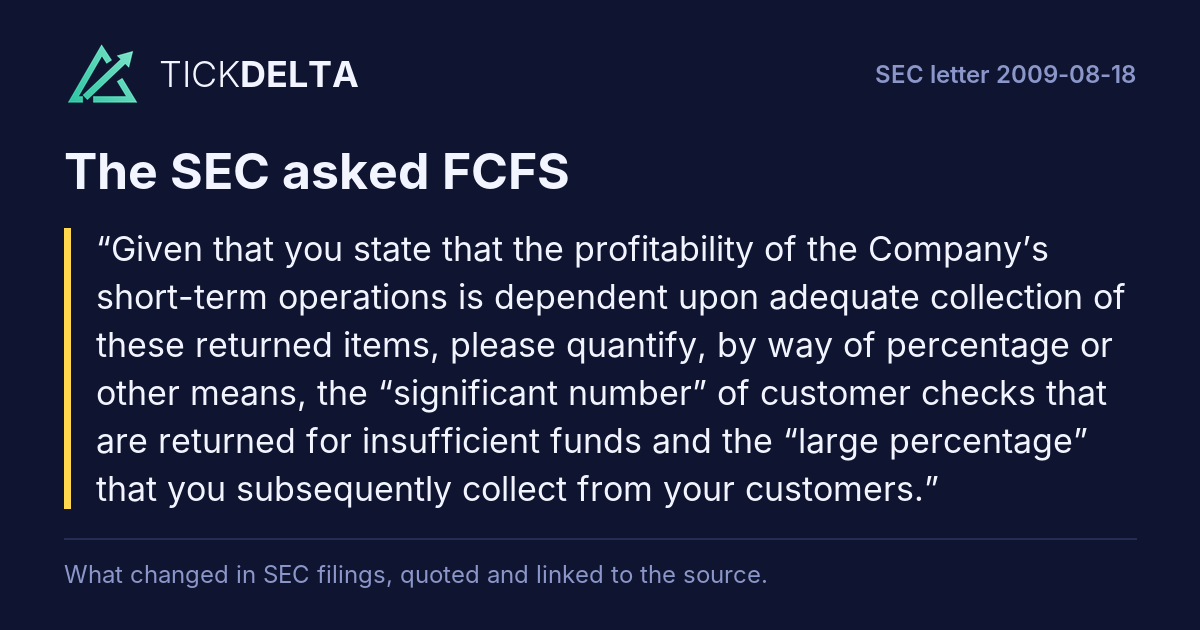
Given that you state that the profitability of the Company’s short-term operations is dependent upon adequate collection of these returned items, please quantify, by way of percentage or other means, the “significant number” of customer checks that are returned for insufficient funds and the “large percentage” that you subsequently collect from your customers.
FCFS answered
The Company provides an explanation of the accounting for its short-term loan and credit services loss provision in the Critical Accounting Policies in Item 7 of the Form 10-K and discloses its net credit loss provision from combined short-term loan and credit services operations on the face of the income statement. In addition, the net credit loss provision as a percentage of revenues is provided in Item 7 of the Form 10-K in the table of selected operating metrics, and fluctuations of these results are further discussed in the subsequent narrative.
Rest of the answer

You have asked that the Company report the number or percentage of returned items and subsequent redeposits/collections of such. While the Company tracks returned items and re-deposits/collections at a transactional level, the gross amounts and/or percentage of such amounts are not directly relevant to the net credit loss provision, as a single returned item may be re-deposited (either physically or via ACH) and returned for insufficient funds multiple times before it is collected or deemed uncollectible. For example, during the first half of 2009 (six months ending June 30, 2009), total posted returned items related to U.S. short-term loans were $2.3 million, while offsettting redeposits/collections were $1.7 million. As a percentage of U.S. short-term loan revenues, the gross returned check amount was 39%, while redeposits/collections represented a gross offset of 28%. However, after netting the effect of the multiple redeposits and returns of the same checks, the net credit loss on the short-term loan product was only 11% of revenues. Accordingly, we believe that reporting these multiple returns and re-deposits as a percentage of a singular, static revenue amount for each loan does not provide meaningful information to investors. As a result, the Company believes the credit loss information as currently provided is sufficient and the most relevant disclosure of our credit loss provision.

Read in the reply
In its next report

First report after the company's reply of Sep 14, 2009: 10-Q filed Nov 6, 2009 ↗, against the 10-Q filed Aug 4, 2009 ↗.

Tickdelta does not hold the text of both reports, so they are not compared here.

Item 1. Business, page 4 · Short-Term Loan and Credit Services Activities, page 7
SEC asked (2)
With respect to your CSO program, please quantify by way of percentage or other means the “significant number” of customer checks deposited into the independent lender's account due to insufficient funds in the customers' accounts and the amount you subsequently collect.
FCFS answered
As stated in the previous response, the Company provides an explanation of the accounting for its short-term loan and credit services loss provision in the Critical Accounting Policies section in Item 7 of the Form 10-K and discloses its net credit loss provision from combined short-term loan and credit services operations on the face of the income statement, and the net credit loss provision as a percentage of revenues is provided in Item 7 of the Form 10-K in the table of selected operating metrics, and fluctuations of these results are further discussed in the subsequent narrative.
Rest of the answer

The Company believes, as set forth in our previous response, credit loss information as currently provided is sufficient and the most relevant disclosure of our credit loss provision.

Read in the reply
In its next report

First report after the company's reply of Sep 14, 2009: 10-Q filed Nov 6, 2009 ↗, against the 10-Q filed Aug 4, 2009 ↗.

Tickdelta does not hold the text of both reports, so they are not compared here.

Item 2. Properties, page 21
SEC asked (3)
We note that the leases on your pawn and short-term loan operations expire anywhere from 2009 through 2019 Please state the approximate number of leases that are set to terminate over the next fiscal year and provide your general belief as to the likelihood that you will be able to renew these leases.
Rest of the question

We note your statement of belief that termination of any particular lease would not have a material adverse effect on the Company’s operations; please advise if you believe that the failure to renew the leases set to expire in the next year will have a material impact on your operations.

FCFS answered
As of January 1, 2009, approximately 63 store leases were due to expire during fiscal year 2009. Of these 63 leases due to expire, approximately 58 leases included a provision allowing the Company, at its option, to automatically renew and extend the lease for terms ranging from 3 to 5 years under terms and conditions similar to the expiring lease. As of the date of this letter, management believes that the leases at all 63 stores will have been automatically renewed and extended or replaced with new leases by year-end.
Rest of the answer

In summary, as stated in the Form 10-K, we believe that the termination of any particular lease would not have a material adverse effect on its operations, and for the reasons outlined above, we do not believe that a significant number of individual leases will fail to be successfully renewed or replaced. Accordingly, we believe that our existing disclosures are adequate, although we will add commentary in future filings, if we believe that a significant number of leases expiring in the next fiscal year will not be renewed or extended and that failure to renew/extend such leases will have a potentially material adverse impact on Company operations.

Read in the reply
In its next report

First report after the company's reply of Sep 14, 2009: 10-Q filed Nov 6, 2009 ↗, against the 10-Q filed Aug 4, 2009 ↗.

Tickdelta does not hold the text of both reports, so they are not compared here.

Item 7. Management's Discussion and Analysis of Financial Condition and Results…, page 25 · General
SEC asked (4)
Please expand your discussion to discuss known material trends, demands, commitments, events, or uncertainties that will have, or are reasonably likely to have, a material impact on your financial condition, operating performance, revenues, or income, or result in your liquidity decreasing or increasing in any material way.
Rest of the question

In doing so, provide additional information about the quality and variability of your earnings and cash flows so that investors can ascertain the likelihood of the extent past performance is indicative of future performance. In addition, please discuss in reasonable detail: • economic or industry-wide factors relevant to your company, and • material opportunities, challenges and risks in short and long term and the actions you are taking to address them. For example, we note that you discontinued your short-term loan operations in Washington D.C. due to legislation that capped the interest rate that you could charge for these loans. Please identify, to the extent you know, any other jurisdictions in which you operate that maybe close to passing similar legislation, which if enacted, may result in you ceasing your short-term loan operations in that jurisdiction. Please discuss how the cessation of such operations would affect your overall operations and liquidity. Also, in light of the current economic turmoil in the U.S. and Mexico, to the extent material, you should discuss the affect that the current economic turmoil may have on your ability to recoup amounts due on loans that are in default. Please see Item 303 of Regulation S-K and SEC Release No. 338350.

FCFS answered
We believe that we have identified and discussed the key, material economic factors and regulatory trends potentially affecting the Company's revenues, cash flow, profitability and liquidity throughout the various sections of the Form 10-K filing. We note that Item 7 of our Form 10-K and Item 2 of Forms 10-Q provide charts and commentary regarding fluctuations, in both dollar amounts and percentages, of detailed revenues and customer receivable balances by both product line and geographic region.
Rest of the answer

In addition, in Form 10-K in Item 1A Risk Factors, the Company provides detailed discussion of the challenges and risks associated with specific economic and industry-wide factors such as regulatory trends, competition, sustained deterioration of economic conditions, gold market fluctuations and exchange rate fluctuations. Further discussion and quantification of interest rate, foreign currency and gold price risks is provided in Item 7A of the Form 10-K. Opportunities for the Company's growth and expansion are specifically identified in Item 1 of the Form 10-K where industry trends and the business strategy in both the U.S. and Mexico are discussed.

In regard to specific questions about the effect of regulatory changes affecting the short-term loan and credit services products, the Company notes that the potential impact of governmental regulatory risks are discussed and quantified in significant detail in Item 1 of the Form 10-K. For example, when discussing potential negative legislative proposals in Texas under the subsection titled "U.S. State and Local Regulations" of the Form 10-K, we stated that enactment of such legislation "would have a material adverse impact on the revenue and profitability of the Company, as the Company derived approximately $43.6 million in revenue, which is 13% of total revenue, from its credit services product in Texas." The regulatory discussion was further updated in our June 10-Q, where the Company noted in the subsection titled "Regulatory Developments" under Item 2, "Subsequent to the filing of the Form 10-K, legislation affecting the short-term/payday loan products in the states of Washington and South Carolina has been enacted. When this legislation becomes effective in late 2009 and/or 2010, it is likely to further restrict consumer access to short-term/payday loan products, which would have a negative impact on the Company's short-term loan revenue in these markets. For the trailing twelve months ended June 30, 2009, the Company realized pre-tax store-level net income related to short-term/payday loan products in these states of approximately $340,000, which the Company does not consider to be significant."

With regard to the specific question regarding the Company's ability to recoup amounts due on loans in default, we believe that this risk has been and remains limited. The Company's pawn loans receivable, which represented 88% of total customer loans receivable on the balance sheet at December 31, 2008, are fully collaterized by the borrowers' personal property, which we hold in our pawn stores. Non-performing pawn loans are satisfied within approximately 14 to 30 days past the due date through the forfeiture of the pawn collateral, which is transferred into inventory at a cost equal to the loan amount being satisfied. As the typical loan amount on a pawn is only 40% to 60% of the estimated selling price of the collateral, we believe that we have limited risk of loss from non-performing loans, which is substantiated by the fact that sales margins on the sale of forfeited collateral consistently exceed 40%. The credit risk associated with the $5.9 million of short-term loans on the balance sheet and the $12.9 million of CSO loans held by third parties is limited as well. These loans have extremely short durations, with terms that typically range from 7 to 30 days in length. As described in our Critical Accounting Policies under Item 7 of the Form 10-K, past due short-term loans are considered to be immediately in default and are written off, leaving only active loans in the reported balance. Historically, the percentage of these loans that are ultimately non-performing is approximately 4% to 5%. At December 31, 2008, we carried reserves and accruals, as reported in the MD&A section of the Form 10-K, which were consistent with these historical exposures. We further note that as reported in the 2009 filings on Form 10-Q, that the credit loss experienced on the loans and credit services products actually improved in the first half of 2009, as compared to 2008. In summary, while the Staff raises a logical question about the potential for loans being in default, the reality for the Company and the industry in general, has been that credit loss exposures for pawn, short-term loan and credit services products remain limited and relatively unaffected by recent economic trends.

We further add that since the date of our Form 10-K filing, and as reported in subsequent Form 10-Q filings, the Company has not experienced a material negative impact on revenue or profitability from the current global economic turmoil. In short, the Company's business model appears to be generally less impacted by such macro-economic factors. To the extent we begin to see a material negative impact on our operations as a result of the current global economic turmoil in particular, or our ability to recoup amounts due on loans that are in default secondarily, we will expand our disclosures accordingly in future filings.

In light of the Staff's comment, the Company will add in future filings specific references to the topics/risks outlined above, either as expanded discussions or through direct references to other relevant sections of the Form 10-K.

Read in the reply
In its next report

First report after the company's reply of Sep 14, 2009: 10-Q filed Nov 6, 2009 ↗, against the 10-Q filed Aug 4, 2009 ↗.

Tickdelta does not hold the text of both reports, so they are not compared here.

Liquidity and Capital Resources, page 38
SEC asked (5)
We note that you intend to continue expansion primarily through new store openings. We further note your indication that “the majority of capital expenditures, working capital requirements and start-up losses related to this expansion are expected to be funded through operating cash flows and the credit facilities.” Please revise to quantify how much you will need in order to proceed with your expansion plans this
Rest of the question

fiscal year and how much you spent last fiscal year. Also, as you indicate that “the majority” of such costs will come from the 2 sources you mention, please disclose the source(s) of any remaining costs. Refer to Item 303(a)(2) of Regulation S-K.

FCFS answered
The Company recorded capital expenditures of approximately $10 million related to new store openings in fiscal year 2008, and it expects to spend approximately $13 to $15 million on new store openings in fiscal year 2009. At the same time, the Company's cash flows and liquidity to fund this expansion included net cash flows from operating activities of $57.5 million for the fiscal year ended December 31, 2008 and $67.2 million for the trailing twelve months ended June 30, 2009.
Rest of the answer

In addition, the Company had $21.5 million available under its existing credit facilities at December 31, 2008 and $46.5 million available at June 30, 2009. As the Company had more than sufficient cash flows and liquidity available from either of these two sources to fund new store openings, management believes, and believed at the time of the filing of the Form 10-K, that quantification of the amounts required to proceed with store expansion plans was not material or meaningful to investors, and that the liquidity disclosures in the Form 10-K as well as the Forms 10-Q provide the most meaningful disclosure. Other sources of funding expansion, which are primarily proceeds from exercises of stock options and related tax benefits, are immaterial in comparison to operating cash flows and amounts available under the line credit. In future filings, based on the Staff's comment, the Company will in its discussion of expansion through new store openings quantify the material sources of cash that will be used to fund the new store openings.

Read in the reply
In its next report

First report after the company's reply of Sep 14, 2009: 10-Q filed Nov 6, 2009 ↗, against the 10-Q filed Aug 4, 2009 ↗.

Tickdelta does not hold the text of both reports, so they are not compared here.

Item 7A. Quantitative and Qualitative Disclosures About Market Risk, page 44
SEC asked (6)
We note that your operations face market risk from the potential change in interest rates, foreign exchange rates, and gold prices. Please discuss how you manage, if at all, your exposures to these risks. Please refer to Item 305(b) of Regulation S-K.
FCFS answered
We believe that the detailed discussions provided in the Form 10-K, including Item 7A, adequately describe how the Company assesses and manages exposure to these risks. In Item 7A, under the subsection "Interest Rate Risk," it states, "The Company is potentially exposed to market risk in the form of interest rate risk in regard to its long-term line of credit and notes payable." The discussion continues on to quantify the impact of a 1% change in interest rates. The Company believes such risk is not material to the liquidity of the Company.
Rest of the answer

Under the subsection "Foreign Currency Risk," it states that, "The Company bears certain exchange risks from its operations in Mexico," which is quantified in detail in that subsection. The discussion also states that such risks are not managed through financial hedging or speculative transactions. We also believe that the discussion in the subsection "Gold Price Risk" makes it clear that the Company would be impacted by a significant and sustained decline in the price of gold and details the various potential impacts and mitigating factors related to this risk.

While we believe our disclosures as presented in the Form 10-K are adequate under the requirement of Item 305(b) of Regulation S-K, in consideration of the Staff's comment, the Company intends to expand its future disclosures to affirmatively state, if applicable, that the Company does not utilize any financial instruments for the purpose of mitigating specific risks, and to add additional discussion about operational practices and natural hedges, if any, that mitigate these risks.

Read in the reply
In its next report

First report after the company's reply of Sep 14, 2009: 10-Q filed Nov 6, 2009 ↗, against the 10-Q filed Aug 4, 2009 ↗.

Tickdelta does not hold the text of both reports, so they are not compared here.

Item 9A. Disclosure Controls and Procedures, page 45 · Evaluation of Disclosure Controls and Procedures, page 45
SEC asked (7)
In the final sentence of the third paragraph in this section it states “financial controls” rather than “disclosure controls.” In future filings, please state “disclosure controls” rather than “financial controls” when stating your management’s conclusion regarding the effectiveness of your disclosure controls and procedures. Please confirm your understanding in this regard.
FCFS answered
The Company confirms its understanding of the Staff's comment, and we will revise our management's conclusion regarding the effectiveness of disclosure controls and procedures in future filings.
Read in the reply
In its next report

First report after the company's reply of Sep 14, 2009: 10-Q filed Nov 6, 2009 ↗, against the 10-Q filed Aug 4, 2009 ↗.

Tickdelta does not hold the text of both reports, so they are not compared here.

Management's Report on Internal Control Over Financial Reporting, page 45
SEC asked (8)
We note that your management “believes that, as of December 31, 2008, the Company's internal control over financial reporting is effective…” Please confirm that your management “concluded” that your internal controls over financial reporting were effective as of December 31, 2008.
Rest of the question

In future filings please provide the conclusion of your management regarding the effectiveness of your internal controls over financial reporting, rather than their belief as to the effectiveness of your internal controls over financial reporting. Please confirm your understanding in this regard.

FCFS answered
We confirm our management concluded that our internal controls over financial reporting were effective as of December 31, 2008. We will also revise our management's conclusion regarding the effectiveness of our financial controls and procedures in future filings.
Read in the reply
In its next report

First report after the company's reply of Sep 14, 2009: 10-Q filed Nov 6, 2009 ↗, against the 10-Q filed Aug 4, 2009 ↗.

Tickdelta does not hold the text of both reports, so they are not compared here.

Exhibits and Financial Statements Schedules, page 48 · Rule 13a-14(a)/15(d)-14(a) Certifications, Exhibit 31.1 and 31.2
SEC asked (9)
The certification required by Exchange Act Rule 13a-14(a) that you filed as an exhibit to your Form 10-K for the fiscal year ended December 31, 2008 and the fiscal quarter ended March 31, 2009 varies from the exact language of Item 601(b)(31) of Regulation S-K. For example, you excluded the language in the parenthetical in paragraph 4.
Rest of the question

Your certifications should appear exactly as set forth in current Item 601(b)(31) of Regulation S-K. Please confirm your understanding in this regard and revise.

FCFS answered
We confirm our understanding of the Staff's comment, and our certifications in future filings will appear exactly as set forth in current Item 601(b)(31) of Regulation S-K.
Read in the reply
In its next report

First report after the company's reply of Sep 14, 2009: 10-Q filed Nov 6, 2009 ↗, against the 10-Q filed Aug 4, 2009 ↗.

Tickdelta does not hold the text of both reports, so they are not compared here.

Signatures, page 50
SEC asked (10)
Your Form 10-K is not signed as provided in the Form. In this regard, it appears that Mr. Orr signed on behalf of the registrant, but did not sign as your principal financial and accounting officer. In this regard, please confirm that Mr. Orr signed your Form 10-K in his capacity as your principal financial and accounting officer.
Rest of the question

Also, in future filings please insure that your principal executive, financial and accounting officer sign in their capacities as such. Please see Form 10-K and General Instruction D.(2) to Form 10-K.

FCFS answered
We confirm that Mr. Orr signed our Form 10-K in his capacity as our principal financial and accounting officer. The Company will in future filings ensure that the Company's principal executive, financial, and accounting officer sign in their capacities as such.
Read in the reply
Compensation Discussion and Analysis, page 12 · Base Salary, page 12
SEC asked (11)
We note your indication under “Other Items” that your Com pensation Committee has not conducted a formal compensation benchmarking study. However, you also state that you have set various elements of your compensation at competitive levels. Revise your disclosure to explain how you have determined that such amounts are competitive if you haven’t engaged in benchmarking.
Rest of the question

For example, you state here that base salary levels “are set generally to be competitive in relation to the salary levels of executive officers in other companies within the specialty consumer finance industry or other companies of comparable size…” See Item 402(b)(2)(xiv) of Regulation S-K and Question 118.05 of our Regulation S-K Compliance and Disclosure Interpretations located at our web-site, www.sec.gov.

FCFS answered
The Compensation Committee's determination of base salaries for the Company's executive officers is based on the general business experience of its members and their belief that the Company's compensation is competitive and reasonable based on such general business experience. The Compensation Committee does not have a program to review base salaries of executive officers at other companies as part of this determination.
Rest of the answer

The reference in our disclosure to "the salary levels of executive officers in other companies within the specialty consumer finance industry or other companies of comparable size, growth, performance and complexity, taking into consideration the executive officer's position, responsibility and need for special expertise" was intended to refer, in a general way, to the Compensation Committee's belief that base salaries of the executive officers are competitive and reasonable; it was not intended to indicate that the Compensation Committee considers base salaries of executive officers at other companies.

To clarify that the Company does not consider base salaries of executive officers at other companies, we propose a further revision to our future disclosure. The proposed revised disclosure, marked to show changes from the Company's most recent proxy statement, is set forth below:

Base Salary - The Company offers what it believes to be competitive base salaries to its named executive officers. The base salary must be sufficient to attract talented executives and provide a secure base of cash compensation. In addition, base salary levels for the Company's executive officers are set at levels the Compensation Committee believes to be, based on its general business experience, generally to be competitive in relation to the salary levels of executive officers in other companies within the specialty consumer finance industry or and other companies of comparable size, growth, performance and complexity, taking into consideration the executive officer's position, responsibility and need for special expertise. In making decisions as to the base salaries of the Company's executive officers, the Compensation Committee does not engage in benchmarking by using specific compensation data about other companies as a reference point. Annual salary increases, typically determined in January of each year, are not assured and adjustments to base salary compensation take into account subjective factors such as the executive's performance during the prior year, responsibilities, and experience. In 2008, the average salary increase for the named executive officers was 2.3%.

Read in the reply
In its next report

First report after the company's reply of Sep 14, 2009: 10-Q filed Nov 6, 2009 ↗, against the 10-Q filed Aug 4, 2009 ↗.

Tickdelta does not hold the text of both reports, so they are not compared here.

Compensation Discussion and Analysis, page 12 · Base Salary, page 12
SEC asked (12)
We note that your Compensation Committee set the salary of your executives based, in part, on your subjective assessment of the executive’s performance during the prior fiscal year. Please discuss specific elements of individual performance that the Compensation Committee considered when making their subjective assessment of each executive’s performance during the past fiscal year.
Rest of the question

Please see Item 402(b)(2)(vii) of Regulation S-K.

FCFS answered
Historically, the Compensation Committee has evaluated individual performance based on leadership performance, contribution to the officer group, overall operational and customer performance, continuous operational improvements and other appropriate operating measures. Individual performance is evaluated after the end of the fiscal year. The Compensation Committee analyzes the total mix of available information in determining annual incentive awards on a qualitative, and not strictly quantitative, basis.
Rest of the answer

When a specific factor (such as achievement of a specified goal) can be identified as having had a material effect on compensation decisions, the Company will disclose that factor and its effect on compensation in future filings.

Read in the reply
In its next report

First report after the company's reply of Sep 14, 2009: 10-Q filed Nov 6, 2009 ↗, against the 10-Q filed Aug 4, 2009 ↗.

Tickdelta does not hold the text of both reports, so they are not compared here.

Short-Term Incentive Compensation, page 12 · Annual Cash Bonuses, page 12
SEC asked (13)
We note your disclosure that the amount paid to each executive officer under your Annual Cash Bonus program reflects corporate performance and the individual executive’s performance. We also note that you target bonus payments to range from 20% to 200% of the executive’s salary.
Rest of the question

To the extent that the amount of each payment is based upon predefined performance targets, please disclose those targets and discuss how you calculate the amount to be paid as well as how you arrive at the range of payments. To the extent that the amount of each payment is discretionary, please discuss in greater detail the elements of corporate performance and the individual executive officer’s performance that the Compensation Committee considered in setting each 2008 bonus payment.

FCFS answered
As stated in response 12 above, the Compensation Committee has established performance goals that are specifically tailored for each executive officer. In determining bonus amounts, the Compensation Committee gives consideration to the achievement of the personal goals of the individual and of the goals of the Company. The Compensation Committee, in consultation with management, reviewed each individual's achievements and overall contribution to the Company's 2008 results in determining bonus payment amounts.
Rest of the answer

The bonuses were subjectively decided by the Compensation Committee for executive officers while being mindful of the Company's performance. The Company will, in future filings, disclose target and performance elements, along with discretionary awards, to the extent such elements are material and do not compromise the Company from a competitive standpoint.

Read in the reply
In its next report

First report after the company's reply of Sep 14, 2009: 10-Q filed Nov 6, 2009 ↗, against the 10-Q filed Aug 4, 2009 ↗.

Tickdelta does not hold the text of both reports, so they are not compared here.

Executive Incentive Performance Plan, page 13
SEC asked (14)
Please explain why only your Chief Executive Officer appears to be eligible for compensation under this plan.
FCFS answered
Participation in the Executive Incentive Performance Plan (the "Performance Plan") is entirely discretionary. The Company's Compensation Committee determines each year the executive officers who will participate in the Performance Plan. The Compensation Committee determined that the Chief Executive Officer would be the only executive officer to participate in the Performance Plan during fiscal year 2008.
Read in the reply
In its next report

First report after the company's reply of Sep 14, 2009: 10-Q filed Nov 6, 2009 ↗, against the 10-Q filed Aug 4, 2009 ↗.

Tickdelta does not hold the text of both reports, so they are not compared here.

Executive Incentive Performance Plan, page 13
SEC asked (15)
We note that your Chief Executive Officer has the potential to receive annual incentive compensation based upon the achievement of certain performance goals set by the Compensation Committee. We also note that the Chief Executive Officer did not receive a payment under this plan for the year ended December 31, 2008. Please expand your disclosure to discuss in more detail your Executive Incentive Performance Plan.
Rest of the question

In particular, please discuss the performance goals that your Chief Executive officer had to achieve in 2008 to receive payment under the plan, including a quantitative discussion of any specific targets and why the Chief Executive Officer did not receive a payment for the year ended December 31, 2008. Also, please disclose the targets or, to the extent you believe disclosure of the targets are not required because it would result in competitive harm, provide us on a supplemental basis a detailed explanation under Instruction 4 to Item 402(b) of Regulation S-K for this conclusion. If disclosure of the performance-related factor would cause competitive harm, please discuss how difficult it will be for the executive or how likely it will be for you to achieve the target levels or other factors. Please also discuss any discretion that you can exercise in granting an award under this plan absent of the attainment of the stated performance goal. Please see Instruction 4 to Item 402(b) of Regulation S-K and Question 118.04 of our Regulation S-K Compliance and Disclosure Interpretations located at our web-site, www.sec.gov.

FCFS answered
The performance goals established by the Compensation Committee have typically been based upon net income from continuing operations and earnings per share from continuing operations. At the time the performance goals are determined, or at any time prior to the final determination of annual performance incentive compensation, the Compensation Committee may adjust the performance goals to reflect the impact of specified corporate transactions (such as a stock-split or stock dividend), special charges, foreign currency effects, accounting or tax law changes and other extraordinary or
Rest of the answer

nonrecurring events. In addition, the Compensation Committee retains the sole discretion to decrease, but not increase, the amount of any performance award that would otherwise be payable pursuant to the terms of the Performance Plan.

During the fiscal year 2008, the performance measures included net income and diluted earnings per share, with targets of $37.7 million for net income from continuing operations and $1.20 for earnings per share from continuing operations. Each performance measure was weighted 50%. Actual fiscal 2008 net income from continuing operations and earnings per share from continuing operations were $38.1 million and $1.26, respectively. During fiscal 2008, the Company incurred non-recurring charges, related primarily to the disposal of the Auto Master business unit, which was accounted for as a discontinued operation, of $59.7 million or $1.97 per share. After consideration of the loss from discontinued operations, the Compensation Committee, at its sole discretion, determined that while the net income and earnings per share performance measures were satisfied, no award would be paid to the Chief Executive Officer under the terms of the Performance Plan.

As the Chief Executive Officer did not earn an award under the Performance Plan (as disclosed in the Summary Compensation Table of the Proxy), the Company believes, and believed at the time of the filing of the Proxy, that a quantitative discussion of the performance targets for the Chief Executive Officer was not necessary or meaningful to the investors. In light of the Staff's comment, and to the extent it will not cause competitive harm, the Company will include in future filings a discussion of the performance goals that participants in the Performance Plan must achieve to receive payment under the plan, including a quantitative discussion of any specific targets. The Company will also disclose in future filings its discretion for granting awards under the Performance Plan.

Read in the reply
In its next report

First report after the company's reply of Sep 14, 2009: 10-Q filed Nov 6, 2009 ↗, against the 10-Q filed Aug 4, 2009 ↗.

Tickdelta does not hold the text of both reports, so they are not compared here.

Executive Incentive Performance Plan, page 13
SEC asked (16)
Please revise your Grants of Plan-Based Awards table, as appropriate, to disclose the potential payout that your Chief Executive Officer could have received if he satisfied the threshold, target or maximum performance goals of the Executive Incentive Performance Plan or advise why you are not required to do so. Please see Item 402(d) of Regulation S-K.
FCFS answered
The Company believes that information requested to be provided in the Grants of Plan-Based Awards table is adequately described in the narrative of the Executive Compensation section of the Proxy. Specifically, the narrative in this section states the Chief Executive Officer is the only officer participating in the Performance Plan, that the range of awards can range from 0% to 100% of the maximum award and that the Chief Executive Officer did not receive an award in fiscal 2008 under this plan.
Rest of the answer

However, in light of the Staff's comment, the Company agrees to revise the format of its Grants of Plan-Based Awards table in future Proxy filings to include threshold, target, or maximum performance goals of the Performance Plan. The disclosure for fiscal year 2008 is set forth below. Pursuant to the Staff's Compliance & Disclosure Interpretations dated August 14, 2009 of Regulation S-K, since the determination as to whether our Chief Executive Officer qualified for an award was made in the same year the award could have been earned (as disclosed in the Summary Compensation Table), the heading over columns "Threshold," "Target," and "Maximum" has been changed to "Estimated Possible Payouts Under Non-Equity Incentive Plan Awards."

Grants of Plan-Based Awards for Fiscal Year 2008 - The following table provides information regarding the Company's grant of an option to Mr. Coffman as an incentive to join the Company and the estimated possible payout to Mr. Wessel under the Company's Executive Incentive Performance Plan. Except as set forth below, there were no other grants of equity or non-equity awards to named executive officers during 2008.

Name

Grant

Date

Estimated Possible Payouts Under

Non-Equity Incentive Plan

Awards

All Other

Option

Awards:

Number of

Securities

Underlying

Options

(#)

Exercise or Base

Price of

($/Sh)

Date Fair

Value of

Stock and

$

Threshold

($)

Target

Maximum

Rick L. Wessel

-

(1)

$700,000

Stephen O. Coffman

03/24/08

100,000 (2)

10.00

Under the Executive Incentive Performance Plan, a maximum performance award (target) is established for the participants, of which each participant can earn from 0% to 100% of the target. The Plan does not set forth a threshold award, and the maximum award available is equal to 100% of the target award. As set forth in the Summary Compensation Table, Mr. Wessel did not receive a cash award in 2008 under the Plan.

(2)

Award comprised of an option to purchase shares of Common Stock which will vest and become exercisable as follows: 20,000 shares on March 18, 2009, 20,000 shares on March 18, 2010, 20,000 shares on March 18, 2011, 20,000 shares on March 18, 2012 and 20,000 shares on March 18, 2013.

Read in the reply
In its next report

First report after the company's reply of Sep 14, 2009: 10-Q filed Nov 6, 2009 ↗, against the 10-Q filed Aug 4, 2009 ↗.

Tickdelta does not hold the text of both reports, so they are not compared here.

Long-Term Incentive Compensation, page 13
SEC asked (17)
We note that, in general, you did not make any equity awards to your named executives in 2008 because of the size and structure of the awards that you made in 2005. Please discuss what about the structure and size of the awards you made in 2005 led you to conclude not to issue any additional equity awards to your key executives in 2008.
FCFS answered
As described in the Company's Proxy for the year ended December 31, 2005, the Company issued options to named executive officers to purchase 2,240,000 shares of common stock under its existing stock option plans. These options were issued in layers to each recipient with split-adjusted exercise prices for the layers ranging from $12.50 to $20.00.
Rest of the answer

While all of the options granted to named executive officers in 2005 were fully-vested as of the date of grant, the exercise prices for these options exceeded the market price at that date of grant by a premium ranging from 0% to 60%, with a weighted-average premium for such grants of 26%. Given the significant average premium of the exercise price over grant-date price for these options awards, the Company believed, at the time of grant, and continues to believe, that the terms and conditions of these option grants provide meaningful long-term performance-based incentives for the management team. The material terms, conditions and nature of these grants were disclosed and discussed in the Proxy and Form 10-K filings for the year ended December 31, 2005, and the Company considers such previous disclosures to be adequate with regard to this matter.

Read in the reply
In its next report

First report after the company's reply of Sep 14, 2009: 10-Q filed Nov 6, 2009 ↗, against the 10-Q filed Aug 4, 2009 ↗.

Tickdelta does not hold the text of both reports, so they are not compared here.

Summary Compensation Table, page 14
SEC asked (18)
Please tell us why you determined it was appropriate for you to list the compensation paid to Phillip E. Powell under the All Other Compensation column of your Summary Compensation table rather than your salary column.
FCFS answered
Mr. Powell's compensation for 2008 consisted of $600,000 paid as fees under a consulting agreement. The Company believed that since the fees paid to Mr. Phillip Powell did not constitute "salary," the appropriate disclosure would be to report the consulting fees paid to Mr. Powell in the "All Other Compensation" column of the Summary Compensation Table. This is consistent with the detailed disclosure of Mr. Powell's consulting agreement in the Proxy under the subjection "Consulting Agreement" in the Section titled "Executive Compensation."
Read in the reply
In its next report

First report after the company's reply of Sep 14, 2009: 10-Q filed Nov 6, 2009 ↗, against the 10-Q filed Aug 4, 2009 ↗.

Tickdelta does not hold the text of both reports, so they are not compared here.

Summary Compensation Table, page 14
SEC asked (19)
Please describe your methodology for computing the aggregate incremental cost of Phillip E. Powell’s and Rick L. Wessel’s use of the corporate aircraft. Please see Instruction 4 to Item 402(c)(2)(ix) of Regulation S-K.
FCFS answered
We believe that the methodology for the aggregate incremental cost for use of the corporate aircraft is properly disclosed in Footnote (2) of Summary Compensation Table. In this note, the Company states, "The incremental cost of the personal use of the corporate aircraft was determined on a per flight and/or hours used basis based on variable costs associated with personal flight activity. The variable costs used in the calculation included fuel, crew compensation and travel, certain maintenance and repair expenses, landing/parking and supplies."
Read in the reply
In its next report

First report after the company's reply of Sep 14, 2009: 10-Q filed Nov 6, 2009 ↗, against the 10-Q filed Aug 4, 2009 ↗.

Tickdelta does not hold the text of both reports, so they are not compared here.

Summary Compensation Table, page 14
SEC asked (20)
We note the change-of-control payments that are applicable to certain of your named executive officers. While the Commission has not mandated tabular disclosure of potential post-employment payments, we encourage you to present this information in future filings in a tabular format so that investors may assess clearly the amount of compensation to be received under the various scenarios that would lead to a named
Rest of the question

executive officer’s termination or change in control of the company. See section VI of the Securities Act Release 33-8732A.

FCFS answered
The Company will consider this guidance when preparing its next proxy statement.
Read in the reply
In its next report

First report after the company's reply of Sep 14, 2009: 10-Q filed Nov 6, 2009 ↗, against the 10-Q filed Aug 4, 2009 ↗.

Tickdelta does not hold the text of both reports, so they are not compared here.

Review, Approval, or Ratification of Transactions with Related Persons, page 21
SEC asked (21)
Please revise this section to provide additional information regarding your policies and procedures relating to the review and approval of transactions with related persons, as required pursuant to Item 404(b) of Regulation S-K.
Rest of the question

Specifically, indicate the factors you consider when assessing whether or not to approve a related party transaction and whether these policies and procedures are in writing and if not, how your policies and procedures are evidenced. * * * * * Please respond to these comments within 10 business days or tell us when you will provide us with a respo nse. If you amend one of your filings, you may wish to provide us with marked copies of the amendment to expedite our review. Please furnish a letter that keys your responses to our comments and provides any requested information. Detailed letters greatly facilitate our review. Please understand that we may have additional comments after reviewing your amendment and responses to our comments.

FCFS answered
The Company's Audit Committee is responsible for reviewing and approving all related party transactions involving the Company and any director, executive officer, or immediate family member thereof. The Company does not have a formal written policy that sets forth its policies and procedures with respect to reviewing a related party transaction, but does follow applicable law in reviewing the terms of any such related party transaction.
Rest of the answer

The Board of Directors will not approve any transaction unless the transaction has terms reasonably expected to benefit the Company and is no less favorable to the Company than if the related person transaction was with an unrelated party. The Company will include this disclosure in future filings to reflect the foregoing.

The proposed revised disclosure, marked to show changes from the Company's most recent proxy statement, is set forth below:

During our fiscal year ended December 31, 2008, the Company had an informal policy for the review of transactions in which the Company was a participant, and in which any of the Company's directors or executive officers, or their immediate family members, had a direct or indirect material interest. While the Company does not have a written policy, Ppursuant to our Audit Committee Charter, our Audit Committee reviews proposed related party transactions and makes recommendations to the Board of Directors regarding approval or rejection of related party transactions. Our Board of Directors generally reviews the recommendation of the Audit Committee and then and approves all related party transactions prior to us entering into the transaction. Any such related party transaction is evaluated to determine whether such transaction is for the benefit of the Company and upon terms no less favorable to the Company than if the related party transaction was with an unrelated party. The Company had no transactions, nor are there any currently proposed transactions, in which the Company was or is to be a participant where any director, executive officer or any of their immediate family members had a material direct or indirect interest reportable under applicable SEC rules or that required approval of the Board of Directors under the Company's related party transaction policy.

Concluding Company Response:

We acknowledge that we are responsible for the accuracy and adequacy of the disclosures in the filing. We further acknowledge that the Commission's staff comments or changes to disclosures in response to their comments do not foreclose the Commission from taking any action with respect to the filing. We know that we may not assert staff comments as a defense in any proceeding initiated by the Commission or any person under the federal securities laws of the United States.

Read in the reply
In its next report

First report after the company's reply of Sep 14, 2009: 10-Q filed Nov 6, 2009 ↗, against the 10-Q filed Aug 4, 2009 ↗.

Tickdelta does not hold the text of both reports, so they are not compared here.

Item 1. Business, page 4 · Short-Term Loan and Credit Services Activities, page 7
SEC asked (1)
We note your responses to comments one and two from our letter dated August 18, 2009. In future filings please provide a cross-reference to the location where more detailed information regarding your credit loss provision is located in your filing. Please confirm your understanding in this regard.
FCFS answered
We confirm that in future filings we will provide cross-references in Section 1 to the relevant sections of the report where detailed information regarding our credit loss provision is disclosed.
Read in the reply
In its next report

First report after the company's reply of Oct 2, 2009: 10-Q filed Nov 6, 2009 ↗, against the 10-Q filed Aug 4, 2009 ↗.

Tickdelta does not hold the text of both reports, so they are not compared here.

Compensation Discussion and Analysis, page 12 · Base Salary, page 12
SEC asked (2)
We note your response to comment 12 from our letter dated August 18, 2009. Please confirm that you will also include in future filings the specific elements of individual performance that your Compensation Committee has historically considered when making their assessment of each executive’s performance during the past year for purposes of setting compensation.
FCFS answered
We confirm that we will include in future filings the specific elements of individual performance that our Compensation Committee has considered when making their assessment of each executive's performance during the past year for the purposes of setting compensation.
Read in the reply
In its next report

First report after the company's reply of Oct 2, 2009: 10-Q filed Nov 6, 2009 ↗, against the 10-Q filed Aug 4, 2009 ↗.

Tickdelta does not hold the text of both reports, so they are not compared here.

Executive Incentive Performance Plan, page 13
SEC asked (3)
We note your response to comment 14 from our letter dated August 18, 2009. Please discuss what factors the Company’s Compensation Committee considered and their reasoning for deciding to allow only the chief executive officer to participate in the Executive Incentive Performance Plan in 2008.
FCFS answered
The Company's Compensation Committee has historically limited participation in the Executive Incentive Performance Plan (the "Plan") to executives that are deemed to have the most direct, overall responsibility for directing the strategy and operations of the Company. Historically, as well as in 2008, only two executive officer positions were deemed to meet this threshold - the chief executive officer and chief operating officer. At the time the Plan was drafted and approved by the Compensation Committee at the beginning of 2008, Mr.
Rest of the answer

Wessel served in the dual capacity of chief executive officer and chief operating officer, and accordingly, was the only designated participant in the Plan for 2008. We will provide this information regarding the factors and reasoning used by the Compensation Committee in determining the designated participants in the Executive Incentive Performance Plan in future filings.

Read in the reply
In its next report

First report after the company's reply of Oct 2, 2009: 10-Q filed Nov 6, 2009 ↗, against the 10-Q filed Aug 4, 2009 ↗.

Tickdelta does not hold the text of both reports, so they are not compared here.

Executive Incentive Performance Plan, page 13
SEC asked (4)
We note your response to comment 15 from our letter dated August 18, 2009. Please discuss the factors the Company’s Compensation Committee considered and their reasoning for deciding to forgo payment under the Executive Incentive Performance Plan to the chief executive officer even though the pre-set performance criteria were met.
FCFS answered
The Compensation Committee determined that the materiality of the loss from the discontinued operations of Auto Master, in relation to the Company's overall operating results, was of a magnitude that no bonus should be awarded, notwithstanding the attainment of the pre-set performance criteria, which were based on results from continuing operations.
Rest of the answer

We will disclose in future filings the factors and reasoning behind decisions of the Compensation Committee to not award bonuses under the Incentive Plan notwithstanding the attainment of preset performance criteria should they occur in future periods.

Read in the reply
In its next report

First report after the company's reply of Oct 2, 2009: 10-Q filed Nov 6, 2009 ↗, against the 10-Q filed Aug 4, 2009 ↗.

Tickdelta does not hold the text of both reports, so they are not compared here.

Long-Term Incentive Compensation, page 13
SEC asked (5)
We note your response to comment 17 from our letter dated August 18, 2009. Please confirm that you will supplement your future disclosure, if appropriate, with disclosure similar to your response to comment 17.
FCFS answered
We confirm that we will supplement our future disclosure with disclosure similar to our response to comment 17 of the Staff's original comment letter dated August 18, 2009.
Read in the reply
In its next report

First report after the company's reply of Oct 2, 2009: 10-Q filed Nov 6, 2009 ↗, against the 10-Q filed Aug 4, 2009 ↗.

Tickdelta does not hold the text of both reports, so they are not compared here.

Summary Compensation Table, page 14
SEC asked (6)
We note your response to comment 18 from our letter dated August 18, 2009. Please advise if you include the costs associated with “deadhead” flights when calculating your total variable cost. Please respond to these comments within 10 business days or tell us when you will provide us with a response. Please furnish a letter that keys your response to our comment and provides any requested information.
Rest of the question

Detailed letters greatly facilitate our review. Please understand that we may have additional comments after reviewing your responses to our comment.

FCFS answered
The costs associated with "deadhead" flights were included in the Company's calculation of total variable costs. Variable costs allocated to such "deadhead" flights were approximately $15,000 in 2008. No "deadhead" flights were directly associated with personal usage flights of the aircraft.

To clarify that the Company does include costs associated with "deadhead" flights, we will revise our future disclosure.
Rest of the answer

The revised disclosure, marked to show changes from the Company's most recent proxy statement, is set forth below:

(2) The Company provides the named executive officers with certain group life, health, medical, and other noncash benefits generally available to all salaried employees that are not included in this column pursuant to SEC rules. The amounts shown in this column do include (i) matching contributions by the Company under the First Cash 401(k) Profit Sharing Plan; (ii) automobile allowances to certain executive officers; (iii) reimbursement for club dues, (iv) reimbursement of health insurance and long-term disability premiums for Messrs. Phillip Powell and Rick Wessel, and (v) personal use of the Company's aircraft by Messrs. Phillip Powell and Rick Wessel (The incremental cost of the personal use of the corporate aircraft was determined on a per flight and/or hours used basis based on variable costs associated with personal flight activity. The variable costs used in the calculation included fuel, crew compensation and travel, certain maintenance and repair expenses, related unoccupied positioning, or "deadhead," flights, landing/parking and supplies). As permitted by SEC rules, no amounts are shown in this table for perquisites and personal benefits for any individual officers for whom such amounts do not exceed $10,000 in the aggregate.

Concluding Company Response:

We acknowledge that we are responsible for the accuracy and adequacy of the disclosures in the filing. We further acknowledge that the Commission's staff comments or changes to disclosures in response to their comments do not foreclose the Commission from taking any action with respect to the filing. We know that we may not assert staff comments as a defense in any proceeding initiated by the Commission or any person under the federal securities laws of the United States.

Read in the reply
In its next report

First report after the company's reply of Oct 2, 2009: 10-Q filed Nov 6, 2009 ↗, against the 10-Q filed Aug 4, 2009 ↗.

Tickdelta does not hold the text of both reports, so they are not compared here.

Also in this review: closing letter, 2009-10-08

Form 10-K for the Fiscal Year Ended December 31, 2006

2007-04-24 to 2007-07-31 · 14 questions · 2 letters from the SEC, 2 from the company
Review closed 2007-07-31
AcquisitionsDebtResults discussion (MD&A)Goodwill and impairmentSegments
General
SEC asked (1)
Where a comment below requests additional disclosures to be included, please show us in your supplemental response what the revised disclosures will look like. These additional disclosures should be included in your future filings.
FCFS answered
Examples of additional disclosures or provisions are provided as necessary in the appropriate sections below or referenced as an attached exhibit to this letter.
Read in the reply
Item 7a. Quantitative and Qualitative Disclosure About Market Risk
SEC asked (2)
We note that you now have long-term receivables as a result of your acquisition of Auto Master. Please provide market risk disclosures for these financial instruments. We note that, as a result of changes in interest rates, the fair value of these instruments could change although such changes would not be reflected in the balance sheet. See instructions to Item 305(b) of Regulation S-K.
FCFS answered
Auto Master has historically held long-term receivables generated through its automobile finance business to maturity, and the Company intends to continue this policy. This policy serves to limit the Company's earnings and cash flow risk associated with holding such long-term receivables. Our current disclosure under Item 7a. lists interest rates as a market risk and quantifies the potential 2006 impact of a 10% increase in interest rates.
Rest of the answer

The disclosure also specifies that we do not issue or hold financial instruments for trading purposes.

While we believe that our current disclosures about market risk are adequate for investors to evaluate the risk of existing or future investments in the Company, we propose adding the following disclosure to future filings.

"The Company generates long-term receivables (up to 32 months) through the operation of its automobile finance activities. The long-term financing contracts include fixed interest rates, which expose the Company to the risk that rising interest rates will cause the fair value of the receivables to decline. Because the Company's practice and intention is to hold non-delinquent long-term receivables to maturity, such declines would not be reflected in the Company's Consolidated Balance Sheets. In the event of rising interest rates, the Company would consider increasing the interest rates charged to customers to the extent allowable by applicable law and competitive conditions."

Read in the reply
In its next report

First report after the company's reply of May 7, 2007: 10-Q filed May 10, 2007 ↗, against the 10-Q filed Nov 9, 2006 ↗.

Tickdelta does not hold the text of both reports, so they are not compared here.

Notes to the Financial Statements · Note 2 – Summary of Significant Accounting Policies
SEC asked (3)
We note that you consolidate a 50% ownership interest in Cash & Go, Ltd. Please explain why there is no minority interest included in your financial statements with respect to the operation of this entity.
FCFS answered
The minority interest has been reflected in our Consolidated Statements of Income under the "Administrative expenses" caption and in the Consolidated Balance Sheets under the "Accrued liabilities" caption. We have evaluated the impact of the minority interest and found it to be immaterial for separate line-item disclosure in the Company's consolidated financial statements.

The Company adopted FASB Interpretation No. 46(R) as of December 31, 2003, however Cash & Go, Ltd.
Rest of the answer

had a negative retained earnings balance at December 31, 2005 and 2004, therefore, minority interest was zero for both years.

The pre-tax income statement effect was less than $100,000 in 2006.

We will continue to monitor the minority interest and will report it as a separate line item on the Consolidated Statements of Income and Consolidated Balance sheets if it becomes material.

Read in the reply
In its next report

First report after the company's reply of May 7, 2007: 10-Q filed May 10, 2007 ↗, against the 10-Q filed Nov 9, 2006 ↗.

Tickdelta does not hold the text of both reports, so they are not compared here.

Notes to the Financial Statements · Note 2 – Summary of Significant Accounting Policies
SEC asked (4)
Please tell us why you have not disclosed your policies with respect to transactions conducted in foreign currency and consolidation of entities.
FCFS answered
Regarding your question about a consolidation of entities policy, we respectfully refer you to the "Principles of consolidation" section of Note 1 to Consolidated Financial Statements, which we believe adequately describes our accounting principles with respect to consolidation.

We have not provided specific disclosure of our policies with respect to transactions conducted in foreign currency as we do not consider them to be significant. While the Company operated 157 stores in Mexico as of December 31, 2006, many of those stores conduct loan and retail transactions in U.S.
Rest of the answer

dollars, which serves to limit the Company's exposure to exchange rate fluctuations. At December 31, 2006, less than 2.5% of the Company's assets were peso denominated assets. Since, however, we expect our operations in Mexico to keep growing, we agree that such disclosure is appropriate and will include the following policy in future filings:

"The Company conducts its operations in Mexico through foreign subsidiaries having the U.S. dollar as their functional currency. Local currency transactions of international subsidiaries that have the U.S. dollar as their functional currency are re-measured into U.S. dollars using current rates of exchange for monetary assets and liabilities and historical rates of exchange for nonmonetary assets and liabilities. Gains and losses from re-measurement of monetary assets and liabilities are included in store operating expenses.

Read in the reply
In its next report

First report after the company's reply of May 7, 2007: 10-Q filed May 10, 2007 ↗, against the 10-Q filed Nov 9, 2006 ↗.

Tickdelta does not hold the text of both reports, so they are not compared here.

Notes to the Financial Statements · Note 2 – Summary of Significant Accounting Policies
SEC asked (5)
We note that you do not present other comprehensive income. We presume that the functional currency of your Mexican operations is the US dollar. Please confirm that our assumption is correct.
FCFS answered
That assumption is correct.
Read in the reply
In its next report

First report after the company's reply of May 7, 2007: 10-Q filed May 10, 2007 ↗, against the 10-Q filed Nov 9, 2006 ↗.

Tickdelta does not hold the text of both reports, so they are not compared here.

Notes to the Financial Statements · Note 2 – Summary of Significant Accounting Policies
SEC asked (6)
Please tell us if any of the reclassifications made to the financial statements in 2006 are material.
FCFS answered
The only reclassifications of prior year balances occur among certain line items in Note 7 - Accrued Liabilities. The reclassifications, which we do not consider material, were made to more clearly disclose the various components of accrued liabilities. The largest reclassification involved combining the 2005 layaway deposits balance and $811,000 of the 2005 unearned credit service fees balance under a single deferred revenue description in the 2006 table.
Read in the reply
In its next report

First report after the company's reply of May 7, 2007: 10-Q filed May 10, 2007 ↗, against the 10-Q filed Nov 9, 2006 ↗.

Tickdelta does not hold the text of both reports, so they are not compared here.

Note 4 – Acquisition
SEC asked (7)
Revise your disclosures to provide a more detailed condensed balance sheet of Auto Master. We note that you have aggregated all of the tangible assets acquired in your current presentation. See SFAS 141, paragraph 51(e) and appendix C of SFAS 141.
FCFS answered
We agree that your suggestion will improve our disclosure and propose detailing the $28.7 million fair market value of net tangible assets as follows in future filings (in thousands):
Read in the reply
In its next report

First report after the company's reply of May 7, 2007: 10-Q filed May 10, 2007 ↗, against the 10-Q filed Nov 9, 2006 ↗.

Tickdelta does not hold the text of both reports, so they are not compared here.

Note 4 – Acquisition
SEC asked (8)
Please provide pro forma results of operations for both 2006 and 2005. See SFAS 141, paragraphs 54 and 55.
FCFS answered
We note that SFAS 141 does not provide specific criteria for assessing the materiality of an acquisition for purposes of pro forma disclosures. As such, we elected to utilize the materiality criteria for the presentation of pro forma information in accordance with the materiality thresholds provided in the Securities and Exchange Commission's instructions for Form 8-K (see our response to Item No. 9 herein).
Rest of the answer

Given the lack of specific guidance in SFAS 141 on the materiality issue, we are agreeable to your suggestion and will provide Auto

Master pro forma information (as presented in Exhibit 1) in Company's Form

10-Q for the quarter ended March 31, 2007 and future filings.

Read in the reply
In its next report

First report after the company's reply of May 7, 2007: 10-Q filed May 10, 2007 ↗, against the 10-Q filed Nov 9, 2006 ↗.

Tickdelta does not hold the text of both reports, so they are not compared here.

Note 4 – Acquisition
SEC asked (9)
We note that in your Form 8-K filed August 28, 2006 that you disclosed that audited and pro forma financial statements of Auto Master were not required as the acquisition was not significant. Show us how you determined that the acquisition was not significant in accordance with Rule 3-05 of Regulation S-X.
Rest of the question

We note that the total purchase price including assumed debt as well as the total assets acquired were approximately $48 million. We note that $48 million is in excess of 20% of your company’s assets as of December 31, 2005.

FCFS answered
We evaluated the requirement to provide audited and pro forma financial statements for Auto Master in the Form 8-K per the conditions specified in the definition of a significant subsidiary in Rule 1-02(w) of Regulation S-X pursuant to the guidelines of Rule 3-05(b) and Article 11 of Regulation S-X. Per the materiality measures illustrated on Exhibit 4, we determined that it was not necessary to file audited and pro forma financial statements related to the acquisition of Auto Master as follows:

We used a purchase price of $33.7 million in our materiality calculations.
Rest of the answer

The purchase amount is comprised of $23.7 million in cash and $10 million notes payable issued to the shareholders of Auto Master in exchange for all of the capital stock of Auto Master, which was less than 20% of the Company's assets as of December 31, 2006.

This transaction was structured and executed as a stock purchase, as opposed to being an asset purchase.

Per paragraph 20 of SFAS 141, "A cash payment by an acquiring entity shall be used to measure the cost of an acquired entity. Similarly, the fair values of other assets distributed as consideration, such as marketable securities or properties, and the fair values of liabilities incurred by an acquiring entity shall be used to measure the cost of an acquired entity." Our purchase price was thus calculated by combining the $23.7 million of cash paid with the $10 million in notes payable issued to fund the stock acquisition. We believe that our calculation of the purchase price is further supported by paragraph 35 of SFAS 141 which states "...an acquiring entity shall allocate the cost of an acquired entity to the assets acquired and liabilities assumed based on their estimated fair values at date of acquisition." Lastly, our purchase price definition is consistent with Illustration 1 of Appendix C to SFAS 141, which illustrates the purchase price allocation for a stock purchase transaction involving an acquired company with long-term debt. Please note that the liabilities (including long-term debt) assumed in this example are not considered in the purchase price because they were pre-existing liabilities of the entity acquired and not incurred to fund the acquisition.

Read in the reply
In its next report

First report after the company's reply of May 7, 2007: 10-Q filed May 10, 2007 ↗, against the 10-Q filed Nov 9, 2006 ↗.

Tickdelta does not hold the text of both reports, so they are not compared here.

Note 7 – Accrued Liabilities
SEC asked (10)
In future filings, ensure that you provide the disclosures required by paragraph 14 of FIN 45 with respect to your vehicle warranties.
FCFS answered
We will provide such disclosure as requested in future filings as illustrated in Exhibit 2.
Read in the reply
In its next report

First report after the company's reply of May 7, 2007: 10-Q filed May 10, 2007 ↗, against the 10-Q filed Nov 9, 2006 ↗.

Tickdelta does not hold the text of both reports, so they are not compared here.

Note 11 – Goodwill and Other Intangible Assets
SEC asked (11)
Revise your disclosure to present separately goodwill and intangible assets that are not amortized. See SFAS 142, paragraphs 42, 43, 45 and C2 located in Appendix C to SFAS 142.
FCFS answered
We concur with your suggestion and intend to revise our disclosures as illustrated in Exhibit 3 in future filings. Please note that financial statement users, when considering Note 4 - Acquisition, in conjunction with Note 11 - Goodwill and Other Intangible Assets, can determine the components of the changes in goodwill and other intangible assets, as well as the amortization characteristics of each component utilizing the existing disclosures.
Read in the reply
In its next report

First report after the company's reply of May 7, 2007: 10-Q filed May 10, 2007 ↗, against the 10-Q filed Nov 9, 2006 ↗.

Tickdelta does not hold the text of both reports, so they are not compared here.

Note 14 – Operating Segment Information
SEC asked (12)
Please provide a description of the difference between segment income and consolidated income as well as a reconciliation of the measure of segment profit to consolidated income before taxes. See SFAS 131 paragraphs 31(b) and 32(b). Item 15. Exhibits and Financial Statement Schedules (a)(3) Exhibits
FCFS answered
The income disclosure in Note 14 - Operating Segment Information begins with revenues by operating segment. From those revenues, cost of revenues and store operating expenses are deducted to arrive at net store contribution by segment. The net store contribution figure represents the four-wall operating profits of the Company's stores.
Rest of the answer

At the end of Note 14, we have included a reconciliation of total net store contribution for reportable segments to net income taking into account the following reconciling items: administrative depreciation and amortization, administrative expense, interest expense, interest income and provision for income taxes. The administrative expense figure is comprised of all operating expenses incurred outside of the stores. The Company historically has not allocated administrative expenses down to the store level, and does not expect to do so in the future, as management does not perceive this as a value-added activity. Management monitors store operating results and productivity by reviewing store results at the net store contribution level.

While we believe the current operating segment disclosure complies with the intent of SFAS 131, we propose two changes to our disclosure in future filings to further enhance our operating segment reporting.

First, we will reconcile net store contribution by segment to Income Before

Income Taxes instead of Net Income. Second, we will add the following description of the administrative expense reconciling item due to the materiality of that item:

"Administrative expenses are comprised of all operating expenses, except for interest, depreciation and amortization, incurred by the Company that are not allocable to specific stores. It is the Company's policy not to allocate such administrative expenses to specific stores or operating segments."

Item 15. Exhibits and Financial Statement Schedules

(a)(3) Exhibits

Read in the reply
In its next report

First report after the company's reply of May 7, 2007: 10-Q filed May 10, 2007 ↗, against the 10-Q filed Nov 9, 2006 ↗.

Tickdelta does not hold the text of both reports, so they are not compared here.

Exhibit 32.1
SEC asked (13)
We note that you provide the certifications for your CEO and CFO on the same exhibit. In future filings, please provide separate exhibits for each officer certification.
FCFS answered
We will provide separate exhibits for officer certifications as requested in future filings.

In responding to your comments regarding our Form 10-K for the year ended December 31, 2006, the Company acknowledges that:

* the Company is responsible for the adequacy and accuracy of the disclosures in the filing;

* staff comments or changes to disclosure in response to staff comments do not foreclose the Commission from taking any action with respect to the filing; and

* the Company may not assert this action as a defense in any proceeding initiated by the

Commission or any person under the
Rest of the answer

federal securities laws of the United States.

While we have agreed above to make certain changes and additions to our disclosures in future filings, we believe that our disclosures in Form 10-K for the year ended December 31, 2006 comply in all material respects with the applicable disclosure requirements and do not believe that amending the Form 10-K is necessary or advisable. Please note that none of the disclosure changes contemplated herein would affect reported revenues, earnings, cash flows or financial position.

We believe your review was both thorough and fair, and we appreciate your efforts to help us enhance our financial reporting.

Read in the reply
In its next report

First report after the company's reply of May 7, 2007: 10-Q filed May 10, 2007 ↗, against the 10-Q filed Nov 9, 2006 ↗.

Tickdelta does not hold the text of both reports, so they are not compared here.

Notes to the Financial Statements · Note 4 - Acquisition
SEC asked
We note your calculations on Exhibit 4 and response to comment 9 of our letter dated April 24, 2007 regarding the significance of your acquisition of Guaranteed Auto Finance, Inc. and SHAC, Inc., collectively doing business as Auto Master, as reported in Form 8-K filed August 28, 2006 and your compliance with Rule 3-05 of Regulation S-X regarding audited financial statements.
Rest of the question

According to Article 2.1 of the stock purchase agreement dated August 25, 2006 filed as an exhibit to Form 8-K, the total purchase price was $48,150,000. Your calculation of the significance to total investment uses a purchase price of $33,700,000 which excludes the debt assumed of $14,500,000 that was subsequently retired by you after the transaction closed. When performing the tests of significance for total assets, you must include total consideration paid, including amounts relating to liabilities assumed such as the $14,500,000 in this case. Using the total $48, 150,000 purchase price, the revised percentage for total investment would be 25.9% instead of the 18.1% calculated on Exhibit 4, and exceeds the hurdle percentage of 20.0%. Accordingly, the acquisition is considered significant and you are required to provide audited financial statements of Auto Master for the most recent fiscal year of December 31, 2005, along with the latest interim period preceding the acquisition, and the corresponding interim period of the preceding year to comply with Rule 3-05 of Regulation S-X. Please amend Form 8-K filed on August 28, 2006 to include the required audited financial statements of Guaranteed Auto Finance, Inc. and SHAC, Inc., two affiliated companies you acquired, collectively doing business as Auto Master. See paragraph 20 of SFAS 141 and also refer to paragraphs B97 through B98 of SFAS 141. General Please send us your response to our comment within ten business days from the date of this letter. You should provide a cover letter keying your response to our comment, and provide the requested supplementary information, if any. Where our comment requests you to revise future filings, we would expect that information to be included in your next filing. If you believe complying with our comment is not appropriate, please tell us why in your letter. Your supplemental response should be submitted in electronic form on EDGAR as a correspondence file. Refer to Rule 101 (a) of Regulation S-T.

FCFS answered
We agree that such disclosure is appropriate and will amend the Form 8-K filed August 28, 2006 to include the required financial statements and pro forma financial information in the form of Exhibit 1. It is our intention to file the 8-K/A no later than July 13, 2007.
Read in the reply
In its next report

First report after the company's reply of Jun 1, 2007: 10-Q filed Aug 7, 2007 ↗, against the 10-Q filed Nov 9, 2006 ↗.

Tickdelta does not hold the text of both reports, so they are not compared here.

Also in this review: closing letter, 2007-07-31

Letters without questions

Other letters

UPLOAD and CORRESP
5 other letters: notices that a filing will not be reviewed, requests to declare a registration effective, and the like

From the SEC's correspondence on EDGAR: staff letters (form UPLOAD) and company letters (form CORRESP), 37 letters filed since 2007-04-24. Questions and answers are matched by their numbers; topics come from words in each question. The reports are compared word for word (same form, before the first SEC letter against the first report after the company's reply). No AI.

Sources

The SEC's correspondence on EDGAR: staff letters (form UPLOAD) and company letters (form CORRESP), matched question by question. No AI.

Also

Filings: the letters in the filing list.

Work with it

Excel workbook · CSV. Google Sheet that stays up to date: paste =IMPORTDATA("https://tickdelta.com/company/FCFS/export.csv") into a cell.

Next in Owners and insiders:Insider trades
Esc

Type a ticker such as AAPL, a name, an investor such as Buffett, or a topic such as tariffs. ↑ ↓ to move, Enter to open.