Paragraph 38 · 42% changed
Every version of it
Screener
/
SEC EDGAR
/CIK 0000887936
/10-K filed Feb 26, 2026, compared with Feb 20, 2025
/Numbers from the XBRL of the 10-Ks
NYSE
Industrials · Management Consulting Services
FTI Consulting, Inc FCN
The 10-K against last year's
130 changes: 11 added, 2 removed, 113 reworded, 4 quiet changes
10-K Feb 26, 2026 vs Feb 20, 2025
Risk Factors
10.5%
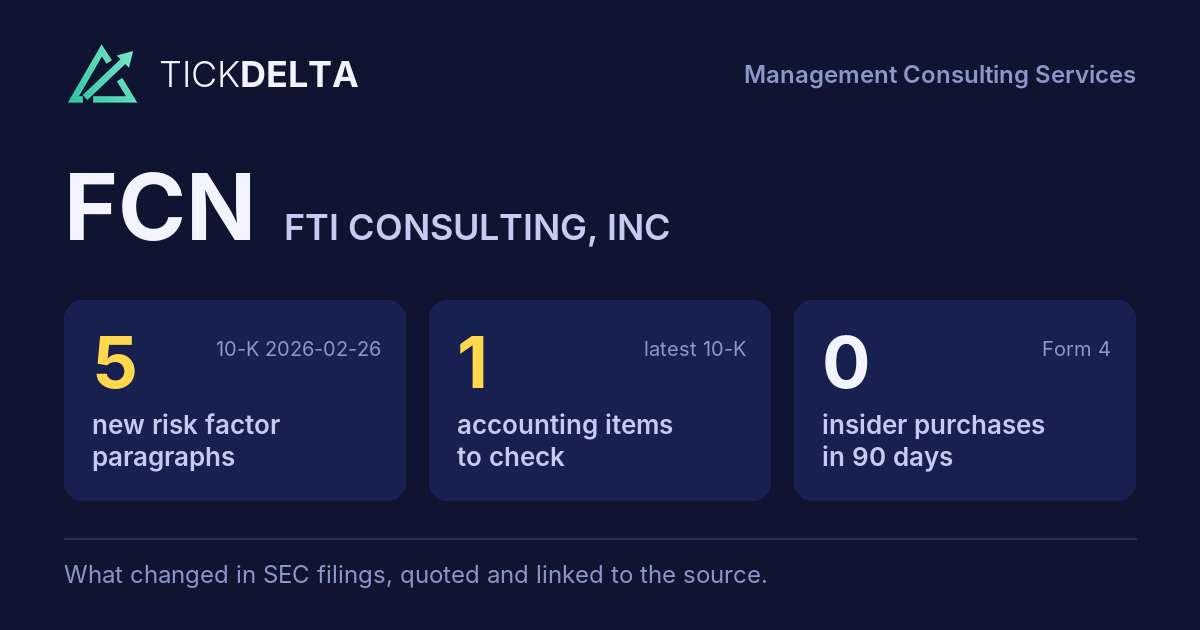
of the text changed · 11,577 words now · 5 new paragraphs, 2 gone
MD&A
15.2%
of the text changed · 8,357 words now · 6 new paragraphs, 0 gone
Legal Proceedings
23.0%
of the text changed · 244 words now
Accounting Policies
12.9%
of the text changed · 3,847 words now
10-K 0000887936-26-000013 (Feb 26, 2026) vs 10-K 0000887936-25-000014 (Feb 20, 2025)
Every paragraph, and how much of it changed
One bar per paragraph, in the order of the 10-K. Height and colour show the share of its words not in the closest paragraph a year earlier; the tallest bars are new paragraphs.
Risk Factors
121 paragraphs · 5 new · 39 reworded · 2 gone · 10-K Feb 26, 2026 against Feb 20, 2025
New paragraph
Reworded (5% of its words or more)
Same or nearly
Paragraph 49 · 38% changed
Every version of it
Paragraph 30 · 36% changed
Every version of it
Paragraph 13 · 36% changed
Every version of it
Paragraph 84 · 35% changed
Every version of it
Many of our engagements involve complex analysis and the exercise of professional judgment, including litigation and governmental investigatory matters where we act as experts. Therefore, we are subject to the risk of professional and other liabilities. Although we believe we maintain an appropriate amount of insurance, it is limited. Damages and/or expenses resulting from any successful claim against us, for indemnity or otherwise, in excess of the amount of insurance coverage will be borne directly by us and could harm our profitability and financial resources. Any claim by a client or third-party against us could expose us to reputational issues that adversely affect our ability to attract new or maintain existing engagements or clients or qualified professionals or other employees, consultants or contractors.
Paragraph 24 · 27% changed
Every version of it
New technologies, such as AI and machine learning, AI, continue to evolve and as a result result, risks continue to be unknown or uncertain. We are increasingly applying AI-based technologies to our solutions and services, to how we deliver work for our clients, and in our own internal operations. As these technologies evolve, some non-expert services and tasks currently performed by our professionals have been and will continue to be replaced by automation, including AI-enabled solutions, which could lead to reduced demand for our services and/or adversely affect the utilization rate of our professionals, if demand for those services is not replaced by demand for new solutions and services or if the pace and level of spending on new solutions or services are not sufficient to make up any shortfall. If we are unable to introduce or if our clients do not accept new pricing or commercial models that reflect the value of these AI-enabled solutions, our results of operations may be adversely affected. There is no assurance that (i) we can successfully develop develop, integrate and deploy AI or other technologies in our business, (ii) such technologies will improve and enhance our services, operations or profitability, (iii) clients will accept the incorporation of such technology in our services, (iv) we can successfully market the use of these technologies to prospective clients, (vi) (v) we can hire and retain staff with the required specialized knowledge and skills to utilize these technologies, (vi) new cybersecurity and or heightened cybersecurity, data protection or other threats and incidents operational risks will not arise, (vii) we can identify, mitigate or recover from cybersecurity incidents or other adverse events that occur, (viii) we can protect and maintain the privacy of our employees and safeguard confidential and proprietary information, (ix) governmental regulation new laws, regulations or regulatory interpretations will not be adopted and what adopted, or that compliance with any such requirements will be, not be burdensome, (x) material additional monetary and time expenditures will not be required, (xi) we can pass on costs of such technologies to clients, (xii) we can integrate AI and other emerging technologies we use will be compatible with AI, our existing systems and technologies, or (xiii) AI and machine learning and other new technologies will not result in significant legal and other liabilities, challenges, regulatory regulatory, reputational or operational issues, and ethical or other dilemmas. The above risks and potential effects could result in material adverse consequences to our operations, reputation, client relationships, ability to market our services, and financial results.
Paragraph 45 · 26% changed
Every version of it
Changes to corporate income tax laws and rules and regulations and tax treaties in jurisdictions where we pay taxes that increase rates, eliminate or reduce deductions or affect the utility or value of deferred tax assets or liabilities could negatively affect our reported financial results and increase our cash tax payment obligations. For example, to the extent the expansion of Section 162(m) of the U.S. Internal Revenue Code, which will become effective for the Company’s year ending December 31, 2027, reduces the amount of tax deductions available to us, our income tax expense would increase, which would reduce our net income.
Paragraph 22 · 24% changed
Every version of it
Paragraph 38 · 42% changed
Every version of it
10-K Feb 20, 2025Our operations involve financial and business risks that differ among the U.S. and the different foreign jurisdictions in which we operate including: (i) cultural and language differences; (ii) various levels of FTI Consulting “brand” recognition; (iii) different employment laws and rules, employment or service contracts, compensation methods, and social and cultural factors that could result in employee turnover, lower utilization rates, higher costs and cyclical fluctuations in utilization that could adversely affect financial and operating results; (iv) foreign currency disruptions and currency fluctuations between the U.S. dollar and foreign currencies that could adversely affect financial and operating results; (v) differing legal and regulatory requirements and other barriers to conducting business; (vi) difficulties resolving the collection of receivables when legal proceedings are necessary; (vii) difficulties in managing our non-U.S. operations, including client relationships, in certain locations; (viii) disparate systems, policies, procedures and processes; (ix) failure to comply with the FCPA and anti-bribery laws of other jurisdictions; (x) higher operating costs; (xi) longer sales and/or collections cycles; (xii) potential restrictions or adverse tax consequences resulting from the repatriation of foreign earnings, such as trapped foreign losses and importation or withholding taxes; (xiii) different or less stable political and/or economic environments; (xiv) wars and other geopolitical conflicts; (xv) conflicts between and among the U.S. and countries in which we conduct business, including those arising from trade disputes or disruptions, the termination or suspension of treaties, or boycotts; (xvi) civil disturbances or other catastrophic events that reduce business activity; (xvii) political interference with our ability to conduct business in the applicable jurisdiction; (xviii) impact of public health crises, including varying governmental responses and requirements, client impacts and travel restrictions; (xix) failure to achieve or maintain a diverse workforce or otherwise meet evolving governmental or client-related standards and requirements pertaining to ESG-related issues; and (xx) physical risks associated with climate change, including rising temperatures, severe storms, energy disruptions, fires or wildfires, flooding and rising sea levels, among others.
10-K Feb 26, 2026
and other geopolitical conflicts; (xv) conflicts between and among the U.S. and countries in which we conduct business, including those arising from trade disputes or disruptions, the termination or suspension of treaties, or boycotts; (xvi) civil disturbances or other catastrophic events that reduce business activity; (xvii) political interference with our ability to conduct business in the applicable jurisdiction; (xviii) impact of public health crises, including varying governmental responses and requirements, client impacts and travel restrictions; (xix) failure to meet evolving governmental or client-related standards and requirements pertaining to sustainability and corporate responsibility-related issues; and (xx) physical risks associated with climate change, including rising temperatures, severe storms, energy disruptions, fires or wildfires, flooding and rising sea levels, among others.
Paragraph 49 · 38% changed
Every version of it
10-K Feb 20, 2025aligned with the International Sustainability Standards Board standards. The threats from environmental events could adversely impact our ability to maintain business continuity, and could impair access to our leased office space in affected geographies and the integrity of our information technology systems. Further, compliance with the disparate climate-related frameworks, including requirements related to greenhouse gas emissions and climate change by federal, state, local and foreign legislatures and governmental agencies could cause us to incur operational and other costs to comply, and penalties if we fail to do so.
10-K Feb 26, 2026
Due to the global nature of our business, we are exposed to a variety of physical risks that may be exacerbated by climate change, including extreme temperatures, severe storms, energy disruptions, fires or wildfires, floods and rising sea levels, among others, all of which are beyond our control. There has also been increased regulation as well as focus from governmental organizations, and our investors, clients and employees, as well as other stakeholders and the media (including social media), on environmental- and sustainability-related issues. Governments and regulators in the U.S. and around the world have been enacting or revising laws and regulations regarding these issues and their priorities or requirements may not be reconcilable. The threats from environmental events could adversely impact our ability to maintain business continuity, and could impair access to our leased office space in affected geographies and the integrity of our information technology systems. Further, compliance with the disparate climate-related frameworks, including requirements related to greenhouse gas emissions and climate change by federal, state, local and foreign legislatures and governmental agencies could cause us to incur operational and other costs to comply, and penalties if we fail to do so.
Paragraph 30 · 36% changed
Every version of it
10-K Feb 20, 2025Our Technology segment also relies on the IP rights we license from third parties. There is no assurance that (i) the software we license to provide our services will remain competitive or technologically innovative, (ii) new, innovative or improved software or products will not be developed by others that will compete more effectively with the software or products we currently license or use to service our customers, or (iii) we can enter into licenses or other agreements on economically advantageous terms to utilize new or more innovative third-party software and products to provide our services. If our Technology segment is unable to license or otherwise use competitively innovative or technologically advanced software and products to provide our services, we could be unable to retain clients, grow our business and capitalize on market opportunities, which would adversely affect our operating margins and financial results, competitive position and reputation.
10-K Feb 26, 2026
Technology segment is unable to license or otherwise use competitively innovative or technologically advanced software and products to provide our services, we could be unable to retain clients, grow our business and capitalize on market opportunities, which would adversely affect our operating margins and financial results, competitive position and reputation.
Paragraph 13 · 36% changed
Every version of it
10-K Feb 20, 2025FLC — The settlement of litigation; less frequent instances of significant mismanagement, fraud, wrongdoing or other business problems that could result in fewer or less complex business engagements; fewer and less complex legal disputes; fewer class action suits; the timing of the completion of engagements; less government regulation, less government enforcement activity, and fewer regulatory investigations; and the timing of government investigations and litigation.
10-K Feb 26, 2026
fewer class action suits; the timing of the completion of engagements; less government regulation, less government enforcement activity, and fewer regulatory investigations; and the timing of government investigations and litigation.
Paragraph 84 · 35% changed
Every version of it
10-K Feb 20, 2025
Many of our engagements involve complex analysis and the exercise of professional judgment, including litigation and governmental investigatory matters where we act as experts. Therefore, we are subject to the risk of professional and other liabilities. Although we believe we maintain an appropriate amount of insurance, it is limited. Damages and/or expenses resulting from any successful claim against us, for indemnity or otherwise, in excess of the amount of insurance coverage will be borne directly by us and could harm our profitability and financial resources. Any claim by a client or third-party against us could expose us to reputational issues that adversely affect our ability to attract new or maintain existing engagements or clients or qualified professionals or other employees, consultants or contractors.
10-K Feb 26, 2026
Many of our engagements involve complex analysis and the exercise of professional judgment, including litigation and governmental investigatory matters where we act as experts. Therefore, we are subject to the risk of professional and other liabilities. Although we believe we maintain an appropriate amount of insurance, it is limited. Damages and/or expenses
Paragraph 24 · 27% changed
Every version of it
10-K Feb 20, 2025
New technologies, such as AI and machine learning, continue to evolve and as a result risks continue to be unknown or uncertain. There is no assurance that (i) we can successfully develop and deploy AI or other technologies in our business, (ii) such technologies will improve and enhance our services, operations or profitability, (iii) clients will accept the incorporation of such technology in our services, (iv) we can successfully market the use of these technologies to prospective clients, (vi) we can hire and retain staff with the required specialized knowledge and skills to utilize these technologies, (vi) new cybersecurity and other threats and incidents will not arise, (vii) we can identify, mitigate or recover from cybersecurity or other adverse events that occur, (viii) we can protect and maintain the privacy of our employees and confidential and proprietary information, (ix) governmental regulation will be adopted and what such requirements will be, (x) material additional monetary and time expenditures will not be required, (xi) we can pass on costs of such technologies to clients, (xii) we can integrate other technologies we use with AI, or (xiii) AI and machine learning and other new technologies will not result in significant legal and other liabilities, challenges, regulatory or operational issues, and ethical or other dilemmas. The above risks and potential effects could result in material adverse consequences to our operations, reputation, client relationships, ability to market our services, and financial results.
10-K Feb 26, 2026
New technologies, such as AI, continue to evolve and as a result, risks continue to be unknown or uncertain. We are increasingly applying AI-based technologies to our solutions and services, to how we deliver work for our clients, and in our own internal operations. As these technologies evolve, some non-expert services and tasks currently performed by our professionals have been and will continue to be replaced by automation, including AI-enabled solutions, which could lead to reduced demand for our services and/or adversely affect the utilization rate of our professionals, if demand for those services is not replaced by demand for new solutions and services or if the pace and level of spending on new solutions or services are not sufficient to make up any shortfall. If we are unable to introduce or if our clients do not accept new pricing or commercial models that reflect the value of these AI-enabled solutions, our results of operations may be adversely affected. There is no assurance that (i) we can successfully develop, integrate and deploy AI or other technologies in our business, (ii) such technologies will improve and enhance our services, operations or profitability, (iii) clients will accept the incorporation of such technology in our services, (iv) we can successfully market the use of these technologies to prospective clients, (v) we can hire and retain staff with the required specialized knowledge and skills to utilize these technologies, (vi) new or heightened cybersecurity, data protection or other operational risks will not arise, (vii) we can identify, mitigate or recover from cybersecurity incidents or other adverse events that occur, (viii) we can protect and maintain the privacy of our employees and safeguard confidential and proprietary information, (ix) new laws, regulations or regulatory interpretations will not be adopted, or that compliance with any such requirements will not be burdensome, (x) material additional monetary and time expenditures will not be required, (xi) we can pass on costs of such technologies to clients, (xii) AI and other emerging technologies will be compatible with our existing systems and technologies, or (xiii) AI and other new technologies will not result in significant legal and other liabilities, challenges, regulatory, reputational or operational issues, and ethical or other dilemmas. The above risks and potential effects could result in material adverse consequences to our operations, reputation, client relationships, ability to market our services, and financial results.
Paragraph 45 · 26% changed
Every version of it
10-K Feb 20, 2025
Changes to corporate income tax laws and rules and regulations and tax treaties in jurisdictions where we pay taxes that increase rates, eliminate or reduce deductions or affect the utility or value of deferred tax assets or liabilities could negatively affect our reported financial results and increase our cash tax payment obligations.
10-K Feb 26, 2026
Changes to corporate income tax laws and rules and regulations and tax treaties in jurisdictions where we pay taxes that increase rates, eliminate or reduce deductions or affect the utility or value of deferred tax assets or liabilities could negatively affect our reported financial results and increase our cash tax payment obligations. For example, to the extent the expansion of Section 162(m) of the U.S. Internal Revenue Code, which will become effective for the Company’s year ending December 31, 2027, reduces the amount of tax deductions available to us, our income tax expense would increase, which would reduce our net income.
Paragraph 22 · 24% changed
Every version of it
10-K Feb 20, 2025Our services are extremely complicated and differ materially among our segment and practice offerings. As a result, the benefits and risks of adopting and implementing new and emerging technologies, such as AI and machine learning in their many forms, necessitates, in most cases, our review and analysis of such technology and its risks and benefits on a service-by-service basis. The need for complex analysis could result in significant delays adopting AI and other technologies, which could adversely impact our competitive position; ability to market services; win new engagements; provide state of the art services to clients; and attract, hire and retain members of our workforce, as compared to early adopters of such technologies. Furthermore, we may not be successful in our AI or other technology-related initiatives. The adoption of technologies, such as AI and machine learning, may require the investment of significant capital, time and resources. Such investment could require the engagement of third-parties or independent contractors and may interfere with the other duties of our management and employees. In addition, the adoption and deployment of AI, machine learning and other new and emerging technologies by
10-K Feb 26, 2026
The benefits and risks of adopting and implementing new and emerging technologies, such as AI, necessitates, in most cases, our review and analysis of such technology and its risks and benefits on a service-by-service basis. The need for complex analysis could result in significant delays adopting AI and other technologies, which could adversely impact our competitive position; ability to market services; win new engagements; provide state-of-the-art services to clients; and attract, hire and retain members of our workforce, as compared to early adopters of such technologies. Furthermore, we may not be successful in our AI or other technology-related initiatives. Moreover, AI algorithms and training methodologies may be flawed and
MD&A
117 paragraphs · 6 new · 59 reworded · 0 gone · 10-K Feb 26, 2026 against Feb 20, 2025
New paragraph
Reworded (5% of its words or more)
Same or nearly
Paragraph 73 · 48% changed
SG&A expenses increased $9.3 million, or 4.4%, to $219.6 were flat over the prior year period at $76.4 million for the year ended December 31, 2024. 2025, which included a 1.7% estimated negative impact from FX. SG&A expenses of 15.8% were 20.2% of revenues in 2024 2025 compared to 15.6% 22.7% in 2023. The increase in SG&A expenses was primarily due to higher infrastructure support and bad debt expenses. 2024.
Paragraph 79 · 40% changed
Paragraph 41 · 37% changed
Unallocated corporate expenses increased $22.2 decreased $19.8 million, or 17.7%, 13.4%, to $147.6 $127.8 million compared to $125.4 $147.6 million for the year ended December 31, 2023. The increase was 2024, primarily due to investments related to artificial intelligence (“AI”) capabilities, higher compensation expenses, largely related to headcount growth, and an increase in legal expenses. settlement gains.
Paragraph 83 · 36% changed
Net cash used in financing activities decreased $339.3 million, or 95.7%, increased $495.1 million to $15.4 $510.5 million compared to $354.7 $15.4 million for the year ended December 31, 2023. 2024. The decrease increase in net cash used in financing activities was primarily due to the repayment an increase of the $315.8 million principal amount of our 2023 Convertible Notes at maturity during 2023, a decrease of $10.8 $848.5 million in payments for common stock repurchases under the Repurchase Program and Program, which was partially offset by an increase in proceeds on stock option exercises net borrowings of $9.6 $365.0 million as under our Credit Facility compared to the prior year. year ended December 31, 2024.
Paragraph 3 · 36% changed
FTI Consulting, Inc., including its consolidated subsidiaries (collectively, the “Company,” “we,” “our” or “FTI Consulting”) is a leading global business advisory expert firm dedicated to helping for organizations manage change, mitigate risk facing crisis and resolve disputes: financial, legal, operational, political & regulatory, reputational and transactional. transformation. Individually, each of our segments and practices is staffed with experts recognized for the depth of their knowledge and a track record of making an impact. Collectively, FTI Consulting offers a comprehensive suite of services designed to assist clients across the business cycle, from proactive risk management to rapid response to unexpected events and dynamic environments.
Paragraph 71 · 35% changed
Revenues increased $36.1 $42.4 million, or 5.5%, 12.6%, to $690.2 $378.5 million for the year ended December 31, 2024. Acquisition-related 2025, which included a 1.5% estimated positive impact from FX. Excluding the estimated impact from FX, revenues contributed $6.8 increased $37.4 million, or 1.0% of the increase. Excluding the acquisition-related revenues, the $29.3 million, or 4.5%, increase in revenues was 11.1%, primarily due to higher realized bill rates and demand for our constructions solutions services, higher realized bill rates for our disputes corporate reputation services and an $18.2 million increase in success fees. pass-through revenues.
Paragraph 28 · 34% changed
Net income for the year ended December 31, 2024 increased $5.2 2025 decreased $9.2 million, or 1.9%, 3.3%, compared to the year ended December 31, 2023. 2024. The increase decrease in net income was primarily due to higher revenues, lower direct costs, which includes the impact of an increase in variable compensation and forgivable loan amortization, as well as higher income taxes taxes, special charges and an FX gain compared to an FX loss in the prior year. This increase interest expense. The decrease was partially offset by higher direct compensation expenses, which includes the impact of a 4.5% increase in billable headcount, higher revenues and lower selling, general and administrative (“SG&A”) expenses, which includes the impact of a 6.2% increase in non-billable headcount, and an increase in bad debt and outside services expenses. include legal settlement gains.
Paragraph 44 · 33% changed
Interest expense decreased $7.4 increased $14.4 million, or 51.5%, 207.8%, to $7.0 million in 2024 compared to $14.3 $21.4 million for the year ended December 31, 2023. The decrease was 2025 compared to $7.0 million for the year ended December 31, 2024, primarily due to lower borrowings, which was partially offset by higher interest rates on our borrowings. Our borrowings in the prior year included amounts owed on our 2.0% convertible senior notes due 2023 (“2023 Convertible Notes”), which matured in August 2023, as well as borrowings on our senior secured unsecured bank revolving credit facility (“Credit Facility”).
Paragraph 73 · 48% changed
10-K Feb 20, 2025
SG&A expenses increased $9.3 million, or 4.4%, to $219.6 million for the year ended December 31, 2024. SG&A expenses of 15.8% of revenues in 2024 compared to 15.6% in 2023. The increase in SG&A expenses was primarily due to higher infrastructure support and bad debt expenses.
10-K Feb 26, 2026
SG&A expenses were flat over the prior year period at $76.4 million for the year ended December 31, 2025, which included a 1.7% estimated negative impact from FX. SG&A expenses were 20.2% of revenues in 2025 compared to 22.7% in 2024.
Paragraph 79 · 40% changed
10-K Feb 20, 2025Year Ended December 31, 2024 2023 Cash Flows (dollars in thousands) Net cash provided by operating activities $ 395,097 $ 224,461 Net cash used in investing activities $ (10,162) $ (73,835) Net cash used in financing activities $ (15,383) $ (354,663) Effect of exchange rate changes on cash and cash equivalents $ (12,281) $ 15,571 DSO (1) 97 100
10-K Feb 26, 2026
Effect of exchange rate changes on cash and cash equivalents $ 21,473 $ (12,281)
Paragraph 41 · 37% changed
10-K Feb 20, 2025
Unallocated corporate expenses increased $22.2 million, or 17.7%, to $147.6 million compared to $125.4 million for the year ended December 31, 2023. The increase was primarily due to investments related to artificial intelligence (“AI”) capabilities, higher compensation expenses, largely related to headcount growth, and an increase in legal expenses.
10-K Feb 26, 2026
Unallocated corporate expenses decreased $19.8 million, or 13.4%, to $127.8 million compared to $147.6 million for the year ended December 31, 2024, primarily due to legal settlement gains.
Paragraph 83 · 36% changed
10-K Feb 20, 2025
Net cash used in financing activities decreased $339.3 million, or 95.7%, to $15.4 million compared to $354.7 million for the year ended December 31, 2023. The decrease was primarily due to the repayment of the $315.8 million principal amount of our 2023 Convertible Notes at maturity during 2023, a decrease of $10.8 million in payments for common stock repurchases under the Repurchase Program and an increase in proceeds on stock option exercises of $9.6 million as compared to the prior year.
10-K Feb 26, 2026
Net cash used in financing activities increased $495.1 million to $510.5 million compared to $15.4 million for the year ended December 31, 2024. The increase in net cash used in financing activities was primarily due to an increase of $848.5 million in payments for common stock repurchases under the Repurchase Program, which was partially offset by an increase in net borrowings of $365.0 million under our Credit Facility compared to the year ended December 31, 2024.
Paragraph 3 · 36% changed
10-K Feb 20, 2025
FTI Consulting, Inc., including its consolidated subsidiaries (collectively, the “Company,” “we,” “our” or “FTI Consulting”) is a global business advisory firm dedicated to helping organizations manage change, mitigate risk and resolve disputes: financial, legal, operational, political & regulatory, reputational and transactional. Individually, each of our segments and practices is staffed with experts recognized for the depth of their knowledge and a track record of making an impact. Collectively, FTI Consulting offers a comprehensive suite of services designed to assist clients across the business cycle, from proactive risk management to rapid response to unexpected events and dynamic environments.
10-K Feb 26, 2026
FTI Consulting, Inc., including its consolidated subsidiaries (collectively, the “Company,” “we,” “our” or “FTI Consulting”) is a leading global expert firm for organizations facing crisis and transformation. Individually, each of our segments and practices is staffed with experts recognized for the depth of their knowledge and a track record of making an impact.
Paragraph 71 · 35% changed
10-K Feb 20, 2025
Revenues increased $36.1 million, or 5.5%, to $690.2 million for the year ended December 31, 2024. Acquisition-related revenues contributed $6.8 million, or 1.0% of the increase. Excluding the acquisition-related revenues, the $29.3 million, or 4.5%, increase in revenues was primarily due to higher realized bill rates and demand for our constructions solutions services, higher realized bill rates for our disputes services and an increase in success fees.
10-K Feb 26, 2026
Revenues increased $42.4 million, or 12.6%, to $378.5 million for the year ended December 31, 2025, which included a 1.5% estimated positive impact from FX. Excluding the estimated impact from FX, revenues increased $37.4 million, or 11.1%, primarily due to higher demand for our corporate reputation services and an $18.2 million increase in pass-through revenues.
Paragraph 28 · 34% changed
10-K Feb 20, 2025
Net income for the year ended December 31, 2024 increased $5.2 million, or 1.9%, compared to the year ended December 31, 2023. The increase in net income was primarily due to higher revenues, lower income taxes and an FX gain compared to an FX loss in the prior year. This increase was partially offset by higher direct compensation expenses, which includes the impact of a 4.5% increase in billable headcount, higher selling, general and administrative (“SG&A”) expenses, which includes the impact of a 6.2% increase in non-billable headcount, and an increase in bad debt and outside services expenses.
10-K Feb 26, 2026
Net income for the year ended December 31, 2025 decreased $9.2 million, or 3.3%, compared to the year ended December 31, 2024. The decrease in net income was primarily due to higher direct costs, which includes the impact of an increase in variable compensation and forgivable loan amortization, as well as higher income taxes, special charges and interest expense. The decrease was partially offset by higher revenues and lower selling, general and administrative (“SG&A”) expenses, which include legal settlement gains.
Paragraph 44 · 33% changed
10-K Feb 20, 2025
Interest expense decreased $7.4 million, or 51.5%, to $7.0 million in 2024 compared to $14.3 million for the year ended December 31, 2023. The decrease was primarily due to lower borrowings, which was partially offset by higher interest rates on our borrowings. Our borrowings in the prior year included amounts owed on our 2.0% convertible senior notes due 2023 (“2023 Convertible Notes”), which matured in August 2023, as well as borrowings on our senior secured bank revolving credit facility (“Credit Facility”).
10-K Feb 26, 2026
Interest expense increased $14.4 million, or 207.8%, to $21.4 million for the year ended December 31, 2025 compared to $7.0 million for the year ended December 31, 2024, primarily due to higher borrowings on our senior unsecured bank revolving credit facility (“Credit Facility”).
A paragraph is matched with the one last year that shares the most of its words; under half in common makes it new. The paragraphs shown are the 8 reworded the most in each section.
The paragraph that changed most in each section
The redline
Marked against last year's 10-K: cut words struck through, new words highlighted.
Risk Factors212 words changed in this paragraph; it is 66% similar to last year's version.
New technologies, such as AI and machine learning, AI, continue to evolve and as a result result, risks continue to be unknown or uncertain. We are increasingly applying AI-based technologies to our solutions and services, to how we deliver work for our clients, and in our own internal operations. As these technologies evolve, some non-expert services and tasks currently performed by our professionals have been and will continue to be replaced by automation, including AI-enabled solutions, which could lead to reduced demand for our services and/or adversely affect the utilization rate of our professionals, if demand for those services is not replaced by demand for new solutions and services or if the pace and level of spending on new solutions or services are not sufficient to make up any shortfall. If we are unable to introduce or if our clients do not accept new pricing or commercial models that reflect the value of these AI-enabled solutions, our results of operations may be adversely affected. There is no assurance that (i) we can successfully develop develop, integrate and deploy AI or other technologies in our business, (ii) such technologies will improve and enhance our services, operations or profitability, (iii) clients will accept the incorporation of such technology in our services, (iv) we can successfully market the use of these technologies to prospective clients, (vi) (v) we can hire and retain staff with the required specialized knowledge and skills to utilize these technologies, (vi) new cybersecurity and or heightened cybersecurity, data protection or other threats and incidents operational risks will not arise, (vii) we can identify, mitigate or recover from cybersecurity incidents or other adverse events that occur, (viii) we can protect and maintain the privacy of our employees and safeguard confidential and proprietary information, (ix) governmental regulation new laws, regulations or regulatory interpretations will not be adopted and what adopted, or that compliance with any such requirements will be, not be burdensome, (x) material additional monetary and time expenditures will not be required, (xi) we can pass on costs of such technologies to clients, (xii) we can integrate AI and other emerging technologies we use will be compatible with AI, our existing systems and technologies, or (xiii) AI and machine learning and other new technologies will not result in significant legal and other liabilities, challenges, regulatory regulatory, reputational or operational issues, and ethical or other dilemmas. The above risks and potential effects could result in material adverse consequences to our operations, reputation, client relationships, ability to market our services, and financial results.
Source: Item 1A, 10-K 0000887936-26-000013 vs Item 1A, 10-K 0000887936-25-000014
Accounting Policies113 words changed in this paragraph; it is 54% similar to last year's version.
Our income tax provision consists principally of U.S. federal, state and international income taxes. We generate income in a significant number of states located throughout the U.S. and in foreign countries in which we conduct business. Our effective income tax rate may fluctuate due to a change in the mix of earnings between higher and lower state or country tax jurisdictions and the impact of non-deductible expenses. Additionally, we record deferred tax assets and liabilities using the asset and liability method of accounting, which requires us to measure these assets and liabilities using the enacted tax rates and laws that will be in effect when the differences are expected to reverse. A valuation allowance is recognized if, based on the weight of available evidence, it is more likely than not that some portion, or all, of the deferred tax asset will not be realized. In evaluating our ability to recover our deferred tax assets, we consider all available positive and negative evidence, including scheduled reversals of temporary differences, projected future taxable income, tax planning strategies and recent results of operations.
Source: Item 8, Note 1 – Description of Business and Summary of Significant Accounting Policies, 10-K 0000887936-26-000013 vs Item 8, Note 1 – Description of Business and Summary of Significant Accounting Policies, 10-K 0000887936-25-000014
MD&A88 words changed in this paragraph; it is 51% similar to last year's version.
Net income for the year ended December 31, 2024 increased $5.2 2025 decreased $9.2 million, or 1.9%, 3.3%, compared to the year ended December 31, 2023. 2024. The increase decrease in net income was primarily due to higher revenues, lower direct costs, which includes the impact of an increase in variable compensation and forgivable loan amortization, as well as higher income taxes taxes, special charges and an FX gain compared to an FX loss in the prior year. This increase interest expense. The decrease was partially offset by higher direct compensation expenses, which includes the impact of a 4.5% increase in billable headcount, higher revenues and lower selling, general and administrative (“SG&A”) expenses, which includes the impact of a 6.2% increase in non-billable headcount, and an increase in bad debt and outside services expenses. include legal settlement gains.
Source: Item 7, 10-K 0000887936-26-000013 vs Item 7, 10-K 0000887936-25-000014
Legal Proceedings38 words changed in this paragraph; it is 77% similar to last year's version.
We are subject to legal actions arising in the ordinary course of business. In management’s opinion, we believe we have adequate legal defenses and/or insurance coverage with respect to the eventuality of such actions. We are not aware of any asserted or unasserted legal proceedings or claims that we believe would have a material adverse effect on our financial condition or our results of operations. During the year ended December 31, 2025, the Company recognized gain contingencies at the conclusion of certain legal actions. These amounts are included as a gain in SG&A expenses on our operations. Consolidated Statements of Comprehensive Income.
Source: Item 3, via Note 15 – Commitments and Contingencies, 10-K 0000887936-26-000013 vs Item 3, via Note 16 – Commitments and Contingencies, 10-K 0000887936-25-000014
Sentences and paragraphs added, removed or reworded
Every change, by type
Sentences and paragraphs of FCN's Risk Factors and MD&A, 10-K Feb 26, 2026 against 10-K Feb 20, 2025. Each links to the text at sec.gov.
Quiet changes are sentences kept from last year with one to four words changed, at least one of them a hedge, a modal or a qualifier (may, could, will, not, significant, material…). A year or date rolling forward is not counted.
The full word list
adverse, adversely, all, although, anticipate, anticipates, any, approximately, believe, believes, can, cannot, certain, could, expect, expects, generally, however, if, intend, intends, largely, likely, many, material, materially, may, might, most, must, never, no, not, possible, primarily, probable, should, significant, significantly, some, substantial, substantially, unlikely, will, would
AddedRisk Factors
datasets may be over-broad, insufficient or contain biased or inaccurate information. The adoption of new technologies, such as AI, may require the investment of significant capital, time and resources. Such investment could require the engagement of third parties or independent contractors and may interfere with the other duties of our management and employees. Leveraging AI capabilities for our internal functions and operations presents additional risks, costs and challenges, including those discussed in these risk factors. The development, adoption and use of AI technologies are still in the early stages and involve significant risks and uncertainties, which may expose us to legal, reputational and financial harm. In addition, AI and other technologies that are open source and available for no or low cost could result in low barriers to development and utilization, and additional competition from third parties, and the adoption and deployment of AI and other new and emerging technologies by competitors more rapidly or successfully than we do could materially adversely affect our competitive position and financial results.
Read it in 10-K Feb 26, 2026 at sec.gov
AddedRisk Factors
harm and the loss of clients and other adverse business consequences, which could negatively impact our financial results or financial condition.
Read it in 10-K Feb 26, 2026 at sec.gov
AddedRisk Factors
and other professionals on a case-by-case basis. The aggregate amount of loans to professionals is significant. We expect to continue issuing unsecured general recourse forgivable loans.
Read it in 10-K Feb 26, 2026 at sec.gov
AddedRisk Factors
In connection with our acquisitions, we generally obtain non-solicitation agreements from the professionals we hire, as well as non-competition agreements from senior managers and professionals. The agreements prohibit such individuals from
Read it in 10-K Feb 26, 2026 at sec.gov
AddedRisk Factors
successful and may not permit us to meet our scheduled debt service obligations. In addition, the terms of existing or future debt agreements, including our Credit Facility, may restrict us from pursuing any of these alternatives.
Read it in 10-K Feb 26, 2026 at sec.gov
RemovedRisk Factors
RemovedRisk Factors
RewordedRisk Factors
There is no assurance that (i) we can successfully develop develop, integrate and deploy AI or other technologies in our business, (ii) such technologies will improve and enhance our services, operations or profitability, (iii) clients will accept the incorporation of such technology in our services, (iv) we can successfully market the use of these technologies to prospective clients, (vi) (v) we can hire and retain staff with the required specialized knowledge and skills to utilize these technologies, (vi) new cybersecurity and or heightened cybersecurity, data protection or other threats and incidents operational risks will not arise, (vii) we can identify, mitigate or recover from cybersecurity incidents or other adverse events that occur, (viii) we can protect and maintain the privacy of our employees and safeguard confidential and proprietary information, (ix) governmental regulation new laws, regulations or regulatory interpretations will not be adopted and what adopted, or that compliance with any such requirements will be, not be burdensome, (x) material additional monetary and time expenditures will not be required, (xi) we can pass on costs of such technologies to clients, (xii) we can integrate AI and other emerging technologies we use will be compatible with AI, our existing systems and technologies, or (xiii) AI and machine learning and other new technologies will not result in significant legal and other liabilities, challenges, regulatory regulatory, reputational or operational issues, and ethical or other dilemmas.
Read it in 10-K Feb 26, 2026 at sec.gov
Show the other 33
RewordedRisk Factors
RewordedRisk Factors
FLC — The settlement of litigation; less frequent instances of significant mismanagement, fraud, wrongdoing or other business problems that could result in fewer or less complex business engagements; fewer and less complex legal disputes; fewer class action suits; the timing of the completion of engagements; less government regulation, less government enforcement activity, and fewer regulatory investigations; and the timing of government investigations and litigation.
Read it in 10-K Feb 26, 2026 at sec.gov
RewordedRisk Factors
Any significant compromise of the security of our information technology systems leading to theft or misuse of our own or our clients’ proprietary or confidential information, or the public disclosure or use of such information by others, could result in losses, damages or penalties, third-party claims, reputational harm and the loss of clients and other adverse business consequences, which could negatively impact our financial results or financial condition.
Read it in 10-K Feb 26, 2026 at sec.gov
RewordedRisk Factors
Some of the factors, events risks, uncertainties and contingencies factors discussed below may have occurred in the past, but the disclosures below are not representations as to whether or not the factors, events risks, uncertainties or contingencies factors have occurred in the past, and instead reflect our beliefs and opinions as to the factors, events, or contingencies risks, uncertainties and factors that could materially and adversely affect us in the future.
Read it in 10-K Feb 26, 2026 at sec.gov
RewordedRisk Factors
If we default on any guaranteed indebtedness, our U.S. subsidiaries that are guarantors could be required to make payments under their guarantees, and the lenders under our Credit Facility could foreclose on certain of our U.S. subsidiaries’ assets to satisfy unpaid obligations, which could materially adversely affect our business and financial results.
Read it in 10-K Feb 26, 2026 at sec.gov
RewordedRisk Factors
In addition to the risks risks, uncertainties and factors discussed below and elsewhere in this Annual Report, other risks risks, uncertainties and uncertainties factors not currently known to us or that we currently consider immaterial could, in the future, materially and adversely affect our business, prospects, financial condition condition, financial results, cash flows and financial results. liquidity.
Read it in 10-K Feb 26, 2026 at sec.gov
RewordedRisk Factors
All of the following risks risks, uncertainties and factors could materially and adversely affect our business, prospects, financial condition and condition, results of operations. operations, cash flows and liquidity.
Read it in 10-K Feb 26, 2026 at sec.gov
RewordedRisk Factors
RewordedRisk Factors
We believe that a workforce that reflects the myriad identities of our clients and vendors with whom we do business, our stakeholders and the populations of the regions in which we have operations results in best in class advice to our clients, improves the quality of our services, promotes employee satisfaction and retention, and increases the overall value of our business.
Read it in 10-K Feb 26, 2026 at sec.gov
RewordedRisk Factors
Substantially all of our wholly-owned U.S. subsidiaries guarantee our obligations under our Credit Facility, and substantially all of their assets are pledged as collateral under the Credit Facility.
Read it in 10-K Feb 26, 2026 at sec.gov
RewordedRisk Factors
(xix) failure to achieve or maintain a diverse workforce or otherwise meet evolving governmental or client-related standards and requirements pertaining to ESG-related sustainability and corporate responsibility-related issues; and (xx) physical risks associated with climate change, including rising temperatures, severe storms, energy disruptions, fires or wildfires, flooding and rising sea levels, among others.
Read it in 10-K Feb 26, 2026 at sec.gov
Quiet changesRisk Factors
Quiet changesRisk Factors
In addition, upon on occasion, we may decide that we should or must resign from a client engagement.
Read it in 10-K Feb 26, 2026 at sec.gov
Quiet changesRisk Factors
Our variable rate indebtedness will subject subjects us to interest rate risk, which could cause our annual debt service obligations to increase significantly.
Read it in 10-K Feb 26, 2026 at sec.gov
Quiet changesRisk Factors
Borrowings under our Credit Facility will be at bear variable rates of interest, including for U.S.
Read it in 10-K Feb 26, 2026 at sec.gov
AddedMD&A
The Company renamed its Corporate Finance & Restructuring segment to Corporate Finance to better align with the segment’s business activities, structure and strategy, as of December 31, 2025. The segment name change did not result in any change to the composition of the segment and has no impact on previously reported financial information.
Read it in 10-K Feb 26, 2026 at sec.gov
AddedMD&A
(1)Excluded from non-GAAP financial measures, including Adjusted EBITDA and Adjusted EPS.
Read it in 10-K Feb 26, 2026 at sec.gov
AddedMD&A
On November 21, 2025, we entered into a material lease agreement to accept possession of three leases (the “Leases”) for our new office space in London, England. We expect to accept possession of the premises on or about September 25, 2027, subject to the satisfaction of certain conditions. The Leases will have a fixed term of 15 years, subject to a break option allowing the tenant, which is a wholly-owned subsidiary of the Company, to terminate the Leases at the end of the 10th year. At the end of the initial 15-year term, the tenant has a one-time contractual right to renew each of the Leases for a term of either five years or ten years. Fixed rental payments under the Leases are scheduled to commence in February 2028, payable in quarterly installments, and will aggregate to approximately $115.0 million.
Read it in 10-K Feb 26, 2026 at sec.gov
AddedMD&A
Income Taxes. As part of the process of preparing our consolidated financial statements, we estimate our income taxes for each of our legal entities in its respective jurisdiction. Differences which are temporary in nature result in deferred tax assets and liabilities. Significant judgment is required in determining our provision for income taxes, our deferred tax assets and liabilities and any valuation allowance recorded against our deferred tax assets.
Read it in 10-K Feb 26, 2026 at sec.gov
AddedMD&A
Subsequent to the initial recognition of deferred tax assets, we assess the likelihood that such deferred tax assets will be realized. We weigh all available positive and negative evidence, including scheduled reversals of temporary differences, projected future taxable income, tax planning strategies and historical results of operations, and if we determine that we may not fully derive the benefit from a deferred tax asset, we consider whether it would be appropriate to apply a valuation allowance against the applicable deferred tax asset. The weight we give to any particular item is, in part, dependent upon the degree to which it can be objectively verified. Pre-tax operating losses on a three-year cumulative basis or lack of sustainable profitability are considered objectively verifiable evidence and will generally outweigh a projection of future taxable income.
Read it in 10-K Feb 26, 2026 at sec.gov
AddedMD&A
Certain of our legal entities have individually experienced operating losses on a three-year cumulative basis or have tax attributes that we have determined may expire unused. In addition, some of our legal entities have recorded a valuation allowance on all or a portion of their deferred tax assets due to the combined effect of operating losses in certain subsidiaries of these entities. Based on all available evidence, we have determined that there is not available objective evidence of a greater than 50% likelihood that the deferred tax assets held by these entities will be realized. Consequently, we have recorded valuation allowances on the deferred tax assets held by these entities as of December 31, 2025. Refer to Note 16, “Income Taxes” in Part II, Item 8 of this Annual Report for further information on income taxes.
Read it in 10-K Feb 26, 2026 at sec.gov
RewordedMD&A
Year Ended December 31, 2025 2024 2023 (in thousands, except per share data) Revenues Corporate Finance $ 1,550,969 $ 1,391,206 $ 1,346,678 FLC 764,687 690,211 654,105 Economic Consulting 720,829 863,557 771,374 Technology 373,883 417,637 387,855 Strategic Communications 378,489 336,041 329,230 Total revenues $ 3,788,857 $ 3,698,652 $ 3,489,242 Segment operating income Corporate Finance $ 288,761 $ 225,711 $ 216,504 FLC 121,223 77,490 81,296 Economic Consulting 18,794 104,090 109,818 Technology 28,109 41,875 48,196 Strategic Communications 60,027 45,790 47,167 Total segment operating income 516,914 494,956 502,981 Unallocated corporate expenses (127,837) (147,594) (125,420) Operating income 389,077 347,362 377,561 Other income (expense) Interest income and other 3,330 10,360 (4,867) Interest expense (21,396) (6,951) (14,331) (18,066) 3,409 (19,198) Income before income tax provision 371,011 350,771 358,363 Income tax provision 100,140 70,683 83,471 Net income $ 270,871 $ 280,088 $ 274,892 Earnings per common share — basic $ 8.33 $ 7.96 $ 8.10 Earnings per common share — diluted $ 8.24 $ 7.81 $ 7.71
Read it in 10-K Feb 26, 2026 at sec.gov
RewordedMD&A
The increase decrease was primarily due to a $4.3 million net FX loss for the year ended December 31, 2025 compared to a $0.5 million net FX gain for the year ended December 31, 2024 compared to 2024, as well as a $9.3 $1.4 million net FX loss for the year ended December 31, 2023 and a $3.3 million increase decrease in interest income.
Read it in 10-K Feb 26, 2026 at sec.gov
RewordedMD&A
Depreciation of property and equipment 5,302 5,400 5,989 Special charges 983 8 — Adjusted Segment EBITDA $ 25,079 $ 109,498 $ 115,807 Gross profit (1) $ 142,356 $ 235,133 $ 218,677 Percentage change in gross profit from prior year 7.5 -39.5 % Gross profit margin (2) 19.7 % 27.2 % 28.3 % Adjusted Segment EBITDA as a percentage of revenues 3.5 % 12.7 % 15.0 % Number of billable professionals (at period end) 1,014 1,110 1,089 Percentage change in number of billable professionals from prior year 1.9 -8.6 % Utilization rate of billable professionals 59 % 66 % 67 % Average billable rate per hour $ 583 $ 584 $ 547
Read it in 10-K Feb 26, 2026 at sec.gov
RewordedMD&A
Interest income and other, which includes FX gains and losses, increased $15.2 decreased $7.0 million, or 67.9%, to a gain of $3.3 million for the year ended December 31, 2025, compared to a gain of $10.4 million for the year ended December 31, 2024, compared to a loss of $4.9 million for the year ended December 31, 2023. 2024.
Read it in 10-K Feb 26, 2026 at sec.gov
RewordedMD&A
The decrease increase in the income tax provision was primarily due to a more less favorable tax benefit related to share-based compensation, as a larger number of resulting from fewer non-qualified stock options were exercised during the year ended December 31, 2024 option exercises and an increase in valuation allowances against certain foreign deferred tax assets as compared to the prior year.
Read it in 10-K Feb 26, 2026 at sec.gov
RewordedMD&A
Depreciation and amortization of intangible assets 13,667 13,319 14,333 Special charges 11,696 5,326 — Adjusted Segment EBITDA $ 314,124 $ 244,356 $ 230,837 Gross profit (1) $ 537,103 $ 453,750 $ 431,971 Percentage change in gross profit from prior year 5.0 18.4 % Gross profit margin (2) 34.6 % 32.6 % 32.1 % Adjusted Segment EBITDA as a percentage of revenues 20.3 % 17.6 % 17.1 % Number of billable professionals (at period end) 2,297 2,286 2,215 Percentage change in number of billable professionals from prior year 3.2 0.5 % Utilization rate of billable professionals 60 % 58 % 60 % Average billable rate per hour $ 529 $ 510 $ 494
Read it in 10-K Feb 26, 2026 at sec.gov
RewordedMD&A
The decrease in gross profit margin was primarily due to lower profitability of our processing, hosting and managed review services, primarily resulting from the decline in revenues from our M&A-related “second request” services, which was partially offset by an increase in profitability of our consulting and hosting services.
Read it in 10-K Feb 26, 2026 at sec.gov
RewordedMD&A
The effect of exchange rate changes on cash and cash equivalents had a favorable impact of $21.5 million for the year ended December 31, 2025 compared to an unfavorable impact of $12.3 million for 2024 compared to a favorable impact of $15.6 million for 2023. the year ended December 31, 2024.
Read it in 10-K Feb 26, 2026 at sec.gov
RewordedMD&A
During 2025, 2026, we currently expect to make capital expenditures to support our organization in an aggregate amount of between $70 $48 million and $86 million, which includes costs related to leasehold improvements for our new office space in Chicago, Illinois, cloud computing costs and investments related to AI capabilities. $58 million.
Read it in 10-K Feb 26, 2026 at sec.gov
RewordedMD&A
Depreciation and amortization of intangible assets 8,447 7,442 6,813 Special charges 5,475 1,785 — Adjusted Segment EBITDA $ 135,145 $ 86,717 $ 88,109 Gross profit (1) $ 274,073 $ 225,185 $ 216,787 Percentage change in gross profit from prior year 3.9 21.7 % Gross profit margin (2) 35.8 % 32.6 % 33.1 % Adjusted Segment EBITDA as a percentage of revenues 17.7 % 12.6 % 13.5 % Number of billable professionals (at period end) 1,541 1,542 1,447 Percentage change in number of billable professionals from prior year 6.6 -0.1 % Utilization rate of billable professionals 57 % 57 % Average billable rate per hour $ 442 $ 390 $ 386
Read it in 10-K Feb 26, 2026 at sec.gov
RewordedMD&A
Depreciation of property and equipment 15,281 15,999 14,515 Special charges 1,928 667 — Adjusted Segment EBITDA $ 45,318 $ 58,541 $ 62,711 Gross profit (1) $ 123,937 $ 145,118 $ 148,512 Percentage change in gross profit from prior year -2.3 -14.6 % Gross profit margin (2) 33.1 % 34.7 % 38.3 % Adjusted Segment EBITDA as a percentage of revenues 12.1 % 14.0 % 16.2 % Number of billable professionals (at period end) (3) 662 714 628 Percentage change in number of billable professionals from prior year 13.7 -7.3 %
Read it in 10-K Feb 26, 2026 at sec.gov
RewordedMD&A
Revenues increased $29.8 decreased $43.8 million, or 7.7%, 10.5%, to $417.6 $373.9 million for the year ended December 31, 2024, 2025, primarily due to higher lower demand for our M&A-related “second request” and information governance, privacy & security services, which was partially offset by lower demand for our investigations services.
Read it in 10-K Feb 26, 2026 at sec.gov
Sources
The two latest 10-Ks on EDGAR, section by section. Each change links to the text at sec.gov.
Also
New risk factors: paragraphs with nothing like them last year, quoted in full.
Work with it
Excel workbook · CSV. Google Sheet that stays up to date: paste =IMPORTDATA("https://tickdelta.com/company/FCN/export.csv") into a cell.