Form 10-K for the Fiscal Year Ended December 31, 2019
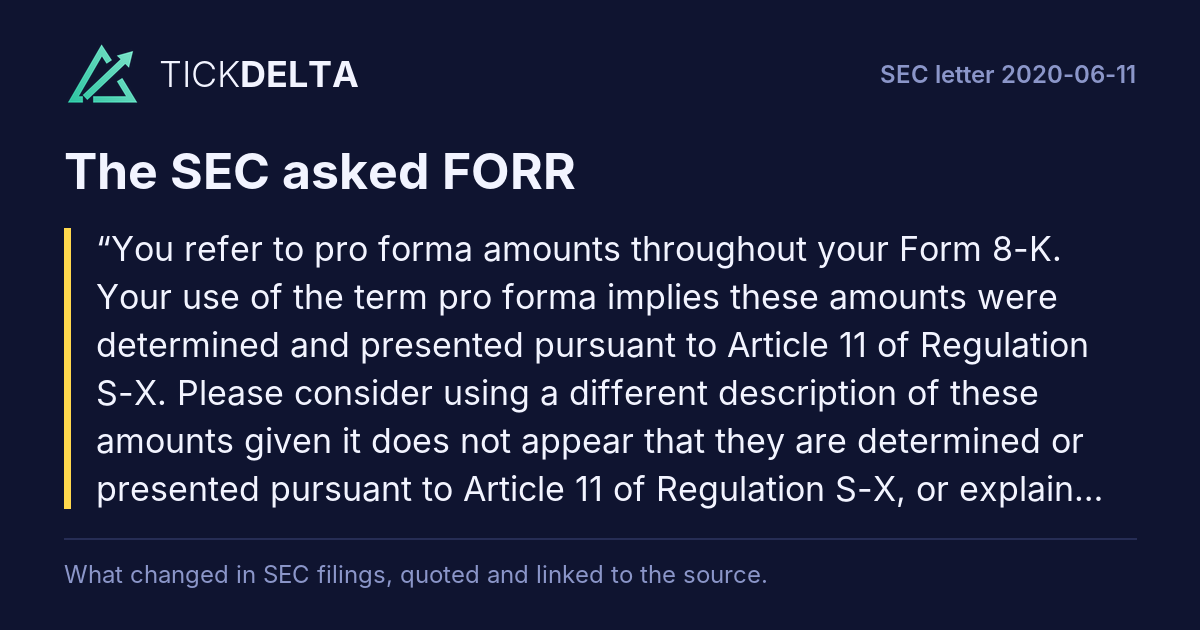
You refer to pro forma amounts throughout your Form 8-K. Your use of the term pro forma implies these amounts were determined and presented pursuant to Article 11 of Regulation S-X. Please consider using a different description of these amounts given it does not appear that they are determined or presented pursuant to Article 11 of Regulation S-X, or explain the basis for your presentation.
In future filings we will not use the term pro forma to refer to non-GAAP amounts or measures (other than those presented pursuant to Article 11 of Regulation S-X) and will instead describe the related amounts or measures as either “non-GAAP” or “adjusted”.Read in the reply
First report after the company's reply of Jun 22, 2020: 10-Q filed Aug 10, 2020 ↗, against the 10-Q filed May 11, 2020 ↗.
Tickdelta does not hold the text of both reports, so they are not compared here.
We refer to the acquisition-related deferred revenue fair value adjustment made to arrive at non-GAAP measures. Please provide us a brief description of the transactions that gave rise to the deferred revenues and why management believes that performance measures excluding the effects of purchase accounting are useful to an investor.Rest of the question
Please tell us how you considered question 100.04 of the Non-GAAP Compliance and Disclosure Interpretations and Rule 100(b) of Regulation G.
In connection with our January 2019 acquisition of SiriusDecisions, Inc. (“SiriusDecisions”) we recorded a downward adjustment of $11.7 million to the deferred revenue of SiriusDecisions to reflect the fair value of the deferred revenue as ofRead in the reply
January 2019. The transactions that gave rise to the deferred revenue at SiriusDecisions as of January 2019 included the majority of the transactions with their customers across their four product lines of Research, Events, Consulting, and Learning.
SiriusDecisions typically invoiced their clients for either all or a portion of the contract amount atRest of the answer
the start of the contract, and revenue would be deferred and recognized during the contract term in accordance with generally accepted accounting principles (“GAAP”).
As indicated above, as part of the purchase accounting for the SiriusDecisions acquisition, the book value of the acquired deferred revenue was reduced by $11.7 million to reflect the fair value of the deferred revenue as of January 2019. This reduction in the book value of deferred revenue meant that we would recognize a lower amount of revenue post-January 2019 compared to the actual contractual value.
The Company believes that disclosure of non-GAAP revenue reflective of the deferred revenue fair value adjustment is important for two key reasons. First, this disclosure allows an investor to compare the historical revenue of SiriusDecisions to the revenue subsequent to the acquisition on an equivalent basis based on the terms of the underlying contractual commitment giving rise to the deferred revenue. Put differently, disclosure enables an investor to understand that the underlying contractual terms have not been negatively altered subsequent to January 2019. Second, this disclosure allows an investor to better determine the amount of year over year organic revenue growth. It is important for an investor to understand that
GAAP revenue in fiscal 2020 will reflect a $0.4 million deferred revenue fair value adjustment, while GAAP revenue in fiscal 2019 reflects an $11.3 million deferred revenue fair value adjustment. Without this disclosure, an investor may incorrectly believe that year over year organic revenue growth was greater than actual in fiscal 2020.
The Company believes that disclosure of non-GAAP revenue reflective of the deferred revenue fair value adjustment is not within the scope of question 100.04 of the Non-GAAP Compliance and
Disclosure Interpretations as the adjustment neither accelerates revenue that would be earned over time in accordance with GAAP to reflect such revenue as though it were earned when customers are billed nor uses any other individually tailored recognition and measurement methods for financial statement line items. Moreover, within the context in which the deferred revenue fair value adjustment is presented, the Company believes that disclosure is compliant with Rule 100(b) of Regulation G as the disclosure neither contains an untrue statement of a material fact nor is misleading. Rather, the disclosure is provided so that investors are better able to understand year over year results and are not left with an incorrect perception that contractual terms were negatively altered in January 2019 or that year over year organic revenue growth was greater than actual in fiscal 2020.
First report after the company's reply of Jun 22, 2020: 10-Q filed Aug 10, 2020 ↗, against the 10-Q filed May 11, 2020 ↗.
Tickdelta does not hold the text of both reports, so they are not compared here.
Please tell us how your presentation of pro forma net income complies with the reconciliation requirement of Regulation G and Item 10(e) of Regulation S-K. In closing, we remind you that the company and its management are responsible for the accuracy and adequacy of their disclosures, notwithstanding any review, comments, action or absence of action by the staff.
Reconciling non-GAAP net income to income from operations avoids duplicative disclosure that would result from reconciling non-GAAP income from operations to income from operations and then separately reconciling non-GAAP net income to net income. We have historically reconciled non-GAAP net income to income from operations as we believed this was consistent with the Commission’s 2003 Adopting Release that at footnote 26 states registrants are afforded flexibility to best make the determination as to which is the most directly comparable financial measure and that non-GAAP financial measuresRead in the replyRest of the answer
that depict performance should be balanced with net income or income from continuing operations. Accordingly, we have historically provided a reconciliation to income from continuing operations.
After further consideration, going forward, we will provide a reconciliation of non-GAAP net income to net income. Please see the tables included in this response that demonstrates the proposed format of this reconciliation.
If you require additional information, please telephone either the undersigned at 617-613-6181, Scott Chouinard, Chief Accounting Officer and Treasurer, at 617-613-6060, or Ryan Darrah, Chief Legal Officer, at 617-613-6223.
First report after the company's reply of Jun 22, 2020: 10-Q filed Aug 10, 2020 ↗, against the 10-Q filed May 11, 2020 ↗.
Tickdelta does not hold the text of both reports, so they are not compared here.
Also in this review: closing letter, 2020-06-24