Form 10-K for the Fiscal Year Ended July 31, 2023
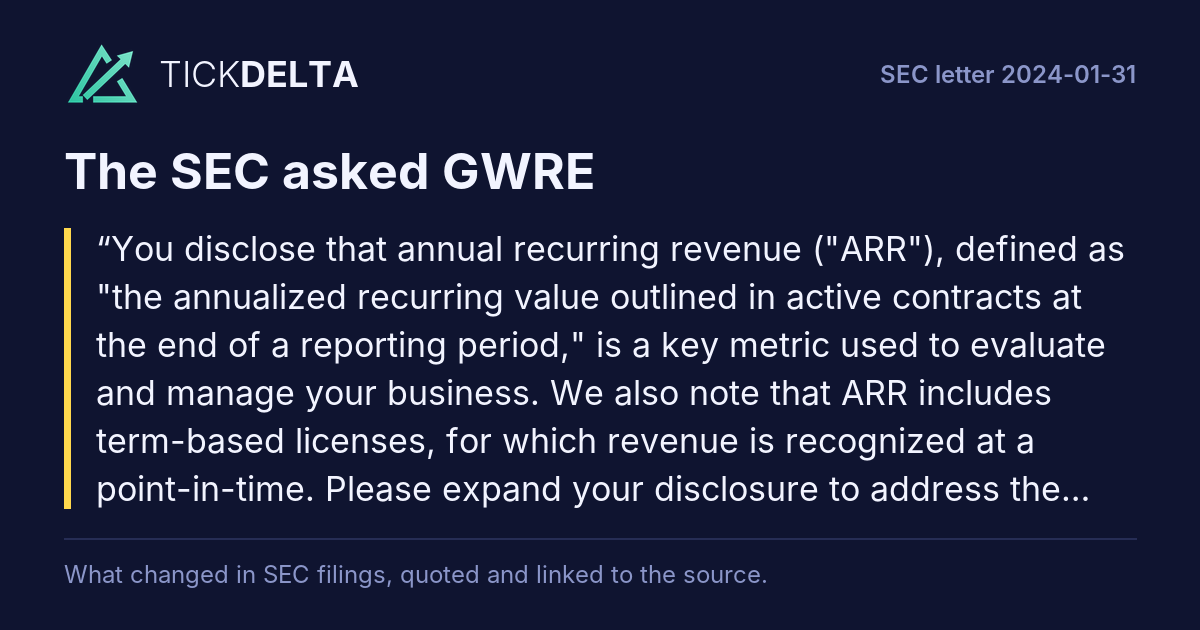
You disclose that annual recurring revenue ("ARR"), defined as "the annualized recurring value outlined in active contracts at the end of a reporting period," is a key metric used to evaluate and manage your business. We also note that ARR includes term-based licenses, for which revenue is recognized at a point-in-time. Please expand your disclosure to address the following and advise us.Rest of the question
• Clarify how the up-front revenue from term-based licenses is factored into your ARR calculation. Address whether you annualize revenue recognized or invoiced amounts. • Clarify whether ARR reflects any actual or anticipated reductions of revenue due to contract non-renewals or cancellations, and discuss any limitations present as a result. • Disclose the renewal rates for term-based arrangements and subscription arrangements for each period presented to support your assumptions. • Describe how migrations from term-based arrangements to subscription arrangements impact your ARR calculation. • Describe how ARR differs from GAAP revenue and specifically address the timing of revenue recognition related to the license performance obligation. • Provide us with your proposed disclosure responsive to the concerns noted above. Refer to SEC Release 33-10751.
We view ARR as a key financial metric that reflects our recurring invoice activity for our software products. We believe this is helpful for investors to contextualize the difference between invoicing and cash flows from the varying revenue recognition patterns of term license and subscription customers. This was especially important during our business model transition from on-premise to cloud-delivered software.Read in the replyRest of the answer
For example, below is a table for hypothetical Customers A and B that each executed a five-year contract with identical annual fees, but Customer A is getting a five-year term license to our on-premise product and Customer B is getting a five-year subscription to our cloud service (assume both of the contracts start on the first day of the fiscal year):
Table 1: ARR by Customer Type
($ in millions)
Year
Fee (annual invoicing)
ARR
Customer A:
On-premise
Term GAAP Revenue
Recognized
Customer B: Cloud
Subscription GAAP
Revenue Recognized
Year 1
$
1.00
Lic: $10.20; Support $0.36
Sub: $2.40
Year 2
2.00
Lic: $0.00; Support $0.36
Year 3
3.00
Year 4
Year 5
Total Value
12.00
$12.00
In the example above, the ARR would be the same regardless of how the customer chooses to consume the software
(cloud or on-premise); however, the revenue patterns would be very different.
Clarify whether ARR reflects any actual or anticipated reductions of revenue due to contract non-renewals or cancellations, and discuss any limitations present as a result.
ARR reflects all actual reductions of fees due to contract non-renewals, cancellations or renegotiations at a lower fee arrangement that are effective as of the period-end date. ARR increases and ARR decreases occur in a manner consistent with the contract effective dates, meaning we do not consider increases or decreases that are contemplated for the future until the associated reporting period, even if those changes may be committed.
Disclose the renewal rates for term-based arrangements and subscription arrangements for each period presented to support your assumptions.
For each of the last three fiscal years, our net renewal rates (which includes both attrition and expansion ARR, for on-premise customers, cloud-migration customers and cloud-first customers) have been over 100% in the aggregate. In addition, excluding any impact of expansion, our ARR renewal rates have been above 95% for each of the last three fiscal years. Our renewal rates for on-premise customers and cloud customers have been generally consistent for each of the last three fiscal years with neither category dropping below 93% in any annual period.
Describe how migrations from term-based arrangements to subscription arrangements impact your ARR calculation.
For migrations from on-premise term-based license arrangements to cloud subscription arrangements (“cloud migration agreements’”), the ARR reflects the annualized invoicing amount outlined in the cloud migration agreements for the reporting period. For example, if we had an on-premise customer that had been paying us $1.0 million per year, and they entered into a five-year cloud migration agreement where the fees aligned to the example above (Table 1), with $1.0 million in year 1, $2.0 million in year 2, and $3.0 million in years 3 through 5, then the ARR would look exactly the same as the example above. Accordingly, we would not see any change in ARR in year 1 since the customer was previously paying us
$1.0 million per year prior to entering into a cloud migration agreement.
Describe how ARR differs from GAAP revenue and specifically address the timing of revenue recognition related to the license performance obligation.
As noted in the example above, ARR differs from GAAP revenue in that ARR generally aligns to invoicing activity, as opposed to GAAP revenue which aligns to the transfer of control of each performance obligation (i.e., ratably for subscription and support and point-in-time for term license).
Provide us with your proposed disclosure responsive to the concerns noted above. Refer to SEC Release 33-10751.
We propose adjusting our ARR disclosure (located in our Annual Report on Form 10-K for the fiscal year ended July 31, 2023 (“fiscal year 2023”) within Management’s Discussion and Analysis of Financial Condition and Results of Operations, subsection Key
Metrics, paragraph titled Annual Recurring Revenue (“ARR”)) as follows in future filings (changes in italics):
We use ARR to quantify the annualized recurring value outlined in active customer contracts at the end of a reporting period.
ARR includes the annualized recurring value of term licenses, subscription agreements, support contracts, and hosting agreements based on customer contractual terms and invoicing activities for the current reporting period, which may not be the same as the timing and amount of revenue recognized. ARR reflects all fee changes due to contract renewals, non-renewals, expansion, cancellations, attrition, or renegotiations at a higher or lower fee arrangement that are effective as of the ARR reporting date. All components of the licensing and other arrangements that are not expected to recur (primarily perpetual licenses and professional services) are excluded from our ARR calculations. In some arrangements with multiple performance obligations, a portion of recurring license and support or subscription contract value is allocated to services revenue for revenue recognition purposes, but does not get allocated for purposes of calculating ARR. This revenue allocation generally only impacts the initial term of the contract. This means that as we increase arrangements with multiple performance obligations that include services at discounted rates, more of the total contract value will be recognized as services revenue, but our reported ARR amount will not be impacted. In fiscal year 2023, the recurring license and support or subscription contract value recognized as services revenue was $29.6 million.
****
We hope the foregoing answers are responsive to your comments. Please do not hesitate to contact me by telephone at 415.216.9391 or by email at [email protected] with any questions or comments regarding this correspondence.
First report after the company's reply of Feb 9, 2024: 10-Q filed Mar 8, 2024 ↗, against the 10-Q filed Dec 8, 2023 ↗.
Tickdelta does not hold the text of both reports, so they are not compared here.
Also in this review: closing letter, 2024-02-15