International Paper IP
New risk paragraphs, branching off last year
Each branch is a paragraph in Risk Factors with nothing like it in the 10-K filed Feb 21, 2025. A box jumps to the paragraph as filed, below.
Paragraphs with nothing like them in last year's 10-K
16 paragraphs in Risk Factors of the 10-K filed Feb 27, 2026 with nothing like them in the 10-K filed Feb 21, 2025. Quoted exactly. Paragraphs that were only edited are under 10-K change.
Compared with the Risk Factors in the latest 10-K of the other 23 Materials companies: a paragraph with at least half its words the same at another company is called similar, and the companies are listed under it. A paragraph most of them have is marked boilerplate. No line means no other company has one like it. This counts text; it does not say how serious a risk is.
•The proposed separation of our EMEA packaging business may not be completed, on the currently contemplated timeline or at all.
•Failure to remediate a material weakness in DS Smith’s internal control over financial reporting could adversely affect our business and results of operations.
We operate in a competitive international environment. Our products compete with other forest products and packaging companies in the markets where we operate.
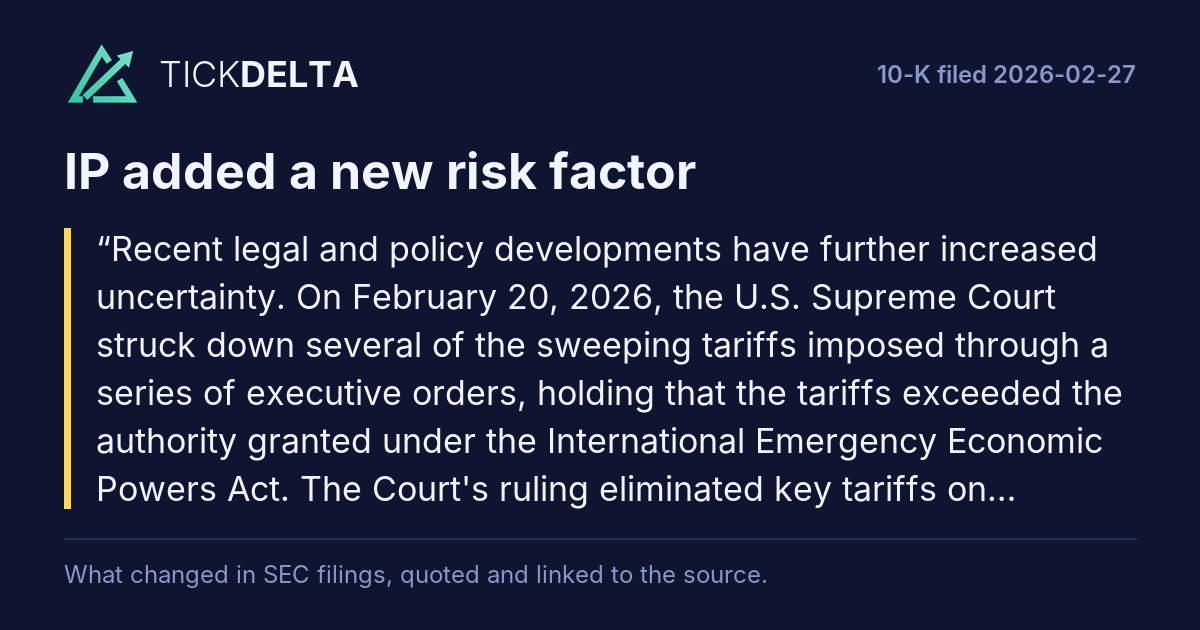
Recent legal and policy developments have further increased uncertainty. On February 20, 2026, the U.S. Supreme Court struck down several of the sweeping tariffs imposed through a series of executive orders, holding that the tariffs exceeded the authority granted under the International Emergency Economic Powers Act. The Court's ruling eliminated key tariffs on imports from numerous major trading partners and created uncertainty regarding the status of various trade agreements and tariff related obligations. The Court did not determine whether importers are owed refunds for tariffs previously paid, although estimates suggest that potential refunds could be substantial, and federal agencies must now determine how to administer the ruling. In response to the Supreme Court’s decision, the government announced new Executive Orders on February 20, 2026, aimed at restructuring U.S. tariff policy and exploring alternative statutory authorities to impose or maintain tariffs. The scope, timing, and implementation of these Executive Orders remains uncertain, and may result in new or modified tariff regimes, additional regulatory requirements, or further trade friction with U.S. trading partners. We may become entitled to refunds of certain tariffs previously paid; however, whether any refund will be available, and the amount and timing of any such refund, remain uncertain and subject to ongoing administrative processes and additional federal guidance. We are continuing to evaluate the impact of both the Supreme Court’s ruling and the new Executive Orders on our supply chain, input costs, pricing, capital investments, and overall operating results, and the ultimate impact, if any, on our business is not yet known.
•terrorism or threats of terrorism, security incidents or other threats to employee safety;
Show the other 3
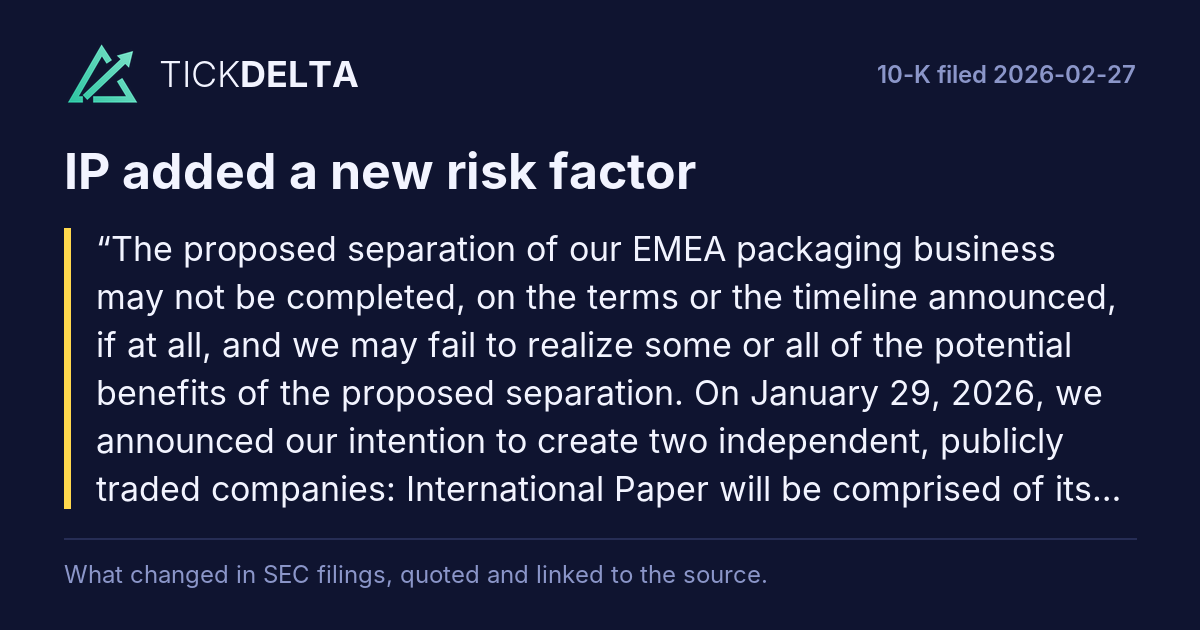
The proposed separation of our EMEA packaging business may not be completed, on the terms or the timeline announced, if at all, and we may fail to realize some or all of the potential benefits of the proposed separation.
On January 29, 2026, we announced our intention to create two independent, publicly traded companies: International Paper will be comprised of its current business in North America including both legacy IP and DS Smith assets, and the EMEA packaging business will be comprised of both legacy DS Smith and IP assets in EMEA. The separation is expected to be structured as a spin-off of the combined EMEA Packaging business to shareholders and is expected to be completed within 12-15 months, subject to the satisfaction of certain customary conditions, including final approval by the IP Board of Directors as well as the filing and effectiveness of a registration statement with the U.S. Securities and Exchange Commission and the publication of a prospectus approved by the U.K. Financial Conduct Authority.
Executing the proposed separation will require significant amounts of time and effort, which could divert management attention, disrupt the activities of our employees and have negative implications for our relationships with our customers and other third parties. We also expect to incur additional costs and expenses in connection with the separation.
The proposed separation is complex, and completion of the proposed separation and the timing of its completion will be subject to a number of factors and conditions, including the readiness of the new company to operate as an independent public company, the successful integration of both legacy DS Smith and International Paper businesses in EMEA into one packaging business and finalization of the capital structure of the new company. The complexity and magnitude of the restructuring and regional integration efforts associated with the separation are significant and will continue to result in substantial costs. The restructuring and regional integration processes could cause an interruption of, or loss of momentum in, the other activities of the Company, and our failure to meet the challenges involved in successfully restructuring and regionally integrating legacy DS Smith and International Paper businesses in North America and EMEA, respectively, could adversely affect the ability to separate and our business financial condition, results of operations, and cash flows. Further, unanticipated developments could delay, prevent or otherwise adversely affect the proposed separation, including disruptions in general or financial market conditions, material adverse changes in business or industry conditions, unanticipated costs and potential problems or delays in obtaining various regulatory and tax approvals or clearances. There can be no assurances regarding the ultimate timing or structure of the proposed separation or that we will be able to complete the proposed separation on the terms or on the timeline that was announced, if at all. In the event that the separation is not completed, we will have incurred and may continue to incur, certain significant non-recurring costs related to the separation without realizing the anticipated benefits.
If the separation is completed, we may not be able to achieve the full strategic and financial benefits that are expected to result from the separation. An inability to realize some or all of the anticipated benefits of the separation, as well as any delays encountered in the process, could have an adverse effect on our business, financial condition, results of operations and cash flows. There can be no assurance that the combined value of the common stock and ordinary shares of the two companies will be equal or exceed the value that our common stock might have been had the proposed separation not occurred.
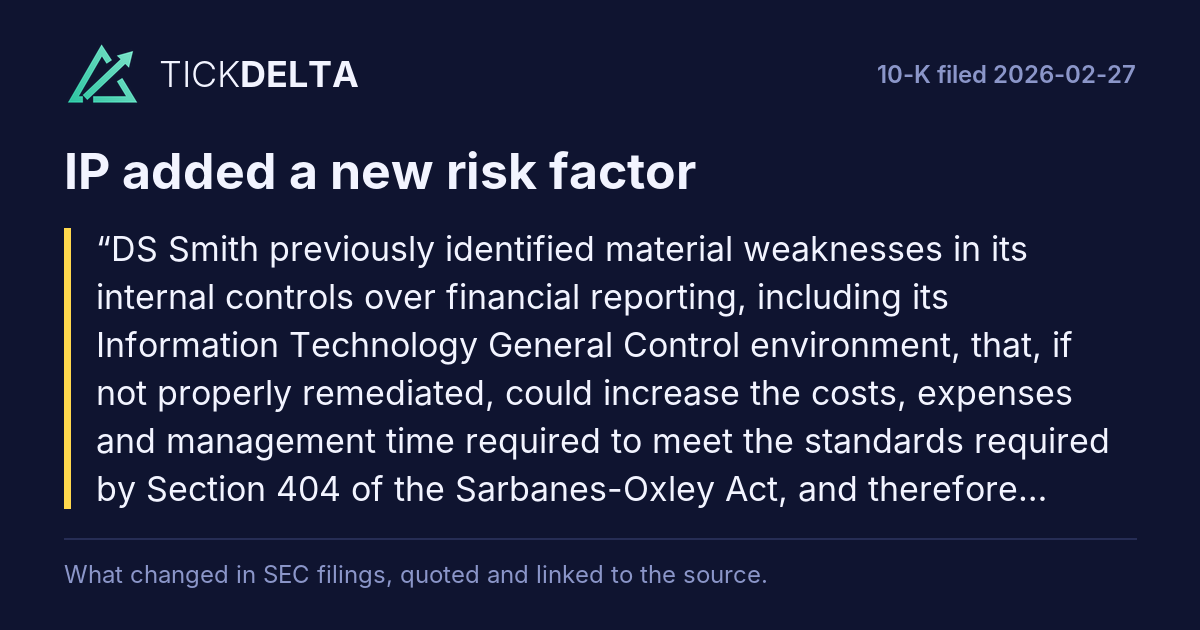
DS Smith previously identified material weaknesses in its internal controls over financial reporting, including its Information Technology General Control environment, that, if not properly remediated, could increase the costs, expenses and management time required to meet the standards required by Section 404 of the Sarbanes-Oxley Act, and therefore adversely affect the business of the Company and its share price.
A material weakness is a deficiency, or a combination of deficiencies, in internal control over financial reporting, such that there is a reasonable possibility that a material misstatement of our annual or interim consolidated financial statements will not be prevented or detected on a timely basis.
Prior to January 31, 2025, DS Smith was not required to comply with Section 404 of the Sarbanes-Oxley Act or to formally assess the effectiveness of its internal controls over financial reporting for that purpose. As described under Item 8 “Report of Management on Financial Statements” and Item 9A. "Controls and Procedures," in connection with the preparation of the acquisition proxy statement, the independent auditors identified material weaknesses in DS Smith's internal control environment including Information Technology General Controls ("ITGCs") in fiscal years ended April 30, 2022, April 30, 2023, and April 30, 2024, which would have constituted material weaknesses under Section 404 of the Sarbanes-Oxley Act. DS Smith’s ITGCs were not consistently operating effectively due to inappropriate user and administrative access, ineffective change-management, inadequate third-party management, and insufficient authentication and security protocols.
In accordance with SEC guidance, our management’s assessment of the effectiveness of the Company’s internal control over financial reporting as of December 31, 2025, excluded DS Smith. During 2025, International Paper worked to incorporate the internal controls and procedures for DS Smith into the Company’s internal control environment and will continue to incorporate the internal controls and procedures for the legacy DS Smith assets in North America post separation. Management is focused on remediating the DS Smith ITGC deficiencies, and has initiated a redesign of ITGCs across DS Smith systems, including enhancing governance over user access and system changes, by delivering training across DS Smith to further educate and upskill control and process owners. Management intends to implement the redesigned control framework in 2026.
These remediation measures may be time consuming and costly and there is no assurance that these initiatives will ultimately have the intended effects. The deficiencies in DS Smith’s internal control over financial reporting will not be considered remediated until the controls operate for a sufficient period and management has concluded, through testing that these controls operate effectively. If we do not successfully remediate the deficiencies, or if other deficiencies are identified or arise in the future, we may incur additional costs and expenses and will be required to dedicate management's time to meeting the standards required by Section 404 of the Sarbanes-Oxley Act. In such case, we may be unable to maintain compliance with securities law requirements regarding timely filing of periodic reports, in addition to applicable stock exchange listing requirements and requirements under certain of our agreements, which could adversely affect investor confidence in us, our business, and the trading price of our common stock. In addition, these DS Smith ITGC deficiencies may also have the effect of heightening other risks described in this “Risk Factors” section.
We continue to provide retiree health care benefits to certain former U.S. employees, as well as financial assistance toward the cost of individual retiree medical coverage for certain former U.S. salaried employees. Prior to the acquisition, DS Smith and its predecessor entities maintained a number of separate defined benefit pension arrangements for different employee groups. These plans were closed or frozen at different times and, in some cases, were subsequently terminated or transitioned to multiemployer plans. For certain union represented groups, we continue to make required contributions or other payments tied to historical withdrawal liabilities or plan funding obligations. We also assumed a small legacy retiree life insurance benefit for a limited group of former employees, which will continue only for the remaining covered participants through 2027. DS Smith did not provide retiree health care benefits to its U.S. employees, and no new retiree health care obligations were created as part of the acquisition.
Paragraphs in the 10-Q filed Nov 4, 2026 that were not in the one before
New in the latest 10-Q
42 paragraphs in the 10-Q filed Nov 4, 2026 with nothing like them in the 10-Q filed Aug 5, 2026 (at least half the words must differ; new numbers alone do not count). Quoted exactly, grouped by the item heading above them. This is text that changed, not a judgement of how serious it is.
Financial statements and notes
fair value of the preferred stock was $ 168 million on the transaction closing date, and the Company did not identify any observable price changes or indicators of impairment as of September 30, 2026.
Read in the 10-Q
In connection with the completed sale, the Company recorded a net loss on the sale of the business of $ 39 million and $ 42 million which is included in Discontinued Operations, net of taxes in the accompanying condensed consolidated statement of operations for the three months and nine months ended September 30, 2026. The $ 39 million loss recorded in the third quarter of 2026 primarily reflects the final working capital adjustment associated with the transaction.
Read in the 10-Q
During the third quarter of 2026, the Company identified a triggering event related to the PS EMEA reporting unit as part of its quarterly review, driven by updated macroeconomic indicators and updated industry outlooks. In response, the Company performed a quantitative goodwill impairment test for the PS NA and PS EMEA reporting units, comparing each reporting unit’s carrying value to its estimated fair value.
Read in the 10-Q
Estimated fair values were determined using discounted future cash flows and market multiples, which use inputs that are classified within Level 2 and Level 3 of the fair value hierarchy. The discounted cash flow approach requires significant management judgments, including assumptions related to forecasts of future revenues, operating margins and discount rates. The market-multiple approach similarly requires significant assumptions regarding adjusted EBITDA multiples.
Read in the 10-Q
The quantitative impairment test concluded that the carrying amount of the PS EMEA reporting unit exceeded its estimated fair value. As a result, the Company recorded a goodwill impairment charge of approximately $ 1.4 billion, which is reflected in Impairment of goodwill in the accompanying consolidated statement of operations. The carrying amount of the PS NA reporting unit did not exceed its estimated fair value, and no impairment was recorded for that reporting unit.
Read in the 10-Q
Show the other 37
The effective tax rate for the nine months ended September 30, 2026 differs from the statutory rate primarily due to the discrete tax impact of adjustments from settlement of IRS audits and a non-deductible goodwill impairment charge recorded during the third quarter. Additionally, the Company's effective tax rate is impacted by the mix of earnings between foreign and domestic jurisdictions.
Read in the 10-Q
In addition, on September 24, 2026, the Company received a subpoena from the U.S. Department of Justice in connection with a grand jury investigation in the Northern District of Illinois concerning the pricing and sale of containerboard and related products. The Company is fully cooperating with the investigation.
Read in the 10-Q
• Loss from continuing operations of $1.1 billion includes a $1.4 billion non-cash goodwill impairment charge for our PS EMEA business segment
Read in the 10-Q
• Cash provided by operating activities of $1.5 billion for the nine months ended September 30, 2026
Read in the 10-Q
• Free cash flow (non-GAAP) of $(180) million for the nine months ended September 30, 2026 (1)
Read in the 10-Q
For the third quarter, the Company reported a loss from continuing operations of $1.1 billion, primarily reflecting a $1.4 billion non-cash goodwill impairment charge relating to the PS EMEA business segment. The Company’s third-quarter Business segments' operating profit and Adjusted EBITDA from continuing operations (non-GAAP) increased sequentially as we continued to execute against our strategic priorities in a challenging operating environment. These priorities are anchored by our three core pillars: maintaining an advantaged cost position, delivering a superior customer experience, and achieving a high relative supply position in the markets we serve.
Read in the 10-Q
During the third quarter, operating performance improved across our PS NA and PS EMEA packaging businesses, reflecting the realization of previously announced pricing actions, cost reduction initiatives and operational improvements, which helped mitigate elevated input costs and persistent challenging market conditions. We also made steady progress advancing the planned separation of our EMEA packaging business into an independent company.
Read in the 10-Q
PS NA business segment operating profit increased sequentially in the third quarter, as price realization and improved operating performance more than offset softer demand and higher input costs. Net sales were higher due to continued realization of previously announced pricing actions, partially offset by lower sales volumes. The Company’s box shipments decreased approximately 2% on a daily basis compared with the prior-year period, primarily reflecting transitory disruption in the West Coast fresh fruit and vegetable markets, weaker protein markets, seasonally lower daily demand, and lower export sales. Operating costs were sequentially lower, reflecting increased production following the Riverdale paper machine conversion, a full quarter of earnings from our recently acquired North Pacific Paper Company (“NORPAC”) mill, additional 80/20 cost-out savings and improved mill operating performance. Planned maintenance outage spending was significantly lower than in the second quarter, reflecting a lighter outage schedule. These benefits were partially offset by higher energy, recovered fiber and diesel costs, as well as the temporary suspension of operations at the Pine Hill, Alabama mill due to weather-related roof damage. Roof repairs were completed and operations resumed earlier than anticipated, helping mitigate disruption across the mill system and the impact on customer shipments.
Read in the 10-Q
PS EMEA business segment operating (loss) improved sequentially, reflecting price realization and lower operating costs despite continued challenging market conditions and higher input costs. Net sales were relatively flat as higher sales prices for paper were offset by lower sales volumes in a persistently soft market. Operating costs were lower, driven by ongoing strategic cost reduction actions, disciplined management of controllable costs and lower variable costs associated with reduced volumes. These benefits were partially offset by higher input costs, primarily energy.
Read in the 10-Q
Looking ahead, we expect PS NA business segment operating profit to be sequentially higher in the fourth quarter. Net sales are expected to increase, driven by continued realization of previously announced pricing actions, seasonally higher sales volumes, and additional new customer business. Operating costs are expected to be higher, reflecting higher recovered fiber and diesel fuel costs, seasonally higher labor and benefit costs and increased planned maintenance outage spending. These increases are expected to be partially offset by benefits from the continued ramp-up of production at Riverdale, further integration of NORPAC and the absence of the Pine Hill mill downtime experienced in the third quarter.
Read in the 10-Q
Effective this quarter, as a result of the planned separation of PS EMEA and related UK regulatory requirements, the Company is no longer including our existing PS EMEA financial guidance in our guidance framework and does not anticipate providing such guidance in the future.
Read in the 10-Q
The Company continues to operate in a challenging macroeconomic environment characterized by subdued demand in certain packaging end markets and elevated input costs, particularly for energy, recovered fiber and diesel fuel. Demand in North America and EMEA remained soft during the third quarter amid cautious consumer sentiment and continued economic and geopolitical uncertainty. During the third quarter, the Company’s global input costs increased by approximately $94 million sequentially, including approximately $55 million in North America and $39 million in EMEA. The Company addresses these pressures through mitigation strategies such as pricing actions, cost reduction initiatives, adapting mill operations, supply chain decisions, and disciplined management of controllable costs. These actions have partially mitigated the impact of these pressures on the Company’s business and results of operations. Continued volatility resulting from geopolitical developments, changes in trade policies and tariffs, and higher labor, transportation, energy, and raw material costs could adversely affect our business and results of operations.
Read in the 10-Q
(a) Non-cash goodwill impairment related to the Company's PS EMEA business segment.
Read in the 10-Q
(d) Includes the sale of assets of the previously closed box plant in Compton, California and charges associated with the Company's subsequently sold aircraft assets.
Read in the 10-Q
(e) Includes a tax benefit related to capital losses associated with the sale of our Global Cellulose Fibers business and a tax benefit associated with the settlement of tax audits.
Read in the 10-Q
(f) Includes charges related to the sale of our kraft paper bag business and the sale of the Company's box plant in Chile.
Read in the 10-Q
(g) Environmental remediation adjustments associated with remediation work at a waste pit site at a mill acquired but never operated by the Company, and last utilized by the predecessor owner of the mill.
Read in the 10-Q
Earnings (loss) from continuing operations before income taxes and equity earnings (loss) (1,127) (714)
Read in the 10-Q
higher due to previously published price movements. Operating costs are expected to be lower. Input costs are expected to be higher.
Read in the 10-Q
In light of regulatory requirements and the planned separation, management has elected to not provide fourth quarter financial expectations for the PS EMEA segment. Following completion of the separation, the segment's results will no longer be reflected in the Company's continuing operations, and as such, management believes that providing forward-looking guidance would not be useful to investors.
Read in the 10-Q
Controls and procedures
Based upon that evaluation, our Chief Executive Officer and Chief Financial Officer concluded that the Company's disclosure controls and procedures were not effective as of September 30, 2026. This conclusion reflects management’s determination that the previously identified and disclosed information technology general controls (“ITGC”) deficiencies within the legacy DS Smith information technology environment constitute a material weakness in the Company’s internal control over financial reporting (the “ITGC Material Weakness”).
Read in the 10-Q
Notwithstanding the material weakness described below, Management has concluded that the financial statements included in this Quarterly Report present fairly, in all material respects, our financial position, results of operations and cash flows in conformity with U.S. GAAP.
Read in the 10-Q
A material weakness is a deficiency, or combination of deficiencies, in internal control over financial reporting such that there is a reasonable possibility that a material misstatement of the Company's annual or interim financial statements will not be prevented or detected on a timely basis.
Read in the 10-Q
As more fully discussed in Item 1A “Risk Factors” of this report, prior to the acquisition of DS Smith on January 31, 2025, a material weakness was identified related to the aggregation of deficient controls within the legacy DS Smith information technology environment. At the time of the acquisition, DS Smith was not subject to the internal control requirements of Section 404 of the Sarbanes-Oxley Act. Following the acquisition, management began integrating DS Smith into the Company's internal control framework, including assessing and remediating existing ITGC deficiencies in the Company's internal control over financial reporting.
Read in the 10-Q
Based on the results of management's assessment as of September 30, 2026, including the results of design and effectiveness testing, management concluded that the control deficiencies related to the legacy DS Smith ITGCs, constitute a material weakness in the Company's internal control over financial reporting.
Read in the 10-Q
The Company is undertaking the separation of its EMEA packaging business. As a result, the Company anticipates that the material weakness in the Company's internal control over financial reporting will be remediated following completion of the separation.
Read in the 10-Q
Risk Factors
The proposed separation of our EMEA packaging business may not be completed, on the terms or the timeline announced, if at all, and we may fail to realize some or all of the potential benefits of the proposed separation.
Read in the 10-Q
Executing the proposed separation will require significant amounts of time and effort, which could divert management attention, disrupt the activities of our employees and have negative implications for our relationships with our customers and other third parties. We have incurred and expect to continue to incur additional costs and expenses in connection with the separation.
Read in the 10-Q
The proposed separation is complex, and completion of the proposed separation and the timing of its completion will be subject to a number of factors and conditions, including the readiness of the new company to operate as an independent public company, the successful integration of both legacy DS Smith and International Paper businesses in EMEA into one packaging business and finalization of the capital structure of the new company. The complexity and magnitude of the restructuring and regional integration efforts associated with the separation are significant and will continue to result in substantial costs. The restructuring and regional integration processes could cause an interruption of, or loss of momentum in, the other activities of the Company, and our failure to meet the challenges involved in successfully restructuring and regionally integrating legacy DS Smith and International Paper businesses in North America and EMEA, respectively, could adversely affect our ability to separate businesses and our business financial condition, results of operations, and cash flows. Further, unanticipated developments could delay, prevent or otherwise adversely affect the proposed separation, including disruptions in general or financial market conditions, material adverse changes in business or industry conditions, unanticipated costs and potential problems or delays in obtaining various regulatory and tax approvals or clearances. In addition, the Board of Directors may, consistent with its fiduciary duties and after evaluating strategic alternatives and opportunities to maximize shareholder value, determine to pursue a strategic alternative.
Read in the 10-Q
There can be no assurances regarding the ultimate timing or structure of the proposed separation or that we will be able to complete the proposed separation on the terms or on the timeline that was announced, if at all. In the event that a separation is not completed, we will have incurred and may continue to incur, certain significant non-recurring costs related to a separation without realizing the anticipated benefits.
Read in the 10-Q
If a separation is completed, we may not be able to achieve the full strategic and financial benefits that are expected to result from the separation. An inability to realize some or all of the anticipated benefits of a separation, as well as any delays encountered in the process, could have an adverse effect on our business, financial condition, results of operations and cash
Read in the 10-Q
flows. There can be no assurance that the combined value of the common stock and ordinary shares of the two companies will be equal or exceed the value that our common stock might have been had the proposed separation not occurred.
Read in the 10-Q
Management has identified a material weakness in its internal controls over financial reporting related to previously identified acquisition related legacy DS Smith material weaknesses.
Read in the 10-Q
As more fully disclosed in Item 4, “Controls and Procedures,” under the supervision and with the participation of our management, including our principal executive officer and principal financial officer, we conducted an evaluation of the effectiveness of the design and operation of our disclosure controls and procedures and internal control over financial reporting. Based on that evaluation, management has concluded that our disclosure controls and procedures were not effective as of the end of the period covered by this report, due to a material weakness identified in legacy DS Smith’s internal control over financial reporting.
Read in the 10-Q
Prior to the acquisition of DS Smith on January 31, 2025, material weaknesses were identified within the legacy DS Smith internal control environment of the historic financial periods (the “Legacy DS Smith Material Weaknesses”). Among other matters, DS Smith’s Information Technology General Controls ("ITGCs") were not consistently operating effectively. As DS Smith was not previously subject to the internal control requirements of Section 404 of the Sarbanes-Oxley Act, management began integrating DS Smith into the Company's internal control framework, including assessing and remediating the legacy DS Smith ITGC control deficiencies.
Read in the 10-Q
Based on management's assessment as of September 30, 2026, including the design and effectiveness testing, management concluded that the legacy DS Smith ITGC control deficiencies constitute a material weakness in the Company's internal control over financial reporting.
Read in the 10-Q
The Company is undertaking the separation of its EMEA packaging business. As a result, the Company anticipates that the material weakness will be remediated following the separation.
Read in the 10-Q
The 10-Q's risk factors against the 10-K
Item 1A of the 10-Q filed Nov 4, 2026 against Item 1A of the 10-K filed Feb 27, 2026.
A 10-Q repeats only the risks that changed, so a 10-K paragraph that is missing from it is not counted as removed.
Added is a paragraph with nothing like it in the 10-K, Reworded a sentence that is in both with several words changed,
Quiet changes a sentence in both where one to four words changed and one is a hedge or a modal
(cut words struck through, new words highlighted).
Text on the page, not a score; each links to the filing at sec.gov.
What the 10-Q itself says about its risk factors:There have been no material changes from the risk factors disclosed in our Annual Report on Form 10-K for the fiscal year ended December 31, 2025 (Part I, Item 1A) other than as discussed below.
Read in the 10-Q
Show the other 3
Phrases used for the first time
Two-word phrases in Risk Factors of the 10-K filed Feb 27, 2026 that are in none of the 1 earlier 10-Ks stored, back to Feb 21, 2025
Where each one is used
- proposed separation: •The proposed separation of our EMEA packaging business may not be completed, on the currently contemplated timeline or at all.
- emea packaging: •The proposed separation of our EMEA packaging business may not be completed, on the currently contemplated timeline or at all.
- executive orders: Recent legal and policy developments have further increased uncertainty. On February 20, 2026, the U.S. Supreme Court struck down several of the sweeping tariffs imposed through a series of executive orders, holding that the tariffs exceeded the authority granted under the International Emergency Economic Powers...
- regional integration: Moreover, effective internal controls are necessary to provide reliable and accurate financial reports, and the planned separation of our North America and EMEA businesses may create complexity in our financial systems and internal controls and make them more difficult to manage. Further regional integration of...
- planned separation: We are subject to increasingly stringent federal, state, local and international laws governing the protection of the environment that continue to evolve as new guidance is provided by regulatory and governing bodies and as pending or future litigation is resolved. The changing laws, regulations and standards...
- control environment: DS Smith previously identified material weaknesses in its internal controls over financial reporting, including its Information Technology General Control environment, that, if not properly remediated, could increase the costs, expenses and management time required to meet the standards required by Section 404 of...
- smith’s internal: •Failure to remediate a material weakness in DS Smith’s internal control over financial reporting could adversely affect our business and results of operations.
- trading partners: Recent legal and policy developments have further increased uncertainty. On February 20, 2026, the U.S. Supreme Court struck down several of the sweeping tariffs imposed through a series of executive orders, holding that the tariffs exceeded the authority granted under the International Emergency Economic Powers...
Used at least twice, small words left out. Counted, not picked: a phrase can be new because the company renamed something.
What was taken out
40 paragraphs of last year's Risk Factors with nothing like them now. The longest are quoted.
Sources
Item 1A of each 10-K and 10-Q on EDGAR, quoted exactly. Each paragraph links to the filing at sec.gov.
Also
10-K change: what was reworded or cut, section by section.
Work with it
Excel workbook · CSV. Google Sheet that stays up to date: paste =IMPORTDATA("https://tickdelta.com/company/IP/export.csv") into a cell.