Kinsale Capital Group, Inc. KNSL
New risk paragraphs, branching off last year
Each branch is a paragraph in Risk Factors with nothing like it in the 10-K filed Feb 21, 2025. A box jumps to the paragraph as filed, below.
Paragraphs with nothing like them in last year's 10-K
7 paragraphs in Risk Factors of the 10-K filed Feb 20, 2026 with nothing like them in the 10-K filed Feb 21, 2025. Quoted exactly. Paragraphs that were only edited are under 10-K change.
We could suffer security breaches, loss of data or proprietary information, cyberattacks, and other information technology failures, and are subject to laws and regulations concerning data privacy and security that are continually evolving. Actual or suspected information technology failures or failures to comply with applicable law could disrupt our operations, damage our reputation, and adversely affect our business, financial condition, or results of operations.
We and our service providers face numerous and evolving cybersecurity and operational risks that threaten the confidentiality, integrity, and availability of systems and data. These risks include vulnerabilities in commercial software integrated into our systems or into the products and services of our suppliers, as well as increasingly sophisticated cyberattack techniques that frequently change and may originate from less regulated or remote areas of the world. Events such as natural catastrophes, industrial accidents, terrorist attacks, power failures, computer viruses, ransomware, extortion attempts, business email compromise, or security breaches by unauthorized persons, including hackers or other threat actors, may cause our systems to fail or be inaccessible for extended periods. These events may also result in fraudulent fund transfers, unauthorized access to or exfiltration of sensitive or proprietary information, or other material operational impacts.
We have implemented a variety of security measures, business contingency plans, and disaster recovery procedures designed to protect systems housed internally and through third-party cloud services. However, we cannot guarantee the effectiveness of these measures. We also monitor vendor and third-party risk, but we may fail to appropriately assess or understand the risks associated with these relationships, including the adequacy of their security and control environments. Sustained or repeated system failures, service interruptions, or successful cyberattacks could severely limit our ability to write and process new and renewal business, provide customer service, pay claims, or otherwise operate in the ordinary course of business. In addition, when vulnerabilities are discovered, we may be unable to remedy them promptly because attackers increasingly use tools and techniques designed to evade detection or remove forensic evidence.
Our operations also depend on the continuous availability of our physical facilities. Disruption, damage, or loss of these facilities, for example due to natural catastrophes, utility failures, or other events, could impair our ability to maintain business functions that cannot be performed offsite or remotely. This could compound the effects of system interruptions or cyber events.
As part of our normal business activities, we collect, store, and process personal information regarding employees, claimants, brokers, agents, and vendors. As a result, we are subject to numerous federal, state, and local laws and regulations governing data privacy, security, breach notification, and the use of personal information. These requirements continue to evolve, often becoming more stringent. Any failure or perceived failure to comply with applicable laws, regulations, policies, or regulatory guidance could result in investigations, enforcement actions, litigation, fines, penalties, or adverse publicity. These outcomes could erode trust in our company and adversely affect our business, financial condition, and results of operations.
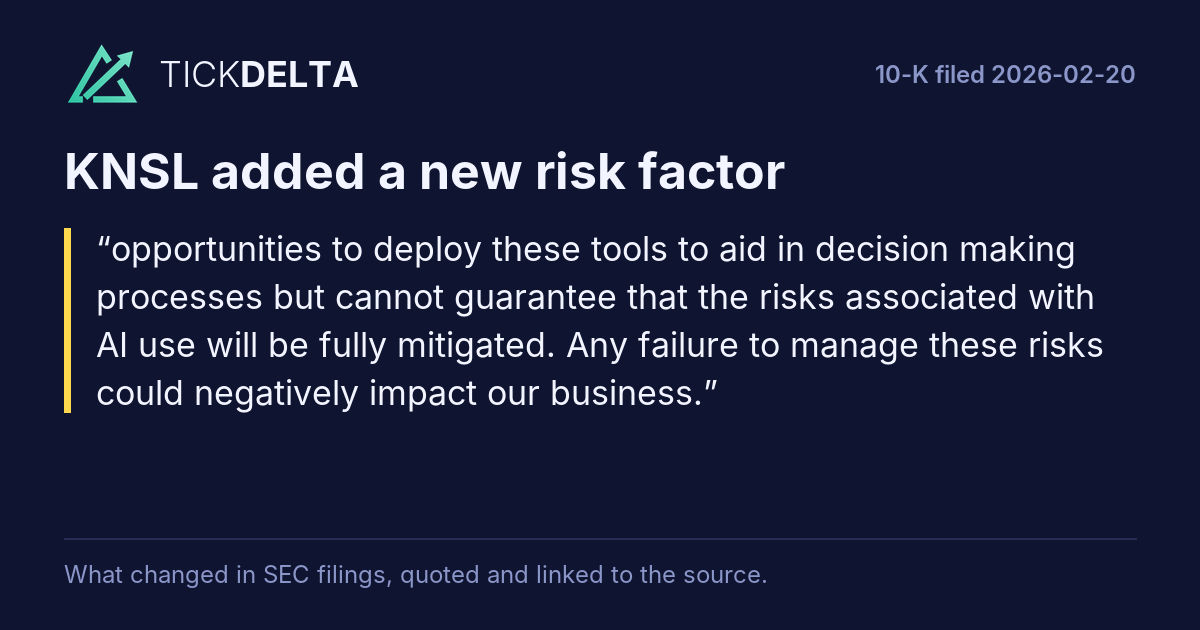
Artificial intelligence is an evolving and rapidly developing technology, and its adoption presents additional risks.
opportunities to deploy these tools to aid in decision making processes but cannot guarantee that the risks associated with AI use will be fully mitigated. Any failure to manage these risks could negatively impact our business.
Paragraphs in the 10-Q filed Oct 22, 2026 that were not in the one before
New in the latest 10-Q
10 paragraphs in the 10-Q filed Oct 22, 2026 with nothing like them in the 10-Q filed Jul 23, 2026 (at least half the words must differ; new numbers alone do not count). Quoted exactly, grouped by the item heading above them. This is text that changed, not a judgement of how serious it is.
Financial statements and notes
Consolidated Statements of Changes in Stockholders' Equity (Unaudited) - Continued
Read in the 10-Q
Nine Months Ended September 30, 2026 2025 (in thousands) ──────────────────────────────────────────────────────────────────────────────────────────────────────────────────────────────────────────────── Operating activities: Net cash provided by operating activities $ 754,886 $ 802,344 Investing activities: Purchase of property and equipment (12,638) (43,083) Purchase of real estate investment (230) — Change in short-term investments, net 3,874 (6,515) Purchases – fixed-maturity securities (1,450,422) (1,768,360) Purchases – equity securities (266,401) (131,419) Sales – fixed-maturity securities 795,437 677,634 Sales – equity securities 169,310 14,585 Maturities and calls – fixed-maturity securities 289,001 554,307 Net cash used in investing activities (472,069) (702,851) Financing activities: Proceeds from borrowing under credit facility 30,000 15,000 Repayment of credit facility (30,000) — Payroll taxes withheld and remitted on share-based payments (6,757) (6,282) Proceeds from stock options exercised 1,213 606 Dividends paid (17,048) (11,869) Treasury stock acquired – share repurchases (263,078) (39,999) Net cash used in financing activities (285,670) (42,544) Net change in cash and cash equivalents (2,853) 56,949 Cash and cash equivalents at beginning of year 163,361 113,213 Cash and cash equivalents at end of period $ 160,508 $ 170,162
Read in the 10-Q
30, 2026 was driven by increases in U.S. Treasury yields during the periods, which reduced the fair value of our fixed-maturity portfolio. These unrealized losses were market-related and not credit-related. The increase in net unrealized losses also resulted in an increase in the related deferred tax asset.
Read in the 10-Q
Three months ended September 30, 2026 compared to three months ended September 30, 2025
Read in the 10-Q
During the third quarter of 2026, the Company repositioned a portion of its investment portfolio to improve expected long-term returns. The Company sold certain common stock holdings and reinvested the proceeds in higher conviction common stock investments. The sales reversed unrealized gains previously recognized in the change in fair value of equity securities and recognized largely corresponding realized gains. The Company simultaneously sold lower-yielding fixed-maturity securities in a loss position and reinvested the proceeds in higher-yielding fixed-maturity securities. The losses on the fixed-maturity sales, which had previously been recorded in accumulated other comprehensive loss within stockholders’ equity, were reclassified into net income upon sale and offset the realized gains on the equity sales. The repositioning reduced third quarter pre-tax earnings by $37.6 million.
Read in the 10-Q
Show the other 5
Certain prior year amounts are reclassified to conform to current year's divisions and the business underwritten within them.
Read in the 10-Q
Nine months ended September 30, 2026 compared to nine months ended September 30, 2025
Read in the 10-Q
The lower change in the fair value of equity securities primarily reflected the repositioning of a portion of the Company’s investment portfolio during the third quarter of 2026 to improve expected long-term returns. The Company sold certain common stock holdings and reinvested the proceeds in higher conviction common stock investments. The sales reversed unrealized gains previously recognized in the change in fair value of equity securities and recognized largely corresponding realized gains. The Company simultaneously sold lower-yielding fixed-maturity securities in a loss position and reinvested the proceeds in higher-yielding fixed-maturity securities. The losses on the fixed-maturity sales, which had previously been recorded in accumulated other comprehensive loss within stockholders’ equity, were reclassified into net income upon sale and offset the realized gains on the equity sales.
Read in the 10-Q
Certain prior year amounts are reclassified to conform to current year's divisions and the business underwritten within them.
Read in the 10-Q
The change in the fair value of equity securities for the nine months ended September 30, 2026 primarily reflected the reversal of gains recognized in prior periods on equity securities sold during 2026, in connection with the repositioning of the equity portfolio during the period.
Read in the 10-Q
The 10-Q's risk factors against the 10-K
Item 1A of the 10-Q filed Oct 22, 2026 against Item 1A of the 10-K filed Feb 20, 2026.
A 10-Q repeats only the risks that changed, so a 10-K paragraph that is missing from it is not counted as removed.
Added is a paragraph with nothing like it in the 10-K, Reworded a sentence that is in both with several words changed,
Quiet changes a sentence in both where one to four words changed and one is a hedge or a modal
(cut words struck through, new words highlighted).
Text on the page, not a score; each links to the filing at sec.gov.
What the 10-Q itself says about its risk factors:There have been no material changes in our risk factors from those disclosed in our Annual Report on Form 10-K for the year ended December 31, 2025.
Read in the 10-Q
1 paragraph in the 10-Q's Item 1A, and none of them adds, rewords or quietly edits a paragraph of the 10-K's.
Phrases used for the first time
Two-word phrases in Risk Factors of the 10-K filed Feb 20, 2026 that are in none of the 1 earlier 10-Ks stored, back to Feb 21, 2025
Where each one is used
- technology failures: We could suffer security breaches, loss of data or proprietary information, cyberattacks, and other information technology failures, and are subject to laws and regulations concerning data privacy and security that are continually evolving. Actual or suspected information technology failures or failures to comply...
- service providers: Our business is highly dependent on our information technology and telecommunications systems, including our web-based underwriting system. Among other things, we rely on these systems to interact with brokers and insureds, to underwrite business, to prepare policies and process premiums, to perform actuarial and...
- personal information: As part of our normal business activities, we collect, store, and process personal information regarding employees, claimants, brokers, agents, and vendors. As a result, we are subject to numerous federal, state, and local laws and regulations governing data privacy, security, breach notification, and the use of...
Used at least twice, small words left out. Counted, not picked: a phrase can be new because the company renamed something.
What was taken out
4 paragraphs of last year's Risk Factors with nothing like them now. The longest are quoted.
Sources
Item 1A of each 10-K and 10-Q on EDGAR, quoted exactly. Each paragraph links to the filing at sec.gov.
Also
10-K change: what was reworded or cut, section by section.
Work with it
Excel workbook · CSV. Google Sheet that stays up to date: paste =IMPORTDATA("https://tickdelta.com/company/KNSL/export.csv") into a cell.