Form 10-K for the fiscal year ended December 31, 2022
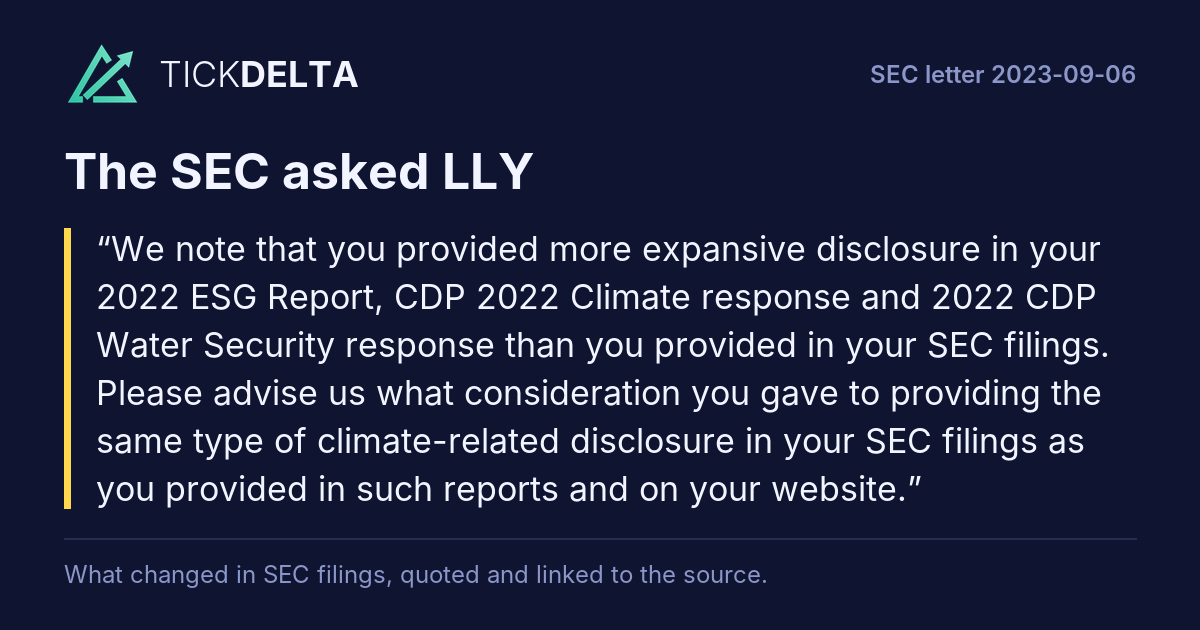
We note that you provided more expansive disclosure in your 2022 ESG Report, CDP 2022 Climate response and 2022 CDP Water Security response than you provided in your SEC filings. Please advise us what consideration you gave to providing the same type of climate-related disclosure in your SEC filings as you provided in such reports and on your website.
In evaluating whether to include climate-related disclosures in Lilly’s SEC filings, including our annual reports on Form 10-K, Lilly carefully considers the requirements applicable to such filings under U.S. securities laws and regulations and the SEC’s published guidance, including the 2010 Commission Guidance Regarding Disclosure Related to Climate Change and the SEC Division of Corporation Finance Sample Letter to Companies Regarding Climate Change Disclosures.Read in the reply ↗Rest of the answer
Where we believe climate-related information is material or is otherwise required, Lilly discloses such information.
In contrast, our 2022 ESG Report and CDP 2022 Climate and Water Security responses are prepared and designed to provide certain information that may be useful or of interest to a wide range of stakeholders (including certain investors, existing and prospective employees, patients, customers, suppliers, media, business partners, and communities in which we operate). Many of these constituencies are interested in climate-related information that is not material or otherwise required in our SEC filings. Accordingly, this information is not prepared in response to SEC disclosure requirements. Instead, it is informed by, among other considerations, various environmental, social, and governance (ESG) frameworks (such as the Sustainability Accounting Standards Board and Task Force on Climate-Related Financial Disclosures) as well as industry-specific approaches. Lilly considered whether any of the more expansive disclosures in our 2022 ESG Report, CDP 2022 Climate response, and 2022 CDP Water Security response constituted material information or information necessary to make the required statements in the 2022 Form 10-K not misleading. We determined that such disclosure did not. Except as disclosed in our SEC filings, we do not believe this information is quantitatively or qualitatively material to our business, results of operations, or financial condition.
We will continue to monitor and evaluate our climate-related disclosures in connection with future SEC filings to ensure that material information or otherwise-required disclosure is included.
First report after the company's reply of 2023-09-20: 10-Q filed 2023-11-02 ↗, against the 10-Q filed 2023-08-08 ↗.
Tickdelta does not hold the text of both reports, so they are not compared here.
We note your disclosure on page 33 that you are subject to increased negative attention from the media, stockholders, activists, and other stakeholders on climate change, social and sustainability matters, which could negatively affect your business and reputation. Please expand your disclosure to discuss the potential response from investors, lenders and customers.Rest of the question
In addition, we note you indicate in your CDP 2022 Climate response that climate-related risks are identified and assessed through your risk management process. To the extent material, discuss the indirect consequences of climate-related regulation or business trends, such as the following: • decreased demand for goods or services that produce significant greenhouse gas emissions or are related to carbon-based energy sources; • increased demand for goods that result in lower emissions than competing products; • increased competition to develop innovative new products that result in lower emissions; and • increased demand for generation and transmission of energy from alternative energy sources.
To date, we do not believe increased negative attention from the media, stockholders, activists, and other stakeholders on climate change, social and sustainability matters has materially impacted our business, reputation or operations. As we navigate an evolving ESG environment, we remain cognizant that ESG risks may nonetheless increase.Read in the reply ↗Rest of the answer
We disclosed in our 2022 Form 10-K that the perception that we have failed to act in a socially responsible manner, whether or not valid, results in adverse publicity that can negatively affect our business and reputation, as well as potentially increase scrutiny from legislators and regulatory authorities. We will continue to monitor these and other potential stakeholder responses and intend to supplement our ESG disclosure if and as warranted.
We carefully consider the public attention we receive related to ESG matters and the effect on our business and reputation. By way of example, a 2022 statement made by Lilly regarding the impact that proposed changes in Indiana abortion laws may have on our business resulted in news articles (including in the New York Times (Aug. 6, 2022 – “Major Indiana Employers Criticize State’s New Abortion Law” by Lora Kelly) and CNBC (Aug. 6, 2022 “Large Indiana employers Eli Lilly and Cummins speak out about the state’s new restrictive abortion law” by Lauren Thomas)) and other media interest. The same statement was cited by a shareholder proponent in a shareholder proposal submitted for inclusion in Lilly’s 2023 annual proxy statement requesting that the Company issue a public report detailing the risks and costs to the Company caused by opposing or otherwise altering Company policy in response to enacted or proposed state policies regulating abortion. Proponents of other ESG topics, such as carbon emissions, animal testing, and political contributions have also submitted shareholder proposals to Lilly in recent years. While such attention has not materially impacted the company, we actively monitor these developments and intend to supplement our ESG disclosure if, and as, warranted.
As noted, climate-related risks, including from applicable regulations, are identified and assessed through Lilly’s enterprise risk management (ERM) process. As part of its oversight responsibilities, the Company’s Board of Directors (the Board) and its committees are involved in the oversight of risk management of the Company. At this time, Lilly has not identified any direct or indirect consequences of climate-related regulation or business trends that have or are reasonably likely to materially affect our business, financial condition, or results of operations.
Lilly necessarily allocates time and expense to adhere to climate-related regulation and its own internal objectives. These include external assurance of our annual greenhouse gas emissions, retaining professional advisory firms to consult on emerging regulations and the actions Lilly needs to take in order to comply and time, expense and infrastructure investments to monitor and achieve our greenhouse gas emissions goals. To date these allocations and other impacts of adherence have been immaterial. In contrast, where regulatory contingencies may represent a material investor consideration, Lilly endeavors to provide more fulsome disclosure. For example, in our most recent periodic reports we address potential impacts of the Inflation Reduction Act of 2022 in Risk Factors and Management’s Discussion and Analysis of Financial Condition disclosures. To further corporate initiatives and as a corporate steward, Lilly also invests in renewable energy resources and undertakes various other climate-related measures. We view indirect consequences of these developing business practices as likewise immaterial for SEC reporting purposes. In particular, we expect product demand and competitiveness to hinge centrally on the effectiveness, safety, and ease of use of our medicines and other factors directly cited in our Form 10-K Item 1. Business disclosures.
Climate-related contingencies are also considered for purposes of business continuity planning and are assessed through the ERM process with a focus on developing, implementing, and maintaining plans to ensure the ability to continue critical business operational processes in the case of an interruption. Lilly develops risk mitigation plans, such as information technology disaster recovery mitigations, corporate incident support team plans, and third-party risk management to support continuity planning in the ordinary course.
While the impact of future environmental laws and regulations is uncertain, the risk factors in our 2022 Form 10-K appropriately reflect our current assessment of the material risks to Lilly arising from current climate and environmental regulation and business trends. With respect to future filings, the Company will continue to monitor and evaluate whether additional disclosure may be warranted.
First report after the company's reply of 2023-09-20: 10-Q filed 2023-11-02 ↗, against the 10-Q filed 2023-08-08 ↗.
Tickdelta does not hold the text of both reports, so they are not compared here.
We note your disclosure on page 29 indicating that you may experience manufacturing, quality, or supply chain difficulties, disruptions, or shortages in part due to "natural disasters (including increased instances of natural disasters or other events that may be due to climate change)." Discuss the physical effects of climate change on your operations and results.Rest of the question
This disclosure may include the following: • severity of weather, such as floods, hurricanes, sea levels, arability of farmland, extreme fires, and water availability and quality; • quantification of material weather-related damages to your property or operations; • potential for indirect weather-related impacts that have affected or may affect your major customers or suppliers; and • any weather-related impacts on the cost or availability of insurance. Your response should include quantitative information for each of the periods for which financial statements are presented in your Form 10-K and explain whether changes are expected in future periods.
should include quantitative information for each of the periods for which financial statements are presented in your Form 10-K and explain whether changes are expected in future periods.
Lilly respectfully advises the Staff that in the years covered by the 2022 Form 10-K, and during subsequent periods, the physical effects of climate change have not had a direct or indirect material adverse impact on the Company’s financial performance, nor have they caused a material adverse effect on the Company’s operations, or otherwise materially impacted the Company.Read in the reply ↗Rest of the answer
Rather, natural disasters (including increased instances of natural disasters or other events that may be due to climate change) largely represent a potential prospective risk to Lilly. While local and regional weather-related disasters, such as tornados, hurricanes, fires, floods, or snowstorms, have occurred in a number of geographic regions where the Company and its business partners operate, we are unable to discern if a particular weather-related damage is caused by climate change or historical weather patterns. From time to time, some of our property and operations have been temporarily impacted by severe weather-related events, but such damage has not been material to our operations. We take steps to prepare for weather related events, including regularly reviewing business continuity and emergency response plans for manufacturing facilities and offices and conducting annual risk reviews to help protect our people and facilities. From time to time as part of our ongoing business continuity resiliency, we may upgrade communications networks, IT systems or make facility infrastructure enhancements. If the frequency and intensity of weather-related events increase in the future as a result of climate change, it is unpredictable whether such events will impact any of our facilities and, if so, what the extent of such impact would be.
Lilly has a diverse geographic presence within the United States and internationally, and its facilities and suppliers vary widely in size and geographical location. This includes an expansive supplier network with thousands of suppliers around the world. As we expand our manufacturing capacity in order to meet expected demand for our products, we expect to continue to enter into various agreements for contract manufacturing and for supply of materials.
The Company’s aggregate property insurance costs as a percentage of cost of products sold and operating expenses increased approximately 0.086% from 2021 to 2022. The Company’s insurers have not indicated that such increase was due to weather-related impacts and the Company has not experienced any difficulty in obtaining insurance due to weather-related impacts. Such increase was largely attributed to an increase in total insured value of the Company’s property, inventory, and business interruption value.
We believe our risk disclosure regarding natural disasters and climate change adequately address prospective risks to Lilly without engaging in undue speculation or diluting material disclosures by the inclusion of information related to immaterial incidents experienced to date (including as may have been precipitated by climate change). To the extent natural disasters, including any weather-related damages or weather-related impacts on the cost or availability of insurance, are material to the Company’s operations and results in the future, the Company will provide appropriate disclosure in accordance with applicable reporting requirements regarding such effects.
First report after the company's reply of 2023-09-20: 10-Q filed 2023-11-02 ↗, against the 10-Q filed 2023-08-08 ↗.
Tickdelta does not hold the text of both reports, so they are not compared here.
If material, please discuss any purchase or sale of carbon credits or offsets and the effects on your business, financial condition, and results of operations. To the extent applicable, ensure you provide quantitative information with your response for each of the periods for which financial statements are presented in your Form 10-K and for any future periods.Rest of the question
We remind you that the company and its management are responsible for the accuracy and adequacy of their disclosures, notwithstanding any review, comments, action or absence of action by the staff.
We are working to drive greenhouse gas emission reductions throughout our operations. Our initial priority is to reduce emissions and transition purchased electricity to renewable sources before we purchase offsets to cover remaining emissions. Any such carbon credit or offset purchases to date have been de minimis and immaterial.Read in the reply ↗Rest of the answer
While the company has invested in renewable energy projects, none of those investments has been a material capital expenditure and Lilly is not currently committed to any material investments in renewable energy projects.
* * * * * * * *
In connection with its response to the Staff’s comments, we acknowledge that Lilly and its management are responsible for the accuracy and adequacy of its disclosures, notwithstanding any review, comments, action or absence of action by the Staff.
First report after the company's reply of 2023-09-20: 10-Q filed 2023-11-02 ↗, against the 10-Q filed 2023-08-08 ↗.
Tickdelta does not hold the text of both reports, so they are not compared here.
We note your response to our prior comment 2 states that you have "not identified any direct or indirect consequences of climate-related regulation or business trends that have or are reasonably likely to materially affect [your] business, financial condition, or results of operations." Please include a discussion explaining in greater detail your analysis and how you concluded on the materiality of each of theRest of the question
items noted in our prior comment for which disclosure was not deemed necessary. For example, please explain how you determined that you "expect product demand and competitiveness to hinge centrally on the effectiveness, safety, and ease of use of our medicines and other factors directly cited in our Form 10-K."
In evaluating whether to include disclosures in Lilly’s SEC filings, including our annual reports on Form 10-K, Lilly carefully considers the requirements applicable to such filings under U.S. securities laws and regulations and the SEC’s published guidance, including the 2010 Commission Guidance Regarding Disclosure Related to Climate Change and the SEC Division of Corporation Finance Sample Letter to Companies Regarding Climate Change Disclosures.Read in the reply ↗Rest of the answer
The Company’s process to identify and consider events and circumstances that may affect our business, financial condition, and results of operations is informed by, among other things, operational performance, market conditions, and the Company’s comprehensive risk-management program.
In evaluating risks (including climate-based risks) to the Company, we conduct assessments considering factors such as financial impact, impact on our ability to achieve Lilly’s business objectives, impact on, or potential disruptions to, production, and customer and patient impact.
Risk management and monitoring is performed and managed by the global ethics and compliance function, which is led by our Executive Vice President, Enterprise Risk Management, and Chief Ethics and Compliance Officer, with input from subject matter experts within the business. Our global health, safety and environment (HSE) committee includes senior leadership from key areas of our business and plays a central role in monitoring compliance with environmental regulations, policies, procedures and standards, as well as performance against goals and continuous improvement. The HSE committee meets quarterly to, among other things, assess and manage HSE risks and opportunities, including climate-related risks and opportunities, which feeds into the enterprise risk management process.
The Company’s board of directors oversees key enterprise-level risks and our enterprise risk management process for identifying and creating mitigation plans for enterprise level risks is overseen by the audit committee of the board of directors. Furthermore, the directors and corporate governance committee of the board identifies and brings to the attention of the full board, as appropriate, current and emerging social, environmental, political and governance developments and public policy issues that may affect the business operations, performance or reputation of the Company.
Taking into consideration the information evaluated under the above-described process, the Company does not believe that any climate-related regulation or business trends were reasonably expected to have a material effect on the Company’s business, financial condition and results of operations for the periods reported in the 2022 Form 10-K or would otherwise require disclosure in our Form 10-K.
In our experience, the most important competitive factors for our business include product effectiveness, safety, and ease of use; formulary placement, price, payer coverage and reimbursement rates, and demonstrated cost-effectiveness; regulatory approvals; marketing effectiveness; and research and development of new products, processes, modalities, and uses. Most new products or uses that we introduce must compete with other branded, biosimilar, or generic products already on the market or that are later developed by competitors. When competitors introduce new products, uses, or delivery systems with therapeutic or cost advantages, including by developing new modalities, our products become subject to decreased sales volumes, progressive price reductions, or both. Therefore, we believe our long-term competitive success depends on discovering and developing (either alone or in collaboration with others) or acquiring innovative, cost-effective products that provide improved outcomes for patients and deliver value to payers, and continuously improving the productivity of our operations in a highly competitive environment.
To date, we have not experienced a discernible demand impact related to whether any of the Company’s products produce significant greenhouse gas (GHG) emissions or are related to carbon based energy sources. Nor have we experienced a discernible trend in customers’ demand for our products or services based on the Company’s or our competitors’ GHG emissions or use of carbon-based energy sources.
Furthermore, the Company has not experienced increased competition to develop innovative new products that result in lower emissions. While there is perpetual competition in the pharmaceutical industry, such competition is to develop innovative new products, and the Company does not see climate-related regulation or climate-based business trends as a significant competitive factor.
We do not generate or transmit energy to customers, so our solar or alternative energy generation are for our own use. We have not experienced a discernible trend in customers’ demand for our products or services based on production using alternative energy sources.
The Company will continue to monitor the impacts of climate change on the Company’s business, financial condition and results of operations. If, in the future, the Company determines that there are direct or indirect consequences material to the Company, the Company will include appropriate disclosures in future filings.
First report after the company's reply of 2023-10-26: 10-Q filed 2023-11-02 ↗, against the 10-Q filed 2023-08-08 ↗.
Tickdelta does not hold the text of both reports, so they are not compared here.
We note your response to our prior comment 3. Please further address the following: • Your response states that occasionally your property and operations have been temporarily impacted by severe weather-related events, but such damage has not been material to your operations.Rest of the question
Please provide us with quantitative information for each of the periods identified in our prior comment regarding weather-related damages to your property or operations. • Your 2022 CDP Water Security Response indicates that the primary direct and indirect use of freshwater is vital for production. Please tell us how you considered disclosure regarding the impact of water availability and quality in the manufacturing of your products, including your determination of materiality for your business and operations. • Please revise your disclosure to more clearly address how you could be impacted if severe weather impacts your customers. In this regard, we note your disclosure on page 7 of your Form 10-K stating that in 2022, 2021, and 2020, McKesson Corporation, AmerisourceBergen Corporation and Cardinal Health, Inc. each accounted for a significant percentage of your consolidated revenue. • We note that your response states that your cost of insurance as a percentage of cost of products sold and operating expenses increased 0.086% from 2021 to 2022. Please provide us with information quantifying the cost of property insurance for each of the periods for which financial statements are presented in your Form 10-K and whether you expect any future period changes to the cost of insurance.
The Company did not experience any material impacts from severe weather-related events, nor did it make any insurance claims related to weather-related damages to our property, for each of the years ended December 31, 2022, 2021, and 2020.
•Your 2022 CDP Water Security Response indicates that the primary direct and indirect use of freshwater is vital for production.Read in the reply ↗Rest of the answer
Please tell us how you considered disclosure regarding the impact of water availability and quality in the manufacturing of your products, including your determination of materiality for your business and operations.
We use freshwater for production processes and cooling purposes. Pharmaceutical production requires continuous access to high quality water for primary uses (i.e., for manufacturing products and equipment cleaning and sanitization). Our bulk active pharmaceutical ingredient manufacturing sites and final dosage finishing sites generally use the largest volume of water within our production. Packaging sites require little water. Water risks are considered as part of the established enterprise risk management framework described above and as otherwise required. As with any manufacturer, water availability and quality is a factor considered in site scoping for new manufacturing locations, as applicable. Before embarking on facility construction, we may consider water risks related to the locations of manufacturing and packaging plants to assess if a drought/water disruption scenario would significantly impact the sites and/or our business. Overall, we have not identified water-related scenarios that are likely to have a material financial or strategic impact on the Company. Water risks exist, but we expect realized impacts, if any, would be minimal.
•Please revise your disclosure to more clearly address how you could be impacted if severe weather impacts your customers. In this regard, we note your disclosure on page 7 of your Form 10-K stating that in 2022, 2021, and 2020, McKesson Corporation, AmerisourceBergen Corporation and Cardinal Health, Inc. each accounted for a significant percentage of your consolidated revenue.
We sell most of our products worldwide. In the U.S., most of our products are distributed through wholesalers that serve pharmacies, physicians and other healthcare professionals, and hospitals. The three wholesalers identified on page 7 of the 2022 Form 10-K are national or multinational distributors of pharmaceuticals and other products with multiple locations and business continuity programs of their own. As such, localized weather-related events experienced in their distribution network would not necessarily impact our operations in a significant way.
We disclosed in our 2022 Form 10-K that “if one of these significant wholesalers should encounter financial or other difficulties, it might decrease the amount of business the wholesaler does with us or we might be unable to timely collect the amounts that the wholesaler owes us, which could negatively impact our results of operations.” We believe that this disclosure adequately apprises investors of the risk related to our reliance on wholesale distribution of our products in the U.S., without overstating the impact of any subset of this risk. If the impact of severe weather on these wholesalers becomes a material risk to the Company, we will include such description in our disclosure, as appropriate.
•We note that your response states that your cost of insurance as a percentage of cost of products sold and operating expenses increased 0.086% from 2021 to 2022. Please provide us with information quantifying the cost of property insurance for each of the periods for which financial statements are presented in your Form 10-K and whether you expect any future period changes to the cost of insurance.
While immaterial to the Company’s expenses, the Company’s aggregate property insurance costs as a percentage of cost of products sold and operating expenses for each of the periods ended December 31, 2020, 2021, and 2022 was 0.078%, 0.077%, and 0.086%, respectively. Our prior letter inadvertently included the metric for aggregate property insurance costs as a percentage of cost of products sold and operating expenses in 2022 rather than the increase in such expense from 2021 to 2022. Property insurance costs are influenced by a variety of factors that impact insurers and their customers, including changes in the insurance market, technology, environmental factors, regulation, etc. The Company’s insurers have not indicated that property insurance costs have been disproportionately impacted by weather-related impacts, and the Company has not experienced any difficulty in obtaining insurance due to weather-related impacts. We expect our costs of insurance will fluctuate in future periods based on a variety of factors, including those referenced above, as well as the need to insure the additional manufacturing facilities which we are building.
First report after the company's reply of 2023-10-26: 10-Q filed 2023-11-02 ↗, against the 10-Q filed 2023-08-08 ↗.
Tickdelta does not hold the text of both reports, so they are not compared here.
We note your response to our prior comment 4 and reissue it in part. Please quantify your carbon credit or offset purchases for each of the periods for which financial statements are presented in your Form 10-K and for any future periods.
Our primary emission reduction strategy is to directly reduce emissions and replace carbon-intensive sources with clean energy sources where possible. To achieve our voluntary emissions reduction goals, we recognize that we may need to offset remaining emissions by purchasing certificates from climate protection projects with recognized quality standards or through other methods. In 2020, 2021, and 2022, we did not purchase any carbon offsets.Read in the reply ↗Rest of the answer
The decision to purchase carbon offsets, if any, will be made based on the emissions that cannot be eliminated after we’ve completed efforts to directly reduce emissions, which cannot be estimated at this time.
Because “carbon credit” is subject to different definitions and interpretations, we advise the Staff as follows:
•We have utilized the European Union Emissions Trading System (ETS) (a carbon emission trading scheme) in connection with operations at two of our manufacturing facilities in Europe. From time to time, one or both of these two facilities may purchase an allowance to emit over the ETS caps. For each of fiscal years 2020, 2021, and 2022, we purchased approximately €2 to €3 million per year of emission allowances under the ETS. The ETS may not be categorized as a carbon offset, but some may categorize it as a so-called “cap and trade” system. As mentioned above, our primary emission reduction strategy is to directly reduce emissions and replace carbon-intensive sources with clean energy sources where possible, we expect to continue to purchase allowances in line with prior periods in the near future.
•We purchased renewable energy certificates, which are applied to purchase electricity through our utility provider in the U.S., representing $0 in 2020, $0 in 2021, and $163,890 in 2022. We expect to continue to purchase renewable energy through our service provider in Indianapolis in the near term.
The Company does not believe that its participation in the ETS nor its purchase of renewable energy certificates is material.
* * * * * * * *
In connection with its response to the Staff’s comments, we acknowledge that Lilly and its management are responsible for the accuracy and adequacy of its disclosures, notwithstanding any review, comments, action or absence of action by the Staff.
First report after the company's reply of 2023-10-26: 10-Q filed 2023-11-02 ↗, against the 10-Q filed 2023-08-08 ↗.
Tickdelta does not hold the text of both reports, so they are not compared here.
We note your response to prior comment 1 and re-issue it in part. Please expand your disclosure to address how your reputation or brand could be affected by climate change and the potential response from investors, lenders, and customers.
Lilly has not observed negative impacts to its reputation or brand from climate change that have resulted in adverse consequences to its business, financial condition, and results of operations. We respectfully refer the Staff to the disclosure in the introductory language to the Risk Factors section in the 2022 Form 10-K, which states the following with respect to the entire Risk Factors section: “Certain of these risks could also adversely affect the company’s reputation.” The perception that we have failed to act in an expected manner, whether or not valid, can result in adverse publicityRead in the reply ↗Rest of the answer
that can negatively affect our business and reputation. Lilly believes that this remains a prospective reputational and brand risk; as it relates to climate change, the risk is not more significant than other factors that give rise to these types of risks.
We disclosed the following in the 2022 Form 10-K:
“Our ability to achieve any stated environmental, social or governance goal, target or objective is subject to numerous factors and conditions, many of which are outside our control. Examples of such factors include evolving regulatory requirements affecting sustainability standards or disclosures or imposing different requirements, the availability of requisite financing, and the availability of suppliers that can meet our sustainability and other goals. If we fail to achieve, are perceived to have failed or been delayed in achieving, or improperly report our progress toward achieving these goals and commitments, it could negatively affect our reputation or investor confidence, and expose us to enforcement actions and litigation.”
While we acknowledge that our reputation could be negatively affected if we fail to achieve, are perceived to have failed to achieve or are delayed in achieving, climate change goals and commitments, we respectfully advise that we cannot confirm that such effects would be material to our business and we are unable to speculate as to the potential response from investors, lenders, and customers. However, we will continue to evaluate our disclosure regarding reputational or brand risks that may result from climate-related contingencies and related stakeholder responses and will supplement our disclosure in future SEC filings, if appropriate.
First report after the company's reply of 2023-11-09: 10-K filed 2024-02-21 ↗, against the 10-K filed 2023-02-22 ↗.
Tickdelta does not hold the text of both reports, so they are not compared here.
We note your response to prior comment 2 stating that you did not experience any material impacts from severe weather-related events and re-issue it in part. Please quantify all weather-related damages to your property or operations for each of the years ended December 31, 2022, 2021, and 2020.
Individual weather-related damage and loss events affecting our property and operations that equal or exceed $100,000 are tracked by our corporate risk management group. For each of the years ended December 31, 2022, 2021 and 2020, there were no tracked damage or loss events affecting our property and operations from weather related events that met or exceeded that threshold.Read in the reply ↗Rest of the answer
As stated previously, Lilly has not experienced any material impacts from severe weather-related events in any of the relevant periods.
* * * * * * * *
In connection with its response to the Staff’s comments, we acknowledge that Lilly and its management are responsible for the accuracy and adequacy of its disclosures, notwithstanding any review, comments, action or absence of action by the Staff.
First report after the company's reply of 2023-11-09: 10-K filed 2024-02-21 ↗, against the 10-K filed 2023-02-22 ↗.
Tickdelta does not hold the text of both reports, so they are not compared here.
Also in this review: request for more time, 2023-10-05, closing letter, 2023-11-15