Screener / SEC EDGAR /CIK 0000912242 /10-K filed Feb 20, 2026, compared with Feb 28, 2025 /Numbers from the XBRL of the 10-Ks
NYSE Real estate · REIT

Macerich Co MAC

Compare with peers Embed
SEC comment letters, last 20 years

7 reviews of MAC's filings by SEC staff

UPLOAD and CORRESP
Reviews 7 latest letter May 4, 2021
Questions asked 44 each answered in the company's own letter
No closing letter 1 reviews without a letter saying the staff completed it

When the SEC's staff reviews a filing, it writes to the company with numbered questions, and the company answers each one in a letter. SEC publishes the exchange once the review is over, at least 20 business days later. A question is not an accusation; most reviews end with the company adding detail to its next filing.

How the reviews went

Every review on EDGAR, from the first staff letter to the letter that closes it

  1. 1. Staff letters 15 UPLOAD
  2. 2. Questions in them 44 numbered comments
  3. 3. Company replies 11 CORRESP
  4. 4. Reviews closed 6 of 7 closing letter

Half the closed reviews took 68 days or less from the first letter to the closing letter.

Form 10-K for the year ended December 31, 2020

2021-05-04 to 2021-05-17 · 1 question · 1 letter from the SEC, 1 from the company
Review closed 2021-05-17
Results discussion (MD&A)Leases
Management's Discussion and Analysis of Financial Condition and Results of Operations, page
SEC asked
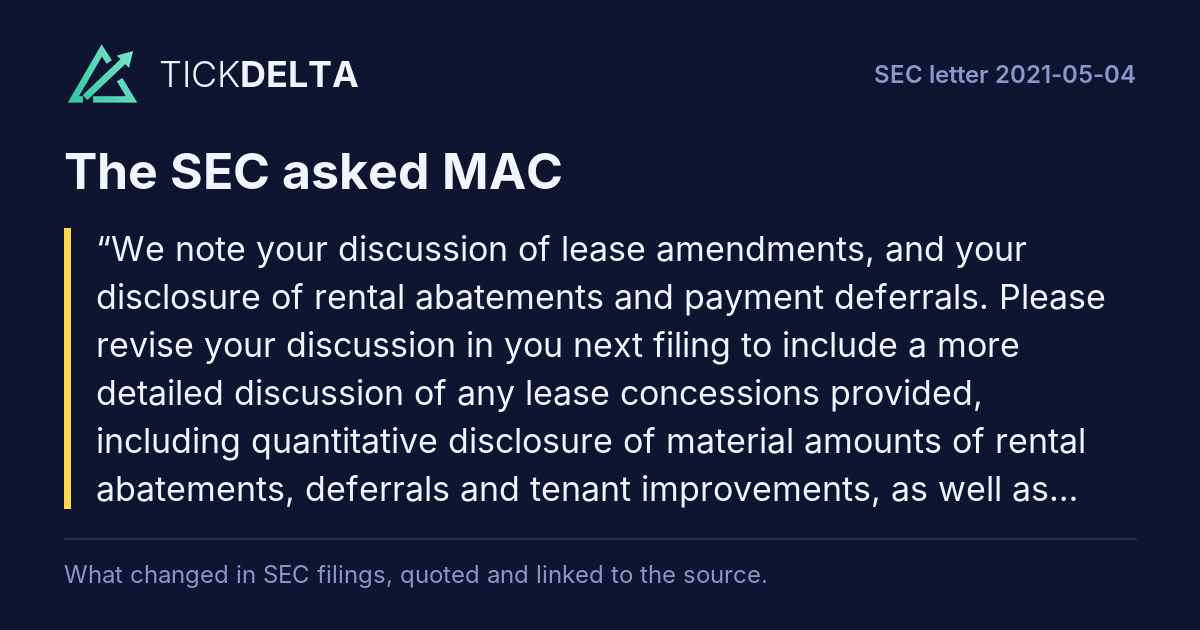
We note your discussion of lease amendments, and your disclosure of rental abatements and payment deferrals. Please revise your discussion in you next filing to include a more detailed discussion of any lease concessions provided, including quantitative disclosure of material amounts of rental abatements, deferrals and tenant improvements, as well as the time period over which the deferrals are being provided.
Rest of the question

Reference is made to Question 4 of the FASB Q&A "Accounting For Lease Concessions Related To The Effects Of The Covid-19 Pandemic".

MAC answered
The Company acknowledges the Staff’s comment and refers the Staff to page 32 of its Form

10-Q for the quarterly period ended March 31, 2021, filed on May 10, 2021 (the “Form 10-Q”). As requested by the Staff, the Form 10-Q includes a more detailed discussion of lease concessions provided, including quantitative disclosure of material amounts of rental abatements and deferrals, as well as the time period over which the deferrals are being provided. There were no tenant improvements to disclose.
Read in the reply
In its next report

First report after the company's reply of May 13, 2021: 10-Q filed Aug 6, 2021 ↗, against the 10-Q filed Nov 6, 2020 ↗.

Tickdelta does not hold the text of both reports, so they are not compared here.
Also in this review: closing letter, 2021-05-17
Form 10-K for the fiscal year ended December 31, 2018

2019-09-12 to 2019-10-16 · 2 questions · 2 letters from the SEC, 2 from the company
Review closed 2019-10-16
Results discussion (MD&A)
Item 2. Management's Discussion and Analysis of Financial Condition and Results of Operations · Funds from Operations ("FFO"), page 42
SEC asked
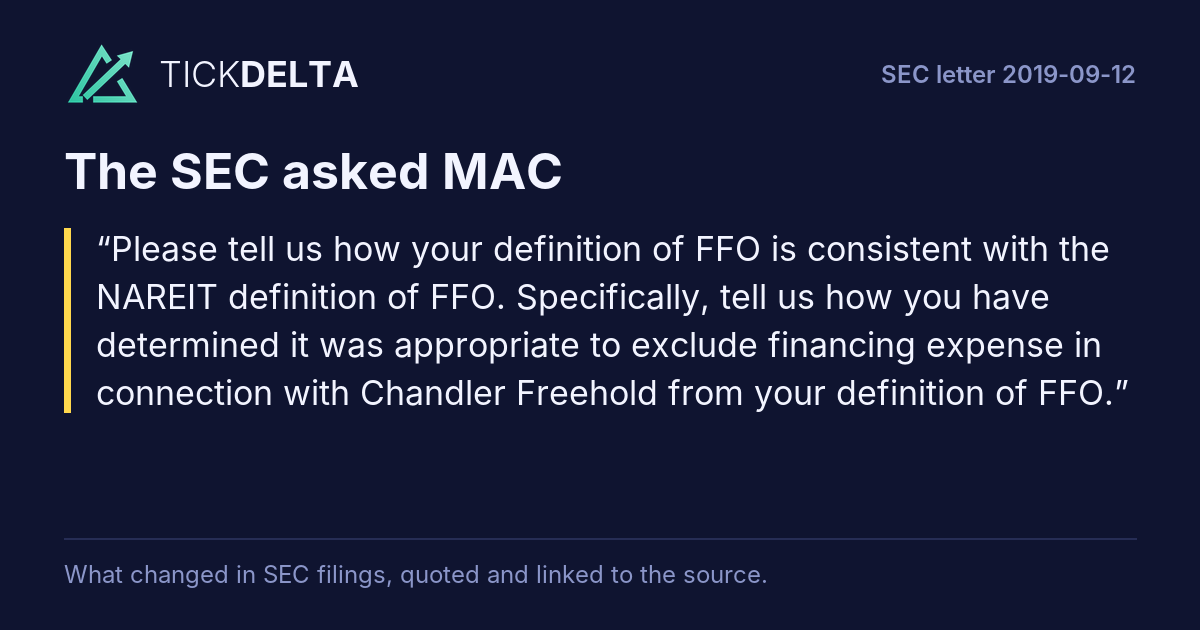
Please tell us how your definition of FFO is consistent with the NAREIT definition of FFO. Specifically, tell us how you have determined it was appropriate to exclude financing expense in connection with Chandler Freehold from your definition of FFO.
MAC answered
As noted on page 42 of the Form 10-Q, as a result of the Company adopting Accounting Standards Codification 606

(“ASC 606”) effective January 1, 2018, the Company began treating its joint venture in Chandler Freehold as a financing arrangement for accounting purposes. In connection with this treatment, the Company recognizes financing expense on (i) the changes in fair value of the financing arrangement obligation, (ii) any payments to the joint venture partner equal to their pro rata share of net income and (iii) any payments to the joint venture partner less than or in excess of their pro
Rest of the answer

rata share of net income. As disclosed in Note 12 on page 25 of the Form 10-Q, these financing arrangement adjustments are recognized as additions or reductions to interest expense in the

Company’s consolidated statements of operations. The Company excludes from its definition of FFO the noted expense, or reduction in expense, related to the changes in fair value and for the payments to the joint venture partner less than or in excess of their pro rata share of net income. The exclusion of these amounts allows the Company’s current FFO to be comparable with the Company’s FFO from prior quarters. It should be noted that these exclusions from the

Company’s FFO for the three and six months ended June 30, 2019 and for the year ended December 31, 2018 resulted in a decrease to the Company’s FFO of $15.2 million, $27.6 million and $8.8 million, respectively.

Securities and Exchange Commission

The Nareit White Paper defining FFO, dated April 2002, and all related amendments predate the effectiveness of ASC 606. Nareit published an FFO White Paper Restatement in 2018, however, in which Nareit specifically noted that “[t]his 2018 Nareit FFO White Paper Restatement is intended to serve as a useful distillation and consolidation of previous

Nareit guidance and is not meant to alter the fundamental definition of FFO.” Although the Nareit definition of FFO predates the effectiveness of ASC 606, the Company believes that excluding the noted expense, or reduction in expense, resulting from the financing arrangement is consistent with the key objective of FFO as a performance measure that is comparable across quarters.

Read in the reply
In its next report

First report after the company's reply of Sep 27, 2019: 10-Q filed Nov 5, 2019 ↗, against the 10-Q filed Aug 5, 2019 ↗.

Tickdelta does not hold the text of both reports, so they are not compared here.

Item 2. Management's Discussion and Analysis of Financial Condition and Results of Operations · Funds from Operations ("FFO"), page 42
SEC asked
We note your response to comment 1 of our letter dated September 12, 2019. We are unclear how your exclusion of the Chandler Freehold financing expense is consistent with the commonly understood industry definition of FFO. Please revise future filings to retitle the measure or remove the related adjustment.
MAC answered
The Company acknowledges the Staff’s comment and will retitle the measure in future filings.
Read in the reply
In its next report

First report after the company's reply of Oct 9, 2019: 10-Q filed Nov 5, 2019 ↗, against the 10-Q filed Aug 5, 2019 ↗.

Tickdelta does not hold the text of both reports, so they are not compared here.

Also in this review: closing letter, 2019-10-16

Form 10-K

2018-09-19 to 2018-12-17 · 3 questions · 2 letters from the SEC, 2 from the company
Review closed 2018-12-17
LeasesResults discussion (MD&A)Revenue
Management’s Overview and Summary, page 42 · Comparison of years ended December 31, 2017 and 2016, page 50
SEC asked (1)
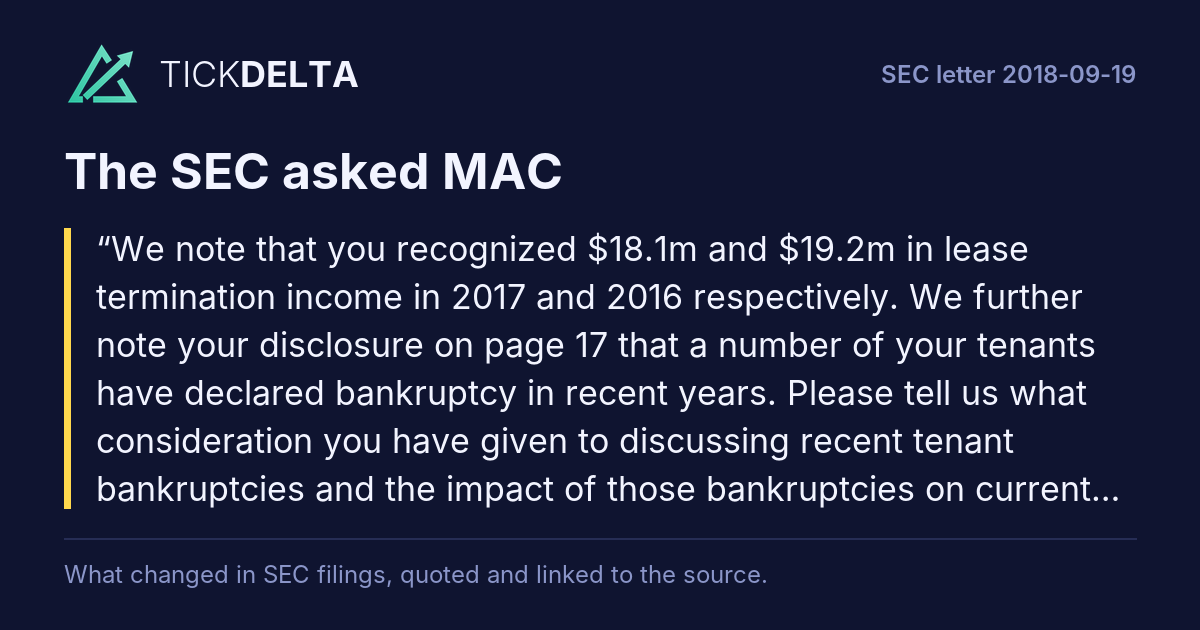
We note that you recognized $18.1m and $19.2m in lease termination income in 2017 and 2016 respectively. We further note your disclosure on page 17 that a number of your tenants have declared bankruptcy in recent years. Please tell us what consideration you have given to discussing recent tenant bankruptcies and the impact of those bankruptcies on current and future operations in your MD&A. Financial Statements 11.
Rest of the question

Co-Venture Arrangement, page 93

MAC answered
The amount of the Company’s lease termination income in a particular period is largely unrelated to any bankruptcies of the Company’s tenants during such period. The Company’s lease termination income principally represents payments received from the Company’s tenants where the Company and the tenant mutually agree to terminate a lease prior to the contractual expiration date. These lease terminations could happen for a number of reasons, such as the Company wishing to repurpose the space or a tenant looking for more square feet.
Rest of the answer

Typically, where there is a termination of a lease as a result of a bankruptcy, the Company would not recognize any income in connection with such a termination.

Securities and Exchange Commission

When drafting the Management’s Discussion and Analysis of Financial Condition and

Results of Operations section (“MD&A”), the Company considers known material trends, demands, commitments, events and uncertainties. The impact of bankruptcies on the Company’s current and future operations was not deemed to be a material trend, event or uncertainty given that bankruptcies did not have a material impact on the Company’s current operations and were not expected to have a material impact on its future operations. At the time of filing the Form 10-K, the Company maintained over a 94% occupancy for the prior two years and it has continued to do so through June 30, 2018. In the event the Company determines that tenant bankruptcies may have a material impact on the Company’s current or future operations, the Company will include appropriate disclosure in its MD&A.

Financial Statements

11. Co-Venture Arrangements, page 93

Read in the reply
In its next report

First report after the company's reply of Oct 4, 2018: 10-Q filed Nov 5, 2018 ↗, against the 10-Q filed Aug 3, 2018 ↗.

Tickdelta does not hold the text of both reports, so they are not compared here.

Management’s Overview and Summary, page 42 · Comparison of years ended December 31, 2017 and 2016, page 50
SEC asked (2)
Please explain to us in greater detail why the adoption of ASC 606 resulted in a change in the accounting for the joint venture holding Freehold Raceway Mall and Chandler Fashion Center. Cite any relevant accounting guidance in your response.
MAC answered
Based on the guidance of ASC 360-20, “Property, Plant, and Equipment-Real Estate Sales,” the

Company determined that the marketing right provision in the Company’s Chandler Fashion Center and Freehold Raceway Mall joint venture agreement, which was executed in September 2009, precluded sale accounting for the formation of the joint venture (“Chandler/Freehold Transaction”), as the Company did not give up control of the assets.
Rest of the answer

Under legacy ASC

360-20-40-38, if a seller has the right to repurchase an asset, the transaction had to be accounted for as a financing, leasing, or profit-sharing arrangement rather than as a sale. Following this guidance, beginning September 2009, the Company accounted for the Chandler/Freehold Transaction as a profit-sharing arrangement.

In May 2014, the FASB issued ASU 2014-09, “Revenue from Contracts with Customers,” (the

“Standard”) which amended ASC 360-20. As a result, the sale of real estate is now covered under ASC 610-20, “Other Income-Gains and Losses from the

Derecognition of Nonfinancial Assets.” Upon adoption of ASC 606 and 610 on January 1, 2018, the Company reevaluated the accounting for the Chandler/Freehold Transaction as this transaction was not considered a completed sale at the date of initial adoption.

Under ASC 606 and ASC 610-20, the Company is still precluded from accounting for the Chandler/Freehold Transaction as a sale due to the marketing right provision. However, under ASC 606 and ASC 610-20 there is no option to apply a profit-sharing model and such transactions must be accounted for as a lease or financing arrangement. Under ASC 610-10-55-68 to ASC 610-10-55-71, a seller’s right to repurchase an asset should be accounted for (i) as a lease arrangement if the asset is expected to be repurchased for less than the original selling price or (ii) as a financing arrangement if the asset is expected to be repurchased for more than the original selling price. As the repurchase price under the agreement is fair value and the fair values of Freehold and Chandler have increased and are expected to remain in excess of the original purchase price, the Company determined to account for the Chandler/Freehold Transaction as a financing arrangement effective January 1, 2018.

Read in the reply
In its next report

First report after the company's reply of Oct 4, 2018: 10-Q filed Nov 5, 2018 ↗, against the 10-Q filed Aug 3, 2018 ↗.

Tickdelta does not hold the text of both reports, so they are not compared here.

Management’s Overview and Summary, page 42 · Comparison of years ended December 31, 2017 and 2016, page 50
SEC asked
We have considered your response to our prior comment one. Please address the following with respect to tenant bankruptcies and other store closings. Please provide the information requested separately for tenant bankruptcies and other store closings:  Please tell us the gross number of tenant bankruptcies and store closings during 2016, 2017 and year to date 2018 and the gross number of stores affected.
Rest of the question

 Please tell us the gross leasable area of stores affected by tenant bankruptcy and store closings.  Please provide us with an analysis of the gross amount of lost rent as a result of tenant bankruptcies and store closings from the date of lease termination or bankruptcy through the original lease termination date for each future annual period impacted.

MAC answered
Securities and Exchange Commission

Page

As noted in the Company’s response letter dated October 4, 2018, the Company considers known material trends, demands, commitments, events and uncertainties when drafting Management’s Discussion and Analysis of Financial Condition and Results of Operations section (“MD&A”) and the impact of bankruptcies on the

Company’s current and future operations was not deemed to be a material trend, event or uncertainty given that bankruptcies did not have a material impact on the Company’s current operations and were not expected to have a material impact on
Rest of the answer

its future operations at the time of filing the Form 10-K. The Company based its determination in part upon the following data from the prior three fiscal years:

The number of tenant bankruptcies was: (i) 10 tenants in 2016, or 0.59% of the Company’s total tenants as of

December 31, 2015; (ii) 21 tenants in 2017, or 1.18% of the Company’s total tenants as of December 31, 2016; and (iii) 13 tenants during the nine months ended September 30, 2018, or 0.76% of the Company’s tenants as of

December 31, 2017. The gross number of store closings in connection with bankruptcies was: (i) 40 stores in 2016, or 0.69% of the Company’s stores as of December 31, 2015; (ii) 92 stores in 2017, or 1.70% of the Company’s stores as of December 31, 2016; and (iii) 20 stores during the nine months ended September 30, 2018, or 0.38% of the Company’s stores as of December 31, 2017.

The gross leasable area (“GLA”) of stores closed was: (i) 269,650 square feet in 2016, or less than

1.0% of the Company’s total GLA as of December 31, 2015; (ii) 411,790 square feet in 2017, or approximately 1.0% of the Company’s GLA as of December 31, 2016; and (iii) 417,960 square feet during the nine months ended

September 30, 2018, or approximately 1.0% of the Company’s GLA as of December 31, 2017.

The average lost rent per year from the date of bankruptcy through the original lease termination date (the last such lease termination date would have been in the calendar year 2028) for the tenant bankruptcies from January 1, 2016 through September 30, 2018 was approximately $12.4 million per year and this number does not reflect amounts recovered through bankruptcy proceedings and amounts received, or to be received, upon releasing the vacated space. The $12.4 million average lost rent per year, excluding amounts received in connection with bankruptcy proceedings and amounts received, or to be received, upon releasing the vacated space, represents less than 1.0% of the Company’s total revenues for each of the fiscal years ended December 31, 2015, 2016 and 2017.

The occupancy rate of the Company’s portfolio was extremely consistent from 2015 through 2018: (i) 96.1% at

December 31, 2015; (ii) 95.4% at December 31, 2016; (iii) 95.0% at December 31, 2017; and (iv) 95.1% at September 30, 2018.

The Company continues to monitor tenant bankruptcies and their impact on the Company and, as a result of the Sears Holdings Corporation (“Sears”) bankruptcy filing on October 15, 2018, the Company included disclosure on tenant bankruptcies and the potential impact of the Sears bankruptcy in MD&A on pages 34 and 35 of the Company’s Form

10-Q filed on November 5, 2018.

Read in the reply
In its next report

First report after the company's reply of Nov 16, 2018: 10-K filed Feb 25, 2019 ↗, against the 10-K filed Feb 23, 2018 ↗.

Tickdelta does not hold the text of both reports, so they are not compared here.

Also in this review: closing letter, 2018-12-17

Form 10-K for the year ended December 31, 2015

2016-05-24 to 2016-09-09 · 2 questions · 2 letters from the SEC, 2 from the company
Review closed 2016-09-09
China
Note 4. Investments in Unconsolidated Joint Ventures, page 11
SEC asked
We note that you have entered into joint ventures in which you own greater than 50% of the investee. For each of these investments, please provide us with a summary that identifies each such investee and provides the basis for your conclusions that you are not required to consolidate the entity despite your greater than 50% ownership interest.
MAC answered
The Company evaluated its investment in Pacific Premier Retail, LLC (“PPR”), New River Associates LLC (“Arrowhead Towne Center”) and the Macerich HHF Centers LLC (“MAC Heitman Portfolio”) under Accounting Standards Codification 810-10 - Consolidation. The Company first determined that none of these investments was a variable interest entity as (1) the equity investment at risk for each entity was sufficient to finance the activities of each entity without additional subordinated financial support; (2) as a group, the holders of each of the equity investments at risk have (a) the power to
Rest of the answer

direct the activities that most significantly impact each entity’s economic performance, (b) the obligation to absorb expected losses, and (c) the right to receive expected residual returns; and (3) substantially all of the activities for each entity do not involve or are not conducted on behalf of an investor that has disproportionately fewer voting rights.

Therefore, the Company evaluated each of the three investments under the voting interest model. Under the voting interest model, the presumption is that a controlling financial interest in an entity is the ownership of a majority voting interest, directly or indirectly, of more than 50% of the voting shares. However, if noncontrolling shareholders or limited partners have substantive participation rights, then the majority shareholder or partner does not have a controlling financial interest. Accordingly, the Company evaluated the key provisions of each investment’s operating agreement to determine whether it had control, as follows:

Pacific Premier Retail LLC

The operating agreement of PPR provides for a board of five directors, of which three directors are appointed by the Company and two directors are appointed by the outside partner. Under the PPR operating agreement, all major decisions, including approval of budgets, capital calls, and financing transactions must be approved unanimously by the board of directors of PPR. The outside partner also participates in the selection, termination, and setting of compensation of management. In addition, the outside partner has other rights including the ability to approve major contracts, approve normal cash distributions, and approve capital projects. These are all substantive participating rights held by the outside partner. Accordingly, the Company determined that since the outside partner effectively participates in significant financial and operating decisions of PPR that are made in the ordinary course of business, the presumption of control has been overcome and the Company should account for its investment in PPR under the equity method of accounting.

Arrowhead Towne Center

The operating agreement of Arrowhead Towne Center is comparable in all material aspects to the PPR operating agreement. As with PPR’s operating agreement, the operating agreement for Arrowhead Towne Center provides for a board of five directors, of which three directors are appointed by the Company and two directors are appointed by the outside partner. The operating agreement states that all major decisions, including approval of budgets, capital calls, and financing transactions must be approved unanimously by the board of directors of Arrowhead Towne Center. The outside partner also participates in the selection, termination, and setting of compensation of management. In addition, the outside partner has other rights including the ability to approve major contracts, approve normal cash distributions, and approve capital projects. These are all substantive participating rights held by the outside partner. Accordingly, the Company determined that since the outside partner effectively participates in significant financial and operating decisions of Arrowhead Towne Center that are made in the ordinary course of business, the presumption of control has been overcome and the Company should account for its investment in Arrowhead Towne Center under the equity method of accounting.

MAC Heitman Portfolio

The operating agreement of the MAC Heitman Portfolio provides that the Company and outside partner each appoint two authorized representatives. Each approval, consent and decision of a member is conveyed by the authorized representatives. All major decisions, including approval of budgets, capital calls, leasing guidelines, and financing transactions must be approved unanimously by both members of the joint venture through their authorized representatives. The outside partner also participates in the selection, termination, and setting of compensation of management. In addition, the outside partner has other rights including the ability to approve normal cash distributions and approve any capital projects not otherwise included in the approved budget. These are all substantive participating rights held by the outside partner. Accordingly, the Company determined that since the outside partner effectively participates in significant financial and operating decisions of the MAC Heitman Portfolio that are made in the ordinary course of business, the presumption of control has been overcome and the Company should account for its investment in the MAC Heitman Portfolio under the equity method of accounting.

The Company hereby acknowledges that: the Company is responsible for the adequacy and accuracy of the disclosure in the filing; Staff comments or changes to disclosure in response to Staff comments do not foreclose the Commission from taking any action with respect to the filing; and the Company may not assert Staff comments as a defense in any proceeding initiated by the Commission or any person under the federal securities laws of the United States.

Read in the reply
In its next report

First report after the company's reply of Jun 10, 2016: 10-Q filed Aug 3, 2016 ↗, against the 10-Q filed May 6, 2016 ↗.

Tickdelta does not hold the text of both reports, so they are not compared here.

Note 4. Investments in Unconsolidated Joint Ventures, page 11
SEC asked
We have considered your response to our prior comment 1. We are unclear how your response addresses the revised consolidation guidance under ASU 2015-02. For example, we are unclear how your analysis of whether the referenced entities are variable interest entities conforms to the revised guidance for limited partnerships and similar entities under ASU 2015-02.
Rest of the question

Please provide us with an updated analysis for the referenced entities.

MAC answered
The Company evaluated its investments in the referenced entities to determine whether each investment should be consolidated. Based on the nature of the joint venture arrangements, none of the joint ventures qualified for any of the consolidation or variable interest entity (VIE) scope exceptions as defined in ASC 810-10-15-12 and 17. The Company then evaluated the referenced entities under the revised guidance for limited partnerships and similar entities under ASU 2015-02.
Rest of the answer

Accordingly, under ASC 810-10-15-14 (as amended by ASU 2015-02), to determine whether the entities are VIEs, the Company evaluated whether any of the following conditions exist:

a. Are the equity investments at risk insufficient to finance the activities of the referenced entities?

The Company has identified the referenced entities’ US GAAP equity and determined that the interests should be considered at risk, based on the guidance of ASC 810-10-15-14 (a)(1)-(4). The equity interest at risk for each of the entities greatly exceeds 10% of the entities’ total assets as discussed in ASC 810-10-25-45, and the assets owned by these entities have historically demonstrated that they can finance their activities without additional subordinated financial support.

b. As a group, do the equity-at-risk investors lack any one of the following three characteristics:

1. Do the equity-at-risk investors have the power, through voting rights or similar rights, to direct the activities of the legal entities that most significantly impact the entities’ economic performance?

For limited partnerships and similar entities, partners lack this power if a simple majority or lower threshold of limited partners with equity at risk lack both the ability to exercise substantive kick-out rights and substantive participating rights. The outside partners do not have substantive kick-out rights, but as detailed in our previous response letter dated June 10, 2016, they have substantive participating rights.

Read in the reply
In its next report

First report after the company's reply of Aug 3, 2016: 10-Q filed Nov 2, 2016 ↗, against the 10-Q filed May 6, 2016 ↗.

Tickdelta does not hold the text of both reports, so they are not compared here.

Also in this review: closing letter, 2016-09-09

Schedule 14A

2015-04-20 to 2015-05-01 · 33 questions · 5 letters from the SEC, 1 from the company
No closing letter
Legal and contingenciesAcquisitions
SEC letter of Apr 20, 2015 ↗ no reply letter on EDGAR (the company may have answered in an amended filing)
General
SEC asked (1)
Each statement or assertion of opinion or belief must be clearly characterized as such, and a reasonable factual basis must exist for such opinion or belief. Support for opinions or beliefs should be self-evident, disclosed in soliciting materials, or provided to the staff on a supplemental basis.
Rest of the question

Please qualify the following types of statements as your belief in future filings, and provide supplemental support for these particular statements with your response:  “… the egregious governance missteps undertaken by Macerich in relation to their refusal to meaningfully engage with Simon Property Group.”  “You have gravely underestimated the damage you have done to Macerich by restaggering your Board, adopting a poison pill and now actively seeking to block shareholders’ voices from being heard at the Annual Meeting by litigating with us on the validity of our nominations.”  “… Simon (NYSE: SPG) undoubtedly continues to be interested as an acquirer.”  “… your commitment to de-stagger the Board and reengage with Simon ….”  “… stopped short of corporate governance apocalypse.”

MAC answered

No reply letter found.

General
SEC asked (2)
In future soliciting material, please refrain from making statements that could be viewed as impugning the character of other parties as contemplated by Rule 14a-9. In particular, please refrain from making assertions that the directors have not properly exercised their fiduciary duties in future filings without qualifying the statements as your opinion or belief, and provide an adequate supporting basis for these
Rest of the question

assertions with your response.

MAC answered

No reply letter found.

General
SEC asked (1)
Please clearly mark your form of proxy as preliminary. See Rule 14a-6(e)(1).
MAC answered
In response to the Staff’s comment, the Company has revised the form of proxy attached to the Amended Submission to clearly mark that it is preliminary.
Read in the reply
General
SEC asked (2)
In the forefront of your proxy statement, please discuss the potential consequences of the pending litigation involving the submission of nominees by Land and Buildings, including if Land and Buildings prevails. In doing so, please discuss how the company intends to treat votes submitted by Orange Capital and Land and Buildings pursuant to proxy authority granted by shareholders using the gold proxy card.
MAC answered
In response to the Staff’s comment, the Company has revised the disclosure on page i of the Amended Submission.
Read in the reply
What vote is required to approve each matter? page 5
SEC asked (3)
Disclosure indicates that brokers may exercise discretionary authority to vote on Proposal 2 in the absence of voting instructions. It is our understanding that in a contested election a broker does not have discretionary authority to vote on any proposals to be voted on at the meeting, whether routine or not. Please provide support for your assertion, or revise your disclosure as necessary.
MAC answered
In response to the Staff’s comment, the Company has revised the disclosure on page 5 of the Amended Submission.
Read in the reply
Proposal 1: Election of Class I Directors, page 6
SEC asked (4)
Disclosure indicates that “[v]otes for the purported nominees named on the [ ] proxy card will not be recognized at our Annual Meeting.” Please revise to clarify whether votes for the Land and Buildings’ nominees will be recognized if the Baltimore City Circuit Court denies the declaratory relief sought by the company or otherwise finds in favor of Land and Buildings regarding its lawsuit.
MAC answered
In response to the Staff’s comment, the Company has revised the disclosure on page 7 of the Amended Submission.
Read in the reply
Proposal 1: Election of Class I Directors, page 6
SEC asked (5)
Please confirm to us that in the event the board of directors identifies or nominates a substitute nominee prior to the annual meeting, the company will file an amended proxy statement that (1) identifies the substitute nominee, (2) discloses whether the nominee has consented to being named in the revised proxy statement and to serve, if elected, and (3) includes disclosure required by Items 5(b) and 7 of Schedule
Rest of the question

14A with respect to the nominee.

MAC answered
The Company confirms that, in the event the board of directors identifies or nominates a substitute nominee prior to the annual meeting, it will file an amended proxy statement that (1) identifies the substitute nominee, (2) discloses whether the nominee has consented to being named in the amended proxy statement and to serve, if elected, and (3) includes disclosure required by Items 5(b) and 7 of Schedule 14A with respect to the nominee.
Read in the reply
Solicitation of Proxies, page 75
SEC asked (6)
Please provide the information required by Item 4(b)(3)(iii) and 4(b)(4) of Schedule 14A.
MAC answered
In response to the Staff’s comment, the Company has revised the disclosure on page 75 of the Amended Submission.
Read in the reply
Annex A – Information Regarding Participants
SEC asked (7)
Please revise to clarify the amount of each class of securities which the participant owns of record but not beneficially. See Item 5(b)(1)(v) of Schedule 14A.
MAC answered
In response to the Staff’s comment, the Company has revised the disclosure on Annex A to the Amended Submission.
Read in the reply
Annex A – Information Regarding Participants
SEC asked (8)
Please provide the information required by Item 5(b)(vi) of Schedule 14A.
MAC answered
In response to the Staff’s comment, the Company has revised the disclosure on Annex A to the Amended Submission.

[Remainder of this page left intentionally blank]

The Company respectfully believes that the proposed revisions to the Preliminary Proxy Statement, and the supplemental information contained herein, are responsive to the Staff’s comments. If you have any questions or would like further information concerning the Company’s responses to your Comment Letter, please do not hesitate to contact me at (617) 570-1531 or John T. Haggerty of Goodwin Procter LLP at (617) 570-1526.
Read in the reply
SEC letter of Apr 27, 2015 ↗ no reply letter on EDGAR (the company may have answered in an amended filing)
SEC asked (1)
In future soliciting material, please refrain from making statements that could be viewed as misleading within the meaning of Rule 14a-9. In that regard, please provide the factual foundation for your belief that “Macerich is continuing its pattern of trampling on the rights of shareholders.” See Note (b) to Rule 14a-9.
MAC answered

No reply letter found.

SEC asked (2)
Please provide supplemental support for the assertion that Orange Capital and L&B have had “conversations with a substantial number of large shareholders of the Company” regarding their support for the Orange Capital/L&B agenda.
MAC answered

No reply letter found.

SEC letter of Apr 29, 2015 ↗ no reply letter on EDGAR (the company may have answered in an amended filing)
General
SEC asked (1)
It appears you intend to rely on Rule 14a-5(c) to fulfill certain disclosure obligations by reference to the company’s proxy statement. Please note that in our view, reliance on Rule 14a-5(c) before the company distributes information to security holders is not appropriate.
Rest of the question

Please tell us whether you intend to disseminate your proxy statement prior to the distribution of the company proxy statement and, if so, confirm your understanding that you must undertake to provide any omitted information to security holders in the form of a proxy supplement.

MAC answered

No reply letter found.

General
SEC asked (2)
In the forefront of your proxy statement, please discuss the potential consequences of the pending litigation involving the submission of nominees by Land and Buildings, including if the company prevails. In doing so, please highlight the likelihood that shareholders using the gold proxy card will be disenfranchised since the company has indicated that votes for nominees named on the gold proxy card will not be
Rest of the question

recognized at the annual meeting.

MAC answered

No reply letter found.

General
SEC asked (3)
Please state whether you intend to submit votes on Proposals 2 and 3 for all shares of stock for which you have been granted proxy authority if, for any reason, you learn subsequent to receiving such proxy authority that your nominees will not be considered by shareholders at the 2015 annual meeting. We may have further comment.
MAC answered

No reply letter found.

General
SEC asked (4)
Please revise your disclosure to describe how the current board of directors has not pursued a “strategic course that would maximize the potential value” of the company.
MAC answered

No reply letter found.

General
SEC asked (5)
Please note that you must avoid issuing statements that directly or indirectly impugn the character, integrity or personal reputation or make charges of illegal, improper or immoral conduct without factual foundation. Provide us supplementally, or disclose, the factual foundation for such assertion or revise the statement. In this regard, note that the factual foundation for such assertions must be reasonable.
Rest of the question

Refer to Rule 14a-9. Provide support for your assertion that you are seeking to “change a minority of the board to ensure that the interests of the shareholders are appropriately represented in the boardroom.”

MAC answered

No reply letter found.

General
SEC asked (6)
With a view toward revised disclosure, please advise us whether any participant has any agreement or understanding with Simon Property Group, Inc. or any affiliates thereof with respect to any future employment or with respect to any future transactions to which the company or any of its affiliates will or may be a party. See Item 5(b)(1)(xii) of Schedule 14A.
MAC answered

No reply letter found.

Background of this Proxy Solicitation, page 3
SEC asked (7)
Please advise us, with a view toward revised disclosure, how the rumored potential acquisition of the company related to Land and Buildings’ decision not to acquire shares of the company’s stock in early March. Also advise us how Mr. Litt would have been involved in Simon Property Group’s acquisition of the company absent Mr. Coppola’s purported urging to the contrary.
MAC answered

No reply letter found.

Background of this Proxy Solicitation, page 3
SEC asked (8)
Disclosure indicates that on March 20, “the Board, unbeknownst to the public, set its Record Date to be March 20, 2015.” Please remove this statement or provide support for the assertion that the company did not set the record date in accordance with NYSE Listed Company Manual Rule 204.21.
MAC answered

No reply letter found.

Background of this Proxy Solicitation, page 3
SEC asked (9)
Disclosure indicates that on March 25 and March 26, Mr. Leanse denied Land and Buildings’ second and third requests for the Questionnaire. Please revise to disclose why Mr. Leanse denied those requests.
MAC answered

No reply letter found.

Background of this Proxy Solicitation, page 3
SEC asked (10)
Refer to the first entry for March 31, 2015. You disclose that the company announced its decision to reject Simon’s final offer “without any negotiation.” We note that the company indicated in a press release dated March 31, 2015 that it had maintained communications with Simon. Please revise.
MAC answered

No reply letter found.

Proposal 1: Election of Directors, page 5
SEC asked (11)
We note your disclosure regarding the independence of your nominees (page 7). Please revise to clarify that a final determination as to your nominees would be made after their election and appointment to the board, as required by the NYSE rules.
MAC answered

No reply letter found.

Proposal 1: Election of Directors, page 5
SEC asked (12)
Please disclose why you recommend that security holders vote for your nominees.
MAC answered

No reply letter found.

Who is making this Proxy Solicitation …, page 13
SEC asked (13)
Disclosure indicates that Orange/L&B will solicit proxies. Please provide the information required by Item 4(b)(2) of Schedule 14A.
MAC answered

No reply letter found.

Annex I: Information on the Participants
SEC asked (14)
Please disclose the percentage of common stock beneficially owned by your nominees. See Item 6(d) of Schedule 14A and Item 403(b) of Regulation S-K.
MAC answered

No reply letter found.

Annex I: Information on the Participants
SEC asked (15)
Please provide all information required by Item 5(b)(viii) of Schedule 14A with respect to the call and put options.
MAC answered

No reply letter found.

SEC letter of May 1, 2015 ↗ no reply letter on EDGAR (the company may have answered in an amended filing)
Response to Comment 1 of our April 20, 2015 Letter
SEC asked (1)
Please provide a reasonable factual basis for the assertion that the company’s adoption of a shareholder rights plan and implementation of a staggered board in response to an unsolicited takeover bid amounts to “egregious governance missteps.” The assertion appears to disregard the possibility that such actions may have been a reasonable exercise of the board of directors’ fiduciary duties in the context of an
Rest of the question

unsolicited takeover bid.

MAC answered

No reply letter found.

Response to Comment 1 of our April 20, 2015 Letter
SEC asked (2)
Please provide support for the assertion that the board’s rejection of the filing persons’ notice of intent to nominate and related lawsuit generated negative publicity.
MAC answered

No reply letter found.

Response to Comment 1 of our April 20, 2015 Letter
SEC asked (3)
Provide additional support for the unqualified and inadequately supported assertion that Simon “undoubtedly continues to be interested” in acquiring the company or refrain from making this or similar statements in future filings.
MAC answered

No reply letter found.

Response to Comment 1 of our April 20, 2015 Letter
SEC asked (4)
Provide additional support for the unqualified and inadequately supported assertion that the company committed to de-stagger the board or refrain from making this or similar statements in future filings.
MAC answered

No reply letter found.

Response to Comment 1 of our April 20, 2015 Letter
SEC asked (5)
Please provide a reasonable factual basis for the assertion that the actions you reference amounted to a “corporate governance apocalypse.” This assertion also appears to disregard the possibility that such actions may have been a reasonable exercise of the board of directors’ fiduciary duties in the context of an unsolicited takeover bid. Response to Comment 2 of our April 20, 2015 Letter
MAC answered

No reply letter found.

Response to Comment 1 of our April 20, 2015 Letter
SEC asked (6)
We reissue comment 2. Provide a reasonable factual basis for the assertion that the directors failed to exercise their fiduciary duties or refrain from making such statements in future filings. Your response to comment 2 contains conclusory statements and does not address why the actions taken by the board of directors were not a proper exercise of their fiduciary duties.
MAC answered

No reply letter found.

Form 10-K for the year ended December 31, 2013

2014-04-28 to 2014-05-13 · 1 question · 1 letter from the SEC, 1 from the company
Review closed 2014-05-13
FORM 10-K FOR THE YEAR ENDED DECEMBER 31, 2013 · Note 4 – Investments in Unconsolidated Joint Ventures, pages 78 – 84
SEC asked
We note that in prior years you identified Pacific Premier Retail LP as being significant to warrant the inclusion of separate stand-alone financial statements pursuant to Rule 309 of Regulation S-X. Based on the equity in net income recognized by you from Pacific Premier Retail LP it appears that it remains significant for the year ended December 31, 2013.
Rest of the question

Please clarify how you have complied with Rule 3-09 of Regulation S-X.

MAC answered
The Company determined Pacific Premier Retail LP (“PPRLP”) was not significant as defined in Rule 3-09 of Regulation S-X during the three year period ended December 31, 2013. The stand-alone financial statements for PPRLP were included in the Company’s Annual Report on Form 10-K for the year ended December 31, 2012 (the “2012 10-K”) as PPRLP was significant for the year ended December 31, 2010. While not required, the Company elected to include audited financial statements of PPRLP for 2012 and 2011 in lieu of unaudited financial statements in the 2012 10-K.
Rest of the answer

During the year ended December 31, 2013, PPRLP sold Redmond Town Center-Office, Kitsap Mall and Redmond Town Center (See Note 4 – Investments in Unconsolidated Joint Ventures of the Company’s Consolidated Financial Statements in the 2013 10-K).

Accordingly, PPRLP classified the results of these dispositions as discontinued operations in its stand-alone financial statements as follows (dollars in thousands):

For the years ended December 31,

Revenues:

2013

2012

2011

Minimum rents

$

103,957

100,848

98,772

Percentage rents

4,019

4,202

4,132

Tenant recoveries

46,939

45,881

44,508

Other

5,357

4,605

4,187

Total revenues

160,272

155,536

151,599

Expenses:

Shopping center and operating expenses

45,152

44,876

45,445

Interest expense

43,445

47,796

45,737

Depreciation and amortization

34,599

32,691

31,535

Total expenses

123,196

125,363

122,717

Income from continuing operations

37,076

30,173

28,882

Discontinued operations:

Gain on sale of assets

182,754

-

Income from discontinued operations

7,926

15,012

19,424

Total income from discontinued operations

190,680

15,102

Net income

227,756

45,275

48,306

Company’s equity from net income:

Continuing operations

15,954

15,345

14,689

Discontinued operations

94,844

7,681

9,879

Total Company’s equity in net income

110,798

23,026

24,568

The Company did not separately present income from continuing and discontinued operations in the Combined and Condensed Statements of Operations of Unconsolidated Joint Ventures in Note 4 of the 2013 10-K. In accordance with Rule 1-02(w) of Regulation S-X, the computation of the numerator in the calculation of significance is based on the registrant’s proportionate share of the pre-tax income from continuing operations reflected in the separate financial statements of the investee. Accordingly, the Company used its proportionate share of PPRLP’s income from continuing operations in the numerator. For purposes of calculating the denominator, in accordance with Rule 1-02(w) of Regulation S-X, the Company used its average income from continuing operations for the past five years since income from continuing operations for 2013 was more than 10% less than the five year average income.

The following table sets forth the Company’s significance test for PPRLP in accordance with Rule 3-09 of Regulation S-X for the year ended December 31, 2013:

The Macerich Company (“Registrant”)

Test of Significant Subsidiaries (Rule 3-09 of Regulation S-X)

December 31, 2013

(Dollars in thousands)

Registrant

Adjustments

Income from for Discontinued

Operations, Income

Taxes and

Adjusted

Continuing

Noncontrolling

For the Years Ended December 31

Operations

Interests

159,023

(99,937

)

59,086

303,166

(35,173

267,993

239,442

(32,364

207,078

2010

29,191

(19,573

9,618

2009

201,786

(36,005

165,781

5-Year Average

141,911

Current Year compared to 5-Year Average

41.6%

Income used for Registrant (1)

Subsidiary - PPRLP

Investment Test

Total Investment in Subsidiary

(59,632

Total Assets - Registrant

9,075,250

-1%

Income Test

Pre-tax income - Subsidiary pro rata

Pre-tax income - Registrant

11%

(1) In accordance with Rule 1-02(w) of Regulation S-X, the denominator in the pretax income test may be replaced by the registrant’s average pretax income over the last five fiscal years when the registrant’s current year pretax income is at least 10% lower than that average.

As provided above, PPRLP’s income from continuing operations was below 20% of the Company’s income from continuing operations for the year ended December 31, 2013. Accordingly, separate stand-alone financial statements of PPRLP were not required to be filed in the 2013 10-K.

In making this response, the Company acknowledges that: the Company is responsible for the adequacy and accuracy of the disclosure in the filing; Staff comments or changes to disclosure in response to Staff comments do not foreclose the Commission from taking any action with respect to the filing; and the Company may not assert Staff comments as a defense in any proceeding initiated by the Commission or any person under the federal securities laws of the United States.

Read in the reply
In its next report

First report after the company's reply of May 9, 2014: 10-Q filed Aug 1, 2014 ↗, against the 10-Q filed Nov 4, 2013 ↗.

Tickdelta does not hold the text of both reports, so they are not compared here.

Also in this review: closing letter, 2014-05-13

Form 10-K

2013-04-04 to 2013-06-11 · 2 questions · 2 letters from the SEC, 2 from the company
Review closed 2013-06-11
Leases
Notes to Consolidated Financial Statements, page 77
SEC asked
Summary of Significant Accounting Policies, page 77 Capitalization of Costs, page 78 We are unable to locate your disclosure indicating the amount of indirect costs 2. capitalized consistent with your response dated June 26, 2012. Please advise.
MAC answered
Consistent with the Company’s response dated June 26, 2012, the Company has provided more detail regarding its capitalization policies. In the “Capitalization of Costs” section that was added on page 78 of its Form 10-K in response to the Staff’s previous comment, the Company provided detailed disclosure on its capitalization policies including disclosure on the capitalization of direct and indirect costs and the allocation of capitalized indirect costs between development and redevelopment activities.
Rest of the answer

The Company has not disclosed the amount of indirect costs capitalized during the fiscal year given that such costs were immaterial (less than $2.0 million). To the extent that the Company determines that its capitalized indirect costs are material in future periods, the Company will disclose the amount of such indirect capitalized costs.

The Company hereby acknowledges that: the Company is responsible for the adequacy and accuracy of the disclosure in the filing, Staff comments or changes to disclosure in response to Staff comments do not foreclose the Commission from taking any action with respect to the filing; and the Company may not assert Staff comments as a defense in any proceeding initiated by the Commission or any person under the federal securities laws of the United States.

Read in the reply
Item 1. Business, page 3 · Lease Expirations, page 13
SEC asked
We note your response to comment one from our letter dated April 4, 2013, particularly your discussion regarding disclosure of market rents. Please note that we are requesting disclosure focused on the spread between current rents and current market rents (i.e., not an estimate of future market rents).
Rest of the question

In future Exchange Act periodic reports, to the extent you have material lease expirations in the next year, please include disclosure regarding the relationship of rents on expiring leases to market rents. To the extent you do not track this information, please tell us that.

MAC answered
The Staff’s comment is noted and the Company believes that, in general, the most objective data to compare the relationships between rents on leases that will expire in the near term and rents on new leases is the change in rents for the Company’s own recent leases as compared to expiring leases. The Company has historically disclosed the base rents for recent leases as compared to expiring leases in the Company’s Annual Report on Form 10-K. Please see the disclosure starting on page 11 of the Company’s Form 10-K for the year ended December 31, 2012.
Rest of the answer

Additionally, the Company has historically included in its periodic reports disclosure on lease renewal trends. Please see (i) page 52 of the Company’s Form 10-K for the year ended December 31, 2012 and (ii) page 42 of the Company’s Form 10-Q for the quarter ended March 31, 2013. The Company confirms that in all future periodic reports it will disclose the base rents for recent leases as compared to expiring leases. The Company believes that generally rents on new and renewed leases (excluding leases with extension options) approximate market rents. Also, to the extent the Company has material lease expirations, the Company confirms that it will include disclosure on lease renewal trends in its periodic reports. Furthermore, for the reasons outlined in the Company’s letter dated May 2, 2013, the Company continues to believe that quantification of current market rental rates is not appropriate for inclusion in these filings.

Read in the reply
In its next report

First report after the company's reply of May 20, 2013: 10-Q filed Aug 8, 2013 ↗, against the 10-Q filed Nov 5, 2012 ↗.

Tickdelta does not hold the text of both reports, so they are not compared here.

Also in this review: closing letter, 2013-06-11

Letters without questions

Other letters

UPLOAD and CORRESP
1 other letter: notices that a filing will not be reviewed, requests to declare a registration effective, and the like

From the SEC's correspondence on EDGAR: staff letters (form UPLOAD) and company letters (form CORRESP), 33 letters filed since 2013-04-04. Questions and answers are matched by their numbers; topics come from words in each question. The reports are compared word for word (same form, before the first SEC letter against the first report after the company's reply). No AI.

Sources

The SEC's correspondence on EDGAR: staff letters (form UPLOAD) and company letters (form CORRESP), matched question by question. No AI.

Also

Filings: the letters in the filing list.

Work with it

Excel workbook · CSV. Google Sheet that stays up to date: paste =IMPORTDATA("https://tickdelta.com/company/MAC/export.csv") into a cell.

Next in Owners and insiders:Insider trades
Esc

Type a ticker such as AAPL, a name, an investor such as Buffett, or a topic such as tariffs. ↑ ↓ to move, Enter to open.