Paragraph 32 · 50% changed
Every version of it
Screener
/
SEC EDGAR
/CIK 0001049521
/10-K filed Aug 18, 2026, compared with Aug 11, 2025
/Numbers from the XBRL of the 10-Ks
Nasdaq
Technology · Electronic Components
Mercury Systems Inc MRCY
The 10-K against last year's
140 changes: 33 added, 23 removed, 82 reworded, 2 quiet changes
10-K Aug 18, 2026 vs Aug 11, 2025
Risk Factors
18.8%
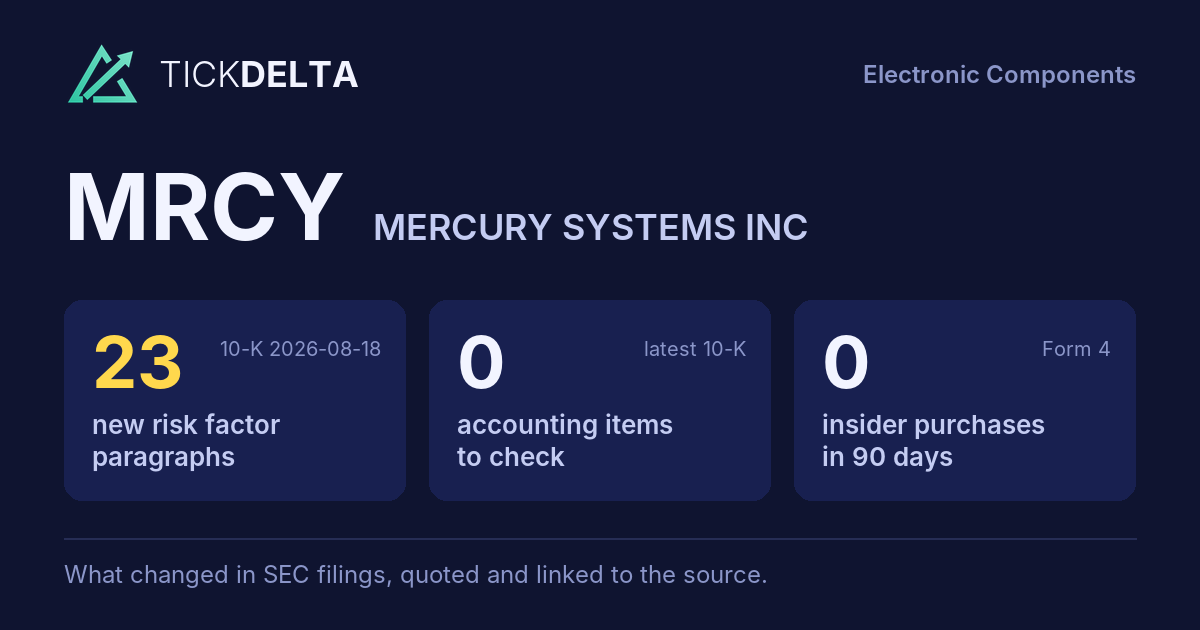
of the text changed · 10,228 words now · 23 new paragraphs, 9 gone
MD&A
25.8%
of the text changed · 9,435 words now · 10 new paragraphs, 14 gone
10-K 0001049521-26-000045 (Aug 18, 2026) vs 10-K 0001049521-25-000024 (Aug 11, 2025) Not compared: Legal Proceedings, Accounting Policies.
Every paragraph, and how much of it changed
One bar per paragraph, in the order of the 10-K. Height and colour show the share of its words not in the closest paragraph a year earlier; the tallest bars are new paragraphs.
Risk Factors
145 paragraphs · 23 new · 51 reworded · 9 gone · 10-K Aug 18, 2026 against Aug 11, 2025
New paragraph
Reworded (5% of its words or more)
Same or nearly
Paragraph 126 · 49% changed
Every version of it
Paragraph 70 · 49% changed
Every version of it
Paragraph 143 · 42% changed
Every version of it
determining what the director of a Massachusetts corporation reasonably believes to be in the best interests of the corporation, a director may consider the interests of the corporation's employees, suppliers, creditors, and customers, the economy of the state, the region, and the nation, community and societal considerations and the long-term and short-term interests of the corporation and its shareholders, including the possibility that these interests may be best served by the continued independence of the corporation.
Paragraph 18 · 37% changed
Every version of it
Our markets are highly competitive, with frequent technological advances and evolving industry standards. Competitors may offer lower pricing, superior products or better delivery, reducing demand for our offerings. Operational challenges have impacted our on-time delivery, affecting visibility and revenue. Customers may opt for lower-cost alternatives or insource previously outsourced products. Rapid technological changes could lead to new competitors, resulting in lost customers and programs. Negative perceptions regarding cost or delivery issues may further impact our ability to secure business. Limited engagement with key government-funded laboratories (e.g., DARPA, MIT Lincoln Labs, Labs and MITRE) may hinder our ability to become a design partner for defense prime contractors. As defense agencies evaluate lessons learned from modern conflicts, new entrants offering low‑cost, modular systems may gain influence in early design phases, reducing our access to future programs.
Paragraph 114 · 37% changed
Every version of it
•We sell certain products and services to U.S. and international defense contractors or directly to the U.S. government on a commercial item basis, eliminating the requirement to disclose and certify cost or pricing data. To the extent that there are interpretations or changes in the Federal Acquisition Regulations (“FAR”) regarding the qualifications necessary to sell commercial items, there could be a material impact on our business and operating results. For example, there have been legislative proposals to narrow the definition of a “commercial item” (as defined in the FAR) or to require cost and pricing data on commercial items that could limit or adversely impact our ability to contract under commercial item terms. Changes could be accelerated due to changes in our mix of business, in federal regulations, or in the interpretation of federal regulations, which may subject us to increased oversight by the Defense Contract Audit Agency (“DCAA”) for certain of our products or services. Such changes could also trigger contract coverage for a larger percentage of our contracts under the Cost Accounting Standards (“CAS”), requiring compliance with a defined set of business systems criteria. Failure to comply with applicable CAS requirements could adversely impact our ability to win future CAS-type contracts and subject us to 5% billing withholding on open cost type contracts and those subject to progress payment financing. For example, one of our business entities is currently operating on a disapproved CAS system and that business is subject to billing withholding which has resulted in approximately $0.4 million of cash withheld. We have recently completed a pre-award accounting system audit with DCAA to allow this business to perform cost-type contracts while the system remains disapproved, and we anticipate the system to be approved during fiscal 2027 upon completion of a full
Paragraph 31 · 33% changed
Every version of it
Trade policies and export controls could significantly increase the cost of our manufacturing operations, potentially reducing our costs, reduce gross margins and disrupt demand for our products.
Paragraph 52 · 33% changed
Every version of it
•changes in estimates of completion (EAC) Estimates at Completion (“EAC”) on fixed price engagements, which represent a substantial percentage of our business. business, or inaccurate cost estimation at time of proposal, leading to unanticipated cost increases.
Paragraph 32 · 50% changed
Every version of it
10-K Aug 11, 2025Trade policies pose a risk to our manufacturing operations, potentially reducing our gross margins and impacting demand for our products. There is uncertainty with respect to trade policies and treaties between the U.S. and other countries. The U.S. has announced broad increases in tariffs on imported components, subject to limited exceptions. Major U.S. trading partners have announced retaliatory tariffs in response and some have negotiated new trade agreements. As a result, we are exposed to increased tariffs with respect to products and components that we import into the U.S. Our gross margins could be reduced, potentially significantly, in the event we are unable to recover tariffs or duties from our customers. Further, although we are required to pay tariffs upon importation of the components, we may not be able to recover these amounts from our customers
10-K Aug 18, 2026
There is substantial uncertainty with respect to trade policies, enforcement and treaties between the U.S. and other countries. The U.S. government continues to implement broad tariffs on imported goods and components, including temporary baseline duties of 10% or higher alongside sweeping country-specific reciprocal tariffs. While certain measures face ongoing domestic legal and structural modifications, the U.S. Trade Representative has proposed shifting these baseline duties into long-term frameworks under Section 301 and Section 232 authorities. Concurrently, major U.S. trading partners have enacted retaliatory tariffs. As a result, we face direct exposure to increased costs on products and components imported into the U.S. Our gross margins could be reduced, potentially significantly, if we cannot pass these costs to customers. Furthermore, lag times between our tariff payments at importation and customer recovery could materially adversely impact our operating cash flow in a given period. Any significant price increases passed along to our customers may reduce overall demand.
Paragraph 126 · 49% changed
Every version of it
10-K Aug 11, 2025We may need to adopt new information technology systems and infrastructure to scale our business and obtain the synergies from prior acquisitions as well as organic growth. Our information technology and business systems and infrastructure could create product development or production work stoppages, unnecessarily increase our inventory, negatively impact product delivery times and quality and increase our compliance costs. In addition, an inability to maximize the utility and benefit of our current information technology and business tools could impact our ability to meet cost reduction and planned efficiency and operational improvement goals.
10-K Aug 18, 2026
and benefit of our current information technology and business tools could impact our ability to meet cost reduction and planned efficiency and operational improvement goals.
Paragraph 70 · 49% changed
Every version of it
10-K Aug 11, 2025Economic, capital market and political conditions could adversely affect our business, results of operations, and financial condition.
10-K Aug 18, 2026
Any of these risks, individually or in combination, could materially and adversely affect our business, financial condition and results of operations.
Paragraph 143 · 42% changed
Every version of it
10-K Aug 11, 2025
and its shareholders, including the possibility that these interests may be best served by the continued independence of the corporation.
10-K Aug 18, 2026
determining what the director of a Massachusetts corporation reasonably believes to be in the best interests of the corporation, a director may consider the interests of the corporation's employees, suppliers, creditors, and customers, the economy of the state, the region, and the nation, community and societal considerations and the long-term and short-term interests of the corporation and its shareholders, including the possibility that these interests may be best served by the continued independence of the corporation.
Paragraph 18 · 37% changed
Every version of it
10-K Aug 11, 2025
Rapid technological changes could lead to new competitors, resulting in lost customers and programs. Negative perceptions regarding cost or delivery issues may further impact our ability to secure business. Limited engagement with key government-funded laboratories (e.g., DARPA, MIT Lincoln Labs, and MITRE) may hinder our ability to become a design partner for defense prime contractors.
10-K Aug 18, 2026
Our markets are highly competitive, with frequent technological advances and evolving industry standards. Competitors may offer lower pricing, superior products or better delivery, reducing demand for our offerings. Operational challenges have impacted our on-time delivery, affecting visibility and revenue. Customers may opt for lower-cost alternatives or insource previously outsourced products. Rapid technological changes could lead to new competitors, resulting in lost customers and programs. Negative perceptions regarding cost or delivery issues may further impact our ability to secure business. Limited engagement with key government-funded laboratories (e.g., DARPA, MIT Lincoln Labs and MITRE) may hinder our ability to become a design partner for defense prime contractors. As defense agencies evaluate lessons learned from modern conflicts, new entrants offering low‑cost, modular systems may gain influence in early design phases, reducing our access to future programs.
Paragraph 114 · 37% changed
Every version of it
10-K Aug 11, 2025
•We sell certain products and services to U.S. and international defense contractors or directly to the U.S. government on a commercial item basis, eliminating the requirement to disclose and certify cost data. To the extent that there are interpretations or changes in the Federal Acquisition Regulations (“FAR”) regarding the qualifications necessary to sell commercial items, there could be a material impact on our business and operating results. For example, there have been legislative proposals to narrow the definition of a “commercial item” (as defined in the FAR) or to require cost and pricing data on commercial items that could limit or adversely impact our ability to contract under commercial item terms. Changes could be accelerated due to changes in our mix of business, in federal regulations, or in the interpretation of federal regulations, which may subject us to increased oversight by the Defense Contract Audit
10-K Aug 18, 2026
•We sell certain products and services to U.S. and international defense contractors or directly to the U.S. government on a commercial item basis, eliminating the requirement to certify cost or pricing data. To the extent that there are interpretations or changes in the Federal Acquisition Regulations (“FAR”) regarding the qualifications necessary to sell commercial items, there could be a material impact on our business and operating results. Changes could be accelerated due to changes in our mix of business, in federal regulations, or in the interpretation of federal regulations, which may subject us to increased oversight by the Defense Contract Audit Agency (“DCAA”) for certain of our products or services. Such changes could also trigger contract coverage for a larger percentage of our contracts under the Cost Accounting Standards (“CAS”), requiring compliance with a defined set of business systems criteria. Failure to comply with applicable CAS requirements could adversely impact our ability to win future CAS-type contracts and subject us to 5% billing withholding on open cost type contracts and those subject to progress payment financing. For example, one of our business entities is currently operating on a disapproved CAS system and that business is subject to billing withholding which has resulted in approximately $0.4 million of cash withheld. We have recently completed a pre-award accounting system audit with DCAA to allow this business to perform cost-type contracts while the system remains disapproved, and we anticipate the system to be approved during fiscal 2027 upon completion of a full
Paragraph 31 · 33% changed
Every version of it
10-K Aug 11, 2025
Trade policies could increase the cost of our manufacturing operations, potentially reducing our gross margins and demand for our products.
10-K Aug 18, 2026
Trade policies and export controls could significantly increase our manufacturing costs, reduce gross margins and disrupt demand for our products.
Paragraph 52 · 33% changed
Every version of it
10-K Aug 11, 2025
•changes in estimates of completion (EAC) on fixed price engagements, which represent a substantial percentage of our business.
10-K Aug 18, 2026
•changes in Estimates at Completion (“EAC”) on fixed price engagements, which represent a substantial percentage of our business, or inaccurate cost estimation at time of proposal, leading to unanticipated cost increases.
MD&A
107 paragraphs · 10 new · 58 reworded · 14 gone · 10-K Aug 18, 2026 against Aug 11, 2025
New paragraph
Reworded (5% of its words or more)
Same or nearly
Paragraph 5 · 47% changed
Paragraph 6 · 44% changed
Our capabilities, technology, people people, culture and R&D investment strategy combine to all differentiate Mercury in our the aerospace and defense industry. We maintain our technological edge by investing in the critical capabilities building blocks of processing, developing valuable IP and intellectual property (“IP” or “building blocks”) in processing, leveraging embracing open standards and open architectures to adapt quickly those architectures. This lets us rapidly shape these building blocks into products and solutions for highly data-intensive applications, missions, including emerging needs in areas such as artificial intelligence (“AI”). like AI processing at the edge.
Paragraph 15 · 43% changed
Paragraph 61 · 42% changed
Paragraph 53 · 33% changed
Our cash and cash equivalents increased decreased by $128.6 $94.8 million during fiscal 2025 2026 primarily as the result of $138.9 the $150.0 million provided by operating activities, $6.2 million of proceeds from sale of manufacturing operations to Cicor Group, $3.7 million of proceeds from employee stock plans, $2.7 million provided by repayment on the sale of our mc.com domain name, and $1.9 million provided by other investing activities. These inflows were partially offset by $19.8 Revolver, $34.3 million invested in purchases of property and equipment, $4.5 $15.0 million of cash paid in for shares of the asset acquisition of Star Lab Company's common stock under the share repurchase program, and $2.2 $3.2 million of cash paid in deferred financing and offering costs. These outflows were partially offset by $102.4 million provided by operating activities and $5.4 million of proceeds from employee stock plans.
Paragraph 42 · 32% changed
Our primary sources of liquidity come from existing cash and cash generated from operations, our Revolver, and our ability to raise capital under our universal shelf registration statement. Our near-term fixed commitments for cash expenditures consist primarily of payments under operating leases and inventory purchase commitments. During fiscal 2024, our Our working capital decreased primarily related to unbilled receivables balance, which we define as Total current assets less Cash and deferred revenue. As we completed our challenged programs cash equivalents and received follow-on production awards, both our unbilled receivables and inventory have begun converting to cash, which is reducing our working capital balances. During fiscal 2025, our working capital balance declined $90.1 million Total current liabilities, as of July 3, 2026 was $430.6 million, as compared to the prior year. $448.7 million as of June 27, 2025.
Paragraph 45 · 32% changed
Paragraph 23 · 31% changed
Gross margin was 27.9% 28.6% for fiscal 2025, 2026, an increase of 440 70 basis points from the 23.5% 27.9% gross margin realized during fiscal 2024. 2025. The higher gross margin was primarily driven by lower manufacturing variances of $15.8 million, partially offset by higher scrap, inventory reserves, and warranty provisions of $3.8 million, $2.3 million, and $1.1 million, respectively. The increase was also driven by net EAC change impact on our programs recognized over time of $21.1 $18.7 million recorded in the period, an incremental improvement of approximately $52.2 $2.3 million, or 650 40 basis points, when compared to the prior period as well as lower manufacturing adjustments of $16.4 million, related to inventory reserves, warranty expense, and certain other non-recurring cost adjustments. We may experience increases in our manufacturing costs related to the imposition of tariffs on the import of components from other countries. See Item 1A. Risk Factors for discussion on potential impact from tariffs. We did not see material increases to these costs in fiscal 2025, but they could impact our gross margins in fiscal 2026. period.
Paragraph 5 · 47% changed
10-K Aug 11, 2025As a leading manufacturer of essential components, products, modules and subsystems, we sell to the top U.S. and European defense prime contractors, the U.S. government and original equipment manufacturers (“OEM”) commercial aerospace companies. Our mission-critical products and solutions are deployed by our customers for a variety of applications including sensor and radar processing, electronic warfare, avionics, weapons, and command, control, communications, and intelligence ("C4I"). Mercury has built a trusted, robust portfolio of proven capabilities, leveraging the most advanced commercial silicon technologies and purpose-built to exceed the performance needs of our defense and commercial customers. Customers add their own applications and algorithms to our specialized, secure and innovative products and pre-integrated solutions. This allows them to complete their full system by integrating with their platform, the sensor technology and, increasingly, the processing from Mercury.
10-K Aug 18, 2026
solutions for a variety of applications including sensor and radar processing, electronic warfare, avionics, weapons, and C4I. We deliver a trusted, robust portfolio of proven capabilities, built on the most advanced commercial silicon technologies to exceed the performance needs of our defense and commercial customers.
Paragraph 6 · 44% changed
10-K Aug 11, 2025
Our capabilities, technology, people and R&D investment strategy combine to differentiate Mercury in our industry. We maintain our technological edge by investing in critical capabilities and intellectual property (“IP” or “building blocks”) in processing, leveraging open standards and open architectures to adapt quickly those building blocks into solutions for highly data-intensive applications, including emerging needs in areas such as artificial intelligence (“AI”).
10-K Aug 18, 2026
Our capabilities, technology, people, culture and R&D strategy all differentiate Mercury in the aerospace and defense industry. We maintain our technological edge by investing in the critical building blocks of processing, developing valuable IP and embracing open standards and architectures. This lets us rapidly shape these building blocks into products and solutions for highly data-intensive missions, including emerging areas like AI processing at the edge.
Paragraph 15 · 43% changed
10-K Aug 11, 2025On March 28, 2025, we announced the departure of our Executive Vice President and Chief Operating Officer, with Mr. Ballhaus, our Chairman and CEO, leading the business operations group, with the group’s senior leaders reporting directly to him. Mr. Farnsworth, our Executive Vice President and Chief Financial Officer, assumed additional responsibilities including leading a rigorous and focused organization-wide management operating system; actioning a robust and aligned technology investment strategy; overseeing execution related customer engagements; and driving operational performance.
10-K Aug 18, 2026
leading a rigorous and focused organization-wide management operating system; actioning a robust and aligned technology investment strategy; overseeing execution related customer engagements; and driving operational performance.
Paragraph 61 · 42% changed
10-K Aug 11, 2025We had a liability at June 27, 2025 of $4.0 million for uncertain tax positions that have been taken or are expected to be taken in various income tax returns. We do not know the ultimate resolution of these uncertain tax positions and as such, do not know the ultimate timing of payments related to this liability. Accordingly, these amounts are not included in the above table.
10-K Aug 18, 2026
not know the ultimate timing of payments related to this liability. Accordingly, these amounts are not included in the above table.
Paragraph 53 · 33% changed
10-K Aug 11, 2025
Our cash and cash equivalents increased by $128.6 million during fiscal 2025 primarily as the result of $138.9 million provided by operating activities, $6.2 million of proceeds from sale of manufacturing operations to Cicor Group, $3.7 million of proceeds from employee stock plans, $2.7 million provided by the sale of our mc.com domain name, and $1.9 million provided by other investing activities. These inflows were partially offset by $19.8 million invested in purchases of property and equipment, $4.5 million of cash paid in the asset acquisition of Star Lab and $2.2 million of cash paid in deferred financing and offering costs.
10-K Aug 18, 2026
Our cash and cash equivalents decreased by $94.8 million during fiscal 2026 primarily as the result of the $150.0 million repayment on the Revolver, $34.3 million invested in purchases of property and equipment, $15.0 million of cash paid for shares of the Company's common stock under the share repurchase program, and $3.2 million of cash paid in deferred financing and offering costs. These outflows were partially offset by $102.4 million provided by operating activities and $5.4 million of proceeds from employee stock plans.
Paragraph 42 · 32% changed
10-K Aug 11, 2025
Our primary sources of liquidity come from existing cash and cash generated from operations, our Revolver, and our ability to raise capital under our universal shelf registration statement. Our near-term fixed commitments for cash expenditures consist primarily of payments under operating leases and inventory purchase commitments. During fiscal 2024, our working capital decreased primarily related to unbilled receivables and deferred revenue. As we completed our challenged programs and received follow-on production awards, both our unbilled receivables and inventory have begun converting to cash, which is reducing our working capital balances. During fiscal 2025, our working capital balance declined $90.1 million compared to the prior year.
10-K Aug 18, 2026
Our primary sources of liquidity come from existing cash and cash generated from operations, our Revolver, and our ability to raise capital under our universal shelf registration statement. Our near-term fixed commitments for cash expenditures consist primarily of payments under operating leases and inventory purchase commitments. Our working capital balance, which we define as Total current assets less Cash and cash equivalents and Total current liabilities, as of July 3, 2026 was $430.6 million, as compared to $448.7 million as of June 27, 2025.
Paragraph 45 · 32% changed
10-K Aug 11, 2025On October 4, 2023, we filed a shelf registration statement on Form S-3ASR with the SEC. The shelf registration statement, which was effective upon filing with the SEC, registered each of the following securities: debt securities, preferred stock, common stock, warrants and units. We intend to use the proceeds from financings using the shelf registration statement for general corporate purposes, which may include the following:
10-K Aug 18, 2026
stock, common stock, warrants and units. We intend to use the proceeds from financings using the shelf registration statement for general corporate purposes, which may include the following:
Paragraph 23 · 31% changed
10-K Aug 11, 2025
Gross margin was 27.9% for fiscal 2025, an increase of 440 basis points from the 23.5% gross margin realized during fiscal 2024. The higher gross margin was primarily driven by net EAC change impact on our programs recognized over time of $21.1 million recorded in the period, an incremental improvement of approximately $52.2 million, or 650 basis points, when compared to the prior period as well as lower manufacturing adjustments of $16.4 million, related to inventory reserves, warranty expense, and certain other non-recurring cost adjustments. We may experience increases in our manufacturing costs related to the imposition of tariffs on the import of components from other countries. See Item 1A. Risk Factors for discussion on potential impact from tariffs. We did not see material increases to these costs in fiscal 2025, but they could impact our gross margins in fiscal 2026.
10-K Aug 18, 2026
Gross margin was 28.6% for fiscal 2026, an increase of 70 basis points from the 27.9% gross margin realized during fiscal 2025. The higher gross margin was primarily driven by lower manufacturing variances of $15.8 million, partially offset by higher scrap, inventory reserves, and warranty provisions of $3.8 million, $2.3 million, and $1.1 million, respectively. The increase was also driven by net EAC change impact on our programs recognized over time of $18.7 million recorded in the period, an incremental improvement of approximately $2.3 million, or 40 basis points, when compared to the prior period.
A paragraph is matched with the one last year that shares the most of its words; under half in common makes it new. The paragraphs shown are the 8 reworded the most in each section.
The paragraph that changed most in each section
The redline
Marked against last year's 10-K: cut words struck through, new words highlighted.
Risk Factors224 words changed in this paragraph; it is 31% similar to last year's version.
Source: Item 1A, 10-K 0001049521-26-000045 vs Item 1A, 10-K 0001049521-25-000024
MD&A209 words changed in this paragraph; it is 31% similar to last year's version.
On November 7, 2023, 4, 2025, we entered into Amendment No. 5 (“Amendment No. 5”) to the Company’s Credit Agreement dated May 2, 2016, as amended to date. Due to the uncertainty surrounding a government shutdown or prolonged continuing resolution and the potential impact on the second quarter and fiscal 2024 results, we proactively executed Amendment No. 5 7 to allow for a temporary increase in the Consolidated Total Net Leverage Ratio covenant requirement from 4.50 to 5.25 for Revolver. This amendment extended the second quarter ended December 29, 2023. As part of Amendment No. 5, we agreed to a temporary reduction of Revolver capacity to $750.0 million through the earlier of May 15, 2024 or the filing maturity date of the compliance certificate for the period ended March 29, 2024. credit facility by five years to November 4, 2030 with a facility size of $850.0 million. We had $576.5 $591.5 million in outstanding borrowings both prior to and following the closing of Amendment No. 5. 7. On April 30, 2026, we repaid $150.0 million of the Revolver, leaving $441.5 million drawn on the Revolver as of that date. The repayment was funded with available cash on hand and did not affect our assessment of liquidity or capital resources. We remained in compliance with all applicable financial covenants both before and after the partial repayment. We continue to evaluate opportunities to further reduce outstanding borrowings under the facility depending on market conditions, operational requirements and cash flows. See Note L in the accompanying consolidated financial statements for further discussions of the Revolver.
Source: Item 7, 10-K 0001049521-26-000045 vs Item 7, 10-K 0001049521-25-000024
Sentences and paragraphs added, removed or reworded
Every change, by type
Sentences and paragraphs of MRCY's Risk Factors and MD&A, 10-K Aug 18, 2026 against 10-K Aug 11, 2025. Each links to the text at sec.gov.
Quiet changes are sentences kept from last year with one to four words changed, at least one of them a hedge, a modal or a qualifier (may, could, will, not, significant, material…). A year or date rolling forward is not counted.
The full word list
adverse, adversely, all, although, anticipate, anticipates, any, approximately, believe, believes, can, cannot, certain, could, expect, expects, generally, however, if, intend, intends, largely, likely, many, material, materially, may, might, most, must, never, no, not, possible, primarily, probable, should, significant, significantly, some, substantial, substantially, unlikely, will, would
AddedRisk Factors
We may be unable to increase production to satisfy the increasing demand for our products.
Read it in 10-K Aug 18, 2026 at sec.gov
AddedRisk Factors
We may be unable to successfully execute our production plans and meet growing demand for our products, which could adversely affect our business, financial condition and results of operations. Our backlog and new bookings have increased significantly, reflecting strong demand from our prime contractor customers and end users. To convert this demand into revenue on our customers’ expected timelines, we must scale our operations, improve quality and delivery performance and ensure that our suppliers can support anticipated higher volumes. As demand grows, our ability to execute effectively becomes increasingly critical, and any failure to do so could materially impact our financial results. Meeting this demand requires us to: increase throughput across our manufacturing facilities through additional shifts and workforce planning; improve product quality and compliance with customer and regulatory requirements; ensure timely availability of materials and components from suppliers; and manage production schedules and costs efficiently as volumes rise, including with our contract manufacturers such as Cicor in Europe in support of our EMEA operations.
Read it in 10-K Aug 18, 2026 at sec.gov
AddedRisk Factors
If we are unable to expand capacity at the pace required, or if we encounter operational disruptions, equipment constraints, labor shortages, supplier delays or quality issues, we may not be able to deliver products on schedule or at expected cost levels. This could result in contractual penalties, reduced margins, loss of future business, damage to customer relationships and harm to our reputation.
Read it in 10-K Aug 18, 2026 at sec.gov
AddedRisk Factors
Additionally, rapid scaling increases the risk of operational inefficiencies, manufacturing errors and cost overruns. Even short‑term disruptions could have an outsized impact due to the concentration of certain programs and customers in our backlog. Our ability to meet growing demand also depends on the performance of our suppliers, many of whom face similar capacity and labor challenges. Any failure by a supplier to deliver materials or components on time or to required specifications could delay our production and increase costs. If we do not successfully execute our growth plans or maintain operational performance as demand increases, our revenue, profitability and competitive position could be adversely affected.
Read it in 10-K Aug 18, 2026 at sec.gov
AddedRisk Factors
Ineffective inventory management may lead to excess or obsolete stock, higher costs, operational disruptions or inaccurate valuation.
Read it in 10-K Aug 18, 2026 at sec.gov
AddedRisk Factors
We maintain significant amounts of raw materials, work‑in‑process and finished goods to support production and customer demand. Inaccurate demand forecasting, changes in customer requirements, supply chain disruptions or production inefficiencies may result in excess or obsolete inventory. Failure to effectively manage our inventory could result in production delays, increased carrying costs, inventory write‑downs or misstatements in inventory valuation.
Read it in 10-K Aug 18, 2026 at sec.gov
AddedRisk Factors
competitors into aerospace and defense electronics could reduce demand for our products, negatively impacting revenue and operating results.
Read it in 10-K Aug 18, 2026 at sec.gov
AddedRisk Factors
Price escalation for semiconductor and memory components may adversely affect our profitability.
Read it in 10-K Aug 18, 2026 at sec.gov
Show the other 61
AddedRisk Factors
We rely on advanced electronic components, including semiconductor microchips, memory modules and specialized microelectronics, to manufacture our products and solutions. The global market for these components has experienced, and may continue to experience, volatility and price increases. These cost increases are driven by factors beyond our control, including escalating global demand, supply chain constraints, geopolitical tensions and inflationary pressures. A significant portion of our business is conducted through FFP contracts, and in some cases we assume the full financial risk for all costs incurred during performance. Consequently, a substantial increase in the cost of memory or other chips, if not mitigated through customer funded inventory purchases or other measures, may erode our operating margins. Continued cost escalation across our broader
Read it in 10-K Aug 18, 2026 at sec.gov
AddedRisk Factors
supply chain, combined with our inability to adjust FFP contract pricing, could materially and adversely affect our business, financial condition and results of operations.
Read it in 10-K Aug 18, 2026 at sec.gov
AddedRisk Factors
Beyond tariffs, the U.S. government has continually expanded export-control restrictions under the Export Administration Regulations (“EAR”) and International Traffic in Arms Regulations (“ITAR”) targeting advanced electronics, semiconductors, and dual-use technologies. These regulations have increased licensing requirements, added country-specific controls, and expanded definitions of controlled technologies, thereby increasing our compliance burdens and potential product redesign requirements. Regulatory enforcement, audits and civil penalties have intensified. Even inadvertent violations of EAR or ITAR could result in substantial fines, mandatory remediation or export restrictions, materially harming our operations and customer relationships. Mitigating these rapidly shifting trade barriers and compliance rules can be expensive, time-consuming and highly disruptive to our management and global supply chain. We cannot be sure of our ability to obtain any licenses required to export our products or to receive authorization from the U.S. government for international sales or domestic sales to foreign persons including transfers of technical data or the provision of technical services.
Read it in 10-K Aug 18, 2026 at sec.gov
AddedRisk Factors
•changes in foreign national priorities and government budgets, including local manufacturing of defense-related goods and services;
Read it in 10-K Aug 18, 2026 at sec.gov
RemovedRisk Factors
RemovedRisk Factors
RemovedRisk Factors
RemovedRisk Factors
RemovedRisk Factors
RemovedRisk Factors
RemovedRisk Factors
RemovedRisk Factors
RemovedRisk Factors
RewordedRisk Factors
Additionally, on a limited number of programs the customer has co-manufacturing rights rights, and customers periodically otherwise re-compete technical redesigns of components we are currently selling to them, either of which could lead leads to a shift of production on such a program away from us which in turn could lead to lower revenues. revenues overall if not fully mitigated with gains in new or existing programs.
Read it in 10-K Aug 18, 2026 at sec.gov
RewordedRisk Factors
These risks may be enhanced for our International EMEA operations as we outsourced our former Swiss manufacturing operations to Cicor Group in June 2025, and Cicor will be transitioning manufacturing from our legacy Geneva location, which they now operate, to their other facilities in Switzerland and the United Kingdom during fiscal 2025. 2027.
Read it in 10-K Aug 18, 2026 at sec.gov
RewordedRisk Factors
RewordedRisk Factors
Revenues from international operations accounted for 2% of our total net revenues in fiscal 2026, and accounted for 5% of our total net revenues in each fiscal 2025, 2024, 2025 and 2023. 2024.
Read it in 10-K Aug 18, 2026 at sec.gov
RewordedRisk Factors
RewordedRisk Factors
Our gross margins could be reduced, potentially significantly, in the event if we are unable cannot pass these costs to recover tariffs or duties from our customers.
Read it in 10-K Aug 18, 2026 at sec.gov
RewordedRisk Factors
As a result, we are exposed face direct exposure to increased tariffs with respect to costs on products and components that we import imported into the U.S.
Read it in 10-K Aug 18, 2026 at sec.gov
RewordedRisk Factors
Trade policies and export controls could significantly increase the cost of our manufacturing operations, potentially reducing our costs, reduce gross margins and disrupt demand for our products.
Read it in 10-K Aug 18, 2026 at sec.gov
RewordedRisk Factors
If we are unable to repair these problems in a timely manner, we may experience a loss of or delay in revenue and significant damage to our reputation and business prospects.
Read it in 10-K Aug 18, 2026 at sec.gov
RewordedRisk Factors
We are unable to predict the likely duration and severity of adverse economic conditions in the United States and other countries, but the longer the duration or the greater the severity, the greater the risks we face in operating our business.
Read it in 10-K Aug 18, 2026 at sec.gov
RewordedRisk Factors
Other potential costs could include damage to our reputation, loss of brand value, incident response costs, loss of stock market value, regulatory inquiries, litigation value and management distraction. litigation.
Read it in 10-K Aug 18, 2026 at sec.gov
RewordedRisk Factors
Sales of our products and services, primarily as a subcontractor or team member with defense prime contractors, and in some cases directly, to the U.S. government, as well as foreign governments, accounted for approximately 97%, 97% and 95% and 98% of our total net revenues in fiscal years 2025, 2024 2026, 2025 and 2023, 2024, respectively.
Read it in 10-K Aug 18, 2026 at sec.gov
Quiet changesRisk Factors
There is substantial uncertainty with respect to trade policies policies, enforcement and treaties between the U.S. and other countries.
Read it in 10-K Aug 18, 2026 at sec.gov
Quiet changesRisk Factors
Over time revenue recognition is more reliant on estimates than the accounting for some of our component sales.
Read it in 10-K Aug 18, 2026 at sec.gov
AddedMD&A
Mercury Systems is a global leader in aerospace and defense electronics, providing breakthrough capabilities in signal and data processing. With a four-decade legacy of innovation that spans silicon to systems and RF front ends to effectors, we accelerate commercial technology adoption to deliver powerful and secure mission-critical processing solutions to the edge. We are headquartered in Andover, Massachusetts, and have multiple locations worldwide. Our end-to-end processing ecosystem, the Mercury Processing Platform, is built on technologies we have developed and acquired over 40 years. Our technologies are available as standard products or custom solutions from silicon to system scale to ensure interoperability, reduced complexity, optimized performance and speed development.
Read it in 10-K Aug 18, 2026 at sec.gov
AddedMD&A
As a leading manufacturer of essential components, modules and subsystems, we sell to the top U.S. and European defense prime contractors, the U.S. government and OEM commercial aerospace companies. Our customers deploy our
Read it in 10-K Aug 18, 2026 at sec.gov
AddedMD&A
On November 3, 2025, the Board of Directors authorized a new share repurchase program for the purchase of up to $200.0 million of our outstanding common stock. The program has no expiration date and repurchases may be made through open market or privately negotiated transactions from time to time at prevailing market prices. The timing and amount of repurchases will depend on market conditions and other factors. Repurchased shares are accounted for as authorized and unissued shares. All share repurchases are made in accordance with Rule 10b-18. As of July 3, 2026, there was $185.0 million available for future share repurchases under this share repurchase program See Note O in the accompanying consolidated financial statements for more information on our share repurchase program.
Read it in 10-K Aug 18, 2026 at sec.gov
AddedMD&A
On November 4, 2025, we executed Amendment No. 7 to the Revolver. This amendment extended the maturity date of the credit facility by five years to November 4, 2030 with a facility size of $850.0 million. We had $591.5 million in outstanding borrowings prior to the closing of Amendment No. 7. On April 30, 2026, we repaid $150.0 million of the Revolver, leaving $441.5 million drawn on the Revolver as of that date. The repayment was funded with available cash on hand and did not affect our assessment of liquidity or capital resources. We remained in compliance with all applicable financial covenants both before and after the partial repayment. We continue to evaluate opportunities to further reduce outstanding borrowings under the facility depending on market conditions, operational requirements and cash flows. See Note L in the accompanying consolidated financial statements for further discussions of the Revolver.
Read it in 10-K Aug 18, 2026 at sec.gov
AddedMD&A
On March 3, 2026, we completed the asset acquisition of a provider of specialized manufacturing processes that support key Mercury programs that are ramping into production.
Read it in 10-K Aug 18, 2026 at sec.gov
AddedMD&A
There were 53 weeks and 52 weeks included in the results of operations for fiscal 2026 and fiscal 2025, respectively.
Read it in 10-K Aug 18, 2026 at sec.gov
AddedMD&A
The following tables set forth, for the periods indicated, financial data from the Consolidated Statements of Operations and Comprehensive Loss:(In thousands) Fiscal 2026 As a % of Fiscal 2025 As a % of Total Net Total Net Revenue Revenue Net revenues $ 983,622 100.0% $ 912,020 100.0% Cost of revenues 702,457 71.4 657,526 72.1 Gross margin 281,165 28.6 254,494 27.9 Operating expenses: Selling, general and administrative 175,031 17.8 154,412 16.9 Research and development 59,736 6.1 67,647 7.4 Amortization of intangible assets 38,904 4.0 42,849 4.7 Restructuring and other charges 5,939 0.6 7,216 0.8 Acquisition costs and other related expenses 1,275 0.1 1,997 0.2 Total operating expenses 280,885 28.6 274,121 30.0 Income (loss) from operations 280 — (19,627) (2.1) Interest income 7,723 0.8 3,607 0.4 Interest expense (29,590) (3.0) (33,430) (3.7) Other expense, net (7,302) (0.7) (974) (0.1) Loss before income tax provision (benefit) (28,889) (2.9) (50,424) (5.5) Income tax provision (benefit) 784 0.1 (12,520) (1.4) Net loss $ (29,673) (3.0)% $ (37,904) (4.1)%
Read it in 10-K Aug 18, 2026 at sec.gov
AddedMD&A
On November 4, 2025, we executed Amendment No. 7 to the Revolver. This amendment extended the maturity date of the credit facility by five years to November 4, 2030, with a facility size of $850.0 million.
Read it in 10-K Aug 18, 2026 at sec.gov
AddedMD&A
On November 3, 2025, the Board of Directors authorized a new share repurchase program for the purchase of up to $200.0 million of our outstanding common stock. The program has no expiration date and repurchases may be made through open market or privately negotiated transactions from time to time at prevailing market prices. The timing and amount of repurchases will depend on market conditions and other factors. Repurchased shares are accounted for as authorized and unissued shares. All share repurchases are made in accordance with Rule 10b-18. During fiscal 2026, 222 shares of our common stock were repurchased under the share repurchase program at an average cost of $67.70 per share. As of July 3, 2026, there was $185.0 million available for future share repurchases under this share repurchase program.
Read it in 10-K Aug 18, 2026 at sec.gov
AddedMD&A
The Company utilizes the management approach for determining its operating segment in accordance with ASC 280. During the second quarter of fiscal 2026, the Company completed its internal reorganization, which changed how segment management reviewed discrete financial information, by consolidating two divisions into a single integrated structure that unified all lines of business and matrixed business functions. The Company's U.S.-based businesses are now aligned into two product-oriented reporting units, Signal Technologies and Processing Technologies, a third reporting unit focused on more comprehensive solutions, Integrated Processing Solutions, and a fourth reporting unit is dedicated to bringing its advanced edge processing capabilities to the international market, Europe, the Middle East and Africa ("EMEA"). The Company concluded that the internal reorganization and change in reporting units qualified as a triggering event and required goodwill to be tested for impairment during the second quarter of fiscal 2026. As required by ASC 350, the Company tested goodwill for impairment immediately before and after the reorganization. The testing indicated that the fair values of the Company's reporting units each had an estimated fair value substantially in excess of their carrying values. As a result of these analyses, it was determined that goodwill was not impaired before or after the reorganization. There has been no change to the Company's conclusion of one operating and reportable segment in fiscal 2026.
Read it in 10-K Aug 18, 2026 at sec.gov
RemovedMD&A
RemovedMD&A
RemovedMD&A
RemovedMD&A
RemovedMD&A
RemovedMD&A
RemovedMD&A
RemovedMD&A
RemovedMD&A
RemovedMD&A
RemovedMD&A
RemovedMD&A
RewordedMD&A
Such risks and uncertainties include, but are not limited to, cost increases, our inability to increase production and deliver products on time and with appropriate quality, continued funding of defense programs, the timing and amounts of such funding, general economic and business conditions, including unforeseen weakness in the Company’s our markets, effects of any U.S. federal government shutdown or extended continuing resolution, effects of increasingly volatile geopolitical unrest events and regional conflicts, competition, changes in technology and methods of marketing, delays in or cost increases related to completing development, engineering and manufacturing programs, changes in customer order patterns, changes in product mix, continued success in technological advances and delivering technological innovations, changes in, or in the U.S. government’s interpretation of, federal export control or procurement rules and regulations, including tariffs, changes in, or in the interpretation or enforcement of, environmental rules and regulations, market acceptance of the Company's our products, shortages in or delays in receiving components, supply chain delays or volatility for critical components, production delays or unanticipated expenses including due to quality issues or manufacturing execution issues, failure to meet contractual performance specifications, adherence to required manufacturing standards, capacity underutilization, increases in scrap or inventory write-offs, failure to achieve or maintain manufacturing quality certifications, such as AS9100, failure to achieve or maintain qualified business systems, such as those required by the DFARS, adverse findings in government audits or investigations, the impact of supply chain disruption, inflation and labor shortages, among other things, on program execution and the resulting effect on customer satisfaction, inability to fully realize the expected benefits from acquisitions, restructurings, restructurings and operational efficiency initiatives or delays in realizing such benefits, challenges in integrating acquired businesses and achieving anticipated synergies, effects of shareholder activism, increases in interest rates, changes to industrial security and cyber-security regulations and requirements and impacts from any cyber or insider threat events, including the risks from heightened, persistent, and increasingly sophisticated nation-state level cyberattacks and emerging threats associated with agentic AI-enabled cyber tools, changes in tax rates or tax regulations, changes to interest rate swaps or other cash flow hedging arrangements, changes to generally accepted accounting principles, difficulties in retaining key employees and customers, litigation, including the dispute arising with the former CEO over his resignation, state law claim related to our settled federal securities class action lawsuit, unanticipated costs under fixed-price service and system integration engagements, and various other factors beyond our control.
Read it in 10-K Aug 18, 2026 at sec.gov
RewordedMD&A
During fiscal 2025, we invested $13.5 million, a decrease of $20.8 million, as compared to $34.3 million during fiscal 2024 primarily due to lower purchases of purchased property and equipment of $14.5 million, $19.8 million and paid $4.5 million of cash in the asset acquisition of Star Lab, partially offset by the proceeds from the sale of manufacturing operations to Cicor Group of $6.2 million, $2.7 million provided by the sale of mc.com, and an inflow of $1.9 million provided by other investing activities, partially offset by $4.5 million of cash paid in the asset acquisition of Star Lab. activities.
Read it in 10-K Aug 18, 2026 at sec.gov
RewordedMD&A
For the Fiscal Years Ended (In thousands) July 3, 2026 June 27, 2025 June 28, 2024 June 30, 2023 Net loss $ (29,673) $ (37,904) $ (137,640) $ (28,335) Other non-operating adjustments, net 2,963 (7,742) (592) (1,589) Interest expense (income), expense, net 21,867 29,823 33,816 24,106 Income tax provision (benefit) provision 784 (12,520) (51,635) (20,207) Depreciation 33,779 39,178 40,369 43,777 Amortization of intangible assets 38,904 42,849 47,661 53,552 Restructuring and other charges(1) 5,939 7,216 26,170 6,981 Impairment of long-lived assets — — — Acquisition, financing and other third party costs(2) 4,509 6,638 4,370 10,019 Fair value adjustments from purchase accounting 525 617 710 356 Litigation and settlement expense, net 13,451 13,010 4,927 495 COVID related expenses — — 67 Stock-based and other non-cash compensation expense(3) expense 57,144 38,273 41,257 43,031 Adjusted EBITDA $ 150,192 $ 119,438 $ 9,413 $ 132,253
Read it in 10-K Aug 18, 2026 at sec.gov
RewordedMD&A
For the Fiscal Years Ended (In thousands, except per share data) July 3, 2026 June 27, 2025 June 28, 2024 June 30, 2023 Net loss and diluted loss per share $ (29,673) $(0.50) $ (37,904) $(0.65) $ (137,640) $(2.38) $ (28,335) $(0.50) Other non-operating adjustments, net 2,963 (7,742) (592) (1,589) Amortization of intangible assets 38,904 42,849 47,661 53,552 Restructuring and other charges(1) 5,939 7,216 26,170 6,981 Impairment of long-lived assets — — — Acquisition, financing and other third party costs(2) 4,509 6,638 4,370 10,019 Fair value adjustments from purchase accounting 525 617 710 356 Litigation and settlement expense, net 13,451 13,010 4,927 495 COVID related expenses — — 67 Stock-based and other non-cash compensation expense(3) expense 57,144 38,273 41,257 43,031 Impact to income taxes(4) taxes(3) (29,592) (25,091) (26,621) (27,776) Adjusted income (loss) and adjusted diluted earnings (loss) per share $ 64,170 $1.06 $ 37,866 $0.64 $ (39,758) $(0.69) $ 56,801 $1.00 Diluted weighted-average shares outstanding 60,737 59,203 57,738 56,874
Read it in 10-K Aug 18, 2026 at sec.gov
RewordedMD&A
The higher gross margin increase was primarily also driven by net EAC change impact on our programs recognized over time of $21.1 $18.7 million recorded in the period, an incremental improvement of approximately $52.2 $2.3 million, or 650 40 basis points, when compared to the prior period as well as lower manufacturing adjustments of $16.4 million, related to inventory reserves, warranty expense, and certain other non-recurring cost adjustments. period.
Read it in 10-K Aug 18, 2026 at sec.gov
RewordedMD&A
The increase in total revenue was primarily driven by the other sensor and effector, radar, other, electronic warfare, and C4I end applications increases of $67.7 $46.9 million, $34.4 $19.1 million, $16.4 million, and $15.1 million, $1.6 million respectively, partially offset by decreases a decrease to other sensor and effector and electronic warfare end applications of $30.2 million and $10.3 million, respectively. $12.2 million.
Read it in 10-K Aug 18, 2026 at sec.gov
RewordedMD&A
Amortization of intangible assets decreased $4.9 $3.9 million to $38.9 million during fiscal 2026, as compared to $42.8 million during for fiscal 2025, as compared to $47.7 million for fiscal 2024, due to various developed technology, customer relationship, and backlog relationship intangibles being fully amortized during in fiscal 2024 2025 and 2025. fiscal 2026.
Read it in 10-K Aug 18, 2026 at sec.gov
RewordedMD&A
During fiscal 2025, 2026, we incurred $7.2 $5.9 million of restructuring and other charges, related to severance related charges primarily associated with workforce reductions initiated during the reduction in workforce initiated January 29, 2025 period that eliminated approximately 145 positions. 100 positions, predominantly in selling, general and administrative, research and development, and manufacturing.
Read it in 10-K Aug 18, 2026 at sec.gov
RewordedMD&A
Land, Other, Naval, Space, and Naval Other platforms increased $50.5 $53.7 million, $43.5 $23.7 million, $22.0 million, and $7.9 million, $10.3 million respectively, partially offset by decreases a decrease to the Airborne and Space platforms platform of $20.6 million and $4.6 million, respectively. $38.1 million.
Read it in 10-K Aug 18, 2026 at sec.gov
RewordedMD&A
The effective tax rate for fiscal 2025 2026 differed from the federal statutory rate primarily due to federal nondeductible compensation and state research and development tax credits, changes to reserves for unrecognized income tax benefits and state taxes, valuation allowances recorded, partially offset by nondeductible compensation and tax provisions benefits related to stock compensation.
Read it in 10-K Aug 18, 2026 at sec.gov
RewordedMD&A
Farnsworth, our Executive Vice President and Chief Financial Officer, assumed additional responsibilities including leading a rigorous and focused organization-wide management operating system; actioning a robust and aligned technology investment strategy; overseeing execution related customer engagements; and driving operational performance.
Read it in 10-K Aug 18, 2026 at sec.gov
RewordedMD&A
We experienced revenue increases across the modules and sub-assemblies sub-assemblies, components, and integrated solutions product groupings of $60.5 million $43.5 million, $15.1 million, and $18.7 $13.0 million, respectively, partially offset by a decrease to the components product grouping of $2.5 million. respectively.
Read it in 10-K Aug 18, 2026 at sec.gov
Sources
The two latest 10-Ks on EDGAR, section by section. Each change links to the text at sec.gov.
Also
New risk factors: paragraphs with nothing like them last year, quoted in full.
Work with it
Excel workbook · CSV. Google Sheet that stays up to date: paste =IMPORTDATA("https://tickdelta.com/company/MRCY/export.csv") into a cell.