Screener / SEC EDGAR /CIK 0001296445 /10-K filed Feb 26, 2026, compared with Feb 27, 2025 /Numbers from the XBRL of the 10-Ks
NYSE Utilities · Electric Utilities

Ormat Technologies, Inc. ORA

Compare with peers Embed
New in the 10-K 16 paragraphs with nothing like them in the 10-K filed Feb 27, 2025 New in the 10-Q 17 paragraphs not in the 10-Q filed Aug 6, 2026 10-Q against the 10-K 3 risk factor paragraphs and sentences added or reworded

New risk paragraphs, branching off last year

Each branch is a paragraph in Risk Factors with nothing like it in the 10-K filed Feb 27, 2025. A box jumps to the paragraph as filed, below.

16 new

Paragraphs with nothing like them in last year's 10-K

Quoted exactly

16 paragraphs in Risk Factors of the 10-K filed Feb 26, 2026 with nothing like them in the 10-K filed Feb 27, 2025. Quoted exactly. Paragraphs that were only edited are under 10-K change.

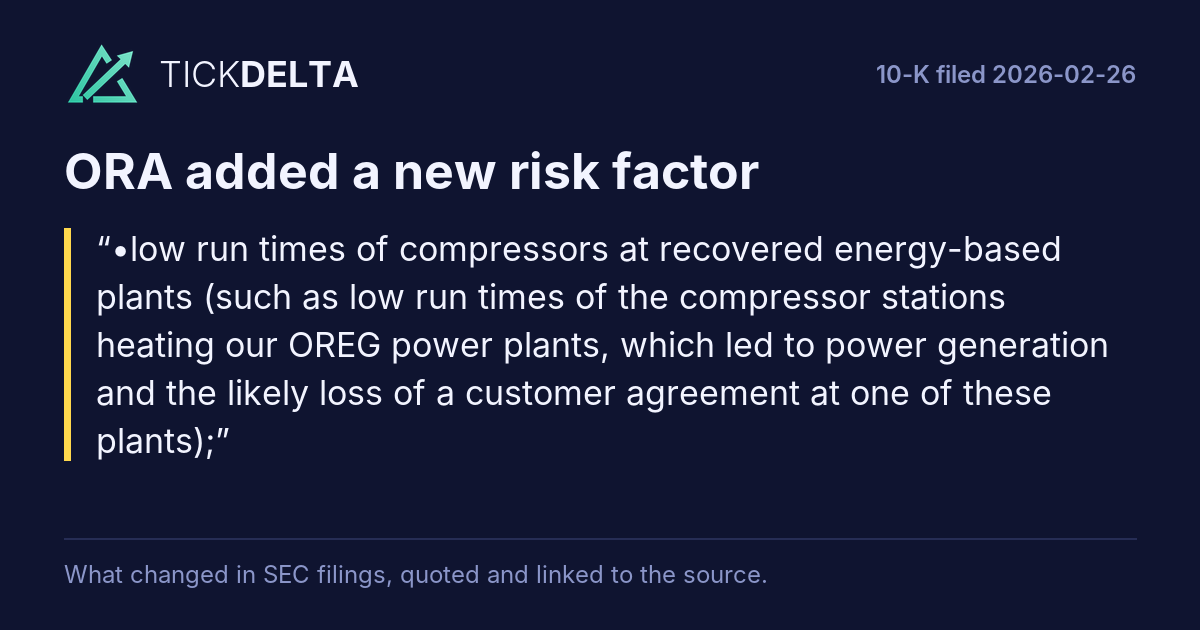
•low run times of compressors at recovered energy-based plants (such as low run times of the compressor stations heating our OREG power plants, which led to power generation and the likely loss of a customer agreement at one of these plants);

Read in the 10-K

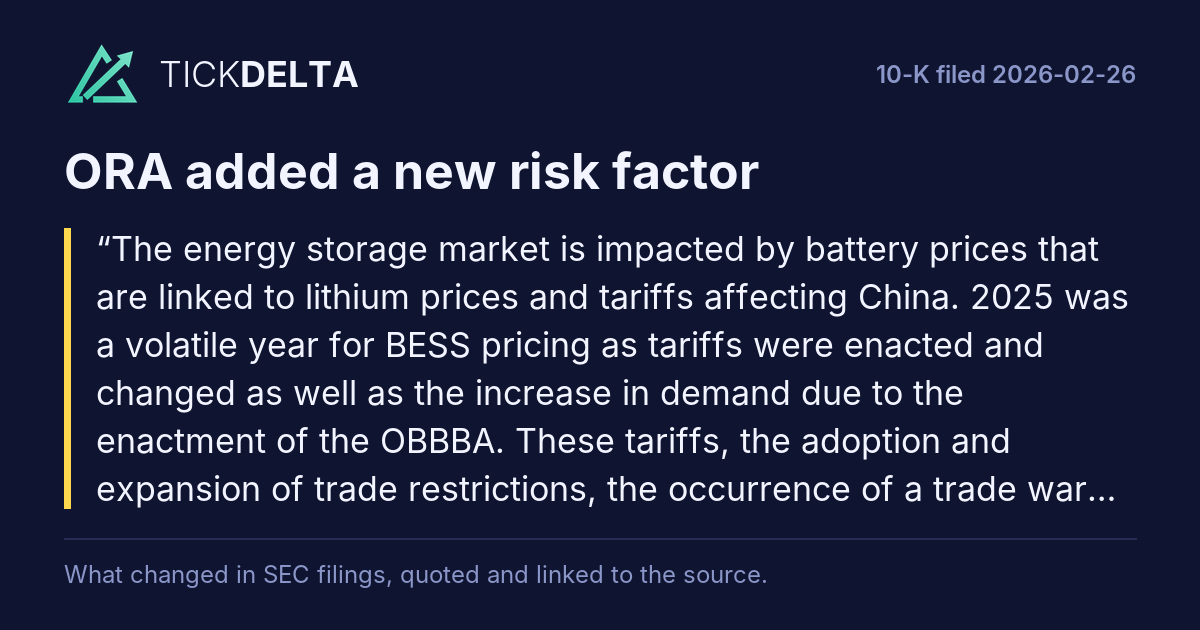
The energy storage market is impacted by battery prices that are linked to lithium prices and tariffs affecting China. 2025 was a volatile year for BESS pricing as tariffs were enacted and changed as well as the increase in demand due to the enactment of the OBBBA. These tariffs, the adoption and expansion of trade restrictions, the occurrence of a trade war or other governmental action related to tariffs, trade agreements or related policies have the potential to adversely impact our supply chain and access to equipment, our costs and ability to economically serve certain markets. If additional measures are imposed or other negotiated outcomes occur, our ability or the ability of our suppliers to purchase these products on competitive terms or to access specialized technologies from other countries could be further limited, which could adversely affect our business, financial condition and results of operations.

The OBBBA also introduced FEOC requirements for projects starting construction in 2026 and beyond, which led to developers safe harboring equipment prior to the end of 2025 so that ITC can be maintained. For more information, see Part I, Item 1 “Business—Business Opportunities—United States—Federal.” The FEOC rules may have the result of leading to pressure for increased supply chain costs, reduced supply chain options, and may lead to increased priced pressure for energy products and projects. Various battery suppliers are preparing to manufacture batteries in the U.S., which is expected to result in additional tax benefits for projects that will use domestically produced batteries. The reduction, elimination or inability to monetize government incentives and/or continued volatility in the tariff, could adversely affect our business, financial condition, future results and cash flows.

Read in the 10-K

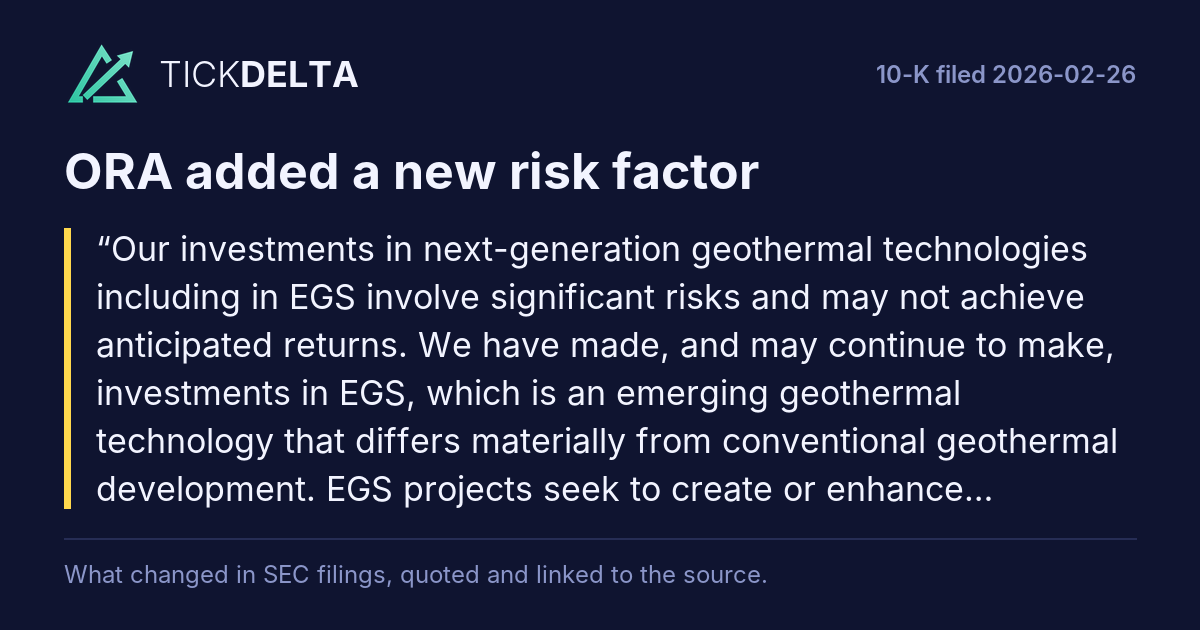
Our investments in next-generation geothermal technologies including in EGS involve significant risks and may not achieve anticipated returns.

We have made, and may continue to make, investments in EGS, which is an emerging geothermal technology that differs materially from conventional geothermal development. EGS projects seek to create or enhance geothermal reservoirs through advanced drilling, stimulation, and reservoir management techniques. While EGS has the potential to

expand the geographic and resource base for geothermal energy, the technology has not yet been widely deployed at commercial scale.

EGS projects involve substantial technical, operational, and geological uncertainties, including risks related to reservoir creation and sustainability, drilling success rates, well productivity, thermal recovery, induced seismicity, permitting, and long-term system performance. There can be no assurance that EGS projects in which we invest will achieve expected technical milestones, operate reliably, or produce energy at commercially viable levels.

In addition, EGS projects generally require significant upfront capital investment, extended development timelines, and may be dependent on continued technological advances, third-party expertise, government incentives, or regulatory support. Cost overruns, delays, or changes in regulatory frameworks could adversely affect project economics. Further, because EGS is a relatively nascent technology, there is limited operating history to validate assumptions regarding long-term performance, maintenance requirements, and decommissioning obligations.

If our EGS investments fail to progress as anticipated, experience technical or regulatory setbacks, or do not achieve commercial viability, we may be required to impair some or all of our investments, incur additional costs, or forego expected returns. Any such outcomes could have a material adverse effect on our results of operations, financial condition, and cash flows.

Read in the 10-K

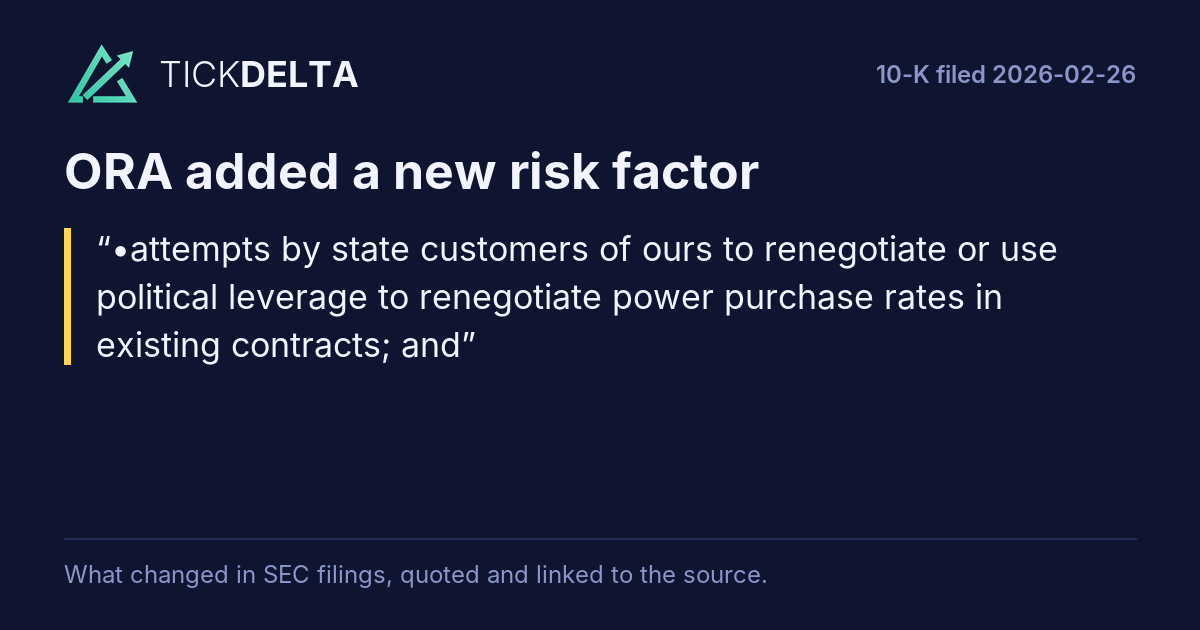
•attempts by state customers of ours to renegotiate or use political leverage to renegotiate power purchase rates in existing contracts; and

Read in the 10-K

Existing congestion of transmission capacity, as well as expansion of transmission systems and competition from other developers seeking access to expanded systems, could also affect our performance.

Read in the 10-K
Show the other 3

“Risks Related to Governmental Regulations, Laws and Taxation—The absence of new or renewed BLM permits for solar PV projects on U.S. federal lands could impair our development activities, project pipeline and growth prospects.”

Read in the 10-K

The absence of new or renewed BLM permits for solar PV projects on U.S. federal lands could impair our development activities, project pipeline and growth prospects.

The BLM has not issued new permits or renewed certain permits for standalone solar facilities, solar projects paired with energy storage, or solar installations intended to support geothermal auxiliary loads on U.S. federal lands where we have applied for permits to develop or for renewed permits to continue operating. While we have not recently experienced formal cancellations, the lack of new approvals and renewals creates significant regulatory uncertainty and may materially limit our ability to advance existing projects or develop new projects in locations that require federal land use permit, rights-of-way, environmental approvals, or other permits.

As a result, we may experience material delays in development timelines, increased project costs, loss of site control, termination or renegotiation of power purchase or interconnection agreements, and potential impairment of development assets. Limitations on access to U.S. federal lands may also reduce the number of viable development sites and increase competition and costs for projects on non-federal lands. Any of these factors could reduce our project pipeline, delay revenue generation, and adversely affect our growth prospects, financial condition, results of operations, and cash flows.

Read in the 10-K

Construction and operation of our geothermal power plants, battery energy storage systems and solar PV facilities has benefited, and may benefit in the future, from public policies and government incentives that support energy production (including, in certain cases, renewable energy and enhance the economic feasibility of these projects in regions and countries where we operate. On July 4, 2025, the OBBBA was enacted into law in the United States. The OBBBA allows for geothermal to qualify for 100% PTC or ITC related to projects that start construction by the end of December 2033, 75% PTC or ITC by the end of December 2034 and 50% PTC or ITC by the end of December 2035. These incentives allow the Company to transfer credits to unrelated third parties or enter into tax equity transactions, potentially improving project economics and reducing required Company capital. We expect that the construction and operations of our geothermal power plants, battery energy storage systems and solar PV will benefit in the future from certain aspects of the OBBBA and enhance the economic feasibility of projects in the United States. For information relating to risks of the OBBBA, see Part I, Item 1 “Risk Factors—Risks Related to the Company’s Business and Operation—Our investments and profitability in Battery Energy Storage System (BESS) may be negatively affected by a number of factors, including increases in storage costs, expanded trade restrictions, risk of fire and volatility in merchant prices.”

Read in the 10-K

Paragraphs in the 10-Q filed Nov 5, 2026 that were not in the one before

New in the latest 10-Q

17 paragraphs in the 10-Q filed Nov 5, 2026 with nothing like them in the 10-Q filed Aug 6, 2026 (at least half the words must differ; new numbers alone do not count). Quoted exactly, grouped by the item heading above them. This is text that changed, not a judgement of how serious it is.

Financial statements and notes

Additionally, as previously described under Note 1 to the consolidated financial statements included in the Company’s 2025 Annual Report, the Company accounted for the Dominica project transaction under the guidance of ASC 853, Service Concession Arrangements (“ASC 853”), which directs a reporting entity to apply ASC 606, Revenue from Contracts with Customers. Under ASC 853, the Company identified the construction and the operation of the power plant as two distinct performance obligations in this project. During the third quarter of 2026, in conjunction with the commencement of commercial operations of the power plant, the Company started recognizing revenues relating to the operation of the power plant performance obligation. Such revenues are included under Electricity revenues in the condensed consolidated financial statements.

Read in the 10-Q

New Accounting Pronouncements Effective in the Nine Months Ended September 30, 2026

Read in the 10-Q

Other non-operating income (expense), net 192 124 (19,952) 422 Total consolidated income before income taxes and equity in income of investees $22,596 $19,970 $68,386 $79,536

Read in the 10-Q

On October 26, 2026, Ormat Nevada Inc., a wholly owned subsidiary of the Company, entered into a definitive agreement with Northleaf Geothermal Holdings LLC (“Northleaf”) to acquire all of Northleaf’s ownership interests in the Puna Geothermal power plant (“PGV”), for an aggregate purchase price of $ 59.5 million. The consideration consists of an initial cash payment of $ 38.4 million, payable upon closing, plus interest at an annual rate of 5% from the agreement date through the payment date, and a deferred payment of $ 21.1 million, bearing no interest and payable within five business days following the achievement of a specified commercial operation milestone of the Puna repower power plant. The deferred payment obligation will automatically expire if the specified milestone is not achieved by September 30, 2030. The transaction is subject to customary closing conditions and is expected to close on or before January 7, 2027. Following transaction completion, the Company will own 100 % of PGV and will continue to consolidate PGV in its consolidated financial statements.

Read in the 10-Q

• Next generation technologies such as Enhanced Geothermal Systems (“EGS”), in which we have made investments, involve substantial technical, operational, and geological risks.

Read in the 10-Q
Show the other 12

• In October, 2026, we secured eight parcels totaling 20,266 acres in Nevada through a Bureau of Land Management (“BLM”) geothermal lease sale for potential hydrothermal and EGS development. These awards follow our August 2026 award of nine parcels totaling 13,324 acres for EGS development and an additional 488 acres at Cove Fort in Utah, as well as six parcels in New Mexico totaling 12,314 acres for both EGS and hydrothermal development.

Read in the 10-Q

• In September 2026, the Company announced that it had been selected by the U.S. Department of Energy, or DOE, for up to approximately $35 million in funding to advance geothermal development activities at its Dixie Valley project in Nevada and Cove Fort project in Utah, subject to completion of award negotiations with the DOE. The Dixie Valley project, in collaboration with SLB and the University of Utah, was selected for up to $25 million in funding to support the design, drilling, testing and validation of an EGS doublet (a horizontal injection paired with a production well). The Cove Fort project, in partnership with the University of Utah, was selected for up to $9.7 million in funding to support drilling and subsurface characterization of the existing hydrothermal resource.

Read in the 10-Q

accelerating the implementation of next-generation geothermal solutions. The strategic commercial agreement was closed.

Read in the 10-Q

(*) The 2031 Convertible Notes are presented as due in March 2031, which corresponds to their original maturity date.

Read in the 10-Q

Risk Factors

Next-generation geothermal technologies such as EGS, in which we have made investments, involve significant technical, operational, and geological risks.

Read in the 10-Q

We have made, and may continue to make, investments in EGS, which is an emerging geothermal technology that differs materially from conventional geothermal development. EGS projects seek to create or enhance geothermal reservoirs through advanced drilling, stimulation, and reservoir management techniques. While EGS has the potential to expand the geographic and resource base for geothermal energy, the technology has not yet been widely deployed at commercial scale.

Read in the 10-Q

In addition, EGS projects generally require significant upfront capital investment, extended development timelines, and may be dependent on continued technological advances, third-party expertise, government incentives, or regulatory support. Cost overruns, delays, or changes in regulatory frameworks could adversely affect project economics. Further, because EGS is a relatively nascent technology, there is limited operating history to validate assumptions regarding long-term performance, maintenance requirements, and decommissioning obligations. In sum, if our EGS investments fail to progress as anticipated, experience technical or regulatory setbacks, or do not achieve commercial viability, we may be required to impair some or all of our investments, incur additional costs, or forego expected returns.

Read in the 10-Q

EGS activities conducted at or near our existing operating geothermal power plants, including drilling, well stimulation, and fluid injection, could also adversely affect the productivity of existing hydrothermal reservoirs and the performance or operation of these facilities. This could potentially result in reduced power generation, operational disruptions, or additional costs. Technological advances in EGS may also prove to be superior to, or may not be compatible with, some of our existing technologies, investments and infrastructure, and may require us to make significant additional expenditures to remain competitive.

Read in the 10-Q

Other information

(a) Item 5.03. Amendments to Articles of Incorporation or Bylaws; Change in Fiscal Year.

Read in the 10-Q

On November, 4, 2026, the Company’s Board of Directors adopted amendments to the Company’s Seventh Amended and Restated By-laws (the “By-laws,” and as so amended, the “Amended By-laws”).

Read in the 10-Q

The Amended By-laws include amendments to do the following: update the disclosure requirements and procedures for stockholder action by written consent; expand the disclosure requirements for stockholders nominating individuals for election to the Board of Directors or proposing other business at a stockholder meeting, including with respect to affiliates and persons acting in concert; require stockholder nominees to participate in interviews with the Company’s Board of Directors, if requested, update questionnaire responses and provide additional information; and designate certain Delaware courts as the exclusive forum for specified corporate claims and federal courts as the exclusive forum for claims arising under the Securities Act.

Read in the 10-Q

The foregoing summary is qualified in its entirety by reference to the Amended By-laws, a copy of which is attached as Exhibit 3.1 to this quarterly report and incorporated by reference herein. Additionally, a copy of the Amended By-laws, marked to show changes to the By-laws, is included as Exhibit 3.2 to this quarterly report (additions are double-underlined, moves are single-underlined, and deletions are struck through) and incorporated by reference herein.

Read in the 10-Q

The 10-Q's risk factors against the 10-K

Item 1A of the 10-Q filed Nov 5, 2026 against Item 1A of the 10-K filed Feb 26, 2026. A 10-Q repeats only the risks that changed, so a 10-K paragraph that is missing from it is not counted as removed. Added is a paragraph with nothing like it in the 10-K, Reworded a sentence that is in both with several words changed, Quiet changes a sentence in both where one to four words changed and one is a hedge or a modal (cut words struck through, new words highlighted). Text on the page, not a score; each links to the filing at sec.gov.

Added10-Q Nov 5, 2026 vs 10-K Feb 26, 2026
A comprehensive discussion of our other risk factors is included in the “Risk Factors” section of our annual report on Form 10-K for the year ended December 31, 2025 which was filed with the SEC on February 26, 2026. The risks described in our Form 10-K are not the only risks we face. Additional risks and uncertainties not currently known to us or that we currently deem to be immaterial also may materially adversely affect our business, financial condition and/or operating results. During the period covered by this quarterly report on Form 10-Q, there have been no material changes in our risk factors previously disclosed in our 2025 Annual Report, except as reflected in the disclosure in “General - Trends and Uncertainties” in Part I, Item 2 of this quarterly report on Form 10-Q and below.

Read it in the 10-Q at sec.gov

Added10-Q Nov 5, 2026 vs 10-K Feb 26, 2026
Next-generation geothermal technologies such as EGS, in which we have made investments, involve significant technical, operational, and geological risks.

Read it in the 10-Q at sec.gov

Added10-Q Nov 5, 2026 vs 10-K Feb 26, 2026
EGS activities conducted at or near our existing operating geothermal power plants, including drilling, well stimulation, and fluid injection, could also adversely affect the productivity of existing hydrothermal reservoirs and the performance or operation of these facilities. This could potentially result in reduced power generation, operational disruptions, or additional costs. Technological advances in EGS may also prove to be superior to, or may not be compatible with, some of our existing technologies, investments and infrastructure, and may require us to make significant additional expenditures to remain competitive.

Read it in the 10-Q at sec.gov

Phrases used for the first time

Two-word phrases in Risk Factors of the 10-K filed Feb 26, 2026 that are in none of the 1 earlier 10-Ks stored, back to Feb 27, 2025

egs projects ×4united states ×3project economics ×3project pipeline ×3low run ×2run times ×2see part ×2part item ×2development timelines ×2power purchase ×2issued new ×2new permits ×2geothermal auxiliary ×2auxiliary loads ×2renewed permits ×2renewed blm ×2
Where each one is used
  • egs projects: We have made, and may continue to make, investments in EGS, which is an emerging geothermal technology that differs materially from conventional geothermal development. EGS projects seek to create or enhance geothermal reservoirs through advanced drilling, stimulation, and reservoir management techniques. While EGS...
  • united states: The OBBBA also introduced FEOC requirements for projects starting construction in 2026 and beyond, which led to developers safe harboring equipment prior to the end of 2025 so that ITC can be maintained. For more information, see Part I, Item 1 “Business—Business Opportunities—United States—Federal.” The FEOC rules...
  • project economics: In addition, EGS projects generally require significant upfront capital investment, extended development timelines, and may be dependent on continued technological advances, third-party expertise, government incentives, or regulatory support. Cost overruns, delays, or changes in regulatory frameworks could...
  • project pipeline: “Risks Related to Governmental Regulations, Laws and Taxation—The absence of new or renewed BLM permits for solar PV projects on U.S. federal lands could impair our development activities, project pipeline and growth prospects.”
  • low run: •low run times of compressors at recovered energy-based plants (such as low run times of the compressor stations heating our OREG power plants, which led to power generation and the likely loss of a customer agreement at one of these plants);
  • run times: •low run times of compressors at recovered energy-based plants (such as low run times of the compressor stations heating our OREG power plants, which led to power generation and the likely loss of a customer agreement at one of these plants);
  • see part: The OBBBA also introduced FEOC requirements for projects starting construction in 2026 and beyond, which led to developers safe harboring equipment prior to the end of 2025 so that ITC can be maintained. For more information, see Part I, Item 1 “Business—Business Opportunities—United States—Federal.” The FEOC rules...
  • part item: The OBBBA also introduced FEOC requirements for projects starting construction in 2026 and beyond, which led to developers safe harboring equipment prior to the end of 2025 so that ITC can be maintained. For more information, see Part I, Item 1 “Business—Business Opportunities—United States—Federal.” The FEOC rules...

The 10-K at sec.gov

Used at least twice, small words left out. Counted, not picked: a phrase can be new because the company renamed something.

What was taken out

27 paragraphs of last year's Risk Factors with nothing like them now. The longest are quoted.

Across all companies
Although we are a multinational company and we do not derive a majority of our revenues from Israel, we have known ties to Israel through the presence of our senior management and a significant portion of our Product segment there. The perception that we are an Israeli company could impair our business and results of operations due to the international response to Israel’s ongoing military conflicts on its borders or future similar conflicts. Our business could be substantially harmed by the interruption or curtailment of trade between Israel and its trading partners or the use of...
In the 10-K filed Feb 27, 2025
Since the beginning of the current war, several hundred thousand Israeli reservists have been drafted at various points in time to perform military service, including, an average of six percent of our workforce in Israel (average of two percent of our total global workforce), the vast majority of whom work in our Product segment. Some rockets have also landed during the war near our facilities. While these disruptions have caused an increase in insurance premium costs for shipments into and out of the seaport, as of the date of this Annual Report, none of our facilities or infrastructure...
In the 10-K filed Feb 27, 2025
Currently, we do not expect any significant impacts to the construction or operations of our geothermal power plants, recovered energy-based power plants, battery energy storage systems and solar PV facilities. However, the new U.S. presidential administration and/or the current U.S. Congress may, within the scope of their authority, take action to revise, repeal, or otherwise modify existing rules and regulations, including various tax incentives, and the impact of such on the Company remains uncertain at this time. The IRA and its tax credits remain in place as of the date of this Annual...
In the 10-K filed Feb 27, 2025
Our investments in BESS facilities may also be negatively affected by the prospect of expanded trade restrictions between the governments of the U.S. and where our global supply chain partners operate. As of early 2025, the Trump administration has imposed a 10% tariff on goods imported from China. We source the components of our batteries used in our battery energy storage services primarily from China, including into the U.S. At this time, it is unclear how further expanded trade restrictions may impact our investments or our global supply chain partners’ businesses, although they pose...
In the 10-K filed Feb 27, 2025

Sources

Item 1A of each 10-K and 10-Q on EDGAR, quoted exactly. Each paragraph links to the filing at sec.gov.

Also

10-K change: what was reworded or cut, section by section.

Work with it

Excel workbook · CSV. Google Sheet that stays up to date: paste =IMPORTDATA("https://tickdelta.com/company/ORA/export.csv") into a cell.

Next:10-K change
Esc

Type a ticker such as AAPL, a name, an investor such as Buffett, or a topic such as tariffs. ↑ ↓ to move, Enter to open.