Screener / SEC EDGAR /CIK 0001296445 /10-K filed Feb 26, 2026, compared with Feb 27, 2025 /Numbers from the XBRL of the 10-Ks
NYSE Utilities · Electric Utilities

Ormat Technologies, Inc. ORA

Compare with peers Embed
SEC comment letters, last 20 years

5 reviews of ORA's filings by SEC staff

UPLOAD and CORRESP
Reviews 5 latest letter Nov 1, 2024
Questions asked 24 each answered in the company's own letter
No closing letter 0 reviews without a letter saying the staff completed it

When the SEC's staff reviews a filing, it writes to the company with numbered questions, and the company answers each one in a letter. SEC publishes the exchange once the review is over, at least 20 business days later. A question is not an accusation; most reviews end with the company adding detail to its next filing.

How the reviews went

Every review on EDGAR, from the first staff letter to the letter that closes it

  1. 1. Staff letters 8 UPLOAD
  2. 2. Questions in them 24 numbered comments
  3. 3. Company replies 8 CORRESP
  4. 4. Reviews closed 5 of 5 closing letter

Half the closed reviews took 33 days or less from the first letter to the closing letter.

Form 10-K for the fiscal year ended December 31, 2023

2024-11-01 to 2024-12-02 · 1 question · 1 letter from the SEC, 1 from the company
Review closed 2024-12-02
Debt
Note 11- Long-Term Debt, Credit Agreements and Finance Liability · Don A. Campbell Senior Secured Notes - Non-Recourse, page 148
SEC asked
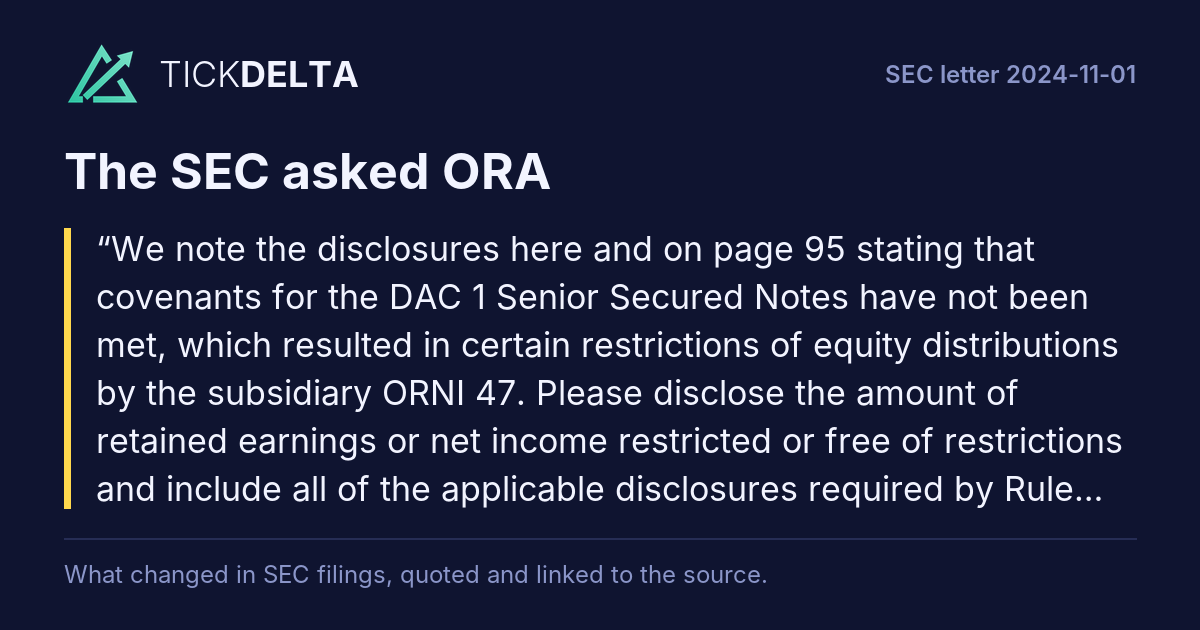
We note the disclosures here and on page 95 stating that covenants for the DAC 1 Senior Secured Notes have not been met, which resulted in certain restrictions of equity distributions by the subsidiary ORNI 47. Please disclose the amount of retained earnings or net income restricted or free of restrictions and include all of the applicable disclosures required by Rule 4-08(e) of Regulation S-X.
ORA answered
to the Staff’s comment, the Company will enhance its future disclosures filed with the Commission to comply with the applicable requirements of Rule 4-08(e) of Regulation S-X, by (i) indicating the amount of retained earnings or net income restricted or free of restrictions on the payment of dividends, and (ii) continuing to describe the most significant restrictions on the Company’s payment of dividends and any other information required by such rule.
Rest of the answer

For illustrative purposes only, assuming the same revisions in future disclosures, the cited disclosure on page 148 of the 2023 Form 10-K would read as follows:

“As of December 31, 2023, we did not meet the dividend distribution criteria related to the DAC 1 Senior Secured Notes, which resulted in certain equity distribution restrictions from this related subsidiary. The amount restricted for distribution by this subsidiary was

$7.2 million as of December 31, 2023. There were no other restrictions on the retained earnings or net income of Ormat Technologies,

Read in the reply
In its next report

First report after the company's reply of Nov 26, 2024: 10-K filed Feb 27, 2025 ↗, against the 10-K filed Feb 23, 2024 ↗.

Tickdelta does not hold the text of both reports, so they are not compared here.

Also in this review: closing letter, 2024-12-02

ORMAT TECHNOLOGIES, INC. · Forms 8-K · Filed June 27, 2022 and August 4, 2022 · File No. 001-32347

2022-08-11 to 2022-09-07 · 5 questions · 2 letters from the SEC, 2 from the company
Review closed 2022-09-07
Liquidity and cashResults discussion (MD&A)
Forms 8-K filed June 27, 2022 and August 4, 2022 · General
SEC asked (1)
We note that your Item 1.01 and 8.01 Form 8-K filed June 27, 2022 announced that you entered into an indenture for the issuance of Senior Convertible Notes. Attached to the June 27, 2022 Form 8-K as Exhibit 99.1 and 99.2 are press releases in which you disclose that the Company intends to offer “Green Convertible Senior Notes” due 2027.
Rest of the question

You further attached to a August 4, 2022 Item 2.02 Form 8-K as Exhibit 99.1 your press release announcing the results of operations for the fiscal quarter ended June 30, 2022, where you disclosed the closing of the offering of $431.3 million in "green convertible senior notes" due in 2027. Please provide to us, and explain where you have made available to investors, an explanation of what the “Green” Convertible Senior Notes designation means, including whether this designation carries any legal meaning.

ORA answered
Green bonds are bonds, the proceeds of which are intended for use in sustainability-focused projects. As the U.S. Department of Energy explains, “the main difference between green bonds and traditional bonds is that the issuer publicly states how it will use the proceeds to fund sustainable projects, allowing the bond to be marketed to investors as green.”1

While there is not a universal set of requirements for green bonds, a popular standard is the Green Bond Principles developed by the International

Capital Markets Association (“ICMA”).
Rest of the answer

The ICMA is a non-profit organization of over 600 members active in all segments of international debt capital markets in 65 jurisdictions globally. It discloses that its members include private and public sector issuers, banks and securities dealers, asset and fund managers, insurance companies, law firms, capital market infrastructure providers and central banks.

1 U.S. Department of Energy, Better Buildings Initiative, “What are Green Bonds?”, available at https://betterbuildingssolutioncenter.energy.gov/financing-navigator/option/green-bonds.

ICMA’s

Green Bond Principles (June 2021) are a voluntary set of best practices with the stated mission of “promoting the role that the global debt capital markets can play in financing progress towards environmental and social sustainability.”2

Under these principles, “Green Bonds” are “any type of bond instrument where the proceeds or an equivalent amount will be exclusively applied to finance or re-finance, in part or in full, new and/or existing eligible Green Projects … and which are aligned with the four core components of the [Green Bond Principles].” These four core components are (1) use of proceeds for green projects, (2) process for evaluation and selection, which communicate to investors in green bonds, among other things, the sustainability objectives of the eligible green projects and the process by which the issuer determines how the project fits within the categories of eligible green projects, (3) management of proceeds, and (4) reporting on the allocation of proceeds to eligible green projects until fully allocated.

In its offering memorandum, dated June

22, 2022 (the “Offering Memorandum”), in connection with the sale of its 2.50% Convertible Senior Notes due 2027 (the “Offering” and the “Notes”, respectively), the Company included for potential purchasers of the Notes, who consisted entirely of qualified institutional buyers or persons reasonably believed to be qualified institutional buyers within the meaning of Rule 144A, the Ormat Green

Finance Framework, a copy of which is included as Exhibit A. Pursuant to this framework, which was developed in connection with the Offering, the Notes qualify for the “green” designation.

In addition to the disclosures above, the Company makes clear to potential purchasers of the Notes on pages 22 – 23 of the Offering

Memorandum the voluntary nature of the “green” designation and that such designation does not carry any legal meaning or otherwise impose a legal obligation on the Company to allocate proceeds in a specific manner. The referenced disclosure provides as follows:

The indenture will not require that we allocate amounts relating to this offering to expenditures meeting the eligibility criteria or take the other actions as described under “Use of Proceeds.”

We intend to allocate an amount equivalent to the net proceeds from this offering to finance and/or refinance, in whole or in part, new or on-going projects (“Eligible Green Projects”) in accordance with the Ormat Green Finance Framework in, or substantially in, the manner described under “Use of Proceeds” and to take the other actions as described under “Use of Proceeds”;

however, the indenture will not require us to do so. Any failure to do so will not constitute an event of default under the indenture nor require us to purchase or redeem any of the notes or make any additional payments to holders or take or refrain from taking any particular action as a result thereof. There can be no assurance that the relevant projects or uses that are the subject of, or related to, any Eligible

Green Projects will be capable of being implemented in or substantially in such manner or in accordance with any timing schedule and that accordingly an amount equal to such proceeds will be totally or partially allocated to such Eligible Green Projects. There can also be no assurance that such Eligible Green Projects will lead to the results or outcomes (whether or not related to environmental or broader sustainability issues) originally anticipated by us. Any failure to allocate amounts relating to this offering to Eligible Green Projects, meet or continue to meet the investment requirements or aspirations of certain sustainability focused investors, or take the other actions as described under “Use of Proceeds,” may negatively affect the market price of the notes to the extent investors are required or choose to sell their holdings as a result of such failure.

2 ICMA, Green Bond Principles: Voluntary Process for Issuing Green Bonds (June 2021), available at https://www.icmagroup.org/assets/documents/Sustainable-finance/2022-updates/Green-Bond-Principles_June-2022-280622.pdf.

may allocate or re-allocate amounts relating to this offering in ways that you do not consider to meet the criteria for an Eligible Green

Project.

have significant flexibility in allocating amounts relating to this offering as described under “Use of Proceeds,” including re-allocating in the event we no longer own or operate assets to which we originally allocated such amounts in respect of Eligible Green

Projects or if the assets to which we originally allocated such amounts no longer meet the criteria for an Eligible Green Project. The ultimate allocation of amounts relating to this offering may therefore not meet some or all of your expectations at the time of this offering or as they may evolve during the life of this offering, even if we believe the expenditures to which we allocated such amounts were in respect of Eligible Green Projects.

cannot assure you that we will be able to identify sufficient business activities qualifying as Eligible Green Projects to which we could re-allocate amounts relating to this offering if we no longer own or operate a previously-allocated Eligible Green Project or if a previously-allocated

Eligible Green Project no longer meets the applicable criteria. Any failure to do so will not constitute an event of default under the indenture nor require us to purchase or redeem any of the notes or make any additional payments to holders or to take or refrain from taking any particular action as a result thereof.

cannot provide assurance that disbursements or allocations for Eligible Green Projects will be made or the amounts of such disbursements or allocations or, if such disbursements or allocations are made, on the timing of such disbursements or allocation.

value of the notes may be negatively affected to the extent investors are required or choose to sell their holdings due to the ultimate allocation of amounts relating to this offering not meeting their expectations or requirements.

Eligible Green Projects receiving allocations may not meet internationally recognized sustainability standards or your particular investment criteria, which may cause the market value of the notes to deteriorate. We cannot assure you that our reporting described under “Use of Proceeds” will meet your needs or expectations.

Although we have used the term “Eligible Green Projects” or otherwise referred to “green” aspects of this financing in this offering memorandum, there is no universally agreed definition (legal, regulatory or otherwise) nor market consensus as to what constitutes a “green” or “sustainable” or an equivalently-labelled expenditure or as to what precise attributes are required for a particular expenditure to be defined as “green” or “sustainable” or given such an equivalent label nor can any assurance be given that such a definition or consensus will develop over time.

Accordingly, no assurance is or can be given to investors that the Eligible Green Projects will meet any or all investor expectations or requirements regarding such “green,” “sustainable” or other equivalently-labelled performance objectives or that this offering will constitute a suitable investment for all investors seeking exposure to green assets or providing funds which can be considered to constitute sustainable financing. Prospective investors in this offering must determine for themselves the relevance of the description of the use of proceeds of this offering for the purposes of any investment by them together with any other investigation that they deem necessary. We can give no assurance that the Eligible Green Projects to which the amounts relating to this offering are allocated will satisfy, or continue to satisfy, investor criteria or expectations, taxonomies or standards regarding environmental impact and sustainability performance, nor can we give any assurance that the Eligible Green Projects criteria and other aspects of the framework described under

“Use of Proceeds” will satisfy, or continue to satisfy present or future investor criteria or expectations, taxonomies, standards, laws, regulations or industry guidelines.

addition, we give no assurance that any information that we or any other person may provide in connection with this offering now or in the future will be sufficient to enable any potential investor to satisfy any disclosure or reporting requirements imposed on it from time to time either as a result of their own objectives or those of their clients as set out in their by-laws or other governing rules and/or investment portfolio mandates. In addition, such requirements may have been conditioned by the application of laws and regulations relating to the types of, and criteria relating to, investments that such funds can make in order to qualify or be eligible as a particular type of “green” or other sustainable finance related investment. The rules applicable to such investors and funds, whether internal or resulting from any such investment portfolio mandates and/or applicable laws and regulations, may require them to make periodic disclosure of their investments, including any investment in this offering. Such requirements may evolve over time.

value of the notes may be negatively affected to the extent investors are required or choose to sell their holdings due to our definition of Eligible Green Projects or reporting relating to this offering not meeting their expectations or requirements. Our use of the proceeds from the offering sale of the notes may not comply with all or part of any relevant legislation or standards.

Read in the reply
Forms 8-K filed June 27, 2022 and August 4, 2022 · General
SEC asked (2)
In your Form 10-Q for Fiscal Quarter Ended June 30, 2022 on pages 37-38 you disclose that the net proceeds from the sale of the notes were approximately $420.4 million. You disclosed that you used (1) approximately $18.0 million of the net proceeds from this offering to repurchase concurrently with the closing of the offering shares of your common stock in privately negotiated transactions at a price per share equal
Rest of the question

to $69.45, (2) approximately $24.5 million of the net proceeds from this offering to pay the cost of the capped call transactions, (3) approximately $221.9 million to fund the prepayment of your Series 3 Bonds, and accrued and unpaid interest thereon, and make-whole payments, and (4) the remainder for general corporate purposes. You further disclose that you intend to allocate an amount equivalent to the net proceeds from this offering to finance and/or refinance, in whole or in part, one or more eligible green projects in accordance with the Company’s Green Finance Framework, and that in addition to proceeds from the offering, you may use cash from operations or borrowings under your credit facilities in order to effect such allocation. Given this description of your use of the proceeds from the notes offering, explain your basis for describing the notes as “Green Convertible Senior Notes" in your Forms 8-K. We also note such references to "convertible green notes" and "green convertible bonds" in your earnings call transcript and earnings call slides available on your website for the Q2 earnings conference call.

ORA answered
The Company respectfully refers the Staff to its response to Comment 1 above. As discussed above, bonds meeting the standards outlined in the ICMA’s Green

Bond Principles are considered “green bonds” in the marketplace. The Company intends to allocate an amount equal to the net proceeds from the sale of the notes (approximately $420.4 million) to “Eligible Green Projects” as defined in the Ormat

Green Finance Framework.
Rest of the answer

Upon full allocation of such amount, the Company also intends to obtain a report confirming such allocation from a qualified independent external reviewer, such as a “Big 4” accounting firm.

Read in the reply
Forms 8-K filed June 27, 2022 and August 4, 2022 · General
SEC asked (3)
Provide to us, and explain where you have made available to investors, a description of your Green Finance Framework, including any criteria or standards this framework suggests or requires for the selection of projects. In your response, describe eligible green projects and tell us how and by whom the Green Finance Framework was developed, reviewed and/or approved.
ORA answered
The Ormat Green

Finance Framework was made available to investors in the Offering to facilitate their investment decision. The Company was planning in the ordinary course to make a copy of the Framework available on its website and has recently done so under the

“Sustainability—Ormat Policies” at www.ormat.com. The Company is primarily engaged in the geothermal energy power business.
Rest of the answer

The Company has robust disclosure on the nature of its business and, because of this focus, the Company expects that the substantial majority of its investments would qualify as Eligible Green Projects.

Ormat Green Finance Framework was developed in alignment with the Green Bond Principles (2021) as published by the ICMA by the Company’s finance, legal and investor relations personnel, with assistance from the Company’s investment bankers and outside counsel, and approved by the Company’s senior management.

As outlined in the Ormat Green Finance Framework, Eligible Green Projects are allocations made by the Company or any of its subsidiaries to any of the projects defined below in the 24 months prior to or 24 months following the issuance date. Eligible Green Projects include the following: (A) Renewable Energy: Expenditures related to the research, field and site development, acquisition, manufacturing, distribution, maintenance, management and operation of: (i) new geothermal energy generation facilities with GHG emissions less than 100g

CO2e/KWh, (ii) upgrades to existing geothermal energy generation facilities to increase efficiency, resiliency and reliability, (iii) energy storage systems, or (iv) solar PV systems; and (B) Eco-efficient and/or circular economy adapted products: Expenditures to create and increase capacity, research and development to improve and optimize technologies, and the management of storage and distribution assets for recovered energy generation facilities.

Pursuant to the Ormat Green Finance Framework, the Company established an ESG Working Group comprising members of its executive, finance, investor relations, legal and environmental, social and governance (ESG) team. The working group reviews and selects projects that qualify as

Eligible Green Projects. In addition, upon full allocation of an amount equal to the net proceeds of the offering, the Company also intends to obtain a report confirming such allocation from a qualified independent external reviewer, such as a “Big 4” accounting firm.

Read in the reply
Forms 8-K filed June 27, 2022 and August 4, 2022 · General
SEC asked (4)
You disclose that you intend to allocate an amount equivalent to the net proceeds from this offering to finance and/or refinance, in whole or in part, one or more eligible green projects in accordance with the Green Finance Framework, and that in addition to proceeds from the offering, you may use cash from operations or borrowings under your credit facilities in order to effect such allocation.
Rest of the question

Explain whether you are contractually required to allocate an amount equivalent to the net proceeds from this offering to finance and/or refinance the eligible green projects. Please also explain why the framework means that you are offering “green” Convertible Senior Notes.

ORA answered
The Company respectfully refers the Staff to its responses to Comments 1, 2 and 3. As disclosed in the portions of the Offering Memorandum excerpted above, the Company is not contractually obligated to allocate the net proceeds from the offering to finance and/or refinance, in whole or in part, one or more Eligible Green Projects. As discussed above, because of its business focus, the Company expects that the substantial majority of its investments would qualify as Eligible Green Projects.

Company’s Green Finance Framework was developed in alignment with the Green Bond Principles.
Rest of the answer

Accordingly, consistent with market practice, when an offering meets the requirements set forth in the Company’s Green Finance Framework, the Company may designate the offered securities as “green.”

Read in the reply
Response Letter dated August 18, 2022 · General
SEC asked
We note your response to our prior comments. To the extent that future documents filed or furnished with the SEC include reference to “green bonds”, “green notes” or a “green finance framework”, confirm your understanding that you will include definitions of these terms or tell investors where such information can be located.
Rest of the question

For example, we note that you reference your green finance framework without further description in your recent Form 10-Q for the quarter ended June 30, 2022, in stating that you intend “to allocate an amount equivalent to the net proceeds from this offering to finance and/or refinance, in whole or in part, one or more eligible green projects in accordance with the Company’s

ORA answered
The Company respectfully acknowledges the Staff’s comment. The Company confirms that, to the extent that future documents filed or furnished with the Commission include reference to “green bonds”, “green notes” or a “green finance framework”, it will include definitions of these terms or inform investors where such information can be located.

***

U.S.
Read in the reply

Also in this review: closing letter, 2022-09-07

Form 10-K for the Fiscal Year Ended December 31, 2016

2017-08-04 to 2017-09-06 · 1 question · 1 letter from the SEC, 1 from the company
Review closed 2017-09-06
Executive pay
Annual Bonus, page 25
SEC asked
We note that the payment of bonuses to your named executive officers (other than your CEO) pursuant to the Plan was based on the “achievement of certain performance measures” and that “[t]arget, minimum and maximum awards, specified as a percentage of the employee's base compensation, [were] established for each participating employee.” Please revise to provide disclosure regarding the performance measures upon
Rest of the question

which such awards were based, how such performance measures were evaluated, the various target levels set by the Compensation Committee, and the level of performance actually achieved the Company and/or each named executive officer. Please also clarify whether the Compensation Committee has the discretion to grant such awards absent attainment of the stated performance targets. In addition, please revise to provide disclosure regarding the considerations made by the Compensation Committee when determining the number of equity awards awarded to each named executive officer; in this regard, we note that, in making such determinations, the Compensation Committee considers the Company’s performance and relative stockholder return, the expected contribution of the officer in question, the Company’s growth and success and past awards given. Please refer to Item 402 (b)(2)(iv),(v) and (vi) of Regulation S-K.

ORA answered
Ormat Technologies, Inc. (the "Company") acknowledges receipt of the letter dated August 4, 2017 (the "Staff Letter") from the staff (the "Staff") of the Division of Corporation Finance of the United States Securities and Exchange Commission (the "Commission") containing comments to the disclosures provided by the Company in its Definitive Proxy Statement on Schedule 14A filed with the Commission on April 10, 2017 (the "2017 Proxy Statement").

Set forth below are the Staff's comments contained in the Staff Letter (in bold face type) followed by our responses.

Annual Bonus, page 25

We note
Rest of the answer

that the payment of bonuses to your named executive officers (other than your CEO) pursuant to the Plan was based on the "achievement of certain performance measures" and that "[t]arget, minimum and maximum awards, specified as a percentage of the employee's base compensation, [were] established for each participating employee." Please revise to provide disclosure regarding the performance measures upon which such awards were based, how such performance measures were evaluated, the various target levels set by the Compensation

ORMAT TECHNOLOGIES, INC.

6225 Neil Road ●

Reno, NV 89511-1136 ●

Phone : (775) 356-9029 ●

Fax : (775) 356-9039

E-mail: [email protected]

Web site: http://www.ormat.com

Committee, and the level of performance actually achieved by the Company and/or each named executive officer. Please also clarify whether the Compensation Committee has the discretion to grant such awards absent attainment of the stated performance targets. In addition, please revise to provide disclosure regarding the considerations made by the Compensation Committee when determining the number of equity awards awarded to each named executive officer; in this regard, we note that, in making such determinations, the Compensation Committee considers the Company's performance and relative stockholder return, the expected contribution of the officer in question, the Company's growth and success and past awards given. Please refer to Item 402(b)(2)(iv), (v) and (vi) of Regulation S-K.

The Company proposes to replace in its future proxy statement filings on Schedule 14A the disclosures in the third and fourth paragraphs under the heading "Annual Bonus" in Compensation Discussion and Analysis in the 2017 Proxy Statement with the following disclosures:

"Annual bonuses for our other NEOs are payable in accordance with the Company's Annual Management Incentive Plan (the "Plan"), which was approved by the Board and the Compensation Committee on February 23, 2016. The Plan provides for annual cash incentive awards for participating employees based upon achievement of certain performance measures established by the Compensation Committee, based on the recommendations of our CEO. At the beginning of each fiscal year, our CEO reviews with the Compensation Committee the Company's objectives under the strategic plan, the Company's annual budget, the compensation practices of our peers and other market data, and recommends measurable financial and/or operational goals for the upcoming fiscal year. These measurable financial and/or operational goals may be with respect to the performance of the Company on a consolidated basis, the performance of the Company in a particular country or region and/or the performance of a business unit or operating segment of the Company, including a geographically-based business unit.

Based upon the CEO's recommendations, the Compensation Committee establishes Company Performance Metrics (as defined in the Plan), other individual performance criteria and varying levels of achievement under such Company Performance Metrics that result in the payment of minimum and maximum cash incentive awards, specified by the Compensation Committee as a percentage of the Plan participant's base salary, for each Plan participant for each fiscal year. The Compensation Committee also assigns a weight to the Company Performance Metrics and individual performance criteria that reflects the contribution of achievement of each Company Performance Metric and the individual performance criteria to a Plan participant's incentive award. The Company Performance Metrics and individual performance criteria against which performance is measured for each Plan participant in a given fiscal year may include: consolidated revenue, consolidated adjusted EBITDA, net income, Electricity segment revenue, Electricity segment gross profits, generation (GWh), Product segment sales, Product segment gross margin, next year bookings, project costs as of project completion and/or manufacturing costs as of project completion. In the event the level of achievement of a Company Performance Metric falls between the levels corresponding to a minimum and maximum incentive award, the Plan participant's incentive award will be based on a linear interpolation between the minimum and maximum incentive award amounts. Levels of achievement for each Plan participant for each fiscal year are measured by the CEO (or the Compensation Committee, in the case of an incentive award to the CEO) based on the reported Company Performance Metrics in the Company's audited financial statements, Annual Report on Form 10-K for such fiscal year and/or internal budgets, within 45 days after approval of the Company's annual financial statements by the Board. The Plan also requires that (i) at least 50% of any performance-based award be based on achievement of the established Company Performance Metrics and/or individual performance criteria and (ii) no performance-based award be paid under the Plan for any fiscal year unless the Company's consolidated annual net income for such fiscal year is positive. Under the Plan, the Compensation Committee has the authority to make incentive awards to any one or more Plan participants during any fiscal year as the Compensation Committee determines in its discretion is appropriate and in the best interests of the Company, regardless of the level of achievement of established Company Performance Metrics for such fiscal year. Such discretionary awards may be based upon the Plan participant's individual performance or achievement of individual goals and certain subjective assessments of the Plan participant's leadership and other contributions to the Company, as well as expected future contributions to the Company."

Additionally, the Company proposes to add to its future proxy statement filings on Schedule 14A under the heading "Annual Bonus" in Compensation Discussion and Analysis the following disclosures, updated to reflect information for the fiscal years covered by such future filings:

"For fiscal year 2016, incentive awards to each of our NEOs (other than our CEO) under the Plan were based upon (i) for all NEOs (other than our CEO), achievement of revenue and Adjusted EBITDA targets of $660 million and $308 million, respectively and (ii) for each NEO (other than our CEO), achievement of individual performance criteria specific to each NEO's role at the Company, including net income, Electricity and Product segment revenue, Electricity and Product segment gross margin, Product segment new sales (i.e., sales made in fiscal year 2016 for which the Company expects to recognize revenue after the end of fiscal year 2016) and electricity generation, compared to the Company's goals. The Company Performance Metrics applicable to all NEOs and the individual performance criteria specific to each NEO are based upon the Company's fiscal year 2016 corporate strategic initiatives, the Company's annual budget and individual performance. The chart below indicates the weight assigned to each Company Performance Metric and the individual performance criteria for each NEO for fiscal year 2016:

Named Executive Officer

Revenue

Adjusted EBITDA

Individual Performance Criteria

Discretionary

Doron Blachar, Chief Financial Officer

20%

40%

Zvi Krieger, Executive Vice President, Electricity Segment

10%

60%

Bob Sullivan, Executive Vice President, Business Development Sales and Marketing

Shimon Hatzir, Executive Vice President, Engineering

30%

0%

The chart below indicates the target and actual level of performance achieved with respect to each of the Company Performance Metrics applicable to all NEOs (other than our CEO), as determined by the CEO (all dollar amounts are in millions):

Company Performance Metric

Target

Actual

$660

$663

$308

$324

The Compensation Committee set minimum and maximum incentive award amounts for fiscal year 2016 at approximately 8% and 75% of the NEOs' annual base salaries, or approximately one month's base salary and nine months' base salary, respectively. The chart below indicates, for each of our NEOs (other than the CEO), after linear interpolation, the amount of the incentive award earned and paid out to him, expressed as a percentage of the maximum incentive award amount:

% of Award Earned and Paid Out

85%

83%

75%

71%

Accordingly, Messrs. Blachar, Krieger, Sullivan and Hatzir received incentive awards of approximately 64%, 62%, 56% and 53% of their annual base salaries, respectively, under the Plan in respect of the level of performance achieved with respect to the Company Performance Metrics and individual performance criteria, as described above."

Additionally, the Company proposes to replace in its future proxy statement filings on Schedule 14A the disclosures in the second paragraph under the heading "Equity Awards" in Compensation Discussion and Analysis in the 2017 Proxy Statement with the following disclosures:

"Within one month after the Compensation Committee determines the annual basket of equity awards that may be made to all of our employees, including our NEOs, our CEO recommends to the Compensation Committee the particular amount of equity awards to be made to each of the NEOs after consideration of a variety of factors, including the Company's performance and relative stockholder return, the expected contribution of the NEO to the Company's growth and success, awards granted to the NEOs in past years and certain survey and other market data regarding our peers' compensation practices. These factors are not assigned any particular weight nor does the Compensation Committee use a formula to apply these factors in order to determine the number of equity awards to be made to each of our NEOs. Instead, the Compensation Committee uses its judgment and experience in considering these factors to determine the appropriate number of equity awards to be granted to each of our NEOs for each fiscal year to ensure there is a strong link between our NEOs' compensation and performance and alignment of our NEOs' interests with those of our stockholders. Additionally, the Compensation Committee benchmarks against the average value of long-term equity incentive awards granted to NEOs with similar responsibilities at peer companies based on information provided to the Compensation Committee by AON Hewitt and Zviran (Israel), with the goal of offering competitive equity compensation that allows us to retain and incentivize our NEOs, while remaining within appropriate ranges established by our peers and the broader market. In general, the equity awards we grant to our NEOs are subject to the same pricing, vesting and exercise terms that govern the grant of equity awards to all of our employees. "

Please do not hesistate to contact the undersigned if there are any remaining questions or if you require further information.

Read in the reply
In its next report

First report after the company's reply of Aug 31, 2017: 10-Q filed Nov 9, 2017 ↗, against the 10-Q filed May 9, 2017 ↗.

Tickdelta does not hold the text of both reports, so they are not compared here.

Also in this review: closing letter, 2017-09-06

Form 10-K for the Fiscal Year Ended December 31, 2015

2016-06-24 to 2016-09-08 · 12 questions · 2 letters from the SEC, 2 from the company
Review closed 2016-09-08
SegmentsRevenueResults discussion (MD&A)Income taxesAcquisitions
Management’s Discussion and Analysis of Financial Condition and Results of Operation · General
SEC asked (1)
Please address the following comments regarding the geographic dispersion of your revenues and income:  Although your disclosures on pages 9, 10 and 99 indicate that the United States represents approximately 70% of your Electricity Segment and 90% of your Product Segment revenues for fiscal years 2014 and 2015, your disclosure on page 189 suggests that domestic revenues are closer to 50% of your overall revenues
Rest of the question

over that timeframe. Please reconcile these disclosures for us and revise your disclosures for clarity.  We note from the table on page 180 that your pre-tax income predominantly relates to your foreign operations. Please tell us and disclose why there is such a disparity in the pre-tax income contributed by your domestic and foreign operations. In doing so, clarify why your domestic operations generate minimal pre-tax income/losses despite material revenues. Please enhance your results of operations disclosures by separately discussing the results and trends of the geographic regions and/or countries in which you operate.

ORA answered
Reno, NV 89511-1136 ●

Phone : (775) 356-9029 ●

Fax : (775) 356-9039

E-mail: [email protected]

Web site: http://www.ormat.com that domestic revenues are closer to 50% of your overall revenues over that timeframe. Please reconcile these disclosures for us and revise your disclosures for clarity.
Read in the reply
In its next report

First report after the company's reply of Jul 14, 2016: 10-Q filed Aug 4, 2016 ↗, against the 10-Q filed May 6, 2016 ↗.

Tickdelta does not hold the text of both reports, so they are not compared here.

Overview, page 93
SEC asked (2)
Although you indicate at the top of page 94 that approximately 86% of fiscal year 2015 electricity segment revenues were from PPAs with fixed energy rates unaffected by fluctuations in energy commodity prices, you indicate in your Q4-15 earnings call on February 24, 2016 that 40% of your fiscal 2015 electricity revenues were tied to oil and natural gas prices.
Rest of the question

Please explain the reasons for this apparent discrepancy and clarify your disclosures accordingly.

ORA answered

No numbered answer found in the reply. Read the reply ↗

Overview, page 93
SEC asked (3)
We note your electricity segment generated power of 4,835,109 MWh in 2015 and 4,450,910 MWh in 2014. Based on total electricity revenues for those years, you earned, on average, $77.75 and $85.89 for each MWh in 2015 and 2014, respectively. We also note that the new contracts you are entering into are not affected by natural gas and oil prices and are at a rate of approximately $85.00.
Rest of the question

Please disclose and discuss the changes in rate per MWh as we believe the fluctuations in this metric provides valuable and insightful trend information to your investors regarding your electricity PPAs.

ORA answered

No numbered answer found in the reply. Read the reply ↗

Overview, page 93
SEC asked (4)
Please tell us and disclose whether the decline in energy commodity prices has affected the price of geothermal energy and whether it has affected contract negotiations. To the extent applicable, please also add disclosure discussing the risk of consumers switching to electricity generated from other sources, such as natural gas or fuel oil, due to the current low prices of such commodities.
Rest of the question

In doing so, please specifically address the risk for your power plants currently under construction as well the effect on future acquisitions.

ORA answered

No numbered answer found in the reply. Read the reply ↗

Comparison of the Year Ended December 31, 2015 and the Year Ended December 31, 2014 · Product Segment, page 105
SEC asked (5)
You state that the 23.4% increase in product segment revenues was primarily due to timing of revenue recognition, different product mix and commencing revenue recognition for new contracts. Your explanation of the increase in revenue is not overly informative and is similar to the explanation given in the prior year.
Rest of the question

Please expand your disclosure to provide additional detail on the changes in product mix and names of the significant contracts and amounts of revenue recorded for those contracts in the current and prior years. Quantify, where possible, the extent to which each identified factor contributed to the overall change in revenues. If a significant amount of product revenue was recorded for the Sarulla project, please also add disclosure that this contract will end sometime during 2017.

ORA answered

No numbered answer found in the reply. Read the reply ↗

In its next report

First report after the company's reply of Jul 14, 2016: 10-Q filed Aug 4, 2016 ↗, against the 10-Q filed May 6, 2016 ↗.

Tickdelta does not hold the text of both reports, so they are not compared here.

Income Taxes, page 107
SEC asked (6)
We note on page 181 that there is an effect of foreign income tax that creates a difference between the statutory and effective tax rate. To the extent material, please revise your discussion to separately discuss the reasons for fluctuations in the effective tax rates related to each material country in which you operate and consider quantifying the impact of each country on the overall effective tax rate.
Rest of the question

If a particular country contributes disproportionately to your income based on significantly lower tax rates, explain the impact such tax structures had on your results. If changes in the geographical mix of income were a significant driver of changes in your effective tax rate, please explain to us and disclose the facts and circumstances leading to the changes in the geographical mix of income and whether you expect these changes to continue. We refer you to Item 303(a)(3)(i) of Regulation S-K and Section III.B of SEC Release No. 33-8350. Please also clarify for us your statement on page 107 that your fiscal 2015 effective tax rate differs from the federal statutory rate “due to losses in the U.S. and certain foreign jurisdiction.”

ORA answered

No numbered answer found in the reply. Read the reply ↗

In its next report

First report after the company's reply of Jul 14, 2016: 10-Q filed Aug 4, 2016 ↗, against the 10-Q filed May 6, 2016 ↗.

Tickdelta does not hold the text of both reports, so they are not compared here.

Notes to Consolidated Financial Statements · Foreign currency translation, page 136
SEC asked (7)
Since you indicate that all of your subsidiaries and investees use the U.S. dollar as their functional currency, please clarify why you reference currency translation adjustments impacting comprehensive income. Also tell us if any of your foreign deposits disclosed on page 133 are held in currencies other than the U.S. dollar.
ORA answered

No numbered answer found in the reply. Read the reply ↗

In its next report

First report after the company's reply of Jul 14, 2016: 10-Q filed Aug 4, 2016 ↗, against the 10-Q filed May 6, 2016 ↗.

Tickdelta does not hold the text of both reports, so they are not compared here.

Note 2 – Share Exchange Transaction, page 142
SEC asked (8)
We note that you issued 3 million shares to your former parent in exchange for net assets with a carrying value of approximately $28 million. We note that the shares had an approximate fair value of $90 million on the date the share exchange was completed. Please tell us the authoritative GAAP guidance you relied upon in accounting for this transaction.
Rest of the question

In doing so, tell us what consideration you gave to reflecting the excess fair value distributed to your former parent as a reduction to equity.

ORA answered

No numbered answer found in the reply. Read the reply ↗

In its next report

First report after the company's reply of Jul 14, 2016: 10-Q filed Aug 4, 2016 ↗, against the 10-Q filed May 6, 2016 ↗.

Tickdelta does not hold the text of both reports, so they are not compared here.

Note 20 – Income Taxes, page 180
SEC asked (9)
Please clarify why your disclosures on page 107 suggest that you have a full valuation allowance on your domestic deferred tax assets related to net operating loss carryforwards and unutilized tax credits (PTCs and ITCs), when your deferred tax table on page 182 appears to indicate that such deferred tax assets are not fully reserved.
Rest of the question

In doing so, explain the difference between the related $70.5 million deferred tax asset discussed on page 107 to the related gross deferred tax assets totaling approximately $176 million on page 182.

ORA answered

No numbered answer found in the reply. Read the reply ↗

In its next report

First report after the company's reply of Jul 14, 2016: 10-Q filed Aug 4, 2016 ↗, against the 10-Q filed May 6, 2016 ↗.

Tickdelta does not hold the text of both reports, so they are not compared here.

Note 21 – Business Segments, page 187
SEC asked (10)
Please identify for us your operating segments and disclose whether operating segments have been aggregated. See ASC 280-10-50-21.
ORA answered

No numbered answer found in the reply. Read the reply ↗

In its next report

First report after the company's reply of Jul 14, 2016: 10-Q filed Aug 4, 2016 ↗, against the 10-Q filed May 6, 2016 ↗.

Tickdelta does not hold the text of both reports, so they are not compared here.

Notes to Consolidated Financial Statements · Foreign currency translation, page 136
SEC asked (1)
We have reviewed your response to comment 7, including your proposed future disclosure. Since foreign currency translation adjustments are recorded within other comprehensive income and foreign currency transaction gains and losses are recorded within income pursuant to ASC 830-20-35, please revise your disclosures and statement of operations line item to remove reference to “translations” being recorded within
Rest of the question

income.

ORA answered
The Company will revise its disclosures and statement of operations line item to remove reference to "translations" being recorded within income in its future reports pursuant to the Securities Exchange Act of 1934, as amended (the "Exchange Act").

Note 21 – Business Segments, page 187

ORMAT TECHNOLOGIES, INC.
Read in the reply
In its next report

First report after the company's reply of Aug 12, 2016: 10-Q filed Nov 8, 2016 ↗, against the 10-Q filed May 6, 2016 ↗.

Tickdelta does not hold the text of both reports, so they are not compared here.

Note 21 – Business Segments, page 187
SEC asked (2)
We have reviewed your responses to comments 1 and 10, noting that your “profitability varies by geographic region.” Considering electricity prices and the availability factor of some of your domestic plants are “significantly lower” than that of your foreign power plants and your domestic power plants have a higher cost of revenues than your foreign plants, it appears that your foreign and domestic electricity
Rest of the question

operations have dissimilar economic characteristics. Please tell us how you determined that your Electricity reportable segment does not contain multiple operating segments by addressing the following comments. Please note that information pertaining to your Products segment can be excluded from this assessment.  Tell us the title and describe the role of your Chief Operating Decision Maker (CODM) and each of the individuals who report to the CODM.  Identify and describe the role of each of your segment managers.  Tell us how often the CODM meets with his direct reports, the financial information the CODM reviews to prepare for those meetings, the financial information discussed in those meetings, and who else attends those meetings.  Tell us who is held accountable for each power plant or each subset of power plants, along with the title and role of the person each of these individuals reports to in the organization.  Describe the information regularly provided to the CODM and how frequently it is prepared.  Describe the information regularly provided to the Board of Directors and how frequently it is prepared.  Explain how budgets are prepared, who approves the budget at each step of the process, the level of detail discussed at each step, and the level at which the CODM makes changes to the budget.  Describe the level of detail communicated to the CODM when actual results differ from budgets and who is involved in meetings with the CODM to discuss budget-toactual variances.  Describe the basis for determining the compensation for each of the individuals that report to the CODM.

ORA answered
Ormat's major operational and financial decisions are made by its CEO in consultation with the CFO, collectively the CODM. As it relates to major operational and financial decisions for the Electricity segment, the role of the CODM is to focus on the decisions that will maximize the internal rate of return of deployable capital.
Rest of the answer

The CODM considers decisions relating to potential acquisitions, development, construction and financing of new power plants, and expansion or overhauls of existing power plants.

In addition to the CFO being a direct report to the CEO, the CEO's direct reports also include the following executive and other officers of the Company:

a)

Executive Vice President – Electricity Segment, Mr. Zvi Krieger b)

Executive Vice President – Product Segment, Mr. Shlomi Argas c)

Executive Vice President Business Development Sales and Marketing, Mr. Bob Sullivan d)

Executive Vice President – Production, Mr. Erez Klein e)

Executive Vice President Engineering, Mr. Simon Hatzir f)

Vice President HR – Ms. Liat Arad-Inbar g)

General Counsel – Ms. Lynn Alster h)

IT Manager – Mr. Meir Moshka

Identify and describe the role of each of your segment managers.

FASB ASC 280-10-50-7 provides that "[g]enerally, an operating segment has a segment manager who is directly accountable to and maintains regular contact with the chief operating decision maker to discuss operating activities, financial results, forecasts or plans for the segment. The term segment manager identifies a function, not necessarily a manager with a specific title."

The Company believes that Mr. Krieger, as the Executive Vice President – Electricity Segment and Mr. Argas, as the Executive Vice President – Product Segment meet the definition of "segment manager" for the Company's Electricity and Product segments, respectively.

The Electricity segment manager is responsible for overseeing the operating activities, financial results and forecasts for all of the Company's power plants, regardless of location. Operational decisions for the Electricity segment are frequent and include, but are not limited to, decisions relating to employee matters and labor allocation, maintenance and repairs and certain safety related matters. The segment manager makes these types of operational decisions in consultation with his direct reports (unlike capital deployment decisions which are made by the CODM). The Electricity segment manager is directly accountable to, and maintains regular contact with the CEO with respect to his areas of responsibility and will provide updates of certain, but not all of, the various day-to-day operating decisions that have been made at our power plants so as to keep the CEO informed of the results of the Electricity segment.

The Product segment manager is responsible for overseeing the timely delivery and performance quality of our products, managing costs and expenses actually incurred to complete customer orders compared to the costs and expenses originally budgeted for such orders, regardless of location, and reporting the Product segment's overall results. The Product segment manager provides regular updates of the performance of the Product segment at weekly and monthly meetings with the CODM.

Tell us how often the CODM meets with his direct reports, the financial information the CODM reviews to prepare for those meetings, the financial information discussed in those meetings, and who else attends those meetings.

The CODM meets with the Executive Vice Presidents, as a group, formally once a week and in addition, formally once a month. The CEO also meets weekly with each of the Executive Vice Presidents individually on an informal basis in order to stay informed as to current activities in their respective areas of responsibility. The CEO meets with his three other direct reports periodically and on an as-needed basis.

For the weekly meeting with the group of Executive Vice Presidents, there are no formal reports prepared, rather a weekly discussion agenda is prepared and discussion topics vary based upon the various operating developments that require updating to the CODM.

The financial and operational information prepared and provided at the monthly meetings for the Electricity segment are (i) actual vs. budget for megawatt generation by power plant and in the aggregate, (ii) actual vs. budget for revenue by power plant and in the aggregate, (iii) actual vs. budget for total expenses by power plant and in the aggregate, and (iv) actual vs. budget for EBITDA by power plant and in the aggregate. For each of the above items (i) – (iv), the information is also subtotaled for our domestic power plants and for our foreign power plants.

The Electricity segment financial information consists only of generation in megawatt hours ("MWh"), revenues, expenses, gross margin and EBITDA. There is no discrete balance sheet or cash flow for the Electricity segment as a whole or for either the domestic or foreign operations within the Electricity segment.

During the monthly meetings, the Electricity segment manager informs the CODM of the overall financial results of the Electricity segment. He also provides updates to the CODM as to the results of individual plants to the extent that they represent larger drivers in any material budget to actual variances. This level of detail is provided to support the explanations for the material variances (if any) in the segment. The particular power plant or plants that drive overall segment variances may differ from month to month. By providing the individual power plant information, the segment manager can quickly point to which power plants may be driving the variance in the overall Electricity segment results for that month and also report on operating decisions that were made by the segment manager and his team with respect to the individual power plants driving variances. The information is not necessarily provided for the CODM to make operating decisions at the individual power plants (see discussion of the roles and responsibilities of the CODM and segment manager as described under the first and second bullet points above).

Tell us who is held accountable for each power plant or each subset of power plants, along with the title and role of the person each of these individuals reports to in the organization.

The Electricity segment manager has two managers that report to him. These direct reports are (i) the Vice President of Operations, Mr. Ohad Zimron, who oversees our domestic power plants, and (ii) the Director of Operations, Mr. Ezra Zemach, who oversees our foreign power plants. The reason for the split of responsibilities between these two managers regarding domestic and foreign power plants was principally decided as a way to manage the workload and improve real-time handling of required decision-making, given the different time zones in which the power plants are located, not necessarily due to any differences between the economic characteristics or geographies of the plants. These two managers have individual power plant managers that report to each of them. Both managers reside in the U.S. and have certain overlap in responsibilities as they share various functions. As such, Mr. Zimron and Mr. Zemach work closely together in resolving certain issues and matters for all of the Company's power plants. In addition, there are global meetings that include all of the power plant managers and there are also frequent discussions between Mr. Zimron and Mr. Zemach and the power plant managers on technical and operational issues in order to facilitate technical and engineering information sharing for the benefit of the entire Electricity segment. In addition, there are certain functions that are within the Electricity segment that serve all of the power plants regardless of geographic location. Those functions include engineering, wellfield maintenance and drilling. Further, within the Electricity segment, there is a Senior Finance Director who provides financial planning and analysis for the entire segment.

Describe the information regularly provided to the CODM and how frequently it is prepared.

The financial information for the Electricity segment that is provided to the CODM is prepared on a monthly basis and is described in the response under the third bullet point above.

Describe the information regularly provided to the Board of Directors and how frequently it is prepared.

Our Board of Directors (the "Board") receives a quarterly presentation with regard to the Electricity segment. The financial information in the quarterly presentation to the Board includes the following:

-

Total budget and actual megawatt production for the Electricity segment (this information is also provided for the individual power plants along with their respective gross margin percentage and price per megawatt, with subtotals for domestic and foreign power plants)

Budget vs. actual comparison for total revenues for the Electricity segment

Budget vs. actual comparison for total expenses for the Electricity segment

Budget vs. actual comparison for total EBITDA for the Electricity segment

A description of any individually large drivers of material budget vs. actual variances

The Company is covered by several sell-side analysts that issue research reports and updates on the Company. The reports that are issued and the models used by the analysts look at the Electricity segment as a whole and do not separate between individual power plants or the geographic location of power plants.

Explain how budgets are prepared, who approves the budget at each step of the process, the level of detail discussed at each step, and the level at which the CODM makes changes to the budget.

Budgets for the Electricity segment are initially prepared on a plant-by-plant basis by the respective power plant managers in consultation with the Electricity segment Senior Finance Director (the role of the Senior Finance Director is described under the fourth bullet point above). Each power plant's annual revenue budget is based upon estimated megawatt production for the upcoming year and pricing assumptions based upon the relevant power purchase agreement ("PPA"). Each power plant also builds an annual expense budget using a global standard template with numerous detailed expense categories. Upon the completion of the initial individual power plant budgets by the appropriate plant manager, Mr. Zimron and Mr. Zemach review the budgets with the plant managers and adjustments are made. Following that review process, the individual plant budgets are then presented to the Executive Vice President of the Electricity segment for additional review and adjustment. This process generally occurs over a 2 month period. Following the completion of the review by the Electricity segment manager and his direct reports, the total consolidated Electricity segment budget is submitted to the CODM for final review and comment prior to finalization. We note that while the consolidated Electricity segment budget does include individual power plant budgets, the scope of changes to the budget by the CODM are risk-based in nature and focus on uncertainties related to items such as megawatt generation, whether planned maintenance shutdowns should be scheduled, variable pricing in certain PPAs, cost assumptions for any material maintenance or timing or cost of planned drilling activities.

Describe the level of detail communicated to the CODM when actual results differ from budgets and who is involved in meetings with the CODM to discuss budget-to-actual variances.

The level of detail communicated to the CODM, including the frequency of discussions when actual results differ from budgets is described in the response under the third bullet point above. Also, as discussed in the response under the third bullet point above, the Electricity segment manager meets with the CODM each month to discuss segment results, but on occasion one or both of his direct reports may join the meeting to discuss segment results with the CODM.

Describe the basis for determining the compensation for each of the individuals that report to the CODM.

The compensation of the Executive Vice President of the Electricity segment is comprised of a base salary, as well as bonus. The bonus component is based on various parameters that include targets for (i) the Company's overall EBITDA performance, (ii) EBITDA performance of the Electricity segment as a whole and (iii) the overall performance of the group that is responsible for exploration and drilling. There are no bonus targets that are based on, or otherwise related to, domestic or foreign Electricity segment results.

The compensation of each of the other Executive Vice Presidents that are direct reports to the CODM are similarly comprised of a base salary, as well as bonus. The bonus component may vary based on the particular direct report's area of responsibility, but includes the Company's overall revenue and adjusted EBITDA performance, and other relevant considerations for the applicable function. None of these compensation packages include salary or bonus elements that are keyed off results or achievements of domestic versus foreign operations.

Conclusion

As discussed above, based upon the structure of our organization (i.e., CODM with distinct segment managers), the nature of the decision making responsibilities at the various levels within the organization, including the manner in which the CODM allocates resources between the operating segments and the way the CODM assesses performance of the Electricity operating segment, management maintains that the Electricity segment does not contain multiple operating segments.
Read in the reply
In its next report

First report after the company's reply of Aug 12, 2016: 10-Q filed Nov 8, 2016 ↗, against the 10-Q filed May 6, 2016 ↗.

Tickdelta does not hold the text of both reports, so they are not compared here.

Also in this review: closing letter, 2016-09-08

Form 10-K for the fiscal year ended December 31, 2012

2013-09-06 to 2013-10-11 · 5 questions · 2 letters from the SEC, 2 from the company
Review closed 2013-10-11
Income taxesResults discussion (MD&A)Liquidity and cashGoodwill and impairment
Management’s Discussion and Analysis of Financial Condition and Results of Operations, page · Liquidity and Capital Resources, page 118
SEC asked (1)
We note your disclosure on page 141 that you had deposits in foreign countries of approximately $33.2M and $57.8M at December 31, 2012 and 2011, respectively. Given your significant foreign operations coupled with the fact that these balances are a significant component of the consolidated balance sheet, please tell us your consideration of disclosing a statement that you would need to accrue and pay taxes if
Rest of the question

repatriated and, if true, a statement that you do not intend to repatriate the funds.

ORA answered
The Company considered this matter in light of, among others, Item 303(a) (1) of Regulation S−K and Section IV of SEC Release 33−8350. As more fully described in the response to #3 below, the Company plans for its foreign subsidiaries to continue to invest their earnings outside of the United States (“U.S.”), and it currently does not have plans to repatriate these earnings.

In the event that the Company changes its plans and repatriates these earnings, even though there may be subsequent tax consequences to the Company, it is impractical at this time for the Company to determine if it would
Rest of the answer

need to accrue and pay taxes in respect thereof. As of December 31, 2012, the Company has net operating losses in the U.S. of approximately $267.6 million. Likewise, the Company cannot predict at this time what the applicable tax laws would be in the U.S. and in the applicable foreign jurisdiction that the Company will be operating at the time of any such repatriation, and what tax credits (if any) would be available to the Company at the time of such distribution.

As such, the Company did not believe any disclosure with respect to the subject matter of the Staff's comment was necessary. However, in light of the Staff’s comment, we will continue to evaluate our disclosure in connection with future filings regarding this matter and, where material, we will provide additional disclosure as appropriate. In addition, beginning with its Form 10-Q for the fiscal quarter ended September 30, 2013 and in its future filings, the Company intends to add the following language in the Liquidity and Capital Resources section of its Management Discussion and Analysis:

“We believe that based on our plans to increase our operations outside of the U.S., the cash generated from our operations outside of the U.S. will be reinvested outside of the U.S.. In addition, our U.S. sources of cash and liquidity are sufficient to meet our needs in the U.S. and, accordingly, we do not currently plan to repatriate the funds we have designated as being permanently invested outside the U.S. If we change our plans, we may be required to accrue and pay U.S. taxes to repatriate these funds.”

Read in the reply
In its next report

First report after the company's reply of Sep 20, 2013: 10-Q filed Nov 6, 2013 ↗, against the 10-Q filed Aug 12, 2013 ↗.

Tickdelta does not hold the text of both reports, so they are not compared here.

Notes to Condensed Consolidated Financial Statements, page 140 · Note 19 – Income Taxes, page 185
SEC asked (2)
We note the reconciling item of “Dividends from foreign subsidiaries” as a major contributor to the difference between the U.S federal statutory tax rate and your effective tax rate. Please tell us more about the nature of this significant reconciling item. Please also tell us what consideration you gave to providing more detail on this reconciling item. We refer you to ASC 740-10-50-12.
ORA answered
The Company has historically concluded that the permanent reinvestment of unrepatriated earnings allowed for under ASC 740 applies to the earnings of its foreign subsidiaries. Accordingly, the Company has not recorded deferred taxes for the repatriation of such foreign earnings.

During the quarter ended December 31, 2012, the Company repatriated earnings from two foreign subsidiaries, Ormat Holding Corporation (“OHC”), a Cayman entity, and Ormat Systems Ltd (“OSL”), an Israeli entity:

-

OHC distributed $100.0 million in cash and recorded a payable to Ormat International Inc., a
Rest of the answer

wholly-owned subsidiary of the Company, in the amount of $50.0 million, for a total distribution of $150.0 million. Of such amounts, approximately $137.0 million was a distribution out of tax “earnings and profits” and, therefore, was recognized as a taxable dividend that was offset by net operating losses, and the remaining $13.0 million reduced the Company’s tax basis in OHC, as provided for in IRC §316.

With regard to the repatriation of approximately $100.0 million from OSL, approximately $79.0 million was distributed in the form of a note to the Company and approximately $21.0 million was converted from a preexisting trade payable to a note. Of such amounts, approximately $40.2 million was recognized as an inclusion in taxable income in 2012 as provided for in IRC §956 and offset by the Company’s net operating losses, and approximately $59.8 million will be recognized in taxable income during 2013 under IRC §956.

These cash distributions to the Company made during 2012 were the first ever remittances of foreign earnings received by the Company, and were a one-time event and we do not plan to repatriate the funds we have designated as being permanently invested outside the U.S. (see also the response to the Staff's comment #3 below).

We believe that the description “Dividends from foreign subsidiaries” used in the reconciliation of the statutory rate appropriately reflects the nature of the reconciling item in compliance with ASC 740-10-50-12.

Read in the reply
In its next report

First report after the company's reply of Sep 20, 2013: 10-Q filed Nov 6, 2013 ↗, against the 10-Q filed Aug 12, 2013 ↗.

Tickdelta does not hold the text of both reports, so they are not compared here.

Notes to Condensed Consolidated Financial Statements, page 140 · Note 19 – Income Taxes, page 185
SEC asked (3)
We note your intention to reinvest undistributed earnings of your foreign subsidiaries. Please reconcile this intention with the loan received from Ormat Systems Ltd. and please elaborate for us why this does not represent a change in your indefinite reinvestment position.
ORA answered
The Company has historically concluded that the permanent reinvestment of unrepatriated earnings allowed for under ASC 740 applies to the earnings of its foreign subsidiaries. Accordingly, the Company has not recorded deferred taxes for the repatriation of such foreign earnings.

The cash distributions to the Company made during 2012 were the first ever remittances of foreign earnings received by the Company, and were a one-time event.
Rest of the answer

Nevertheless, as a result of these distributions the Company re-evaluated its position that the undistributed earnings of foreign subsidiaries are indefinitely reinvested. Upon analysis of all factors and future cash projections, summarized below, the Company continues to maintain that the indefinite reinvestment assertion is appropriate.

The cash for both of the distributions discussed was generated through third party financing with favorable terms received in the fourth quarter of 2012 when the Company met the conditions for funding on a newly constructed power plant in Kenya which is owned by OHC through its subsidiary OrPower 4, Inc. (“OrPower 4”). OrPower 4 had constructed the Kenya plant using equipment and technology produced and provided by OSL (creating a loan to OrPower 4 from OSL). Once the third party financing was received, OrPower 4 repaid the loan to OSL using a portion of the Kenya financing. As a result of this one-time event, both OSL and OHC had unusually a significant amount of cash on-hand that management believed was not necessary for OSL or OHC to finance their operations or to develop future foreign projects.

Although the company used the proceeds to pay down higher interest debt in the U.S., the Company did not require the distribution to cover its U.S. operations or make U.S. debt payments and there were no outstanding loans payable to the Company prior to the distribution. The Company believes that it has sufficient capital in the U.S., including cash on hand, cash generated through the U.S. operations, and sufficient access to the capital markets as well as credit facilities, to support its ongoing operating needs, existing loan payments and future capital expenditures. The Company's U.S. operations currently generate positive cash flows and are projected to continue to generate positive cash flows as well as taxable income. In addition, the Company has analyzed the current cash and future cash flow of its foreign subsidiaries. Based on the Company’s current business strategy, the foreign subsidiaries have existing and future plans that will require that they use their cash, including cash for current and future project sites in foreign jurisdictions (including explorations in several sites in Chile, advanced negotiation on a Build, Operate, Transfer (“BOT”) contract in Honduras (a 35 Mega Watt project), various business developments in Indonesia including a $1.6 billion project (the Sarulla project) that the Company will own 12.75% of the concessioner and supply products for a total price of $254 million, negotiations on a Build, Operate, Transfer (“BOT”) contract in New Zealand (a 45 Mega Watt project) and other locations and foreign loan repayments). Furthermore, foreign subsidiaries have direct debt facilities and need cash to satisfy their local borrowings. Given these cash flow requirements, the Company plans that its foreign subsidiaries will use their own cash as well as debt facilities which are available to those subsidiaries to support the growth outside of the U.S.

Read in the reply
In its next report

First report after the company's reply of Sep 20, 2013: 10-Q filed Nov 6, 2013 ↗, against the 10-Q filed Aug 12, 2013 ↗.

Tickdelta does not hold the text of both reports, so they are not compared here.

Note 1 – General and Basis of Presentation, page 8 · Revision of Previously Issued Financial Statements, page 8
SEC asked (4)
We note your revision of financial statements for the year ended December 31, 2012 and quarter ended March 31, 2013 regarding the calculation and presentation of your income tax provision and the related deferred tax asset which relates to the non-cash impairment charge recorded in the fourth quarter of 2012.
Rest of the question

Please provide us with your SAB 99 materiality analysis to support your conclusion that your previously issued financial statements were not materially misstated. Please ensure you describe in detail why you believe your previously issued financial statements were qualitatively and quantitatively not materially misstated.

ORA answered
During the preparation of the financial statements for the second quarter of 2013, the Company discovered an error in the financial statements for the year ended December 31, 2012, and for the first quarter of 2013 regarding the calculation and presentation of its income tax provision and the related deferred tax asset. The attached SAB 99 analysis was prepared by the Director of Finance and reviewed by the Company's Audit Committee on August 8, 2013.
Rest of the answer

Based on the weight of quantitative and qualitative factors detailed in the attached analysis, the Company concluded that its previously issued financial statements were not qualitatively or quantitatively materially misstated. However, the correction was too large to record in the second quarter of 2013 and the Company corrected the error by revising the affected financial statements.

* * * * * *

We trust that the responses provided above address the issues raised in the Staff Letter. If you have any questions or require further clarification, please do not hesitate to contact the undersigned at (775) 356-9029 (ext. 32218).

Read in the reply
In its next report

First report after the company's reply of Sep 20, 2013: 10-Q filed Nov 6, 2013 ↗, against the 10-Q filed Aug 12, 2013 ↗.

Tickdelta does not hold the text of both reports, so they are not compared here.

Notes to Condensed Consolidated Financial Statements, page 140 · Note 19 – Income Taxes, page 185
SEC asked
We note your response to prior comment 2 and believe that, with a view toward transparency, the information included in that response would be useful information to the readers of the financial statements in helping to understand the nature of the reconciling item “dividends from foreign subsidiaries.” In future filings please include similar information from your response.
ORA answered
to the SEC’s comments, the Company will include additional discussion of significant reconciling items of its effective tax rate. Beginning with the Company’s Form 10-K for the year ending December 31, 2013 and in future filings, to the extent applicable, the Company will add the following language to the Notes to the Consolidated Financial Statements:

“During the quarter ended December 31, 2012, the Company repatriated earnings of approximately $250.0 million from two of its wholly-owned foreign subsidiaries.
Rest of the answer

These cash distributions to the Company made during 2012 were the first ever remittances of foreign earnings received by the Company and were a one-time event. The Company does not plan to repatriate the funds designated as being permanently invested outside the U.S. Of the cash distributions in 2012, $177.2 million was considered to be “Dividends from foreign subsidiaries”, which impacted the Company’s effective tax rate and $13.0 million reduced the Company’s tax basis in its foreign subsidiary. In addition, $59.8 million, which resulted in a deferred tax liability at December 31, 2012, was recognized as taxable income in 2013."

* * * * * *

We trust that the responses provided above address the issues raised in the Staff Letter. If you have any questions or require further clarification, please do not hesitate to contact the undersigned at (775) 356-9029 (ext. 32218).

Read in the reply
In its next report

First report after the company's reply of Oct 4, 2013: 10-Q filed Nov 6, 2013 ↗, against the 10-Q filed Aug 12, 2013 ↗.

Tickdelta does not hold the text of both reports, so they are not compared here.

Also in this review: closing letter, 2013-10-11

From the SEC's correspondence on EDGAR: staff letters (form UPLOAD) and company letters (form CORRESP), 21 letters filed since 2013-09-06. Questions and answers are matched by their numbers; topics come from words in each question. The reports are compared word for word (same form, before the first SEC letter against the first report after the company's reply). No AI.

Sources

The SEC's correspondence on EDGAR: staff letters (form UPLOAD) and company letters (form CORRESP), matched question by question. No AI.

Also

Filings: the letters in the filing list.

Work with it

Excel workbook · CSV. Google Sheet that stays up to date: paste =IMPORTDATA("https://tickdelta.com/company/ORA/export.csv") into a cell.

Next in Owners and insiders:Insider trades
Esc

Type a ticker such as AAPL, a name, an investor such as Buffett, or a topic such as tariffs. ↑ ↓ to move, Enter to open.