tickdelta
Sign in

Tickdelta is free for now. Sign up and get Pro free

← Screener

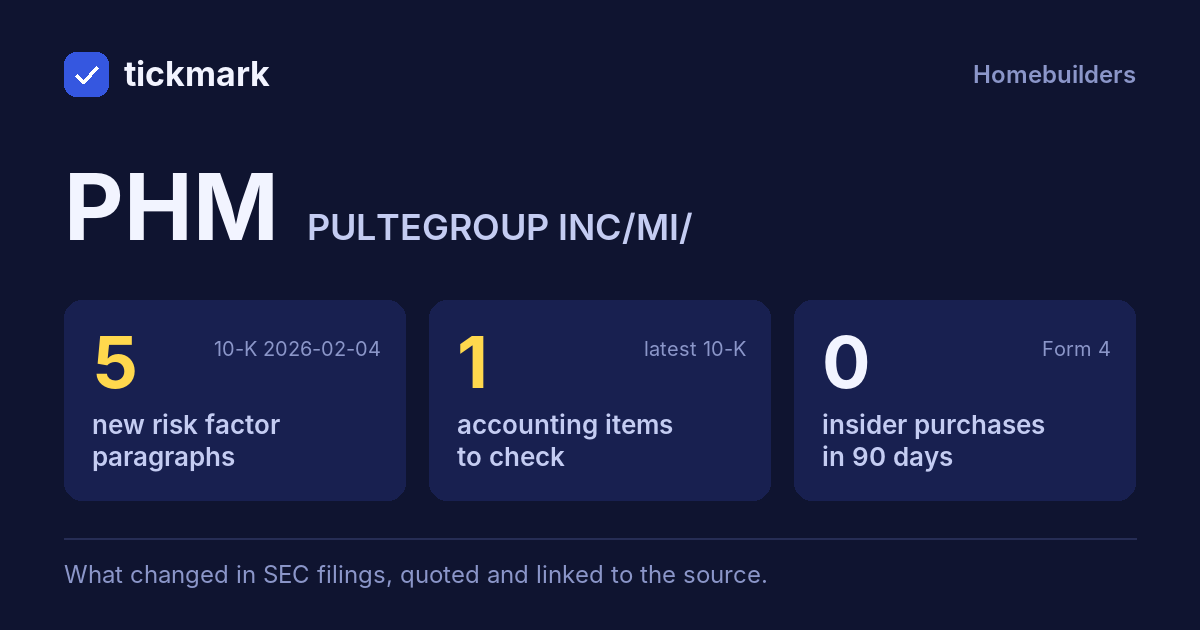
PHMPulteGroup

Consumer discretionary · Homebuilders · NYSE
Employees
6,506
Headquarters
Atlanta, GA
Next results
around Jan 28, 2027
Compare with peers → Embed

When the SEC's staff reviews a filing, it writes to the company with numbered questions, and the company answers each one in a letter. SEC publishes the exchange once the review is over, at least 20 business days later. Below: what the staff asked PHM, and the company's answer to each question, quoted from the letters. A question is not an accusation; most reviews end with the company adding detail to its next filing.

Form 8-K

2023-03-09 to 2023-03-20 · 5 questions · 1 letter from the SEC, 1 from the company
Review closed 2023-03-20
Non-GAAP measuresSegmentsGoodwill and impairmentLegal and contingencies
Reconciliation of Non-GAAP Financial Measures (Unaudited), page 10
SEC asked (1)
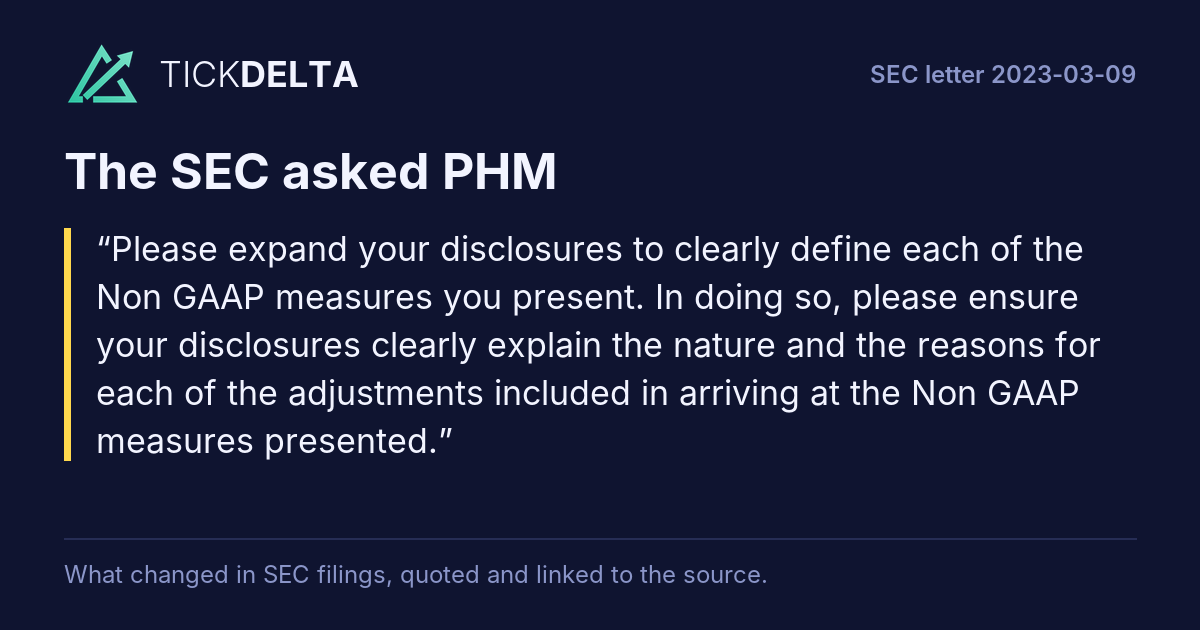
Please expand your disclosures to clearly define each of the Non GAAP measures you present. In doing so, please ensure your disclosures clearly explain the nature and the reasons for each of the adjustments included in arriving at the Non GAAP measures presented.
PHM answered
We acknowledge the Staff's comment and understand the need for transparency in our disclosures of non-GAAP financial measures. In future filings, we will more clearly define each non-GAAP financial measure presented and more clearly explain the nature of and reasons for each adjustment. Read in the reply ↗
Consolidated Balance Sheets, page 38
SEC asked (2)
Please revise to disaggregate your goodwill from intangibles on the face of your balance sheet (refer to ASC 350-20-45-1) to clearly delineate the balance of goodwill (nonamortizable) from other intangible assets. Please also expand your footnotes to include the disclosures required in ASC 350-20-50-1 by reportable segment.
PHM answered
In future filings, we will revise the face of the balance sheet to clearly delineate goodwill and align our disclosure within the applicable financial statement footnote with the requirements of ASC 350-20-50-1 as it relates to our reporting segments, including the presentation of the gross amount of goodwill and accumulated impairment losses and any changes in the carrying amounts during the period. Read in the reply ↗
Consolidated Statement of Operations, page 39
SEC asked (3)
Please show earnings from equity investments as a separate line item in your statement of operations or tell us why your presentation is appropriate. Please refer to Rule 5-03(b)(12) of Regulation S-X. 10. Other assets and accrued and other liabilities, page 62
PHM answered
In future filings, we will disaggregate earnings from equity investments as a separate line item in our statement of operations in accordance with Rule 5-03(b)(12) of Regulation S-X and will adjust our presentation within the applicable financial statement footnote to conform with this disaggregation.

10. Other assets and accrued and other liabilities, page 62 Read in the reply ↗
Consolidated Statement of Operations, page 39
SEC asked (4)
We note that within your accrued and other liabilities, there was approximately $351 million and $324 million as of December 31, 2022 and December 31, 2021 respectively related to "Other" liabilities. Such amounts represented approximately 21% of the total accrued and other liabilities balance and approximately 6% of total liabilities for each of the periods presented.
Rest of the question

In future filings, please expand your disclosures to provide additional clarity related to the underlying components included within such balances. 11. Commitments and contingencies, page 63

PHM answered
We confirm that there were no individual balances within "Other" liabilities that exceeded 5% of total liabilities at either December 31, 2022 or December 31, 2021. In future filings, we will expand our disclosures surrounding balances included within "Other" liabilities to provide additional clarity related to the underlying components.

11. Commitments and contingencies, page 63 Read in the reply ↗
Consolidated Statement of Operations, page 39
SEC asked (5)
In future filings, please expand your disclosures to highlight any amounts recognized related to CDD liabilities for each of the periods presented.
PHM answered
We acknowledge the Staff's comment and confirm that there were no such liabilities at either December 31, 2022 or December 31, 2021. In future filings, we will expand our disclosures as needed based on our consolidated balances of CDD liabilities.

We acknowledge that PulteGroup, Inc. is responsible for the accuracy and adequacy of our disclosures, notwithstanding any review, comments, action, or absence of action by the Staff.

We would welcome the opportunity to discuss any questions you may have regarding this response at your convenience. You may contact me at (404) 978-6417. Read in the reply ↗
Also in this review: closing letter, 2023-03-20
Form 10-K

2018-04-04 to 2018-05-30 · 4 questions · 1 letter from the SEC, 1 from the company
Review closed 2018-05-30
Results discussion (MD&A)Non-GAAP measuresLiquidity and cashGoodwill and impairmentCritical estimatesInventoryRevenueLegal and contingenciesReserves and insuranceIncome taxes
Note 2 – Inventory and land held for sale, Page 57 · Note 9 – Fair value disclosures, Page 69
SEC asked (1)
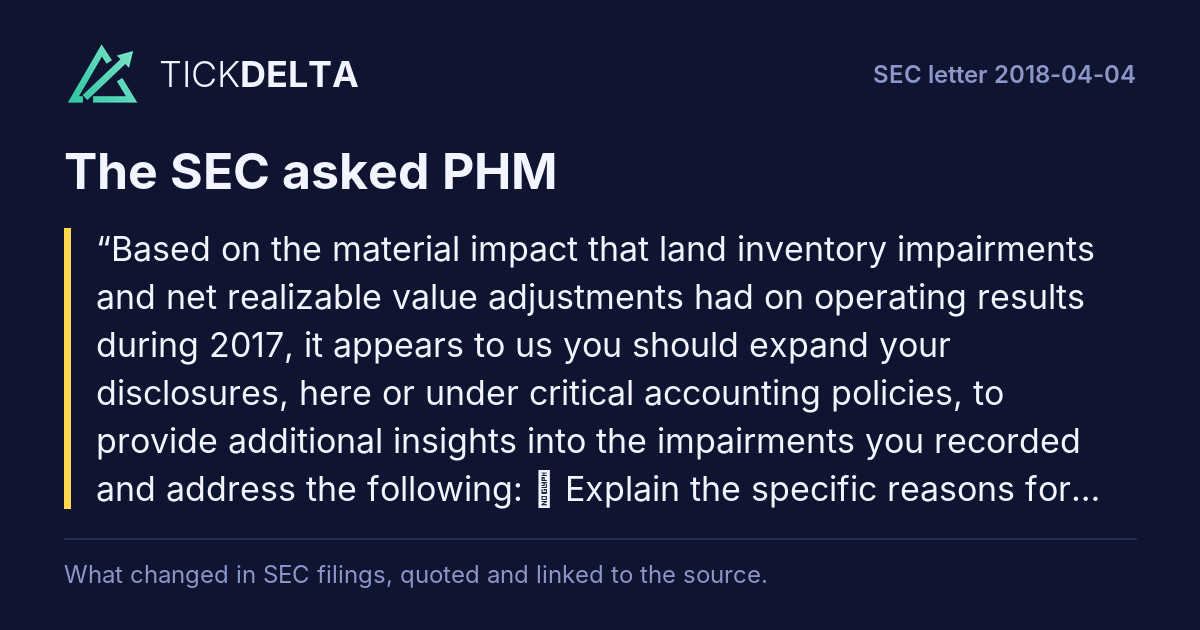
Based on the material impact that land inventory impairments and net realizable value adjustments had on operating results during 2017, it appears to us you should expand your disclosures, here or under critical accounting policies, to provide additional insights into the impairments you recorded and address the following:  Explain the specific reasons for the impairments you recorded in the second and fourth
Rest of the question

quarters of 2017.  Quantify and discuss the significant estimates and assumptions you used to determine estimated cash flows and fair values, including but not limited to projected sales price, absorption rates, timing and amounts of estimated future cash flows, and discount rates and address how sensitive your fair value estimates are based on your assumptions.  Disclose the number of developments/communities you tested for impairment.  Disclose the carrying values of the assets you tested.  Discuss material uncertainties associated with your key assumptions and potential events and/or circumstances that could have a negative impact on estimated fair values.  Clarify if the fair value disclosures related to house and land inventory and land held for sale in note 9 represent amounts at the relevant measurement date or amounts at the end of the reporting period based on the requirement of ASC 82010-50-2(a) and more fully disclose the valuation techniques and inputs you used in each fair value measurement as required by ASC 820-10-50-2(bbb) and ASC 820-10-50-2(f).

PHM answered
As the Staff noted, there were two distinct events that occurred during the second and fourth quarters of 2017 that led to the significant land inventory impairments and net realizable value adjustments. These events were unique in nature, driven by facts and circumstances specific to a small number of communities, and not reflective of our overall inventory portfolio or broader market conditions.
Rest of the answer

In order to better distinguish between these two events, we will include disclosure similar to the following in future filings in Note 2:

PulteGroup, Inc., 3350 Peachtree Road N.E., Suite 150, Atlanta, GA 30326

404.978.6400 pultegroupinc.com

Securities and Exchange Commission

"Land-Related Charges

We recorded the following land-related charges ($000's omitted):

Statement of Operations Classification

2017

2016

2015

Net realizable value adjustments ("NRV") - land held for sale

Land sale cost of revenues

$

83,576

1,105

(901

)

Land impairments

Home sale cost of revenues

88,952

1,074

7,347

Impairments of unconsolidated entities

Other expense, net

8,017

—

Write-offs of deposits and pre-acquisition costs

11,367

17,157

5,021

Total land-related charges

191,912

19,336

11,467

As noted in Note 1, we periodically elect to sell parcels of land to third parties in the event such assets no longer fit into our strategic operating plans or are zoned for commercial or other development. The NRVs in 2017 were primarily the result of a plan we announced in May 2017 to sell select non-core and underutilized land parcels following a strategic review of our land portfolio. The Company determined that it would sell certain inactive land parcels, representing approximately 17 communities and 4,600 lots. These land parcels were located in diverse geographic areas and no longer fit into our strategic plans. The land parcels identified for sale included: land requiring significant additional development spend that would not yield suitable returns; land in excess of near-term need; and land entitled for certain product types inconsistent with our primary offerings. As a consequence of the change in strategy with respect to the future use of these land parcels, we recorded NRVs totaling $81.0 million in the three months ended June 30, 2017, related to inventory with a pre-NRV carrying value of $151.0 million. An additional $2.6 million of NRVs were recorded throughout 2017 as the result of adjustments to the aforementioned valuations as the sale process progressed or related to other land parcels we chose to sell. The estimated fair values of these inactive land parcels held for sale were generally based on comparisons to market comparable transactions, letters of intent, active negotiations with market participants, or similar market-based information supplemented in certain instances by estimated future net cash flows discounted for inherent risk associated with each underlying asset.

Land impairments relate to communities that are either active or that we intend to eventually open and build out. In total for 2017, we reviewed each of our land positions for potential indicators of impairment and performed detailed impairment calculations for 13 communities resulting in total land impairment charges of $89.0 million related to nine communities with total pre-impairment carrying values of $105.8 million. The impairments resulted from:

As part of the May 2017 strategic review, we decided to accelerate the monetization of two small communities primarily through a combination of changing the product offerings and lowering the sales prices within the communities. This decision resulted in land impairments of $31.5 million in the three months ended June 30, 2017.

Separately, we recorded impairment charges of $57.5 million related to certain communities due to operating performance that was significantly lower than expectations. Of this amount, $53.0 million related to one large project that was impaired in the three months ended December 31, 2017. This impairment resulted from increases in our estimates for future land development and house construction costs combined with lower pricing and slower sales paces for this project, which is located in an area where competitive conditions limit our ability to offset our cost increases through higher sales prices.

As noted in Note 1, we determine the fair value of a community's inventory using a combination of discounted cash flow models and market comparable transactions, where available. These estimated cash flows are significantly impacted by estimates related to expected average selling prices, expected sales paces, expected land development and construction timelines, and anticipated land development, construction, and overhead costs. The assumptions used in the discounted cash flow models are specific to each community, which are located in several geographic markets and offer homes at sales prices reflective of the product offering and market. Accordingly, determining the fair value of a community's inventory involves a number of variables, many of which are interrelated. The table below summarizes certain quantitative unobservable inputs utilized in determining the fair value of impaired communities during 2017:

Unobservable Input

Range

Average selling price ($000s)

$207 to

$818

Sales pace per quarter (units)

Discount rate

12%

25%

Our evaluations for impairments are based on our best estimates of the future cash flows to be generated from our communities. Due to uncertainties in the estimation process, the significant volatility in demand for new housing, the long life cycles of many communities, and potential changes in our strategy related to certain communities, actual results could differ significantly from such estimates."

Clarify if the fair value disclosures related to house and land inventory and land held for sale in note 9 represent amounts at the relevant measurement date or amounts at the end of the reporting period based on the requirement of ASC 820-10-50-2(a) and more fully disclose the valuation techniques and inputs you used in each fair value measurement as required by ASC 820-10-50-2(bbb) and ASC 820-10-50-2(f).

In applying the guidance contained in ASC 820 to our homebuilding inventory and land held for sale, we follow the homebuilding industry convention of including only those assets that were adjusted to fair value as of the respective balance sheet dates, i.e., the end of the reporting period. This information is disclosed in each quarterly 10-Q so that the most recent activity is clear while historical information remains available. We believe this presentation is appropriate as it provides a financial statement user with a clear understanding of the portion of homebuilding inventory that has been adjusted to fair value at any point in time since differences between the fair values and carrying values of homebuilding inventory arise as time elapses. Additionally, since the disclosure of our valuation techniques and other requirements of ASC 820 are contained in other portions of the financial statements, we elect to refer to them so as to avoid repetition and the potential for misunderstanding. These concepts are embodied in the below excerpt from Note 9:

"The non-recurring fair value included in the above table represent only those assets whose carrying values were adjusted to fair value as of the respective balance sheet dates. See Note 1 for a more detailed discussion of the valuation methods used for inventory."

In light of the additional quantitative information we intend to include in future filings as indicated above, we will ensure that we include all of the required disclosures in the same financial statement note and clearly reference its location in other applicable sections of the financial statements, including Note 9.

Read in the reply ↗
In its next report

First report after the company's reply of 2018-04-17: 10-Q filed 2018-04-24 ↗, against the 10-Q filed 2017-10-24 ↗.

Tickdelta does not hold the text of both reports, so they are not compared here.

Note 11 – Commitments and contingencies, Page 74
SEC asked (2)
We note that the warranty reserves provided for homes sold during 2017 is less than the warranty reserves provided during 2016. We also note that home sale revenues and warranty payments both increased during 2017. Please provide an explanation for the decrease in warranty reserves provided during 2017.
PHM answered
As noted in our SEC filings, we accrue for warranty liabilities at the time product revenue is recognized and assess our recorded warranty liabilities for each geographic market in which we choose to operate. Thus, our warranty reserves reflect variations in the mix of homes sold across our geographic markets.
Rest of the answer

Additionally, two other factors contributed to the lower reserves provided in 2017: (1) progress in improving the quality of the homes we sell through continuous improvement in our house construction process, which contributed to more favorable warranty experience in 2017, and (2) an emphasis on efficiencies that have contributed to lower spending on recurring warranty costs. These favorable developments were offset by payments to complete repairs related to homes delivered in previous years in a closed-out community in Florida, as disclosed in Note 11. Such repairs caused total warranty payments to increase in 2017 versus 2016.

In future filings, we will ensure that we have appropriately explained meaningful trends in our warranty reserves.

Read in the reply ↗
In its next report

First report after the company's reply of 2018-04-17: 10-Q filed 2018-04-24 ↗, against the 10-Q filed 2017-10-24 ↗.

Tickdelta does not hold the text of both reports, so they are not compared here.

Exhibit 99.1 · Reconciliation of Non-GAAP Financial Measures, Page 10
SEC asked (3)
It appears to us that your earnings release essentially presents full non-GAAP statements of operations in the reconciliations of non-GAAP financial measures to the most directly comparable GAAP measures. Please tell us how you determined your presentation complies with the guidance in Question 102.10 of the updated C&DI related to Non- GAAP Financial Measures or explain how you intend to revise it.
PHM answered
In our fourth quarter 2017 earnings release, we presented adjusted operating results by line item as we believed that such a presentation would more clearly demonstrate the impact of the identified significant items on our operating results and key operating metrics as such items impacted multiple line items within the statement of operations.
Rest of the answer

In our efforts to comply with the purpose and intent of Regulation G to provide clear and comprehensive disclosures, we disclosed the GAAP results first throughout the earnings release, clearly labeled the non-GAAP results as non-GAAP, and positioned the non-GAAP reconciliation at the end of the earnings release, six pages beyond the GAAP statement of operations.

We acknowledge the Staff's position and the emphasis on this type of information in the updated C&DI related to Non-GAAP Financial Measures. Accordingly, in future filings, to the extent any non-GAAP information is presented, we will not present a full non-GAAP statement of operations when reconciling non-GAAP measures to the most directly comparable GAAP measures.

Read in the reply ↗
In its next report

First report after the company's reply of 2018-04-17: 10-Q filed 2018-04-24 ↗, against the 10-Q filed 2017-10-24 ↗.

Tickdelta does not hold the text of both reports, so they are not compared here.

Exhibit 99.1 · Reconciliation of Non-GAAP Financial Measures, Page 10
SEC asked (4)
We note that your non-GAAP reconciliations appear to present amounts comprised of several adjustments in one line item, making it difficult to fully understand the nature and amount of each non-GAAP adjustment. For example, you disclose in footnote (a) on page 11 of your earnings release that the income tax expense adjustment of $107.7 million is primarily related to the revaluation of deferred tax assets under the
Rest of the question

Tax Act enacted in December 2017; however, you disclose on page 22 of your 2017 Form 10-K that you recorded $172.1 million of income tax expense related to the revaluation of deferred tax assets. Please revise your disclosures to separately present and quantify each non-GAAP adjustment in your non-GAAP reconciliations. Refer to Item 10(e) of Regulation S-K.

PHM answered
We acknowledge the Staff's comment and understand the need for transparency in our disclosures. In future filings, we will separately present and quantify each non-GAAP adjustment in our non-GAAP reconciliations, as applicable.

We acknowledge that PulteGroup, Inc. is responsible for the accuracy and adequacy of our disclosures, notwithstanding any review, comments, action, or absence of action by the staff.

We would welcome the opportunity to discuss any questions you may have regarding this response at your convenience. You may contact me at (404) 978-6417. Read in the reply ↗
In its next report

First report after the company's reply of 2018-04-17: 10-Q filed 2018-04-24 ↗, against the 10-Q filed 2017-10-24 ↗.

Tickdelta does not hold the text of both reports, so they are not compared here.

Also in this review: closing letter, 2018-05-30

Form 10-K

2017-02-17 to 2017-03-08 · 2 questions · 2 letters from the SEC, 2 from the company
Review closed 2017-03-08
Legal and contingenciesReserves and insuranceCritical estimates
Item 8. Financial Statements and Supplementary Data · Note 12 – Commitments and contingencies, page 72
SEC asked
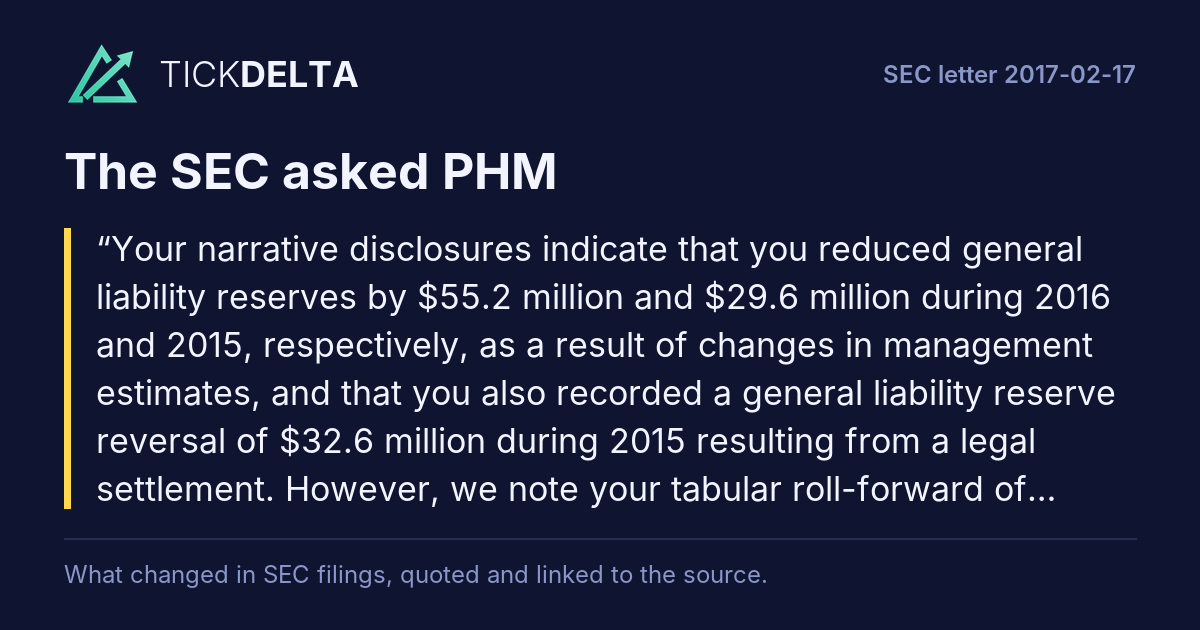
Your narrative disclosures indicate that you reduced general liability reserves by $55.2 million and $29.6 million during 2016 and 2015, respectively, as a result of changes in management estimates, and that you also recorded a general liability reserve reversal of $32.6 million during 2015 resulting from a legal settlement.
Rest of the question

However, we note your tabular roll-forward of self-insurance liabilities on page 75 indicates that you provided net reserves of $40.8 million and $16.1 million during 2016 and 2015, respectively. Please provide us a reconciliation of your narrative and tabular disclosures related to selfinsurance liabilities. In addition, please revise future filings to ensure that your narrative and tabular disclosures related to self-insurance liabilities better enable investors to understand the impact of and activity in your reserves and liabilities during each period presented.

PHM answered
The adjustments cited above are classified within the line item "Net reserves provided" in the aforementioned tabular rollforward. In direct response to the Staff's comment, we have provided below a revised tabular rollforward to be included in future filings that separately identifies such adjustments from reserves provided in the normal course of business ($000s omitted):

PulteGroup, Inc., 3350 Peachtree Road N.E., Suite 150, Atlanta, GA 30326

404.978.6400 pultegroupinc.com

Securities and Exchange Commission

2016

2015

Balance, beginning of period

$

924,563

995,692

Reserves
Rest of the answer

provided

96,027

78,268

Adjustments to previously recorded reserves

(55,243

)

(62,183

Payments, net

(134,289

(87,214

Balance, end of period

831,058

We will make similar disclosures, as applicable, in our future filings beginning with the quarter ending March 31, 2017.

We acknowledge that PulteGroup, Inc. is responsible for the adequacy and accuracy of the disclosures in the filing, notwithstanding any review, comments, actions, or absence of action by the staff.

We would welcome the opportunity to discuss any questions you may have regarding this response at your convenience. You may contact me at (404) 978-6417.

Read in the reply ↗
In its next report

First report after the company's reply of 2017-02-23: 10-Q filed 2017-04-25 ↗, against the 10-Q filed 2016-10-20 ↗.

Tickdelta does not hold the text of both reports, so they are not compared here.

Item 8 – Financial Statements and Supplementary Data · Note 12 – Commitments and Contingencies, page 72
SEC asked
We note your response to comment 1 of our letter dated February 17, 2017. We believe the revised tabular roll-forward you intend to provide in future filings will enhance your disclosures related to self-insurance reserves; however, please also revise your narrative disclosures under critical accounting policies to address the assumptions related to and the reasons for material changes in reserves provided during
Rest of the question

each period presented.

PHM answered
We will include the revised tabular rollforward reflected in our letter dated February 17, 2017, in future filings beginning with the quarter ending March 31, 2017, along with enhanced narrative disclosures under critical accounting policies to address the key assumptions related to and the reasons for material changes in self-insurance reserves during each period presented, as applicable.

We acknowledge that PulteGroup, Inc.
Rest of the answer

is responsible for the accuracy and adequacy of our disclosures, notwithstanding any review, comments, action, or absence of action by the staff.

We would welcome the opportunity to discuss any questions you may have regarding this response at your convenience. You may contact me at (404) 978-6417.

Read in the reply ↗
In its next report

First report after the company's reply of 2017-03-06: 10-Q filed 2017-04-25 ↗, against the 10-Q filed 2016-10-20 ↗.

Tickdelta does not hold the text of both reports, so they are not compared here.

Also in this review: closing letter, 2017-03-08

Form 10-K

2016-04-22 to 2016-05-27 · 2 questions · 2 letters from the SEC, 2 from the company
Review closed 2016-05-27
Legal and contingenciesCritical estimatesReserves and insurance
Item 8. Financial Statements and Supplementary Data, page 42 · Note 12. Commitments and contingencies – Self-insured risks, page 73
SEC asked
We note the general liability reserve reversals that you recorded in 2015 positively impacted pre-tax income by 8%. We also note the difference between the general liability reserve reversals that you recorded in 2015 and the increase in the general liability reserve related to siding repairs that you recorded in 2014 represents over 100% of the increase in pre-tax income from 2014 to 2015.
Rest of the question

Based on the significant impact that changes in these management estimates had on your operating results, it does not appear to us that the current disclosures in note 12 or under critical accounting policies provide sufficient information to enable investors to understand these critical management estimates and judgements that materially impacted your operating results. Please tell us, and expand your disclosures to address, the following:  Explain the material assumptions that resulted in the $69.3 million increase in the general liability reserve for siding repairs in 2014;  Explain the material assumptions that resulted in the $29.6 million reversal of the general liability reserve in 2015 due to favorable claims experience;  Explain the nature and terms of the $32.6 million legal settlement that also resulted in a reversal of the general liability reserve in 2015;  Provide a roll-forward of insurance receivables during the periods presented and explain the factors and material assumptions that impacted these amounts during each period presented; and  More fully address the litigation related to insurance receivables and your basis for determining collection is probable in light of the litigation.

PHM answered
to the Staff's comment on our historical disclosures, we have included the attached exhibit which reflects enhancements to our disclosures that we propose to incorporate into future filings that cover the applicable periods. We have reproduced the entire disclosure from the Form 10-K, Note 12, Self-insured risks so that the Staff can read the proposed enhancements within the context of the overall disclosure and have underlined the enhancements to our disclosures for ease of reference. The disclosures are presented on a pro forma basis as of December 31, 2016.
Rest of the answer

We will make similar disclosures, as applicable, in our quarterly filings beginning with the quarter ending June 30, 2016, as well as in critical accounting policies as appropriate.

As requested, following is a rollforward of our insurance receivables for the periods presented ($000's omitted):

2015

2014

2013

Beginning balance

$

60,596

52,264

54,187

Billed

70,995

26,327

8,119

Collected

(1,421

)

(17,883

(10,042

Write-offs

—

(112

Ending balance

130,170

The increase in our billed insurance receivables resulted from costs incurred to perform corrective repairs, settle claims with customers, and other costs related to the continued progression of construction defect claims that we believe are insured. Contributing to this increase is the fact that for our peak production volume years, including each of the years in the period from 2003 through 2008, we have exceeded our self-insured retention levels and are billing our carriers for claim payments as we fund them. As a result, while our actual claim payments have been decreasing in recent years, as reflected in the rollforward of the liabilities on page 74 of our Form 10-K, our billings to carriers over that period have increased. We expect this trend to continue for the next few years until we have substantially resolved claims related to the peak production volume years.

Given the complexities inherent in resolving construction defect claims in the homebuilding industry as described within Note 12 of our Form 10-K, there generally exists a significant lag between our payment of claims and our reimbursements from applicable insurance carriers. In addition, disputes between homebuilders and carriers over coverage positions relating to construction defect claims are common. Resolution of claims with carriers involves the exchange of significant amounts of information and frequently involves legal action. We are currently engaged in discussions relating to a large portion of the claim costs included in our insurance receivables, including litigation in certain instances, with a number of our carriers relating to the applicability of coverage to such costs under their policies. Following is a summary of the coverage status relating to significant elements of the insurance receivables balance:

We have been engaged in discussions with one of our carriers since 2011 regarding policies covering multiple policy periods involving homes sold between 2003 and 2010. The carrier alleges that we have not satisfied the aggregate retentions under the applicable policies and that, as a result, the reimbursements we have requested are not covered. Due to the carrier's inaction, we filed for two separate binding arbitrations in 2015 as provided for within the policies. The arbitrations are currently in the discovery phase, and hearings before the applicable arbitration panels have been scheduled for 2017. Once resolved with this carrier, it is expected that there will be further discussions and negotiations with other carriers, including excess carriers in these policy periods. Receivables outstanding under these policies totaled $51.9 million at December 31, 2015. We expect that our outstanding receivables under these policies will increase prior to final resolution of the matters as we continue to fund claims under these policies.

We filed suit against two of our carriers in 2007 in response to their non-payment of claims relating to homes sold prior to 2003. One of the carriers subsequently countersued claiming that we owe reimbursements to the carrier for claims paid by the carrier relating to homes sold by one of our acquired subsidiaries dating back to 1995. The court ruled in our favor in 2012 regarding the carrier's countersuit. Additionally, we received favorable rulings in our suit against the carriers in 2014 regarding certain matters, while other matters remain outstanding. Mediations and discussions with all parties continue, but final resolution will most likely extend into 2017 and beyond. Receivables outstanding under these policies totaled $50.7 million as of December 31, 2015, which we do not expect to increase materially as the statute of limitations for claims under these policies has expired.

In each of the above matters, we have provided significant amounts of information to the insurance carriers supporting our claims and initiated legal action as plaintiff in order to accelerate reimbursement of our costs following years of inaction by the carriers. With respect to the Staff's question relating to our evaluation of the realizability of our insurance receivables, we follow the guidance in ASC 410-30-35-8, which states that "...an asset relating to the recovery shall be recognized only when realization of the claims for recovery is deemed probable." Probable is used in the context of ASC 450-20-20: "The future event or events is likely to occur." We also consider the guidance within ASC 410-30-35-9, which states: "If the claim is the subject of litigation, a rebuttable presumption exists that realization of the claim is not probable." While such guidance is specific to environmental obligations, we understand that the principle is generally applied to other types of insurance recoveries.

Our consideration of the facts and circumstances relating to the insurance receivables recorded as of December 31, 2015, included the following facts and historical context:

Our understanding of the claims and related policies - The claims and policies related to these receivables are very well known to us. The underlying claims for which we are seeking reimbursement have been monitored for years and have been the subject of significant scrutiny and analysis by us and our third party administrator prior to submission to the carriers for reimbursement. While each general liability claim is unique and has its own facts and circumstances, the claims underlying the recorded insurance receivables are generally of a similar nature to other claims for which coverage has been received in the past.

Views of legal counsel - Both in-house and external counsel believe the costs we have submitted for reimbursement are consistent with the coverage provided by the insurance policies and that the carriers are contractually obligated to fund these receivables.

Legal rulings to date - While some aspects remain outstanding, we have received legal rulings on certain aspects of our litigated claims with our carriers that are supportive of our coverage expectations.

Historical experience - We have a long history of recoveries under our insurance policies, including significant recoveries from our current carriers under different policies, recoveries from other carriers for policies covering the same policy periods, and recoveries from other carriers for similar claims under similar policies covering different policy periods.

Payment history - We have not had any significant write-offs of insurance-related receivables in the past.

Counterparty default risk - We maintain our insurance policies with highly-rated underwriters for whom we believe counterparty default risk is not significant.

Based on the above, we have determined that collection of such receivables is probable and that the facts and historical context support overcoming the "rebuttable presumption" within ASC 410-30-35-9.

We acknowledge that:

PulteGroup, Inc. is responsible for the adequacy and accuracy of the disclosure in the filing;

Staff comments or changes to disclosure in response to Staff comments do not foreclose the Commission from taking any action with respect to the filing; and

PulteGroup, Inc. may not assert Staff comments as a defense in any proceeding initiated by the Commission or any person under the federal securities laws of the United States.

We would welcome the opportunity to discuss any questions you may have regarding this response at your convenience. You may contact me at (404) 978-6417.

Read in the reply ↗
In its next report

First report after the company's reply of 2016-05-05: 10-Q filed 2016-07-21 ↗, against the 10-Q filed 2016-04-21 ↗.

Tickdelta does not hold the text of both reports, so they are not compared here.

Item 8. Financial Statements and Supplementary Data, page 42 · Note 12. Commitments and contingencies – Self-insured risks, page 73
SEC asked
We note your response to our letter dated April 22, 2016, including your proposed disclosures. In regard to the insurance receivables you recorded, please disclose the amounts recorded that are being contested and discuss the reasons you concluded these amounts are probable of recovery.
PHM answered
In future filings, beginning with our Form 10-Q for the quarter ending June 30, 2016, we will disclose the amounts of recorded insurance receivables that are being contested and the reasons we conclude that such amounts are probable of recovery.

We would welcome the opportunity to discuss any questions you may have regarding this response at your convenience. You may contact me at (404) 978-6417. Read in the reply ↗
In its next report

First report after the company's reply of 2016-05-26: 10-Q filed 2016-07-21 ↗, against the 10-Q filed 2016-04-21 ↗.

Tickdelta does not hold the text of both reports, so they are not compared here.

Also in this review: closing letter, 2016-05-27

Form 14A

2014-05-29 to 2014-06-06 · 1 question · 1 letter from the SEC, 1 from the company
Review closed 2014-06-06
Executive pay
Compensation Discussion and Analysis, page 24 · Market Comparisons, page 30
SEC asked
Please refer to comment seven in our letter dated April 29, 2011 and your response dated May 19, 2011. We note that you continue to disclose that the committee uses a guideline range of the 50th to 75th percentile of market data to establish target compensation levels; however you do not disclose where each element of actual compensation fell relative to the guideline range.
Rest of the question

Please revise your future filings to comply with our prior comment seven in full.

PHM answered
In future filings of our Proxy Statement, we will disclose where each element of actual compensation fell relative to any disclosed guideline range of target compensation levels for the relevant compensation element.

We acknowledge that:

•

PulteGroup, Inc. is responsible for the adequacy and accuracy of the disclosure in the filing;

staff comments or changes to disclosure in response to staff comments do not foreclose the Commission from taking any action with respect to the filing; and

PulteGroup, Inc.
Rest of the answer

may not assert staff comments as a defense in any proceeding initiated by the Commission or any person under the federal securities laws of the United States.

Read in the reply ↗

Also in this review: closing letter, 2014-06-06

Form 10-K for the Fiscal Year Ended December 31, 2010

2011-08-01 to 2011-12-08 · 2 questions · 2 letters from the SEC, 4 from the company
Review closed 2011-12-08
SegmentsAcquisitionsControls
Form 10-K for Fiscal Year Ended December 31, 2010
SEC asked
We appreciate the information that you have provided to us in response to our concerns about your segment reporting. We note the following about this information: - On page four of your letter dated May 19, 2011, you tell us that your CEO is your CODM.
Rest of the question

- In consultation with the CEO, each Area is provided with an invested capital target, which is used to determine the allocation of capital to the Divisions within that Area. - The Area capital allocations targets are reviewed by the CEO quarterly in order to monitor the Area’s progress with respect to its’ invested capital target. - All acquisitions and sales of land parcels exist under a formal process of approval by the corporate office. Please tell us whether this requires the CEO approval. - We note that the reporting package contains discrete financial information at the Company, Homebuilding, Area, Division and Community level. Please note our view. If information is provided to the CODM, it is presumed that he uses such information. Further, after review of such information, it appears to us that the level of detail is in fact quite normal and appropriate for a CEO and anything less may imply a weakness of internal control. In your letter, you note that ASC 280 stipulates that the segments are evident from the structure of the public entity. We agree. However it appears to us that your communities, or at a minimum, your Divisions, are your operating segments and any aggregation of them is required to be consistent with the objectives of the guidance. In your letter to us on June 19, 2006 you told us that your CODM consisted of three individuals, the Chief Executive Officer (CEO), the Chief Operating Officer (COO) and the Chief Financial Officer (CFO). In your letter dated May 19, 2011, you told us that the CODM is the Chief Executive Officer. Please tell us on what date this change was made. Explain to us how the reporting and decision functions changed. Please be very specific in your response, so that we may understand how the COO and CFO, were no longer able to be part of the CODM group. Provide us with contemporaneous information to support the date of change.

PHM answered
To clarify our previous responses, the Company’s formal process for the corporate office approving all acquisitions and sales of land parcels does not require the formal approval by the CEO for each such transaction.

Regarding the change in the CODM, the CEO assumed more direct responsibility for the Company’s homebuilding operations with the elimination of the COO position in August 2010 (see Form 8-K filed August 12, 2010). Under the revised structure, the

Area Presidents report directly to the CEO along with certain other positions that previously reported to the COO.
Rest of the answer

In conjunction with these changes, the CODM changed to the CEO because the CEO has the ultimate responsibility “to allocate resources to and assess the performance of” (ASC 280-10-50-5) the Company’s operations.

Regarding the determination of operating segments, ASC 280-10-50-1 states:

“b. Its operating results are regularly reviewed by the public entity’s chief operating decision maker to make decisions about resources to be allocated to the segment and assess its performance.” (emphasis added)

We respectfully submit that the CEO assesses performance and allocates resources for our Homebuilding operations at the Area level. A variety of information, including the information we submitted, is used to assess the performance of the Areas and determine each Area’s invested capital targets. The Area presidents are in turn responsible for assessing performance and allocating capital within their respective Areas. We would also like to highlight that the Division presidents do not meet the definition of a segment manager, which ASC 280-10-50-7 describes as one that is “directly accountable to and maintains regular contact with the chief operating decision maker to discuss operating activities, financial results, forecasts, or plans for the segment”. In our organization, these criteria accurately describe our Area presidents.

We continue to believe that our

Areas represent our operating segments. In the event that you were to conclude that our Divisions represent our operating segments, we believe that the most appropriate aggregation of our Divisions would be in accordance with our Area structure in order to align with our internal organizational structure. This allows investors to see our Homebuilding operations from management’s vantage point. Presenting our Homebuilding operations in an alternative format would be inconsistent with how our operating results are reviewed and evaluated internally. Accordingly, whether our Areas or our Divisions are deemed to be the operating segments for our Homebuilding operations, we believe that our presentation of reportable segments is consistent with the objectives of ASC 280.

Read in the reply ↗
Form 10-K for Fiscal Year Ended December 31, 2010
SEC asked
We have considered your responses to our comments and the supplemental CODM materials you have furnished. Please note our view that the receipt of materials by the CODM indicates that such information is used by the CODM to make informed decisions regarding resource allocations and to assess performance.
Rest of the question

Based on the CODM materials you have provided, it appears to us that, at the very least, your 23 “Divisions” represent your operating segments as defined in ASC 280-10-50-1. Please provide us an aggregation analysis of your Divisions that incorporates the criteria outlined in ASC 280- 10-50-11. It may be helpful to explain to us the relative weighting you ascribe each factor. Please note our view that geographic proximity would appear to be a significant factor in any aggregation analysis, considering the nature of your industry.

PHM answered
We note your view regarding the determination of our operating segments. In applying the criteria outlined in ASC 280-10-50-11, we considered the following (repeated from our response dated July 8, 2011 for ease of reference):

•

Nature of the products and services - We are engaged in the acquisition and development of land and the construction of residential housing on such land within the United States. Our Divisions offer similar products, including single family detached and attached housing.
Rest of the answer

One of our key strategic initiatives is to continue standardizing and reducing the number of floor plans and home designs offered to our customers nationally.

Nature of the production processes - All Divisions employ similar processes for constructing homes and follow national construction standards. Construction work is generally performed by independent contractors under similar contracts. We also enter into many national purchasing contracts that standardize our materials and pricing across our Homebuilding operations.

Type or class of customer for products and services - We construct and sell homes to individual customers throughout the United States and service the majority of major customer groups, including first-time, move-up, and active adult customers. We develop communities and construct homes targeted towards these major customer groups using a standardized process to segment potential customers into well-defined buyer profiles.

Methods used to distribute products or provide services - We sell homes using company sales personnel and model homes generally located on-site at local communities. We also employ various national marketing and customer relations programs, including standardized processes for sales practices, communication with the customer throughout the construction process, and post-sale customer satisfaction surveys.

Regulatory environment - We operate in a regulatory environment that is substantially similar across our operations. For example, sales personnel are required to follow federal Real Estate Settlement Procedures Act and Fair Housing Act guidelines and many of our land development and construction activities are subject to the same federal rules and regulations. While each community is subject to the requirements of local municipal authorities, the approval processes for plan development, permitting, and house construction are similar across all geographies.

We have provided on a supplemental basis under separate cover the requested aggregation of our Homebuilding operations into reportable segments based on the view that each of our Divisions represents an operating segment. Based on the similarities across our Homebuilding operations and consistent with the SEC's expressed views, we believe our proposed aggregation, which considers geographic proximity as a significant factor, provides an appropriate presentation of our Homebuilding operations in accordance with ASC 280.

We intend to adopt this revised segment presentation in conjunction with our Form 10-K for the year ending December 31, 2011, including reclassification of applicable segment information for all prior periods presented.

Read in the reply ↗

Also in this review: company letter, 2011-08-12, company letter, 2011-10-04, closing letter, 2011-12-08

2 other letters: notices that a filing will not be reviewed, requests to declare a registration effective, and the like
  • 2011-07-08 · PHM: letter to the SEC · PulteGroup, Inc. · Form 10-K for the Fiscal Year Ended December 31, 2010 · Filed...
  • 2011-06-24 · PHM: letter · PulteGroup, Inc. · Form 10-K for the Fiscal Year Ended December 31, 2010 · Filed...

From the SEC's correspondence on EDGAR: staff letters (form UPLOAD) and company letters (form CORRESP), 28 letters filed since 2011-06-24. Questions and answers are matched by their numbers; topics come from words in each question. The reports are compared word for word (same form, before the first SEC letter against the first report after the company's reply). No AI.

Work on PHM in a spreadsheet: Excel workbook (a sheet per section, ten years by column, charts, links to the filings) · CSV. For a Google Sheet that stays up to date, paste =IMPORTDATA("https://tickdelta.com/company/PHM/export.csv") into a cell.