Form 10-K
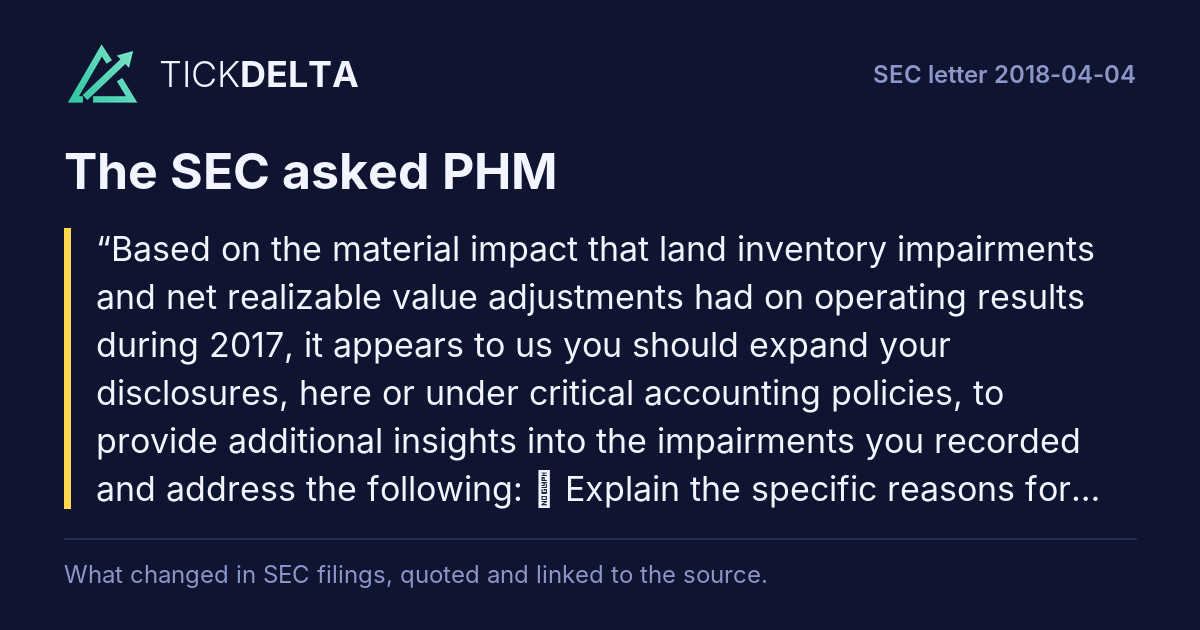
Based on the material impact that land inventory impairments and net realizable value adjustments had on operating results during 2017, it appears to us you should expand your disclosures, here or under critical accounting policies, to provide additional insights into the impairments you recorded and address the following: Explain the specific reasons for the impairments you recorded in the second and fourthRest of the question
quarters of 2017. Quantify and discuss the significant estimates and assumptions you used to determine estimated cash flows and fair values, including but not limited to projected sales price, absorption rates, timing and amounts of estimated future cash flows, and discount rates and address how sensitive your fair value estimates are based on your assumptions. Disclose the number of developments/communities you tested for impairment. Disclose the carrying values of the assets you tested. Discuss material uncertainties associated with your key assumptions and potential events and/or circumstances that could have a negative impact on estimated fair values. Clarify if the fair value disclosures related to house and land inventory and land held for sale in note 9 represent amounts at the relevant measurement date or amounts at the end of the reporting period based on the requirement of ASC 82010-50-2(a) and more fully disclose the valuation techniques and inputs you used in each fair value measurement as required by ASC 820-10-50-2(bbb) and ASC 820-10-50-2(f).
As the Staff noted, there were two distinct events that occurred during the second and fourth quarters of 2017 that led to the significant land inventory impairments and net realizable value adjustments. These events were unique in nature, driven by facts and circumstances specific to a small number of communities, and not reflective of our overall inventory portfolio or broader market conditions.Read in the reply ↗Rest of the answer
In order to better distinguish between these two events, we will include disclosure similar to the following in future filings in Note 2:
PulteGroup, Inc., 3350 Peachtree Road N.E., Suite 150, Atlanta, GA 30326
404.978.6400 pultegroupinc.com
Securities and Exchange Commission
"Land-Related Charges
We recorded the following land-related charges ($000's omitted):
Statement of Operations Classification
2017
2016
2015
Net realizable value adjustments ("NRV") - land held for sale
Land sale cost of revenues
$
83,576
1,105
(901
)
Land impairments
Home sale cost of revenues
88,952
1,074
7,347
Impairments of unconsolidated entities
Other expense, net
8,017
—
Write-offs of deposits and pre-acquisition costs
11,367
17,157
5,021
Total land-related charges
191,912
19,336
11,467
As noted in Note 1, we periodically elect to sell parcels of land to third parties in the event such assets no longer fit into our strategic operating plans or are zoned for commercial or other development. The NRVs in 2017 were primarily the result of a plan we announced in May 2017 to sell select non-core and underutilized land parcels following a strategic review of our land portfolio. The Company determined that it would sell certain inactive land parcels, representing approximately 17 communities and 4,600 lots. These land parcels were located in diverse geographic areas and no longer fit into our strategic plans. The land parcels identified for sale included: land requiring significant additional development spend that would not yield suitable returns; land in excess of near-term need; and land entitled for certain product types inconsistent with our primary offerings. As a consequence of the change in strategy with respect to the future use of these land parcels, we recorded NRVs totaling $81.0 million in the three months ended June 30, 2017, related to inventory with a pre-NRV carrying value of $151.0 million. An additional $2.6 million of NRVs were recorded throughout 2017 as the result of adjustments to the aforementioned valuations as the sale process progressed or related to other land parcels we chose to sell. The estimated fair values of these inactive land parcels held for sale were generally based on comparisons to market comparable transactions, letters of intent, active negotiations with market participants, or similar market-based information supplemented in certain instances by estimated future net cash flows discounted for inherent risk associated with each underlying asset.
Land impairments relate to communities that are either active or that we intend to eventually open and build out. In total for 2017, we reviewed each of our land positions for potential indicators of impairment and performed detailed impairment calculations for 13 communities resulting in total land impairment charges of $89.0 million related to nine communities with total pre-impairment carrying values of $105.8 million. The impairments resulted from:
As part of the May 2017 strategic review, we decided to accelerate the monetization of two small communities primarily through a combination of changing the product offerings and lowering the sales prices within the communities. This decision resulted in land impairments of $31.5 million in the three months ended June 30, 2017.
Separately, we recorded impairment charges of $57.5 million related to certain communities due to operating performance that was significantly lower than expectations. Of this amount, $53.0 million related to one large project that was impaired in the three months ended December 31, 2017. This impairment resulted from increases in our estimates for future land development and house construction costs combined with lower pricing and slower sales paces for this project, which is located in an area where competitive conditions limit our ability to offset our cost increases through higher sales prices.
As noted in Note 1, we determine the fair value of a community's inventory using a combination of discounted cash flow models and market comparable transactions, where available. These estimated cash flows are significantly impacted by estimates related to expected average selling prices, expected sales paces, expected land development and construction timelines, and anticipated land development, construction, and overhead costs. The assumptions used in the discounted cash flow models are specific to each community, which are located in several geographic markets and offer homes at sales prices reflective of the product offering and market. Accordingly, determining the fair value of a community's inventory involves a number of variables, many of which are interrelated. The table below summarizes certain quantitative unobservable inputs utilized in determining the fair value of impaired communities during 2017:
Unobservable Input
Range
Average selling price ($000s)
$207 to
$818
Sales pace per quarter (units)
Discount rate
12%
25%
Our evaluations for impairments are based on our best estimates of the future cash flows to be generated from our communities. Due to uncertainties in the estimation process, the significant volatility in demand for new housing, the long life cycles of many communities, and potential changes in our strategy related to certain communities, actual results could differ significantly from such estimates."
Clarify if the fair value disclosures related to house and land inventory and land held for sale in note 9 represent amounts at the relevant measurement date or amounts at the end of the reporting period based on the requirement of ASC 820-10-50-2(a) and more fully disclose the valuation techniques and inputs you used in each fair value measurement as required by ASC 820-10-50-2(bbb) and ASC 820-10-50-2(f).
In applying the guidance contained in ASC 820 to our homebuilding inventory and land held for sale, we follow the homebuilding industry convention of including only those assets that were adjusted to fair value as of the respective balance sheet dates, i.e., the end of the reporting period. This information is disclosed in each quarterly 10-Q so that the most recent activity is clear while historical information remains available. We believe this presentation is appropriate as it provides a financial statement user with a clear understanding of the portion of homebuilding inventory that has been adjusted to fair value at any point in time since differences between the fair values and carrying values of homebuilding inventory arise as time elapses. Additionally, since the disclosure of our valuation techniques and other requirements of ASC 820 are contained in other portions of the financial statements, we elect to refer to them so as to avoid repetition and the potential for misunderstanding. These concepts are embodied in the below excerpt from Note 9:
"The non-recurring fair value included in the above table represent only those assets whose carrying values were adjusted to fair value as of the respective balance sheet dates. See Note 1 for a more detailed discussion of the valuation methods used for inventory."
In light of the additional quantitative information we intend to include in future filings as indicated above, we will ensure that we include all of the required disclosures in the same financial statement note and clearly reference its location in other applicable sections of the financial statements, including Note 9.
First report after the company's reply of 2018-04-17: 10-Q filed 2018-04-24 ↗, against the 10-Q filed 2017-10-24 ↗.
Tickdelta does not hold the text of both reports, so they are not compared here.
We note that the warranty reserves provided for homes sold during 2017 is less than the warranty reserves provided during 2016. We also note that home sale revenues and warranty payments both increased during 2017. Please provide an explanation for the decrease in warranty reserves provided during 2017.
As noted in our SEC filings, we accrue for warranty liabilities at the time product revenue is recognized and assess our recorded warranty liabilities for each geographic market in which we choose to operate. Thus, our warranty reserves reflect variations in the mix of homes sold across our geographic markets.Read in the reply ↗Rest of the answer
Additionally, two other factors contributed to the lower reserves provided in 2017: (1) progress in improving the quality of the homes we sell through continuous improvement in our house construction process, which contributed to more favorable warranty experience in 2017, and (2) an emphasis on efficiencies that have contributed to lower spending on recurring warranty costs. These favorable developments were offset by payments to complete repairs related to homes delivered in previous years in a closed-out community in Florida, as disclosed in Note 11. Such repairs caused total warranty payments to increase in 2017 versus 2016.
In future filings, we will ensure that we have appropriately explained meaningful trends in our warranty reserves.
First report after the company's reply of 2018-04-17: 10-Q filed 2018-04-24 ↗, against the 10-Q filed 2017-10-24 ↗.
Tickdelta does not hold the text of both reports, so they are not compared here.
It appears to us that your earnings release essentially presents full non-GAAP statements of operations in the reconciliations of non-GAAP financial measures to the most directly comparable GAAP measures. Please tell us how you determined your presentation complies with the guidance in Question 102.10 of the updated C&DI related to Non- GAAP Financial Measures or explain how you intend to revise it.
In our fourth quarter 2017 earnings release, we presented adjusted operating results by line item as we believed that such a presentation would more clearly demonstrate the impact of the identified significant items on our operating results and key operating metrics as such items impacted multiple line items within the statement of operations.Read in the reply ↗Rest of the answer
In our efforts to comply with the purpose and intent of Regulation G to provide clear and comprehensive disclosures, we disclosed the GAAP results first throughout the earnings release, clearly labeled the non-GAAP results as non-GAAP, and positioned the non-GAAP reconciliation at the end of the earnings release, six pages beyond the GAAP statement of operations.
We acknowledge the Staff's position and the emphasis on this type of information in the updated C&DI related to Non-GAAP Financial Measures. Accordingly, in future filings, to the extent any non-GAAP information is presented, we will not present a full non-GAAP statement of operations when reconciling non-GAAP measures to the most directly comparable GAAP measures.
First report after the company's reply of 2018-04-17: 10-Q filed 2018-04-24 ↗, against the 10-Q filed 2017-10-24 ↗.
Tickdelta does not hold the text of both reports, so they are not compared here.
We note that your non-GAAP reconciliations appear to present amounts comprised of several adjustments in one line item, making it difficult to fully understand the nature and amount of each non-GAAP adjustment. For example, you disclose in footnote (a) on page 11 of your earnings release that the income tax expense adjustment of $107.7 million is primarily related to the revaluation of deferred tax assets under theRest of the question
Tax Act enacted in December 2017; however, you disclose on page 22 of your 2017 Form 10-K that you recorded $172.1 million of income tax expense related to the revaluation of deferred tax assets. Please revise your disclosures to separately present and quantify each non-GAAP adjustment in your non-GAAP reconciliations. Refer to Item 10(e) of Regulation S-K.
We acknowledge the Staff's comment and understand the need for transparency in our disclosures. In future filings, we will separately present and quantify each non-GAAP adjustment in our non-GAAP reconciliations, as applicable.
We acknowledge that PulteGroup, Inc. is responsible for the accuracy and adequacy of our disclosures, notwithstanding any review, comments, action, or absence of action by the staff.
We would welcome the opportunity to discuss any questions you may have regarding this response at your convenience. You may contact me at (404) 978-6417. Read in the reply ↗
First report after the company's reply of 2018-04-17: 10-Q filed 2018-04-24 ↗, against the 10-Q filed 2017-10-24 ↗.
Tickdelta does not hold the text of both reports, so they are not compared here.
Also in this review: closing letter, 2018-05-30