Added10-Q 2026-11-03 vs 10-K 2026-02-17
local laws that allow first right of refusal for tenants or community organizations may increase the length of time to dispose of a property.
Tickdelta is free for now. Sign up and get Pro free
UDR is a self-administered real estate investment trust, or REIT, that owns, operates, acquires, renovates, develops, redevelops, disposes of, and manages multifamily apartment communities in targeted markets located in the United States. 10-K, Item 1
2 paragraphs in Risk Factors of the 10-K filed Feb 17, 2026 with nothing like them in the 10-K filed Feb 18, 2025. Quoted exactly. Paragraphs that were only edited are under 10-K change.
Compared with the Risk Factors in the latest 10-K of the other 29 Real estate companies: a paragraph with at least half its words the same at another company is called similar, and the companies are listed under it. A paragraph most of them have is marked boilerplate. No line means no other company has one like it. This counts text; it does not say how serious a risk is.
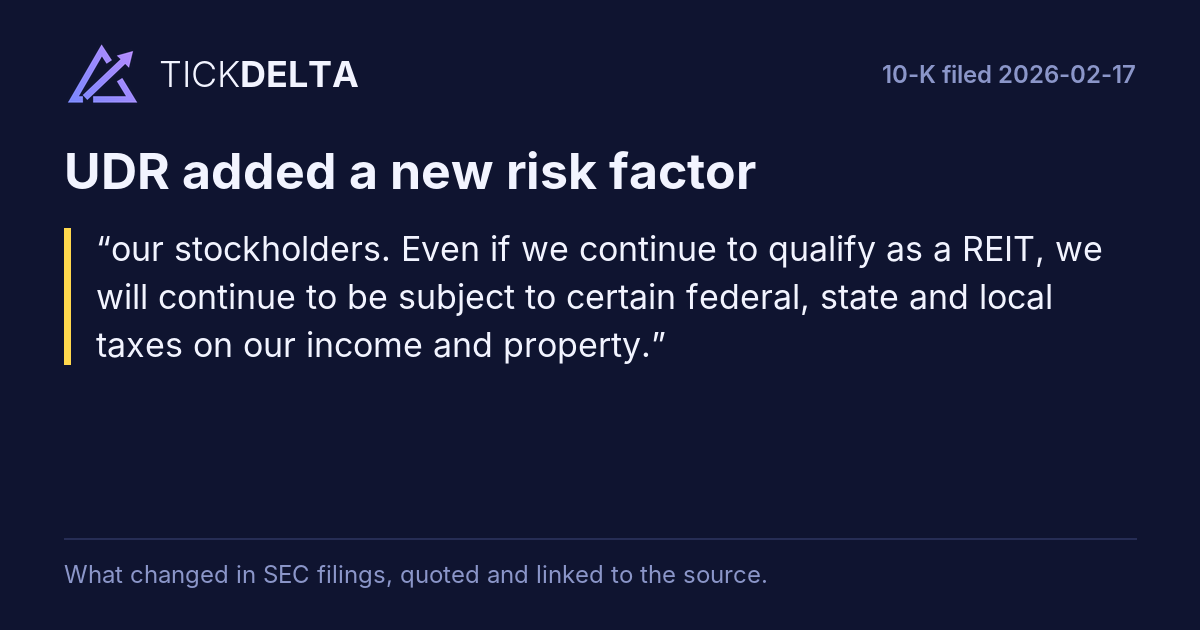
our stockholders. Even if we continue to qualify as a REIT, we will continue to be subject to certain federal, state and local taxes on our income and property.
Read in the 10-K ↗
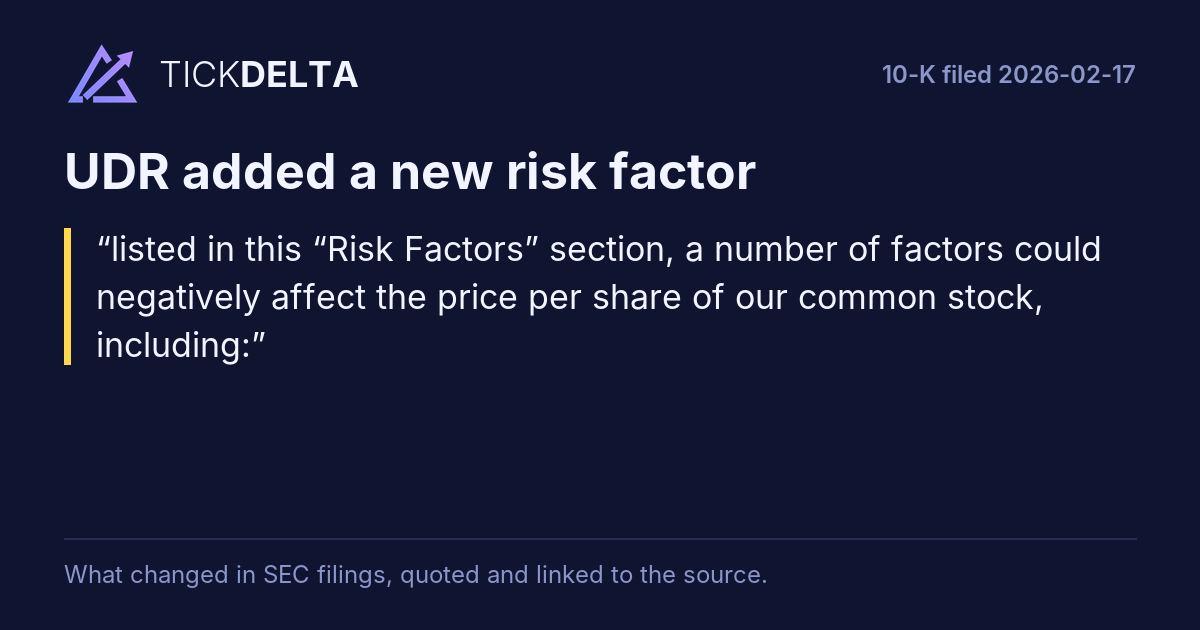
listed in this “Risk Factors” section, a number of factors could negatively affect the price per share of our common stock, including:
Read in the 10-K ↗
43 paragraphs in the 10-Q filed Nov 3, 2026 with nothing like them in the 10-Q filed Jul 28, 2026 (at least half the words must differ; new numbers alone do not count). Quoted exactly, grouped by the item heading above them. This is text that changed, not a judgement of how serious it is.
with the acquisition, the loan and accrued interest were settled in full through the receipt of the operating community's ownership interests. (See Note 3, Real Estate Owned for more information)
Read in the 10-Q ↗
(c) The Company and a syndicate of lenders previously entered into a $19.0 million secured credit facility with an unaffiliated third party. The Company’s commitment is $3.0 million (exclusive of accrued interest), all of which has been funded. Interest payments accrue and are due at maturity of the facility. The facility is secured by substantially all of the borrower’s assets and matures at the earliest of the following: (a) acceleration in the event of default; or (b) June 2027.
Read in the 10-Q ↗
(e) The Company has a secured mezzanine loan with a third party developer of a 237 apartment home community located in Menifee, California, which was completed in 2025, with an aggregate commitment of $24.8 million (exclusive of accrued and unpaid interest), all of which has been funded. Interest payments accrue and are due at maturity of the loan. In 2026, the maturity date of the note was extended to December 31, 2028. The secured mezzanine loan previously had a scheduled maturity date in D...
Read in the 10-Q ↗
(f) In May 2026, the Company entered into a $50.0 million secured mezzanine loan with its joint venture partner of five operating communities with 710 apartment homes located in New York, New York, with an aggregate commitment of $50.0 million, all of which was funded as of September 30, 2026. The loan investment's effective interest rate is approximately 8.0%, including the impact of the loan origination fee. Interest payments are paid monthly. The secured mezzanine loan has a scheduled matu...
Read in the 10-Q ↗
ended September 30, 2026 and 2025 was less than $0.1 million and $0.1 million, respectively, and during the nine months ended September 30, 2026 and 2025 was $0.1 million and $(0.1) million, respectively.
Read in the 10-Q ↗
Real estate assets owned by the Company consist of income producing operating properties, properties under development, land held for future development, and held for disposition properties. As of September 30, 2026, the Company owned and consolidated 162 communities in 12 states plus the District of Columbia totaling 54,222 apartment homes. The following table summarizes the carrying amounts for our real estate owned (at cost) as of September 30, 2026 and December 31, 2025
Read in the 10-Q ↗
In July 2026, the Company contributed one wholly-owned operating community, with 360 apartment homes located in Nashville, Tennessee, to our existing joint venture with LaSalle, while maintaining our 51% ownership interest in the venture. The contribution resulted in the Company no longer retaining a controlling interest in the community, and the Company deconsolidated the operating community. In connection with the contribution, our joint venture partner contributed cash and new debt was placed on the newly contributed operating community and an existing operating community, resulting in the Company receiving approximately $103.2 million of cash proceeds. The transaction was accounted for as a partial sale and resulted in a gain of approximately $75.2 million, which was recorded in Gain/(loss) on sale of real estate owned on the Consolidated Statement of Operations, which consisted of the gain on
Read in the 10-Q ↗
the partial sale and the initial measurement of our retained interest at fair value. (See Note 5, Joint Ventures and Partnerships for further discussion).
Read in the 10-Q ↗
The Company has determined that the Operating Partnership is a VIE, as its limited partners lack substantive kick-out rights and substantive participating rights. Prior to its liquidation in July 2026, the DownREIT Partnership was
Read in the 10-Q ↗
UDR’s joint ventures and partnerships are funded with a combination of debt and equity. Our losses are typically limited to our investment and except as noted below, the Company does not guarantee any debt, capital payout or other obligations associated with our joint ventures and partnerships.
Read in the 10-Q ↗
In October 2026, the Company formed a joint venture (the “Apollo JV”) with Apollo-managed funds and affiliates (“Apollo”). The Apollo JV owns 19 operating communities with a total of 7,059 apartment homes, valued at approximately $2.0 billion. The communities were previously wholly owned by the Company. Under the terms of the agreement, the Company contributed the communities to the Apollo JV, and Apollo invested approximately $1.34 billion of equity capital in the Apollo JV in exchange for Class B Units representing an approximate 67% interest. The Company received Class A Units representing an approximate 33% interest in the Apollo JV and continues to operate and manage the communities, for which it earns an asset management fee.
Read in the 10-Q ↗
The Company consolidates the Apollo JV under the voting interest model because the Company’s equity interest entitles it to appoint four of the five members of the Apollo JV’s board of managers and to serve as the Apollo JV’s asset manager, responsible for its day-to-day management.
Read in the 10-Q ↗
The Apollo JV transaction was accounted for as an issuance of noncontrolling interest in a consolidated subsidiary without a loss of control, and no gain or loss was recognized. The Company received approximately $1.34 billion for Apollo’s capital contribution. The noncontrolling interest was recognized at Apollo’s approximate 67% share of the historical carrying amount of the Apollo JV’s net assets, rather than at the amount of Apollo’s contribution, with the difference recorded as an increase to Additional paid-in capital on the Consolidated Balance Sheets. Direct and incremental transaction costs were recorded as a reduction of Additional paid-in capital.
Read in the 10-Q ↗
The Apollo JV operating agreement provides for, among other things, quarterly distributions of available cash flow to its members, initially allocated 33% to the Class A Units and 67% to the Class B Units. Upon a sale or liquidation of the Apollo JV, proceeds are distributed 33% to the Class A Units and 67% to the Class B Units until Apollo has received a return of its invested capital and achieved its target internal rate of return (the “Target IRR”) of 7.00%, which increases to 7.30% on the seventh anniversary of December 31, 2026 (the “Measurement Date”) and 7.60% on the ninth anniversary of the Measurement Date. Thereafter, proceeds are distributed to the Class A Units. The Target IRR is not a fixed or guaranteed payment obligation of the Company or the Apollo JV; rather, it establishes the threshold at which liquidating distributions shift from the 33%/67% sharing ratio to all residual economics retained by the Class A Units. The Company holds an option, exercisable from the fifth through the tenth anniversaries of the Measurement Date and subject to certain
Read in the 10-Q ↗
change in the Company's joint venture partner and did not result in a sale of the Company's interest or the recognition of a gain or loss.
Read in the 10-Q ↗
(d) The Debt and Preferred Equity Program is the program through which the Company makes investments, including preferred equity investments, first mortgage loans, mezzanine loans (loans are recorded in Notes receivable, net on the Consolidated Balance Sheets) or other structured investments that may receive a fixed yield on the investment and may include provisions pursuant to which the Company participates in the increase in value of the property upon monetization of the applicable property...
Read in the 10-Q ↗
In February 2026, the Company received aggregate proceeds of approximately $138.9 million from the full repayment of two preferred equity investments.
Read in the 10-Q ↗
In August 2026, the Company received full repayment of $29.5 million from its preferred equity investment in a 384 apartment home apartment community, located in Orlando, Florida, upon the recapitalization of the joint venture.
Read in the 10-Q ↗
(e) Represents UDR’s maximum funding commitment only and therefore excludes other activity such as income from investments.
Read in the 10-Q ↗
As of September 30, 2026 and December 31, 2025, the Company had deferred fees of $8.3 million and $8.4 million, respectively, which will be recognized through earnings over the weighted average life of the related properties, upon the disposition of the properties to a third party, or upon completion of certain development obligations.
Read in the 10-Q ↗
The Company may, in the future, make additional capital contributions to certain of our joint ventures and partnerships should additional capital contributions be necessary to fund acquisitions or operations.
Read in the 10-Q ↗
We consider various factors to determine if a decrease in the value of our Investment in and advances to unconsolidated joint ventures, net is other-than-temporary. These factors include, but are not limited to, age of the venture, our intent and ability to retain our investment in the entity, the financial condition and long-term prospects of the entity, and the relationships with the other joint venture partners and its lenders. Based on the significance of the unobservable inputs, we classify these fair value measurements within Level 3 of the valuation hierarchy. The Company
Read in the 10-Q ↗
In September 2026, the Company acquired the developer’s equity interest in a 483 apartment home community located in Riverside, California, by repaying the joint venture’s first mortgage loan and obtaining the developer’s interest through a deed in lieu of foreclosure. The Company previously held a secured mezzanine loan with the developer. As a result,
Read in the 10-Q ↗
In July 2026, the Company contributed one wholly-owned operating community, with 360 apartment homes located in Nashville, Tennessee, to our existing joint venture with LaSalle, while maintaining our 51% ownership interest in the venture. The contribution resulted in the Company no longer retaining a controlling interest in the community, and the Company deconsolidated the operating community. In connection with the contribution, our joint venture partner contributed cash and new debt was placed on the newly contributed operating community and an existing operating community, resulting in the Company receiving approximately $103.2 million of cash proceeds. The transaction was accounted for as a partial sale and resulted in a gain of approximately $75.2 million, which was recorded in Gain/(loss) on sale of real estate owned on the Consolidated Statement of Operations, which consisted of the gain on the partial sale and the initial measurement of our retained interest at fair value. (See Note 5, Joint Ventures and Partnerships for further discussion).
Read in the 10-Q ↗
impairments in the value of its investments in unconsolidated joint ventures during the nine months ended September 30, 2026 and 2025.
Read in the 10-Q ↗
a decrease in real estate depreciation expense of $4.3 million primarily due to communities sold in 2026 and 2025 and assets that became fully depreciated, partially offset by communities acquired in 2026 and 2025;
Read in the 10-Q ↗
a decrease in real estate depreciation expense of $7.6 million primarily due to communities sold in 2026 and 2025 and assets that became fully depreciated, partially offset by communities acquired in 2026 and 2025.
Read in the 10-Q ↗
lower returns. These competitive advantages may reduce the number of suitable investment opportunities available to us or increase the cost of acquiring or developing properties.
Read in the 10-Q ↗
we may lose all or part of our investment in the entity, be delayed in recovering our investment or the expected returns or directly or indirectly take over the property or the management thereof at a time at which we would not have done so absent the failure to meet expectations or the default. In addition, in the event of a default or other changes in the circumstances of an investment, including a change in the value of the applicable property, we may be, and have been in the past, required to change the manner in which the investment is accounted for, including our ability to recognize earnings, or recognize an impairment or a loss on consolidation.
Read in the 10-Q ↗
A Change in U.S. Government Policy or Support Regarding Fannie Mae or Freddie Mac Could Have a Material Adverse Impact on Our Business. While in recent years we have decreased our borrowings from Fannie Mae and Freddie Mac,
Read in the 10-Q ↗
On October 28, 2026, the Board of Directors (the “Board”) of the Company adopted amended and restated bylaws (as amended and restated, the “Amended and Restated Bylaws”), which became effective the same day. Among other things, the amendments effected by the Amended and Restated Bylaws:
Read in the 10-Q ↗
address the universal proxy rules adopted by the U.S. Securities and Exchange Commission (the “SEC”) by clarifying that no person may solicit proxies in support of a director nominee other than the Board’s nominees unless such person has complied with Rule 14a-19 under the Securities Exchange Act of 1934, as amended (the “Exchange Act”), including applicable notice and solicitation requirements, and provide that the nomination of a nominating person's proposed nominees will be disregarded...
Read in the 10-Q ↗
require a stockholder nominating directors to represent whether it (or a group of which it is a part) intends to solicit the holders of shares representing at least 67% of the voting power of shares entitled to vote on the election of directors in support of director nominees other than the Board’s nominees;
Read in the 10-Q ↗
revise the advance notice period for stockholders to nominate directors or bring other business before an annual meeting of stockholders to specify that, if the date of the annual meeting is more than 30 days before or more than 60 days after the anniversary date of the previous year’s annual meeting, notice must be delivered not more than 150 days prior to such annual meeting and not less than the later of the 120th day before the meeting or the tenth day following public announcement of...
Read in the 10-Q ↗
update advance notice disclosure requirements in connection with stockholder nominations of directors and submissions of proposals regarding other business at stockholder meetings (other than proposals to be included in the Company’s proxy materials pursuant to Rule 14a-8 under the Exchange Act) to:
Read in the 10-Q ↗
o require the notice from stockholders to include certain information from all participants in the solicitation;
Read in the 10-Q ↗
o require additional background information and disclosures regarding proposing stockholders, proposed director nominees and business;
Read in the 10-Q ↗
o require proposing stockholders to update and supplement their notices so that the information provided remains true and correct as of specified dates prior to the meeting; and
Read in the 10-Q ↗
o remove the requirement for the notice from stockholders to disclose information about certain performance-related fees;
Read in the 10-Q ↗
enhance the procedures and disclosure requirements in connection with stockholders seeking to call a special meeting, including by requiring that a stockholder of record first request that the Board fix a record date for determining the stockholders entitled to demand a special meeting, requiring that holders of at least 10% of the votes entitled to be cast deliver demands within the prescribed period, and requiring that additional background information accompany any such record date req...
Read in the 10-Q ↗
require that a stockholder directly or indirectly soliciting proxies from other stockholders use a proxy card color other than white, which is reserved for the exclusive use of the Board.
Read in the 10-Q ↗
The Amended and Restated Bylaws also incorporate certain modernizing, clarifying, conforming and additional changes, including provisions addressing the conduct of stockholder meetings, electronic notice and “householding” of stockholder notices, the issuance of uncertificated shares, the ratification of corporate acts, and various updates to conform the Amended and Restated Bylaws to the MGCL.
Read in the 10-Q ↗
The foregoing description of the Amended and Restated Bylaws does not purport to be complete and is qualified in its entirety by reference to the full text of the Amended and Restated Bylaws, a copy of which is filed with this Report as Exhibit 3.7 and is incorporated herein by reference.
Read in the 10-Q ↗
Item 1A of the 10-Q filed Nov 3, 2026 against Item 1A of the 10-K filed Feb 17, 2026.
A 10-Q repeats only the risks that changed, so a 10-K paragraph that is missing from it is not counted as removed.
Added is a paragraph with nothing like it in the 10-K, Reworded a sentence that is in both with several words changed,
Quiet changes a sentence in both where one to four words changed and one is a hedge or a modal
(cut words struck through, new words highlighted and underlined).
Text on the page, not a score; each links to the filing at sec.gov.
The first 24 of 33 are shown (at most 12 of each type).
Work on UDR in a spreadsheet:
Excel workbook (a sheet per section, ten years by column, charts, links to the filings) ·
CSV.
For a Google Sheet that stays up to date, paste =IMPORTDATA("https://tickdelta.com/company/UDR/export.csv") into a cell.