tickdelta
Sign in

Tickdelta is free for now. Sign up and get Pro free

← Screener

UDRUDR, Inc.

Real estate · REIT · NYSE

UDR is a self-administered real estate investment trust, or REIT, that owns, operates, acquires, renovates, develops, redevelops, disposes of, and manages multifamily apartment communities in targeted markets located in the United States. 10-K, Item 1

Employees
1,420
Headquarters
Highlands Ranch, CO
CEO
Thomas W. Toomey
Next results
around Feb 8, 2027
Compare with peers → Embed

When the SEC's staff reviews a filing, it writes to the company with numbered questions, and the company answers each one in a letter. SEC publishes the exchange once the review is over, at least 20 business days later. Below: what the staff asked UDR, and the company's answer to each question, quoted from the letters. A question is not an accusation; most reviews end with the company adding detail to its next filing.

Schedule 14A

2022-08-31 to 2022-10-25 · 3 questions · 1 letter from the SEC, 1 from the company
Review closed 2022-10-25
Controls
Definitive Proxy Statement on Schedule 14A filed March 31, 2022 · General
SEC asked (1)
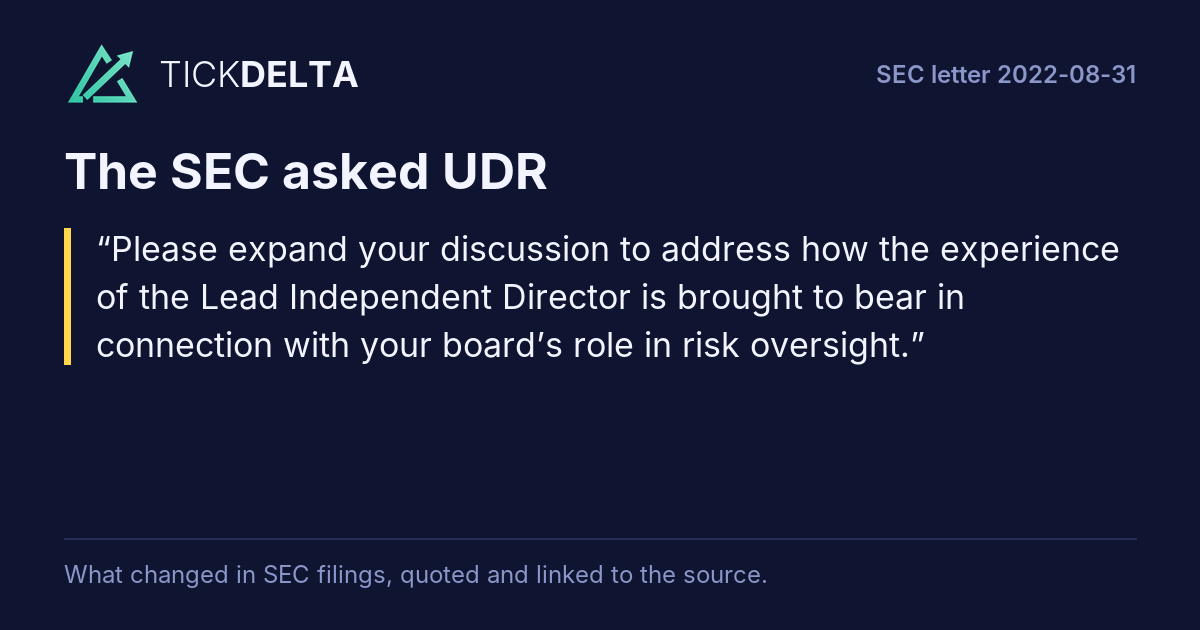
Please expand your discussion to address how the experience of the Lead Independent Director is brought to bear in connection with your board’s role in risk oversight.
UDR answered
to the Staff’s comment, beginning with the proxy statement for the 2023 Annual Meeting of Shareholders, the Company will expand the above-referenced disclosure in the Proxy Statement to address how the extensive experience of the Board’s Lead Independent Director is brought to bear in connection with the Board’s role in risk oversight. Read in the reply ↗
Definitive Proxy Statement on Schedule 14A filed March 31, 2022 · General
SEC asked (2)
Please expand upon the role that your Lead Independent Director plays in the leadership of the board. For example, please enhance your disclosure to address whether or not your Lead Independent Director may: • represent the board in communications with shareholders and other stakeholders; or • require board consideration of, and/or override your CEO on, any risk matters.
UDR answered
to the Staff’s comment, beginning with the proxy statement for the 2023 Annual Meeting of Shareholders, the Company will expand the above-referenced discussion in the Proxy Statement addressing the role that the Lead Independent Director plays in the leadership of the Board. To the extent applicable, the Company will address the examples cited by the Staff in Comment 2. Read in the reply ↗
Definitive Proxy Statement on Schedule 14A filed March 31, 2022 · General
SEC asked (3)
Please expand upon how your board administers its risk oversight function. For example, please disclose: • the timeframe over which you evaluate risks (e.g., short-term, intermediate-term, or long-term) and how you apply different oversight standards based upon the immediacy of the risk assessed; • whether you consult with outside advisors and experts to anticipate future threats and trends, and how often you
Rest of the question

re-assess your risk environment; • how the board interacts with management to address existing risks and identify significant emerging risks; • whether you have a Chief Compliance Officer and to whom this position reports; and • how your risk oversight process aligns with your disclosure controls and procedures.

UDR answered
to the Staff’s comment, beginning with the proxy statement for the 2023 Annual Meeting of Shareholders, the Company will expand the above-referenced discussion in the Proxy Statement addressing how the Board administers its risk oversight function. To the extent applicable, the Company will address the examples cited by the Staff in Comment 3. Read in the reply ↗
Also in this review: closing letter, 2022-10-25
Form 10-K for the fiscal year ended December 31, 2017

2018-09-20 to 2018-10-16 · 1 question · 1 letter from the SEC, 1 from the company
Review closed 2018-10-16
United Dominion Realty, L.P. Consolidated Balance Sheets, page F-51
SEC asked
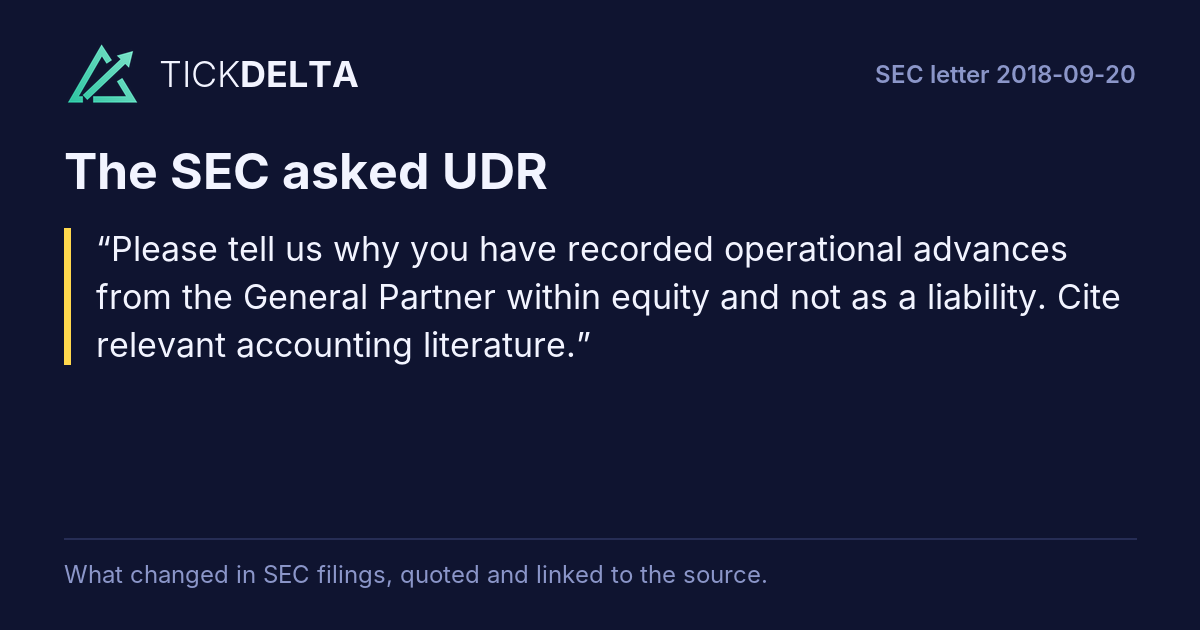
Please tell us why you have recorded operational advances from the General Partner within equity and not as a liability. Cite relevant accounting literature.
UDR answered
As of December 31, 2017, UDR, as the General Partner of the OP, owned 100 percent of the OP’s general partnership interests and approximately 95 percent of its limited partnership interests. UDR is the primary beneficiary and consolidates the OP under the Variable Interest Entity model as disclosed on page F-19 of the Form 10-K.
Rest of the answer

By virtue of being the sole General Partner of the OP, UDR has the complete discretion to control all of the operating, financing and investing activities of the OP, including the ability to authorize, issue, sell, redeem or purchase units or securities of the OP (excluding certain preferred units) without the approval of the limited partners.

As disclosed on page F-64 of the Form 10-K, the OP participates in UDR’s central cash management program, wherein all of the OP’s cash receipts are remitted to the General Partner and all cash disbursements are funded by the General Partner on behalf of the OP.

It is important to note that there is no existing contractual agreement with respect to the Advances (defined below) and no terms in place requiring probable settlement at a specified event, determinable date, or on demand (i.e., there is no agreement applicable to the Advances with a maturity date or other debt-like features or terms and no interest is being incurred). As such, the Advances are not a legal form of debt. Furthermore, as of the balance sheet date, UDR had no current or foreseeable intention to require the OP to repay the Advances (a future sacrifice of economics will not occur), which management believes further supports that the Advances are not a liability or debt.

Based upon the combination of the information above and our analysis of relevant accounting literature cited below, management believes that the advances from the General Partner to the OP (“the Advances”) are appropriately recorded within equity.

Management, as part of its analysis, considered Staff Accounting Bulletin (“SAB”) Topic 4.A., Subordinated Debt, which specifically addresses the balance sheet classification of an instrument issued in a legal form of debt under U.S. GAAP, Question 4 of SAB Topic 1.B.1., which management interprets as providing that the Staff does not take a position on equity versus debt classification in separate financial statements of a subsidiary when no contractual agreement exists, and ASC 480, Distinguishing Liabilities from Equity (“ASC 480”), which provides guidance for determining whether certain freestanding financial instruments are classified as liabilities. Management has concluded from the analysis of this relevant accounting literature that the Advances are appropriately recorded within equity.

SAB Topic 4.A. provides an example of when it is not appropriate to classify a legal form of debt as equity.

“Facts: Company E proposes to include in its registration statement a balance sheet showing its subordinate debt as a portion of stockholders' equity.

Question: Is this presentation appropriate?

Interpretive Response: Subordinated debt may not be included in the stockholders' equity section of the balance sheet. Any presentation describing such debt as a component of stockholders' equity must be eliminated. Furthermore, any caption representing the combination of stockholders' equity and only subordinated debts must be deleted.”

It is important to note that as of December 31, 2017, the OP had $273.3 million of unsecured notes payable to the General Partner with annual interest rates of 5.34%, 5.18% and 4.12% which mature on August 31, 2021, December 31, 2023 and April 1, 2026, respectively. These unsecured notes represent debt and are appropriately classified as liabilities on the OP’s consolidated balance sheets. If the Advances were a legal form of debt similar to the unsecured notes, management believes the classification of a liability would then be appropriate.

Management believes that the Advances do qualify to be recorded as equity, because there is no existing contractual agreement and no terms in place requiring probable settlement at a specified event, determinable date, or on demand. Furthermore, UDR had no current or foreseeable intention to require the OP to repay the Advances. Management believes treatment for such transactions is consistent with the Staff’s interpretive response in Question 4 of SAB Topic 1.B.1. which states, “Because of the inherent difficulty in distinguishing the elements of a subsidiary’s capital structure, the staff has not insisted that the historical income statements include an interest charge on intercompany debt if such a charge was not provided in the past, except when debt specifically related to the operations of the subsidiary and previously carried on the parent’s books will henceforth be recorded in the subsidiary’s books.” Management interprets this as providing that the Staff does not take a position on equity versus debt classification in separate financial statements of a subsidiary when no contractual agreement exists. The increase in the amount of Advances from December 31, 2016 to December 31, 2017 was primarily a result of the General Partner prepaying third-party secured debt of the OP.

In addition, management believes that the transactions cited in SAB Topic 5.T., Accounting for Expenses or Liabilities Paid by Principal Stockholder(s), are similar to the transactions that the General Partner incurred on behalf of the OP and, therefore, further support equity presentation. SAB Topic 5.T. cites an example of when a company's principal shareholder transfers shares to a plaintiff to settle litigation against the company, whereby the settlement should be recognized as an expense in the company’s financial statements with a corresponding credit to contributed (paid-in) capital. SAB Topic 5.T. also states in the interpretive response that “similar accounting is required in this and other transactions where a principal stockholder pays an expense for the company, unless the stockholder’s action is caused by a relationship or obligation completely unrelated to his position as a stockholder or such action clearly does not benefit the company.” SAB Topic 5.T. continues, “The staff believes that the substance of such transactions is the payment of an expense of the company through contributions by the stockholder. Therefore, the staff believes it would be inappropriate to account for such transactions according to the form of the transaction.” Footnote 36 within SAB Topic 5.T. also cites an example as it relates to operational costs of a subsidiary which are incurred by the parent on its behalf: “the staff notes that AICPA Technical Practice Aids §4160 also indicates that the payment by principal stockholders of a company’s debt should be accounted for as a capital contribution.”

To assist the Staff, management summarizes its position below in support of the conclusion the Advances are appropriately recorded within equity and not as a liability.

·

As the sole General Partner of the OP, UDR has the complete discretion to control all of the operating, financing and investing activities of the OP, including the ability to authorize, issue, sell, redeem or purchase units or securities of the OP (excluding certain preferred units) without the approval of the limited partners.

Management does not believe that the Advances meet the essential characteristics of a liability or debt under SAB Topic 4.A., Question 4 of SAB Topic 1.B.1., or ASC 480 as the Advances have no contractual terms (i.e., no agreement in place), are not a legal form of debt, do not contain any debt-like features, and UDR has no current or foreseeable intention to require the OP to repay the Advances.

When contractual terms do exist, the OP does appropriately record them as a liability consistent with the unsecured notes payable to the General Partner as of December 31, 2017.

The Advances funded by the General Partner are a part of UDR’s central cash management program and have essentially provided capital from the General Partner to fund the OP’s operating, financing and investing activities. Management believes the Advances are similar to the transactions cited in SAB Topic 5.T., therefore, supporting classification as a component of equity.

We trust the responses above adequately address the Staff’s comment set forth in its letter dated September 20, 2018.

Read in the reply ↗
In its next report

First report after the company's reply of 2018-09-27: 10-Q filed 2018-10-30 ↗, against the 10-Q filed 2018-07-31 ↗.

Tickdelta does not hold the text of both reports, so they are not compared here.

Also in this review: closing letter, 2018-10-16

6 other letters: notices that a filing will not be reviewed, requests to declare a registration effective, and the like

From the SEC's correspondence on EDGAR: staff letters (form UPLOAD) and company letters (form CORRESP), 12 letters filed since 2016-08-09. Questions and answers are matched by their numbers; topics come from words in each question. The reports are compared word for word (same form, before the first SEC letter against the first report after the company's reply). No AI.

Work on UDR in a spreadsheet: Excel workbook (a sheet per section, ten years by column, charts, links to the filings) · CSV. For a Google Sheet that stays up to date, paste =IMPORTDATA("https://tickdelta.com/company/UDR/export.csv") into a cell.