Form 10-K for the Fiscal Year Ended December 31, 2020
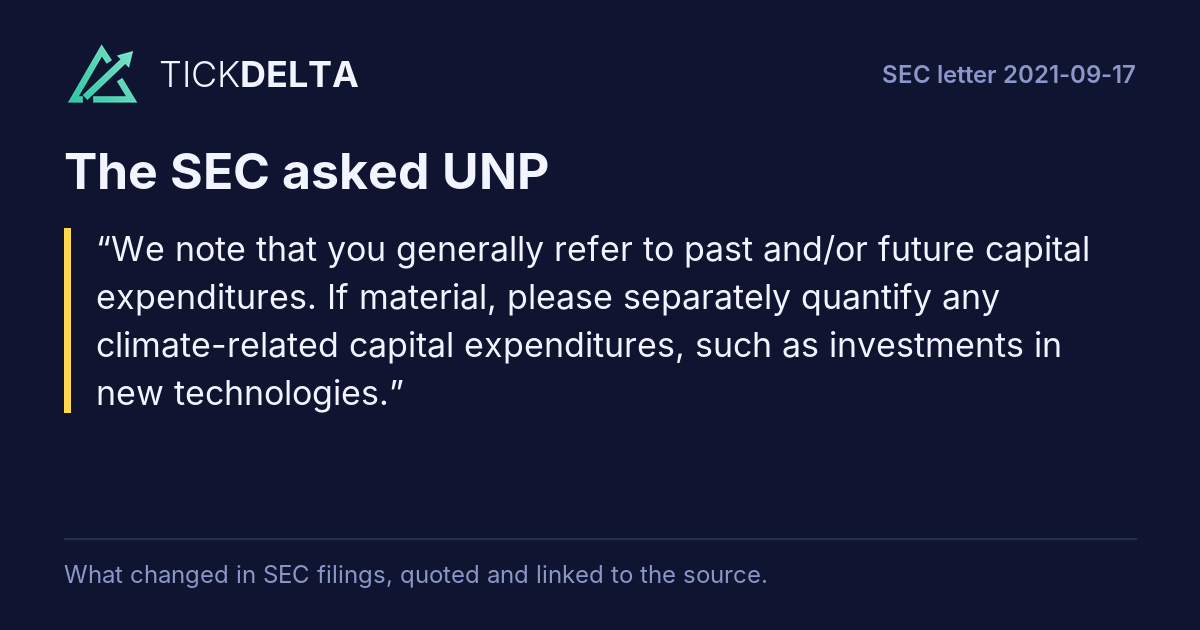
We note that you generally refer to past and/or future capital expenditures. If material, please separately quantify any climate-related capital expenditures, such as investments in new technologies.
Our rail equipment and infrastructure require significant capital investment for replacement, improvement, and expansion each year. These investments not only support the transportation needs of our customers but also enhance safety, improve our operational efficiency, and support economic growth. The Company defines climate-related capital expenditures as investments to lower greenhouse gas emissions, prevent and/or mitigate infrastructure damage from climate-related natural disasters, and replace infrastructure damaged by climate-related natural disasters.Read in the reply ↗Rest of the answer
These three forms of investment are discussed in more detail in the following paragraphs.
First are investments to reduce the greenhouse gas emissions from our locomotive fleet, which represent approximately 94% of the greenhouse gas emissions generated by the Company. These emissions-related investments have been for Environmental Protection Agency (EPA) prescribed tier upgrades on our locomotive fleet and the Company’s program to install energy management technologies on locomotives to optimize train handling and fuel efficiency. For the fiscal years ended December 31, 2020, 2019, and 2018, the Company invested $36 million, $68 million, and $65 million, respectively, on tier upgrades and energy management technologies. During the same periods, the Company’s capital program totaled approximately $2.84 billion, $3.2 billion, and $3.2 billion, respectively. Therefore, the tier upgrades and energy management investments were not material to an understanding of our business, financial condition, and results of operations.
Second are investments made to harden portions of our rail network identified as more susceptible to climate-related damage, such as hurricanes in the south, extreme cold in the northern region, and forest fires in the west. Climate-related benefits from these efforts are generally ancillary in nature because the primary purpose of these infrastructure hardening investments is to renew the Company’s assets to facilitate safe and efficient operations. Investments related solely to climate-related event mitigation include raising the height of the track profile to prevent water over the top of the rails and the addition or expansion of culverts to prevent flood waters from washing out the track. Investments in these types of improvements for the periods covered by our 2020 10-K were not material to an understanding of our business, financial condition, and results of operations.
Third are investments made to replace our infrastructure because of significant climate-related events, such as severe flooding or forest fires. The replacement costs are generally capital investments, but significant climate-related events may also be accompanied by lost revenue and/or elevated operating expenses. One of our year-over-year operating expense variance drivers discussed in Item 7 Management’s Discussion and Analysis of Financial Condition and Results of Operations (MD&A) in our 2020 10-K was lower weather-related costs, as we did not experience material climate-related events for fiscal year ended December 31, 2020, but did for fiscal year ended December 31, 2019. The weather-related events in 2019 were discussed in more detail in the MD&A in our Form 10-K for the Fiscal Year ended December 31, 2019 (2019 10-K). Additionally, in our Form 8-K filed on September 17, 2021, we discussed the business impact of severe flooding, winter storms, and infrastructure destroyed by forest fires, further illustrating how the Company discloses such material events in a timely manner.
In summary, for the fiscal years ended December 31, 2020, 2019, and 2018, the capital investments made by the Company relating solely to climate were not material to an understanding of our business, financial condition, and results of operations. Going forward, we will continue to follow our disclosure controls and procedures and disclose any future material and quantifiable climate-related capital expenditures.
If material, disclose any anticipated reputational risks resulting from your operations that produce material greenhouse gas emissions.
Our risk factor on page 15 of the 2020 10-K captioned, “We May Be Affected by Climate Change and Market or Regulatory Responses to Climate Change” discusses material climate-change related factors that make an investment in the Company’s securities speculative or risky.
Further, the risk factor on page 14 of the 2020 10-K captioned “We Face Competition from Other Railroads and Other Transportation Providers,” discusses the relative cost and carbon competitiveness of railroads versus the trucking industry – our major ground transportation competitor.Read in the reply ↗Rest of the answer
As stated by the Association of American Railroads, “[r]ailroads account for 40% of U.S. freight, but account for just 0.5% of total U.S. greenhouse gas emissions, according to EPA data, and just 1.9% of transportation-related greenhouse gas emissions.” In addition, “moving freight by rail instead of truck lowers greenhouse gas emissions by up to 75% on average.” Further, we work closely with our customers to contribute to and improve their own efforts to reduce Scope 3 emissions. Consequently, because rail freight transportation is less greenhouse gas intensive, we do not believe reputational risk resulting from our operations that produce greenhouse gas emissions is among the material climate-change related risks that we presently face.
If material, discuss the significant physical effects of climate change on your operations and results. This disclosure may include the following: • quantification of material weather-related damages to your property or operations; • the impact to your business of decreased agricultural production capacity of your customers located in areas affected by drought or other weather-related changes; and • anyRest of the question
weather-related impacts on the cost or availability of insurance.
As a railroad with a vast network across the western two-thirds of the United States, we have been and remain exposed to severe weather conditions on a regular basis. When material, we have disclosed weather-related damage to our property or impacts on our operations in the past and will continue to do so in the future. For example, in 2019 we were affected by a series of significant weather events, and we disclosed the impact of those events on our business in the 2019 10-K, under the Executive Summary of the MD&A.Read in the reply ↗Rest of the answer
Further, we included those events as a driver related to Company’s performance under the various subsections throughout the 2019 10-K. These events in 2019 are also referenced in the 2020 10-K as drivers for year-over-year variances because we did not experience similar events in 2020.
Any material impact to our customers affected by climate-related changes is disclosed in the MD&A of our annual and quarterly reports. Our book of business is diverse and comprised of 10 different commodity categories with approximately 10,000 customers, operating from all major West Coast and Gulf Coast ports to eastern gateways and connecting to Canada and Mexico. As a result, any customeror location-specific migration of production or weather-related damage must be significant to have a material impact on the Company’s business, financial condition, and results of operations. For example, we refer the Staff to the MD&A in the 2019 10-K, where we disclosed that agricultural product shipments were impacted by weather-related challenges; the MD&A in our Form 10-K for the Fiscal Year ended December 31, 2017, where we disclosed a decline in rock shipments due to inclement weather; and, the MD&A in our Form 10-K for the Fiscal Year ended December 31, 2015, where we disclosed how flooded coal mines and washed-out tracks impacted shipments. Similarly, although shipments of coal, sand, and petroleum products during 2020 were primarily impacted by low crude oil and natural gas prices, over the last several years, the Company has disclosed the material effects of the move away from fossil fuels on our coal business and on shipments of crude oil and energy-related products by rail. For example, in the 2021 Outlook section in the 2020 10-K MD&A’s Executive Summary under “Market Conditions” on page 27, we stated that “other factors such as natural gas prices, weather conditions, and demand for other energy sources may impact the coal market” and “crude oil price spreads may drive demand for petroleum products and drilling materials”.
Finally, we confirm that pricing in the property insurance market is elevated because of the frequency of claims and limitations on overall market capacity. We have seen increases in our premiums, but these increases did not have a material effect on our business, financial condition, and results of operations for the periods covered by our 2020 10-K. If we experience any weather-related impacts on the cost or availability of property insurance that are material to an understanding of our business, financial condition, or results of operations, we will make appropriate disclosures in our future filings.
If applicable and material, provide disclosure about any purchase or sale of carbon credits or offsets and any material effects on your business, financial condition, and results of operations.
The Company purchases and uses carbon credits in the State of California, but they do not have a material effect on our business, financial condition, and results of operations. For the year ended December 31, 2020, 2019 and 2018, the Company purchased $3 million, $17 million, and $15 million, respectively, in carbon credits and had balances of $33 million, $38 million, and $28 million, respectively, in available credits at period end.
The Company continues to evaluate climate-related impacts, trends, and uncertainties as they develop. These factors may become material in the future.Read in the reply ↗Rest of the answer
In addition, the Company is committed to reducing its carbon footprint as evidenced in our Form 8-K dated March 10, 2020, announcing the Company’s intent to set science-based targets. We subsequently disclosed in our Form 8-K dated February 10, 2021, that our science-based targets were approved by the Science Based Targets Initiative (SBTI). These targets commit us to a 26% reduction of our absolute Scope 1 and Scope 2 greenhouse gas emissions by 2030 versus a 2018 baseline.
In addition to disclosures in our SEC filings, our stakeholders have access to information regarding all our environmental, social, and governance initiatives through our annual Building America Report (available at: https://www.up.com/aboutup/esg/building-america-report/index.htm).
Please provide us with quantification of amounts incurred as support for the statement made in response to comment 1 that investments made to harden portions of your rail network identified as more susceptible to climate-related damage have not been material to the periods covered by your 2020 Form 10-K.
Capital expenditures related solely to climate-related event mitigation totaled approximately $25 million, $24 million, and $11 million in the years 2018, 2019, and 2020, respectively. To provide context, capital expenditures under our annual infrastructure replacement program totaled $1.8 billion, $2.0 billion, and $1.8 billion in those respective years. Read in the reply ↗
First report after the company's reply of 2021-12-17: 10-K filed 2022-02-04 ↗, against the 10-K filed 2021-02-05 ↗.
Tickdelta does not hold the text of both reports, so they are not compared here.
Your response to prior comment 2 regarding reputational risks resulting from operations that produce material greenhouse gas emissions appears to focus on emissions from the railroad industry compared to other types of ground transportation services.Rest of the question
Please revise to provide disclosure explaining how your reputation or brand could be negatively impacted as a result of emissions of greenhouse gasses from your own operations, such as diesel exhaust.
The Commission Guidance Regarding Disclosure Related to Climate Change, Release No.33-9106 (Feb. 2, 2010), states in part that “possible indirect consequences or opportunities may include [among others]: increased demand for goods that result in lower emissions than competing products.” As stated in our previous response, moving freight by rail instead of truck lowers greenhouse gas emissions by up to 75% on average. We do not believe that reputational risk from our operations is among the material climate-change related risks that we have faced to date.Read in the reply ↗Rest of the answer
Despite the relative emissions advantages of rail versus truck, the Company is proactively addressing our greenhouse gas emissions as communicated to all our stakeholders in our climate action plan, which was publicly released on December 6, 2021. Additionally, we recognize that community awareness (including our customers and shareholders) of climate change is continuously increasing and may lead to higher reputational risk in the future. Our disclosures will change over time to reflect these increases if they materialize. We intend to revise our risk factor in our Form 10-K for Fiscal Year Ended December 31, 2021 (2021 10-K), to address reputational risk, at a minimum, as follows:
Significant cost increases, government regulation, or changes of consumer preferences for goods or services relating to alternative sources of energy, emissions reductions, and greenhouse gas emissions could materially affect the markets for the commodities we carry and demand for our services, which in turn could have a material adverse effect on our results of operations, financial condition, and liquidity.
First report after the company's reply of 2021-12-17: 10-K filed 2022-02-04 ↗, against the 10-K filed 2021-02-05 ↗.
Tickdelta does not hold the text of both reports, so they are not compared here.
We note your response to comment 3 and the reference to disclosure in your 2019 Form 10-K. We also note the reference to weather-related events, such as wildfire and heavy rain, during the current year in your response to prior comment 1.Rest of the question
We partially reissue our prior comment as it does not appear that you have provided quantification of material weather-related damages to your property or operations as a significant physical effect of climate change.
We note your comment and will provide quantification of weather-related damages to our property in the Capital Investments portion of our Management’s Discussion and Analysis in our future filings when material and determinable. For reference, those amounts are $15 million, $113 million, and $40 million in the years 2018, 2019, and 2020, respectively. We acknowledge that weather-related events, such as wildfire and heavy rain, have occurred during the current year. However, not all such events result in material damage to our property or operations.Read in the reply ↗Rest of the answer
In addition, because weather-related events can have both direct and indirect effects on our operations, and non-weather-related events can simultaneously affect our network, it requires significant judgment, and may not be possible, to determine the amount and cause of any incremental operating expense associated with such events. In those situations, we seek to quantify variances to individual operating expense lines and then disclose the drivers of those variances from most to least impactful in our filings with the SEC.
First report after the company's reply of 2021-12-17: 10-K filed 2022-02-04 ↗, against the 10-K filed 2021-02-05 ↗.
Tickdelta does not hold the text of both reports, so they are not compared here.
In your response to comment 3, you state that agricultural product shipments have been impacted by weather-related challenges. Please tell us how your disclosure considers climate change as a business risk due to its potential effect on your customers in the agricultural industry.
Our risk factor on page 12 of the 2020 10-K, captioned “Severe Weather Could Result in Significant Business Interruptions and Expenditures”, states that our revenue can be adversely affected by severe weather that causes damage and disruptions to our customers. In addition, our disclosure in Item 1 on page 8 of the 2020 10-K, captioned “Seasonality”, reflects our evaluation of how climate change affects our customers in the agricultural industry.Read in the reply ↗Rest of the answer
Specifically, we discuss the seasonality of some of the commodities that we transport, including agricultural products that have specific growing and harvesting seasons, and we specifically disclose that peak shipping seasons for these commodities can vary considerably each year depending upon various factors, including the strength of harvests, which in turn can be impacted by climate change. In our 2021 10-K and future filings, we will provide clarification on factors, including climate change, that impact the strength of harvests.
First report after the company's reply of 2021-12-17: 10-K filed 2022-02-04 ↗, against the 10-K filed 2021-02-05 ↗.
Tickdelta does not hold the text of both reports, so they are not compared here.
We note from you response to comment 3 that you have experienced an increase in insurance premiums, however, these increases did not have a material effect on your business, financial condition, and results of operations. Provide us with additional detail to support this statement, including quantification. In addition, tell us how you evaluated weather-related impacts on the availability of insurance.
Property insurance premiums appear in the “Other” operating expense line of our income statement. Year-over-year increases in such premiums represent 1% or less of the year-over-year increase in our “Other” operating expense line for the years covered by our 2020 10-K.
Our property insurance premiums are driven by a combination of market conditions, program limits, and deductibles. The Company’s insurance team works closely with brokers to assemble a program with multiple insurance providers that balances our premiums with risk mitigation.Read in the reply ↗Rest of the answer
These program design changes may include increases in our deductible, changes to program limits, and greater use of our captive insurance company. We evaluate the availability of insurance and status of the market, including effects of climate change, through advice provided by the brokers, based on what they are seeing with other customers, as well as feedback from the insurance carriers during our underwriter presentations.
First report after the company's reply of 2021-12-17: 10-K filed 2022-02-04 ↗, against the 10-K filed 2021-02-05 ↗.
Tickdelta does not hold the text of both reports, so they are not compared here.
Also in this review: request for more time, 2021-09-27, request for more time, 2021-11-22, request for more time, 2021-12-13, closing letter, 2022-01-25