WECWEC Energy Group
For more information about our business operations, including financial and geographic information, see Note 22, Segment Information, and Item 7. 10-K, Item 1
- Headquarters
- Milwaukee, WI
- Next results
- around Jan 4, 2027
10 paragraphs in Risk Factors of the 10-K filed Feb 20, 2026 with nothing like them in the 10-K filed Feb 21, 2025. Quoted exactly. Paragraphs that were only edited are under 10-K change.
Compared with the Risk Factors in the latest 10-K of the other 30 Utilities companies: a paragraph with at least half its words the same at another company is called similar, and the companies are listed under it. A paragraph most of them have is marked boilerplate. No line means no other company has one like it. This counts text; it does not say how serious a risk is.
Our operations are subject to extensive and evolving federal, state, and local environmental laws, regulations, and permit requirements related to, among other things, air emissions (including, but not limited to CO2, methane, mercury, SO2, NOx, ozone and other pollutants), protection of natural resources, water quality, wastewater discharges, management of hazardous and toxic substances and solid wastes and soils, and climate change. Many of these rules are now the subject of a large deregulatory effort by the EPA and have resulted, and are expected to continue to result in, the adoption of new federal, state, and/or local level laws and regulations. Any EPA actions will require formal rulemaking proceedings and are likely to be subject to legal challenges. In addition, at the end of 2025, the President issued executive orders directing the DOE to issue orders keeping certain coal plants running for grid reliability despite utilities' plans to retire them. Future orders impacting our planned retirements of coal plants could impact our ability to execute on our capital plan and to meet our environmental goal. We continue to monitor the evolving regulatory landscape and standards for impacts on our business operations and financial condition.
Read in the 10-K ↗
Tax legislation and regulations can adversely affect, among other things, our financial condition, results of operations, cash flows, liquidity, and credit ratings. In July 2025, the OBBBA was signed into law, enacting significant modifications to clean-energy tax credits previously provided under the IRA. The OBBBA provides companies the ability to earn solar and wind tax credits at current credit rates under new beginning of construction rules. Solar and wind tax incentives can be denied for energy projects that use
equipment beyond statutory guidelines from prohibited foreign entities or for taxpayers that exceed certain thresholds of equity or debt held by prohibited foreign entities.
Read in the 10-K ↗
We face risks related to providing service to our large-scale customers, including potential customers under our proposed VLC and Bespoke Resources Tariffs, which could impact our business, results of operations, and financial condition.
We are engaged in discussions with a small number of customers to provide power to large-scale data centers being constructed to support AI and other technology capabilities. Because of the significant demand and energy needs associated with these facilities, extending service to these facilities requires investment in incremental electric infrastructure. Subject to pending regulatory approvals from the PSCW, WE has made and will continue to make significant infrastructure investments in new solar and battery projects, natural gas power plants, and other generation and distribution assets to power and serve these large-scale data centers and other projects. Our transmission affiliate, ATC, also has made and will continue to make significant investments in additional transmission infrastructure to serve the increased customer load.
Read in the 10-K ↗
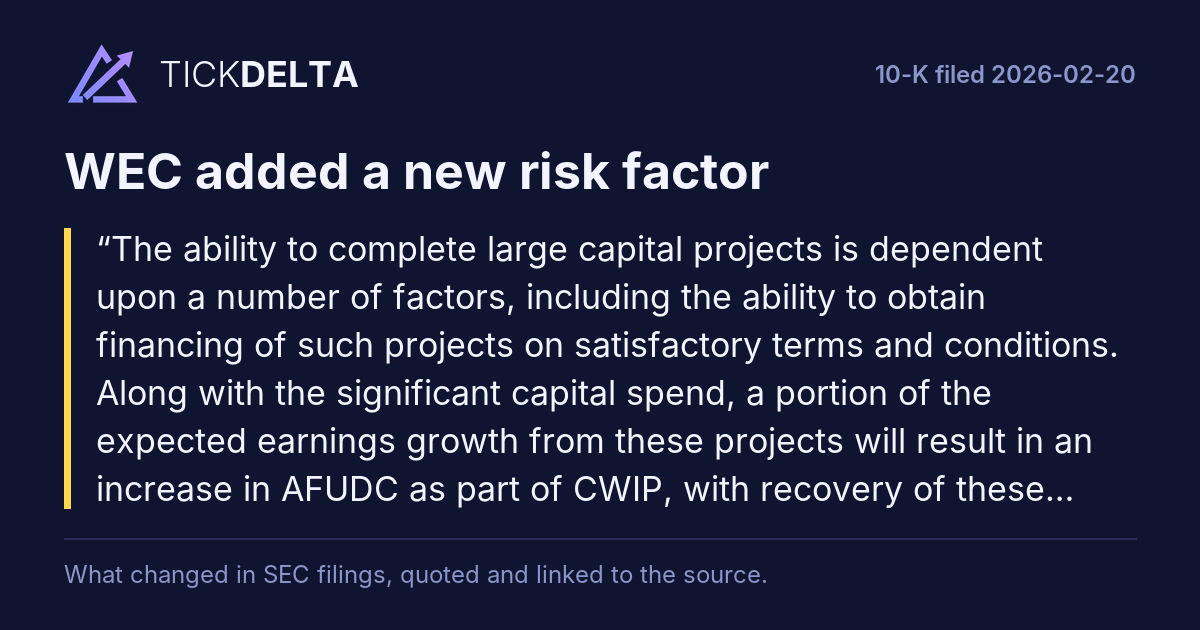
The ability to complete large capital projects is dependent upon a number of factors, including the ability to obtain financing of such projects on satisfactory terms and conditions. Along with the significant capital spend, a portion of the expected earnings growth from these projects will result in an increase in AFUDC as part of CWIP, with recovery of these costs delayed until the capital project is placed in service. As a result of this delay in receiving cash proceeds, we may be required to issue additional debt and/or equity to support these projects, which could negatively impact our earnings, balance sheet, and/or credit metrics. Other dependent factors include the ability to secure regulatory permits, secure sufficient land for the siting of power generation facilities, obtain necessary interconnection or transmission service in MISO, garner public support for these projects, and the ability of suppliers and contractors to fulfill their obligations under contracts. Successful completion of these projects may be further influenced by changes in law or regulation, such as new legislation or regulation impacting large data center cost allocation or environmental compliance requirements, trade and tariff issues, including those associated with imported solar panels, as well as supply chain delays or disruptions, workforce challenges, and other events beyond our control. If these projects are significantly delayed or become subject to cost overruns or cancellation due to these or other factors, we could incur additional costs and termination payments or face increased risk of potential write-offs of our investments in these projects. The occurrence of any of these events may materially affect the schedule, cost, and performance of these projects.
Similar paragraph at 1 of 30 other Utilities companies: ETRThis concentration of business with a small number of customers in an industry based on emerging technologies, including AI and machine learning, presents several risks. We cannot predict the rate at which or the extent to which these emerging technologies will be broadly adopted and successful as business models. Changes in industry practice or advances in these technologies could reduce the demand for electricity to power data centers. Significant capital spend to build out required infrastructure or a downturn in business could cause the loss of these customers or may weaken their financial condition, liquidity and/or creditworthiness, including their ability to satisfy their reimbursement obligations to us. Similarly, customers may reduce their investment in these new technologies or abandon them entirely.
Any of these situations may result in the early termination or non-renewal of these customers’ electric service agreements or renewal on terms less favorable to us. Electric service agreements with these customers include provisions for early termination payments, but they may not fully protect against all risks. While the assets constructed to serve these customers may otherwise be useful in our utility operations, there is a risk that we may not be able to fully recover our investment in or a return on those assets.
Similar paragraph at 1 of 30 other Utilities companies: ETROur business, results of operations, and financial condition could be materially adversely affected as a result of any or all of these factors.
Read in the 10-K ↗
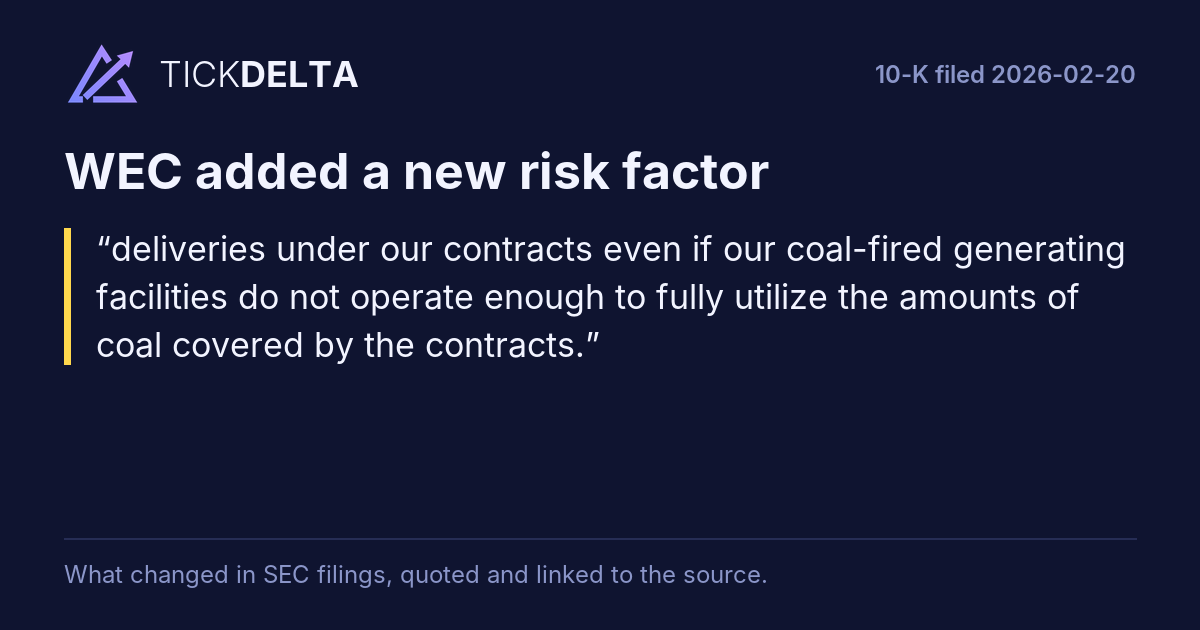
deliveries under our contracts even if our coal-fired generating facilities do not operate enough to fully utilize the amounts of coal covered by the contracts.
Read in the 10-K ↗
New in the latest 10-Q
20 paragraphs in the 10-Q filed Oct 30, 2026 with nothing like them in the 10-Q filed Aug 4, 2026 (at least half the words must differ; new numbers alone do not count). Quoted exactly, grouped by the item heading above them. This is text that changed, not a judgement of how serious it is.
Financial statements and notes
(1) These amounts primarily represent the deferral of the incremental revenue requirement of incurred costs resulting from changes to the retirement of certain generation facilities.
Read in the 10-Q ↗
2025 storm was increased from $ 8.8 million to $ 12.0 million in the third quarter of 2025 based on finalization of the damage assessment.
Read in the 10-Q ↗
During the third quarter of 2026, we physically settled various forward sales contracts that were entered into under our October 2025 EDA. As a result of these settlements, we issued 3,027,623 shares of common stock at a weighted-average net price of $ 114.79 per share. The net proceeds from the issuance were $ 347.5 million.
Read in the 10-Q ↗
Pension Benefits Three Months Ended September 30 Nine Months Ended September 30 (in millions) 2026 2025 2026 2025 Service cost $ 5.6 $ 5.2 $ 16.8 $ 15.7 Interest cost 28.7 29.6 85.9 89.0 Expected return on plan assets (42.8) (43.8) (128.2) (131.5) Gain on plan settlement (1.0) (0.7) (1.0) (0.7) Amortization of prior service credit — — (0.1) (0.1) Amortization of net actuarial loss 10.5 9.0 31.8 32.1 Net periodic benefit cost (credit) $ 1.0 $ (0.7) $ 5.2 $ 4.5
Read in the 10-Q ↗
During the third quarter of 2026, annual impairment tests were completed at all of our reporting units that carried a goodwill balance as of July 1, 2026. No impairments resulted from these tests.
Read in the 10-Q ↗
to comply with either standard. See the Federal Deregulatory Actions discussion above for more information regarding potential deregulatory actions regarding this rule.
Read in the 10-Q ↗
(4) Represents operation and maintenance associated with the earnings mechanisms we have in place, both the current year sharing estimate and the amortization of prior year amounts. See Note 26, Regulatory Environment, in our 2025 Annual Report on Form 10-K, for more information.
Read in the 10-Q ↗
(4) Represents operation and maintenance associated with the earnings mechanisms we have in place, both the current year sharing estimate and the amortization of prior year amounts.
Read in the 10-Q ↗
• A $0.9 million decrease related to MERC CIP revenue, which was offset in operation and maintenance expense. Rebates and programs are available to residential and commercial customers of MERC through the CIP, which is funded by ratepayers using the Conservation Cost Recovery Charge and the Conservation Cost Recovery Adjustment funds that are collected on their monthly billing statements.
Read in the 10-Q ↗
In September 2026 the DOC set AD/CVD duties on imports of solar cells and panels from India, Indonesia and Laos based on findings that producers in those countries are benefiting from illegal subsidies and selling solar products below cost in the United States. The USITC is expected to make a final determination this fall. If the USITC votes affirmatively, final rates will then be issued and take effect. Further, the DOC recently began an investigation into solar panels from Ethiopia and a petition was filed requesting investigation into solar panels from South Korea, both based on similar claims that solar panels from those countries are being made with Chinese-made components in violation of AD/CVD laws.
Read in the 10-Q ↗
On August 26, 2026, President Trump issued Executive Order 14421, declaring a national emergency to protect the United States bulk-power system from security threats associated with foreign-supplied electric equipment and technology. The order authorizes the United States Secretary of Energy to restrict, evaluate, and mitigate transactions involving the installation of foreign-sourced bulk-power system components that pose certain security threats initiated after the order and to establish a framework for identifying and monitoring the same foreign-sourced components already in the domestic power infrastructure prior to this order. This order covers facilities and control systems necessary for operating an interconnected transmission network and electric generation facilities but excludes local distribution. The Executive Order requires the United States Department of Energy to publish rules or regulations implementing this order no later than 120 days from August 26, 2026, or December 24, 2026. We are currently evaluating the potential operational and financial implications of this order.
Read in the 10-Q ↗
American Transmission Company LLC's Ozaukee County Distribution Interconnection Project
Read in the 10-Q ↗
In September 2025, ATC filed an application for a CPCN with the PSCW to construct the Ozaukee County Distribution Interconnection Project. This proposed project is an important part of our plan to serve the data center under construction in Port Washington, Wisconsin, and includes the construction of new transmission lines, rebuilding and upgrading existing lines, and the construction of up to five new electrical substations. The PSCW deemed this CPCN application complete in December 2025. However, on September 10, 2026, based upon numerous revisions, modifications, and additional documents filed by ATC, the PSCW issued an order stating the current state of the CPCN application was unreasonably complicated and rescinded its previous completeness determination. As requested by the PSCW, ATC refiled its application for a CPCN to construct the Ozaukee County Distribution Interconnection Project on September 14, 2026. We are monitoring this project and all related PSCW actions for any potential impacts on our capital plan and earnings.
Read in the 10-Q ↗
We have reviewed our critical accounting policies and considered whether any new critical accounting estimates or other significant changes to our accounting policies require additional disclosures. We have found that the disclosures made in our 2025 Annual Report on Form 10-K are still current and that there have been no significant changes, except as follows:
Read in the 10-Q ↗
We completed our annual goodwill impairment tests for all of our reporting units that carried a goodwill balance as of July 1, 2026. No impairments were recorded as a result of these tests. For all of our reporting units, the fair values calculated in step one of the test were greater than their carrying values. The fair values for the reporting units were calculated using a combination of the income approach and the market approach.
Read in the 10-Q ↗
For the income approach, we used internal forecasts to project cash flows. Any forecast contains a degree of uncertainty, and changes in these cash flows could significantly increase or decrease the calculated fair value of a reporting unit. For our reporting units that are regulated, a fair recovery of and return on costs prudently incurred to serve customers is assumed. An unfavorable outcome in a rate case could cause the fair values of our reporting units to decrease.
Read in the 10-Q ↗
Key assumptions used in the income approach include ROEs, the long-term growth rates used to determine terminal values at the end of the discrete forecast period, and the discount rates. The discount rate is applied to estimated future cash flows and is one of the most significant assumptions used to determine fair value under the income approach. As interest rates rise, the calculated fair values will decrease. The discount rate is based on the weighted-average cost of capital for each reporting unit, taking into account both the after-tax cost of debt and cost of equity. The terminal year ROE for each utility is driven by its current allowed ROE. The terminal growth rate is based primarily on a combination of historical and forecasted statistics for real gross domestic product and personal income for each utility service area.
Read in the 10-Q ↗
For the market approach, we used a higher weighting for the guideline public company method than the guideline merged and acquired company method due to a low number of mergers and acquisitions in recent years. The guideline public company method uses financial metrics from similar publicly traded companies to determine fair value. The guideline merged and acquired company method calculates fair value by analyzing the actual prices paid for recent mergers and acquisitions in the industry. We applied multiples derived from these two methods to the appropriate operating metrics for our reporting units to determine fair value.
Read in the 10-Q ↗
The underlying assumptions and estimates used in the impairment tests were made as of a point in time. Subsequent changes in these assumptions and estimates could change the results of the tests.
Read in the 10-Q ↗
For all of our reporting units that carried a goodwill balance at July 1, 2026, the fair value exceeded its carrying value by over 50%. Based on these results, our reporting units are not at risk of failing step one of the goodwill impairment test.
Read in the 10-Q ↗
The 10-Q's risk factors against the 10-K
Item 1A of the 10-Q filed Oct 30, 2026 against Item 1A of the 10-K filed Feb 20, 2026.
A 10-Q repeats only the risks that changed, so a 10-K paragraph that is missing from it is not counted as removed.
Added is a paragraph with nothing like it in the 10-K, Reworded a sentence that is in both with several words changed,
Quiet changes a sentence in both where one to four words changed and one is a hedge or a modal
(cut words struck through, new words highlighted and underlined).
Text on the page, not a score; each links to the filing at sec.gov.
What the 10-Q itself says about its risk factors:
Read in the 10-Q ↗
There were no material changes from the risk factors disclosed in Item 1A. Risk Factors in Part I of our 2025 Annual Report on Form 10-K.
1 paragraph in the 10-Q's Item 1A, and none of them adds, rewords or quietly edits a paragraph of the 10-K's.
Work on WEC in a spreadsheet:
Excel workbook (a sheet per section, ten years by column, charts, links to the filings) ·
CSV.
For a Google Sheet that stays up to date, paste =IMPORTDATA("https://tickdelta.com/company/WEC/export.csv") into a cell.