Paragraph 41 · 47% changed
Every version of it
Screener
/
SEC EDGAR
/CIK 0001075531
/10-K filed Feb 18, 2026, compared with Feb 20, 2025
/Numbers from the XBRL of the 10-Ks
Nasdaq
Consumer discretionary · Travel Services
Booking Holdings BKNG
The 10-K against last year's
289 changes: 21 added, 60 removed, 201 reworded, 7 quiet changes
10-K Feb 18, 2026 vs Feb 20, 2025
Risk Factors
24.0%
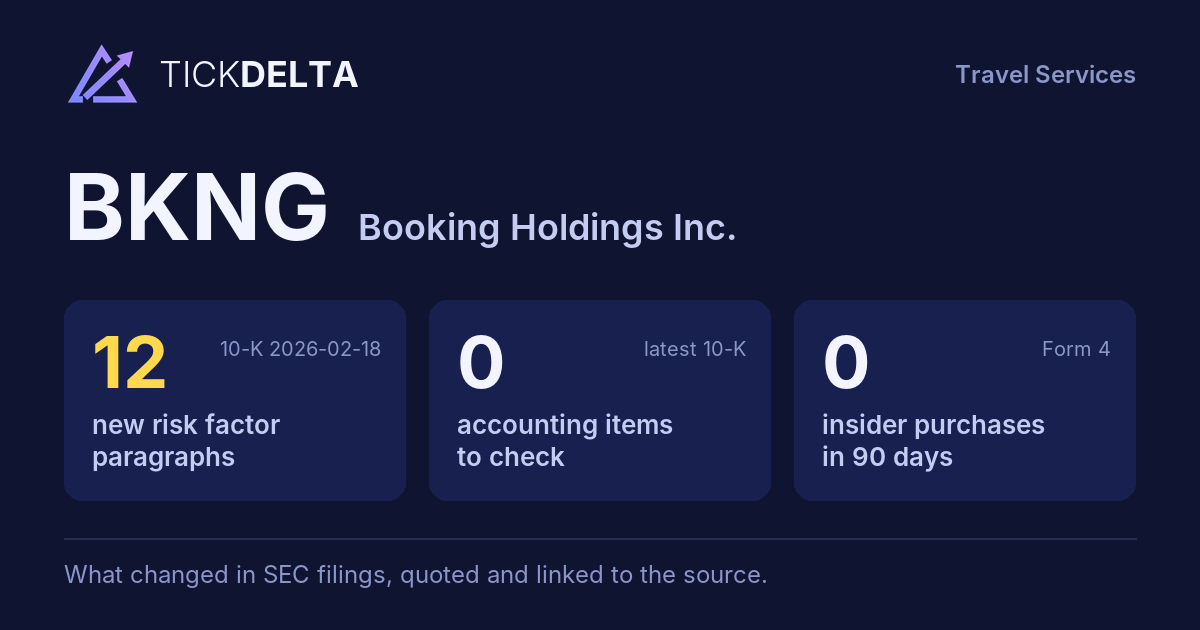
of the text changed · 12,540 words now · 12 new paragraphs, 33 gone
MD&A
32.5%
of the text changed · 7,659 words now · 9 new paragraphs, 27 gone
Legal Proceedings
43.9%
of the text changed · 2,054 words now
Accounting Policies
11.9%
of the text changed · 4,545 words now
10-K 0001075531-26-000009 (Feb 18, 2026) vs 10-K 0001075531-25-000010 (Feb 20, 2025)
Every paragraph, and how much of it changed
One bar per paragraph, in the order of the 10-K. Height and colour show the share of its words not in the closest paragraph a year earlier; the tallest bars are new paragraphs.
Risk Factors
125 paragraphs · 12 new · 74 reworded · 33 gone · 10-K Feb 18, 2026 against Feb 20, 2025
New paragraph
Reworded (5% of its words or more)
Same or nearly
Paragraph 100 · 47% changed
Every version of it
Paragraph 73 · 46% changed
Every version of it
We are subject to competition and consumer protection laws and regulations around the world. These laws and regulations evolve, and their interpretation, application, and enforcement can also change, be unpredictable, or be affected by changing political or social pressures. As we expand our business into new areas, including building the Connected Trip vision and integrating Gen AI into our offerings, we may become subject to additional laws and regulations. We have been the subject of investigations or inquiries by national competition authorities ("NCAs") ("Competition Authorities") and other governmental authorities. authorities regarding competition law matters, consumer protection issues, and other areas. For example, we are involved in investigations related to whether certain of Booking.com's contractual parity arrangements with accommodation providers are anti-competitive because they require partners anti-competitive, including with respect to provide Booking.com with rates, conditions, and availability at least as favorable as those issues like contractual parity, pricing tools or programs offered to other OTCs partners, or by the partner itself. In July 2024, the Comisión Nacional de los Mercados y la Competencia (the "CNMC") ranking criteria used in Spain notified Booking.com of its decision displaying results to impose a fine and consumers. See Note 16 to restrict our Consolidated Financial Statements for information regarding certain business practices based on the allegation that certain practices by Booking.com may produce adverse effects for hotels and other OTCs. Booking.com does not agree with the rationale stated legal proceedings in the decision and which we are involved. To resolve certain of the restrictions imposed, and has filed an appeal. In September 2017 the Swiss Price Surveillance Office opened an investigation that may require Booking.com to reduce its commissions in Switzerland. To resolve and close certain of these investigations, proceedings or investigations we have been or are involved in, we have made commitments regarding future business practices or activities, such as agreeing activities including related to narrow the scope of our parity arrangements. While arrangements, the information we believe that provide about our search results ranking, and how we are complying with the commitments display prices, discounts, and popularity and availability statements. Though we have made, taken steps to comply with such commitments, investigating authorities or third parties may determine otherwise assert that our measures are insufficient and decide to may pursue legal further action to compel compliance or seek other remedies. We cooperate with regulators but we are unable to predict what, if any, effect any investigations or their resolution, including the effect of any commitments we might make, will have on our business, industry practices, or online commerce more generally. An unfavorable outcome in an investigation could encourage additional regulatory inquiries that could become widespread over time, significantly increasing the potential financial and reputational impact on us. To the Company. Additionally, these types of extent that investigations can or inquiries result and have resulted in the assessment of additional commitments, changes to our business practices, negative publicity, fines, damages from private litigation, or other remedies, it could have a material adverse effect on our business, financial condition, and negative publicity. results of operations.
Paragraph 70 · 38% changed
Every version of it
Paragraph 83 · 34% changed
Every version of it
The implementation of unfavorable regulations or unfavorable interpretations of existing regulations by judicial or regulatory bodies could require us to incur significant compliance costs, cause the development of the affected markets to become impractical and otherwise have a material an adverse effect on our business and results of operations. For example, Turkish courts have ruled that Booking.com is subject to certain registration requirements in order to offer domestic accommodations to Turkish residents. If the appeal of this decision is not successful, Booking.com would be subject to Turkish registration requirements in order to resume offering domestic accommodations to Turkish residents, which would continue to negatively impact our business.
Paragraph 64 · 33% changed
Every version of it
The U.S.'s U.S. Tax Cuts and Jobs Act (the "Tax Act") introduced a tax on 50% of global intangible low-taxed income ("GILTI"), which is income determined to be in excess of a specified routine rate of return on qualifying business assets. The Tax Act further introduced ("GILTI") and a base erosion and anti-abuse tax. The One Big Beautiful Bill Act (the "BBB Act") enacted in July 2025 made changes to certain international, foreign tax ("BEAT") aimed at preventing the erosion of credit, and domestic tax provisions in the U.S. tax base effective in 2025 and a new tax deduction with respect to certain foreign-derived intangible income. If we are unable to operate our business so that BEAT does not impact us, our effective tax rate, results of operations and cash flows would be adversely affected. The interpretation and implementation of the Tax Act have had and could have a negative impact on our results of operations and cash flows. 2026. In addition, the U.S.'s Inflation Reduction Act includes a 15% corporate minimum tax on book income and a 1% excise tax on stock repurchases. The interpretation and implementation of these provisions the Tax Act, the BBB Act, the Inflation Reduction Act, and other tax legislation could have a negative impact on our results of operations and cash flows. Increases in the U.S. corporate income tax rate, increasing the percentage of GILTI subject to tax in the U.S., or other changes to U.S. federal tax laws could have a negative impact on our results of operations and cash flows.
Paragraph 6 · 32% changed
Every version of it
Other events beyond our control such as pandemics, terrorist attacks, natural disasters, trade disputes, sanctions, wars and regional hostilities, political unrest, travel-related accidents, or increased focus on the environmental impact of travel overtourism may disrupt or limit the ability or willingness of travelers to visit certain locations, or result in declines in demand for our or travel offerings. Responses to such events by governments or global organizations restrictions, which could restrict travel in ways that could negatively impact our ability to conduct our business. Because these These events and their impacts are largely unpredictable, they unpredictable and can dramatically and suddenly abruptly affect consumer travel behavior by consumers, demand for and provision of our services, and relationships with travel service providers and other partners, any of which can could adversely affect our business and results of operations.
Paragraph 84 · 30% changed
Every version of it
Compliance with the legal requirements of multiple jurisdictions increases our cost of doing business. These laws Global laws, regulations, and regulations, changing social, political and public policies, which sometimes conflict, include impact a wide range of subjects, including the U.S. Foreign Corrupt Practices Act, the UK Bribery Act, the DSA digital marketplace regulations, and DMA, and local laws prohibiting corrupt payments to governmental officials or third parties, data privacy requirements, emerging regulations governing the development, marketing, and use of AI, labor relations laws, non-discrimination, human rights or anti-human trafficking laws, tax laws, anti-trust or competition laws, U.S., EU, or U.N. export controls, sanctioned country or sanctioned persons mandates, sustainability, and consumer protection laws. Violations of these laws and regulations have resulted and in the future could result in fines, penalties, and criminal sanctions against us, our officers, or our employees and prohibitions on how or where we conduct business. In certain jurisdictions the basis of assessing damages is changing, which may make it difficult to estimate what such fines and penalties would amount to if successfully asserted against us. Violations could delay or prevent potential acquisitions and could materially damage our reputation, brands, global expansion efforts, ability to attract and retain employees and business partners, business, and operating results. Even if we comply with these laws and regulations, doing business in certain jurisdictions or violations of these laws and regulations by the parties with which we conduct business could harm our reputation and brands, which could adversely affect our results of operations and stock price. operations. We could also face difficulties transferring funds from or converting currencies in certain countries. In addition, if these restrictions are not applicable to competitors, it may provide them a competitive advantage. Additionally, our employees in certain countries in Europe are represented by works councils and/or trade unions. We are required to consult with works councils on certain matters such as restructurings (such as our Transformation Program), acquisitions and divestitures, and other matters that could impact our labor force. Consultation may not be completed on terms satisfactory to us and could result in increases in our cost of labor, diversion of management's attention away from operating our business, delays in certain initiatives, and expose us to claims and litigation. We are also subject to a variety of other regulatory, legal, and public policy risks and challenges in managing an organization operating in various countries, including:
Paragraph 41 · 47% changed
Every version of it
10-K Feb 20, 2025In addition, we are conducting a multi-year phased migration to integrate and upgrade certain systems and processes. The implementation of new information technology, payment, enterprise resource planning, or other systems is disruptive and costly and may not be successful, which could adversely affect our business and results of operations. Any failure to implement or adapt to new technologies in a timely manner or at all could adversely affect our ability to compete, increase our consumer acquisition costs, or otherwise adversely affect our business, brands, market share, reputation, or results of operations.
10-K Feb 18, 2026
We are committed to the enhancement of our operational systems and we face risks deploying information technology, payment processing, enterprise resource planning, and other systems as such initiatives are resource-intensive, may cause operational disruption and could affect our results of operations. Inability to successfully implement or adapt these technologies in a timely manner could adversely affect our business or results of operations.
Paragraph 100 · 47% changed
Every version of it
10-K Feb 20, 2025In response to focus by our investors and other stakeholders, we made climate-related commitments and issued a Climate Action Plan. We continue to evaluate these commitments, including those related to offering more sustainable trip options as well as ESG disclosures that may be required in certain jurisdictions. Our ability to do so is subject to risks including: (1) the availability and cost of limiting or offsetting our use of carbon-based energy sources and technologies, (2) evolving regulatory requirements affecting ESG standards and disclosures, (3) our ability to work with partners and providers that can meet our sustainability and other standards, (4) the availability of vendor or other third-party data, (5) the impact of our organic growth and acquisitions or dispositions of businesses or operations on our ESG goals, and (6) customers' actual demand for ESG-oriented product offerings, which may be more expensive and less available than other options. We may need to invest significant effort and resources relating to required ESG disclosures, and inconsistent and uncertain regulations may lead us to revise or discontinue our commitments or how we measure and report ESG data. In addition, regulatory developments regarding sustainability labeling have resulted and could result in further changes to, or the discontinuation of, ESG programs or objectives.
10-K Feb 18, 2026
Environmental and social matters are an area of evolving focus among our stockholders and other stakeholders, including customers, partners, employees, governments, regulators, and non-governmental organizations, and business partners and vendors. We have invested in various initiatives regarding matters such as environmental sustainability, inclusion, and human rights, but such initiatives are costly and may not have the desired effect. For example, we have made climate-related commitments through our Climate Action Plan and continue to evaluate whether we, our partners, and our vendors are able to meet evolving sustainability and other standards, particularly as AI-related energy consumption increases. We may need to invest significant effort and resources relating to required environmental and social disclosures, and inconsistent and uncertain regulations may lead us to revise or discontinue our commitments or how we measure and report data. In addition, regulatory developments regarding sustainability labeling have resulted and could result in further changes to, or the discontinuation of, environmental and social programs or objectives.
Paragraph 73 · 46% changed
Every version of it
10-K Feb 20, 2025
competition authorities ("NCAs") and other governmental authorities. For example, we are involved in investigations related to whether certain of Booking.com's contractual parity arrangements with accommodation providers are anti-competitive because they require partners to provide Booking.com with rates, conditions, and availability at least as favorable as those offered to other OTCs or by the partner itself. In July 2024, the Comisión Nacional de los Mercados y la Competencia (the "CNMC") in Spain notified Booking.com of its decision to impose a fine and to restrict certain business practices based on the allegation that certain practices by Booking.com may produce adverse effects for hotels and other OTCs. Booking.com does not agree with the rationale stated in the decision and certain of the restrictions imposed, and has filed an appeal. In September 2017 the Swiss Price Surveillance Office opened an investigation that may require Booking.com to reduce its commissions in Switzerland. To resolve and close certain of these investigations, we have made commitments regarding future business practices or activities, such as agreeing to narrow the scope of our parity arrangements. While we believe that we are complying with the commitments we have made, investigating authorities or third parties may determine otherwise and decide to pursue legal action to compel compliance or seek other remedies. We cooperate with regulators but we are unable to predict what, if any, effect any investigations or their resolution, including the effect of any commitments we might make, will have on our business, industry practices, or online commerce more generally. An unfavorable outcome in an investigation could encourage additional regulatory inquiries that could become widespread over time, significantly increasing the potential financial and reputational impact on the Company. Additionally, these types of investigations can result and have resulted in the assessment of fines, private litigation, and negative publicity.
10-K Feb 18, 2026
We are subject to competition and consumer protection laws and regulations around the world. These laws and regulations evolve, and their interpretation, application, and enforcement can also change, be unpredictable, or be affected by changing political or social pressures. As we expand our business into new areas, including building the Connected Trip vision and integrating Gen AI into our offerings, we may become subject to additional laws and regulations. We have been the subject of investigations or inquiries by national competition authorities ("Competition Authorities") and other governmental authorities regarding competition law matters, consumer protection issues, and other areas. For example, we are involved in investigations related to whether certain of Booking.com's arrangements with accommodation providers are anti-competitive, including with respect to issues like contractual parity, pricing tools or programs offered to partners, or the ranking criteria used in displaying results to consumers. See Note 16 to our Consolidated Financial Statements for information regarding certain legal proceedings in which we are involved. To resolve certain of the proceedings or investigations we have been or are involved in, we have made commitments regarding future business practices or activities including related to our parity arrangements, the information we provide about our search results ranking, and how we display prices, discounts, and popularity and availability statements. Though we have taken steps to comply with such commitments, investigating authorities or third parties may assert that our measures are insufficient and may pursue further action or seek other remedies. We cooperate with regulators but are unable to predict what, if any, effect any investigations or their resolution, including the effect of any commitments we might make, will have on our business, industry practices, or online commerce more generally. An unfavorable outcome in an investigation could encourage additional regulatory inquiries that could become widespread over time, significantly increasing the potential financial and reputational impact on us. To the extent that investigations or inquiries result in additional commitments, changes to our business practices, negative publicity, fines, damages from private litigation, or other remedies, it could have a material adverse effect on our business, financial condition, and results of operations.
Paragraph 70 · 38% changed
Every version of it
10-K Feb 20, 2025A number of jurisdictions in the U.S. have initiated lawsuits or other proceedings against OTCs, including us, related to, among other things, the payment of certain travel transaction taxes that could include historical taxes that are claimed to be owed, interest, penalties, punitive damages, and/or attorney's fees and costs. Additional jurisdictions may assert that we are subject to travel transaction taxes and could seek to collect such taxes, either retroactively, prospectively, or both. We continue to defend against these lawsuits and, where appropriate, intend to continue to assert that we should not be subject to such taxes. Although we believe we do not owe the taxes claimed in these lawsuits, litigation is uncertain, and if there was an adverse outcome in these lawsuits or similar litigation in other jurisdictions, it could result in liabilities for past and/or future bookings, and it could have an adverse effect on our business, reputation, profit margins, and results of operations. Jurisdictions could also seek to amend their tax statutes in order to collect travel transaction taxes from us on a prospective basis.
10-K Feb 18, 2026
these lawsuits or similar litigation in other jurisdictions, it could result in liabilities for past and/or future bookings, and it could have an adverse effect on our business, reputation, profit margins, and results of operations. Jurisdictions could also seek to amend their tax statutes in order to collect travel transaction taxes from us on a prospective basis.
Paragraph 83 · 34% changed
Every version of it
10-K Feb 20, 2025
The implementation of unfavorable regulations or unfavorable interpretations of existing regulations by judicial or regulatory bodies could require us to incur significant compliance costs, cause the development of the affected markets to become impractical and otherwise have a material adverse effect on our business and results of operations. For example, Turkish courts have ruled that Booking.com is subject to certain registration requirements in order to offer domestic accommodations to Turkish residents. If the appeal of this decision is not successful, Booking.com would be subject to Turkish registration requirements in order to resume offering domestic accommodations to Turkish residents, which would continue to negatively impact our business.
10-K Feb 18, 2026
The implementation of unfavorable regulations or unfavorable interpretations of existing regulations by judicial or regulatory bodies could require us to incur significant compliance costs, cause the development of the affected markets to become impractical and otherwise have an adverse effect on our business and results of operations.
Paragraph 64 · 33% changed
Every version of it
10-K Feb 20, 2025
The U.S.'s Tax Cuts and Jobs Act (the "Tax Act") introduced a tax on 50% of global intangible low-taxed income ("GILTI"), which is income determined to be in excess of a specified routine rate of return on qualifying business assets. The Tax Act further introduced a base erosion and anti-abuse tax ("BEAT") aimed at preventing the erosion of the U.S. tax base and a new tax deduction with respect to certain foreign-derived intangible income. If we are unable to operate our business so that BEAT does not impact us, our effective tax rate, results of operations and cash flows would be adversely affected. The interpretation and implementation of the Tax Act have had and could have a negative impact on our results of operations and cash flows. In addition, the U.S.'s Inflation Reduction Act includes a 15% corporate minimum tax on book income and a 1% excise tax on stock repurchases. The interpretation and implementation of these provisions could have a negative impact on our results of operations and cash flows. Increases in the U.S. corporate income tax rate, increasing the percentage of GILTI subject to tax in the U.S., or other changes to U.S. federal tax laws could have a negative impact on our results of operations and cash flows.
10-K Feb 18, 2026
The U.S. Tax Cuts and Jobs Act (the "Tax Act") introduced a tax on 50% of global intangible low-taxed income ("GILTI") and a base erosion and anti-abuse tax. The One Big Beautiful Bill Act (the "BBB Act") enacted in July 2025 made changes to certain international, foreign tax credit, and domestic tax provisions in the U.S. effective in 2025 and 2026. In addition, the U.S.'s Inflation Reduction Act includes a 15% corporate minimum tax on book income and a 1% excise tax on stock repurchases. The interpretation and implementation of the Tax Act, the BBB Act, the Inflation Reduction Act, and other tax legislation could have a negative impact on our results of operations and cash flows. Increases in the U.S. corporate income tax rate, increasing the percentage of GILTI subject to tax in the U.S., or other changes to U.S. federal tax laws could have a negative impact on our results of operations and cash flows.
Paragraph 6 · 32% changed
Every version of it
10-K Feb 20, 2025
Other events beyond our control such as pandemics, terrorist attacks, natural disasters, wars and regional hostilities, travel-related accidents, or increased focus on the environmental impact of travel may disrupt or limit the ability or willingness of travelers to visit certain locations, or result in declines in demand for our travel offerings. Responses to such events by governments or global organizations could restrict travel in ways that could impact our ability to conduct our business. Because these events and their impacts are largely unpredictable, they can dramatically and suddenly affect travel behavior by consumers, demand for and provision of our services, and relationships with travel service providers and other partners, any of which can adversely affect our business and results of operations.
10-K Feb 18, 2026
Other events beyond our control such as pandemics, terrorist attacks, natural disasters, trade disputes, sanctions, wars and regional hostilities, political unrest, travel-related accidents, or overtourism may result in declines in demand or travel restrictions, which could negatively impact our business. These events and their impacts are largely unpredictable and can abruptly affect consumer travel behavior and relationships with travel service providers and partners, which could adversely affect our business and results of operations.
Paragraph 84 · 30% changed
Every version of it
10-K Feb 20, 2025
Compliance with the legal requirements of multiple jurisdictions increases our cost of doing business. These laws and regulations, which sometimes conflict, include the U.S. Foreign Corrupt Practices Act, the UK Bribery Act, the DSA and DMA, and local laws prohibiting corrupt payments to governmental officials or third parties, data privacy requirements, emerging regulations governing the development, marketing, and use of AI, labor relations laws, non-discrimination, human rights or anti-human trafficking laws, tax laws, anti-trust or competition laws, U.S., EU, or U.N. sanctioned country or sanctioned persons mandates, and consumer protection laws. Violations of these laws and regulations have resulted and in the future could result in fines, penalties, and criminal sanctions against us, our officers, or our employees and prohibitions on how or where we conduct business. Violations could delay or prevent potential acquisitions and could materially damage our reputation, brands, global expansion efforts, ability to attract and retain employees and business partners, business, and operating results. Even if we comply with these laws and regulations, doing business in certain jurisdictions or violations of these laws and regulations by the parties with which we conduct business could harm our reputation and brands, which could adversely affect our results of operations and stock price. In addition, if these restrictions are not applicable to competitors, it may provide them a competitive advantage. Additionally, our employees in certain countries in Europe are represented by works councils and/or trade unions. We are required to consult with works councils on certain matters such as restructurings (such as our Transformation Program), acquisitions and divestitures, and other matters that could impact our labor force. Consultation may not be completed on terms satisfactory to us and could result in increases in our cost of labor, diversion of management's attention away from operating our business, delays in certain initiatives, and expose us to claims and litigation. We are also subject to a variety of other regulatory, legal, and public policy risks and challenges in managing an organization operating in various countries, including:
10-K Feb 18, 2026
Compliance with requirements of multiple jurisdictions increases our cost of doing business. Global laws, regulations, and changing social, political and public policies, which sometimes conflict, impact a wide range of subjects, including the digital marketplace regulations, and laws prohibiting corrupt payments to governmental officials or third parties, data privacy requirements, emerging regulations governing the development, marketing, and use of AI, labor relations laws, non-discrimination, human rights or anti-human trafficking laws, tax laws, competition laws, export controls, sanctioned country or sanctioned persons mandates, sustainability, and consumer protection laws. Violations of these laws and regulations have resulted and in the future could result in fines, penalties, and criminal sanctions against us, our officers, or our employees and prohibitions on how or where we conduct business. In certain jurisdictions the basis of assessing damages is changing, which may make it difficult to estimate what such fines and penalties would amount to if successfully asserted against us. Violations could delay or prevent potential acquisitions and could materially damage our reputation, brands, global expansion efforts, ability to attract and retain employees and business partners, business, and operating results. Even if we comply with these laws and regulations, doing business in certain jurisdictions or violations of these laws and regulations by the parties with which we conduct business could harm our reputation and brands, which could adversely affect our results of operations. We could also face difficulties transferring funds from or converting currencies in certain countries. In addition, if these restrictions are not applicable to competitors, it may provide them a competitive advantage.
MD&A
103 paragraphs · 9 new · 71 reworded · 27 gone · 10-K Feb 18, 2026 against Feb 20, 2025
New paragraph
Reworded (5% of its words or more)
Same or nearly
Paragraph 20 · 48% changed
In November the fourth quarter of 2024, we announced began the implementation of organizational changes to improve operating expense efficiency, increase organizational agility, free up resources that can be reinvested into further improving our intention offering to implement certain organizational changes, including modernizing processes travelers and systems, initiating an expected workforce reduction, optimizing procurement, partners, and seeking real estate savings better position our business for the long term (the "Transformation Program"). We believe it is important to make these organizational changes The Transformation Program resulted in order to drive further expense efficiency, create room for reinvestment approximately $250 million in projects and initiatives that will support savings in 2025. Given the growth stronger-than-expected early results of our business over the long run, and further improve our organizational agility. We expect the Transformation Program Program, in the third quarter of 2025, we raised our expectation for the ultimate annual run-rate savings to ultimately deliver about a range of $500 to $550 million from our previous guidance of $400 to $450 million in annual run rate savings over the next three years million, as compared to our 2024 expense base. We are As of the end of 2025, we have enabled approximately $550 million in the early stages of this program annual run-rate savings and we expect to realize these run-rate savings by the majority end of the run rate savings to be achieved after 2025. 2026. We expect that the restructuring costs and accelerated investments related to the Transformation Program will largely be incurred in by the next two to three years end of 2026 and are estimated to be, in the aggregate, approximately less than one times the expected annual run rate run-rate savings.
Paragraph 7 · 46% changed
Paragraph 31 · 44% changed
The estimated fair value of KAYAK was determined using a combination of standard valuation techniques, including an income approach (discounted cash flow) and a market approach (applying comparable company multiples). The income approach estimates fair value utilizing long-term growth rates and discount rates applied to the cash flow projections. An increase or decrease of one percentage point to the earnings before interest, taxes, depreciation and amortization ("EBITDA") growth rates used in the cash flow projections would result in an increase of approximately $45 million and a decrease of approximately $40 million, respectively, to the estimated fair value of KAYAK as of September 30, 2025. The discount rate is determined based on the reporting unit's estimated weighted-average cost of capital and adjusted to reflect the risks inherent in its cash flows, which require significant judgments. If the discount rate used in the income approach increases or decreases by 0.5%, the impact to the estimated fair value of KAYAK at September 30, 2025 ranges from a decrease of approximately $20 million to an increase of approximately $25 million. The market approach estimates value using prices and other relevant information generated by market transactions involving identical or comparable companies. The income approach estimates value based on publicly-traded companies, including the expectation use of future cash flows that a company will generate. These future cash flows are discounted to their present values using a discount rate based on a company's weighted-average cost of capital adjusted to reflect the risks inherent in its cash flows. The key unobservable inputs and ranges used for the June 2023 impairment evaluation include the weighted average cost of capital of 10.5%-14.5% and a terminal earnings before interest, taxes, depreciation, and amortization ("EBITDA") multiple of 14x-16x. The key unobservable inputs and ranges used for the June 2022 impairment evaluation include, for the market approach, percentage decrease in the calibrated EBITDA multiple (36%) and for the income approach, the weighted average cost of capital of 10%-14% and the terminal EBITDA multiple of 14x-16x. Significant changes in any of these inputs would result in significantly different fair value measurements. multiple. A change in the assumption used for the EBITDA multiples multiple would result in a directionally similar change in the fair value and a change in the assumption used for weighted average cost of capital would result in a directionally opposite change in the fair value.
Paragraph 28 · 43% changed
The determination estimation of the recoverable values of asset groups and the fair values of investments where we are a minority shareholder and have access to limited information from the investee our reporting units reflects numerous assumptions that are subject to various risks and uncertainties, including key assumptions regarding the investee's each reporting unit's expected growth rates and operating margin, as well as other margin and with respect to matters outside of our control, such as discount rates and market comparables. It requires significant judgments and estimates and actual Actual results could be materially different than those the judgments and estimates utilized used. Generally, changes in the assumptions used for comparable company multiples would result in directionally similar changes in the fair value estimate. and changes in the assumptions used for discount rates would result in directionally opposite changes in the fair value. Future events and changing market conditions may lead us to re-evaluate the assumptions reflected in used to estimate the valuation, which fair values of our reporting units. Such changes may result include travel service providers reducing or withdrawing from our services, generative AI better enabling or offering alternatives for travel service providers to reach consumers, or competitors affecting our ability to market to and reach consumers in a need to recognize additional impairment charges. cost-efficient way.
Paragraph 74 · 36% changed
Year Ended December 31, Increase (Decrease) (in (In millions) 2025 2024 2023 Interest expense Other income (expense), net $ (1,295) (1,297) $ (897) 44.3% Interest and dividend income 1,114 1,020 9.2% (82)
Paragraph 64 · 35% changed
General and administrative expenses decreased year-over-year in 2024 2025 due to the impact of the $337 million accrual of a loss of $530 million in 2024 related to a draft decision the settlement of certain Italian indirect tax matters, partially offset by the Spanish competition authority in 2023, which was subsequently reduced by $78 $89 million in 2024 when the decision was finalized. expense in 2025 related to certain other indirect tax matters. In addition, the year-over-year decrease in general and administrative expenses in 2025 was impacted by a $78 million reduction in 2024 was due to in the termination fee of $90 million accrual related to the acquisition agreement for fine imposed by the Etraveli Group in 2023 as well as the settlement of certain indirect tax matters of $62 million in 2023. The year-over-year decrease in general and administrative expenses in 2024 was partially offset by additional expenses of $337 million related to the settlement agreement with the Italian Tax Authorities in 2024. Spanish competition authority.
Paragraph 66 · 35% changed
Information technology expenses increased year-over-year in 2024 2025 due primarily to an increase in expenses related to cloud computing costs and outsourced data center costs, as well as software license and system maintenance fees. changes in foreign currency exchange rates.
Paragraph 70 · 33% changed
Transformation CostsYear Ended December 31, Increase (Decrease) (in (In millions) 2025 2024 2023 Transformation costs $ 34 $ * % of Total revenues 0.1 % —% 205 $34
Paragraph 20 · 48% changed
10-K Feb 20, 2025
In November 2024, we announced our intention to implement certain organizational changes, including modernizing processes and systems, initiating an expected workforce reduction, optimizing procurement, and seeking real estate savings (the "Transformation Program"). We believe it is important to make these organizational changes in order to drive further expense efficiency, create room for reinvestment in projects and initiatives that will support the growth of our business over the long run, and further improve our organizational agility. We expect the Transformation Program to ultimately deliver about $400 to $450 million in annual run rate savings over the next three years as compared to our 2024 expense base. We are in the early stages of this program and we expect the majority of the run rate savings to be achieved after 2025. We expect that restructuring costs and accelerated investments related to the Transformation Program will be incurred in the next two to three years and are estimated to be, in the aggregate, approximately one times the expected annual run rate savings.
10-K Feb 18, 2026
In the fourth quarter of 2024, we began the implementation of organizational changes to improve operating expense efficiency, increase organizational agility, free up resources that can be reinvested into further improving our offering to travelers and partners, and better position our business for the long term (the "Transformation Program"). The Transformation Program resulted in approximately $250 million in savings in 2025. Given the stronger-than-expected early results of the Transformation Program, in the third quarter of 2025, we raised our expectation for the ultimate annual run-rate savings to a range of $500 to $550 million from our previous guidance of $400 to $450 million, as compared to our 2024 expense base. As of the end of 2025, we have enabled approximately $550 million in annual run-rate savings and we expect to realize these run-rate savings by the end of 2026. We expect that the restructuring costs and accelerated investments related to the Transformation Program will largely be incurred by the end of 2026 and are estimated to be, in the aggregate, less than one times the expected annual run-rate savings.
Paragraph 7 · 46% changed
10-K Feb 20, 2025Our global room nights in 2024 increased 9% year-over-year driven primarily by healthy travel demand in Europe and Asia. We saw the booking window expand in 2024 compared to 2023, which benefited year-over-year room night growth.
10-K Feb 18, 2026
In the fourth quarter of 2025, global room nights increased 9% year-over-year. We saw healthy travel demand across all our major regions in the fourth quarter of 2025.
Paragraph 31 · 44% changed
10-K Feb 20, 2025
The market approach estimates value using prices and other relevant information generated by market transactions involving identical or comparable companies. The income approach estimates value based on the expectation of future cash flows that a company will generate. These future cash flows are discounted to their present values using a discount rate based on a company's weighted-average cost of capital adjusted to reflect the risks inherent in its cash flows. The key unobservable inputs and ranges used for the June 2023 impairment evaluation include the weighted average cost of capital of 10.5%-14.5% and a terminal earnings before interest, taxes, depreciation, and amortization ("EBITDA") multiple of 14x-16x. The key unobservable inputs and ranges used for the June 2022 impairment evaluation include, for the market approach, percentage decrease in the calibrated EBITDA multiple (36%) and for the income approach, the weighted average cost of capital of 10%-14% and the terminal EBITDA multiple of 14x-16x. Significant changes in any of these inputs would result in significantly different fair value measurements. A change in the assumption used for EBITDA multiples would result in a directionally similar change in the fair value and a change in the assumption used for weighted average cost of capital would result in a directionally opposite change in the fair value.
10-K Feb 18, 2026
The estimated fair value of KAYAK was determined using a combination of standard valuation techniques, including an income approach (discounted cash flow) and a market approach (applying comparable company multiples). The income approach estimates fair value utilizing long-term growth rates and discount rates applied to the cash flow projections. An increase or decrease of one percentage point to the earnings before interest, taxes, depreciation and amortization ("EBITDA") growth rates used in the cash flow projections would result in an increase of approximately $45 million and a decrease of approximately $40 million, respectively, to the estimated fair value of KAYAK as of September 30, 2025. The discount rate is determined based on the reporting unit's estimated weighted-average cost of capital and adjusted to reflect the risks inherent in its cash flows, which require significant judgments. If the discount rate used in the income approach increases or decreases by 0.5%, the impact to the estimated fair value of KAYAK at September 30, 2025 ranges from a decrease of approximately $20 million to an increase of approximately $25 million. The market approach estimates value using prices and other relevant information generated by market transactions involving comparable publicly-traded companies, including the use of the EBITDA multiple. A change in the assumption used for the EBITDA multiple would result in a directionally similar change in the fair value.
Paragraph 28 · 43% changed
10-K Feb 20, 2025
The determination of the fair values of investments where we are a minority shareholder and have access to limited information from the investee reflects numerous assumptions that are subject to various risks and uncertainties, including regarding the investee's expected growth rates and operating margin, as well as other matters outside of our control, such as discount rates and market comparables. It requires significant judgments and estimates and actual results could be materially different than those judgments and estimates utilized in the fair value estimate. Future events and changing market conditions may lead us to re-evaluate the assumptions reflected in the valuation, which may result in a need to recognize additional impairment charges.
10-K Feb 18, 2026
The estimation of the recoverable values of asset groups and the fair values of our reporting units reflects numerous assumptions that are subject to various risks and uncertainties, including key assumptions regarding each reporting unit's expected growth rates and operating margin and with respect to matters outside of our control, such as discount rates and market comparables. Actual results could be materially different than the judgments and estimates used. Generally, changes in the assumptions used for comparable company multiples would result in directionally similar changes in the fair value and changes in the assumptions used for discount rates would result in directionally opposite changes in the fair value. Future events and changing market conditions may lead us to re-evaluate the assumptions used to estimate the fair values of our reporting units. Such changes may include travel service providers reducing or withdrawing from our services, generative AI better enabling or offering alternatives for travel service providers to reach consumers, or competitors affecting our ability to market to and reach consumers in a cost-efficient way.
Paragraph 74 · 36% changed
10-K Feb 20, 2025
Year Ended December 31, Increase (Decrease) (in millions) 2024 2023 Interest expense $ (1,295) $ (897) 44.3% Interest and dividend income 1,114 1,020 9.2%
10-K Feb 18, 2026
Year Ended December 31, (In millions) 2025 2024 Other income (expense), net $ (1,297) $ (82)
Paragraph 64 · 35% changed
10-K Feb 20, 2025
General and administrative expenses decreased year-over-year in 2024 due to the accrual of a loss of $530 million related to a draft decision by the Spanish competition authority in 2023, which was subsequently reduced by $78 million in 2024 when the decision was finalized. In addition, the year-over-year decrease in general and administrative expenses in 2024 was due to the termination fee of $90 million related to the acquisition agreement for the Etraveli Group in 2023 as well as the settlement of certain indirect tax matters of $62 million in 2023. The year-over-year decrease in general and administrative expenses in 2024 was partially offset by additional expenses of $337 million related to the settlement agreement with the Italian Tax Authorities in 2024.
10-K Feb 18, 2026
General and administrative expenses decreased year-over-year in 2025 due to the impact of the $337 million accrual in 2024 related to the settlement of certain Italian indirect tax matters, partially offset by $89 million in expense in 2025 related to certain other indirect tax matters. In addition, the year-over-year decrease in general and administrative expenses in 2025 was impacted by a $78 million reduction in 2024 in the accrual related to the fine imposed by the Spanish competition authority.
Paragraph 66 · 35% changed
10-K Feb 20, 2025
Information technology expenses increased year-over-year in 2024 due to an increase in expenses related to cloud computing costs and outsourced data center costs, as well as software license and system maintenance fees.
10-K Feb 18, 2026
Information technology expenses increased year-over-year in 2025 due primarily to an increase in cloud computing costs, as well as changes in foreign currency exchange rates.
Paragraph 70 · 33% changed
10-K Feb 20, 2025
Transformation CostsYear Ended December 31, Increase (Decrease) (in millions) 2024 2023 Transformation costs $ 34 $ * % of Total revenues 0.1 % —%
10-K Feb 18, 2026
Transformation CostsYear Ended December 31, (In millions) 2025 2024 Transformation costs $ 205 $34
A paragraph is matched with the one last year that shares the most of its words; under half in common makes it new. The paragraphs shown are the 8 reworded the most in each section.
The paragraph that changed most in each section
The redline
Marked against last year's 10-K: cut words struck through, new words highlighted.
Legal Proceedings445 words changed in this paragraph; it is 34% similar to last year's version.
Beginning in 2014, Booking.com B.V. received several letters from the Netherlands Pension Fund for the Travel Industry (Reiswerk) ("BPF") claiming that it was required to participate in the mandatory pension scheme of the BPF with retroactive effect to 1999, which has a higher contribution rate than the pension scheme in which it is currently participating. historically participated in. BPF instituted legal proceedings and in 2016 the District Court of Amsterdam rejected all of against Booking.com B.V. (which were continued by BPF's claims. BPF appealed the decision to the Court of Appeal, legal successor, Pension Fund PGB ("PGB")) and, in May 2019, the Court of Appeal also rejected all of BPF's claims, in each case by ruling that Booking did not meet the definition of a travel intermediary for purposes of the mandatory pension scheme. BPF then appealed to the Netherlands Supreme Court. In April 2021, the Supreme Court overturned the previous decision of the Court of Appeal and held that Booking.com B.V. met the definition of a travel intermediary for the purposes of the mandatory pension scheme. The Supreme Court ruled only on the qualification of Booking.com B.V. as a travel intermediary for the purposes of the mandatory pension scheme and did not rule on the various other defenses brought forward by the Company against BPF's claims. The Supreme Court referred the matter to another Court of Appeal to assess the other defenses brought forward by the Company. In January 2024, that a Dutch Court of Appeal ruled that Booking.com B.V. is required to participate in the mandatory pension scheme of the BPF PGB with retroactive effect to 1999. The Company has filed an appeal of the decision to the Netherlands Supreme Court. Although the Company disagrees disagreed with and appealed the decision, it accrued losses of $ 276 million and $ 77 million for the years ended December 31, 2023 and 2024, respectively, included in "Personnel" expenses in the Consolidated Statements of Operations. The corresponding liability is included in "Accrued expenses and other current liabilities" in the Consolidated Balance Sheet as of December 31, 2024. After a loss final ruling by the Dutch Supreme Court in March 2025, Booking.com B.V. changed its pension scheme going forward and with retroactive effect to 1999, in line with the outcome of 253 the litigation and arrangement with PGB. During the year ended December 31, 2025, the Company paid $ 136 million Euros ($ 276 million), included to settle the pension liability as of December 31, 2024, reflecting the arrangement with PGB that became effective during the period. The impact of the reduction in the pension liability from December 31, 2024 of $ 176 million is recorded in "Personnel" expenses in the Consolidated Statement of Operations for the year ended December 31, 2023. During the year ended December 31, 2024, the Company recorded 2025. There may be additional estimated expenses of 72 million Euros ($ 77 million) included in "Personnel" expenses in the Consolidated Statements of Operations. The related liability is included in "Accrued expenses and other current liabilities" in the Consolidated Balance Sheets as of December 31, 2024 and 2023. On a go-forward basis, Booking.com B.V. expects to begin paying pension premiums claims with respect to the BPF scheme or to increase contributions to eligibility of certain employees in scope of the benefit of employees under its existing pension scheme. scheme, which may result in additional costs.
Source: Item 3, via Note 16 – COMMITMENTS AND CONTINGENCIES, 10-K 0001075531-26-000009 vs Item 3, via Note 16 – COMMITMENTS AND CONTINGENCIES, 10-K 0001075531-25-000010
Risk Factors375 words changed in this paragraph; it is 42% similar to last year's version.
We are subject to competition and consumer protection laws and regulations around the world. These laws and regulations evolve, and their interpretation, application, and enforcement can also change, be unpredictable, or be affected by changing political or social pressures. As we expand our business into new areas, including building the Connected Trip vision and integrating Gen AI into our offerings, we may become subject to additional laws and regulations. We have been the subject of investigations or inquiries by national competition authorities ("NCAs") ("Competition Authorities") and other governmental authorities. authorities regarding competition law matters, consumer protection issues, and other areas. For example, we are involved in investigations related to whether certain of Booking.com's contractual parity arrangements with accommodation providers are anti-competitive because they require partners anti-competitive, including with respect to provide Booking.com with rates, conditions, and availability at least as favorable as those issues like contractual parity, pricing tools or programs offered to other OTCs partners, or by the partner itself. In July 2024, the Comisión Nacional de los Mercados y la Competencia (the "CNMC") ranking criteria used in Spain notified Booking.com of its decision displaying results to impose a fine and consumers. See Note 16 to restrict our Consolidated Financial Statements for information regarding certain business practices based on the allegation that certain practices by Booking.com may produce adverse effects for hotels and other OTCs. Booking.com does not agree with the rationale stated legal proceedings in the decision and which we are involved. To resolve certain of the restrictions imposed, and has filed an appeal. In September 2017 the Swiss Price Surveillance Office opened an investigation that may require Booking.com to reduce its commissions in Switzerland. To resolve and close certain of these investigations, proceedings or investigations we have been or are involved in, we have made commitments regarding future business practices or activities, such as agreeing activities including related to narrow the scope of our parity arrangements. While arrangements, the information we believe that provide about our search results ranking, and how we are complying with the commitments display prices, discounts, and popularity and availability statements. Though we have made, taken steps to comply with such commitments, investigating authorities or third parties may determine otherwise assert that our measures are insufficient and decide to may pursue legal further action to compel compliance or seek other remedies. We cooperate with regulators but we are unable to predict what, if any, effect any investigations or their resolution, including the effect of any commitments we might make, will have on our business, industry practices, or online commerce more generally. An unfavorable outcome in an investigation could encourage additional regulatory inquiries that could become widespread over time, significantly increasing the potential financial and reputational impact on us. To the Company. Additionally, these types of extent that investigations can or inquiries result and have resulted in the assessment of additional commitments, changes to our business practices, negative publicity, fines, damages from private litigation, or other remedies, it could have a material adverse effect on our business, financial condition, and negative publicity. results of operations.
Source: Item 1A, 10-K 0001075531-26-000009 vs Item 1A, 10-K 0001075531-25-000010
MD&A220 words changed in this paragraph; it is 37% similar to last year's version.
In November the fourth quarter of 2024, we announced began the implementation of organizational changes to improve operating expense efficiency, increase organizational agility, free up resources that can be reinvested into further improving our intention offering to implement certain organizational changes, including modernizing processes travelers and systems, initiating an expected workforce reduction, optimizing procurement, partners, and seeking real estate savings better position our business for the long term (the "Transformation Program"). We believe it is important to make these organizational changes The Transformation Program resulted in order to drive further expense efficiency, create room for reinvestment approximately $250 million in projects and initiatives that will support savings in 2025. Given the growth stronger-than-expected early results of our business over the long run, and further improve our organizational agility. We expect the Transformation Program Program, in the third quarter of 2025, we raised our expectation for the ultimate annual run-rate savings to ultimately deliver about a range of $500 to $550 million from our previous guidance of $400 to $450 million in annual run rate savings over the next three years million, as compared to our 2024 expense base. We are As of the end of 2025, we have enabled approximately $550 million in the early stages of this program annual run-rate savings and we expect to realize these run-rate savings by the majority end of the run rate savings to be achieved after 2025. 2026. We expect that the restructuring costs and accelerated investments related to the Transformation Program will largely be incurred in by the next two to three years end of 2026 and are estimated to be, in the aggregate, approximately less than one times the expected annual run rate run-rate savings.
Source: Item 7, 10-K 0001075531-26-000009 vs Item 7, 10-K 0001075531-25-000010
Accounting Policies124 words changed in this paragraph; it is 34% similar to last year's version.
In December 2023, September 2025, the FASB issued an ASU to modernize the accounting standards update related to income taxes that requires additional disclosures on the rate reconciliation for software costs accounted for under ASC 350-40, Intangibles - Goodwill and taxes paid. The update requires disclosure of additional categories of information in the tax rate reconciliation table about federal, state and foreign income taxes and more details about certain items that meet a quantitative threshold. Income taxes paid (net of refunds received) are required to be disclosed disaggregated by federal (national), state and foreign taxes and also by jurisdiction based on a quantitative threshold. Other - Internal-Use Software. The update is effective for annual and interim financial statements beginning with the fiscal year 2025. In preparation for the adoption of the update, the 2028. The Company is currently evaluating the impact of the update to its the Consolidated Financial Statements and establishing the related processes and internal controls. Statements.
Source: 10-K text, Note 2 – SUMMARY OF SIGNIFICANT ACCOUNTING POLICIES, 10-K 0001075531-26-000009 vs 10-K text, Note 2 – SUMMARY OF SIGNIFICANT ACCOUNTING POLICIES, 10-K 0001075531-25-000010
Sentences and paragraphs added, removed or reworded
Every change, by type
Sentences and paragraphs of BKNG's Risk Factors and MD&A, 10-K Feb 18, 2026 against 10-K Feb 20, 2025. Each links to the text at sec.gov.
AddedRisk Factors
We operate in highly competitive and rapidly evolving global markets for travel and restaurant reservation services. Barriers to entry are low, and we compete with online travel companies ("OTCs"), travel service providers offering direct booking (such as airlines, hotels, and rental car companies), traditional travel agencies and operators, companies offering travel-related software, payments, or technology solutions, financial services and credit card companies, and global technology companies with significantly greater scale, data, and financial resources. For example, Google links travel search to its dominant search engine and has integrated travel products into Google Maps and its Gemini generative AI ("Gen AI") offering. Other large technology platforms and AI-native competitors are developing Gen AI-powered assistants and agents that can search, compare, recommend, and facilitate travel and dining reservations directly within their search engines, operating systems, messaging platforms, or "super-apps." These offerings may reduce consumers choosing to visit dedicated online travel platforms, reducing direct traffic, bookings, and customer relationships. Gen AI also lowers barriers to entry and enables competitors to potentially replicate or improve core functionality, personalize recommendations and pricing, and acquire customers more efficiently through non-travel consumer interactions. AI agents may further evolve into full-service booking platforms, increasing competitive pressure and disintermediating OTCs. If our Gen AI investments are not successful or we are unable to successfully adapt to such changes, our ability to compete, and our business and results of operations, could be adversely affected.
Read it in 10-K Feb 18, 2026 at sec.gov
AddedRisk Factors
A significant portion of consumer traffic to our services is derived from third-party platforms, including Google and other search engines, mobile operating systems, app marketplaces, mapping services, and other digital distribution channels. These platforms increasingly incorporate Gen AI features, such as AI-generated answers, assistants, and recommendations, that may satisfy user intent without directing users to our services or may favor the platform's own or affiliated offerings.
Read it in 10-K Feb 18, 2026 at sec.gov
AddedRisk Factors
Changes in algorithms, ranking methodologies, user interfaces, access terms, pricing, or the placement of AI-generated content by these platforms could reduce the visibility of our services, increase customer acquisition costs, or decrease traffic and bookings. In addition, platform providers may restrict data access, limit interoperability, or impose commercial terms that disadvantage us relative to competing or native AI-enabled services.
Read it in 10-K Feb 18, 2026 at sec.gov
AddedRisk Factors
If we are unable to maintain favorable placement, access, or economics across traditional digital search as well as evolving AI-mediated distribution channels, our distribution of travel and restaurant reservations through such third-party distribution channels is likely to decline and our business, competitive position, and results of operations could be adversely affected.
Read it in 10-K Feb 18, 2026 at sec.gov
AddedRisk Factors
Alternative accommodation rules and regulations are complex, evolving, can be inconsistent among individual localities, and could limit or negatively affect property owners' and managers' ability to rent properties. For example, in conjunction with the
Read it in 10-K Feb 18, 2026 at sec.gov
AddedRisk Factors
succeed in attracting, and retaining well-qualified employees, our business, ability to grow and innovate, competitive position, reputation, and results of operations would be adversely affected.
Read it in 10-K Feb 18, 2026 at sec.gov
AddedRisk Factors
During fiscal year 2025, as a result of our annual goodwill impairment test, we recognized goodwill and intangible assets impairment charges. See Note 11 to our Consolidated Financial Statements. The estimation of fair value reflects numerous assumptions that are subject to risks and uncertainties, including key assumptions regarding expected growth rates and operating margin, discount rates, and market comparables. It requires significant judgments and estimates and actual results could be materially different than the judgments and estimates used to estimate fair value. Future events and changing market conditions may lead us to re-evaluate our current assumptions and may result in a need to recognize an additional goodwill or long-lived asset impairment charge that could have a material adverse effect on our results of operations.
Read it in 10-K Feb 18, 2026 at sec.gov
AddedRisk Factors
Competition and consumer-law-related investigations, legislation, judgments, or issues have in the past resulted in and could in the future result in private litigation. We are currently involved in such litigation and aware of such potential litigation. For example, a Dutch consumer group has filed a claim against Booking.com relating to the historical use of contractual parity provisions, as well as allegations that Booking.com and Agoda employed misleading practices, and we are aware of similar efforts to pursue potential claims in other jurisdictions. See Note 16 to our Consolidated Financial Statements for more information regarding this and other such claims or potential claims. Class action litigation can be time-consuming, costly, and unpredictable, regardless of merit, and there may be evolving jurisprudence and less experience with such matters in certain of the geographies where we are or may be involved in such litigation, making outcomes less certain and harder to forecast. If we were to be found liable, it could result in, among other things, payment of damages, commitments to change certain business practices, or reputational damage, any of which could harm our business, results of operations, brands, or competitive position.
Read it in 10-K Feb 18, 2026 at sec.gov
Show the other 13
AddedRisk Factors
legislation utilizes a "gatekeeper" or VLOP designation to extend its scope, we could be subject to further regulations, restrictions, or compliance or other obligations that are not applicable to our competitors.
Read it in 10-K Feb 18, 2026 at sec.gov
AddedRisk Factors
Additionally, our employees in certain countries are represented by works councils and/or trade unions. We are required to consult with works councils on certain matters (such as our Transformation Program), acquisitions and divestitures, and other matters that could impact our labor force. Consultation may not be completed on terms satisfactory to us and could result in increases in our cost of labor, diversion of management's attention away from operating our business, delays in certain initiatives, and expose us to claims and litigation.
Read it in 10-K Feb 18, 2026 at sec.gov
AddedRisk Factors
compromised, we could incur significant fines or experience a significant increase in payment card transaction costs. Compliance with the Standard may not prevent all security incidents.
Read it in 10-K Feb 18, 2026 at sec.gov
AddedRisk Factors
•announcements of Gen AI developments or related product launches, particularly relating to agentic capabilities;
Read it in 10-K Feb 18, 2026 at sec.gov
AddedMD&A
While the geopolitical and macroeconomic environment can impact global travel demand, we believe our diversified global portfolio of leading travel brands, flexible platforms, and strong financial position helps us to navigate a range of scenarios. We continue to take a long-term view, staying focused on delivering value to our travelers and partners, maintaining disciplined cost management, and making strategic investments as appropriate.
Read it in 10-K Feb 18, 2026 at sec.gov
AddedMD&A
We review long-lived assets whenever events or changes in circumstances indicate that the carrying amount of the asset may not be recoverable. The assessment of possible impairment is based upon the ability to recover the carrying value of the assets from the estimated undiscounted future net cash flows, before interest and taxes, of the related asset group. In the accounting for business combinations, the excess of the consideration transferred over the net of the amounts allocated to the identifiable assets acquired and liabilities assumed is recognized as goodwill. Goodwill is assigned to reporting units that are expected to benefit from the synergies of the business combination. When the composition of one or more reporting units is changed, goodwill is reassigned to the affected reporting units using a relative fair value approach. A substantial portion of our intangible assets and goodwill as of December 31, 2025 relates to the acquisitions of OpenTable and Getaroom.
Read it in 10-K Feb 18, 2026 at sec.gov
AddedMD&A
We test goodwill for impairment on an annual basis and between annual tests if an event occurs or circumstances change that would more likely than not reduce the fair value of a reporting unit below its carrying amount. We test goodwill at a reporting unit level and our annual goodwill impairment tests are performed as of September 30.
Read it in 10-K Feb 18, 2026 at sec.gov
AddedMD&A
As of September 30, 2025, we performed our annual goodwill impairment test. Except for the KAYAK reporting unit, the fair values of our reporting units exceeded their respective carrying values.
Read it in 10-K Feb 18, 2026 at sec.gov
AddedMD&A
For the KAYAK reporting unit's goodwill, we recognized an impairment charge of $180 million for the three months ended September 30, 2025, resulting in an adjusted carrying value of $203 million at September 30, 2025. In addition, for the KAYAK asset group's intangible assets (trade names and supply and distribution agreements), we recognized an impairment charge of $277 million for the three months ended September 30, 2025. The impairments were primarily driven by a reduction in the forecasted cash flows for KAYAK, reflecting its meta-search business being impacted by expected increases in customer acquisition costs.
Read it in 10-K Feb 18, 2026 at sec.gov
AddedMD&A
At September 30, 2025, the fair values of KAYAK's trade names and supply and distribution agreements were $103 million and $76 million, respectively, estimated using an income approach. The key unobservable inputs used for these intangible assets include royalty rates, distributor margins, and supplier attrition rates (in the range of 2% to 5%, as applicable) and the useful lives of the trade names (20 years). Significant changes in any of these inputs in isolation would result in significantly different fair value measurements. Generally, a change in the assumption used for the royalty rate, distributor margin, and expected useful life would result in a directionally similar change in the fair value and a change in the assumption used for the attrition rate would result in a directionally opposite change in the fair value.
Read it in 10-K Feb 18, 2026 at sec.gov
AddedMD&A
For a contingency that might result in a gain, substantially all uncertainties about its realization should be resolved before it is recognized in the financial statements. Recoveries of costs and losses incurred in the past and recorded in the financial statements are recognized when the recovery is probable, reasonably estimable, and there is direct linkage to the loss event. Establishing direct linkage requires judgment and evaluation of all the underlying facts and circumstances, including the relationship between the recovery, the loss event, and the costs and losses incurred.
Read it in 10-K Feb 18, 2026 at sec.gov
AddedMD&A
See Note 2 to our Consolidated Financial Statements for additional information about the components of our operating expenses and the related accounting policies. The year-over-year growth in our total operating expenses for 2025 was increased in part by changes in foreign currency exchange rates.
Read it in 10-K Feb 18, 2026 at sec.gov
AddedMD&A
In the first quarter of 2025, our Board of Directors (the "Board") authorized a program to repurchase up to $20 billion of our common stock. At December 31, 2025, we had a total remaining authorization of $21.8 billion related to share repurchase programs authorized by the Board.
Read it in 10-K Feb 18, 2026 at sec.gov
Sources
The two latest 10-Ks on EDGAR, section by section. Each change links to the text at sec.gov.
Also
New risk factors: paragraphs with nothing like them last year, quoted in full.
Work with it
Excel workbook · CSV. Google Sheet that stays up to date: paste =IMPORTDATA("https://tickdelta.com/company/BKNG/export.csv") into a cell.