BKNGBooking Holdings
Our mission is to make it easier for everyone to experience the world. 10-K, Item 1
- Employees
- 24,300
- Headquarters
- Norwalk, CT
- Next results
- around Feb 17, 2027
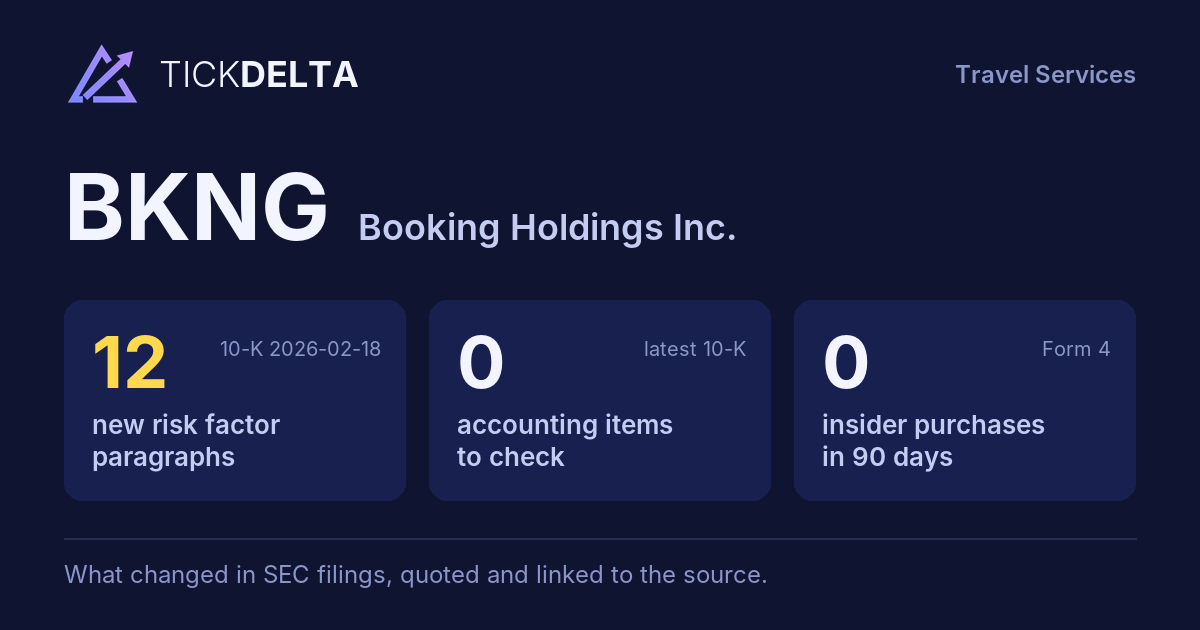
12 paragraphs in Risk Factors of the 10-K filed Feb 18, 2026 with nothing like them in the 10-K filed Feb 20, 2025. Quoted exactly. Paragraphs that were only edited are under 10-K change.
Compared with the Risk Factors in the latest 10-K of the other 46 Consumer discretionary companies: a paragraph with at least half its words the same at another company is called similar, and the companies are listed under it. A paragraph most of them have is marked boilerplate. No line means no other company has one like it. This counts text; it does not say how serious a risk is.
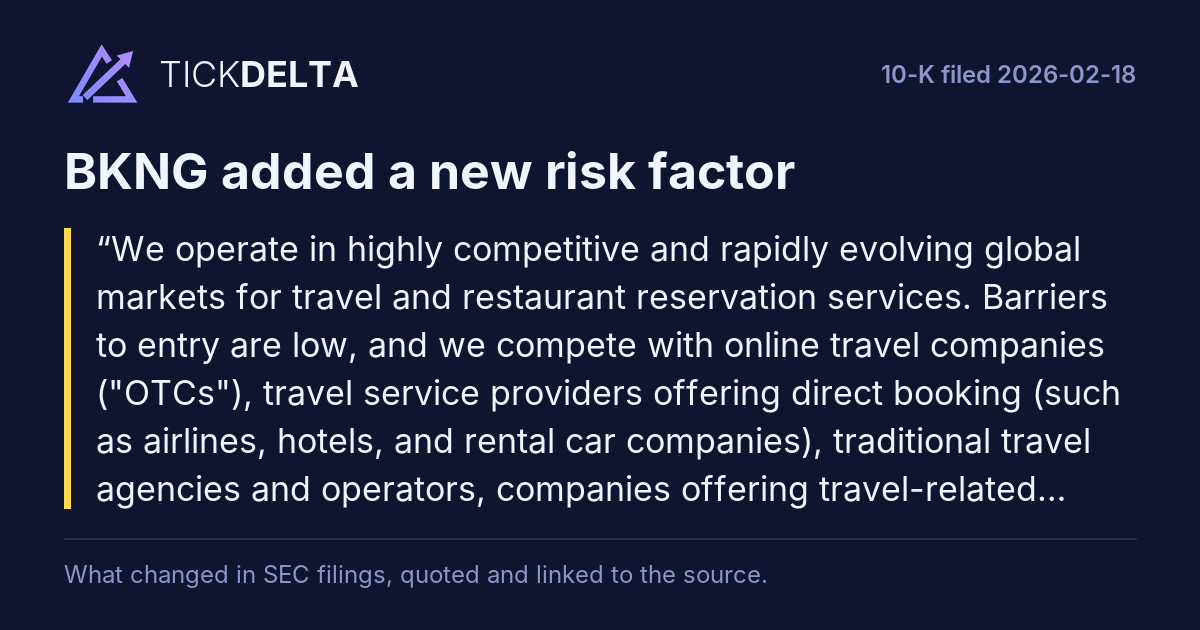
We operate in highly competitive and rapidly evolving global markets for travel and restaurant reservation services. Barriers to entry are low, and we compete with online travel companies ("OTCs"), travel service providers offering direct booking (such as airlines, hotels, and rental car companies), traditional travel agencies and operators, companies offering travel-related software, payments, or technology solutions, financial services and credit card companies, and global technology companies with significantly greater scale, data, and financial resources. For example, Google links travel search to its dominant search engine and has integrated travel products into Google Maps and its Gemini generative AI ("Gen AI") offering. Other large technology platforms and AI-native competitors are developing Gen AI-powered assistants and agents that can search, compare, recommend, and facilitate travel and dining reservations directly within their search engines, operating systems, messaging platforms, or "super-apps." These offerings may reduce consumers choosing to visit dedicated online travel platforms, reducing direct traffic, bookings, and customer relationships. Gen AI also lowers barriers to entry and enables competitors to potentially replicate or improve core functionality, personalize recommendations and pricing, and acquire customers more efficiently through non-travel consumer interactions. AI agents may further evolve into full-service booking platforms, increasing competitive pressure and disintermediating OTCs. If our Gen AI investments are not successful or we are unable to successfully adapt to such changes, our ability to compete, and our business and results of operations, could be adversely affected.
Read in the 10-K ↗
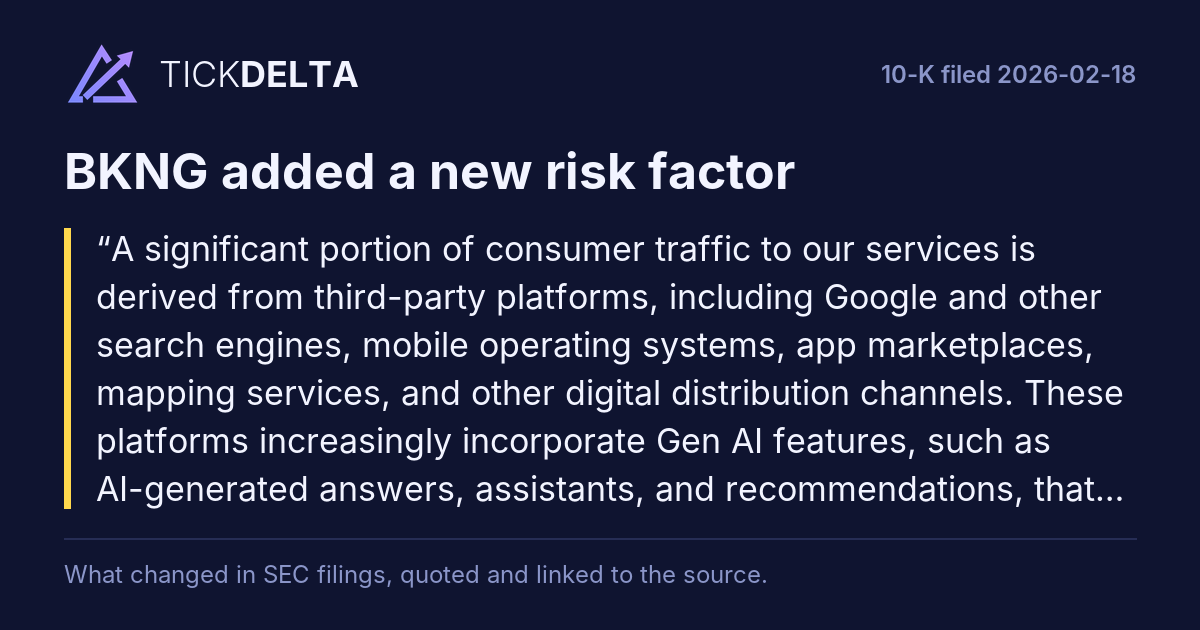
A significant portion of consumer traffic to our services is derived from third-party platforms, including Google and other search engines, mobile operating systems, app marketplaces, mapping services, and other digital distribution channels. These platforms increasingly incorporate Gen AI features, such as AI-generated answers, assistants, and recommendations, that may satisfy user intent without directing users to our services or may favor the platform's own or affiliated offerings.
Changes in algorithms, ranking methodologies, user interfaces, access terms, pricing, or the placement of AI-generated content by these platforms could reduce the visibility of our services, increase customer acquisition costs, or decrease traffic and bookings. In addition, platform providers may restrict data access, limit interoperability, or impose commercial terms that disadvantage us relative to competing or native AI-enabled services.
If we are unable to maintain favorable placement, access, or economics across traditional digital search as well as evolving AI-mediated distribution channels, our distribution of travel and restaurant reservations through such third-party distribution channels is likely to decline and our business, competitive position, and results of operations could be adversely affected.
Read in the 10-K ↗
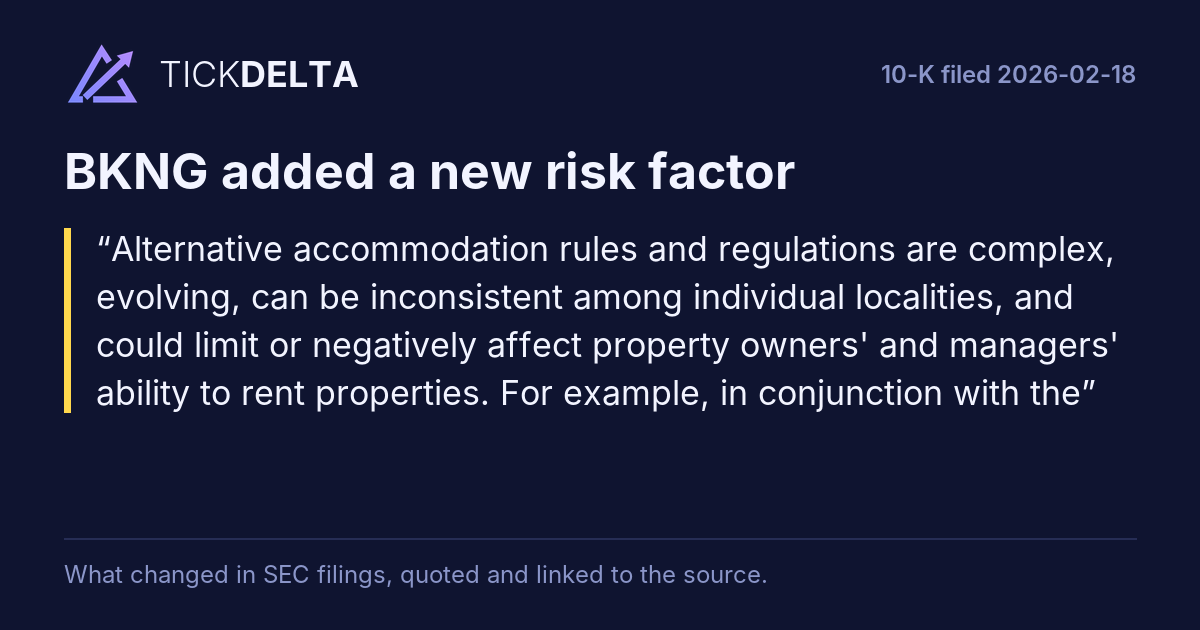
Alternative accommodation rules and regulations are complex, evolving, can be inconsistent among individual localities, and could limit or negatively affect property owners' and managers' ability to rent properties. For example, in conjunction with the
Read in the 10-K ↗
succeed in attracting, and retaining well-qualified employees, our business, ability to grow and innovate, competitive position, reputation, and results of operations would be adversely affected.
Read in the 10-K ↗
During fiscal year 2025, as a result of our annual goodwill impairment test, we recognized goodwill and intangible assets impairment charges. See Note 11 to our Consolidated Financial Statements. The estimation of fair value reflects numerous assumptions that are subject to risks and uncertainties, including key assumptions regarding expected growth rates and operating margin, discount rates, and market comparables. It requires significant judgments and estimates and actual results could be materially different than the judgments and estimates used to estimate fair value. Future events and changing market conditions may lead us to re-evaluate our current assumptions and may result in a need to recognize an additional goodwill or long-lived asset impairment charge that could have a material adverse effect on our results of operations.
Read in the 10-K ↗
Competition and consumer-law-related investigations, legislation, judgments, or issues have in the past resulted in and could in the future result in private litigation. We are currently involved in such litigation and aware of such potential litigation. For example, a Dutch consumer group has filed a claim against Booking.com relating to the historical use of contractual parity provisions, as well as allegations that Booking.com and Agoda employed misleading practices, and we are aware of similar efforts to pursue potential claims in other jurisdictions. See Note 16 to our Consolidated Financial Statements for more information regarding this and other such claims or potential claims. Class action litigation can be time-consuming, costly, and unpredictable, regardless of merit, and there may be evolving jurisprudence and less experience with such matters in certain of the geographies where we are or may be involved in such litigation, making outcomes less certain and harder to forecast. If we were to be found liable, it could result in, among other things, payment of damages, commitments to change certain business practices, or reputational damage, any of which could harm our business, results of operations, brands, or competitive position.
Read in the 10-K ↗
legislation utilizes a "gatekeeper" or VLOP designation to extend its scope, we could be subject to further regulations, restrictions, or compliance or other obligations that are not applicable to our competitors.
Read in the 10-K ↗
Additionally, our employees in certain countries are represented by works councils and/or trade unions. We are required to consult with works councils on certain matters (such as our Transformation Program), acquisitions and divestitures, and other matters that could impact our labor force. Consultation may not be completed on terms satisfactory to us and could result in increases in our cost of labor, diversion of management's attention away from operating our business, delays in certain initiatives, and expose us to claims and litigation.
Similar paragraph at 1 of 46 other Consumer discretionary companies: EXPERead in the 10-K ↗
2 more
compromised, we could incur significant fines or experience a significant increase in payment card transaction costs. Compliance with the Standard may not prevent all security incidents.
Read in the 10-K ↗
•announcements of Gen AI developments or related product launches, particularly relating to agentic capabilities;
Read in the 10-K ↗
New in the latest 10-Q
5 paragraphs in the 10-Q filed Nov 3, 2026 with nothing like them in the 10-Q filed Aug 4, 2026 (at least half the words must differ; new numbers alone do not count). Quoted exactly, grouped by the item heading above them. This is text that changed, not a judgement of how serious it is.
Financial statements and notes
The effect of foreign currency exchange derivatives recorded in "Other income (expense), net" in the Unaudited Consolidated Statements of Operations is as follows:
Read in the 10-Q ↗
The carrying value of the Company's goodwill at September 30, 2026 and December 31, 2025 was $ 2.7 billion and is stated net of cumulative impairment charges of $ 2.2 billion. The Company tests goodwill for impairment at the reporting unit level on an annual basis as of September 30 and between annual tests if an event occurs or circumstances change that would more likely than not reduce the fair value of a reporting unit below its carrying amount. During the three and nine months ended September 30, 2025, the Company recognized a goodwill impairment charge of $ 180 million and intangible-asset impairment charges of $ 277 million related to KAYAK. These impairment charges are recorded in "Impairment" in the Unaudited Consolidated Statements of Operations. See Note 11 to the Consolidated Financial Statements in the Company's Annual Report on Form 10-K for the year ended December 31, 2025 for information related to the impairment.
Read in the 10-Q ↗
In October 2026, the European Commission opened an investigation into whether certain practices by Booking.com related to platform disclosures and security may violate the Digital Services Act ("DSA"). If the investigation were to find a violation of the DSA, or as part of a negotiated resolution, the Company may face significant fines, may be required to change its business practices, and may face follow-on investigations or litigation.
Read in the 10-Q ↗
In the third quarter of 2026, global room nights increased 7% year-over-year, compared with 5% growth in the second quarter and 6% growth in the first quarter of 2026. The acceleration from the second quarter of 2026 primarily reflected an improvement in international travel originating from Europe and Asia, while domestic travel, meaning travel within a traveler's own country, remained relatively healthy across all regions.
Read in the 10-Q ↗
During the three and nine months ended September 30, 2025, the Company recognized goodwill and intangible-asset impairment charges related to KAYAK. See Note 8 to our Unaudited Consolidated Financial Statements.
Read in the 10-Q ↗
The 10-Q's risk factors against the 10-K
Item 1A of the 10-Q filed Nov 3, 2026 against Item 1A of the 10-K filed Feb 18, 2026.
A 10-Q repeats only the risks that changed, so a 10-K paragraph that is missing from it is not counted as removed.
Added is a paragraph with nothing like it in the 10-K, Reworded a sentence that is in both with several words changed,
Quiet changes a sentence in both where one to four words changed and one is a hedge or a modal
(cut words struck through, new words highlighted and underlined).
Text on the page, not a score; each links to the filing at sec.gov.
What the 10-Q itself says about its risk factors:
Read in the 10-Q ↗
Our operations and financial results are subject to various risks and uncertainties which could adversely affect our business, financial condition, results of operations, cash flows, and the trading price of our common stock. For a discussion of such risks, please refer to Part I, Item 1A, Risk Factors in our Annual Report on Form 10-K for the year ended December 31, 2025 (the "2025 Form 10-K"), as supplemented by the risk factor set forth in Part II, Item 1A of our Quarterly Report on Form 10-Q for the quarterly period ended March 31, 2026.
1 paragraph in the 10-Q's Item 1A, and none of them adds, rewords or quietly edits a paragraph of the 10-K's.
Work on BKNG in a spreadsheet:
Excel workbook (a sheet per section, ten years by column, charts, links to the filings) ·
CSV.
For a Google Sheet that stays up to date, paste =IMPORTDATA("https://tickdelta.com/company/BKNG/export.csv") into a cell.