Rest of the answer
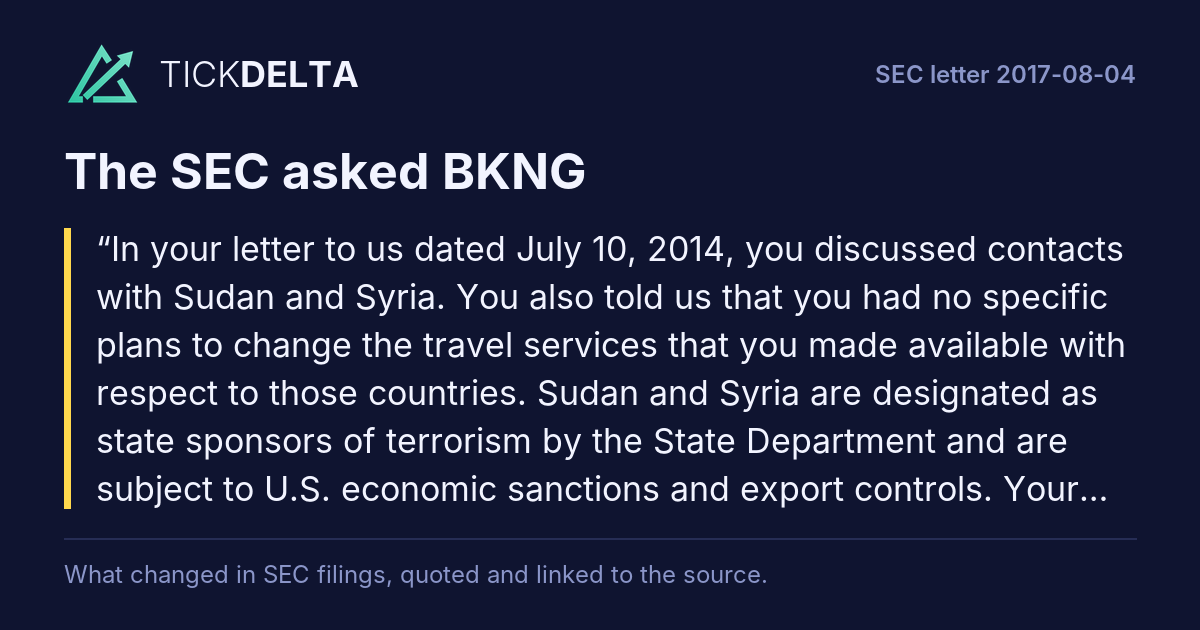
The total gross bookings and revenues derived from these combined activities during the Response Period was approximately $17.8 million and $3.1 million, respectively.
In sum, the aggregate gross bookings and revenues during the Response Period derived from travel services involving Sudan and Syria when compared to total consolidated Priceline Group gross bookings during the Response Period until June 30, 2017 of $189.6 billion and revenue of $30 billion are not quantitatively material to The Priceline Group. As a percentage of total Priceline Group Gross Bookings and total Priceline Group Revenue during the Response Period, the activities described above represent approximately 0.0094% and 0.0103%, respectively.
The Priceline Group remains aware of the U.S. export and re-export controls and economic sanctions in effect against Sudan and Syria and notes that the facilitation of travel by residents of Sudan or Syria is not prohibited or restricted under U.S. laws and regulations. In addition, the fact that hotel travel services are available through Priceline Group Company websites to persons who give billing addresses located in Sudan or Syria is publicly visible on the websites, and The Priceline Group is not aware of any indication that the availability of such hotel travel services through its websites has affected investor sentiment or the Company’s reputation or share value. Accordingly, The Priceline Group does not believe that these qualitative factors affect the quantitative materiality analysis provided above or would be material to an investor in making an investment decision.
Item 7. Management’s Discussion and Analysis of Financial Condition and Results of Operations
Results of Operations, page 40
3. Throughout your discussion we note you frequently list multiple factors as contributing to changes in your results. For example on pages 43 and 45 you disclose:
“Advertising and other revenues increased by 16.3% for the year ended December 31, 2016, compared to the year ended December 31, 2015, primarily due to growth in our KAYAK business, reservation fees at OpenTable, advertising revenue at priceline.com and subscription revenue at OpenTable.”
“General and administrative expenses increased during the year ended December 31, 2016, compared to the year ended December 31, 2015, due primarily to higher occupancy and office expenses related to the expansion of our international businesses, higher fees for outside professionals and higher personnel-related expenses related to increased headcount in our businesses…”
In future filings, when you list multiple factors that contributed to changes in an income statement line item please quantify material factors you discuss to provide your readers with better insight into the underlying reasons behind the changes in your results.
Response:
The Company acknowledges the Staff’s comment and advises the Staff that in future filings, it will assess the quantitative and qualitative material information in its MD&A and quantify factors that contribute to a change in the Company’s results of operations when material and necessary to an understanding of the Company’s business as a whole. The Company advises the Staff that it will follow Instruction 4 to Item 303(a) of Regulation S-K, which provides that “[w]here the consolidated financial statements reveal material changes from year to year in one or more line items, the causes for the changes shall be described to the extent necessary to an understanding of the registrant’s business as a whole” when determining whether to quantify factors that contribute to a change in the Company’s results of operations. In addition, the Company will continue to provide qualitative information in its MD&A about its business, including information about other, less significant factors that contribute to changes in the Company’s results of operations without quantifying those other factors.
Consolidated Statements of Operations, page 71
4. Please tell us how your presentation of gross profit on the face of the statement of operations complies with the guidance in ASC 225-10-S99-8, Rule 5-03 of Regulation S-X and Item 10(e) (1)(ii)(C) of Regulation S-K. In this regard, your gross profit measure appears to present a figure for income before depreciation and amortization. If so, please revise to either: (a) include an appropriate allocation of depreciation and amortization to costs applicable to revenue or (b) remove the gross margin subtotal and relabel the costs applicable to revenue line item throughout the filing to indicate that it excludes depreciation. Further, we note you also disclose gross profit and gross margin excluding depreciation and amortization within Management’s Discussion and Analysis of Financial Condition and Results of Operations. Please identify the measure as a non-GAAP financial measure and provide the disclosures required by Item 10(e) of Regulation S-K. Please also refer to our comment below regarding inclusion of gross profit in your earnings release on Form 8-K and Selected Quarterly Financial Data (Unaudited).
Response:
The Company believes that its depreciation and amortization are not costs of revenues. Therefore, the Company believes that its gross profit does not represent a non-GAAP financial measure as these expenses are more properly presented as operating expenses. Below, the Company has provided additional background and has described the different elements of depreciation and amortization and why the Company believes it is appropriate that they are not included in its cost of revenues.
As background, the Company earns the vast majority of its revenue when consumers make travel reservations of hotel rooms, rental cars and airline tickets with travel service providers through the Company’s websites. Generally speaking, the travel service providers (as well as restaurants and advertising partners) are the Company’s customers and the source of its revenues. Travel reservations can be booked on the Company’s websites through “merchant model” transactions where the Company typically collects payment from the consumer and remits the payment to the travel service provider or “agency model” transactions where the Company does not collect a payment from the consumer but rather receives a commission from the travel service provider. Under the “merchant model”, the Company’s priceline.com subsidiary offers Name Your Own Price® (“NYOP”) travel reservation services where the Company acts as a principal and transacts directly with the consumer on the one hand and the travel service provider on the other. As discussed with the Staff in connection with the Staff’s 2004 comment letter to the Company and as explained in the 10-K and the Company’s other periodic reports, revenue from NYOP reservations is presented on the statement of operations on a gross basis with a related cost of revenue for the amount remitted to the travel service provider. The Company’s cost of revenues consists principally of the cost paid to travel service providers for priceline.com’s NYOP travel reservation services, net of applicable taxes and charges. For all other merchant model transactions, as well as agency model transactions, the Company presents revenue on a net basis in the statement of operations.
As a simple example, suppose that a consumer makes a hotel room reservation on one of the Company’s websites for $100 and that the Company’s margin or commission (including any other fees or costs) is 20%, regardless of whether the reservation is a NYOP merchant model transaction, a non-NYOP merchant model transaction or an agency model transaction. The accounting treatment would be as follows:
NYOP
Non-NYOP Merchant
Agency
Revenues
100
Cost of revenues
Gross profit
The amount recorded in gross profit is the same in each of the above example transactions.
The Company notes that it has been presenting its revenues, cost of revenues and gross profit in this manner since its initial public offering in 1999 and, as explained in its periodic reports, believes that gross profit as reported by the Company is a particularly important measure for evaluating the Company’s business because it is not affected by the different methods of recording revenue and cost of revenues between the Company’s NYOP services and its other services. The Company also believes that investors compare its gross profit to the net revenues of other companies in the same industry (who report solely on a net basis) because of the particular accounting treatment of the Company’s NYOP services.
The Company’s depreciation and amortization consist of (1) amortization of intangible assets with determinable lives acquired from business combinations; (2) depreciation of computer equipment; (3) depreciation of development costs associated with websites and internal-use software; and (4) depreciation of leasehold improvements, furniture and fixtures and office equipment. The nature of the most significant components of depreciation and amortization are described below.
The Company’s intangible assets related to acquired trade names and internet domain names represent brands that have consumer recognition built through advertising investments. Intangible assets related to supply agreements represent the value of customer relationships acquired through previous business combinations (namely, relationships with travel service providers, customers that advertise on KAYAK’s travel meta-search websites and restaurants listed on OpenTable’s websites). Intangible assets related to distribution agreements represent the value of distribution relationships acquired through previous business combinations with affiliate partners that utilize the Company’s customer relationships to generate reservation transactions on the partners’ websites.
The Company designs its websites focused on factors, such as speed, reliability, ease of use and functionality, to maximize the consumer’s experience. The Company believes that depreciation of computer equipment, website development and internal-use software costs are incurred to create a unique, branded consumer experience that is not dependent upon the consumer making a reservation and the Company earning revenue.
Based on the use of these assets and the underlying elements of its depreciation and amortization, the Company does not believe they represent cost of revenues, and therefore, the Company believes that its presentation of cost of revenues and gross profit is in accordance with GAAP.
Additionally, the Company notes that upon adoption of the new revenue standard (ASU 2014-09, Revenue from Contracts with Customers), on January 1, 2018, NYOP transactions will be presented on a net basis because the Company does not control the underlying service provided by the travel service provider prior to its transfer to the consumer. Therefore, after adopting ASC 606, NYOP cost of revenues will be presented net within revenues. For periods after adoption (based on the Company’s use of the modified retrospective method), the Company will no longer present cost of revenues or gross profit in the Statement of Operations or Management’s Discussion and Analysis of Financial Conditions and Results of Operations. This change will make the Company’s reported revenue presentation more comparable to other companies in the online travel industry that already report their revenues exclusively on a net basis.
Note 5. Fair Value Measurements
Embedded Derivative, page 91
5. We note your investment of $25 million in the Ctrip convertible note on September 12, 2016 included a put option that you accounted for as an embedded derivative. Please explain whether the put option associated with your $500 million investment in the Ctrip convertible note on December 11, 2015 was also accounted for as an embedded derivative. If not, please explain the basis for your accounting including the guidance you relied on.
Response:
In Footnote 4, the Company refers to put options for its December 2015 and September 2016 investments in Ctrip convertible debt securities. Under the put options, the Company has a right, at its option, to require Ctrip to repurchase on a specified date the convertible debt security for cash at a price that is equal to 100% of the principal plus accrued but unpaid interest. The Company determined that the economic characteristics and risks of these put options are clearly and closely related to the host contract in accordance with ASC 815-15-25-1(a). Therefore, no further analysis of these put options was required.
Both investments also contain conversion options. The conversion option for the December 2015 investment does not contain an embedded derivative that must be bifurcated from its host contract for measurement purposes. However, as noted in Footnotes 4 and 5, the conversion option for the September 2016 investment did contain an embedded derivative.
For a conversion option to be accounted for separately from its host contract, it must meet the definition of a derivative instrument as defined in ASC 815-10-15-83, as if it were a freestanding instrument. In analyzing ASC 815-10-15-83 (c), neither of these investments can be net settled based on the terms of the contract, but the Company had to assess whether the shares received upon conversion could be readily net settled by a means outside of the contract. The Company considered the implementation guidance in ASC 815-10-55-101 through 110 and then drew parallels from the examples in the codification to its specific facts and circumstances. Based on the Company’s evaluation of the average trading volumes of the underlying stock, the Company concluded that the minimum conversion of $10 million related to the investment in the $25 million convertible debt security could be readily converted to cash. Trading volumes have been monitored each period to determine if that conversion option continues to be net settleable (e.g. the impact on the average daily trading volume was approximately 3% and 4% at December 31, 2016 and June 30, 2017, respectively). However, the minimum conversion of $100 million related to the investment in the $500 million convertible debt security cannot be readily converted into cash because of the significance compared to the average daily trading volume of the underlying stock. Trading volumes have been monitored each period to determine if that conversion option continues to not be net settleable (e.g. the impact on the average daily trading volume exceeded 30% at December 31, 2016 and June 30, 2017). Therefore, because of the differences in the terms of conversion and therefore, the ability of the Company to net settle any future conversion, the accounting between the different tranches of investments in Ctrip convertible debt securities resulted in different accounting conclusions.
Note 14. Commitments and Contingencies
French and Italian Tax Matters, page 106
6. We note in December 2015 the French tax authorities issued Booking.com assessments for approximately 356 million Euros, asserting Booking.com has a permanent establishment in France and is seeking to recover what they claim are unpaid income taxes and value-added taxes. Please provide us with an update on this matter and your consideration of the disclosure requirements of ASC 450.
Response:
a. Update:
The French tax authorities issued the assessments referred to in Footnote 14 in December 2015. Booking.com objected to the assessments in February 2016, setting out the reasons for its objection. In July 2017, the French tax authorities rejected Booking.com’s objection, informing Booking.com that their assertion that Booking.com had a permanent establishment in France remains unchanged, which the Company disclosed in Footnote 11 to its Unaudited Consolidated Financial Statements filed with its Quarterly Report on Form 10-Q for the quarter ended June 30, 2017 (the “10-Q”).
If the French tax authorities make a demand for payment, the Company may choose to pay the full amount of the assessments or provide a guarantee for the taxes only, although, as disclosed in Footnote 14 in the 10-K and in its subsequent periodic reports, any such payment or guarantee would not constitute an admission by the Company that it has a liability.
Booking.com is currently in the process of responding to the French tax authorities’ letter of July 2017 and arranging a meeting with the French tax authorities to further discuss the matter. The Company continues to believe that Booking.com has been, and continues to be, in compliance with French tax laws, and Booking.com intends to contest the assessments in court if it cannot resolve the matter with the French tax authorities.
The Company disclosed in the 10-Q that the French tax authorities have begun a similar audit of the tax years 2013 to 2015, which could result in additional assessments.
b. Consideration of disclosure requirements:
The French tax authorities’ assessments of approximately 356 million Euros, the substantial majority of which represents penalties and interest, relate almost entirely to corporate income taxes and value-added taxes. The Company considered the accounting and disclosure requirements of ASC 740 and ASC 450 related to the potential corporate income tax and value-added tax liabilities, respectively.
i. Corporate Income Tax - ASC 740
The Company concluded that it is more likely than not that it will be able to sustain its position that Booking.com does not have a permanent establishment in France. Accordingly, since it has been concluded that it is more likely than not that its position will be sustained, the Company has recognized the full benefit associated with its position and has not recorded any amount as an uncertain tax position.
ii. Value-added Taxes - ASC 450
Based on the provisions of ASC 450-20-25-2, a loss contingency related to the value-added taxes should be recognized only if (a) it is probable that a loss has been incurred and (b) the amount of loss can be reasonably estimated. Since the Company believes that it is more likely than not that Booking.com does not have a permanent establishment in France, the Company does not have a probable loss regarding value-added taxes associated with a permanent establishment. As a result, the Company has not recorded a loss contingency for the value-added taxes. Pursuant to ASC 450-20-50-4, the Company has disclosed the nature of the contingency and has provided a reader of the financial statements an estimate of a possible loss by disclosing the amount of the assessments.