164 paragraphs in Risk Factors of the 10-K filed Mar 27, 2026
with nothing like them in the 10-K filed Mar 14, 2025. Quoted exactly.
Paragraphs that were only edited are under 10-K change.
Compared with the Risk Factors in the latest 10-K of the other 31 Crypto companies:
a paragraph with at least half its words the same at another company is called similar, and the companies are listed under it.
A paragraph most of them have is marked boilerplate. No line means no other company has one like it.
This counts text; it does not say how serious a risk is.
Ownership of our securities involves a high degree of risk. You should carefully consider the risks described below, together with all other information contained in or incorporated by reference into this Annual Report on Form 10-K, including our audited financial statements and the notes thereto, and “Management’s Discussion and Analysis of Financial Condition and Results of Operations.” The following discussion highlights material risks that could adversely affect our business, financial condition, results of operations, cash flows, liquidity, prospects and the trading price of our Ordinary Shares.
Read in the 10-K ↗
Additional risks and uncertainties not presently known to us or that we currently deem immaterial may also impair our business operations. If any of the risks actually occur, our business could be materially harmed and the market price of our ordinary shares could decline, and you could lose all or part of your investment.
Read in the 10-K ↗
As a result, any actual or perceived security breach of our systems or our third-party partners may:
Read in the 10-K ↗
In July 2025, we sold an aggregate of 22,000,000 ordinary shares at $3.06 per share pursuant to a registered direct offering. In October 2025, we sold an aggregate of $150 million of 4.0% convertible senior notes due 2030 pursuant to a registered offering. During the year ended December 31, 2025, we sold an aggregate of 30,189,161 ordinary shares for an aggregate price of $2.15, net of offering costs pursuant to an at-the-market offering. We had proceeds of $63.4 million, net of offering costs pursuant to an at-the-market offering.
Read in the 10-K ↗
Our revenues, gross margins, liquidity and ability to service obligations depend significantly on prevailing ETH prices and. Prolonged or sharp price declines, or heightened volatility, may impede ETH ecosystem growth or render BTC mining activities unprofitable, reduce the carrying value and liquidity of digital assets held, and decrease investor demand for our securities.
Similar paragraph at 1 of 31 other Crypto companies:
BMNR
Digital assets built on blockchain technology were only introduced in 2008 and remain in the early stages of development. In addition, different digital assets are designed for different purposes. Ethereum, for instance, was designed to serve as a smart contract and decentralized application platform, while Bitcoin was designed to serve as a peer-to-peer electronic cash system. Many other blockchain networks, ranging from cloud computing to tokenized securities networks, have only recently been established. The further growth and development of any digital assets and their underlying networks and other cryptographic and algorithmic protocols governing the creation, transfer and usage of digital assets and related assets represent a new and evolving paradigm that is subject to a variety of factors that are difficult to evaluate, including:
Similar paragraph at 2 of 31 other Crypto companies:
BMNR,
FIGRmany digital assets and networks have limited operating histories, have not been validated in production, and are still in the process of developing and making significant decisions that will affect the design, supply, issuance, functionality, and governance of their respective digital assets and underlying blockchain networks, any of which could adversely affect their respective digital assets;
many blockchain networks are in the process of implementing software upgrades and other changes to their protocols, which could introduce bugs, security risks, or adversely affect the respective blockchain networks;
Similar paragraph at 3 of 31 other Crypto companies:
BMNR,
FIGR,
GEMIseveral large networks, including Ethereum and Bitcoin, are developing new features to address fundamental speed, scalability, and energy usage issues. If these issues are not successfully addressed, or if these networks do not achieve widespread adoption, it could adversely affect the underlying digital assets;
Similar paragraph at 3 of 31 other Crypto companies:
BMNR,
FIGR,
GEMIsecurity issues, bugs, and software errors have been identified with many digital assets and their underlying blockchain networks, some of which have been exploited by malicious actors. There are also inherent security weaknesses in some digital assets, such as when creators of certain blockchain networks use procedures that could allow hackers to counterfeit tokens. Any weaknesses identified with a digital asset could adversely affect its price, security, liquidity, and adoption rate. If one or more malicious actors obtain a majority of the compute or staking power on a digital asset network, as has happened in the past, it may be able to engage in illicit activity, which could cause financial losses to holders, damage the network’s reputation and security, and adversely affect its value;
Similar paragraph at 3 of 31 other Crypto companies:
BMNR,
FIGR,
GEMIblockchain networks may have consolidated points of failure (such as concentrated ownership or an “admin key”), allowing a small group of holders to have significant unilateral control and influence over key decisions related to their blockchain networks, such as governance decisions and protocol changes, as well as the market price of such digital assets;
Similar paragraph at 3 of 31 other Crypto companies:
BMNR,
FIGR,
GEMIif rewards and transaction fees for miners or validators on any particular digital asset network are not sufficiently high to attract and retain miners or validators, a blockchain network’s security and speed may be adversely affected, increasing the likelihood of a malicious attack;
the governance of many decentralized blockchain networks is by voluntary consensus and open competition, and many developers are not directly compensated for their contributions. As a result, there may be a lack of consensus or clarity on the governance of any particular digital asset network, a lack of incentives for developers to maintain or develop the network, and other unforeseen issues, any of which could result in unexpected or undesirable errors, bugs, or changes, or stymie such network’s utility and ability to respond to challenges and grow; and
many blockchain networks are in the early stages of developing partnerships and collaborations, any or all of which may not succeed and adversely affect the usability and adoption of the respective digital assets.
Similar paragraph at 3 of 31 other Crypto companies:
BMNR,
FIGR,
GEMIVarious other technical issues have also been uncovered from time to time that resulted in disabled functionalities, exposure of certain users’ personal information, theft of users’ assets, and other negative consequences, and which required resolution with the attention and efforts of their global miner, user, and development communities. If any such risks or other risks materialize, and in particular if they are not resolved, the development and growth of digital assets may be significantly affected and, as a result, our business, operating results, and financial condition could be adversely affected.
Similar paragraph at 2 of 31 other Crypto companies:
BMNR,
FIGREthereum-specific market, technology and regulatory developments may adversely affect the value and liquidity of our ETH holdings and our Treasury Strategy.
Similar paragraph at 2 of 31 other Crypto companies:
BMNR,
FIGRThe Ethereum network is subject to rapidly evolving technology, competitive dynamics (including alternative Layer 1 and Layer 2 networks), and changing regulatory and market-structure frameworks. Adverse developments—including protocol upgrades with unintended consequences, forks or chain instability, validator concentration, consensus failures, smart contract vulnerabilities, L2 settlement failures, bridge exploits, or regulatory restrictions—could reduce the value or liquidity of ETH and impair our treasury strategy.
Similar paragraph at 1 of 31 other Crypto companies:
BMNROur ETH Treasury Strategy has multiple layers of risk based on corporate finance principles and blockchain mechanics, including but not limited to the following:
Similar paragraph at 1 of 31 other Crypto companies:
BMNRPotential Premium Collapse: Our digital asset treasury relies on equity premiums to raise capital accretively. If share prices fall below NAV, treasury accumulation on our balance sheet may slow down or halt. Decreasing premiums paid for our shares may signal a lack of investor enthusiasm for our ETH Treasury Strategy.
Similar paragraph at 1 of 31 other Crypto companies:
BMNRLiquidity and Macro Sensitivity: Digital asset treasury company equities are typically high-beta assets. For example, a 20% ETH correction can result in 50% equity drawdowns due to leverage and collapsing premiums.
Similar paragraph at 1 of 31 other Crypto companies:
BMNRDilution Fatigue: Repeated capital raises through may desensitize investors. Without yield growth or NAV accretion, new issuances risk being seen as opportunistic liquidity events rather than long-term expansion.
Similar paragraph at 1 of 31 other Crypto companies:
BMNRTogether, these risks form the structural challenges of our ETH Treasury Strategy. Its success depends on maintaining perpetual premium expansion in a market that is inherently cyclical.
Similar paragraph at 1 of 31 other Crypto companies:
BMNROur ETH Treasury Strategy and any decision to hold digital assets may increase our exposure to market volatility and potential uninsured losses.
Similar paragraph at 1 of 31 other Crypto companies:
BMNRMarket conditions and operational needs may necessitate longer holding periods, increasing exposure to price swings. If we hold ETH or other digital assets under our treasury strategy, we would be exposed to additional volatility, regulatory, and market structure risks specific to those assets. We are currently exposed to potential uninsured losses to the extent digital asset balances exceed the custodian’s applicable insurance coverage.
Similar paragraph at 1 of 31 other Crypto companies:
BMNROur strategic exposure to ETH may subject us to ETH-specific market, technology, and regulatory risks.
Similar paragraph at 1 of 31 other Crypto companies:
BMNRThe Ethereum network has distinct market structure, technology, regulatory and liquidity considerations compared to Bitcoin. Adverse developments specific to ETH—including protocol changes, forks, validator dynamics, market dislocations, bridge or DeFi exploits, or regulatory actions—could impair the value or liquidity of our ETH holdings and related strategies.
Similar paragraph at 1 of 31 other Crypto companies:
BMNRAny ETH staking and related activities may expose us to slashing, lock-ups, liquidity, counterparty and operational risks.
Similar paragraph at 1 of 31 other Crypto companies:
BMNRStaking requires operational reliability and adherence to protocol rules. Validators that act maliciously or suffer extended downtime can be “slashed,” resulting in a partial loss of staked principal. Staking may also involve unbonding or lock-up periods that reduce liquidity and flexibility, and, where conducted through third-party providers, introduces counterparty and operational risk. Liquid staking or restaking mechanisms may involve additional smart contract risk, rehypothecation or correlation risks, and market liquidity considerations for derivative tokens. Any failure in our validator operations or at a third-party staking provider could result in losses and reputational harm.
Similar paragraph at 1 of 31 other Crypto companies:
BMNRSmart contract, bridge, oracle and protocol vulnerabilities could result in loss of digital assets or business interruption.
Similar paragraph at 1 of 31 other Crypto companies:
BMNRDecentralized protocols and token standards underpin many Ethereum-based activities. Exploits or failures—whether in widely used standards, core protocol implementations, bridges, or oracles—can cause material losses or network instability. Even if we are not directly exposed to a compromised protocol, contagion effects can depress market prices, reduce liquidity, and disrupt counterparties or service providers on which we rely.
Similar paragraph at 1 of 31 other Crypto companies:
BMNRMarket structure and liquidity for ETH could deteriorate, impacting our ability to transact or to accurately value our holdings.
Similar paragraph at 1 of 31 other Crypto companies:
BMNRWe rely on a limited number of venues for price discovery and liquidity. Market events—including exchange or market-maker disruptions, de-platforming of digital asset participants by banks or service providers, stress in stablecoin markets, or regulatory actions that affect trading venues—could reduce liquidity and increase volatility. A lack of reliable liquidity may impair valuation, hedging, or the ability to rebalance our treasury.
Similar paragraph at 1 of 31 other Crypto companies:
BMNRETH price declines or prolonged underperformance versus other digital assets could adversely affect our financial position and capital access.
Similar paragraph at 1 of 31 other Crypto companies:
BMNROur strategy is focused on ETH as our primary treasury asset. Sustained price declines in ETH or underperformance relative to other assets could reduce the carrying value of our digital assets, increase the frequency or magnitude of impairment charges under applicable accounting policies, and diminish our ability to raise capital or maintain compliance with exchange listing standards.
Similar paragraph at 1 of 31 other Crypto companies:
BMNRRestaking and correlated risk exposures may amplify losses during stress events.
Similar paragraph at 1 of 31 other Crypto companies:
BMNRIf we engage in restaking or similar activities that create stacked security obligations or re-use of staked collateral across protocols, we may face correlated losses across multiple positions in a single adverse event. Losses at one protocol could affect the security or liquidity of positions at another, and recovery pathways may be uncertain or prolonged.
Similar paragraph at 1 of 31 other Crypto companies:
BMNRConcentration and governance risks in the Ethereum ecosystem could create systemic vulnerabilities.
Similar paragraph at 1 of 31 other Crypto companies:
BMNRConcentration of validators among a small number of providers, reliance on a limited set of client implementations, or governance capture by large stakeholders could increase systemic risk. A critical bug in a dominant client, or adverse decisions by influential governance participants, could affect network stability, validator incentives, or ETH economics.
Similar paragraph at 1 of 31 other Crypto companies:
BMNROur treasury strategy and any decision to hold digital assets may increase our exposure to market volatility and potential uninsured losses.
Similar paragraph at 1 of 31 other Crypto companies:
BMNRWhen we hold ETH or other digital assets under our treasury strategy, we are exposed to additional volatility, regulatory, and market structure risks specific to those assets. We are currently exposed to potential uninsured losses to the extent digital asset balances exceed the custodian’s applicable insurance coverage.
Similar paragraph at 1 of 31 other Crypto companies:
BMNR
We hold cash and store digital assets for our treasury and hold fiat and digital assets for corporate investment and operating purposes. In addition, we store the majority of digital assets at third-party custodians for asset management products.
Similar paragraph at 1 of 31 other Crypto companies:
BMNRSecurely storing cash and digital assets is integral to the trust we build with our stockholders and our customers. We believe our policies, procedures, operational controls and controls over financial reporting protect us from material risks surrounding the storing of these assets and conflicts of interest. Our controls over financial reporting include, among others, controls over the segregation of corporate digital assets, controls over the investment and staking processes of our treasury, and controls over digital asset withdrawals. Our financial statements and disclosures, as a whole, will be available through periodic filings on a quarterly basis, and compliant with annual audit requirements of Article 3 of Regulation S-X.
Similar paragraph at 1 of 31 other Crypto companies:
BMNRAny inability by us to maintain our procedures, perceived or otherwise, could harm our business, operating results and financial condition. Any material failure by us or our partners to maintain the necessary controls, policies, procedures or to manage the digital assets we hold for our own investment and operating purposes could also adversely affect our business, operating results and financial condition. Further, any material failure by us or our partners to maintain the necessary controls or to manage digital assets and funds appropriately and in compliance with applicable regulatory requirements could result in reputational harm, litigation, regulatory enforcement actions, significant financial losses, and result in significant penalties and fines and additional restrictions, which could adversely affect our business, operating results and financial condition.
Similar paragraph at 3 of 31 other Crypto companies:
BMNR,
GEMI,
GLXYReliance on mining pools and other third-party service providers may expose us to counterparty failures, operational issues, and losses.
Similar paragraph at 2 of 31 other Crypto companies:
BMNR,
MARAOur rewards are typically earned via pooled mining. We rely on pool operators to honestly and accurately account for our pro rata share of rewards, maintain operational security, and remit proceeds. Pools may lack insurance for theft or loss, and rewards may be held for varying durations. Any failure, insolvency, cyber event, mispricing, or suspension by a pool operator could delay or reduce our receipts or result in losses. A change in pool fee structures or terms could adversely affect yields.
Similar paragraph at 1 of 31 other Crypto companies:
BMNRThe theft, loss or destruction of private keys required to access any digital assets held in custody for our own account or for our operational partners may be irreversible. If we are unable to access our private keys or if we experience a hack or other data loss relating to our ability to access any digital assets, it could cause regulatory scrutiny, reputational harm, and other losses.
Digital assets are generally controllable only by the possessor of the unique private key relating to the digital wallet in which the digital assets are held. While blockchain protocols typically require public addresses to be published when used in a transaction, private keys must be secured and kept private in order to prevent a third party from accessing the digital assets held in such a wallet. To the extent that any of the private keys relating to our wallets containing digital assets held for our own account or for our customers is lost, destroyed, or otherwise compromised or unavailable, and no backup of the private key is accessible, we will be unable to access the digital assets held in the related wallet. Further, we cannot provide assurance that our wallets will not be hacked or compromised. Digital assets and blockchain technologies have been, and may in the future be, subject to security breaches, hacking, or other malicious activities. Any loss of private keys relating to, or hack or other compromise of, digital wallets used to store our customers’ digital assets could adversely affect our customers’ ability to access or sell their digital assets, require us to reimburse our customers for their losses, and subject us to significant financial losses in addition to losing customer trust in us and our products. As such, any loss of private keys due to a hack, employee or service provider misconduct or error, or other compromise by third parties could hurt our brand and reputation, result in significant losses, and adversely affect our business, operating results, and financial condition.
We utilize custodians to mitigate the risks associated with the loss or theft of keys. Cold wallet private key materials are stored and secured at facilities within the United States and internationally. We store the substantial majority of our own digital asset holdings utilizing market-standard storage solution.
Similar paragraph at 1 of 31 other Crypto companies:
BMNR
WhiteFiber’s purchase orders with hardware manufacturers include extended delivery schedules.
WhiteFiber relies on third parties to timely obtain an adequate delivery of hardware. WhiteFiber’s purchase orders with hardware manufacturers include extended delivery schedules spanning several months before the hardware is delivered to our facilities. These fluctuations in delivery timelines necessitate careful planning and advanced purchasing strategies to ensure WhiteFiber can acquire hardware well before their anticipated deployment. Failure to adequately plan for such fluctuations could have a material adverse effect on WhiteFiber’s business, prospects, results of operations and financial condition.
Read in the 10-K ↗
26 more
Dependence on joint ventures and other local partners could adversely affect WhiteFiber’s profits.
WhiteFiber intends to conduct some operations through joint ventures in which unaffiliated third parties may control or have significant influence on the operations of the joint venture. As with any joint venture arrangement, differences in views among the joint venture participants may result in the joint venture operating in a manner that is contrary to WhiteFiber’s preference, delayed decisions or in failures to agree on major issues. These factors could have a material adverse effect on the business and results of operations of its joint ventures and, in turn, its business and combined results of operations. In addition to joint ventures, WhiteFiber may rely on local third-party partners in foreign jurisdiction, as it does in Iceland, to provide various services in support of its cloud services and HPC data center businesses, including installation, service and technical support, as well as the provision of equipment and personnel. If a local partner is unwilling or unable to deliver its services for any reason including, but not limited to, a dispute with WhiteFiber, the deterioration of its financial condition or a loss of personnel, WhiteFiber may be unable to engage an alternative partner or subcontractors to perform the same services, or on terms substantially similar to those with its existing partners. The failure to do so may cause us to breach the terms of existing contracts, impede WhiteFiber’s ability to complete orders, and/or result in damage to our customer relationships in that jurisdiction, any of which may damage WhiteFiber’s reputation and have a material adverse effect on its business in the impacted jurisdiction.
Read in the 10-K ↗
Supply chain disruptions may adversely affect WhiteFiber’s new project development.
Read in the 10-K ↗
As of December 31, 2025, WhiteFiber’s data center served fifteen customers. No one customer accounted for in excess of 50% of data center revenue in the 12 months ended December 31, 2025 or 2024. During fiscal year 2023, 12 customers accounted for all of WhiteFiber’s revenue. During 2025, WhiteFiber’s HPC data center in Iceland had contracts with twenty one customers. DNA Fund accounted for approximately 11.5% of cloud services revenue during the 12 months ended December 31, 2025. WhiteFiber did not generate any revenue from DNA Fund in 2024. WhiteFiber’s Initial Customer accounted for approximately 70.7% of cloud services revenue during the 12 months ended December 31, 2025 and 96.6% of cloud services revenues through December 31, 2024. As of the report date, WhiteFiber and the Initial Customer are engaged in ongoing discussions regarding a potential resolution of the existing service agreements following the agreed pause of services. No definitive agreement has been reached. Following the service pause, WhiteFiber has redeployed the GPUs previously allocated to the Initial Customer to three other customers. Based on WhiteFiber’s current customer mix and contracted capacity for 2026, a limited number of customers are expected to represent a significant portion of cloud services revenue. While WhiteFiber is actively expanding and diversifying its customer base, WhiteFiber’s results may continue to be influenced by the performance and contractual arrangements of these customers.
Read in the 10-K ↗
WhiteFiber’s sales cycles can be long and unpredictable, and its sales efforts require considerable time and expense.
WhiteFiber’s go-to-market approach currently focuses on a top-down sales model to drive demand and pipeline from the large AI labs and AI enterprises. Sales to such customers involves longer and more unpredictable sales cycles. Customers often view the purchase of WhiteFiber’s platform as a significant strategic decision and, as a result, frequently require considerable time to evaluate, test, and qualify WhiteFiber’s platform prior to entering into or expanding a relationship with WhiteFiber. Large enterprises in particular, often undertake a significant evaluation process that further lengthens our sales cycle.
WhiteFiber’s direct sales team develops relationships with its customers, and works on account penetration, account coordination, sales, and overall market development. WhiteFiber spends substantial time and resources on its sales efforts without any assurance that its efforts will produce a sale. Cloud infrastructure capacity purchases are frequently subject to budget constraints, multiple approvals, and unanticipated administrative, processing, and other delays. As a result, it is difficult to predict whether and when a sale will be completed. The failure of WhiteFiber’s efforts to secure sales after investing resources in a lengthy sales process would adversely affect its business, operating results, financial condition, and future prospects.
WhiteFiber’s ability to maintain customer satisfaction depends in part on the quality of its customer support and cloud operations services. Its failure to maintain high-quality customer support and cloud operations services could have an adverse effect on its business, operating results, financial condition, and future prospects.
Similar paragraph at 1 of 31 other Crypto companies:
SBETWhiteFiber believes that the successful use of its platform requires a high level of support and engagement for many of its customers. In order to deliver appropriate customer support and engagement, WhiteFiber must successfully assist its customers in deploying and continuing to use its platform, resolve performance issues, address interoperability challenges with the customers’ existing IT infrastructure, and respond to security threats and cyber-attacks and performance and reliability problems that may arise from time to time. Increased demand for customer support and cloud operations services, without corresponding increases in revenue, could increase its costs and adversely affect its business, operating results, financial condition, and future prospects.
Furthermore, there can be no assurance that WhiteFiber will be able to hire sufficient support personnel as and when needed, particularly if its sales exceed our internal forecasts. WhiteFiber expects to increase the number of its customers, and that growth may put additional pressure on its customer support and cloud operations services teams. WhiteFiber’s customer support and cloud operations services teams may need additional personnel to respond to customer demand. WhiteFiber may be unable to respond quickly enough to accommodate short-term increases in customer demand for services. To the extent that WhiteFiber is unsuccessful in hiring, training, and retaining adequate support resources, its ability to provide high-quality and timely support to its customers will be negatively impacted, and its customers’ satisfaction and their purchase of our infrastructure could be adversely affected.
In addition, as WhiteFiber continues to grow its operations and expand outside of the United States, need to be able to provide efficient services that meet its customers’ needs globally at scale, and its customer support and cloud operations services teams may face additional challenges, including those associated with operating the platforms and delivering support, training, and documentation in languages other than English and providing services across expanded time-zones. If WhiteFiber is unable to provide efficient customer support services globally at scale, its ability to grow its operations may be harmed, and WhiteFiber may need to hire additional services personnel which could increase its expenses, and negatively impact its business, financial condition, operating results, and future prospects.
The broader adoption, use, and commercialization of AI technology, and the continued rapid pace of developments in the AI field, are inherently uncertain. Failure by WhiteFiber’s customers to use its cloud services to support AI use cases in their systems, or its ability to keep up with evolving AI technology requirements and regulatory frameworks, could have a material adverse effect on WhiteFiber’s business, operating results, financial condition, and future prospects.
As part of WhiteFiber’s growth strategy, it seeks to attract and acquire customers requiring high-performance computing, such as AI, machine learning, and automated decision-making technologies, including proprietary AI algorithms and models (collectively, “AI Technologies”).
AI has been developing at a rapid pace, and continues to evolve and change. As demand continues for AI services, AI providers, including our customers, have sought increased compute capacity to enable advancements in their AI models and service the demands of end users. We cannot predict whether additional computing power will continue to be required to develop larger, more powerful AI models, or if the practical limits of AI technology will plateau in the future regardless of available compute capacity. Further, there have been recent advancements in AI technology, including open-source AI models, that may lead to compute and other efficiencies that may impact the demand for AI services, including our platform, solutions, and services, which may adversely impact our revenue and profitability. In the event that existing scaling laws do not continue to apply as they have in the past, demand by our customers for compute resources, including our solutions and services, may not continue to increase over time, or may decrease if overall demand for AI is impacted by a lack of further technological development. If we are unable to keep up with the changing AI landscape or in developing services to meet our customers’ evolving AI needs, or if the AI landscape does not develop to the extent we or our customers expect, our business, operating results, financial condition, and future prospects may be adversely impacted.
Additionally, we may incur significant costs and experience significant delays in developing new solutions and services or enhancing our current platform to adapt to the changing AI landscape, and may not achieve a return on investment or capitalize on the opportunities presented by demand for AI solutions. Moreover, while AI adoption is likely to continue and may accelerate, the long-term trajectory of this technological trend is uncertain. Further, market acceptance, understanding, and valuation of solutions and services that incorporate AI Technologies are uncertain and the perceived value of AI Technologies used and/or provided by our customers could be inaccurate. If AI is not broadly adopted by enterprises to the extent we expect, or if new use cases do not arise, then our opportunity may be smaller than we expect. Further, if the consumer perception and perceived value of AI Technologies is inaccurate this could have a material adverse effect on our customers, which in turn could have a material adverse effect on our business, operating results, financial condition, and future prospects.
Concerns relating to the responsible use by our customers of new and evolving technologies, such as AI, which are supported by our platform, may result in collateral reputational harm to us. AI may pose emerging ethical issues and if our platform enables customer solutions that draw controversy due to their perceived or actual impact on society, we may experience brand or reputational harm, competitive harm, or legal liability.
Furthermore, the rapid pace of innovation in the field of AI has led to developing and evolving regulatory frameworks globally, which are expected to become increasingly complex as AI continues to evolve. Regulators and lawmakers around the world have started proposing and adopting, or are currently considering, regulations and guidance specifically on the use of AI. Regulations related to AI Technologies have been introduced in the United States at the federal level and are also enacted and advancing at the state level. Additional regulations may impact our customers’ ability to develop, use and commercialize AI Technologies, which would impact demand for our platform, solutions, and services and may affect our business, operating results, financial condition, and future prospects.
AI and related industries, including cloud services, are under increasing scrutiny from regulators due to their concerns about market concentration, anti-competitive practices, and the pace of partnerships and acquisitions involving generative AI startups. As the industry continues to grow, transactions and business conduct will likely continue to draw scrutiny from regulators. Our customers may become subject to further AI regulations, including any restrictions on the total consumption of compute technology, which could cause a delay or impediment to the commercialization of AI technology and could lead to a decrease in demand for our customers’ AI infrastructure, and may adversely affect our business, operating results, financial condition, and future prospects.
Similar paragraph at 1 of 31 other Crypto companies:
GLXY
Establishing data centers in remote areas may adversely affect WhiteFiber’s ability to retain staff and increase its compensation costs.
If WhiteFiber establishes data centers in areas with lower populations such as Iceland or remote parts of North America, recruiting and retaining the necessary staff to operate its locations may pose a challenge. When WhiteFiber encounters a relatively low population, the pool of available employees is limited. In addition, some employers have offered significantly higher wages in order to fill vacant positions. This may adversely affect WhiteFiber’s ability to attract and retain qualified personnel and may increase its employee costs if it has to increase the compensation we pay in response to the market.
Severe weather events, such as tornadoes, hurricanes, rain, drought, fire, ice and snowstorms, and high-and low-temperature extremes, occur in regions in which WhiteFiber operates and maintains infrastructure. WhiteFiber’s principal data centers in Iceland and Canada are designed to provide year-round cool weather conditions. Nevertheless climate change could change the frequency and severity of weather events, which may create physical and financial risks to WhiteFiber. Such risks could have an adverse effect on WhiteFiber’s financial condition, results of operations and cash flows. Increases in severe weather conditions or extreme temperatures may cause infrastructure construction projects to be delayed or canceled and limit resources available for such projects resulting in decreased revenue or increased project costs. In addition, drought conditions could restrict the availability of water supplies or limit the ability to obtain water use permits, inhibiting the ability to conduct operations. To date, none of WhiteFiber’s WhiteFiber data centers in Iceland or Canada have experienced any material impacts to its financial condition, results of operations or cash flows due to the physical effects of climate change.
The broader adoption, use, and commercialization of AI technology, and the continued rapid pace of developments in the AI field, are inherently uncertain. Failure by our customers to use its cloud services to support AI use cases in their systems, or WhiteFiber’s ability to keep up with evolving AI technology requirements and regulatory frameworks, could have a material adverse effect on our business, operating results, financial condition, and future prospects.
As part of WhiteFiber’s growth strategy, it seeks to attract and acquire customers requiring high-performance computing, such as AI, machine learning, and automated decision-making technologies, including proprietary AI algorithms and models (collectively, “AI Technologies”).
AI has been developing at a rapid pace, and continues to evolve and change. As demand continues for AI services, AI providers, including WhiteFiber’s customers, have sought increased compute capacity to enable advancements in their AI models and service the demands of end users. We cannot predict whether additional computing power will continue to be required to develop larger, more powerful AI models, or if the practical limits of AI technology will plateau in the future regardless of available compute capacity. Further, there have been recent advancements in AI technology, including open-source AI models, that may lead to compute and other efficiencies that may impact the demand for AI services, including WhiteFiber’s platform, solutions, and services, which may adversely impact its revenue and profitability. In the event that existing scaling laws do not continue to apply as they have in the past, demand by our customers for compute resources, including our solutions and services, may not continue to increase over time, or may decrease if overall demand for AI is impacted by a lack of further technological development. If WhiteFiber is unable to keep up with the changing AI landscape or in developing services to meet its customers’ evolving AI needs, or if the AI landscape does not develop to the extent we or our customers expect, our business, operating results, financial condition, and future prospects may be adversely impacted.
Additionally, we may incur significant costs and experience significant delays in developing new solutions and services or enhancing our current platform to adapt to the changing AI landscape, and may not achieve a return on investment or capitalize on the opportunities presented by demand for AI solutions. Moreover, while AI adoption is likely to continue and may accelerate, the long-term trajectory of this technological trend is uncertain. Further, market acceptance, understanding, and valuation of solutions and services that incorporate AI technologies are uncertain and the perceived value of AI Technologies used and/or provided by WhiteFiber’s customers could be inaccurate. If AI is not broadly adopted by enterprises to the extent WhiteFiber expects, or if new use cases do not arise, then our opportunity may be smaller than it expects. Further, if the consumer perception and perceived value of AI Technologies is inaccurate this could have a material adverse effect on WhiteFiber’s customers, which, in turn, could have a material adverse effect on its business, operating results, financial condition, and future prospects.
Concerns relating to the responsible use by WhiteFiber’s customers of new and evolving technologies, such as AI, which are supported by its platform, may result in collateral reputational harm to WhiteFiber. AI may pose emerging ethical issues and if its platform enables customer solutions that draw controversy due to their perceived or actual impact on society, WhiteFiber may experience brand or reputational harm, competitive harm, or legal liability.
Furthermore, the rapid pace of innovation in the field of AI has led to developing and evolving regulatory frameworks globally, which are expected to become increasingly complex as AI continues to evolve. Regulators and lawmakers around the world have started proposing and adopting, or are currently considering, regulations and guidance specifically on the use of AI. Regulations related to AI Technologies have been introduced in the United States at the federal level and are also enacted and advancing at the state level. Additional regulations may impact our customers’ ability to develop, use and commercialize AI Technologies, which would impact demand for WhiteFiber’s platform, solutions, and services and may affect our business, operating results, financial condition, and future prospects.
AI and related industries, including cloud services, are under increasing scrutiny from regulators due to their concerns about market concentration, anti-competitive practices, and the pace of partnerships and acquisitions involving generative AI startups. As the industry continues to grow, transactions and business conduct will likely continue to draw scrutiny from regulators. WhiteFiber’s customers may become subject to further AI regulations, including any restrictions on the total consumption of compute technology, which could cause a delay or impediment to the commercialization of AI technology and could lead to a decrease in demand for WhiteFiber’s customers’ AI infrastructure, and may adversely affect our business, operating results, financial condition, and future prospects.
Similar paragraph at 1 of 31 other Crypto companies:
GLXY
If one of its customers were to obtain exclusive rights to open source technologies that WhiteFiber employs across our businesses, its ability to realize significant operating efficiencies could be jeopardized.
WhiteFiber’s business model leverages its ability to share significant open source technological innovations across cloud services, its data centers and customers. If one of its customers were to obtain exclusive rights to what are now open source technologies WhiteFiber employs across its businesses, WhiteFiber could be limited in obtaining essential supplies at competitive costs and sharing research and development costs across its businesses. As a result, WhiteFiber’s ability to realize significant operating efficiencies by modifying its existing or new data centers utilizing these technologies and its ability to serve all its customers could be jeopardized, which could materially adversely affects WhiteFiber’s business, results of operations and future prospects.
Read in the 10-K ↗
A party who is able to compromise the physical security measures protecting its facilities could cause interruptions or malfunctions in its operations and misappropriate our property or the property of its customers. As WhiteFiber provides assurances to our customers that its provided the highest level of security, such a compromise could be particularly harmful to its brand and reputation. WhiteFiber may be required to expend significant capital and resources to protect against such threats or to alleviate problems caused by breaches in security. As techniques used to breach security change frequently and are often not recognized until launched against a target, WhiteFiber may not be able to implement new security measures in a timely manner or, if and when implemented, WhiteFiber may not be certain whether these measures could be circumvented. Any breaches that may occur could expose us to increased risk of lawsuits, regulatory penalties, loss of existing or potential customers, harm to WhiteFiber’s reputation and increases in its security costs, which could have a material adverse effect on WhiteFiber’s business, financial condition and results of operations.
WhiteFiber has an evolving business model which is subject to various uncertainties.
Read in the 10-K ↗
WhiteFiber does not have any business interruption or disruption insurance coverage.
Read in the 10-K ↗
WhiteFiber or Bit Digital may fail to perform under the Transition Services Agreement or WhiteFiber may fail to have necessary systems and services in place when the transition services agreement expires.
On July 30, 2025, prior to the consummation of its initial public offering, WhiteFiber and Bit Digital entered into the Transition Services Agreement pursuant to which Bit Digital will provide certain services to WhiteFiber, on a transitional basis. The Transition Services Agreement provides for the performance of certain services by Bit Digital for the benefit of WhiteFiber, or in some cases certain services provided by WhiteFiber for the benefit of Bit Digital, for a limited period of time after its initial public offering. WhiteFiber will rely on Bit Digital to satisfy its obligations under this agreement. If Bit Digital is unable to satisfy its obligations under this agreement, WhiteFiber could incur operational difficulties or losses. If WhiteFiber does not have agreements with other providers of these services once certain transaction agreements expire or terminate, WhiteFiber may not be able to operate its business effectively, which may have a material adverse effect on its financial position, results of operations and cash flows.
Read in the 10-K ↗
result in WhiteFiber’s cloud services being unavailable and interrupt our operations;
Similar paragraph at 2 of 31 other Crypto companies:
CRCL,
GEMI
result in exposure to claims for damages and other remedies by WhiteFiber’s customers and individuals whose personal data is the subject to a cybersecurity incident;
divert the attention of management from the operation of WhiteFiber’s business; and
Read in the 10-K ↗
A party who is able to compromise the physical security measures protecting our facilities could cause interruptions or malfunctions in WhiteFiber’s operations and misappropriate its property or the property of its customers. As WhiteFiber provides assurances to its customers that it provides the highest level of security, such a compromise could be particularly harmful to WhiteFiber’s brand and reputation. WhiteFiber may be required to expend significant capital and resources to protect against such threats or to alleviate problems caused by breaches in security. As techniques used to breach security change frequently and are often not recognized until launched against a target, WhiteFiber may not be able to implement new security measures in a timely manner or, if and when implemented, WhiteFiber may not be certain whether these measures could be circumvented. Any breaches that may occur could expose WhiteFiber to increased risk of lawsuits, regulatory penalties, loss of existing or potential customers, harm to its reputation and increases in its security costs, which could have a material adverse effect on its business, financial condition and results of operations.
WhiteFiber’s inability to resolve favorably any disputes that arise between WhiteFiber and Bit Digital with respect to their past and ongoing relationships including potential conflicts of interests among management may adversely affect WhiteFiber’s operating results.
Certain key management and directors of both Bit Digital and WhiteFiber hold the same or similar positions in both companies. Those positions and their ownership of Bit Digital securities could create, or appear to create, potential conflicts of interest when WhiteFiber’s management and directors and Bit Digital’s management and directors face decisions that could have different implications for Bit Digital and WhiteFiber. Disputes may arise between WhiteFiber and Bit Digital in a number of areas relating to the various transaction agreements, including:
labor, tax, employee benefit, indemnification and other matters arising from WhiteFiber’s separation from Bit Digital;
the nature, quality and pricing of services that WhiteFiber and Bit Digital have agreed to provide each other.
WhiteFiber may not be able to resolve potential conflicts, and even if it does, the resolution may be less favorable than if it were dealing with an unaffiliated party.
Similar paragraph at 1 of 31 other Crypto companies:
ABTCThe agreements WhiteFiber enters into with Bit Digital may be amended upon agreement between the parties. While WhiteFiber is controlled by Bit Digital, it may not have the leverage to negotiate amendments to these agreements if required on terms as favorable to it as those it would negotiate with an unaffiliated third party.
Similar paragraph at 1 of 31 other Crypto companies:
ABTCWhiteFiber relies upon licenses of third-party intellectual property rights and may be unable to protect our software code.
Similar paragraph at 3 of 31 other Crypto companies:
BKKT,
CORZ,
NAKAWhiteFiber actively uses specific hardware and software for our cloud services and colocation data center operations. In certain cases, source code and other software assets may be subject to an open source license, as much technology development underway in this sector is open source. For these works, WhiteFiber intends to adhere to the terms of any license agreements that may be in place.
WhiteFiber does not currently own, and does not have any current plans to seek, any patents in connection with its existing and planned operations. WhiteFiber relies upon trade secrets, trademarks, service marks, trade names, copyrights and other intellectual property rights and expect to license the use of intellectual property rights owned and controlled by others. In addition, WhiteFiber has developed and may further develop certain software applications for purposes of its operations. Our open source licenses may not afford WhiteFiber the protection we need to protect our intellectual property.
Read in the 10-K ↗
The U.S. government has adopted new approaches to trade policy and in some cases, may renegotiate, or potentially terminate, certain existing bilateral or multi-lateral trade agreements. The U.S. government has also imposed tariffs on certain foreign goods and has raised the possibility of imposing significant, additional tariff increases or expanding the tariffs to capture other countries and types of foreign goods. Because WhiteFiber is developing data centers in Canada and the United States, the imposition of tariffs on imports between these countries or from other countries, such as a 50% tariff on copper imports announced in July 2025 by the U.S. government, could materially impact the cost, timeline, and feasibility of our projects. Tariffs imposed by the U.S. on imports from Mexico and Canada or from other countries, as well as reciprocal tariffs imposed by such countries on U.S. goods, could increase WhiteFiber’s costs for key construction materials, specialized equipment, and labor, potentially delaying deployments and reducing profitability.
Data center construction relies heavily on steel, aluminum, copper, electrical components and HVAC systems, some of which the Company is sourcing from Mexico and Canada. The tariffs the U.S. has imposed, or has considered imposing, on Canadian steel, aluminum and copper imports, are expected to increase the cost of WhiteFiber’s potential projects in the U.S. Similarly, if Canada imposes reciprocal tariffs on U.S. exports, WhiteFiber’s projects in Canada could see cost increases for imported power infrastructure, networking hardware, and construction equipment.
Additionally, several transformers, battery storage systems, and cooling systems used in our North American data centers are manufactured in or pass through Mexico. If the U.S. imposes new or additional tariffs on Mexican-manufactured electrical equipment, this could create supply chain bottlenecks and increase capital expenditures for both U.S. and Canadian facilities. Likewise, trade restrictions on Canadian-manufactured networking equipment or semiconductors would disrupt supply availability for our potential projects in the U.S.
Tariffs and trade tensions between the U.S., Mexico, and Canada could also indirectly impact the availability and cost of skilled labor. Many specialized contractors for data center construction, electrical work, and mechanical systems operate across borders. Increased trade friction could reduce labor mobility, increase wages, or limit access to essential expertise, slowing project execution.
Such higher costs for critical data center components, potential disruptions to equipment supply chains and labor and cross-border workforce challenges could have material adverse effects on our business, financial condition and results of operations.
Similar paragraph at 4 of 31 other Crypto companies:
ABTC,
CORZ,
HUT,
XXIAdditionally, if tariffs increase the cost of building and operating data centers in the U.S. and Canada, our customers, hyperscalers and cloud providers, may shift expansion plans to more cost-effective regions, such as Europe or Asia. This could negatively impact short-term and long-term demand for WhiteFiber’s colocation and infrastructure services.
Finally, in response to tariffs, other countries have implemented retaliatory tariffs on U.S. goods. Political tensions as a result of trade policies could reduce trade volume, investment, technological exchange, and other economic activities between major international economies, resulting in a material adverse effect on global economic conditions and the stability of global financial markets, which could in turn have a material adverse impact on our business, financial condition and results of operations.
Similar paragraph at 3 of 31 other Crypto companies:
CLSK,
RIOT,
XXIUncertainty in the global economy and instability within international relations, including changes in governmental policies relating to technology, and any potential downturn in the semiconductor and electronics industries, may negatively impact our business.
There is inherent risk, based on the complex relationships between certain countries and within regions, that political, diplomatic or military events could result in trade disruptions and other disruptions in the markets and industries we serve and our supply chain. For example, the ongoing geopolitical and economic uncertainty between the U.S. and China, the unknown impact of current and future U.S. and Chinese trade regulations, and geopolitical risks between the U.S, Canada, where WhiteFiber’s data centers are located, between the U.S. and Mexico, where certain components are supplied, or between China and Taiwan where chips are manufactured, could, directly or indirectly, materially harm our business, financial condition and results of operations.
While overall semiconductor supply conditions have improved, WhiteFiber continues to monitor potential availability constraints for high-performance GPUs and related hardware, which may affect the timing of future deployments in our cloud services business.
Furthermore, political or economic conflicts between various global actors, and responsive measures that have been taken and could be taken in the future, have created and can further create significant global economic uncertainty that could prolong or expand such conflicts, which could have a lasting impact on regional and global economies and harm our business and operating results.
Failure to maintain exchange listing standards may reduce liquidity, increase financing costs, and negatively affect valuation.
Similar paragraph at 1 of 31 other Crypto companies:
BMNROur listing on NASDAQ subjects us to continued quantitative and qualitative listing requirements. Failure to maintain minimum price, market capitalization, public float, shareholder equity, governance, or filing standards could result in warnings, additional costs, or delisting, reducing liquidity and potentially triggering defaults or investor redemptions.
Similar paragraph at 1 of 31 other Crypto companies:
BMNRLimited access to banking, payments and insurance services for digital asset-related businesses may create operational friction and liquidity risks.
Similar paragraph at 1 of 31 other Crypto companies:
BMNRFinancial institutions may decline to provide deposit, treasury, lending, merchant, custody or other services to digital asset-related companies, leading to operational friction, delays in settlements, and heightened liquidity and operational risk. We may face increased fees, caps, or service interruptions.
Similar paragraph at 1 of 31 other Crypto companies:
BMNRComplex and evolving accounting for digital assets and related items may increase the volatility of our reported results and require significant judgment.
Similar paragraph at 1 of 31 other Crypto companies:
BMNRWe make critical accounting estimates regarding impairment, fair value measurements, estimated useful lives of miners and infrastructure, revenue recognition (including principal-versus-agent considerations in pools), and the classification and presentation of digital assets. Changes in market inputs, evolving practice, or future GAAP guidance could materially affect our reported results.
Similar paragraph at 1 of 31 other Crypto companies:
BMNRAuditor transitions and internal control remediation may result in delays, increased costs, or identification of material weaknesses.
Similar paragraph at 1 of 31 other Crypto companies:
BMNRAuditor transitions increase the risk of delays, additional costs, and identification of control deficiencies. If we identify material weaknesses or significant deficiencies in internal control over financial reporting, we may incur substantial remediation costs, and our ability to report timely and accurately could be impacted.
Similar paragraph at 2 of 31 other Crypto companies:
BMNR,
HYPDIf our breakeven metrics or related assumptions are inaccurate, investors may misinterpret our operating performance and risk profile.
Similar paragraph at 1 of 31 other Crypto companies:
BMNROur breakeven metrics rely on multiple inputs, including energy costs, pool fees, uptime, difficulty, miner efficiency, depreciation and, where disclosed, estimates of financing costs. Assumptions may differ from actual results or from those used by peers, and estimates of financing costs may be imprecise given the nature of past capital raises.
Similar paragraph at 1 of 31 other Crypto companies:
BMNRWe operate in a highly competitive industry, and we compete against unregulated or less regulated companies and companies with greater financial and other resources, and our business, operating results, and financial condition could be adversely affected if we are unable to compete effectively.
The digital asset industry is highly innovative, rapidly evolving, and characterized by healthy competition, experimentation, changing customer needs, frequent introductions of new products and services, and subject to uncertain and evolving industry and regulatory requirements. In ETH staking we view our main competitors as Sharplink Gaming, Bitmine immersion Technologies and The Ether Machine. In Bitcoin mining our main competitors are MARA Holdings, Riot Platform and CleanSpark. We expect competition to intensify in the future as existing and new competitors introduce new products or enhance existing products. We face significant competition from a variety of companies around the world, ranging from digital asset-native companies, including decentralized exchanges, to large traditional financial services incumbents and financial technology providers.
Given the uneven enforcement by United States and foreign regulators, many of these competitors have been able to operate from offshore while offering large numbers of products and services to consumers, including in the United States, Europe, and other highly regulated jurisdictions, without complying with the relevant licensing and other requirements in these jurisdictions, and historically without penalty. Due to our regulated status in several jurisdictions and our commitment to legal and regulatory compliance, we have not been able to offer many popular products and services, including products and services that our unregulated or less regulated competitors are able to offer.
Similar paragraph at 3 of 31 other Crypto companies:
BMNR,
FIGR,
GEMIWe also have expended significant managerial, operational, and compliance costs to comply with laws and regulations applicable to us in the jurisdictions in which we operate and expect to continue to incur significant costs to comply with these requirements, which these unregulated or less regulated competitors have not had to incur.
Similar paragraph at 3 of 31 other Crypto companies:
BMNR,
FIGR,
GEMIIf we are unable to compete successfully, or if competing successfully requires us to take costly actions in response to the actions of our competitors, our business, operating results, and financial condition could be adversely affected.
Dependence on a limited number of counterparties and strategic partners may concentrate risk and exacerbate disruptions.
Similar paragraph at 1 of 31 other Crypto companies:
BMNROur agreements with counterparties and strategic partners, including advisors and financial intermediaries, can concentrate risk. Failures, disputes, terminations, or changes in terms could disrupt operations or curtail growth. Certain arrangements may require bespoke governance or include preferential rights that constrain flexibility.
Similar paragraph at 1 of 31 other Crypto companies:
BMNR
The competition for experienced blockchain and digital asset professionals has intensified, driven by a widening gap between the high demand for specialized skills and a scarce pool of qualified talent. As the industry matures into 2026, companies are struggling to secure senior talent for critical, high-impact roles, often competing with both AI startups and traditional financial institutions. For example, despite a 395% growth in web3 job demand, qualified professionals remain rare, particularly those with experience in live, production-level, or large-scale, cross-chain, or security-focused projects. If we are unable to secure the necessary personnel, our financial condition may be impacted negatively.
Read in the 10-K ↗
Litigation, arbitration or governmental proceedings may be costly, time-consuming, and disruptive, and adverse outcomes could result in significant liabilities.
Similar paragraph at 1 of 31 other Crypto companies:
BMNRFrom time to time, we may be subject to litigation, regulatory investigations, or other legal proceedings. Regardless of the legal merits of a claim, the validity of the allegations, or the eventual outcome of the case, defending against lawsuits involves significant risks, including:
Substantial Legal and Administrative Costs: Defending against lawsuits, including frivolous or meritless claims, requires significant financial resources, including high attorney fees, expert witness costs, and court fees.
Diversion of Management Time and Resources: Litigation is time-consuming and can divert the attention of our management team and employees away from our core business operations.
Reputational Damage: Even if a lawsuit is successfully defended or dismissed, the publicity surrounding the case can harm our reputation, brand image, and relationship with customers, partners, or investors.
Settlement Pressures: The high cost of defense and the distraction of litigation may lead us to settle cases that we believe are without merit to avoid further disruption and expense.
If we are unable to resolve these disputes favorably or if the costs of defending these claims are significant, it could have a material adverse effect on our financial condition, results of operations, and cash flows.
Our stock price may be highly volatile, and future sales or issuances of our securities could depress the trading price.
The market price of digital asset-related equities has experienced extreme volatility, influenced by digital asset prices, regulatory developments, investor sentiment, and macroeconomic conditions. Substantial sales by existing stockholders, issuances under our shelf or equity compensation, or short selling could cause the trading price to decline.
Similar paragraph at 1 of 31 other Crypto companies:
BMNR
Our internal systems rely on software that is highly technical, and, if it contains undetected errors, our business could be adversely affected.
Similar paragraph at 2 of 31 other Crypto companies:
DJT,
FWDIOur internal systems rely on software that is highly technical and complex. In addition, our internal systems depend on the ability of such software to store, retrieve, process and manage immense amounts of data. The software on which we rely has contained, and may now or in the future contain, undetected errors or bugs. Some errors may only be discovered after the code has been released for external or internal use. Any errors, bugs or defects discovered in the software on which we rely could result in harm to our reputation, or liability for damages, any of which could adversely affect our business, results of operations and financial conditions.
Similar paragraph at 2 of 31 other Crypto companies:
DJT,
FWDI
We may be subject to intellectual property infringement claims, which may be expensive to defend and may disrupt our business and operations.
Similar paragraph at 2 of 31 other Crypto companies:
CIFR,
HSDTWe cannot be certain that our operations or any aspects of our business do not or will not infringe upon or otherwise violate trademarks, patents, copyrights, know-how or other intellectual property rights held by third parties. We may be, from time to time in the future, subject to legal proceedings and claims relating to the intellectual property rights of others. In addition, there may be third-party trademarks, patents, copyrights, know-how or other intellectual property rights that are infringed by our products, services or other aspects of our business without our awareness. Holders of such intellectual property rights may seek to enforce such intellectual property rights against us in China, the United States or other jurisdictions. If any third-party infringement claims are brought against us, we may be forced to divert management’s time and other resources from our business and operations to defend against these claims, regardless of their merits. If we were found to have violated the intellectual property rights of others, we may be subject to liability for our infringement activities or may be prohibited from using such intellectual property, and we may incur licensing fees or be forced to develop alternatives of our own. Moreover, the intellectual property ownership and license rights, including copyright, surrounding AI technologies has not been fully addressed by courts or laws or regulations, and the use or adoption of AI technologies into our offerings may result in exposure to claims of copyright infringement or other intellectual property misappropriation. As a result, our business and results of operations may be materially and adversely affected.
Read in the 10-K ↗
For example, California has enacted the California Consumer Privacy Act (“CCPA”) and the California Privacy Rights Act (“CPRA”), which, among other things, allows California consumers to request that certain companies disclose the types of personal information collected by such companies, to correct that information, to delete that information and to opt-out the sale or sharing of personal information for cross-context behavioral advertising. The California Privacy Protection Agency (“CPPA”) has proposed new regulations to require companies to conduct risk assessments, annual cybersecurity audits and set up notice and opt-out and access procedures for the use of automated decision-making technology. These proposed new requirements could increase our costs of compliance and impact our operations and the products and services we offer.
In addition, Iowa, Delaware, Maine, Virginia, Colorado, Utah, Oregon, Montana, Nebraska, New Hampshire, New Jersey, Texas, Utah and Connecticut enacted privacy and data protection laws in recent years that are currently in effect and grant similar rights and impose similar obligations as the CCPA. New privacy laws enacted in Maryland, Minnesota, Rhode Island, and Tennessee will take effect over the next couple years. Other states in the U.S. are also separately proposing laws to regulate privacy and security of personal data. Our failure, and/or the failure by the various third party vendors and service providers with which we do business, to comply with applicable privacy policies or federal or state laws or changes in applicable laws and regulations, or any compromise of security that results in the unauthorized release of personal information or other user data could damage our reputation and the reputation of our third party vendors and service providers, discourage potential users from trying their products and services and/or result in fines and/or proceedings by governmental agencies and/or consumers, any one or all of which could adversely affect our business, financial condition and results of operations and, as a result, our company. In addition, we, our subsidiaries or our business affiliates may not have adequate insurance coverage to compensate for losses.
Foreign data privacy laws, such as the General Data Protection Regulation (“GDPR”) in the European Union and the United Kingdom Data Protection Act (“UK GDPR”) impose data privacy and security requirements that may impact our ability to collect and process personal information of residents of the EU and the UK. The transfer of personal information from such jurisdictions may be subject to additional restrictions and require the use of transfer mechanisms recognized by GDPR and UK GDPR, such as the use of Standard Contractual Clauses, which impose numerous obligations on data importers and exporters. Violations of the GDPR or UK GDPR could impose us to fines of up to €20 million, or up to 4% of the annual worldwide turnover of the preceding financial year, whichever is greater.
Read in the 10-K ↗
As a public company, we are subject to the reporting requirements of the Exchange Act, the Sarbanes-Oxley Act and the Dodd-Frank Act and are required to prepare its financial statements according to the rules and regulations required by the SEC. In addition, the Exchange Act requires that we file annual, quarterly and current reports. The Company’s failure to prepare and disclose this information in a timely manner or to otherwise comply with applicable law could subject it to penalties under federal securities laws, expose it to lawsuits and restrict its ability to access financing. In addition, the Sarbanes-Oxley Act requires that, among other things, we establish and maintain effective internal controls and procedures for financial reporting and disclosure purposes. Internal control over financial reporting is complex and may be revised over time to adapt to changes in WhiteFiber’s business, or changes in applicable accounting rules. We cannot assure you that our internal control over financial reporting will be effective in the future or that a material weakness will not be discovered with respect to a prior period for which we had previously believed that internal controls were effective. If we are not able to maintain or document effective internal control over financial reporting, our independent registered public accounting firm will not be able to certify as to the effectiveness of internal control over financial reporting. We have been adhering to these laws and regulations.
Matters affecting our internal controls may cause it to be unable to report its financial information on a timely basis, or may cause it to restate previously issued financial information, and thereby subject us to adverse regulatory consequences, including sanctions or investigations by the SEC, or violations of applicable stock exchange listing rules. There could also be a negative reaction in the financial markets due to a loss of investor confidence in the Company and the reliability of its financial statements. Confidence in the reliability of our financial statements is also likely to suffer if it or its independent registered public accounting firm reports a material weakness in its internal control over financial reporting. This could have a material and adverse effect on us by, for example, leading to a decline in the share price and impairing its ability to raise additional capital.
Read in the 10-K ↗
A number of states have issued or proposed laws that require developers and deployers of high risk AI tools and systems to conduct risk assessments and take steps to avoid algorithmic discrimination. In addition, these laws provide consumers with the right to pre-use notice and certain rights to opt-out of use of such tools for certain kinds of automated decisions and to seek human review for adverse decisions. These laws could impose additional obligations on us to comply with such requirements and limit the Company’s ability to use AI and automated decision making. Violations of such laws could expose the Company to fines and sanctions and consumer class actions.
Read in the 10-K ↗
Although the March 17, 2026 SEC interpretive release provided a framework for evaluating which digital assets may constitute securities, updating the Howey analysis, and offering guidance on network-based economic activities, there still exists considerable regulatory uncertainty and potential enforcement exposure associated with digital asset holdings and transactions.
Read in the 10-K ↗
On March 17, 2026, the Securities and Exchange Commission (SEC) issued an interpretive release clarifying the application of federal securities laws to certain crypto assets and related transactions. This guidance provides the most detailed regulatory framework to date, including the following:
The SEC introduced a classification system for crypto assets, delineating assets that are likely considered securities from those less likely to fall under securities laws.
Digital assets are evaluated based on characteristics such as investor expectation of profit, decentralization of network controls, and contractual rights to returns or governance.
The release reaffirms and updates the Howey Test for digital assets, considering economic realities of token offerings and distribution structures.
Features such as profit-sharing, network pre-sale arrangements, and centralized management may indicate security status.
Activities such as staking, lending, and liquidity provision may trigger securities law obligations depending on whether they create an investment contract relationship.
Peer-to-peer network functionality that does not confer investor expectations of profits may be treated differently.
The guidance aligns with prior SEC-CFTC positions, noting potential overlap of regulatory authority, particularly for derivative-like products or commodities-related tokens.
Read in the 10-K ↗
Although the statute of limitations for non-compliance by our former business in the PRC is generally two years and the Company has not had any operations in PRC since September 2021, the authority may still find its prior bitcoin mining operations involved a threat to financial security. In such event, the two-year period would be extended to five years.
Read in the 10-K ↗
We believe that we are, and there is a significant risk that we may continue to be, a passive foreign investment company (a “PFIC”), which could result in adverse U.S. federal income tax consequences to U.S. Holders of our Ordinary Shares.
Read in the 10-K ↗
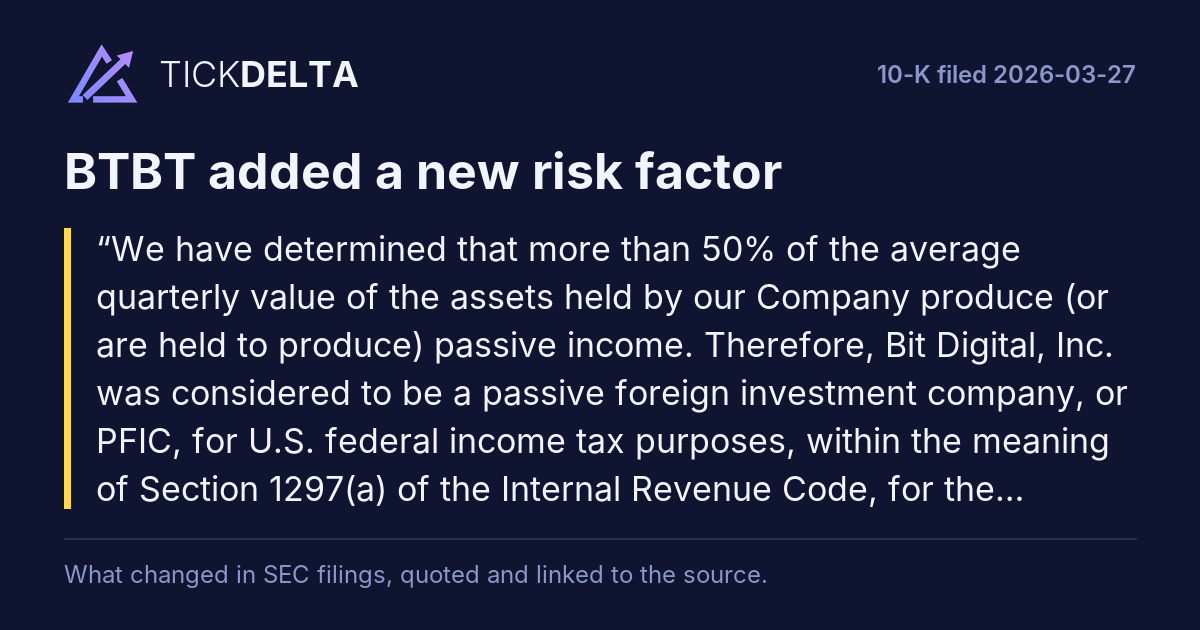
We have determined that more than 50% of the average quarterly value of the assets held by our Company produce (or are held to produce) passive income. Therefore, Bit Digital, Inc. was considered to be a passive foreign investment company, or PFIC, for U.S. federal income tax purposes, within the meaning of Section 1297(a) of the Internal Revenue Code, for the taxable year ended December 31, 2025, and we may continue to be classified as a PFIC in future taxable years.
The determination of whether we are a PFIC is made annually and depends on the application of complex U.S. federal income tax statutes, regulations, interpretation, and the composition of our income and assets. For purposes of the asset test, the value of our assets may be determined, in part, by reference to the market price of our ordinary shares, which may fluctuate significantly. As a result, our PFIC status may change from year to year depending on stock price, the value of our digital asset holdings, and the composition of our operating assets.
If we are classified as a PFIC for any taxable year during which a U.S. holder owns our ordinary shares, such U.S. holder may be subject to adverse U.S. federal income tax consequences. These consequences may include the application of the excess distribution rules under Section 1291 of the Internal Revenue Code, under which gains on the disposition of our ordinary shares and certain distributions may be taxed at the highest applicable tax rates and may be subject to an interest charge on deferred tax liabilities. In addition, U.S. holders may be subject to additional reporting requirements, including the obligation to file IRS Form 8621.
U.S. holders may be able to mitigate certain of these adverse tax consequences by making a qualified electing fund (QEF) or a mark-to-market election with respect to our ordinary shares on a shareholder-by-shareholder basis. We intend to provide U.S. holders with the information necessary to make a QEF election for the 2025 taxable year. However, there can be no assurance that such information will be available on a timely basis or that making such election will be beneficial to any particular U.S. holder.
Prospective investors should consult their own tax advisors regarding the application of the PFIC rules to an investment in our ordinary shares, including the availability and consequences of making a QEF or mark-to-market election and the reporting obligations associated with such investment.
Read in the 10-K ↗
In the future, your percentage ownership in the Company may be diluted because of equity awards that the Company will be granting to its directors, officers and employees or otherwise as a result of equity issuances for acquisitions or capital market transactions. the Company anticipates that its Compensation Committee will grant additional stock-based awards to its directors, officers and employees. Such awards will have a dilutive effect on the Company’s earnings per share, which could adversely affect the market price of our shares.
In addition, the Company’s Amended and Restated Memorandum and Articles of Association authorizes it to issue additional preference shares of par value US$0.01 in the capital of the Company, which have enhanced rights relative to Ordinary Shares, including with respect to dividends, and liquidation preferences. Accordingly, issuing preference shares could affect the value of our Ordinary Shares.
Read in the 10-K ↗
New in the latest 10-Q
101 paragraphs in the 10-Q filed Aug 13, 2026 with nothing like
them in the 10-Q filed May 15, 2026 (at least half the words must differ; new numbers alone do not count).
Quoted exactly, grouped by the item heading above them. This is text that changed, not a judgement of how serious it is.
Financial statements and notes
June 30, December 31, 2026 2025 ──────────────────────────────────────────────────────────────────────────────────────────────────────────────────────────────────────────────────────────────────────────────────────────────────────────────────────────────────────────────────────────────────────────────────────────────────────── (audited) ASSETS Current Assets Cash and cash equivalents $ 83,555 $ 118,356 Restricted cash 4,313 3,857 Accounts receivable, net 23,243 23,922 USDC 408 484 Net investment in lease – current, net 2,573 4,261 Loans receivable 400 400 Digital asset collateral receivable 105,616 - Other current assets, net 25,343 26,735 Total Current Assets 245,451 178,015 Non-Current Assets Deposits for property, plant, and equipment 33,500 52,838 Property, plant, and equipment, net 667,574 360,243 Goodwill 19,402 20,146 Digital assets 120,149 415,734 Digital intangible assets 27,600 - Intangible assets, net 12,001 12,821 Operating lease right of use assets, net 16,925 12,053 Finance lease right of use assets, net - 12,602 Net investment in lease - non-current, net 8,375 9,687 Investment securities 47,890 69,121 Deferred tax assets 7,564 2,578 Other non-current assets, net 29,463 28,580 Total Non-Current Assets 990,443 996,403 Total Assets $ 1,235,894 $ 1,174,418 LIABILITIES AND SHAREHOLDERS’ EQUITY Current Liabilities Accounts payable $ 14,319 $ 8,875 Current portion of deferred revenue 17,909 7,997 Current portion of operating lease liabilities 5,455 5,549 Current portion of finance lease liabilities - 12,911 Short-term debt and current portion of long-term debt, net 78,436 - Income tax payable 367 1,547 Other payables and accrued liabilities 46,019 56,067 Total Current Liabilities 162,505 92,946 Non-Current Liabilities Non-current portion of deferred revenue 125,201 71,554 Non-current portion of operating lease liabilities 10,232 5,415 Long-term debt, net 25,464 - Convertible notes payable, net 336,155 110,291 Derivative liability 23,975 19,260 Deferred tax liabilities 13,951 9,691 Other long-term liabilities 6,279 - Total Non-Current Liabilities 541,257 216,211 Total Liabilities 703,762 309,157 Commitments and Contingencies – Note 22 Bit Digital Shareholders’ Equity Preference shares, $0.01 par value, 10,000,000 and 10,000,000 shares authorized, 1,000,000 and 1,000,000 shares issued and outstanding as of June 30, 2026 and December 31, 2025, respectively 9,050 9,050 Ordinary shares, $0.01 par value, 1,000,000,000 and 1,000,000,000 shares authorized, 354,929,291 and 324,322,214 shares issued, 354,799,305 and 324,192,228 shares outstanding as of June 30, 2026 and December 31, 2025, respectively 3,549 3,243 Treasury stock, at cost, 129,986 and 129,986 shares as of June 30, 2026 and December 31, 2025, respectively (1,172) (1,172) Additional paid-in capital 818,218 890,068 Accumulated deficit (433,206) (178,526) Accumulated other comprehensive (loss) income (1,276) 1,331 Total Bit Digital Shareholders’ Equity 395,163 723,994 Non-controlling Interests 136,969 141,267 Total Equity 532,132 865,261 Total Liabilities and Equity $ 1,235,894 $ 1,174,418
Read in the 10-Q ↗
The Digital Asset Collateral Receivable represents the Company’s contractual right to receive an equivalent quantity and type of digital assets pledged as collateral under borrowing arrangements in which the counterparty has the contractual right to sell, pledge, rehypothecate, assign, invest, use, commingle or otherwise dispose of the pledged digital assets during the term of the arrangement. Upon transfer of the collateral, the Company derecognizes the pledged digital assets as control has transferred to the counterparty and recognizes a Digital Asset Collateral Receivable representing its contractual right to receive fungible digital assets of the same type upon settlement of the related borrowing arrangement.
Read in the 10-Q ↗
The Digital Asset Collateral Receivable is initially measured at the fair value of the digital assets transferred as collateral on the transfer date. Any difference between the carrying amount of the transferred digital assets and the initial measurement of the receivable is recognized in the consolidated statements of operations as an impairment loss or realized gain on transfer, as applicable. Thereafter, the Digital Asset Collateral Receivable is measured at amortized cost. The value and activity relating to the Digital Asset Collateral Receivable are disclosed in Note 7 - Digital Asset Collateral Receivable.
Read in the 10-Q ↗
The Digital Asset Collateral Receivable is classified as current or non-current based on the expected timing of settlement under the related borrowing arrangement. For borrowing arrangements that are repayable on demand or otherwise expected to be settled within twelve months, the Digital Asset Collateral Receivable is classified as a current asset.
Read in the 10-Q ↗
At inception and throughout the term of the arrangement, the Company evaluates the collectability of the Digital Asset Collateral Receivable in accordance with ASC 326, Financial Instruments - Credit Losses. The Digital Asset Collateral Receivable is presented net of any allowance for expected credit losses. The Company applies the current expected credit loss (“CECL”) model and estimates lifetime expected credit losses by considering the creditworthiness of the counterparty, the contractual terms of the borrowing arrangement, current economic conditions, reasonable and supportable forecasts, and other qualitative and quantitative factors relevant to the collectability of the receivable. Based on these assessments, management records an allowance for expected credit losses when necessary. For the periods presented, no allowance for expected credit losses was considered necessary.
Read in the 10-Q ↗
Land acquired by the Company has an unlimited useful life and therefore is not depreciated.
Read in the 10-Q ↗
Notes and loans payable are presented as short-term and long-term debt in the consolidated balance sheet and recognized initially at the amount of proceeds received, net of related debt discount and debt issuance costs, and are subsequently measured at amortized cost using the effective interest method. Interest expense is recognized in the condensed consolidated statements of operations over the term of the related debt. Notes and loans payable are classified as current or long-term debt liabilities based on their contractual maturities, or earlier if a default, cross-default, or other contractual provision entitles the lender to accelerate repayment within twelve months of the balance sheet date.
Read in the 10-Q ↗
Collateralized borrowings represent financing arrangements under which the Company obtains funding secured by its liquid staked ETH (“LsETH”). Upon inception of a collateralized borrowing arrangement, the Company recognizes a loan payable equal to the proceeds received, net of any applicable debt issuance costs.
Read in the 10-Q ↗
Subsequent to initial recognition, the loan payable is measured at amortized cost using the effective interest method. Interest expense, including the amortization of any debt discount or debt issuance costs, is recognized over the period the borrowing is outstanding. Accrued but unpaid interest is recognized as interest payable until settlement.
Read in the 10-Q ↗
The Company’s collateralized borrowings are secured by LsETH pledged to the lender. When the Company determines that control of the pledged collateral has transferred to the lender, the pledged LsETH is derecognized and a collateral receivable is recognized in accordance with the Company’s accounting policy for pledged digital assets. Changes in the accounting for the pledged collateral do not affect the recognition, measurement or presentation of the related loan payable.
Read in the 10-Q ↗
The Company’s collateralized borrowing arrangements may require the Company to maintain collateral at specified contractual collateralization levels. Accordingly, the Company may be required to pledge additional collateral or may receive the return of previously pledged collateral based on changes in the fair value of the pledged digital assets.
Read in the 10-Q ↗
The Company’s collateralized borrowings are evergreen facilities that may be called by the lender upon seven days’ notice or repaid by the Company at any time in accordance with the applicable loan agreements. Because the Company does not have an unconditional right to defer settlement of these borrowings for at least one year after the balance sheet date, the related loan payable is classified as a current liability in the consolidated balance sheets.
Read in the 10-Q ↗
The Company participates in native staking solely as a delegator through a third-party validator. Under this arrangement, the Company delegates ETH directly to the validator, which operates nodes on the Ethereum network to validate transactions and propose new blocks. In exchange for participating in the staking process, the Company is entitled to receive staking rewards, consisting of newly issued ETH and transaction fees, generally based on the amount of ETH delegated by the Company.
Read in the 10-Q ↗
To participate in native staking, the Company’s ETH is deposited into the Ethereum staking deposit smart contract in accordance with the protocol requirements. Although the ETH is committed to the staking protocol, the Company retains control of the underlying digital assets. The deposited ETH is not transferred to the validator or any other counterparty, and neither the validator nor any other party obtains the ability to sell, pledge, lend, or otherwise direct the use of the Company’s staked ETH.
Read in the 10-Q ↗
The withdrawal credentials associated with the staked ETH are designated to the Company’s custodian holds the Company’s digital assets solely for the Company’s benefit and does not obtain control over those assets through its custodial services. Accordingly, the Company concludes that native staked ETH continue to meet the criteria for recognition as its assets and are not derecognized upon deposit into the Ethereum staking deposit contract.
Read in the 10-Q ↗
Rewards earned from native staking activities are recognized as revenue in accordance with ASC 606, Revenue from Contracts with Customers (“ASC 606”). The Company’s delegation of ETH to the validator represents an output of its ordinary activities. Under the staking arrangement, the Company provides the validator with the right to use the Company’s delegated ETH in the validation process and, in exchange, is entitled to receive variable consideration in the form of ETH. The noncash consideration is measured at the fair value of ETH at contract inception using quoted prices on the Coinbase exchange, which the Company has determined to be its principal market.
Read in the 10-Q ↗
Revenue is recognized at the point in time when the Ethereum network confirms completion of the validation activities and the Company’s right to the staking rewards is established. The amount of revenue recognized reflects the protocol rewards to which the Company is entitled under the staking arrangement.
Read in the 10-Q ↗
The Company also participates in liquid staking arrangements through Liquid Collective. Under this arrangement, the Company contributes ETH to the Liquid Collective staking protocol, and LsETH is minted and received in return. LsETH represents the Company’s interest in the underlying staked ETH and the related staking rewards.
Read in the 10-Q ↗
LsETH is accounted for as an indefinite-lived intangible asset in accordance with ASC 350-30, changes in LsETH’s fair value while the Company remains staked with the liquid staking, are not recognized. There is no ongoing performance obligation following the staking of ETH through the liquid staking. LsETH is a non-rebasing token, and accordingly, the quantity of LsETH held by the Company does not increase as staking rewards accrue.
Read in the 10-Q ↗
Staking rewards associated with LsETH are recognized only upon redemption of LsETH for the underlying ETH, at which time the Company becomes entitled to the accumulated staking rewards. The noncash consideration is measured at the fair value of ETH at contract inception, which corresponds to the date the underlying ETH was initially contributed to the Liquid Collective staking arrangement. Staking rewards recognized upon redemption of LsETH are presented within “other (expense) income, net” in the Company’s condensed consolidated statements of operations. For the six months ended June 30, 2026 and 2025, the Company generated revenues of $ nil and $ nil, respectively, from the liquid staking.
Read in the 10-Q ↗
Upon staking ETH through the liquid staking protocol, the ETH is derecognized because the protocol obtains the ability to deploy and direct its use, and the LsETH token is received and recognized concurrently. Any gain or loss on the staking transaction is recognized in accordance with ASC 610-20, Other Income - Gains and Losses from the Derecognition of Nonfinancial Assets (“ASC 610-20”), based on the difference between the carrying amount of the ETH staked and the fair value of the LsETH received, and is included in “Gains (losses) on digital assets” in the Company’s condensed consolidated statements of operations. For the six months ended June 30, 2026, the Company liquid staked ETH and received LsETH and recognized a realized gain of $ 13.8 million from staking ETH and receiving LsETH in exchange.
Read in the 10-Q ↗
On May 8, 2026, the Company, through WhiteFiber, acquired the land and building comprising its MTL-3 facility in Saint-Jérôme, Québec, for a fixed purchase price of CAD $24.2 million, including related transaction costs of CAD $0.5 million, totaling CAD $ 24.7 million (approximately $ 17.3 million). The acquisition was completed pursuant to the purchase option contained in the original 20-year lease agreement dated April 11, 2025.
Read in the 10-Q ↗
For the three months ended June 30, 2026 and June 30, 2025, the Company recognized an impairment loss of $ nil and $ nil, respectively. For the six months ended June 30, 2026 and June 30, 2025, the Company recognized an impairment loss of $ 46.0 million and $ nil, respectively, related to its holdings of LsETH in accordance with ASC 350-30. The impairment is presented on “impairment of digital intangible assets” in the condensed consolidated statement of operations.
Read in the 10-Q ↗
The Company entered into collateralized borrowing arrangements in which LsETH is transferred to lending counterparties as collateral for U.S. dollar borrowings. Under the terms of these arrangements, the lending counterparties have the right to sell, pledge, rehypothecate, assign, invest, use, commingle or otherwise dispose of the transferred LsETH during the term of the borrowing. During the term of these arrangements, the Company retains a contractual right to receive an equivalent quantity of LsETH upon settlement of the related borrowing.
Read in the 10-Q ↗
During the ordinary course of these arrangements, the Company may transfer additional LsETH to satisfy collateral maintenance requirements or receive returned collateral as collateral requirements change or upon repayment of the related borrowing.
Read in the 10-Q ↗
The following table summarizes the Company’s digital asset collateral receivable:
Read in the 10-Q ↗
In the second quarter of 2026, the Company terminated an existing sales-type lease with a customer, derecognizing $1.4 million of net investment in lease and reclassifying the underlying assets to property, plant, and equipment at their carrying value. The Company then entered into a new sales-type lease with a customer, derecognizing those assets out of property, plant, and equipment and recognizing them as net investment in lease at $0.7 million, the present value of the lease receivable. This transaction resulted in a $0.3 million profit, recorded as “Other income” on the condensed consolidated statement of operations (see Note 10. Property, plant and equipment, for further detail).
Read in the 10-Q ↗
For the three and six months ended June 30, 2026 we had an impairment charge of $5.0 million (as described in the section below, Disposals of Property, Plant and Equipment). There were no impairment charges during the three and six months ended June 30, 2025.
Read in the 10-Q ↗
On May 8, 2026, the Company acquired the MTL-3 property following the exercise of the purchase option under the related data center lease agreement (refer to Note 9. Leases). The purchase price of CAD $24.2M (approximately $17.3 million), and the capitalized transactions costs of CAD $1.4M (approximately $1.0 million), was allocated between land and building based on their relative fair value.
Read in the 10-Q ↗
During the six months ended June 30, 2026, the Company determined that it would discontinue further investment in, and use of, its internally-developed software platform. As a result of this decision, effective June 4, 2026, the Company recorded an impairment charge of the remaining book value of $ 5.0 million during the six months ended June 30, 2026. The impairment charge is presented as a separate line item within operating expenses in the accompanying consolidated statements of operations and is excluded from depreciation and amortization expense.
Read in the 10-Q ↗
The SAFE agreement was replaced and superseded, in its entirety, by that certain Simple Agreement for Future Equity instrument of Canopy dated as of June 30, 2024 (the “New SAFE”) between the Canopy and WhiteFiber HPC, Inc. Pursuant to that certain Surrender and Termination Agreement, dated as of August 10, 2026, by and among Canopy, WhiteFiber HPC, Inc. and WhiteFiber AI, Inc., the New SAFE was surrendered to Canopy and terminated on the same date.
Read in the 10-Q ↗
On August 10, 2026, WhiteFiber entered into the PIPE Share Purchase Agreement with SAIHEAT Limited, an exempted company incorporated under the laws of the Cayman Islands (“SAIHEAT”). Pursuant to the PIPE Share Purchase Agreement, WhiteFiber purchased from SAIHEAT, an aggregate of 55,105 SAIHEAT’s Class A Ordinary Shares (the “PIPE Shares”) for aggregate proceeds of approximately $1.0 million at a per-share purchase price of $18.15 per share. WhiteFiber has neither control nor significant influence through investment in PIPE Shares. The Company is currently evaluating the appropriate accounting treatment for this investment under U.S. GAAP. The accounting for this investment had not been finalized as of the date these financial statements were issued and will be reflected in the Company’s financial statements in the third quarter of 2026. Four members of the Company’s management, including Erke Huang, the Company’s Chief Financial Officer, participated in the PIPE transaction in their personal capacity as investors and invested $0.5 million each in SAIHEAT.
Read in the 10-Q ↗
The closing of the PIPE investment transaction is contingent upon the closing of the merger transaction by and among SAIHEAT, Canopy Wave Inc., a Delaware corporation (“Canopy”) and the Canopy stockholders (the “Merger Transaction”). The Merger Transaction requires approval from Nasdaq before any such closing could take place.
Read in the 10-Q ↗
No separate guarantee liability is recognized in the consolidated financial statements as the guarantees provided by the Guarantors are intercompany arrangements that are eliminated upon consolidation under ASC 810-10-45-18. The guarantees are disclosed herein pursuant to the disclosure requirements of ASC 460-10-50-4.
Read in the 10-Q ↗
As of June 30, 2026, the Facility had an effective interest rate of 10.64 %, which includes the stated interest rate of 7.92 %.
Read in the 10-Q ↗
On July 15, 2026, the Amended Credit agreement was repaid in full and refinanced through the Syndicated RBC Credit Facility agreement. The revolving facility from the Amended credit agreement in the form of Letters of Credit and Letters of Guarantee remains in place.
Read in the 10-Q ↗
On July 6, 2026, WhiteFiber’s wholly-owned subsidiary, Enovum Data Center Corp. entered into a syndicated credit agreement (“Syndicated RBC Credit Facility Agreement”). The Syndicated Credit Facility Agreement provides for an aggregate of up to approximately CAD $115 million (approximately $80.8 million) to refinance the Amended Credit Agreement and finance its data centers business. The agreement also includes an accordion feature that permits the Company to increase by up to an additional CAD $25 million (approximately $17.7 million) to refinance the Amended Credit Agreement, subject to the satisfaction of specified conditions. The Syndicated Credit Facility Agreement is a non-revolving facility, and amounts repaid or prepaid may not be reborrowed.
Read in the 10-Q ↗
The Syndicated Credit Facility is secured by first-ranking security interests over substantially all present and future personal property and assets of the borrower and the guarantors, together with first-ranking mortgages on certain owned real estate, including the Company’s MTL-2 and MTL-3 properties and related improvements and equipment.
Read in the 10-Q ↗
On July 15, 2026, the Company drew a CORRA loan amount of CAD $ 36.8 million (approximately $ 26.2 million) under the Syndicated Credit Facility Agreement.
Read in the 10-Q ↗
On May 26, 2026, the Company assigned to B. Riley a $20 million note that was issued to Enovum NC-1 Venture, LLC, an indirect wholly-owned subsidiary of WhiteFiber under the Delayed Draw Term Loan Facility and Security Agreement.
Read in the 10-Q ↗
As of June 30, 2026, the B. Riley Facility had an effective interest rate of 50.6 %, which exceeded the contractual interest rate due to the inclusion of the contractual MOIC payment. The short-term nature of the facility resulted in a higher annualized effective interest rate.
Read in the 10-Q ↗
On March 27, 2026, the Company entered into a collateralized borrowing arrangement with Galaxy Digital LLC (“Galaxy”). The Galaxy Loan Agreement provides for loans to the Company from time to time, with each loan amount, collateral and other terms determined and agreed upon by the Company and Galaxy pursuant to individual Loan Term Sheets. Collateral for each loan may consist of Dollars or Digital Currency, as agreed by the parties. The Loans may be either: an Open Loan, without a Maturity Date, where the Borrower may repay and Lender may recall the Borrowed Asset at any time, or a Term Loan with a predetermined Maturity Date, where the Lender has no right to demand a return of the Borrowed Asset before the Maturity Date. The Borrow Fee for each loan is as agreed upon in the relevant Loan Term Sheet.
Read in the 10-Q ↗
On May 20, 2026, the Company completed an initial draw of $ 50.0 million under the facility, which bears interest at an annual rate of 5.5 %. The borrowing is secured by the Company’s LsETH. Under the terms of the agreement, the Company may be required to provide additional collateral if the value of the pledged collateral falls below the required maintenance threshold specified in the applicable loan documentation.
Read in the 10-Q ↗
The borrowing is an evergreen facility that may be recalled by the lender upon seven days’ notice in accordance with the terms of the loan agreement. As the Company does not have an unconditional right to defer settlement of the borrowing for at least one year after the balance sheet date, the related loan payable is classified as a current liability in the condensed consolidated balance sheets.
Read in the 10-Q ↗
The Company’s outstanding borrowing under the facility is an evergreen loan arrangement that may be repaid at any time by the Company and may be recalled by Galaxy upon seven days’ notice. The Galaxy Loan Agreement has an initial term of one year and automatically renews for successive one-year periods unless terminated in accordance with its terms.
Read in the 10-Q ↗
Because the Company does not have an unconditional right to defer settlement of the borrowing for at least one year after the balance sheet date, the related loan payable has been classified as a current liability in the condensed consolidated balance sheets.
Read in the 10-Q ↗
(a) Includes a $0.8 million dividend declared on February 19, 2026, to the preferred shareholders of Geney Development Ltd (“Geney”) for the six months ended June 30, 2026.
Read in the 10-Q ↗
All revenue and cost of revenue from intersegment transactions have been eliminated in the condensed consolidated statements of operations and comprehensive (loss) income.
Read in the 10-Q ↗
The Company previously issued a guarantee to a third party on behalf of WhiteFiber Iceland ehf, making the Company jointly and severally liable for WhiteFiber Iceland’s payment obligations related to hosting Services fees and electrical costs pursuant to a colocation agreement.
Read in the 10-Q ↗
On September 25, 2025, the guarantee was assumed by WhiteFiber which became directly responsible for such obligations. Following the assumption, the Company is no longer a guarantor under the agreement.
Read in the 10-Q ↗
On July 15, 2026 Enovum NC-Bidco, LLC (the “Principal”), a subsidiary of WhiteFiber, entered into a $ 3 million surety bond from Great American Insurance Company in favor of Duke Energy Carolinas, LLC. The obligations under the surety bond are guaranteed by WhiteFiber, Inc. and Enovum NC-1 Bidco, LLC.
Read in the 10-Q ↗
Legal proceedings
On July 23, 2026, the Court issued a decision granting the motion in part and denying it in part. The Court dismissed the Company’s claims under the New York Uniform Voidable Transactions Act but permitted the Company’s successor-liability claim against the proposed post-combination public company to proceed. With respect to the fraud claims against Mr. Martini-Lo Manto, the Court permitted the claim based on allegedly fraudulent invoices to proceed and dismissed the remaining fraud claims. The Company is evaluating whether to seek leave to replead or to appeal the dismissed claims.
Read in the 10-Q ↗
Financial statements and notes
On April 22, 2026, the Company appealed the Commercial Division’s denial of the preliminary injunction. The Company also filed a request for interim appellate injunctive relief. On May 22, 2026, the Appellate Division issued an interim order, pending determination of the application by a full panel, directing the defendants to escrow $ 5.4 million on or before June 1, 2026 and directing the Company to post a $ 100,000 undertaking. The escrow was not funded. Instead, on June 5, 2026, Blockfusion Data Centers, Inc., the entity that would become the publicly traded parent upon completion of the proposed business combination, executed a limited guarantee in favor of the Company. Subject to its terms, the guarantee covers payment of the net amount, if any, that Blockfusion is finally determined to owe the Company in the Delaware or New York actions under a final, non-appealable judgment (or a settlement to which the guarantor consents), after giving effect to all defenses, counterclaims, and rights of setoff, and is capped at that amount. By its terms, the guarantee will not become effective unless and until the proposed business combination closes, and it will be null and void if the transaction is not consummated. In connection with the guarantee, the Company withdrew its appeal on June 6, 2026, and the interim order is no longer in effect. The proposed business combination has not yet closed.
Read in the 10-Q ↗
On July 15, 2026, the Company obtained a $ 3 million surety bond from Great American Insurance Company in favor of Duke Energy Carolinas, LLC. The surety bond serves as security for the Company’s payment obligations and may be drawn upon if the Company fails to remit payment to Duke Energy within 30 days after receiving a demand for payment.
Read in the 10-Q ↗
On July 6, 2026, WhiteFiber’s wholly-owned subsidiary, Enovum Data Center Corp. entered into a syndicated credit agreement (“Syndicated RBC Credit Facility Agreement”). See Note 13. Debt for additional information.
Read in the 10-Q ↗
On July 30, 2026, WhiteFiber Australia II Pty Ltd (f/k/a Aurix Digital Pty Ltd), a subsidiary of WhiteFiber, entered into a lease of data center space in Sydney, Australia to expand our cloud services offering. The lease, which is guaranteed by WhiteFiber, Inc., is scheduled to commence in the fourth quarter of 2026, has a term of 59 months, and carries a monthly rent of AUD 488 thousand (approximately $344 thousand).
Read in the 10-Q ↗
On August 10, 2026, WhiteFiber entered into the PIPE Share Purchase Agreement with SAIHEAT Limited for aggregate proceeds of approximately $1.0 million at a per-share purchase price of $18.15 per share. Refer to Note 11. Investment Security for additional information.
Read in the 10-Q ↗
On August 11, 2026, the Board of Directors approved the issue of an additional 1,000,000 preference shares with the same exact features of the 1,000,000 issued and outstanding preference shares. These preference shares are being issued to the following persons for services resulting in the growth of the Company, and particularly during the transition period following WhiteFiber’s initial public offering. Sam Tabar, Chief Executive Officer ( 200,000 shares), Erke Huang, Chief Financial Officer ( 200,000 shares in the name of Even Green Holdings Limited) and two other members of management were issued 400,000 shares and 200,000 shares, respectively, or an aggregate of 1,000,000 preference shares which were valued by the Company at $ 2,000,000. An aggregate of 1,000,000 ordinary shares were forfeited back to the Company for zero consideration by the four above-named persons.
Read in the 10-Q ↗
As the business grows, WhiteFiber’s ability to fund its operating needs will depend on the ongoing ability to generate positive cash flow from our operations and raise capital in the capital markets. Accordingly, WhiteFiber has entered into certain credit facilities to finance these areas of growth, including the RBC Facility Agreement discussed here. Refer to Liquidity and capital resources for further discussion on this Facility and other credit facilities of WhiteFiber.
Read in the 10-Q ↗
On June 18, 2025, WhiteFiber entered into a non-recourse credit agreement with RBC (as subsequently amended on July 4, 2025, the “original credit agreement”) providing for an aggregate of up to approximately CAD 60 million (approximately $43.8 million) of financing intended primarily to refinance the buildout of MTL-2 and to provide $5.8 million of revolving term financing. The facilities had not been authorized for use by the lender, as certain conditions precedent had not yet been satisfied, and accordingly no amounts were drawn and no borrowings were available under the original credit agreement.
Read in the 10-Q ↗
On July 6, 2026, WhiteFiber’s wholly-owned subsidiary, Enovum Data Center Corp entered into a syndicated credit agreement with a group of lenders and RBC as administrative agent. The Syndicated Credit Facility Agreement provides for an aggregate of up to approximately CAD $115 million (approximately $80.8 million) to refinance the Amended Credit Agreement and finance its data centers business. The agreement also includes an accordion feature that permits WhiteFiber to increase by up to an additional CAD $25 million (approximately $17.7 million) to refinance the Amended Credit Agreement, subject to the satisfaction of specified conditions. The Syndicated Credit Facility Agreement is a non-revolving facility, and amounts repaid or prepaid may not be reborrowed.
Read in the 10-Q ↗
The Syndicated Credit Facility is secured by first-ranking security interests over substantially all present and future personal property and assets of the borrower and the guarantors, together with first-ranking mortgages on certain owned real estate, including WhiteFiber’s MTL-2 and MTL-3 properties and related improvements and equipment.
Read in the 10-Q ↗
On July 15, 2026, WhiteFiber drew a CORRA loan amount of CAD $36.8 million (approximately $26.2 million) under the Syndicated Credit Facility Agreement.
Read in the 10-Q ↗
WhiteFiber is also developing a capital-light managed services offering through which customers would fund the underlying hardware while WhiteFiber deploys and operates it on their behalf. This offering has not yet generated material revenue.
Read in the 10-Q ↗
As of the date of this Form 10-Q, WhiteFiber has seven existing customers. Its largest customer accounted for approximately 63% of WhiteFiber’s revenue during the six months ended June 30, 2026. During the period WhiteFiber had discontinuation of three customer orders. The discontinued orders resulted in approximately $5.1M impact to revenue during the six months ended June 30, 2026. However, there were new customer orders contracted in the six months ended June 30, 2026 and through the date of this Form 10-Q for total contracted revenue of $635.8M over a six months to three-year period.
Read in the 10-Q ↗
Discontinued customer agreements during the six months ended June 30, 2026 and through the date of this Form 10-Q include: (i) WhiteFiber’s Initial Customer, following execution of the Termination Agreement described below; (ii) a customer whose Master Services Agreement and related purchase order, as previously amended, was terminated in January 2026; and (iii) a customer whose service order, entered into in January 2026, was terminated during the period.
Read in the 10-Q ↗
New customer agreements signed during the six months ended June 30, 2026 and through the date of this Form 10-Q include new service orders entered into with existing customers for additional GPU and CPU/storage capacity, as well as new service orders entered into with new customers, in each case as further described below.
Read in the 10-Q ↗
In the second quarter of 2026, WhiteFiber executed a termination agreement (the “Termination Agreement”) with the Initial Customer. The Termination Agreement preserved $12.5 million of previously invoiced, unpaid trade receivables. This preserved balance was fully collected as of June 30, 2026. Prepayment and service deposit balances were applied against other outstanding receivables and WhiteFiber recognized a bad debt expense of approximately $2.2 million for the unpreserved remaining receivable balance outstanding. Additionally, under the Termination Agreement the Initial Customer is obligated to pay WhiteFiber a fixed termination fee of $12.3 million that was recognized as revenue during the second quarter of 2026. Subsequently, after quarter-end, the termination fee was amended to $15.7 million. The amended amount of $15.7 million remains outstanding as of the date of this Form 10-Q. Following the service pause and termination of the agreement, WhiteFiber redeployed the GPUs previously allocated to the Initial Customer to other customers.
Read in the 10-Q ↗
In May 2026, WhiteFiber entered into a five-year agreement to provide AI compute infrastructure for an investment-grade technology customer in the Paris region utilizing advanced NVIDIA GPU systems, with total contract value in excess of $160 million. Service under this agreement, which was previously expected to commence in July 2026, is now expected to commence in September 2026, subject to final equipment delivery and acceptance milestones. WhiteFiber has secured third-party data center capacity in France to support the deployment and has entered into a binding term sheet for project-level financing with respect to this deployment (the “France Project Financing”). WhiteFiber is currently in the process of negotiating definitive documentation for the France Project Financing; however, certain material terms remain subject to ongoing negotiation between the parties. While WhiteFiber expects to finalize the France Project Financing in the near term, no definitive agreements have been entered into as of the date of this Quarterly Report, and no assurance can be given that WhiteFiber will enter into such financing on the timeline currently anticipated, on the terms contemplated by the binding term sheet, on other terms satisfactory to us, or at all. If consummated, the France Project Financing is expected to be incurred at a project-level subsidiary and would not be guaranteed by WhiteFiber, Inc. The project is expected to be supported by customer prepayments, including 12 months of advance service fees, and project-level financing, with limited long-term reliance on our corporate balance sheet and existing cash resources.
Read in the 10-Q ↗
Also in May 2026, WhiteFiber entered into a two-year cloud services agreement with Hyperbolic Labs, Inc., with Modal Labs as the end customer and reference partner, to deploy H200 GPUs from our existing owned fleet, with total contract value of approximately $17 million. Revenue under this agreement commenced in June 2026. No incremental GPU capital expenditures were required for this deployment.
Read in the 10-Q ↗
The Company’s future results of operations are, in part, dependent on WhiteFiber’s ability to complete and expand capacity at its existing data center projects and to develop its data center pipeline. WhiteFiber substantially completed construction of its MTL-3 facility by the end of October 2025. The site has commenced billing its customer, Cerebras, as of November 1, 2025, in the amount of CAD 1.4 million (approximately $979 thousand USD) monthly for the duration of the five-year contract. Management expects WhiteFiber to start generating revenues 30 days after completion. Additionally, during the third quarter WhiteFiber will begin the initial phases of construction for MTL-2 with an expected delivery near the end of the fiscal year.
Read in the 10-Q ↗
On July 9, 2026, WhiteFiber announced initial research and development results for a proprietary cross-data-center networking architecture designed to link geographically separated data centers into a single logical GPU supercluster. Testing demonstrated 111.2 Tbps of bandwidth across 83 kilometers of dark fiber with a guaranteed round-trip latency of 0.9 milliseconds, and WhiteFiber has submitted related patent applications. WhiteFiber is targeting a commercial launch of this solution in future periods, subject to completion of additional full-spectrum fiber testing; although there can be no assurance that it will do so on the anticipated timeline or at all.
Read in the 10-Q ↗
The Company’s and WhiteFiber’s ability to fund the continued construction and buildout of WhiteFiber’s data center facilities, and to refinance near-term debt maturities, depends on successfully obtaining additional financing on acceptable terms, or at all. If the Company or WhiteFiber is unable to do so, the Company’s business, operating results, and financial condition could be adversely affected.
Read in the 10-Q ↗
During the first quarter of 2026, the Company reallocated a portion of its mining fleet across hosting facilities as part of its ongoing efforts to recalibrate its mining operations. This transition, driven by changes in hosting partnerships, including the transfer of 2,483 miners from Soluna and DEP’s facilities, respectively, to Bitdeer.
Read in the 10-Q ↗
During the second quarter of 2026, the Company transferred 2,451 and 1,778 miners from Soluna and Bitdeer’s facilities, respectively, to Merkle.
Read in the 10-Q ↗
On June 4, 2026, the Company entered into a hosting services agreement with Mendenhall Ops LLC (“Merkle”) for an initial term of one year, which automatically renews for successive one-year periods unless terminated by either party. Pursuant to the terms of the agreement, Merkle agreed to provide colocation, operation, maintenance, and related services at its facilities for the operation of 4,137 bitcoin miners representing approximately 12.55 MW of power capacity and an aggregate hash rate of approximately 0.62 EH/s. In exchange for these services, Merkle is entitled to receive reimbursement of certain operating costs and performance fees ranging from 25% to 40% of net digital assets generated, depending on the miner model. Upon the execution of this service agreement, we paid a power prepayment of $0.7 million.
Read in the 10-Q ↗
For the three months ended June 30, 2026 and 2025, impairment of capitalized software assets were $5.0 million and $nil, respectively, the Company determined that it would discontinue further investment in, and use of, its internally-developed software platform. As a result of this decision, effective June 4, 2026, the Company recorded an impairment charge of the remaining book value of $5.0 million during the three months ended June 30, 2026.
Read in the 10-Q ↗
For the three months ended June 30, 2026 and 2025, gains on digital intangible assets was $11.3 million and $nil, respectively, primarily due to the transfer of LsETH to lending counterparties under collateral arrangements, which resulted in the derecognition of the LsETH and recognition of digital asset collateral receivables. For further details, refer to Note 7. Digital Asset Collateral Receivable.
Read in the 10-Q ↗
Our future effective income tax rate depends on various factors, such as tax legislation, the geographic composition of our pre-tax income, the amount of our pre-tax income as business activities fluctuate, non-deductible expenses, non-taxable capital gain in certain jurisdiction, change of valuation allowance and the effectiveness of our tax planning strategies. The Organisation for Economic Co-operation and Development (“OECD”) has introduced a global minimum tax framework (“Pillar Two”) that generally applies to multinational enterprise groups with consolidated annual revenues of €750 million or more and is intended to ensure a minimum effective tax rate of 15% in each jurisdiction in which such groups operate. Certain jurisdictions have enacted, or are considering enacting, legislation implementing these rules. Based on the Company’s current consolidated revenue, for the six months ended June 30, 2026, the Company is not within the scope of the Pillar Two rules. However, the Company continues to monitor developments related to the implementation of these rules, and future growth or changes in the Company’s operations could result in the Company becoming subject to Pillar Two in future periods.
Read in the 10-Q ↗
For the six months ended June 30, 2026 and 2025, impairment of capitalized software assets were $5.0 million and $nil, respectively. In the second quarter of 2026, the Company determined that it would discontinue further investment in, and use of, its internally-developed software platform. As a result of this decision, effective June 4, 2026, the Company recorded an impairment charge of the remaining book value of $5.0 million during the six months ended June 30, 2026.
Read in the 10-Q ↗
For the six months ended June 30, 2026 and 2025, gains on digital intangible assets was $11.3 million and $nil, respectively, primarily due to the transfer of LsETH to lending counterparties under collateral arrangements, which resulted in the derecognition of the LsETH and recognition of digital asset collateral receivables. For further details, refer to Note 7. Digital Asset Collateral Receivable.
Read in the 10-Q ↗
Our future effective income tax rate depends on various factors, such as tax legislation, the geographic composition of our pre-tax income, the amount of our pre-tax income as business activities fluctuate, non-deductible expenses, non-taxable capital gain in certain jurisdiction, change of valuation allowance and the effectiveness of our tax planning strategies. The Organization for Economic Co-operation and Development (“OECD”) has introduced a global minimum tax framework (“Pillar Two”) that generally applies to multinational enterprise groups with consolidated annual revenues of €750 million or more and is intended to ensure a minimum effective tax rate of 15% in each jurisdiction in which such groups operate. Certain jurisdictions have enacted, or are considering enacting, legislation implementing these rules. Based on the Company’s current consolidated revenue, for the three months ended June 30, 2026, the Company is not within the scope of the Pillar Two rules. However, the Company continues to monitor developments related to the implementation of these rules, and future growth or changes in the Company’s operations could result in the Company becoming subject to Pillar Two in future periods.
Read in the 10-Q ↗
Digital intangible assets were $27.6 million as of June 30, 2026, compared with $nil as of December 31, 2025. The increase was primarily attributable to the Company’s liquid staking of 73,235 ETH during the six months ended June 30, 2026, through which it received 66,192 LsETH. The LsETH holdings were subsequently pledged as collateral for borrowings. Refer to Note 6. Digital Assets Holdings and Note 7. Digital Asset Collateral Receivable, for additional information.
Read in the 10-Q ↗
Short-term and long-term debt, net consists of amounts borrowed under several credit facilities entered into by the Company and its subsidiaries during the six months ended June 30, 2026, including term loan facilities (including the related B. Riley Facility) and collateralized borrowings with Galaxy Digital LLC. Refer to Note 13. Debt, for more information.
Read in the 10-Q ↗
On July 6, 2026, WhiteFiber entered into a syndicated credit agreement. The Syndicated Credit Facility Agreement provides for an aggregate of up to approximately CAD $115 million (approximately $80.8 million) to refinance the Amended Credit Agreement and finance its data centers business. The agreement also includes an accordion feature that permits WhiteFiber to increase by up to an additional CAD $25 million (approximately $17.7 million) to refinance the Amended Credit Agreement, subject to the satisfaction of specified conditions. The Syndicated Credit Facility Agreement is a non-revolving facility, and amounts repaid or prepaid may not be reborrowed.
Read in the 10-Q ↗
On July 15, 2026, WhiteFiber drew a CORRA loan amount of CAD $36.8 million (approximately $26.2 million) under the Syndicated Credit Facility Agreement.
Read in the 10-Q ↗
On May 26, 2026, the Company assigned to B. Riley Securities, Inc. a $20 million note originally issued to Enovum NC-1 Venture, LLC, an indirect wholly-owned subsidiary of WhiteFiber under the Delayed Draw Term Loan Facility.
Read in the 10-Q ↗
As of June 30, 2026, the B. Riley Facility had a net carrying value of $19.4 million and an effective interest rate of 50.6%, which exceeded the contractual rate due to the MOIC payment and the facility’s short-term nature. The facility provides WhiteFiber with additional short-term capital to support ongoing development activities.
Read in the 10-Q ↗
Whitefiber has entered into exclusivity with a consortium of lenders in connection with a proposed secured financing for its NC-1 project. The parties have commenced diligence and are negotiating definitive documentation, and are working toward closing, subject to customary approvals and conditions. There can be no assurance that the financing will be completed on favorable terms or at all. If completed, WhiteFiber expects the financing would return a significant portion of WhiteFiber’s invested capital to the balance sheet for redeployment into future development.
Read in the 10-Q ↗
WhiteFiber future capital requirements will depend on many factors, including WhiteFiber’s ability to refinance or extend near-term debt maturities described above, the revenue growth rate, the success of future product development and capital investment required, and the timing and extent of spending to support further sales and marketing and research and development efforts. In addition, WhiteFiber expects to incur additional costs as a result of operating as a public company. In the event that additional financing is required from outside sources, WhiteFiber cannot be sure that any additional financing will be available to WhiteFiber on acceptable terms if at all. If WhiteFiber are unable to raise additional capital when desired, our business, operating results, and financial condition could be adversely affected.
Read in the 10-Q ↗
On May 20, 2026, the Company entered into a collateralized borrowing arrangement with Galaxy Digital LLC, under which the Company received borrowing proceeds of $50.0 million. The borrowing bears interest at 5.5% per annum and is collateralized by LsETH pledged to the lender. The borrowing is an evergreen facility that may be recalled by the lender upon seven days’ notice in accordance with the terms of the loan agreement. As the Company does not have an unconditional right to defer settlement of the borrowing for at least one year after the balance sheet date, the related loan payable is classified as a current liability in the condensed consolidated balance sheets.
Read in the 10-Q ↗
The borrowing is subject to collateral maintenance requirements, and the Company may be required to transfer additional collateral or may receive the return of collateral based on changes in the value of the pledged collateral relative to the contractual collateralization thresholds.
Read in the 10-Q ↗
Legal proceedings
On July 23, 2026, the Court issued a decision granting the motion in part and denying it in part. The Court dismissed the Company’s claims under the New York Uniform Voidable Transactions Act but permitted the Company’s successor-liability claim against the proposed post-combination public company to proceed. With respect to the fraud claims against Mr. Martini-Lo Manto, the Court permitted the claim based on allegedly fraudulent invoices to proceed and dismissed the remaining fraud claims. The Company is evaluating whether to seek leave to replead or to appeal the dismissed claims.
Read in the 10-Q ↗
On April 22, 2026, the Company appealed the Commercial Division’s denial of the preliminary injunction. The Company also filed a request for interim appellate injunctive relief. On May 22, 2026, the Appellate Division issued an interim order, pending determination of the application by a full panel, directing the defendants to escrow $5.4 million on or before June 1, 2026 and directing the Company to post a $100,000 undertaking. The escrow was not funded. Instead, on June 5, 2026, Blockfusion Data Centers, Inc., the entity that would become the publicly traded parent upon completion of the proposed business combination, executed a limited guarantee in favor of the Company. Subject to its terms, the guarantee covers payment of the net amount, if any, that Blockfusion is finally determined to owe the Company in the Delaware or New York actions under a final, non-appealable judgment (or a settlement to which the guarantor consents), after giving effect to all defenses, counterclaims, and rights of setoff, and is capped at that amount. By its terms, the guarantee will not become effective unless and until the proposed business combination closes, and it will be null and void if the transaction is not consummated. In connection with the guarantee, the Company withdrew its appeal on June 6, 2026, and the interim order is no longer in effect. The proposed business combination has not yet closed.
Read in the 10-Q ↗
Other information
On July 6, 2026, the WhiteFiber’s wholly-owned subsidiary, Enovum Data Center Corp. entered into a syndicated credit agreement (“Syndicated RBC Credit Facility Agreement”). The Syndicated RBC Credit Facility Agreement provides for an aggregate of up to approximately CAD $115 million (approximately $80.8 million) to refinance the Amended Credit Agreement and finance its data centers business. The agreement also includes an accordion feature that permits WhiteFiber to increase by up to an additional CAD $25 million (approximately $17.7 million) to refinance the Amended Credit Agreement, subject to the satisfaction of specified conditions. The Syndicated RBC Credit Facility Agreement is a non-revolving facility, and amounts repaid or prepaid may not be reborrowed.
Read in the 10-Q ↗
The Syndicated RBC Credit Facility is secured by first-ranking security interests over substantially all present and future personal property and assets of the borrower and the guarantors, together with first-ranking mortgages on certain owned real estate, including WhiteFiber’s MTL-2 and MTL-3 properties and related improvements and equipment
Read in the 10-Q ↗
On July 15, 2026, WhiteFiber drew a CORRA loan amount of CAD $36.8 million (approximately $26.2 million) under the Syndicated RBC Credit Facility Agreement.
Read in the 10-Q ↗
Item 6
+ Certain of the schedules to this Exhibit have been omitted in accordance with Regulation S-K Item 601(a)(5).
Read in the 10-Q ↗
The Registrant agrees to furnish supplementally a copy of all omitted exhibits and schedules to the SEC upon its request.
Read in the 10-Q ↗
1. Incorporated by reference to Exhibit 3.1 to the Registrant's Form F-1 registration statement filed on March 10, 2021
Read in the 10-Q ↗
2. Incorporated by reference to Exhibit 3.1 to the Registrant’s Current Report on Form 8-K, filed on July 30, 2026
Read in the 10-Q ↗
The 10-Q's risk factors against the 10-K
Item 1A of the 10-Q filed Aug 13, 2026 against Item 1A of the 10-K filed Mar 27, 2026.
A 10-Q repeats only the risks that changed, so a 10-K paragraph that is missing from it is not counted as removed.
Added is a paragraph with nothing like it in the 10-K, Reworded a sentence that is in both with several words changed,
Quiet changes a sentence in both where one to four words changed and one is a hedge or a modal
(cut words struck through, new words highlighted and underlined).
Text on the page, not a score; each links to the filing at sec.gov.
Added10-Q 2026-08-13 vs 10-K 2026-03-27
Except as set forth below, there have been no material changes from risk factors as previously disclosed in the Company’s Annual Report on Form 10-K for the year-ended December 31, 2025 (“Annual Report”) in response to Item 1A to PART 1 of Form 10-K. You should refer to the other information set forth in this report, including the information set forth in “Management’s Discussion and Analysis of Financial Condition and Results of Operations”, as well as in our consolidated financial statements and the related notes. Our business prospects, financial condition or results of operations could be adversely affected by any of these risks.
Read it in the 10-Q at sec.gov ↗
Added10-Q 2026-08-13 vs 10-K 2026-03-27
Please note the following in considering the risk factor in our Annual Report titled “Uncertainty in the global economy and instability within international relations, including changes in governmental policies relating to technology, and any potential downturn in the semiconductor and electronics industries, may negatively impact our business”: In addition, the recent armed conflict between the U.S. and its allies and Iran has caused a de facto closure of the Strait of Hormuz and further disruption of trade routes in the Red Sea, which has had a significant impact in the Middle East region and on global oil markets. We cannot predict the severity or length of the current conditions impacting international shipping in this region and the continuing disruption of the trade routes in the region of the Red Sea and Strait of Hormuz. Based on the complex relationship between countries involved in our supply chain, disruptions in shipping and the impact on energy prices could have a material and adverse impact on our financial condition, results of operations, and future performance.
Read it in the 10-Q at sec.gov ↗
Reworded10-Q 2026-08-13 vs 10-K 2026-03-27
Although the statute of limitations for non-compliance by our former business in the PRC is generally two years and the Company has not had any operations in PRC since September 2021, been out of the authority PRC, for more than two years, the Authority may still find its prior bitcoin mining operations involved a threat to financial security.
Read it in the 10-Q at sec.gov ↗ · The 10-K sentence ↗