Screener / SEC EDGAR /CIK 0001463101 /10-K filed Feb 17, 2026, compared with Feb 10, 2025 /Numbers from the XBRL of the 10-Ks
Nasdaq Technology · Semiconductors

Enphase Energy, Inc. ENPH

Compare with peers Embed
SEC comment letters, last 20 years

2 reviews of ENPH's filings by SEC staff

UPLOAD and CORRESP
Reviews 2 latest letter Dec 23, 2014
Questions asked 9 each answered in the company's own letter
No closing letter 0 reviews without a letter saying the staff completed it

When the SEC's staff reviews a filing, it writes to the company with numbered questions, and the company answers each one in a letter. SEC publishes the exchange once the review is over, at least 20 business days later. A question is not an accusation; most reviews end with the company adding detail to its next filing.

How the reviews went

Every review on EDGAR, from the first staff letter to the letter that closes it

  1. 1. Staff letters 3 UPLOAD
  2. 2. Questions in them 9 numbered comments
  3. 3. Company replies 3 CORRESP
  4. 4. Reviews closed 2 of 2 closing letter

Half the closed reviews took 52 days or less from the first letter to the closing letter.

Form 10-K for the Fiscal Year Ended December 31, 2013

2014-12-23 to 2015-02-13 · 5 questions · 1 letter from the SEC, 1 from the company
Review closed 2015-02-13
Income taxesControlsLiquidity and cash
Note 5. Warranty Obligations, page 54
SEC asked (1)
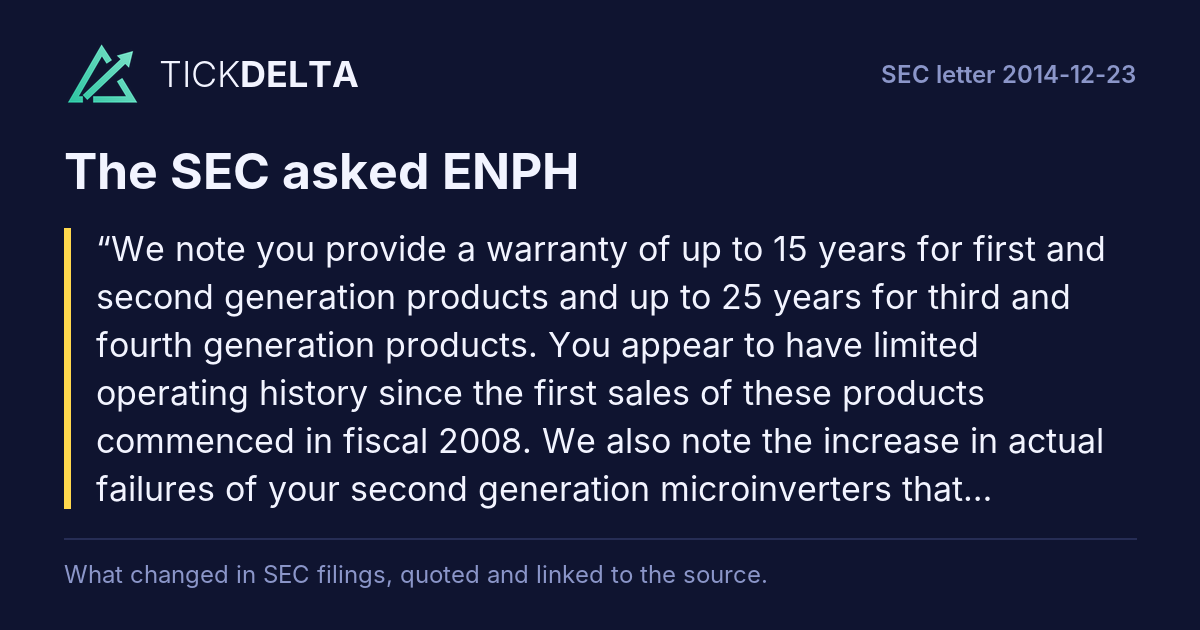
We note you provide a warranty of up to 15 years for first and second generation products and up to 25 years for third and fourth generation products. You appear to have limited operating history since the first sales of these products commenced in fiscal 2008.
Rest of the question

We also note the increase in actual failures of your second generation microinverters that exceeded estimates in 2012 and 2013 and in interim period of 2014 in your September 30, 2014 Form 10-Q that resulted in significant changes in estimates in recent years. Please explain to us how the significant increase in estimated failure rates have been considered in determining your estimate for warranty obligations.

ENPH answered
The Company advises the Staff that the total number of microinverter units shipped by the Company from 2008 (date of first shipment) through December 31, 2014 approximates 7.2 million units. Approximately 1.1 million units are the Company’s first and second generation microinverters, sold from 2008 through the end of 2012, and include a warranty term of up to 15 years. Approximately 6.1 million units are the Company’s third and fourth generation microinverters, sold from 2011through the end of 2014, and include a warranty term of up to 25 years.
Rest of the answer

For all generations of microinverters sold, the Company’s Quality and Reliability department has primary responsibility for establishing, monitoring and revising estimated failure rates, when necessary. In so doing, the department employs a consistent, systemic and rational methodology that carefully considers a number of factors including actual field performance data, root-cause and failure analyses on microinverters returned, and manufacturer and industry data related to the reliability and performance of individual components used in the Company’s microinverters. Through its Enlighten monitoring platform, each unit shipped and placed into production provides the Quality and Reliability department with the opportunity to gather valuable information and data related to the microinverter’s actual field performance in varying operating environments over time.

In addition to actual production data gathered from its microinverters, the Quality and Reliability department also considers the potential impact on long-term failure rates resulting from differences in product design, any variations in the individual components used in production, the potential effect of geographical and climate differences on units deployed, and any revisions to the manufacturing process. Through root-cause and failure analyses, the Quality and Reliability department identifies and isolates the individual failure mechanism(s) present in failed units returned to the Company and determines why such failures occurred. They also investigate the variation in the time-to-failure profiles for any given failure mechanism and incorporate any findings into their failure rate estimates.

In estimating the failure rates for the Company’s third and fourth generation microinverters, the Quality and Reliability department carefully considered the performance-related data collected on its first and second generation microinverters (including the significant increase in failure rates), as well as the information gathered from root-cause and failure analyses performed on those products. This information formed the basis of certain process, design, engineering, and manufacturing improvements that were incorporated into its third and fourth generation microinverters. For example, the Company made significant investments in automation equipment used in the critical stages of its manufacturing process to improve manufacturing yields, reduce production variability and improve the reliability of its microinverters. In addition, the Company made certain modifications and improvements to several key components used in its third and fourth generation microinverters. The Company also implemented significant operational improvements related to the qualification of all component vendors supplying raw materials used in the Company's microinverters. Finally, the Company identified the specific failure mechanisms present in its second generation microinverters and performed discrete tests and analyses to determine that those failure mechanisms were not present in its third or fourth generation products.

Prior to the launch of its third and fourth generation microinverter, the Company employed a more robust and methodical product development, qualification and verification process that involved rigorous environmental stress testing that included, but was not limited to, thermal cycling and damp heat testing. These stress tests and associated test processes were designed to simulate extreme operating conditions under which the Company’s microinverters might be deployed. The Company also introduced and performed accelerated life testing intended to simulate the operation and performance of its microinverters over extended periods of time of up to 25 years. After product launch and during manufacturing production, the Company’s Quality and Reliability and Manufacturing departments executed ongoing reliability and environmental stress testing on its third and fourth generation microinverters. Taken collectively, the Company believes that these factors have resulted in a significant improvement in the performance and reliability of the Company’s third and fourth generation microinverters, and have facilitated improved estimates used by the Company to measure warranty obligations for those products. As a result, since 2011, the Company has not increased the estimated failure rates used for its third or fourth generation microinverters.

Read in the reply
In its next report

First report after the company's reply of Jan 15, 2015: 10-K filed Mar 4, 2015 ↗, against the 10-K filed Mar 4, 2014 ↗.

Tickdelta does not hold the text of both reports, so they are not compared here.
Note 5. Warranty Obligations, page 54
SEC asked (2)
Please tell us the business purpose for modifying the warranty contracts related to microinverters sold since January 1, 2014 to allow for the right, but not the requirement, to assign warranty obligations to a third party. Please also explain why you have changed your accounting to elect the fair value option to measure microinverter warranties for those sold subsequent to January 1, 2014.
ENPH answered
The Company advises the Staff that the change in business practice of modifying the warranty contracts related to microinverters sold since January 1, 2014 to allow for the right, but not the requirement, to assign warranty obligations to a third party resulted from a forward-looking strategy that provides the Company with maximum flexibility in managing the risks associated with the extended duration of its microinverter warranties. The Company believes the solar industry is still in its early stages.
Rest of the answer

As the industry matures and evolves, the Company anticipates new entrants into the solar warranty fulfillment business given the growing installed base of deployed solar components and systems (e.g. solar panels and inverters) which typically carry warranties of up to 25 years. The ability to assign warranty obligations to such third parties in certain situations (e.g. in specific countries or regions, or a specific product generation) may make economic sense and will allow the Company to remain focused on its core business of designing, manufacturing and of selling microinverters.

In addition, after modifying the contractual provisions of the Company's microinverter warranties, the warranty obligations became eligible for fair value accounting pursuant to FASB ASC 825-10-15-4(e). The Company's decision to elect the fair value option for eligible microinverter warranties was made to reflect the underlying economics of the time value of money for an obligation that will be settled over an extended period of up to 25 years.

Read in the reply
In its next report

First report after the company's reply of Jan 15, 2015: 10-K filed Mar 4, 2015 ↗, against the 10-K filed Mar 4, 2014 ↗.

Tickdelta does not hold the text of both reports, so they are not compared here.

Note 11. Income Taxes, page 62
SEC asked (3)
Please revise future filings to disclose the amount of income (loss) before income tax expense attributable to domestic or foreign operations. Refer to Rule 4-08(h) of Regulation S-X.
ENPH answered
The Company advises the Staff that it will revise its footnote disclosures in future filings to disclose the components of income (loss) before income tax expense (benefit) attributable to domestic and foreign operations for the relevant periods.
Read in the reply
In its next report

First report after the company's reply of Jan 15, 2015: 10-K filed Mar 4, 2015 ↗, against the 10-K filed Mar 4, 2014 ↗.

Tickdelta does not hold the text of both reports, so they are not compared here.

Exhibit 31
SEC asked (4)
We note that on page 67 you have included management's report on internal control over financial reporting since this is your second annual report subsequent to your effective registration statement as required by Item 308 of Regulation S-K.
Rest of the question

As such, your 302 certifications are required to include the introductory language in paragraph 4 of the certification that refers to the certifying officers' responsibility for establishing and maintaining internal control over financial reporting for the company and should also include paragraph 4(b) which refers to the design of your internal reporting. Please file an amendment to the Form 10-K to include certifications that include the required language. You may provide an abbreviated amendment that consists of a cover page, explanatory note, signature page and paragraphs 1, 2, 4 and 5 of the certification. Please also apply this comment to each of your Form 10-Q filings for the quarterly periods ended March 31, June 30, and September 30, 2014.

ENPH answered
The Company advises the Staff that it will file the requested amendments to include the required introductory language in paragraph 4 and subparagraph 4(b) of the Section 302 certifications as soon as all Comments are resolved to the satisfaction of the Staff, but in any event prior to the filing of its Form 10-K for the year ended December 31, 2014.
Read in the reply
In its next report

First report after the company's reply of Jan 15, 2015: 10-K filed Mar 4, 2015 ↗, against the 10-K filed Mar 4, 2014 ↗.

Tickdelta does not hold the text of both reports, so they are not compared here.

Quantitative and Qualitative Information about Level 3 Fair Value Measurements, page 11
SEC asked (5)
Please explain to us how you determined the significant unobservable inputs disclosed on page 11 and how these are used in your estimate of fair value. Considering the recent significant changes in estimates from the increase in actual failures of your products and the uncertainty in the timing of cash flows, please tell us about your ability to develop estimates necessary to determine the fair value of your
Rest of the question

warranty obligation. Please also tell us your consideration of the disclosure requirements in FASB ASC 820-10-50-2(g).

ENPH answered
The following describes how the significant unobservable inputs are used in calculating the Company's warranty obligations at fair value:

the Company first estimates the undiscounted cash outflows associated with warranty obligations issued during a period in the same manner as the warranties that were issued prior to January 1, 2014;

the Company then increases the estimated undiscounted cash outflows determined above by a multiple of the profit element and risk premium; and the resultant estimated undiscounted cash outflows, which now incorporate a profit element and risk premium, are then
Rest of the answer

discounted back to a measurement date using an appropriate discount rate (described below) to arrive at a fair value measurement for its warranty obligations.

For the Staff's reference, the significant unobservable inputs used in the fair value measurement of the Company's eligible warranty obligations are (1) a profit element and risk premium; and (2) the Company's credit-adjusted risk-free interest rate (i.e. discount rate). The two unobservable inputs are determined by the Company, with the assistance of an unrelated third-party valuation specialist, as of each reporting date.

In determining the profit element and risk premium used to value the Company's warranty obligations at fair value, the Company considered FASB ASC 820-10-35-16J, which states:

When using a present value technique to measure the fair value of a liability that is not held by another party as an asset (for example, an asset retirement obligation), a reporting entity shall, among other things, estimate the future cash outflows that market participants would expect to incur in fulfilling the obligation. Those future cash outflows shall include market participants’ expectations about the costs of fulfilling the obligation and the compensation that a market participant would require for taking on the obligation. Such compensation includes the return that a market participant would require for the following:

a.

Undertaking the activity (that is, the value of fulfilling the obligation—for example, by using resources that could be used for other activities) b.

Assuming the risk associated with the obligation (that is, a risk premium that reflects the risk that the actual cash outflows might differ from the expected cash outflows).

The profit element and risk premium captures the price that a market participant would require to assume the risk associated with the contingent liability above and beyond the expected liability. In the absence of market information (e.g. quotes, rates, or margins for market participants) indicating the returns a market participant would require to assume warranty obligations of microinverters, the Company turned to the property and casualty insurers who offer products that cover many unique risks and is in the market of assuming a wide range of risk liabilities. Such insurers’ products cover a diverse set of risks including equipment breakdown, errors and omissions, business interruption and professional liability. The Company believes the returns required by property and casualty insurers provide a reasonable basis to estimate the profit element and risk premium that a hypothetical market participant (engaged in warranty fulfillment for microinverters) would require since both parties would be assuming risks associated with the uncertainties in timing and amount of future cash outflows and both would require a profit element to assume similar liabilities.

In determining the discount rate used to value the Company's warranty obligations at fair value, the Company used the risk-free interest rate based on a weighted-average of implied yields on U.S. Treasury zero-coupon issues commensurate with the weighted-average remaining warranty periods outstanding, plus the credit-risk adjusted bond yield curves from publicly available surveys in categories of credit risk (as published by Standard & Poor's and Bank of America Merrill Lynch) that the Company considers similar to its own credit risk.

The Company advises the Staff that the significant changes in estimates from the increase in actual failures of microinverters relate only to its second generation microinverters, which the Company last sold in 2012. The warranties associated with the Company's second generation microinverters are not eligible for fair value accounting as terms of those warranties do not meet the conditions set forth in FASB ASC 825-10-15-4(e). Accordingly, the changes to the failure rate assumptions related to its second generation microinverters do not necessarily have a direct correlation with the Company's ability to develop estimates necessary to determine the fair value of its warranty obligations related to its third and fourth generation microinverters, which are being accounted for at fair value if sold subsequent to January 1, 2014. To date, the Company has not increased the estimated failure rates used for its third or fourth generation microinverters.

As disclosed in Note 1 on page 8 of the 10-Q under the paragraph titled “Fair Value Option for Warranty Obligations Related to Microinverters Sold Since January 1, 2014” and discussed above, the only difference between how warranty obligations are being calculated prior to fair value accounting and post-election of the fair value option is the application of an expected present value technique to the estimated undiscounted cash outflows.

The Company considered FASB ASC 820-10-50-2(g), which requires an entity to provide a narrative description of the sensitivity of the fair value determination to changes in the level 3 inputs, and disclosed in Note 4 on page 11 of the 10-Q the following:

“An increase (decrease) in the profit element and risk premium input in isolation would result in a higher (lower) fair value measurement of the liability. An increase (decrease) in the discount rate in isolation would result in a substantially lower (higher) fair value measurement of the liability.”

In response to the Staff’s comment, the Company will enhance its disclosure in future filings by replacing the above paragraph with quantitative sensitivity analysis of changes in significant level 3 inputs of the (1) profit element and risk premium; and (2) discount rate similar to the following:

“Each of the significant unobservable inputs is independent of the other. The profit element and risk premium are estimated based on requirements of a third-party participant willing to assume the Company's warranty obligations. The discount rate is determined by reference to the Company's own credit standing at the fair value measurement date. Increasing (decreasing) the profit element and risk premium input by 100 basis points would not have a material impact on the fair value measurement of the liability. Increasing (decreasing) the discount rate by 100 basis points would result in a ($______) $______ (decrease) increase to the fair value measurement of the liability.”

******

The Company further acknowledges that:

• the Company is responsible for the adequacy and accuracy of the disclosure in the filing;

Staff comments or changes to disclosure in response to Staff comments do not foreclose the SEC from taking any action with respect to the filing; and the Company may not assert Staff comments as a defense in any proceeding initiated by the SEC or any person under the federal securities laws of the United States.

Read in the reply
In its next report

First report after the company's reply of Jan 15, 2015: 10-K filed Mar 4, 2015 ↗, against the 10-K filed Mar 4, 2014 ↗.

Tickdelta does not hold the text of both reports, so they are not compared here.

Also in this review: closing letter, 2015-02-13

Form 10-K for the Fiscal Year Ended December 31, 2012

2013-09-30 to 2013-11-05 · 4 questions · 2 letters from the SEC, 2 from the company
Review closed 2013-11-05
Results discussion (MD&A)Liquidity and cash
Note 5. Warranty Obligations, page 52
SEC asked (1)
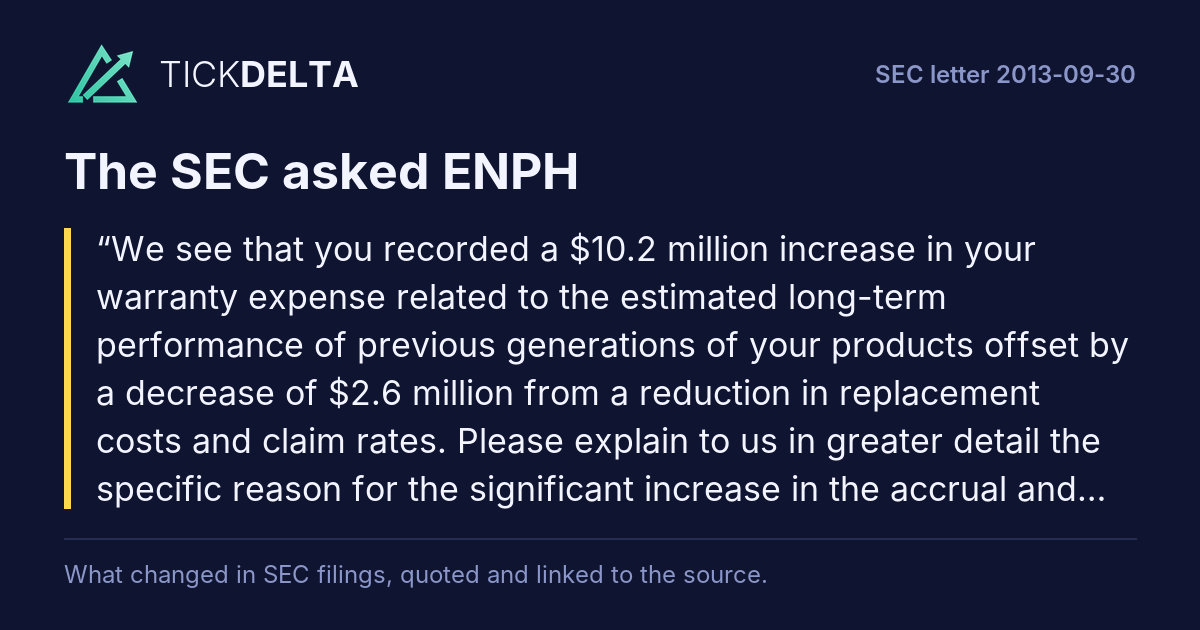
We see that you recorded a $10.2 million increase in your warranty expense related to the estimated long-term performance of previous generations of your products offset by a decrease of $2.6 million from a reduction in replacement costs and claim rates.
Rest of the question

Please explain to us in greater detail the specific reason for the significant increase in the accrual and the related assumptions underlying these changes to your accrual. Please also clarify the reason for your change to present warranty obligation on a gross basis. Discuss how you determined that your warranty accruals are sufficient to cover future warranty claims and clarify each of the factors you considered in your analysis. Include a discussion of the following:  Describe how you determined the change in the estimated long term performance of your previous generations of products including any changes in the estimated mean time between failures.  Discuss how you quantifiably determined the change in the replacement cost for these products.  Discuss how changes in replacement cost are described as a factor in both the increase and decrease in the accrual.  Describe how claims history is cited as a factor in reducing the accrual when your products have a warranty term of 15 or 25 years.  Discuss whether you still factor the “Entrust Program” into your accrual as described on page F-10 of amendment No. 10 to the Form S-1 filed March 28, 2012.

ENPH answered
Increase in Accrued Warranty Liability

The Company advises the Staff that the change in estimate of $7.6 million made during 2012 resulted from two factors: (1) a $10.2 million increase in warranty expense related to an increase in estimated failure rates for the Company’s second generation microinverter as well as charges to reflect additional estimated labor costs expected to be paid to third party installers resulting from the increased failures of its second generation product; and (2) a $2.6 million decrease in warranty expense related to decreased estimated replacement costs and
Rest of the answer

estimated claim rates.

During 2012, the Company experienced actual failures of its second generation product that exceeded the Company’s then current failure rate estimate. The Company analyzed field performance data collected during the year on its second generation product and performed diagnostic root cause failure analysis on those units actually returned by end users. As a result, the Company concluded that an increase in estimated failure rates for its second generation product was warranted. The Company also estimated that additional labor charges would be paid to third party installers who service end users’ installations. The

Company recorded an increase in warranty expense of approximately $10.2 million to reflect the combined impact of these two changes in estimates.

These charges were partially offset by a $2.6 million reduction in warranty expense during 2012 resulting from a decrease in the estimated per unit shipping cost for replacement units delivered to customers as well as a slight decrease in the number of warranty claims expected to be filed by customers during the warranty term. Prior to the third quarter of 2012, the Company’s business practice was to expedite shipment of all replacement units to customers to fulfill warranty claims. These shipping costs are included in the Company’s estimate of total per unit replacement cost. In order to save on these discretionary costs, beginning in the third quarter of 2012, the Company revised its business practice to utilize non-expedited shipping terms for future replacement units, resulting in a reduction in estimated future replacement costs. The revision to estimated claim rates was based on the Company’s observed historical end user behavior through the end of 2012. See response below for further discussion of the underlying key estimates and assumptions used by the Company to estimate warranty costs associated with its microinverter products.

The changes in estimates of $10.2 million and $2.6 million resulted from new information and subsequent developments, and accordingly, from better insight and improved judgment, consistent with ASC 250-10-20 which states:

“A change in accounting estimate is a necessary consequence of the assessment, in conjunction with the periodic presentation of financial statements, of the present status and expected future benefits and obligations associated with assets and liabilities. Changes in accounting estimates result from new information. Examples of items for which estimates are necessary are uncollectible receivables, inventory obsolescence, service lives and salvage values of depreciable assets, and warranty obligations.”

As described further below, on a quarterly basis, the Company uses the best and most complete underlying information available, following a consistent, systematic and rational methodology to determine the liability. The Company considers all available evidence to assess the reasonableness of all key assumptions underlying its estimated warranty obligations for each generation of microinverter. The changes in estimates recorded in 2012 arose from new information available to management and were not the result of mathematical mistakes, mistakes in the application of generally accepted accounting principles, or oversight or misuse of facts that existed at the time.

Evaluation of Factors Considered when Estimating Warranty Accruals

The Company’s warranty accrual provides for the replacement of microinverter units that fail during the product’s warranty term (15 years for first and second generation microinverters and up to 25 years for third and fourth generation microinverters). On a quarterly basis, the Company employs a consistent, systematic and rational methodology to assess the adequacy of its warranty liability. This assessment includes updating all key estimates and assumptions for each generation of product, based on historical results, trends and the most current data available as of the filing date. The key estimates and assumptions used in the warranty liability are thoroughly reviewed by management and the Audit Committee on a quarterly basis. The key estimates used by the Company to estimate its warranty liability are: (1) the number of units expected to fail over time (i.e. failure rate); (2) the number of failed units expected to result in warranty claims over time (i.e. claim rate); and (3) the per unit cost of replacement units (including outbound shipping and limited labor costs) expected to be incurred to replace failed units over time (i.e. replacement cost).

Estimated Failure Rates – The Company’s Quality and Reliability department has primary responsibility to determine the estimated failure rates for each generation of microinverter. To establish initial failure rate estimates for each generation of microinverter, the Company’s quality engineers use a combination of industry standard MTBF (Mean Time Between Failure) estimates for individual components contained in its microinverters, third party data collected on similar equipment deployed in outdoor environments similar to those in which the Company’s microinverters are installed, and rigorous long term reliability and accelerated life cycle testing which simulates the service life of the microinverter in a short period of time. As units are deployed into production environments, the Company continues to monitor product performance via its Enlighten monitoring platform. It typically takes three to nine months between the date of sale and date of end-user installation. Consequently, the Company’s ability to monitor actual failures of units sold similarly lags by three to nine months. When a microinverter fails and is returned, the Company performs diagnostic root cause failure analysis to understand and isolate the underlying mechanism(s) causing the failure. The Company then uses the results of this analysis (combined with the actual, cumulative performance data collected on those units prior to failure via Enlighten) to draw conclusions with respect to how or if the identified failure mechanism(s) will impact the remaining units deployed in the installed base. In 2012, the Company estimated that second generation units remaining in the installed base would fail at a higher rate than previously estimated, resulting in a charge to warranty expense.

Estimated Claim Rates — Warranty claim rate estimates are based upon assumptions with respect to expected customer behavior over the warranty period. As the vast majority of the Company’s microinverters have been sold to end users for residential applications, the Company believes that warranty claim rates will be affected by changes in residential home ownership because the Company expects that subsequent homeowners are less likely to file claims than the homeowners who originally purchase the microinverters as subsequent owners were not involved in the initial purchase, are unaware of the home’s historical energy costs, and would be required to establish a relationship with a system installer to diagnose or replace failed or low-producing units. Another factor affecting estimated claim rates is the end user’s access to system performance data (at the microinverter level) that is available when using the Company’s web-based monitoring service, Enlighten. Both of these factors have been considered and included in the Company’s claim rate estimates.

In the fourth quarter of 2012, the Company revised its claim rate estimate to reflect a decrease in the percentage of end users who are able to access their system’s performance data using the Enlighten monitoring service. Approximately 80-90 percent of end users have purchased systems that include Enlighten. End users who have not purchased Enlighten do not have access to the same inverter-level performance data as end users using Enlighten and, consequently are less likely to know if or when an individual microinverter has failed. In 2012, based on observation of historical results, the Company confirmed that non-Enlighten end users had a lower claim rate than originally estimated. As a result, the Company reduced the estimated claim rate in 2012 to reflect this information.

Estimated Replacement Cost – Three factors are considered in the Company’s analysis of estimated replacement cost:

(1) the estimated cost of replacement microinverters; (2) the estimated cost to ship replacement microinverters to end users; and (3) the estimated labor reimbursement expected to be paid to third party installers performing replacement services for the end user. Because the Company’s warranty provides for the replacement of defective microinverters over long periods of time (between 15 and 25 years, depending on the generation of product purchased), the estimated per unit cost of current and future product generations is considered in the estimated replacement cost. Estimated costs to ship replacement units are based on observable, market-based shipping costs paid by the Company to third party freight carriers. While the Company’s warranty does not explicitly provide for the reimbursement of labor incurred to replace failed microinverters, the Company has a separate program that allows third-party installers to claim fixed-dollar reimbursements for labor costs they incur to replace failed microinverter units for a limited time from the date of original installation. Included in the Company’s estimated replacement cost is an analysis of the number of fixed-dollar labor reimbursements expected to be claimed by third party installers over the limited offering period.

As noted in the Company’s 10-K,

Note 5. Warranty Obligations, page 52, changes in estimated replacement costs contributed to both an increase and a decrease in warranty expense during 2012. As discussed above, the decrease in estimated replacement cost resulted from the Company no longer shipping replacement units to end users on an expedited basis. The increase in estimated replacement cost noted in the Company’s disclosure resulted from additional labor reimbursements expected to be paid to third party installers related to the performance of its second generation microinverter.

Entrust Program – As described on page F-10 of amendment

No. 10 to the Company’s Form S-1 filed March 28, 2012, historical disbursements for lost energy under the Company’s Entrust program had been insignificant. As a result, estimated disbursements under this program were not included in the Company’s estimated warranty accrual. To date, disbursements under this program continue to be insignificant and are expected to be insignificant in future periods. Accordingly, estimated disbursements under this program are not factored into the Company’s estimated warranty accrual.

Change in Presentation

The Company’s warranty accrual includes the estimated cost of replacement units. Prior to the fourth quarter of 2012, warranty obligations were shown net of any related inventory write-downs if the related warranty replacement units had an inventory net book value less than cost. As a result, when the Company recorded inventory write-downs for units that may be used for warranty replacement, the Company recorded a corresponding decrease to the warranty obligations for such units, so as to not expense such amounts twice. Since warranty obligations and inventory are two separate units of accounting with no rights of offset, the Company determined that the appropriate presentation for warranty obligations should be on a gross basis and, therefore, revised its accounting presentation for units held for warranty replacement by recording an asset for the carrying value of those units and an equivalent increase to warranty liability.

The revision in balance sheet presentation resulted in an immaterial increase to other assets and warranty obligations of $1.6 million. The revision had no impact on cost of sales, gross profit, net loss, accumulated deficit or cash used in operating activities for the current or any previously reported periods.

Read in the reply
In its next report

First report after the company's reply of Oct 15, 2013: 10-Q filed Nov 12, 2013 ↗, against the 10-Q filed Aug 7, 2013 ↗.

Tickdelta does not hold the text of both reports, so they are not compared here.

Note 11. Stock-Based Compensation, page 57
SEC asked (2)
We note that you disclose weighted averages for the assumptions underlying your Black- Scholes option pricing models on page 60. However, please tell us and revise future annual filings to provide a description of the significant assumptions used during the year to estimate the fair value of share-based compensation awards consistent with FASB ASC 718-10-50-2(f)(2).
ENPH answered
In future annual filings, the

Company will provide a description of the significant assumptions to estimate the fair value of share-based compensation awards consistent with FASB ASC 718-10-50-2(f)(2) as follows:

The fair value of option awards is estimated on the date of the grant using the Black-Scholes option pricing model with the following weighted-average assumptions:

Expected term – The expected term of the option awards represents the period of time between the grant date of the option awards and the date the option awards are either exercised, converted or cancelled, including an
Rest of the answer

estimate for those option awards still outstanding.

Expected volatility – The Company uses the simplified method, as permitted by the SEC for companies with a limited history of stock option exercise activity, to determine the expected term for its option grants. Expected stock price volatility is determined based on an average of the historical volatilities of the common stock of several companies with characteristics similar to those of the Company.

Risk-free interest rate – The risk-free interest rate is based on the U.S. Treasury yield curve in effect at the time of grant and with a maturity that approximates our expected term.

Dividend yield – The dividend yield is based on our dividend history and the anticipated dividend payout over our expected term.

Read in the reply
In its next report

First report after the company's reply of Oct 15, 2013: 10-Q filed Nov 12, 2013 ↗, against the 10-Q filed Aug 7, 2013 ↗.

Tickdelta does not hold the text of both reports, so they are not compared here.

Note 3. Warranty Obligations, page 8
SEC asked (3)
We reference the discussion in Note 3 of the significant increase in warranty expense resulting from changes in estimates arising from increased failure rates related to previous generation products. Please explain to us in greater detail the reason for the increased failure rates and how this was considered in your estimates of future warranty obligations.
Rest of the question

Please also clarify whether there were any changes made to your products related to the increased failure rates.

ENPH answered
As discussed in the Response to Comment 1 above, on a quarterly basis, the Company performs an extensive analysis of estimated future warranty obligations for each generation of microinverter, following a consistent, systematic and rational methodology. The Company analyzes key warranty estimates and assumptions considering historical results, trends and the most current data available.

During the second quarter of 2013, the Company experienced actual failures of its second generation microinverters that exceeded its then current failure rate estimate.
Rest of the answer

In addition, the Company performed diagnostic root cause failure analysis and reviewed field performance data for its second generation microinverters. As a result of such analyses, and based upon consistent methodologies and the process described in Response to Comment 1 above, the Company concluded it was necessary to increase the estimated failure rates for such second generation microinverters and recorded additional warranty expense in the second quarter of 2013. The changes in estimates in the second quarter of 2013 resulted from new information and subsequent developments, and accordingly, from better insight and improved judgment.

The Company advises the Staff that based on the results of the Company’s diagnostic root cause failure analysis, certain manufacturing and design modifications were made to its second generation microinverter in 2013 to correct identified failure mechanisms. As the Company no longer sells its second generation microinverter, all new second generation units produced are used to replace failed second generation units. The Company also performed an analysis on its third and fourth generation products to verify that the failure mechanisms identified in its second generation product were not present in its third or fourth generation products. Accordingly, no changes in failure rate assumptions were made with respect to the third or fourth generation products.

***

The Company further acknowledges that:

the Company is responsible for the adequacy and accuracy of the disclosure in the filing;

Staff comments or changes to disclosure in response to Staff comments do not foreclose the SEC from taking any action with respect to the filing; and the Company may not assert Staff comments as a defense in any proceeding initiated by the SEC or any person under the federal securities laws of the United States.

Read in the reply
In its next report

First report after the company's reply of Oct 15, 2013: 10-Q filed Nov 12, 2013 ↗, against the 10-Q filed Aug 7, 2013 ↗.

Tickdelta does not hold the text of both reports, so they are not compared here.

Note 5. Warranty Obligations, page 52
SEC asked
We note your response to prior comments 1 and 3. We remind you of the requirement in Item 303 of Regulation S-K to discuss any known trends or uncertainties that you may reasonably expect to have a material favorable or unfavorable impact on your income from operations, liquidity and capital resources.
Rest of the question

In this regard, please revise your MD&A in future filings, including interim periods, to more thoroughly discuss the risks and uncertainties associated with the assumptions and assessment of your warranty accrual. In particular, when material changes to assumptions or accruals are made, specific factors such as field performance data, failure rates and other changes to assumptions should be separately described and discussed. Please revise future filings to provide disclosure similar to the second and third paragraph of your response to comment 1 and the last two paragraphs of your response to comment 3. Please provide us with a copy of your proposed revised disclosure which more fully discusses the changes to your warranty accrual.

ENPH answered
In response to the

Staff’s comment, the Company will revise future filings to provide additional disclosures that more fully discusses the changes to its warranty accrual.

United States Securities and Exchange Commission

In the Form 10-Q for the quarterly period ended

September 30, 2013, the Company proposes to provide the following disclosures in the Cost of Revenues and Gross Profit section of MD&A and also in the notes to the condensed consolidated financial statements:

MANAGEMENT’S DISCUSSION AND ANALYSIS

Results of

Operations for the Three and Nine Months Ended September 30, 2013
Rest of the answer

and 2012

Cost of Revenues and Gross

Profit

Three Months Ended

September 30,

Change in

Nine Months Ended

2013

2012

$

%

(dollars in thousands)

Cost of revenues

44,611

44,489

122

—

119,870

119,878

(8

)

Gross profit

17,435

16,324

1,111

45,920

39,232

6,688

Gross margin

Three Months Ended September 30, 2013 and 2012

Cost of revenues for the three months ended September 30, 2013 were flat, as compared to the same period last year, while net revenues increased by 2%. The increase in gross margin was due to a larger mix of sales from microinverter accessories. Cost of revenues in the three months ended September 30, 2013 included warranty expense of $3.8 million resulting from net changes in estimates, which reduced gross margin by 6 percentage points. During the third quarter of 2013, we experienced actual failures of our second generation microinverters that exceeded our then current failure rate estimate. Based on an analysis of field performance data and diagnostic root-cause failure analysis performed on returned units, we concluded that it was necessary to increase the estimated failure rates for our second generation product and recorded additional warranty expense of

$7.3 million. In addition, we recorded a reduction to warranty expense of $3.1 million related to a decrease in the expected failure rate of our third generation product and of $0.4 million from lower estimated replacement costs. During the third quarter of 2013, we concluded that there was sufficient historical data of actual field performance of previously sold third generation products to support a lower estimated failure rate.

Cost of revenues in the same period last year included warranty expense of $2.9 million resulting from net changes in estimates, which reduced gross margin by 5 percentage points. During the third quarter of 2012, we experienced actual failures of our second generation microinverters that exceeded our then current failure rate estimate. Based on an analysis of field performance data and diagnostic root-cause failure analysis performed on returned units, we concluded that it was necessary to increase the estimated failure rates for our second generation product and recorded additional warranty expense of $4.8 million. In addition, we recorded a reduction to warranty expense of $1.9 million resulting from a decrease in the estimated per unit shipping cost for replacement units delivered to customers. Prior to the third quarter of 2012, our business practice was to expedite shipment of all replacement units to customers to fulfill warranty claims. These shipping costs are included in our estimate of total per unit replacement cost. Beginning in the third quarter of 2012, we revised our business practice to utilize non-expedited shipping terms for future replacement units, resulting in a reduction in estimated future replacement costs.

Nine Months

Ended September 30, 2013 and 2012

Cost of revenues for the nine months ended September 30, 2013 were flat, as compared to the same period last year, while net revenues increased by a 4%. The increase in gross margin was due to a larger mix of sales from microinverter accessories. Cost of revenues in the nine months ended September 30, 2013 included warranty expense of $8.5 million resulting from net changes in estimates, which reduced gross margin by 5 percentage points. This net increase was comprised of an increase in warranty expense of $15.9 million for our second generation product resulting from actual failures exceeding our then current failure rate estimate, and supported by the our analysis of field performance data and diagnostic root-cause failure analysis performed on returned units. In addition, we recorded a reduction to warranty expense of $3.1 million related to a decrease in the expected failure rate for our third generation product (see discussion above). Further decreases to warranty expense from changes to estimated failure rates was a reduction of $4.2 million in warranty expense related to a decrease in estimated claim rates for all product generations. The revision to estimated claim rates was based on our observed historical end user behavior and assumptions with respect to expected customer behavior over the warranty term

(15 years for first and second generation products, up to 25 years for third and fourth generation products). The remaining $0.1 million decrease was due to lower estimated replacement costs.

Cost of revenues in the same period last year included warranty expense of $2.5 million resulting from net changes in estimates, which reduced gross margin by 2 percentage points. Such amounts were primarily related to our second generation microinverter, as noted above in the three months ended September 30, 2012 discussion.

Based on the results of the our diagnostic root cause failure analysis, certain manufacturing and design modifications were made to our second generation microinverter in 2013 to correct identified failure mechanisms. As we have not sold our second generation microinverters since mid-2011, all new second generation units produced are used to replace failed second generation units. We also performed an analysis on our third and fourth generation products and determined that the failure mechanisms identified in our second generation product were not present in our third or fourth generation products.

If actual failure rates, claim rates or replacement costs differ from our estimates in future periods, changes to these estimates would be required, resulting in increases or decreases to our warranty expense. Such increases or decreases could be material.

NOTE 3 –

WARRANTY OBLIGATIONS

The Company’s warranty activities during the three and nine months ended September 30, 2013 and 2012 were as follows (in thousands):

Balance, at beginning of period

26,777

11,412

21,338

8,738

Accruals for warranties issued during the period

1,392

2,515

4,802

6,571

Changes in estimates

3,823

2,896

8,537

2,539

Settlements

(2,626

(1,330

(5,311

(2,355

Balance, at end of period

29,366

15,493

Current portion included in accrued liabilities

8,434

3,589

Long-term portion

20,932

11,904

Included within warranty expense in the three and nine months ended September 30, 2013 were net changes in estimates of $3.8 million and $8.5 million, respectively. During the three and nine months ended September 30, 2013, the Company experienced actual failures of its second generation microinverters that exceeded its then current failure rate estimate. Based on continuing analysis of field performance data and diagnostic root-cause failure analysis performed on returned units, the Company concluded that it was necessary to increase the estimated failure rates for its second generation product and recorded additional warranty expense of $7.3 million and $15.9 million for the three and nine months ended September 30, 2013, respectively. In addition, the Company recorded a reduction to warranty expense of $3.1 million for the three and nine months ended September 30, 2013 related to a decrease in the expected failure rate of the Company’s third generation product. During the third quarter of 2013, the Company concluded that there was sufficient historical data of actual field performance of previously sold third generation products to support a lower estimated failure rate. Further decreases to warranty expense were $0.4 million and $0.1 million of net decreases in estimated replacement costs for the three and nine months ended September 30, 2013, respectively. In addition, for the nine months ended September 30, 2013, the Company updated its estimated claim rates for all product generations resulting in a decrease to warranty expense of $4.2 million. The revision to estimated claim rates was based on the Company’s observed historical end user behavior and assumptions with respect to expected customer behavior over the warranty term (15 years for first and second generation products, up to 25 years for third and fourth generation products).

Included within warranty expense in the three and nine months ended September 30, 2012 were net changes in estimates of $2.9 million and $2.5 million, respectively. During the three and nine months ended September 30, 2012, the Company experienced actual failures of its second generation microinverters that exceeded its then current failure rate estimate. Based on continuing analysis of field performance data and diagnostic root-cause failure analysis performed on returned units, the Company concluded that it was necessary to increase the estimated failure rates for its second generation product and recorded additional warranty expense of $4.8 million and $4.4 million for the three and nine months ended September 30, 2012, respectively. In addition, the Company recorded a reduction to warranty expense of $1.9 million for the three and nine months ended September 30, 2012. During the third quarter of 2012, the Company updated the estimated per unit shipping cost for replacement units delivered to customers and reduced warranty expense to reflect a revision in its business practice. Prior to the third quarter of 2012, the Company’s business practice was to expedite shipment of all replacement units to customers to fulfill warranty claims. These shipping costs are included in the

Company’s estimate of total per unit replacement cost. Beginning in the third quarter of 2012, the Company revised its business practice to utilize non-expedited shipping terms for future replacement units, resulting in the reduction in estimated future replacement costs.

If actual failure rates, claim rates or replacement costs differ from the Company’s estimates in future periods, changes to these estimates would be required, resulting in increases or decreases to the Company’s warranty obligations. Such increases or decreases could be material.

***

The Company intends to file its Quarterly Report on Form 10-Q for the period ended September 30, 2013 on November 12, 2013, which is its Form 10-Q filing deadline. Due to the Edgarization process, the Company must submit a final version of its Form 10-Q for processing on November 8, 2013. Accordingly, the Company respectfully requests an expedited review of this submission.

The Company further acknowledges that:

• the Company is responsible for the adequacy and accuracy of the disclosure in the filing;

Staff comments or changes to disclosure in response to Staff comments do not foreclose the SEC from taking any action with respect to the filing; and the Company may not assert Staff comments as a defense in any proceeding initiated by the SEC or any person under the federal securities laws of the United States.

Read in the reply
In its next report

First report after the company's reply of Nov 1, 2013: 10-Q filed Nov 12, 2013 ↗, against the 10-Q filed Aug 7, 2013 ↗.

Tickdelta does not hold the text of both reports, so they are not compared here.

Also in this review: closing letter, 2013-11-05

Letters without questions

Other letters

UPLOAD and CORRESP
16 other letters: notices that a filing will not be reviewed, requests to declare a registration effective, and the like

From the SEC's correspondence on EDGAR: staff letters (form UPLOAD) and company letters (form CORRESP), 24 letters filed since 2012-03-29. Questions and answers are matched by their numbers; topics come from words in each question. The reports are compared word for word (same form, before the first SEC letter against the first report after the company's reply). No AI.

Sources

The SEC's correspondence on EDGAR: staff letters (form UPLOAD) and company letters (form CORRESP), matched question by question. No AI.

Also

Filings: the letters in the filing list.

Work with it

Excel workbook · CSV. Google Sheet that stays up to date: paste =IMPORTDATA("https://tickdelta.com/company/ENPH/export.csv") into a cell.

Next in Owners and insiders:Insider trades
Esc

Type a ticker such as AAPL, a name, an investor such as Buffett, or a topic such as tariffs. ↑ ↓ to move, Enter to open.