and Other (“ASC 350”). As described in our 2012 Annual Report on Form
Communications reporting unit was estimated using a combination of appropriately weighted income and market approaches.
Rest of the answer
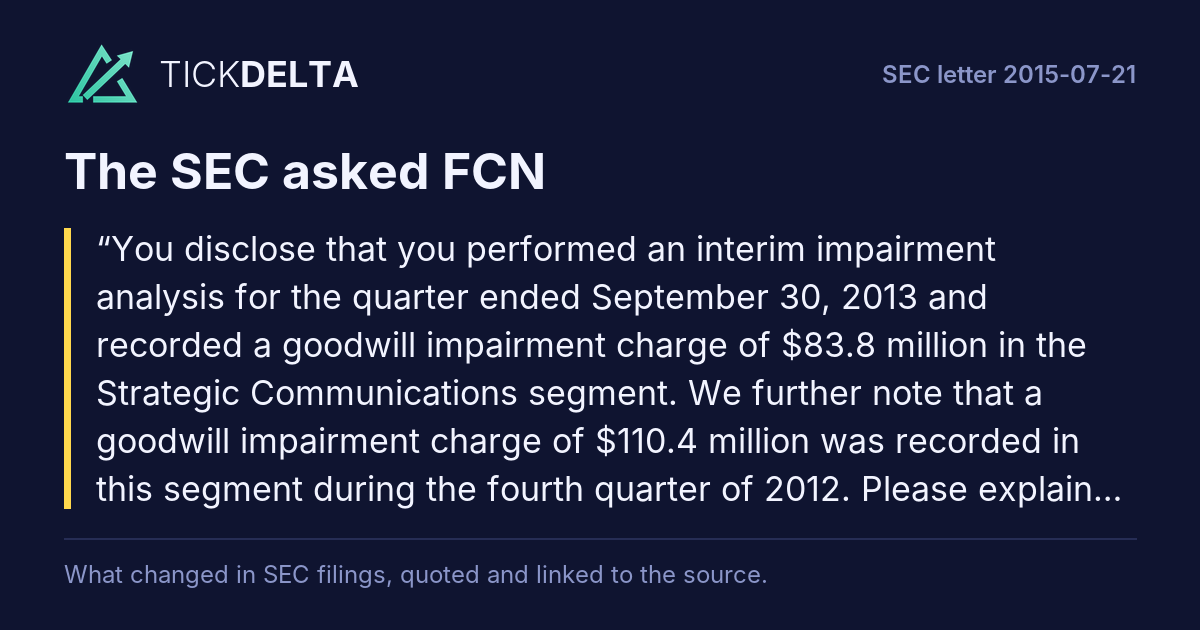
The cash flows employed in the income approach were based on our most recent budget, forecast and business plan, as well as various growth rate assumptions for years beyond the current business plan period, discounted using an estimated Weighted Average Cost of Capital (“WACC”). Our discount rate assumptions were based on an assessment of the risk inherent in the future revenue streams and cash flows and our WACC. The risk adjusted discount rate used represented the estimated WACC for our Strategic Communications reporting unit. As described in our 2012 Annual Report on Form 10-K, the WACC for our reporting units was comprised of (1) a risk free rate of return, (2) an equity risk premium that is based on the rate of return on equity of publicly traded companies with business characteristics comparable to our reporting units, (3) the current after-tax market rate of return on debt of companies with business characteristics similar to our reporting units, each weighted by the relative market value percentages of our equity and debt, and (4) an appropriate size premium. Given the more limited comparability of both the comparable companies and guideline transactions identified, substantial weighting was placed on the income approach. Accordingly, in connection with our 2012 annual goodwill impairment test, we recorded a goodwill impairment charge for the Strategic Communications reporting unit of $110.4 million. We recognized that significant reductions in financial projections for subsequent periods would result in further impairment charges for the Strategic Communications reporting unit and included the following disclosure in the Critical Accounting Policies section of Item 7. Management’s Discussion and Analysis of
Financial Condition and Results of Operations of our annual report on Form 10-K for the year ended December 31, 2012 regarding that possibility:
“There can be no assurance that the estimates and assumptions used in our goodwill impairment testing will prove to be accurate predictions of the future. If our assumptions regarding forecasted cash flows are not achieved or market conditions significantly deteriorate, we may be required to record goodwill impairment charges in future periods, whether in connection with our next annual impairment test or prior to that, if a triggering event occurs outside of the quarter during which the annual goodwill impairment test is performed. It is not possible at this time to determine if any future impairment charge would result or, if it does, whether such charge would be material.”
In addition to performing our annual goodwill impairment test, our accounting policy includes testing goodwill on an interim basis whenever events or changes in circumstances indicate that the carrying value of an asset may not be recoverable. Factors we consider important that could trigger an interim impairment review include, but are not limited to, the following:
• significant underperformance relative to expected historical or projected future operating results;
a significant change in the manner of our use of the acquired asset or the strategy for our overall business;
a significant market decline related to negative industry or economic trends;
a sustained decrease in share price (in both absolute terms and relative to peers), if applicable;
downward revisions to forecasts;
restructuring actions or plans;
industry trends; and/or our market capitalization relative to net carrying value.
For periods following the date of our 2012 annual goodwill impairment test, we considered whether events or circumstances indicated that it was more-likely-than-not that the fair value of our Strategic Communications reporting unit was less than its carrying amount as follows:
Three months ended March 31, 2013
For the three months ended March 31, 2013, we considered the existence of the factors that could trigger an interim impairment review in accordance with our accounting policy as described above. We specifically considered the Strategic Communications reporting unit’s current and expected future financial performance, which continued to support the financial projections utilized in the 2012 annual goodwill impairment test. Based on our analysis of the factors listed above, we concluded that no “triggering events” had occurred that indicated that it was more-likely-than-not that the fair value of our Strategic
Communications reporting unit was less than its carrying amount as of March 31, 2013.
Three and six-months ended June 30, 2013
For the three and six-months ended June 30, 2013, we considered the existence of the factors that could trigger an interim impairment review in accordance with our accounting policy as described above. Based on these considerations, we concluded that no “triggering events” had occurred that indicated that it was more-likely-than-not that the fair value of our
Strategic Communications reporting unit was less than its carrying amount as of June 30, 2013, and as such, no interim impairment test was performed. While no impairment test was performed, we observed that the financial results for the
Strategic Communications reporting unit for the three and six-months ended June 30, 2013 were negatively impacted by then-current market conditions that were not anticipated to continue into the longer term, given the factors known at that time. However, given the fact that the carrying value of the Strategic Communications reporting unit had been adjusted to fair value as of October 1, 2012 and that fair value was weighted heavily on future financial projections under the income approach, in our judgement, given the short term downturn in financial performance, we concluded that it was appropriate to disclose to investors that there were continued risks to future goodwill impairment. We included the following disclosure in the Critical Accounting Policy section of Item 2. Management’s Discussion and Analysis of Financial Condition and Results of Operations on page 41 of our Quarterly Report on Form 10-Q for the three and six-months ended June 30, 2013:
“Goodwill and Other Intangible Assets
On a quarterly basis, we monitor the key drivers of fair value to detect events or other changes that would warrant an interim impairment test of our goodwill and intangible assets. Factors we consider important that could trigger an interim impairment review include, but are not limited to, the following: significant underperformance relative to historical or projected future operating results; a significant change in the manner of our use of the acquired asset or strategy for our overall business; a significant negative industry or economic trend; and our market capitalization relative to net book value. Through our assessment, we determined that there were no events or circumstances that more likely than not would reduce the fair value of any of our reporting units below their carrying value. Accordingly, we did not perform an interim impairment test in either of the quarters in the six-months ended June 30,
2013.
During the fourth quarter of 2012, we performed our goodwill impairment test and determined the carrying values of the goodwill associated with the Strategic Communications reporting unit exceeded its implied fair value, resulting in a $110.4 million non-deductible goodwill impairment charge. The Strategic Communications reporting unit has a goodwill balance of $221.5 million at June 30, 2013. If our long term future growth rates and associated cash flows were to decline from current estimates, the Company could potentially experience future impairment charges.
There can be no assurance that the estimates and assumptions used in our goodwill impairment testing will prove to be accurate predictions of the future. Our next evaluation of goodwill by reporting unit will be performed during the three months ended December 31, 2013. If our assumptions regarding forecasted cash flows are not achieved, we may be required to perform the two-step quantitative goodwill impairment analysis. In addition, if the aforementioned factors have the effect of changing one of the critical assumptions or estimates we use to calculate the value of our goodwill or intangible assets, we may be required to record goodwill and/or intangible asset impairment charges in future periods, whether in connection with our next annual impairment test or if a triggering event occurs outside of the quarter during which the annual goodwill impairment test is performed. It is not possible at this time to determine if any future impairment charge would result or, if it does, whether such charge would be material.”
Three and nine-months ended September 30, 2013
For the three and nine-months ended September 30, 2013, we considered the existence of the factors that could trigger an interim impairment review in accordance with our accounting policy as described above. We disclosed a summary of those factors, described in Footnote 9 to the condensed consolidated financial statements, the executive highlights section and segment results section of Item 2. Management’s Discussion and Analysis of Financial Condition and Results of Operations of our Quarterly Report on Form 10-Q for the three and nine-months ended September 30, 2013, and the critical accounting policy section and segment results section of Item 7. Management’s Discussion and Analysis of Financial Condition and Results of Operations and Footnote 12 to the consolidated financial statements in our Annual Reports on Form 10-K for the years ended December 31, 2014, as follows:
“During the third quarter of 2013, in addition to reduced levels of mergers and acquisitions activity, our Strategic Communications segment has continued to experience pricing pressure for certain discretionary communications services, including initial public offering support services where there is volume but also increasing competition. This has compressed segment margins and contributed to a change in the Company’s near-term outlook for this segment.”
As these macro changes unfolded, our performance in the third quarter of 2013 was adversely impacted and our expectations regarding future periods changed. We lost certain large retained relationships as a result of client pull back in discretionary spending and we experienced delays in obtaining expected project work. In addition, industry related concerns in certain markets outside of the United States, as well as the departures of certain professionals in certain key markets, impacted not only the then-current financial performance and near-term outlook, but also the mid-term outlook for the Strategic Communications reporting unit.
We concluded that these factors represented “triggering events” that indicated that it was more-likely-than-not that the fair value of our Strategic Communications reporting unit was less than its carrying amount as of September 30, 2013.
Accordingly, we performed Step 1 and ultimately Step 2 of the goodwill impairment test based on revised projections that reflected more modest growth over the medium-term as informed by developments during the three-months ended September 30, 2013 in the reporting unit’s business and the market place. As a result of this testing, we recorded a goodwill impairment charge of $83.8 million in the three months ended September 30, 2013.