Form 10-K for the Fiscal Year Ended December 31, 2017
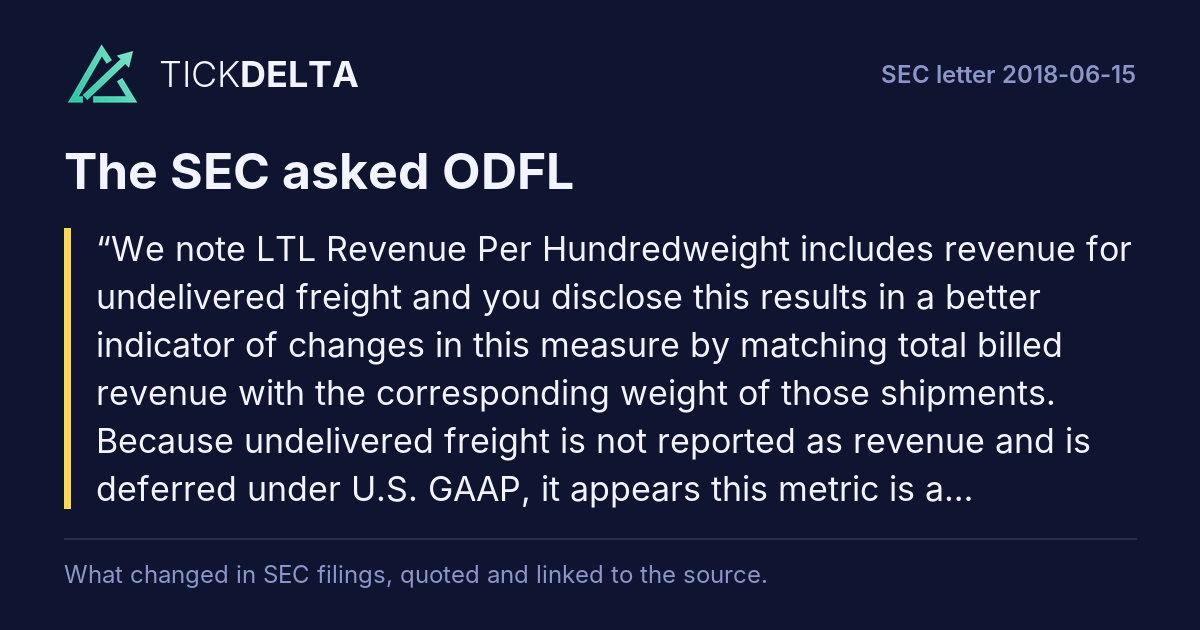
We note LTL Revenue Per Hundredweight includes revenue for undelivered freight and you disclose this results in a better indicator of changes in this measure by matching total billed revenue with the corresponding weight of those shipments. Because undelivered freight is not reported as revenue and is deferred under U.S. GAAP, it appears this metric is a non-GAAP measure.Rest of the question
Please revise your future filings to comply with the disclosure requirements of Item 10(e) of Regulation S-K. If any other key financial and operating metrics or discussion of LTL revenue in your operating results discussion on pages 22 and 23 include revenue for undelivered freight, your disclosure should also be revised similarly. In your response, please provide us your proposed revisions to your current disclosures.
1: Item 10(e)(4) of Regulation S-K and Rule 101(g) of Regulation G exclude certain types of metrics from the definition of non-GAAP financial measures, including operating and other statistical measures. We believe that each of our LTL revenue per hundredweight, LTL revenue per shipment, and LTL revenue per intercity mile metrics disclosed on pages 22 and 23 of our Form 10-K are operating statistics that qualify for this exclusion. Our LTL transportation services are generally priced based on weight, commodity and distance.Read in the reply ↗Rest of the answer
These operating statistics provide a measurement of yield on the shipments we handle and are commonly used in the LTL industry to evaluate pricing trends. These metrics have consistently included revenue for undelivered freight, as we believe this inclusion results in a more accurate representation of the underlying changes in our yields when the total amount of billed revenue is matched with the corresponding weight of the relevant shipment. We further believe that the operating statistics described above are excluded from the definition of non-GAAP financial measures because our calculation of LTL revenue represents billed revenue rather than an adjustment to GAAP revenue, i.e., it represents a factual number designed to indicate the price of services per pound or shipment sold during a particular period. For these reasons, we respectfully submit to the Staff that we do not believe any additional disclosures are required under Item 10(e) of Regulation S-K with respect to these operating statistics.
First report after the company's reply of 2018-06-28: 10-Q filed 2018-08-07 ↗, against the 10-Q filed 2018-05-07 ↗.
Tickdelta does not hold the text of both reports, so they are not compared here.
Please revise your future filings to disclose the following for each of your market risks: (i) the quantitative information for the preceding fiscal year with a discussion of the reasons for material quantitative change; and (ii) a description of model, assumptions and parameters used to define potentialgains/(losses).Rest of the question
Refer to Item 305(a)(3) and paragraph 3(F) of the Instructions to 305(a)(1)(ii) of Regulation S-K, respectively.
2: With respect to the Staff’s comment 2(i), we respectfully advise the Staff that we will include the quantitative information for the preceding fiscal year required by Item 305(a)(3) of Regulation S-K in future filings along with a discussion of the reasons for material quantitative changes, if any.
With respect to the Staff’s comment 2(ii), we note that Item 305(a)(ii)(B) of Regulation S-K requires a description of the model, assumptions, and parameters, which are necessary to understand the disclosures required under Item 305(a)(ii)(A) of Regulation S-K.Read in the reply ↗Rest of the answer
To the extent necessary to understand the disclosures we provide in future filings, we will provide a further description of the model, assumptions and parameters used to define potential gains/(losses). However, we believe our current disclosures provide the information necessary to understand such disclosures. In this regard, we disclose that our sensitivity analysis with respect to our (i) interest rate risk is based on a hypothetical 100 basis point increase in the average interest rate of our credit agreement, (ii) market risk for equity investments is based on a hypothetical 10% change in market value of those investments, and (iii) market risk for awards previously granted under certain of our stock plans is based on a hypothetical 10% change in the price of our common stock as of a certain date.
First report after the company's reply of 2018-06-28: 10-Q filed 2018-08-07 ↗, against the 10-Q filed 2018-05-07 ↗.
Tickdelta does not hold the text of both reports, so they are not compared here.
We note that your Credit Agreement contains a provision, which limits your ability to pay dividends. Please tell us your consideration to disclose the amount of retained earnings or net income that is restricted or free of restrictions for the payment of dividends pursuant to Rule 4-08(e)(1) of Regulation S-X.
3: Rule 4-08(e)(1) of Regulation S-X requires a description of the most significant restrictions on the payment of dividends, including the amount of retained earnings or net income restricted or free of restrictions. As disclosed in Note 2 to our Financial Statements included in our Form 10-K, our credit agreement contains a covenant that limits our ability to pay dividends, unless no defaults or events of default under the credit agreement are ongoing (or would be caused by such a restricted payment).Read in the reply ↗Rest of the answer
However, our credit agreement allows for the payment of dividends in the absence of defaults or events of default, provided such payment is duly authorized by all necessary corporate action and is permitted by applicable law. There was no existing default or event of default under the credit agreement at December 31, 2017. Further, in Item 7 - Liquidity and Capital Resources, we disclose our compliance with all covenants and note that we do not anticipate a significant decline in business levels or financial performance that would cause us to violate any such covenants in the future. As a result, our retained earnings and net income were deemed free of restrictions; therefore, we do not view the restriction under our credit agreement as a significant restriction. Accordingly, we respectfully advise the Staff that we do not believe additional disclosure is required under Rule 4-08(e)(1) of Regulation S-X.
First report after the company's reply of 2018-06-28: 10-Q filed 2018-08-07 ↗, against the 10-Q filed 2018-05-07 ↗.
Tickdelta does not hold the text of both reports, so they are not compared here.
Revise your future filings to disaggregate revenue as required by paragraph ASC 606-1050-5 or explain to us why you do not need to provide this information. Implementation guidance is provided at ASC 606-10-55-89 through 55-91.
4: We generate revenue by providing transportation services and/or solutions to our customers through one operating segment and one management team. Our customer base is diverse, with our largest customer representing less than 4% of our revenue, and essentially all of our revenue from operations is domestic. Our LTL services are short-term in nature, as we generally deliver our customers' freight within one-to-five days after picking it up. In addition to our core LTL services, we offer container drayage, truckload brokerage, supply chain consulting and warehousing services.Read in the reply ↗Rest of the answer
While the nature and timing of revenue for these non-LTL services can vary, the combined revenue represents less than 2% of our revenue from operations and is considered insignificant. All of our assets and infrastructure are located throughout the United States.
ASC 606-10-50-5 requires the disaggregation of revenue recognized from contracts with customers into categories that depict how the nature, amount, timing, and uncertainty of revenue and cash flows are affected by economic factors. In accordance with ASC 606-10-50-5 and the guidance in ASC 606-10-55-89 through 55-91, we elected to disaggregate our revenue from operations within our one segment by type of service in "Note 1. Significant Accounting Policies" of our quarterly and annual filings. We believe the disclosure of revenue from "LTL services" and "Other services" (i.e., non-LTL services) provides the most useful information to users of our financial statements based on categories that are meaningful to our business. These categories are representative of the way in which we have presented information outside of the financial statements and in past press releases. In addition, the category of "LTL services" is the primary way that both investors and our Chief Operating Decision Maker view the business. Based on these factors, we believe our current disaggregated revenue disclosure is appropriate and provides the most useful information to users of our financial statements based on categories that are meaningful to our business.
First report after the company's reply of 2018-06-28: 10-Q filed 2018-08-07 ↗, against the 10-Q filed 2018-05-07 ↗.
Tickdelta does not hold the text of both reports, so they are not compared here.
We note from your disclosure on page 11 (Revenue) that fuel surcharges increased to 12.8% of total revenue in the first quarter of 2018, and you regularly monitor the components of your pricing, including fuel surcharges.Rest of the question
Please tell us if fuel surcharge revenues represent variable consideration under ASC 606 and, if so, tell us and revise your future filings to disclose how you estimate variable consideration amounts, including how you assess the constraint (if applicable) and how you allocate this variable consideration to the performance obligations. Refer to ASC 606-10-32-2 and ASC 60610-50-20 for disclosure guidance.
5: ASC 606-10-32-2 requires that we consider the terms of contracts and our customary business practices to determine transaction prices. In the case for our services, each shipment that we handle is a separate performance obligation represented by an individual bill of lading, which is the basis for determining the charges that are fixed at time of pick-up and billed to the customer. There are many components included in our overall charge for each freight bill, including the fuel surcharge. The fuel surcharge is generally indexed to the U.S.Read in the reply ↗Rest of the answer
Department of Energy published diesel fuel prices that reset each week. It is a fixed rate that is applied at the date of pickup and does not vary between the time of pickup and delivery. The fuel surcharge rate is not variable over the course of the delivery. The fuel surcharge as a percentage of revenue disclosed in our Form 10-Q is the actual amount and is not based on an estimate. Based on these considerations, we respectfully advise the Staff that the fuel surcharge does not represent variable consideration under ASC 606.
First report after the company's reply of 2018-06-28: 10-Q filed 2018-08-07 ↗, against the 10-Q filed 2018-05-07 ↗.
Tickdelta does not hold the text of both reports, so they are not compared here.
We note from page 2 of your 2017 Form 10-K (Competition) that you provide transportation services to third-party logistics providers that determine both the mode of transportation and the carrier. Please tell us the nature of these arrangements in further detail and explain to us whether you are the principal or agent pursuant to ASC 606-1055-36 through 55-39.Rest of the question
Further, to the extent these arrangements are material, disclose whether you present revenues earned from third-party logistics providers on a gross or net basis pursuant to ASC 606-10-50-12(c).
6: As noted in our Form 10-K, we occasionally provide transportation services to third-party logistics providers (“3PLs” and each a “3PL”). Under these arrangements, a 3PL will engage us as a carrier to provide transportation services to its customer (the “Shipper”). Generally, the 3PL will negotiate the terms of the transportation services with us, with such services to be provided by us, and we will invoice the 3PL for such services. The 3PL will then pay us for the services we provided to its customer.Read in the reply ↗Rest of the answer
While the specific terms of each agreement with 3PLs may vary, we remain the principal in these arrangements for the transportation services we provide. In determining that we are the principal in these arrangements, we considered the following factors in accordance with ASC 606-10-55-39:
–
We have the sole responsibility to fulfill the transportation service. That is, no other party has responsibility for providing cargo transportation services to the Shipper.
We assume risk for goods-in-transit from the Shipper. For example, if freight is misplaced or damaged in transit, we may incur losses to satisfy our obligations to the Shipper.
We maintain discretion in establishing pricing and contractual provisions for the transportation services.
The consideration we receive is not in the form of commission.
We are exposed to credit risk in the event that a 3PL or Shipper is unable to make payment.
Based on the above considerations, we determined that we are the principal in these arrangements. As such, we have historically recorded revenue from the transportation services we provide for these transactions on a gross basis, and we respectfully advise the Staff that we believe it is appropriate to continue to do so under ASC 606-10-55-37.
Closing
We hope that our responses appropriately address your comments. Please contact me at 336.822.5519 if you require any additional information or have any questions regarding our response.
First report after the company's reply of 2018-06-28: 10-Q filed 2018-08-07 ↗, against the 10-Q filed 2018-05-07 ↗.
Tickdelta does not hold the text of both reports, so they are not compared here.
In your response to prior comment 1, you indicate that operating statistics such as LTL revenue per hundredweight, LTL revenue per shipment, and LTL revenue are commonly used in the LTL industry to evaluate pricing trends. However, we were only able to identify one competitor that discloses it calculates such measures using billed revenue.Rest of the question
Please provide us with further information related to your understanding of industry practice on the calculation of these measures using billed revenue versus revenue as calculated in accordance with GAAP. Additionally, please provide us with your analysis as to whether you believe billed revenue would represent a non-GAAP measure under Item 10(e) of Regulation S-K, as you calculate these measures using billed revenue. In your response, please provide us with the quantitative difference between billed revenue and revenue reported under GAAP for the periods presented.
Old Dominion Freight Line, Inc. (the “Company”) is in receipt of your comment letter dated July 19, 2018 related to our Annual Report on Form 10-K for the fiscal year ended December 31, 2017 and Quarterly Report on Form 10-Q for the fiscal period ended March 31, 2018 (the “Comment Letter”).
The Company respectfully requests an extension of an additional ten business days to respond to the Comment Letter. The Company confirms that it will respond to the Comment Letter on or before August 16, 2018. Read in the reply ↗
First report after the company's reply of 2018-07-25: 10-Q filed 2018-08-07 ↗, against the 10-Q filed 2018-05-07 ↗.
Tickdelta does not hold the text of both reports, so they are not compared here.
Also in this review: company letter, 2018-08-10, closing letter, 2018-08-21